Improved Translation with Source Syntax Labels
Hieu Hoang School of Informatics University of Edinburgh [email protected]
Philipp Koehn School of Informatics University of Edinburgh [email protected]
Abstract
We present a new translation model that include undecorated hierarchical-style phrase rules, decorated source-syntax rules, and partially decorated rules.
Results show an increase in translation performance of up to 0.8% BLEU for
German–English translation when trained on the news-commentary corpus, using syntactic annotation from a source lan-guage parser. We also experimented with annotation from shallow taggers and found this increased performance by 0.5%BLEU.
1 Introduction
Hierarchical decoding is usually described as a formally syntactic model without linguistic com-mitments, in contrast with syntactic decoding which constrains rules and production with lin-guistically motivated labels. However, the decod-ing mechanism for both hierarchical and syntactic systems are identical and the rule extraction are similar.
Hierarchical and syntax statistical machine translation have made great progress in the last few years and can claim to represent the state of the art in the field. Both use synchronous con-text free grammar (SCFG) formalism, consisting of rewrite rules which simultaneously parse the in-put sentence and generate the outin-put sentence. The most common algorithm for decoding with SCFG is currently CKY+ with cube pruning works for both hierarchical and syntactic systems, as imple-mented in Hiero (Chiang, 2005), Joshua (Li et al., 2009), and Moses (Hoang et al., 2009)
Rewrite rules in hierarchical systems have gen-eral applicability as their non-terminals are undec-orated, giving hierarchical system broad coverage. However, rules may be used in inappropriate sit-uations without the labeled constraints. The gen-eral applicability of undecorated rules create spu-rious ambiguity which decreases translation per-formance by causing the decoder to spend more time sifting through duplicate hypotheses. Syntac-tic systems makes use of linguisSyntac-tically motivated information to bias the search space at the expense of limiting model coverage.
This paper presents work on combining hier-archical and syntax translation, utilizing the high coverage of hierarchical decoding and the in-sights that syntactic information can bring. We seek to balance the generality of using undeco-rated non-terminals with the specificity of labeled non-terminals. Specifically, we will use syntac-tic labels from a source language parser to label non-terminal in production rules. However, other source span information, such as chunk tags, can also be used.
We investigate two methods for combining the hierarchical and syntactic approach. In the first method, syntactic translation rules are used con-currently with a hierarchical phrase rules. Each ruleset is trained independently and used concur-rently to decode sentences. However, results for this method do not improve.
The second method uses one translation model containing both hierarchical and syntactic rules. Moreover, an individual rule can contain both decorated syntactic non-terminals, and undeco-rated hierarchical-style non-terminals (also, the left-hand-side non-terminal may, or may not be decorated). This results in a 0.8% improvement over the hierarchical baseline and analysis suggest that long-range ordering has been improved.
We then applied the same methods but using linguistic annotation from a chunk tagger (Abney, 1991) instead of a parser and obtained an improve-ment of 0.5% BLEU over the hierarchical base-line, showing that gains with additional source-side annotation can be obtained with simpler tools.
2 Past Work
Hierarchical machine translation (Chiang, 2005) extends the phrase-based model by allowing the use of non-contiguous phrase pairs (’production rules’). It promises better re-ordering of transla-tion as the reordering rules are an implicit part of the translation model. Also, hierarchical rules fol-low the recursive structure of the sentence, reflect-ing the lreflect-inguistic notion of language.
However, the hierarchical model has several limitations. The model makes no use of linguis-tic information, thus creating a simple model with broad coverage. However, (Chiang, 2005) also describe heuristic constraints that are used during
rule extraction to reduce spurious ambiguity. The resulting translation model does reduces spurious ambiguity but also reduces the search space in an arbitrary manner which adversely affects transla-tion quality.
Syntactic labels from parse trees can be used to annotate non-terminals in the translation model. This reduces incorrect rule application by restrict-ing rule extraction and application. However, as noted in (Ambati and Lavie, 2008) and else-where,the na¨ıve approach of constraining every non-terminal to a syntactic constituent severely limits the coverage of the resulting grammar, therefore, several approaches have been used to improve coverage when using syntactic informa-tion.
Zollmann and Venugopal (2006) allow rules to be extracted where non-terminals do not exactly span a target constituent. The non-terminals are then labeled with complex labels which amalga-mates multiple labels in the span. This increase coverage at the expense of increasing data sparsity as the non-terminal symbol set increases dramati-cally. Huang and Chiang (2008) use parse infor-mation of the source language, production rules consists of source tree fragments and target lan-guages strings. During decoding, a packed for-est of the source sentence is used as input, the production rule tree fragments are applied to the packed forest. Liu et al. (2009) uses joint decod-ing with a hierarchical and tree-to-strdecod-ing model and find that translation performance increase for a Chinese-English task. Galley et al. (2004) creates minimal translation rules which can explain a par-allel sentence pair but the rules generated are not optimized to produce good translations or cover-age in any SMT system. This work was extended and described in (Galley et al., 2006) which cre-ates rules composed of smaller, minimal rules, as well as dealing with unaligned words. These mea-sures are essential for creating good SMT systems, but again, the rules syntax are strictly constrained by a parser.
Others have sought to add soft linguistic con-straints to hierarchical models using addition ture functions. Marton and Resnik (2008) add fea-ture functions to penalize or reward non-terminals which cross constituent boundaries of the source sentence. This follows on from earlier work in (Chiang, 2005) but they see gains when finer grain feature functions which different constituency types. The weights for feature function is tuned in batches due to the deficiency of MERT when presented with many features. Chiang et al. (2008) rectified this deficiency by using the MIRA to tune
all feature function weights in combination. How-ever, the translation model continues to be hierar-chical.
Chiang et al. (2009) added thousands of linguistically-motivated features to hierarchical and syntax systems, however, the source syntax features are derived from the research above. The translation model remain constant but the parame-terization changes.
Shen et al. (2009) discusses soft syntax con-straints and context features in a dependency tree translation model. The POS tag of the target head word is used as a soft constraint when applying rules. Also, a source context language model and a dependency language model are also used as fea-tures.
Most SMT systems uses the Viterbi approxi-mation whereby the derivations in the log-linear model is not marginalized, but the maximum derivation is returned. String-to-tree models build on this so that the most probable derivation, in-cluding syntactic labels, is assumed to the most probable translation. This fragments the deriva-tion probability and the further partideriva-tion the search space, leading to pruning errors. Venugopal et al. (2009) attempts to address this by efficiently es-timating the score over an equivalent unlabeled derivation from a target syntax model.
Ambati and Lavie (2008); Ambati et al. (2009) notes that tree-to-tree often underperform models with parse tree only on one side due to the non-isomorphic structure of languages. This motivates the creation of an isomorphic backbone into the target parse tree, while leaving the source parse unchanged.
3 Model
In extending the phrase-based model to the hier-archical model, non-terminals are used in transla-tion rules to denote subphrases. Hierarchical non-terminals are undecorated so are unrestricted to the span they cover. In contrast, SCFG-based syntac-tic models restrict the extraction and application of non-terminals, typically to constituency spans of a parse tree or forest. Our soft syntax model combine the hierarchical and source-syntactic ap-proaches, allowing translation rules with undeco-rated and decoundeco-rated non-terminals with informa-tion from a source language tool.
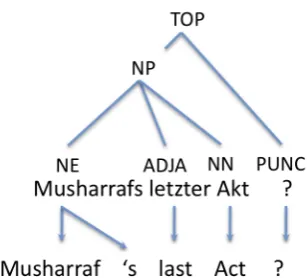
We give an example of the rules extracted from an aligned sentence in Figure 1, with a parse tree on the source side.
Figure 1: Aligned parsed sentence
N P → M usharraf s letzter Akt
# M usharraf 0s Last Act N P → N E1letzter Akt # X1 Last Act
N P → N E1ADJ A2Akt # X1 X2 Act
N P → N E1letzter N N2 # X1 Last X2
T OP → N E1ADJ A2Akt? # X1 X2 Act?
Hierarchical style rules are also extracted where the span doesn’t exactly match a parse constituent. We list 2 below.
X → letzter Akt # Last Act X → letzter X1 # Last X1
Unlexicalized rules with decorated non-terminals are also extracted:
T OP → N P1 P U N C2 # X1X2
N P → N E1ADJ A2N N3 # X1 X2 X3
Rules are also extracted which contains a mix-ture of decorated and undecorated non-terminals. These rules can also be lexicalized or unlexical-ized. A non-exhaustive sample is given below:
X → ADJ A1 Akt # X1 Act
N P → N E1X2 # X1 X2
T OP → N E1letzter X2 # X1 Last X2
At decoding time, the parse tree of the input sentence is available to the decoder. Decorated non-terminals in rules must match the constituent span in the input sentence but the undecoratedX symbol can match any span.
Formally, we model translation as a string-to-string translation using a synchronous CFG that constrain the application of non-terminals to matching source span labels. The source words and span labels are represented as an unweighted word lattice, < V, E >, where each edge in the lattice correspond to a word or non-terminal label over the corresponding source span. In the soft syntax experiments, edges with the default source label, X, are also created for all spans. Nodes in the lattice represent word positions in the sen-tence.
We encode the lattice in a chart, as described in (Dyer et al., 2008). A chart is is a tuple of 2-dimensional matrices< F, R >. Fi,j is the word or non-terminal label of thejth transition starting word position i. Ri,j is the end word position of the node on the right of thejth transition leaving word positioni.
The input sentence is decoded with a set of translation rules of the form
X →< αLs, γ,∼>
whereα andγ and strings of terminals and non-terminals. Lsand the stringαare drawn from the same source alphabet, ∆s. γ is the target string, also consisting of terminals and non-terminals. ∼
is the one-to-one correspondence between non-terminals inα and γ. Ls is the left-hand-side of the source. As a string-to-string model, the left-hand-side of the target is always the default target non-terminal label,X.
Decoding follows the CKY+ algorithms which process contiguous spans of the source sentence bottom up. We describe the algorithm as inference rules, below, omitting the target side for brevity.
Initialization
[X→ •αLs, i, i]
(X →αLs)∈G
Terminal Symbol
[X →α•Fj,kβLs, i, j]
[X→αFj,k•βLs, i, j+ 1]
Non-Terminal Symbol
[X→α•Fj,kβLs, i, j] [X, j, Rj,k]
Left Hand Side
[X→α•Ls, i, Ri,j] [Fi,j =Ls]
[X→αLs•, i, Ri,j]
Goal
[X→αLs•,0,|V| −1]
This model allows translation rules to take ad-vantage of both syntactic label and word context. The presence of default label edges between every node allows undecorated non-terminals to be ap-plied to any span, allowing flexibility in the trans-lation model.
This contrasts with the approach by (Zollmann and Venugopal, 2006) in attempting to improve the coverage of syntactic translation. Rather than cre-ating ad-hoc schemes to categories non-terminals with syntactic labels when they do not span syn-tactic constituencies, we only use labels that are presented by the parser or shallow tagger. Nor do we try to expand the space where rules can ap-ply by propagating uncertainty from the parser in building input forests, as in (Mi et al., 2008), but we build ambiguity into the translation rule.
The model also differs from (Marton and Resnik, 2008; Chiang et al., 2008, 2009) by adding informative labels to rule non-terminals and re-quiring them to match the source span label. The soft constraint in our model pertain not to a ad-ditional feature functions based on syntactic infor-mation, but to the availability of syntactic and non-syntactic informed rules.
4 Parameterization
In common with most current SMT systems, the decoding goal of finding the most probable target language sentenceˆt, given a source language sen-tences
ˆt=argmaxtp(t|s) (1)
The argmax function defines the search objec-tive of the decoder. We estimatep(t|s)by decom-posing it into component models
p(t|s) = 1
Z
Y
m
h0m(t,s)λm (2)
whereh0m(t,s)is the feature function for compo-nentmandλm is the weight given to component m.Z is a normalization factor which is ignored in practice. Components are translation model scor-ing functions, language model, and other features. The problem is typically presented in log-space, which simplifies computations, but otherwise does
not change the problem due to the monotonicity of the log function (hm=logh0m)
logp(t|s) =X
m
λm hm(t,s) (3)
An advantage of our model over (Marton and Resnik, 2008; Chiang et al., 2008, 2009) is the number of feature functions remains the same, therefore, the tuning algorithm does not need to be replaced; we continue to use MERT (Och, 2003).
5 Rule Extraction
Rule extraction follows the algorithm described in (Chiang, 2005). We note the heuristics used for hi-erarchical phrases extraction include the following constraints:
1. all rules must be at least partially lexicalized, 2. non-terminals cannot be consecutive,
3. a maximum of two non-terminals per rule, 4. maximum source and target span width of 10
word
5. maximum of 5 source symbols
In the source syntax model, non-terminals are re-stricted to source spans that are syntactic phrases which severely limits the rules that can be ex-tracted or applied during decoding. Therefore, we can adapt the heuristics, dropping some of the con-straints, without introducing too much complexity.
1. consecutive non-terminals are allowed 2. a maximum of three non-terminals,
3. all non-terminals and LHS must span a parse constituent
In the soft syntax model, we relax the constraint of requiring all non-terminals to span parse con-stituents. Where there is no constituency spans, the default symbolXis used to denote an undeco-rated non-terminal. This gives rise to rules which mixes decorated and undecorated non-terminals.
To maintain decoding speed and minimize spu-rious ambiguity, item (1) in the syntactic extrac-tion heuristics is adapted to prohibit consecutive undecorated non-terminals. This combines the strength of syntactic rules but also gives the trans-lation model more flexibility and higher coverage from having undecorated non-terminals. There-fore, the heuristics become:
1. consecutive non-terminals are allowed, but consecutive undecorated non-terminals are prohibited
2. a maximum of three non-terminals,
5.1 Rule probabilities
Maximum likelihood phrase probabilities,p(¯t|¯s), are calculated for phrase pairs, using fractional counts as described in (Chiang, 2005). The max-imum likelihood estimates are smoothed using Good-Turing discounting (Foster et al., 2006). A phrase count feature function is also create for each translation model, however, the lexical and backward probabilities are not used.
6 Decoding
We use the Moses implementation of the SCFG-based approach (Hoang et al., 2009) which sup-port hierarchical and syntactic training and decod-ing used in this paper. The decoder implements the CKY+ algorithm with cube pruning, as well as histogram and beam pruning, all pruning param-eters were identical for all experiments for fairer comparison.
All non-terminals can cover a maximum of 7 source words, similar to the maximum rule span feature other hierarchical decoders to speed up de-coding time.
7 Experiments
We trained on the New Commentary 2009 cor-pus1, tuning on a hold-out set. Table 1 gives more details on the corpus. nc test2007 was used for testing.
German English Train Sentences 82,306
Words 2,034,373 1,965,325
Tune Sentences 2000
[image:5.595.321.514.60.190.2]Test Sentences 1026
Table 1: Training, tuning, and test conditions
The training corpus was cleaned and filtered us-ing standard methods found in the Moses toolkit (Koehn et al., 2007) and aligned using GIZA++ (Och and Ney, 2003). Standard MERT weight tun-ing was used throughout. The English half of the training data was also used to create a trigram lan-guage model which was used for each experiment. All experiments use truecase data and results are reported in case-sensitive BLEU scores (Papineni et al., 2001).
The German side was parsed with the Bitpar parser2. 2042 sentences in the training corpus failed to parse and were discarded from the train-ing for both hierarchical and syntactic models to
1http://www.statmt.org/wmt09/
2http://www.ims.uni-stuttgart.de/tcl/SOFTWARE/BitPar.html
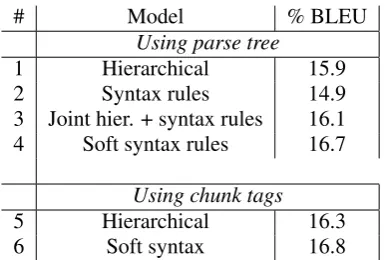
# Model % BLEU
Using parse tree
1 Hierarchical 15.9
2 Syntax rules 14.9
3 Joint hier. + syntax rules 16.1 4 Soft syntax rules 16.7
Using chunk tags
5 Hierarchical 16.3
[image:5.595.79.285.455.522.2]6 Soft syntax 16.8
Table 2: German–English results for hierarchical and syntactic models, in %BLEU
ensure that train on identical amounts of data. Similarly, 991 out of 1026 sentences were parsable in the test set. To compare like-for-like, the base-line translates the same 991 sentences, but evalu-ated over 1026 sentences. (In the experiments with chunk tags below, all 1026 sentences are used).
We use as a baseline the vanilla hierarchical model which obtained a BLEU score of 15.9% (see Table 2, line 1).
7.1 Syntactic translation
Using the na¨ıve translation model constrained with syntactic non-terminals significantly de-creases translation quality, Table 2, line 2. We then ran hierarchical concurrently with the syntac-tic models, line 3, but see little improvement over the hierarchical baseline. However, we see a gain of 0.8% BLEU when using the soft syntax model.
7.2 Reachability
The increased performance using the soft syn-tax model can be partially explained by studying the effect of changes to the extraction and decod-ing algorithms has to the capacity of the transla-tion pipeline. We run some analysis in which we trained the phrase models with a corpus of one sentence and attempt to decode the same sentence. Pruning and recombination were disabled during decoding to negate the effect of language model context and model scores.
The first thousand sentences of the training cor-pus was analyzed, Table 3. The hierarchical model successfully decode over half of the sentences while a translation model constrained by a source syntax parse tree manages only 113 sentences, il-lustrating the severe degradation in coverage when a naive syntax model is used.
# Model Reachable sentences
1 Hierarchical 57.8%
2 Syntax rules 11.3%
3 Joint hier. + syntax rules 57.9%
4 Soft syntax rules 58.5%
[image:6.595.74.542.60.351.2]Table 3: Reachability of 1000 training sentences: can they be translated with the model?
Figure 2: Source span lengths
completely subsumes that of the syntactic model. The MERT tuning adjust the weights so that the syntactic model is very rarely applied during joint decoding, suggesting that the tuning stage prefers the broader coverage of the hierarchical model over the precision of the syntactic model.
However, the soft syntax model slightly in-creases the reachability of the target sentences, lines 4.
7.3 Rule Span Width
The soft syntactic model contains rules with three non-terminals, as opposed to 2 in the hierarchical model, and consecutive non-terminals in the hope that the rules will have the context and linguistic information to apply over longer spans. There-fore, it is surprising that when decoding with a soft syntactic grammar, significantly more words are translated singularly and the use of long span-ning rules is reduced, Figure 2.
However, looking at the usage of the glue rules paints a different picture. There is significantly less usage of the glue rules when decoding with the soft syntax model, Figure 3. The use of the glue rule indicates a failure of the translation model to explain the translation so the decrease in its usage is evidence of the better explanatory power of the soft syntactic model.
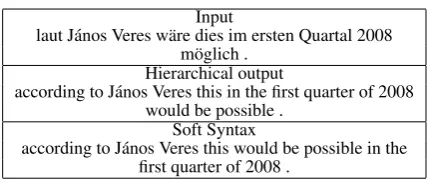
An example of an input sentence, and the best translation found by the hierarchical and soft syn-tax model can be seen in Table 4. Figure 4 is the
Figure 3: Length and count of glue rules used de-coding test set
Figure 4: Example input parse tree
parse tree given to the soft syntax model.
Input
laut J´anos Veres w¨are dies im ersten Quartal 2008 m¨oglich .
Hierarchical output
according to J´anos Veres this in the first quarter of 2008 would be possible .
Soft Syntax
[image:6.595.309.524.415.506.2]according to J´anos Veres this would be possible in the first quarter of 2008 .
Table 4: Example input and best output found
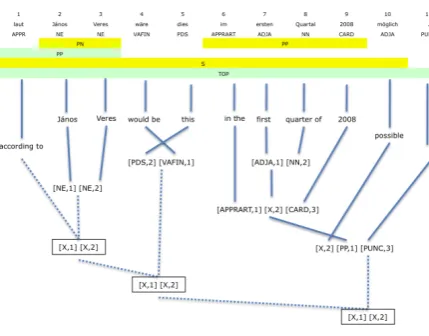
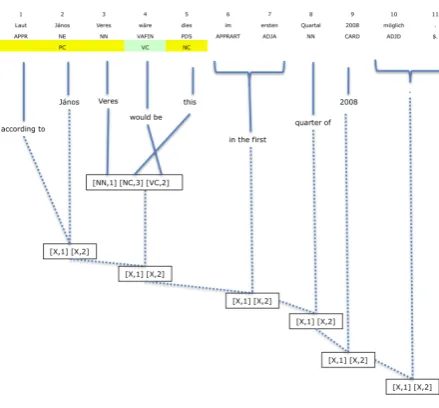
Both output are lexically identical but the output of the hierarchical model needs to be reordered to be grammatically correct. Contrast the derivations produced by the hierarchical grammar, Figure 5, with that produced with the soft syntax model, Figure 6. The soft syntax derivation makes use of several non-lexicalized to dictate word order, shown below.
X → N E1 N E2#X1 X2
X → V AF IN1 P DS2 #X1X2
X → ADJ A1 N N2 #X1 X2
X → AP P RART1X2 CARD3#X1 X2 X3
Figure 5: Derivation with Hierarchical model
Figure 6: Derivation with soft syntax model
The soft syntax derivation include several rules which are partially decorated. Crucially, the last rule in the list above reorders the PP phrase and the non-syntactic phrase X to generate the grammatically correct output. The other non-lexicalized rules monotonically concatenate the output. This can be performed by the glue rule, but nevertheless, the use of empirically backed rules allows the decoder to better compare hypotheses. The derivation also rely less on the glue rules than the hierarchical model (shown in solid rectangles). Reducing the maximum number of non-terminals per rule reduces translation quality but increasing it has little effect on the soft syntax model, Table 5. This seems to indicate that non-terminals are useful as context when applying rules up to a certain extent.
7.4 English to German
We experimented with the reverse language direc-tion to see if the soft syntax model still increased
# non-terms % BLEU
2 16.5
3 16.8
5 16.8
Table 5: Effect on %BLEU of varying number of non-terminals
# Model % BLEU
1 Hierarchical 10.2 2 Soft syntax 10.6
Table 6: English–German results in %BLEU
translation quality. The results were positive but less pronounced, Table 6.
7.5 Using Chunk Tags
Parse trees of the source language provide use-ful information that we have exploited to create a better translation model. However, parsers are an expensive resource as they frequently need manu-ally annotated training treebanks. Parse accuracy is also problematic and particularly brittle when given sentences not in the same domain as the training corpus. This also causes some sentences to be unparseable. For example, our original test corpus of 1026 sentences contained 35 unparsable sentences. Thus, high quality parsers are unavail-able for many source languages of interest.
Parse forests can be used to mitigate the accu-racy problem, allowing the decoder to choose from many alternative parses, (Mi et al., 2008).
The soft syntax translation model is not depen-dent on the linguistic information being in a tree structure, only that the labels identify contiguous spans. Chunk taggers (Abney, 1991) does just that. They offer higher accuracy than syntactic parser, are not so brittle to out-of-domain data and identify chunk phrases similar to parser-based syn-tactic phrases that may be useful in guiding re-ordering.
[image:7.595.77.292.286.454.2]We apply the soft syntax approach as in the pre-vious sections but replacing the use of parse con-stituents with chunk phrases.
[image:7.595.316.530.682.736.2]7.6 Experiments with Chunk Tags
We use the same data as described earlier in this chapter to train, tune and test our approach. The Treetagger chunker (Schmidt and Schulte im Walde, 2000) was used to tag the source (German) side of the corpus. The chunker successfully pro-cessed all sentences in the training and test dataset so no sentences were excluded. The increase train-ing data, as well as the ability to translate all sen-tences in the test set, explains the higher hierar-chical baseline than the previous experiments with parser data. We use the noun, verb and preposi-tional chunks, as well as part-of-speech tags, emit-ted by the chunker.
Results are shown in Table 2, line 5 & 6. Using chunk tags, we see a modest gain of 0.5% BLEU.
[image:8.595.323.510.60.176.2]The same example sentence in Table 4 is shown with chunk tags in Figure 7. The soft syntax model with chunk tags produced the derivation tree shown in Figure 8. The derivation make use of an unlexicalized rule local reordering. In this example, it uses the same number of glue rule as the hierarchical derivation but the output is gram-matically correct.
Figure 8: Translated chunked sentence
However, overall, the number of glue rules used shows the same reduction that we saw using soft syntax in the earlier section, as can be seen in Fig-ure 9. Again, the soft syntax model, this time us-ing chunk tags, is able to reduce the use of the glue rule with empirically informed rules.
8 Conclusion
We show in this paper that combining the gener-ality of the hierarchical approach with the speci-ficity of syntactic approach can improve
transla-Figure 9: Chunk - Length and count of glue rules used decoding test set
tion. A reason for the improvement is the bet-ter long-range reordering made possible by the in-crease capacity of the translation model.
Future work in this direction includes us-ing tree-to-tree approaches, automatically created constituency labels, and back-off methods be-tween decorated and undecorated rules.
9 Acknowledgement
This work was supported in part by the EuroMa-trixPlus project funded by the European Commis-sion (7th Framework Programme) and in part un-der the GALE program of the Defense Advanced Research Projects Agency, Contract No. HR0011-06-C-0022.
References
Abney, S. (1991). Parsing by chunks. InRobert Berwick, Steven Abney, and Carol Tenny: Principle-Based Parsing. Kluwer Academic Publishers.
Ambati, V. and Lavie, A. (2008). Improving syntax driven translation models by re-structuring divergent and non-isomorphic parse tree structures. InAMTA.
Ambati, V., Lavie, A., and Carbonell, J. (2009). Extraction of syntactic translation models from parallel data using syn-tax from source and target languages. InMT Summit. Chiang, D. (2005). A hierarchical phrase-based model for
statistical machine translation. InProceedings of the 43rd Annual Meeting of the Association for Computational Lin-guistics (ACL’05), pages 263–270, Ann Arbor, Michigan. Association for Computational Linguistics.
Chiang, D., Knight, K., and Wang, W. (2009). 11,001 new features for statistical machine translation. InProceedings of Human Language Technologies: The 2009 Annual Con-ference of the North American Chapter of the Association for Computational Linguistics, pages 218–226, Boulder, Colorado. Association for Computational Linguistics. Chiang, D., Marton, Y., and Resnik, P. (2008). Online
large-margin training of syntactic and structural translation fea-tures. InProceedings of the 2008 Conference on Empiri-cal Methods in Natural Language Processing, pages 224– 233, Honolulu, Hawaii. Association for Computational Linguistics.
[image:8.595.76.296.383.587.2]Foster, G., Kuhn, R., and Johnson, H. (2006). Phrasetable smoothing for statistical machine translation. In Proceed-ings of the 2006 Conference on Empirical Methods in Nat-ural Language Processing, pages 53–61, Sydney, Aus-tralia. Association for Computational Linguistics. Galley, M., Graehl, J., Knight, K., Marcu, D., DeNeefe, S.,
Wang, W., and Thayer, I. (2006). Scalable inference and training of context-rich syntactic translation models. In
Proceedings of the 21st International Conference on Com-putational Linguistics and 44th Annual Meeting of the As-sociation for Computational Linguistics, pages 961–968, Sydney, Australia. Association for Computational Lin-guistics.
Galley, M., Hopkins, M., Knight, K., and Marcu, D. (2004). What’s in a translation rule? InProceedings of the Joint Conference on Human Language Technologies and the Annual Meeting of the North American Chapter of the As-sociation of Computational Linguistics (HLT-NAACL). Hoang, H., Koehn, P., and Lopez, A. (2009). A Unified
Framework for Phrase-Based, Hierarchical, and Syntax-Based Statistical Machine Translation. In Proc. of the International Workshop on Spoken Language Translation, pages 152–159, Tokyo, Japan.
Huang, L. and Chiang, D. (2008). Forest-based translation rule extraction. InEMNLP, Honolulu, Hawaii.
Koehn, P., Hoang, H., Birch, A., Callison-Burch, C., Fed-erico, M., Bertoldi, N., Cowan, B., Shen, W., Moran, C., Zens, R., Dyer, C., Bojar, O., Constantin, A., and Herbst, E. (2007). Moses: Open source toolkit for statistical ma-chine translation. InProceedings of the 45th Annual Meet-ing of the Association for Computational LMeet-inguistics Com-panion Volume Proceedings of the Demo and Poster Ses-sions, pages 177–180, Prague, Czech Republic. Associa-tion for ComputaAssocia-tional Linguistics.
Li, Z., Callison-Burch, C., Dyer, C., Khudanpur, S., Schwartz, L., Thornton, W., Weese, J., and Zaidan, O. (2009). Joshua: An open source toolkit for parsing-based machine translation. InProceedings of the Fourth Work-shop on Statistical Machine Translation, pages 135–139, Athens, Greece. Association for Computational Linguis-tics.
Liu, Y., Mi, H., Feng, Y., and Liu, Q. (2009). Joint decod-ing with multiple translation models. InIn Proceedings of ACL/IJCNLP 2009, pages 576–584, Singapore.
Marton, Y. and Resnik, P. (2008). Soft syntactic constraints for hierarchical phrased-based translation. InProceedings of ACL-08: HLT, pages 1003–1011, Columbus, Ohio. As-sociation for Computational Linguistics.
Mi, H., Huang, L., and Liu, Q. (2008). Forest-based trans-lation. InProceedings of ACL-08: HLT, pages 192–199, Columbus, Ohio. Association for Computational Linguis-tics.
Och, F. J. (2003). Minimum error rate training for statistical machine translation. InProceedings of the 41st Annual Meeting of the Association of Computational Linguistics (ACL).
Och, F. J. and Ney, H. (2003). A systematic comparison of various statistical alignment models. Computational Lin-guistics, 29(1):19–52.
Papineni, K., Roukos, S., Ward, T., and Zhu, W.-J. (2001). BLEU: a method for automatic evaluation of machine translation. Technical Report RC22176(W0109-022), IBM Research Report.
Schmidt, H. and Schulte im Walde, S. (2000). Robust German noun chunking with a probabilistic context-free grammar. InProceedings of the International Conference on Computational Linguistics (COLING).
Shen, L., Xu, J., Zhang, B., Matsoukas, S., and Weischedel, R. (2009). Effective use of linguistic and contextual infor-mation for statistical machine translation. InProceedings
of the 2009 Conference on Empirical Methods in Natural Language Processing, pages 72–80, Singapore. Associa-tion for ComputaAssocia-tional Linguistics.
Venugopal, A., Zollmann, A., Smith, N. A., and Vogel, S. (2009). Preference grammars: Softening syntactic con-straints to improve statistical machine translation. In Pro-ceedings of Human Language Technologies: The 2009 An-nual Conference of the North American Chapter of the As-sociation for Computational Linguistics, pages 236–244, Boulder, Colorado. Association for Computational Lin-guistics.