Collocational Aid for Learners of Japanese as a Second Language
Lis Pereira and Yuji Matsumoto Graduate School of Information Science Nara Institute of Science and Technology
{lis-k, matsu}@is.naist.jp
Abstract
We present Collocation Assistant, a pro-totype of a collocational aid designed to promote the collocational competence of learners of Japanese as a second language (JSL). Focusing on noun-verb construc-tions, the tool automatically flags possi-ble collocation errors and suggests better collocations by using corrections extracted from a large annotated Japanese language learner corpus. Each suggestion includes several usage examples to help learners choose the best candidate. In a preliminary user study with JSL learners, Collocation Assistant received positive feedback, and the results indicate that the system is help-ful to assist learners in choosing correct word combinations in Japanese.
1 Introduction
Collocational competence is one of the factors which contribute to the differences between na-tive speakers and second language learners (Shei and Pain, 2000). However, studies confirm that the correct use of collocations is challenging, even for advanced second language learners (Liu, 2002; Nesselhauf, 2003; Wible et al., 2003). Since there are no well-defined rules to determine collocation preferences, language learners are prone to pro-duce word combinations that, although they may be grammatically and semantically well formed, may sound “unnatural” to a native speaker. More-over, the number of tools designed to target lan-guage learners’ collocation errors is limited or in-existent for many languages, which makes it dif-ficult for learners to detect and correct these er-rors. Therefore, an application that can detect a learners’ collocation errors and suggest the most appropriate ”ready-made units” as corrections is an important goal for natural language processing (Leacock et al., 2014).
In this paper, we describe Collocation Assis-tant, a web-based and corpus-based collocational aid, aiming at helping JSL learners expand their collocational knowledge. Focusing on noun-verb constructions, Collocation Assistant flags possi-ble collocation errors and suggests a ranked list of more conventional expressions. Each suggestion is supported with evidence from authentic texts, showing several usage examples of the expres-sion in context to help learners choose the best candidate. Based on our previous study (Pereira et al., 2013), the system generates corrections to the learners’ collocation error tendencies by us-ing noun and verb corrections extracted from a large annotated Japanese learner corpus. For rank-ing the collocation correction candidates, it uses the Weighted Dice coefficient (Kitamura and Mat-sumoto, 1997). We add to our previous work by implementing an interface that allows end-users to identify and correct their own collocation errors. In addition, we conducted a preliminary evalua-tion with JSL learners to gather their feedback on using the tool.
2 The need for collocational aids
Existing linguistic tools are often of limited utility in assisting second language learners with collo-cations. Most spell checkers and grammar check-ers can help correct errors made by native speak-ers, but offer no assistance for non-native errors. Futagi et al. (2008) note that common aids for second language learners namely, dictionaries and thesauri are often of limited value when the learner does not know the appropriate collocation and must sort through a list of synonyms to find one that is contextually appropriate. Yi et al. (2008) observe that language learners often use search en-gines to check if a phrase is commonly used by ob-serving the number of results returned. However, search engines are not designed to offer alterna-tive phrases that are more commonly used than the
learner’s phrase (Park et al., 2008). Concordancers seem to be an alternative to search engines, but they retrieve too much information because they usually allow only single-word queries. Too much information might distract and confuse the user (Chen et al., 2014). Thus, a computer program that automatically identifies potential collocation errors and suggests corrections would be a more appropriate resource for second language learners. A few researchers have proposed useful English corpus-based tools for correcting collocation er-rors (Futagi et al., 2008; Liu et al., 2009; Park et al., 2008; Chang et al., 2008; Wible et al., 2003; Dahlmeier and Ng, 2011). In a user study, Park et al. (2008) observed positive reactions from users when using their system. In another study, Liou et al. (2006) showed that the miscolloca-tion aid proposed by Chang et al. (2008) can help learners improve their knowledge in collocations. One limitation is that these proposed tools rely on resources of limited coverage, such as dictionar-ies, thesauri, or manually constructed databases to generate the candidates. Another drawback is that most of these systems rely solely on well-formed English resources (except Wible et al., 2003) and do not actually take into account the learners’ ten-dencies toward collocation errors.
3 Collocation Assistant
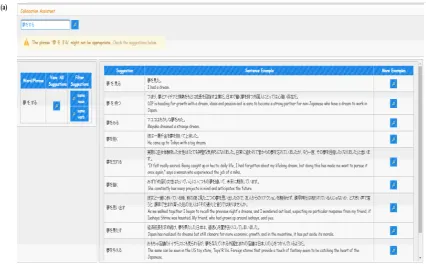
In the proposed system, we focused on provid-ing Japanese collocation suggestions for potential collocation errors in Japanese noun-verb construc-tions. Given the noun-verb collocation input by a learner, the system first checks if it exists in the reference corpora. If not, the input is validated as a potential collocation error and a message is dis-played to the user. Next, the system suggests more appropriate noun-verb collocations. For instance, if the learner types *夢をする (yume wo suru ,
lit. ‘to do a dream’), the system flags a collocation error. When the user clicks on “same noun”, the system displays better collocations with the same noun input by the user, such as 夢を見る(yume wo miru, ‘to dream’) and 夢を持つ (yume wo
motsu, ‘to hold a dream’), as shown in Figure 1. Likewise, when the user clicks on “same verb”, the system displays better collocations with the same verb input by the user. If the user clicks on ”View all suggestions”, all possible better collocations with the same noun or the same verb input by the user are displayed. Aside from the collocations,
sentence examples for each phrase suggestion are displayed, showing the phrase in context with sur-rounding text. Showing phrases in context can be crucial in helping users determine which phrase is most appropriate (Park et al., 2008). Even if the learner’s input is not flagged as an error, it will undergo the same correction process, since better collocations than the input might exist. In this case, the learner will check the ranked sug-gestions and sentence examples and choose the most appropriate expression. The current system does not detect which component (noun or verb) is wrong in a noun-verb construction. Therefore, the learner must specify which component would be corrected by the system. This has been the common evaluation setup in collocation error cor-rection, which assumes that the error is already detected and more focus is given on correcting the identified errors. (Dahlmeier and Ng, 2011). In case the learner types only a noun or only a verb, the system will suggest collocations contain-ing words that strongly collocate with this input.
3.1 Approach to collocation suggestion
Based on our previous study (Pereira et al., 2013), our Collocation Assistant generates collocation corrections by using noun and verb corrections extracted from a large annotated Japanese lan-guage learner corpus, Lang-81. This approach to generating corrections achieved superior perfor-mance compared to methods that generate can-didates based solely on the semantic relation of words. Using noun and verb corrections extracted from a learner corpus, our system can explore the learners’ tendency to commit collocation errors. For ranking the collocation correction candidates, the tool uses the Weighted Dice coefficient (Ki-tamura and Matsumoto, 1997). This association measure achieved the best performance in our task among other association measures evaluated (i.e. pointwise mutual information, log-likelihood and dice coefficient).
3.2 Resources used for providing sentence examples
We used several monolingual and bilingual re-sources for providing useful sentence examples to users. These resources are:
Bilingual resources. 1) Tatoeba Corpus2, a
Figure 1: An example of collocation suggestions produced by the system given the erroneous collocation *夢をする(yume wo suru, lit. ‘to do a dream’) as input. (a) Collocation suggestions are shown on the
free collaborative online database of example sen-tences geared towards foreign language learners. We used the Japanese-English sentences available in the website. 2) Hiragana Times (HT) Corpus3, a Japanese-English bilingual corpus of magazine articles of Hiragana Times, a bilingual magazine written in Japanese and English to introduce Japan to non-Japanese, covering a wide range of topics (culture, society, history, politics, etc.). 3) Ky-oto Wikipedia (KW) Corpus4, a corpus created by manually translating Japanese Wikipedia articles (related to Kyoto) into English.
Monolingual resource: the Balanced Corpus
of Contemporary Written Japanese (Maekawa, 2008) was used for the noun-verb expressions where no bilingual examples were available.
#jpsentences #ensentences Tatoeba 203,191 203,191
HT 117,492 117,492
KW 329,169 329,169
BCCWJ 871,184
-Table 1: Data used as sentence examples.
4 Preliminary User Study of the Collocation Assistant
We conducted a preliminary evaluation with JSL learners to gather their feedback on using the Col-location Assistant. The results gave us insights about the usefulness of the tool, and about the pos-sible interesting evaluations that should be carried out in the future.
4.1 Participants
In this study, 10 JSL learners, all graduate stu-dents from the same institution as the authors were invited to participate. Participants’ ages ranged from 24 to 33 years, and the average age was 27.5. Among the respondents, 2 were female and 8 were male, and they had different language back-grounds (Chinese, Indonesian, Tagalog, Swahili, Spanish, and Basque). Regarding their proficiency level, three were beginners, three were interme-diate, and four were advanced learners, based on the Japanese-Language proficiency test certificate level they previously obtained. All participants were regular computer users.
3http://www.hiraganatimes.com/ 4https://alaginrc.nict.go.jp/WikiCorpus/
4.2 Procedure
A collocation test was designed to examine whether or not the tool could help JSL learners find proper Japanese collocations. This included 12 Japanese sentences from the Lang-8 learner corpus and from another small annotated Japanese learner corpus, NAIST Goyo Corpus (Oyama, Ko-machi and Matsumoto, 2013). The sentences and their corrections were further validated by a pro-fessional Japanese teacher. Each sentence con-tained one noun-verb collocation error made by JSL learners. The participants were asked to use the Collocation Assistant to identify and correct the errors. Next, they were asked to write a small paragraph in Japanese and to use the tool if they needed. After performing the task, a survey ques-tionnaire was also administered to better under-stand the learners’ impressions of the tool. The questionnaire contained 43 questions answerable by a 7-point Likert-scale (with 7 labeled “strongly agree” and 1 labeled “strongly disagree”). The second part of the questionnaire contained 7 open-ended questions. Our survey questionnaire in-quired on the difficulty of Japanese collocations, the usefulness of Collocation Assistant, the design of Collocation Assistant and the quality of the re-trieved data.
4.3 Results on the Collocation Test and Survey Questionnaire
participants had difficulty in finding sentence ex-amples close to the meaning of the sentences in the test. Although we need to evaluate this tool with a larger number of users, we observed that the system was effective in helping the learners choose the proper collocations. In the question-naire administered, all participants acknowledged their difficulty in using Japanese collocations ap-propriately and stated that the software aids they used did not provide enough information about the meaning of Japanese phrases nor help in correct-ing errors in Japanese expressions. Their attitude toward the usefulness of Collocation Assistant was mostly positive and they thought the tool was use-ful to help choose the proper way to use Japanese expressions. Most participants considered the in-terface easy to use (M=6.3, SD=0.8). Regarding the quality of the retrieved data, the participants expressed satisfaction with the retrieved colloca-tions, with an average score of 6.5 (SD=0.7). They also expressed satisfaction with the ranking of the collocations presented, with an average score of 5.8 (SD=0.6). Additionally, they reported that the sentence examples further helped them under-stand in which context an expression should be used. However, some participants expressed dis-satisfaction with the complexity of some example sentences: some of the sentences were too long and difficult to understand. In the second part of the questionnaire, some participants stated that the Collocation Assistant could be helpful when learn-ing new words and when one does not know which word combinations to use. They also suggested that the tool could be useful for teachers too when giving feedback to their students about the com-mon errors they make and when providing alter-native ways of expressing the same idea. Lastly, they suggested several improvements regarding the sentence examples and the interface: show shorter and simpler example sentences, highlithgt the user’s input in the sentence examples and allow English search.
5 Conclusions
In this paper, we presented a collocational aid system for JSL learners. The tool flags possible collocation errors and suggests corrections by us-ing corrections extracted from a large annotated Japanese language learner corpus. Our Colloca-tion Assistant received positive feedback from JSL learners in a preliminary user study. The system
can be used independently as a phrase dictionary, or it can be integrated into the writing component of some bigger CALL systems. For example, Col-location Assistant can be used by teachers as a way to obtain better understanding about learners’ errors and help them provide better feedback to the students. One limitation of our experiments is the limited contextual information (only the noun, particle, and verb written by the learner). In the future, to verify our approach and to improve on our current results, we plan to consider a wider context size and other types of constructions (e.g., adjective-noun, adverb-verb, etc.). We also intend to investigate how to adjust the difficulty level of the sentences according to the user’s proficienSo-lution cy level. Finally, we plan to conduct a more extensive evaluation with JSL learners to verify the usefulness of the tool in practical learning sce-narios.
Acknowledgments
We would like to thank anonymous reviewers for their insightul comments and suggestions.
References
Chang, Y. C., Chang, J. S., Chen, H. J. and Liou, H. C. 2008. An automatic collocation writ-ing assistant for Taiwanese EFL learners: A case of corpus-based NLP technology. Computer As-sisted Language Learning, 21(3), 283–299. doi: 10.1080/09588220802090337.
Chen, M.-H., Huang, C.-C., Huang, S.-T., Chang, J.S. and Liou, H.-C. 2014. An Automatic Reference Aid for ImprovingEFL Learners’ Formulaic Expres-sionsin Productive Language Use. IEEE Transac-tions on Learning Technologies, 01/2014; 7(1):57-68. doi:10.1109/TLT.2013.34.
Dahlmeier, D. and Ng, H. T. 2011. Correcting seman-tic collocation errors with L1-induced paraphrases. In Proceedings of the Conference on Empirical Methods in Natural Language Processing-(pp. 107-117). Edinburgh, Scotland, UK, July 27–31, 2011.
Futagi, Y., Deane, P., Chodorow, M. and Tetreault, J. 2008. A computational approach to detecting col-location errors in the writing of non-native speakers of English. Computer Assisted Language Learning
21(4), 353–367. doi: 10.1080/09588220802343561
Leacock, C., Chodorow, M., Gamon, M., and Tetreault, J. 2014. Automated grammatical error detection for language learners. Synthesis lectures on human lan-guage technologies, 7(1), 1-170.
Liou, H., Chang, J., Chen, H., Lin, C., Liaw, M., Gao, Z., Jang, J., Yeh, Y, Chuang, T. and You, G. (2006) 2006. Corpora processing and computational scaf-folding for a Web-based English learning environ-ment: The CANDLE Project.CALICO Journal, 24 (1), 77-95.
Liu, A. L. 2002. A Corpus-based Lexical Seman-tic Investigation of VN Miscollocations in Taiwan Learners’ English. Master Thesis, Tamkang Univer-sity, Taiwan.
Maekawa, K. 2008. Balanced Corpus of Contem-porary Written Japanese. In Proceedings of The 6th Workshop on Asian Language Resources- (pp. 101–102). Association for Computational Linguis-tics, Stroudsburg, PA, USA.
Nesselhauf, N. 2003. The use of collocations by ad-vanced learners of English and some implications for teaching.Applied Linguistics, 24, 223–242. Oyama,H., Komachi, M. and Matsumoto, Y. 2013.
Towards Automatic Error Type Classification of Japanese Language Learners’ Writings. In Proceed-ings of the 27th Pacific Asia Conference on Lan-guage, Information, and Computation, pp.163-172, Taipei, Taiwan.
Park, T., Lank, E., Poupart, P. and Terry, M. 2008. ”Is the Sky Pure Today?” AwkChecker: An Assis-tive Tool for Detecting and Correcting Collocation Errors. InProceedings of the 21th Annual Assotia-tion for Computing Machinery Symposium on User Interface Software and Technology-pages 121-130. Monterey, CA, USA.
Pereira, L., Manguilimotan, E. and Matsumoto, Y. 2013. Automated Collocation Suggestion for Japanese Second Language Learners. In Proceed-ings of the Student Research Workshop 51st Annual Meeting of the ACL, pages 52-58, Sofia, Bulgaria. Shei, C.-C. and Pain, H. 2000. An esl writer’s
collo-cational aid.Computer Assisted Language Learning, 13(2):167–182.
Wible, D., Kuo, C., Tsao, N., Liu, A. and Lin, H. 2003. Bootstrapping in a Language Learning En-vironment,Journal of Computer-Assisted Learning, 19(1), pp. 90-102. SSCI, LLBA.
Yi, X., Gao, J. and Dolan, W. A web-based English proofing system for English as a Second Language users. 2008. InProceedings of the 3rd International Joint Conference on Natural Language