Automatic Emotion Classification for Interpersonal Communication
Frederik Vaassen
CLiPS - University of Antwerp S.L.202, Lange Winkelstraat 40-42
B-2000 Antwerpen, Belgium [email protected]
Walter Daelemans
CLiPS - University of Antwerp S.L. 203, Lange Winkelstraat 40-42
B-2000 Antwerpen, Belgium [email protected]
Abstract
We introduce a new emotion classification task based on Leary’s Rose, a framework for interpersonal communication. We present a small dataset of 740 Dutch sentences, out-line the annotation process and evaluate an-notator agreement. We then evaluate the per-formance of several automatic classification systems when classifying individual sentences according to the four quadrants and the eight octants of Leary’s Rose. SVM-based classi-fiers achieve average F-scores of up to 51% for 4-way classification and 31% for 8-way clas-sification, which is well above chance level. We conclude that emotion classification ac-cording to the Interpersonal Circumplex is a challenging task for both humans and ma-chine learners. We expect classification per-formance to increase as context information becomes available in future versions of our dataset.
1 Introduction
While sentiment and opinion mining are popular re-search topics, automatic emotion classification of text is a relatively novel –and difficult– natural lan-guage processing task. Yet it immediately speaks to the imagination. Being able to automatically identify and classify user emotions would open up a whole range of interesting applications, from in-depth analysis of user reviews and comments to en-riching social network environments according to the user’s emotions.
Most experiments in emotion classification focus on a set of basic emotions such as “happiness”,
“sad-ness”, “fear”, “anger”, “surprise” and “disgust”. The interpretation of “emotion” we’re adopting in this paper, however, is slightly more specific. We con-centrate on the emotions that are at play in interper-sonal communication, more specifically in the dy-namics between participants in a conversation: is one of the participants taking on a dominant role? Are the speakers working towards a common goal, or are they competing? Being able to automati-cally identify these power dynamics in interpersonal communication with sufficient accuracy would open up interesting possibilities for practical applications. This technology would be especially useful in e-learning, where virtual agents that accept (and inter-pret) natural language input could be used by players to practice their interpersonal communication skills in a safe environment.
The emotion classification task we present in this paper involves classifying individual sentences into the quadrants and octants of Leary’s Rose, a frame-work for interpersonal communication.
We give a brief overview of related work in sec-tion 2 and the framework is outlined in secsec-tion 3. Section 4 introduces the dataset we used for clas-sification. Section 5 outlines the methodology we applied, and the results of the different experiments are reported on in section 6. We discuss these results and draw conclusions in section 7. Finally, section 8 gives some pointers for future research.
2 Related Work
The techniques that have been used for emotion clas-sification can roughly be divided into pattern-based methods and machine-learning methods. An
used technique in pattern-based approaches is to use pre-defined lists of keywords which help determine an instance’s overall emotion contents. The AESOP system by Goyal et al. (2010), for instance, attempts to analyze the affective state of characters in fables by identifying affective verbs and by using a set of projection rules to calculate the verbs’ influence on their patients. Another possible approach –which we subscribe to– is to let a machine learner deter-mine the appropriate emotion class. Mishne (2005) and Keshtkar and Inkpen (2009), for instance, at-tempt to classify LiveJournal posts according to their mood using Support Vector Machines trained with frequency features, length-related features, semantic orientation features and features representing special symbols. Finally, Rentoumi et al. (2010) posit that combining the rule-based and machine learning ap-proaches can have a positive effect on classification performance. By classifying strongly figurative ex-amples using Hidden Markov Models while relying on a rule-based system to classify the mildly figura-tive ones, the overall performance of the classifica-tion system is improved.
Whereas emotion classification in general is a relatively active domain in the field of computa-tional linguistics, little research has been done re-garding the automatic classification of text accord-ing to frameworks for interpersonal communication. We have previously carried out a set of classifica-tion experiments using Leary’s Rose on a smaller dataset (Vaassen and Daelemans, 2010), only tak-ing the quadrants of the Rose into account. To our knowledge, this is currently the only other work con-cerning automatic text classification using any real-ization of the Interpersonal Circumplex. We expand on this work by using a larger dataset which we eval-uate for reliability. We attempt 8-way classification into the octants of the Rose, and we also evaluate a broader selection of classifier setups, including one-vs-all and error-correcting systems.
3 Leary’s Rose
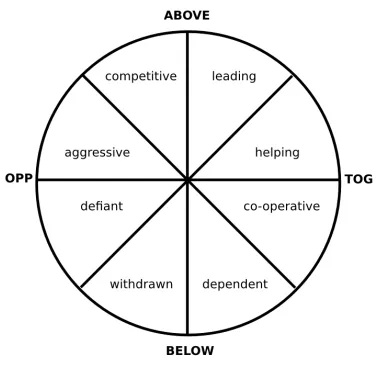
[image:2.612.332.521.57.244.2]Though several frameworks have been developed to describe the dynamics involved in interpersonal communication (Wiggins, 2003; Benjamin, 2006), we have chosen to use the Interpersonal Circum-plex, better known as “Leary’s Rose” (Leary, 1957).
Figure 1: Leary’s Rose
Leary’s Rose (Figure 1) is defined by two axes: the
above-below axis (vertical), which tells us whether the speaker is being dominant or submissive towards the listener; and thetogether-opposedaxis (horizon-tal), which says something about the speaker’s will-ingness to co-operate with the listener. The axes di-vide the Rose into four quadrants, and each quadrant can again be divided into two octants.
What makes the Circumplex especially interest-ing for interpersonal communication traininterest-ing is that it also allows one to predict (to some extent) what position the listener is most likely going to take in reaction to the way the speaker positions him-self. Two types of interactions are at play in Leary’s Rose, one of complementarity and one of similar-ity. Above-behavior triggers a (complementary) re-sponse from the below zone and vice versa, while
together-behavior triggers a (similar) response from the together zone andopposed-behavior triggers a (similar) response from the opposed area of the Rose. The speaker can thus influence the listener’s emotions (and consequently, his response) by con-sciously positioning himself in the quadrant that will likely trigger the desired reaction.
4 Dataset
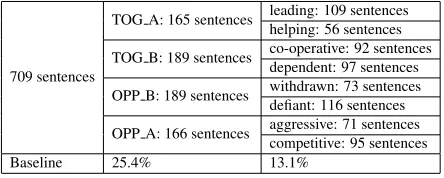
The dataset1contains a total of 740 Dutch sentences labeled according to their position on the Interper-sonal Circumplex. The majority of the sentences were gathered from works specifically designed to teach the use of Leary’s Rose (van Dijk, 2000; van Dijk and Moes, 2005). The remaining sentences were specifically written by colleagues at CLiPS and by e-learning company Opikanoba. 31 sentences that were labeled as being purely neutral were re-moved from the dataset for the purposes of this clas-sification experiment, leaving a set of 709 Dutch sentences divided across the octants and quadrants of the Interpersonal Circumplex. Table 1 shows the class distribution within the dataset and also lists the statistical random baselines for both 8-class and 4-class 4-classification tasks.
709 sentences
TOG A: 165 sentences leading: 109 sentences helping: 56 sentences TOG B: 189 sentences co-operative: 92 sentences
dependent: 97 sentences OPP B: 189 sentences withdrawn: 73 sentences defiant: 116 sentences OPP A: 166 sentences aggressive: 71 sentences
competitive: 95 sentences Baseline 25.4% 13.1%
Table 1: Distribution of classes within the dataset2
Below are a few example sentences with their cor-responding position on the Rose.
• Please have a seat and we’ll go over the options together. -helping (TOG A)
• So what do you think I should do now? - de-pendent (TOG B)
• That’s not my fault, administration’s not my re-sponsibility! -defiant (OPP B)
• If you had done your job this would never have happened! -aggressive (OPP A)
4.1 Agreement Scores
Placing sentences on Leary’s Rose is no easy task, not even for human annotators. An added complica-tion is that the sentences in the dataset lack any form of textual or situational context. We therefore expect agreement between annotators to be relatively low.
1
Dataset available on request. 2
“TOG” and “OPP” stand fortogetherandopposed respec-tively, while “A” and “B” stand foraboveandbelow.
To measure the extent of inter-annotator disagree-ment, we had four annotators label the same random subset of 50 sentences. The annotators were given a short introduction to the workings of Leary’s Rose, and were then instructed to label each of the sen-tences according to the octants of the Rose using the following set of questions:
• Is the current sentence task-oriented (opposed) or relationship-oriented (together)?
• Does the speaker position himself as the dom-inant partner in the conversation (above) or is the speaker submissive (below)?
• Which of the above two dimensions (affinity or dominance) is most strongly present?
[image:3.612.75.297.280.369.2]Annotators were also given the option to label a sen-tence as being purely neutral should no emotional charge be present.
Table 2 shows Fleiss’ kappa scores calculated for 4 and 8-class agreement.
# of classes κ 4 0.37 8 0.29
Table 2: Inter-annotator agreement, 4 annotators
Though the interpretation of kappa scores is in itself subjective, scores between 0.20 and 0.40 are usually taken to indicate “fair agreement”.
The full dataset was also annotated a second time by the initial rater six months after the first annota-tion run. This yielded the intra-annotator scores in Table 3. A score of 0.5 is said to indicate “moderate agreement”.
# of classes κ 4 0.50 8 0.37
Table 3: Intra-annotator agreement
The relatively low kappa scores indicate that the classification of isolated sentences into the quad-rants or octants of Leary’s Rose is a difficult task even for humans.
main annotator and each of the other annotators on the random subset of 50 sentences. This gives us an upper baseline of 51.3% for 4-way classification and 36.0% for the 8-class task.
5 Methodology
Our approach falls within the domain of automatic text categorization (Sebastiani, 2002), which fo-cuses on the classification of text into predefined cat-egories. Starting from a training set of sentences labeled with their position on the Rose, a machine learner should be able to pick up on cues that will al-low the classification of new sentences into the cor-rect emotion class. Since there are no easily identi-fiable keywords or syntactic structures that are con-sistently used with a position on Leary’s Rose, using a machine learning approach is a logical choice for this emotion classification task.
5.1 Feature Extraction
The sentences in our dataset were first syntacti-cally parsed using the Frog parser for Dutch (Van den Bosch et al., 2007). From the parsed out-put, we extracted token, lemma, part-of-speech, syn-tactic and dependency features using a “bag-of-ngrams” approach, meaning that for each n-gram (up to trigrams) of one of the aforementioned fea-ture types present in the training data, we counted how many times it occurred in the current instance. We also introduced some extra features, including average word and sentence length, features for spe-cific punctuation marks (exclamation points, ques-tion marks...) and features relating to (patterns of) function and content words.
Due to efficiency and memory considerations, we did not use all of the above feature types in the same experiment. Instead, we ran several experiments us-ing combinations of up to three feature types.
5.2 Feature Subset Selection
Whereas some machine learners (e.g. Support Vec-tor Machines) deal relatively well with large num-bers of features, others (e.g. memory-based learn-ers) struggle to achieve good classification accuracy when too many uninformative features are present. For these learners, we go through an extra feature selection step where the most informative features are identified using a filter metric (see also Vaassen
and Daelemans (2010)), and where only the top n
features are selected to be included in the feature vectors.
5.3 Classification
We compared the performance of different classifier setups on both the 4-way and 8-way classification tasks. We evaluated a set of native multiclass clas-sifiers: the memory-based learner TiMBL (Daele-mans and van den Bosch, 2005), a Na¨ıve Bayes classifier and SVM Multiclass (Tsochantaridis et al., 2005), a multiclass implementation of Support Vec-tor Machines. Further experiments were run using SVM light classifiers (Joachims, 1999) in a one-vs-all setup and in an Error-Correcting Output Code setup (ECOCs are introduced in more detail in sec-tion 5.3.1). Parameters for SVM Multiclass and SVM light were determined using Paramsearch’s two-fold pseudo-exhaustive search (Van den Bosch, 2004) on vectors containing only token unigrams. The parameters for TiMBL were determined using a genetic algorithm designed to search through the parameter space3.
5.3.1 Error-Correcting Output Codes
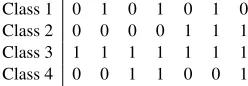
There are several ways of decomposing multiclass problems into binary classification problems. Error-Correcting Output Codes (ECOCs) (Dietterich and Bakiri, 1995) are one of these techniques. Inspired by distributed output coding in signal processing (Sejnowski and Rosenberg, 1987), ECOCs assign a distributed output code –or “codeword”– to each class in the multiclass problem. These codewords, when taken together, form a code matrix (Table 4).
[image:4.612.364.488.528.571.2]Class 1 0 1 0 1 0 1 0 Class 2 0 0 0 0 1 1 1 Class 3 1 1 1 1 1 1 1 Class 4 0 0 1 1 0 0 1
Table 4: Example code matrix
Each column of this code matrix defines a binary classification task, with a 0 indicating that the in-stances with the corresponding class label should be part of a larger negative class, and a 1
ing the positive class. A binary classifier (or “di-chotomizer”) is trained for each column. When a new instance is to be classified, it is first classified by each of these dichotomizers, which each return their predicted class (1or0). The combined output from each dichotomizer forms a new codeword. The final class is determined by choosing the codeword in the code matrix that has the smallest distance (according to some distance metric) to the predicted codeword.
This method offers one important advantage com-pared to other, simpler ensemble methods: because the final class label is determined by calculating the distance between the predicted codeword and the class codewords, it is possible to correct a certain number of bits in the predicted codeword if the dis-tance between the class codewords is large enough.
Formally, a set of ECOCs can correctbd−12 cbits, where d is the minimum Hamming distance (the number of differing bits) between codewords in the code matrix. The error-correcting capacity of an ECOC setup is thus entirely dependent on the code matrix used, and a great deal of attention has been devoted to the different ways of constructing such code matrices (Ghani, 2000; Zhang et al., 2003;
´
Alvarez et al., 2007).
In our ECOC classification setup, we used code matrices artificially constructed to maximize their error-correcting ability while keeping the number of classifiers within reasonable bounds. For 4-class classification, we constructed 7-bit codewords us-ing the exhaustive code construction technique de-scribed in Dietterich and Bakiri (1995). For the 8-class 8-classification problem, we used a Hadamard matrix of order 8 (Zhang et al., 2003), which has optimal row (and column) separation for the given number of columns. Both matrices have an error-correcting capacity of 1 bit.
6 Results
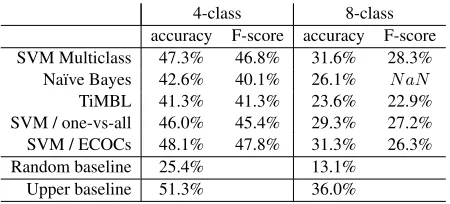
All results in this section are based on 10-fold cross-validation experiments. Table 5 shows accuracy scores and average F-scores for both 4-way and 8-way classification using classifiers trained on to-ken unigrams only, using optimal learner parame-ters. For TiMBL, the number of token unigrams was limited to the 1000 most predictive according to the
Gini co¨efficient4. All other learners used the full range of token unigram features. The Na¨ıve Bayes approach performed badly on the 8-way classifica-tion task, wrongly classifying all instances of some classes, making it impossible to calculate an F-score.
4-class 8-class accuracy F-score accuracy F-score SVM Multiclass 47.3% 46.8% 31.6% 28.3% Na¨ıve Bayes 42.6% 40.1% 26.1% N aN
TiMBL 41.3% 41.3% 23.6% 22.9% SVM / one-vs-all 46.0% 45.4% 29.3% 27.2% SVM / ECOCs 48.1% 47.8% 31.3% 26.3% Random baseline 25.4% 13.1%
[image:5.612.315.540.137.239.2]Upper baseline 51.3% 36.0%
Table 5: Accuracy and average F-scores - token unigrams
All classifiers performed better than the random baseline (25.4% for 4-class classification, 13.1% for classification into octants) to a very significant de-gree. We therefore take these token unigram scores as a practical baseline.
feature types accuracy avg. F-score SVM Multiclass w1, l3, awl 49.4% 49.4%
[image:5.612.318.536.360.417.2]TiMBL w1, w2, l1 42.0% 42.0% SVM / one-vs-all l2, fw3, c3 51.1% 51.0% SVM / ECOCs l2, c3 52.1% 51.2%
Table 6: Best feature type combinations - quadrants5
feature types accuracy avg. F-score SVM / one-vs-all w1, l1, c1 34.0% 30.9%
SVM / ECOCs w2, fw3, c3 34.8% 30.2%
Table 7: Best feature type combinations - octants
We managed to improve the performance of some of the classifier systems by including more and dif-ferent features types. Tables 6 and 7 show perfor-mance for 4-way and 8-way classification respec-tively, this time using the best possible combination
4
The filter metric and number of retained features was de-termined by testing the different options using 10-fold CV and by retaining the best-scoring combination (Vaassen and Daele-mans, 2010).
5
of up to three feature types6for every classifier setup where an improvement was noted.
We used McNemar’s test (Dietterich, 1998) to compare the token unigram scores with the best fea-ture combination scores for each of the above clas-sifiers. For both 4-way and 8-way classification, the one-vs-all and ECOC approaches produced signif-icantly different results7. The improvement is less significant for TiMBL and SVM Multiclass in the 4-way classification experiments.
Note that for classification into quadrants, the per-formance of the SVM-based classifiers is very close to the upper baseline of 50.3% we defined earlier. It is unlikely that performance on this task will im-prove much more unless we add context information to our interpersonal communication dataset. The 8-way classification results also show promise, with scores up to 30%, but there is still room for improve-ment before we reach the upper baseline of 36%.
In terms of classifiers, the SVM-based systems perform better than their competitors. Na¨ıve Bayes especially seems to be struggling, performing signif-icantly worse for the 4-class classification task and making grave classification errors in the 8-way clas-sification task. The memory-based learner TiMBL fares slightly better on the 8-class task, but isn’t able to keep up with the SVM-based approaches.
When we examine the specific features that are identified as being the most informative, we see that most of them seem instinctively plausible as impor-tant cues related to positions on Leary’s Rose. Ques-tion marks and exclamaQues-tion marks, for instance, are amongst the 10 most relevant features. So too are the Dutch personal pronouns “u”, “je” and “we” – “u” being a second person pronoun marking polite-ness, while “je” is the unmarked form, and “we” be-ing the first person plural pronoun. Of course, none of these features on their own are strong enough to accurately classify the sentences in our dataset. It is only through complex interactions between many features that the learners are able to identify the cor-rect class for each sentence.
6
The best feature type combination for each setup was de-termined experimentally by running a 10-fold cross-validation test for each of the possible combinations.
74-class SVM one-vs-all: P=0.0014, 4-class SVM ECOCs: P=0.0170, 8-class SVM one-vs-all: P=0.0045, 8-class SVM ECOCs: P=0.0092
7 Conclusions
We have introduced a new emotion classification task based on the Interpersonal Circumplex or “Leary’s Rose”, a framework for interpersonal com-munication. The goal of the classification task is to classify individual sentences (outside of their textual or situational context), into one of the four quad-rants or eight octants of Leary’s Rose. We have out-lined the annotation process of a small corpus of 740 Dutch sentences, and have shown the classification task to be relatively difficult, even for human anno-tators. We evaluated several classifier systems in a text classification approach, and reached the best re-sults using SVM-based systems. The SVM learners achieved F-scores around 51% on the 4-way classi-fication task, which is close to the upper baseline (based on inter-annotator agreement), and perfor-mance on 8-class classification reached F-scores of almost 31%.
8 Future Research
The initial results of the emotion classification tasks described in this paper are promising, but there is a clear sense that without some contextual informa-tion, it is simply too difficult to correctly classify sentences according to their interpersonal emotional charge. For this reason, we are currently developing a new version of the dataset, which will no longer contain isolated sentences, but which will instead consist of full conversations. We expect that having the sentences in their textual context will make the classification task easier for both human annotators and machine learners. It will be interesting to see if and how the classification performance improves on this new dataset.
Acknowledgments
References
Victor ´Alvarez, Jose A. Armario, Maria D. Frau, Elena Martin and Amparo Osuna. 2007. Error Correcting Codes from Quasi-Hadamard Matrices.Lecture Notes in Computer Science, volume 4547/2007.
Lorna S. Benjamin, Jeffrey C. Rothweiler and Kenneth L. Critchfield. 2006. The Use of Structural Analy-sis of Social Behavior (SASB) as an Assessment Tool.
Annual Review of Clinical Psychology, Vol. 2, No. 1. Walter Daelemans and Antal van den Bosch. 2005.
Memory-Based Language Processing. Cambridge University Press, Cambridge, UK.
Thomas G. Dietterich and Ghulum Bakiri. 1995. Solving Multiclass Learning Problems via Error-Correcting Output Codes. Journal of Artificial Intelligence Re-search.
Thomas G. Dietterich. 1998. Approximate Statistical Tests for Comparing Supervised Classification Learn-ing Algorithms.Neural Computing, volume 10. Rayid Ghani. 2000. Using Error-Correcting Codes for
Text Classification. Proceedings of the Seventeenth In-ternational Conference on Machine Learning. Amit Goyal, Ellen Riloff, Hal Daume III and Nathan
Gilbert. 2010. Toward Plot Units: Automatic Af-fect State Analysis. Workshop on Computational Ap-proaches to Analysis and Generation of Emotion in Text.
Thorston Joachims. 1999. Making large-scale support vector machine learning practical. MIT Press, Cam-bridge, MA.
Fazel Keshtkar and Diana Inkpen. 2009. Using Senti-ment Orientation Features for Mood Classification in Blogs.Proceedings of the IEEE International Confer-ence on Natural Language Processing and Knowledge Engineering (IEEE NLP-KE 2009).
Timothy Leary. 1957. Interpersonal Diagnosis of sonality: Functional Theory and Methodology for Per-sonality Evaluation. Ronald Press Company, New York.
Kim Luyckx. 2011. The Effect of Author Set Size and Data Size in Authorship Attribution. Literary and Lin-guistic Computing, volume 26/1.
Francesco Masulli and Giorgio Valentini. 2004. An Ex-perimental Analysis of the Dependence Among Code-word Bit Errors in ECOC Learning Machines. Neuro-computing, volume 57.
Gilad Mishne. 2005. Experiments with Mood Classifi-cation in Blog Posts. Proceedings of the 1st Workshop on Stylistic Analysis of Text for Information Access. Vassiliki Rentoumi, Stefanos Petrakis, Manfred
Klen-ner, George A. Vouros and Vangelis Karkaletsis. 2010. United we Stand: Improving Sentiment Anal-ysis by Joining Machine Learning and Rule Based
Methods. Proceedings of the Seventh conference on International Language Resources and Evaluation (LREC’10).
Fabrizio Sebastiani. 2002. Machine Learning in Auto-mated Text Categorization. ACM Comput. Surv., vol-ume 34/1.
Terrence J. Sejnowski and Charles R. Rosenberg. 1987. Parallel Networks that Learn to Pronounce English Text.Complex Systems.
Ioannis Tsochantaridis, Thorsten Joachims, Thomas Hof-mann and Yasemin Altun. 2005. Large Margin Methods for Structured and Interdependent Output Variables. Journal of Machine Learning Research, 6:1453-1484 (2005).
Frederik Vaassen and Walter Daelemans. 2010. Emotion Classification in a Serious Game for Training Com-munication Skills. Computational Linguistics in the Netherlands 2010: selected papers from the twentieth CLIN meeting.
Antal van den Bosch. 2004. Wrapped Progressive Sam-pling Search for Optimizing Learning Algorithm Pa-rameters. Proceedings of the 16th Belgian-Dutch Con-ference on Artificial Intelligence (BNAIC2004). Antal van den Bosch, Bertjan Busser, Walter Daelemans
and Sander Canisius. 2007. An Efficient Memory-based Morphosyntactic Tagger and Parser for Dutch.
Selected Papers of the 17th Computational Linguistics in the Netherlands Meeting (CLIN17).
Bert van Dijk. 2000. Be¨ınvloed anderen, begin bij jezelf. Over gedrag en de Roos van Leary, 4th edition. Thema.
Bert van Dijk and Fenno Moes. 2005. Het grote be¨ınvloedingsspel. Thema.
Jerry S. Wiggins. 2003. Paradigms of Personality As-sessment. Guilford Press.