Meteor 1.3: Automatic Metric for Reliable Optimization and Evaluation of
Machine Translation Systems
Michael Denkowski and Alon Lavie Language Technologies Institute
School of Computer Science Carnegie Mellon University Pittsburgh, PA 15232, USA
{mdenkows,alavie}@cs.cmu.edu
Abstract
This paper describes Meteor 1.3, our submis-sion to the 2011 EMNLP Workshop on Sta-tistical Machine Translation automatic evalua-tion metric tasks. New metric features include improved text normalization, higher-precision paraphrase matching, and discrimination be-tween content and function words. We include Ranking and Adequacy versions of the metric shown to have high correlation with human judgments of translation quality as well as a more balanced Tuning version shown to out-perform BLEU in minimum error rate training for a phrase-based Urdu-English system.
1 Introduction
The Meteor1 metric (Banerjee and Lavie, 2005; Denkowski and Lavie, 2010b) has been shown to have high correlation with human judgments in eval-uations such as the 2010 ACL Workshop on Statisti-cal Machine Translation and NIST Metrics MATR (Callison-Burch et al., 2010). However, previous versions of the metric are still limited by lack of punctuation handling, noise in paraphrase matching, and lack of discrimination between word types. We introduce new resources for all WMT languages in-cluding text normalizers, filtered paraphrase tables, and function word lists. We show that the addition of these resources to Meteor allows tuning versions of the metric that show higher correlation with human translation rankings and adequacy scores on unseen
1
The metric name has previously been stylized as “ME-TEOR” or “METEOR”. As of version 1.3, the official stylization is simply “Meteor”.
test data. The evaluation resources are modular, us-able with any other evaluation metric or MT soft-ware.
We also conduct a MT system tuning experiment on Urdu-English data to compare the effectiveness of using multiple versions of Meteor in minimum error rate training. While versions tuned to various types of human judgments do not perform as well as the widely used BLEU metric (Papineni et al., 2002), a balanced Tuning version of Meteor consis-tently outperforms BLEU over multiple end-to-end tune-test runs on this data set.
The versions of Meteor corresponding to the translation evaluation task submissions, (Ranking and Adequacy), are described in Sections 3 through 5 while the submission to the tunable metrics task, (Tuning), is described in Section 6.
2 New Metric Resources
2.1 Meteor Normalizer
Whereas previous versions of Meteor simply strip punctuation characters prior to scoring, version 1.3 includes a new text normalizer intended specifi-cally for translation evaluation. The normalizer first replicates the behavior of the tokenizer distributed with the Moses toolkit (Hoang et al., 2007), includ-ing handlinclud-ing of non-breakinclud-ing prefixes. After tok-enization, we add several rules for normalization, intended to reduce meaning-equivalent punctuation styles to common forms. The following two rules are particularly helpful:
• Remove dashes between hyphenated words. (Example: far-off → far off)
• Remove full stops in acronyms/initials. (Exam-ple:U.N. → UN)
Consider the behavior of the Moses tokenizer and Meteor normalizers given a reference trans-lation containing the phrase “U.S.-based organization”:
Moses: U.S.-based organization
Meteor≤1.2: U S based organization
Meteor 1.3: US based organization
Of these, only the Meteor 1.3 normalization allows metrics to match all of the following stylizations:
U.S.-based organization US-based organization U.S. based organization
US based organization
While intended for Meteor evaluation, use of this normalizer is a suitable preprocessing step for other metrics to improve accuracy when reference sen-tences are stylistically different from hypotheses.
2.2 Filtered Paraphrase Tables
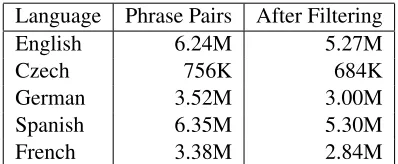
The original Meteor paraphrase tables (Denkowski and Lavie, 2010b) are constructed using the phrase table “pivoting” technique described by Bannard and Callison-Burch (2005). Many paraphrases suf-fer from word accumulation, the appending of un-aligned words to one or both sides of a phrase rather than finding a true rewording from elsewhere in par-allel data. To improve the precision of the para-phrase tables, we filter out all cases of word accumu-lation by removing paraphrases where one phrase is a substring of the other. Table 1 lists the number of phrase pairs found in each paraphrase table before and after filtering. In addition to improving accu-racy, the reduction of phrase table sizes also reduces the load time and memory usage of the Meteor para-phrase matcher. The tables are a modular resource suitable for other MT or NLP software.
2.3 Function Word Lists
Commonly used metrics such as BLEU and ear-lier versions of Meteor make no distinction between content and function words. This can be problem-atic for ranking-based evaluations where two system
Language Phrase Pairs After Filtering
English 6.24M 5.27M
Czech 756K 684K
German 3.52M 3.00M
Spanish 6.35M 5.30M
[image:2.612.327.526.57.139.2]French 3.38M 2.84M
Table 1: Sizes of paraphrase tables before and after filter-ing
Language Corpus Size (sents) FW Learned
English 836M 93
Czech 230M 68
French 374M 85
German 309M 92
[image:2.612.316.538.184.268.2]Spanish 168M 66
Table 2: Monolingual corpus size (words) and number of function words learned for each language
outputs can differ by a single word, such as mistrans-lating either a main verb or a determiner. To improve Meteor’s discriminative power in such cases, we in-troduce a function word list for each WMT language and a newδ parameter to adjust the relative weight given to content words (any word not on the list) ver-sus function words (see Section 3). Function word lists are estimated according to relative frequency in large monolingual corpora. For each language, we pool freely available WMT 2011 data consisting of Europarl (Koehn, 2005), news (sentence-uniqued), and news commentary data. Any word with relative frequency of10−3 or greater is added to the func-tion word list. Table 2 lists corpus size and number of function words learned for each language. In ad-dition to common words, punctuation symbols con-sistently rise to the tops of function word lists.
3 Meteor Scoring
Meteor evaluates translation hypotheses by align-ing them to reference translations and calculatalign-ing sentence-level similarity scores. This section de-scribes our extended version of the metric.
For a hypothesis-reference pair, the search space of possible alignments is constructed by identifying all possible matches between the two sentences ac-cording to the following matchers:
iden-tical.
Stem: Stem words using a language-appropriate Snowball Stemmer (Porter, 2001) and match if the stems are identical.
Synonym: Match words if they share member-ship in any synonym set according to the Word-Net (Miller and Fellbaum, 2007) database.
Paraphrase: Match phrases if they are listed as paraphrases in the paraphrase tables described in Section 2.2.
All matches are generalized to phrase matches with a start position and phrase length in each sen-tence. Any word occurring less than length posi-tions after a match start is considered covered by the match. The exact and paraphrase matchers sup-port all five WMT languages while the stem matcher is limited to English, French, German, and Spanish and the synonym matcher is limited to English.
Once matches are identified, the final alignment is resolved as the largest subset of all matches meeting the following criteria in order of importance:
1. Require each word in each sentence to be cov-ered by zero or one matches.
2. Maximize the number of covered words across both sentences.
3. Minimize the number ofchunks, where achunk is defined as a series of matches that is contigu-ous and identically ordered in both sentences.
4. Minimize the sum of absolute distances be-tween match start positions in the two sen-tences. (Break ties by preferring to align words and phrases that occur at similar positions in both sentences.)
Given an alignment, the metric score is calculated as follows. Content and function words are iden-tified in the hypothesis (hc, hf) and reference (rc,
rf) according to the function word lists described in
Section 2.3. For each of the matchers (mi), count
the number of content and function words covered by matches of this type in the hypothesis (mi(hc),
mi(hf)) and reference (mi(rc),mi(rf)). Calculate
weighted precision and recall using matcher weights (wi...wn) and content-function word weight (δ):
P =
P
iwi·(δ·mi(hc) + (1−δ)·mi(hf))
δ· |hc|+ (1−δ)· |hf|
Target WMT09 WMT10 Combined English 20,357 24,915 45,272
Czech 11,242 9,613 20,855
French 2,967 5,904 7,062
German 6,563 10,892 17,455
[image:3.612.322.533.56.141.2]Spanish 3,249 3,813 7,062
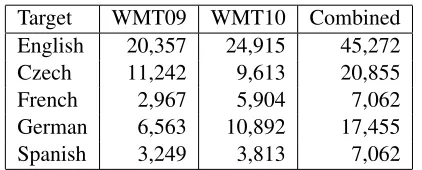
Table 3: Human ranking judgment data from 2009 and 2010 WMT evaluations
R=
P
iwi·(δ·mi(rc) + (1−δ)·mi(rf))
δ· |rc|+ (1−δ)· |rf|
The parameterized harmonic mean ofP andR(van Rijsbergen, 1979) is then calculated:
Fmean=
P ·R α·P+ (1−α)·R
To account for gaps and differences in word order, a fragmentation penalty is calculated using the total number of matched words (m, average over hypoth-esis and reference) and number of chunks (ch):
P en=γ·
ch m
β
The Meteor score is then calculated:
Score= (1−P en)·Fmean
The parametersα,β,γ,δ, andwi...wnare tuned
to maximize correlation with human judgments.
4 Parameter Optimization
4.1 Development Data
The 2009 and 2010 WMT shared evaluation data sets are made available as development data for WMT 2011. Data sets include MT system outputs, reference translations, and human rankings of trans-lation quality. Table 3 lists the number of judgments for each evaluation and combined totals.
4.2 Tuning Procedure
To evaluate a metric’s performance on a data set, we count the number of pairwise translation rankings preserved when translations are re-ranked by met-ric score. We then compute Kendall’sτ correlation coefficient as follows:
Tuneτ (WMT09) Testτ (WMT10) Lang Met1.2 Met1.3 Met1.2 Met1.3 English 0.258 0.276 0.320 0.343 Czech 0.148 0.162 0.220 0.215 French 0.414 0.437 0.370 0.384 German 0.152 0.180 0.170 0.155 Spanish 0.216 0.240 0.310 0.326
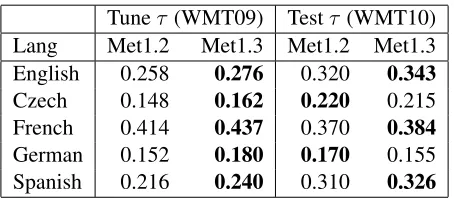
Table 5: Meteor 1.2 and 1.3 correlation with ranking judgments on tune and test data
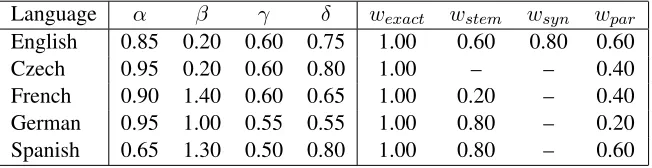
For each WMT language, we learn Meteor pa-rameters that maximizeτ over the combined 2009 and 2010 data sets using an exhaustive parametric sweep. The resulting parameters, listed in Table 4, are used in the default Ranking version of Meteor 1.3.
For each language, theδ parameter is above 0.5, indicating a preference for content words over func-tion words. In addifunc-tion, the fragmentafunc-tion penalties are generally less severe across languages. The ad-ditional features in Meteor 1.3 allow for more bal-anced parameters that distribute responsibility for penalizing various types of erroneous translations.
5 Evaluation Experiments
To compare Meteor 1.3 against previous versions of the metric on the task of evaluating MT system out-puts, we tune a version for each language on 2009 WMT data and evaluate on 2010 data. This repli-cates the 2010 WMT shared evaluation task, allow-ing comparison to Meteor 1.2. Table 5 lists correla-tion of each metric version with ranking judgments on tune and test data. Meteor 1.3 shows significantly higher correlation on both tune and test data for En-glish, French, and Spanish while Czech and German demonstrate overfitting with higher correlation on tune data but lower on test data. This overfitting ef-fect is likely due to the limited number of systems providing translations into these languages and the difficulty of these target languages leading to sig-nificantly noisier translations skewing the space of metric scores. We believe that tuning to combined 2009 and 2010 data will counter these issues for the official Ranking version.
Meteor-1.2r Meteor-1.3r Tune / Test MT08 MT09 MT08 MT09 MT08 0.620 0.625 0.650 0.636 MT09 0.612 0.630 0.642 0.648
Tune / Test P2 P3 P2 P3
[image:4.612.316.541.58.160.2]P2 -0.640 -0.596 -0.642 -0.594 P3 -0.638 -0.600 -0.625 -0.612
Table 6: Meteor 1.2 and 1.3 correlation with adequacy and H-TER scores on tune and test data
5.1 Generalization to Other Tasks
To evaluate the impact of new features on other evaluation tasks, we follow Denkowski and Lavie (2010a), tuning versions of Meteor to maximize length-weighted sentence-level Pearson’sr correla-tion coefficient with adequacy and H-TER (Snover et al., 2006) scores of translations. Data sets in-clude 2008 and 2009 NIST Open Machine Trans-lation Evaluation adequacy data (Przybocki, 2009) and GALE P2 and P3 H-TER data (Olive, 2005). For each type of judgment, metric versions are tuned and tested on each year and scores are compared. We compare Meteor 1.3 results with those from ver-sion 1.2 with results shown in Table 6. For both adequacy data sets, Meteor 1.3 significantly outper-forms version 1.2 on both tune and test data. The version tuned on MT09 data is selected as the official Adequacy version of Meteor 1.3. H-TER versions either show no improvement or degradation due to overfitting. Examination of the optimal H-TER pa-rameter sets reveals a mismatch between evalua-tion metric and human judgment type. As H-TER evaluation is ultimately limited by the TER aligner, there is no distinction between content and function words, and words sharing stems are considered non-matches. As such, these features do not help Meteor improve correlation, but rather act as a source of ad-ditional possibility for overfitting.
6 MT System Tuning Experiments
Language α β γ δ wexact wstem wsyn wpar
English 0.85 0.20 0.60 0.75 1.00 0.60 0.80 0.60
Czech 0.95 0.20 0.60 0.80 1.00 – – 0.40
[image:5.612.144.470.58.142.2]French 0.90 1.40 0.60 0.65 1.00 0.20 – 0.40 German 0.95 1.00 0.55 0.55 1.00 0.80 – 0.20 Spanish 0.65 1.30 0.50 0.80 1.00 0.80 – 0.60
Table 4: Optimal Meteor parameters for WMT target languages on 2009 and 2010 data (Meteor 1.3 Ranking)
devtest set, we select a version of Meteor by explor-ing the effectiveness of usexplor-ing multiple versions of the metric to tune phrase-based translation systems for the same language pair.
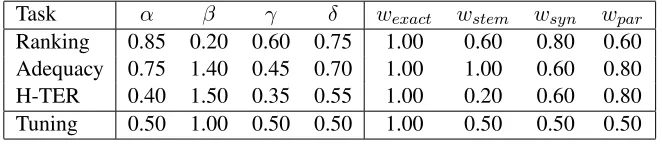
[image:5.612.325.523.184.435.2]We use the 2009 NIST Open Machine Transla-tion EvaluaTransla-tion Urdu-English parallel data (Przy-bocki, 2009) plus 900M words of monolingual data from the English Gigaword corpus (Parker et al., 2009) to build a standard Moses system (Hoang et al., 2007) as follows. Parallel data is word aligned using the MGIZA++ toolkit (Gao and Vogel, 2008) and alignments are symmetrized using the “grow-diag-final-and” heuristic. Phrases are extracted us-ing standard phrase-based heuristics (Koehn et al., 2003) and used to build a translation table and lex-icalized reordering model. A standard SRI 5-gram language model (Stolke, 2002) is estimated from monolingual data. Using Z-MERT, we tune this sys-tem to baseline metrics as well as the versions of Meteor discussed in previous sections. We also tune to a balanced Tuning version of Meteor designed to minimize bias. This data set provides a single set of reference translations for MERT. To account for the variance of MERT, we run end-to-end tuning 3 times for each metric and report the average results on two unseen test sets: newswire and weblog. Test set translations are evaluated using BLEU, TER, and Meteor 1.2. The parameters for each Meteor version are listed in Table 7 while the results are listed in Table 8.
The results are fairly consistent across both test sets: the Tuning version of Meteor outperforms BLEU across all metrics while versions of Meteor that perform well on other tasks perform poorly in tuning. This illustrates the differences between eval-uation and tuning tasks. In evaleval-uation tasks, metrics are engineered to score 1-best translations from sys-tems most often tuned to BLEU. As listed in Table 7,
Newswire
Tuning Metric BLEU TER Met1.2
BLEU 23.67 72.48 50.45
TER 25.35 59.72 48.60
TER-BLEU/2 26.25 61.66 49.69 Meteor-tune 24.89 69.54 51.29 Meteor-rank 19.28 94.64 49.78 Meteor-adq 22.86 77.27 51.40 Meteor-hter 25.23 66.71 50.90
Weblog
Tuning Metric BLEU TER Met1.2
BLEU 17.10 76.28 41.86
TER 17.07 64.32 39.75
TER-BLEU/2 18.14 65.77 40.68 Meteor-tune 18.07 73.83 42.78 Meteor-rank 14.34 98.86 42.75 Meteor-adq 16.76 81.63 43.43 Meteor-hter 18.12 70.47 42.28
Table 8: Average metric scores for Urdu-English systems tuned to baseline metrics and versions of Meteor
Task α β γ δ wexact wstem wsyn wpar
[image:6.612.141.472.58.130.2]Ranking 0.85 0.20 0.60 0.75 1.00 0.60 0.80 0.60 Adequacy 0.75 1.40 0.45 0.70 1.00 1.00 0.60 0.80 H-TER 0.40 1.50 0.35 0.55 1.00 0.20 0.60 0.80 Tuning 0.50 1.00 0.50 0.50 1.00 0.50 0.50 0.50
Table 7: Parameters for Meteor 1.3 tasks
7 Conclusions
We have presented Ranking, Adequacy, and Tun-ing versions of Meteor 1.3. The RankTun-ing and Ad-equacy versions are shown to have high correlation with human judgments except in cases of overfitting due to skewed tuning data. We believe that these overfitting issues are lessened when tuning to com-bined 2009 and 2010 data due to increased variety in translation characteristics. The Tuning version of Meteor is shown to outperform BLEU in minimum error rate training of a phrase-based system on small Urdu-English data and we believe that it will gener-alize well to other tuning scenarios. The source code and all resources for Meteor 1.3 and the version of Z-MERT with Meteor integration will be available for download from the Meteor website.
References
Satanjeev Banerjee and Alon Lavie. 2005. METEOR: An Automatic Metric for MT Evaluation with Im-proved Correlation with Human Judgments. InProc. of ACL WIEEMMTS 2005.
Colin Bannard and Chris Callison-Burch. 2005. Para-phrasing with bilingual parallel corpora. In Proc. of ACL2005.
Chris Callison-Burch, Philipp Koehn, Christof Monz, Kay Peterson, Mark Przybocki, and Omar Zaidan. 2010. Findings of the 2010 Joint Workshop on Sta-tistical Machine Translation and Metrics for Machine Translation. In Proc. of ACL WMT/MetricsMATR 2010.
Michael Denkowski and Alon Lavie. 2010a. Choosing the Right Evaluation for Machine Translation: an Ex-amination of Annotator and Automatic Metric Perfor-mance on Human Judgment Tasks. InProc. of AMTA 2010.
Michael Denkowski and Alon Lavie. 2010b. METEOR-NEXT and the METEOR Paraphrase Tables: Improve Evaluation Support for Five Target Languages. In
Proc. of ACL WMT/MetricsMATR 2010.
Qin Gao and Stephan Vogel. 2008. Parallel Implemen-tations of Word Alignment Tool. In Proc. of ACL WSETQANLP 2008.
Hieu Hoang, Alexandra Birch, Chris Callison-burch, Richard Zens, Rwth Aachen, Alexandra Constantin, Marcello Federico, Nicola Bertoldi, Chris Dyer, Brooke Cowan, Wade Shen, Christine Moran, and On-dej Bojar. 2007. Moses: Open Source Toolkit for Sta-tistical Machine Translation. InProc. of ACL 2007. Philipp Koehn, Franz Josef Och, and Daniel Marcu.
2003. Statistical Phrase-Based Translation. InProc. of NAACL/HLT 2003.
Philipp Koehn. 2005. Europarl: A Parallel Corpus for Statistical Machine Translation. InProc. of MT Sum-mit 2005.
Zhifei Li, Chris Callison-Burch, Chris Dyer, Juri Gan-itkevitch, Sanjeev Khudanpur, Lane Schwartz, Wren Thornton, Jonathan Weese, and Omar Zaidan. 2009. Joshua: An Open Source Toolkit for Parsing-based Machine Translation. InProc. of WMT 2009.
George Miller and Christiane Fellbaum. 2007. WordNet. http://wordnet.princeton.edu/.
Joseph Olive. 2005. Global Autonomous Language Ex-ploitation (GALE). DARPA/IPTO Proposer Informa-tion Pamphlet.
Kishore Papineni, Salim Roukos, Todd Ward, and Wei-Jing Zhu. 2002. BLEU: a Method for Automatic Eval-uation of Machine Translation. InProc. of ACL 2002. Robert Parker, David Graff, Junbo Kong, Ke Chen, and Kazuaki Maeda. 2009. English Gigaword Fourth Edi-tion. Linguistic Data Consortium, LDC2009T13. Martin Porter. 2001. Snowball: A language for
stem-ming algorithms. http://snowball.tartarus.org/texts/. Mark Przybocki. 2009. NIST Open
Machine Translation 2009 Evaluation. http://www.itl.nist.gov/iad/mig/tests/mt/2009/. Matthew Snover, Bonnie Dorr, Richard Schwartz,
Lin-nea Micciulla, and John Makhoul. 2006. A Study of Translation Edit Rate with Targeted Human Annota-tion. InProc. of AMTA 2006.
Andreas Stolke. 2002. SRILM - an Extensible Language Modeling Toolkit. InProc. of ICSLP 2002.