
Reusing adaptive learning resources
6
0
0
Full text
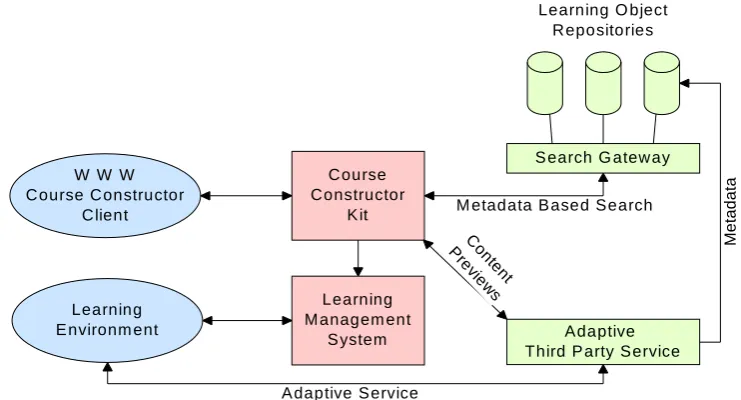
(2) 2. 3.. Support lecturers in building new courses from existing materials through a Course Constructor Kit (CCK). Provide means for integrating adaptive material into newly built courses.. A simplified structure of the EASEL components is shown in Figure 1. The course author uses the CCK through the WWW Course Constructor Client to look for appropriate learning material from local and remote repositories via the search gateway. The selected material is then assembled and stored as a content package in the Learning Management System (LMS) from where it can be accessed by the learners through a Learning Environment (LE). In the case of adaptive resources, which are delivered via third party services (see below, Section 2.2), the repositories contain only the metadata for these adaptive resources. This metadata is transferred through the LMS to the LE. which then communicates with the adaptive service using the Content Interworking API described below. Learning O bject Repositories. Learning Environm ent. Learning M anagem ent System. M etadata Based Search nt te s on ew C e vi Pr. Course Constructor Kit. Metadata. Search G ateway W W W Course Constructor Client. Adaptive Third Party Service. Adaptive Service. Figure 1: EASEL Architecture. 2.1. Interface for Adaptive Content In most cases of adaptivity, the adaptive learning resource and LE communicate through a SCORM compliant Content Interworking API [9]. This communication consists of two elements, the provision of learner information for the adaptive learning resource by the LE, and the update of information on the learner's performance and progress stored in the LE by the adaptive learning resource. The interface can be characterised through three main phases: 1. 2.. 3.. Initialisation phase: The adaptive resource requests to initialise a new session. Communication phase: The adaptive resource stores and retrieves variables and their values using a common data model. The stored variables may be used by the same adaptive learning resource at a later time or by a different resource. Any changes are only stored temporarily and locally to the current session until changes are requested to be made permanently. Finalisation phase: The adaptive resource requests to close the session after permanently storing all changed variables and values. Such a permanent storage can also be performed within a session through a commit command.. 2.2. Different Approaches to Adaptivity within EASEL Within EASEL, the different partners will take three different approaches to achieve adaptivity: pre-selection, document-internal rules, and third party service. In the pre-selection approach, the concept of adaptivity is understood in a broader sense than normally. Adaptivity here takes place during course construction, i.e. the material is adapted to the specific course including the teacher's preferences and not to the individual learner Opposed to the other two approaches explained below, the pre-selection is achieved offline and not during.
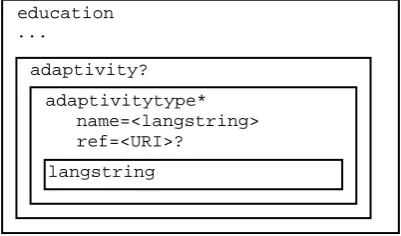
(3) runtime. Nevertheless, appropriate metadata describing the adaptive elements of this content is also required to facilitate its effective discovery and reuse. With respect to the LE, this approach is the least demanding and most portable one as the learning material is static by the time it is passed over from the CCK to the LMS and LE. In the document-internal rules approach, the learning resources contain rules specifying the adaptivity. These rules are then interpreted utilising the Content Interworking API to persistently store variables across multiple pages (see above for an overview on this API). A similar approach is currently investigated within the CLEO project [8]. This approach is the most demanding and the least portable one with respect to the LE as it must provide the respective functionality. In the third party service approach (TPS), the adaptive content is provided through an external service. The CCK only stores a reference to the external service as part of the course in the LMS and LE. When a learner reaches this adaptive part of a course, a connection to the TPS is launched. The TPS then retrieves information about the learner and his knowledge, preferences, and progress from the LE, using the Content Interworking API, and subsequently adapts the learning material according to these information.. 3. A GENERIC METADATA SCHEMA EXTENSION FOR ADAPTIVE CONTENTS One major goal of the EASEL project is to extend educational metadata standards (e.g. IMS Metadata) such that they can describe adaptive features of electronic learning resources. There exist a number of standards and specifications issued by different communities and institutions, however, due to a large overlap in the activities of standard developing bodies and working groups, these different standards are closely related to each other. We decided to take the IMS Learning Resource Metadata v1.1 specification [10] as a basis for our work. One reason was the fact that this is a specification for which an official XML encoding specification is also available. Another reason being that IMS has efficient procedures for the development and update of its specifications, i.e. a decision on proposed extensions is made quite quickly. Due to the overlap between the different existing standards it should be easy to adopt the proposed extensions to the other standards. 3.1. A Basic Generic Adaptivity Element We propose a new, optional element adaptivity within the education block of IMS Metadata (a first sketch of this proposal has been given by Conlan et al., [11]). Figure 2 shows the structure of this new element. It contains an education ... adaptivity? adaptivitytype* name=<langstring> ref=<URI>? langstring. Figure 2: The proposed generic adaptivity metadata element arbitrary number of elements adaptivitytype each of which describes one type or aspect of adaptivity available for this learning resource. The adaptivitytype element itself has two attributes (a mandatory name and an optional ref), and a langstring content. The name denotes the type or aspect of adaptivity for which information is provided while the langstring content contains the information itself. The second, optional attribute ref can be used to specify a URI where the vocabulary used in the langstring content is defined. The possible values for the name will be partially restricted by a best practice list. Below, an adaptivity element for an imaginary content is shown containing several different adaptivitytype entries. The competencies types elements in this example show that a hierarchical structure is possible. This demands that the same vocabulary should be used for the langstring content of all competencies.XXX entries..
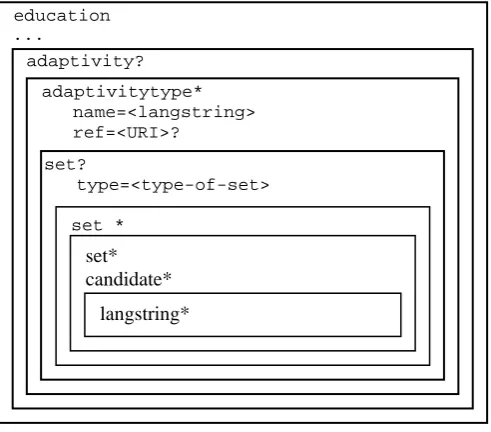
(4) <adaptivity> <adaptivitytype name="specialneed"> Visual Disability </adaptivitytype> <adaptivitytype name="competencies.taught" ref="some-sameURI"> RDBMS Management </adaptivitytype> <adaptivitytype name="competencies.required" ref="some-sameURI"> Database concepts </adaptivitytype> <adaptivitytype name="learningstyle" ref="some-otherURI"> auditive </adaptivitytype> </adaptivity> This example denotes a learning resource that offers four different types of adaptivity. The specialneeds entry declares the usability of this learning resource for blind learners. The competencies.taught entry says that the learner acquires the competency to manage a relational database management system learning with this resource, i.e. the entry specifies the objectives of the learning object. A learning object may also have several possible objectives from which the learner (or learning environment) may choose. The content of this competency RDBMS management is described in more detail at the referred resource. The next entry specifies that the learner should already have acquired the competency Database concepts before processing the current resource because that knowledge is needed for understanding and successful processing. Such information may be used for navigation support, i.e. for an adaptive sequencing of learning objects. The exact meaning of this competency is defined in the same referred resource as the taught competency. This is important in order to ensure that taught and required competencies can be related to each other (see the next section on vocabularies). The final entry learningstyle claims that the resource is useful for learners preferring an oral presentation of contents. 3.2. A Structured Adaptivity Element The generic element laid down in the previous section provides, in principle, a means for describing many different approaches for adaptivity. However, for some approaches it would be advantageous to be able to structure the information specified within a certain adaptivitytype entry. Regarding the specification of competencies required to be able to understand a certain document, for example, should cover two aspects at the same time. There may be several competencies necessary to be able to understand the document, and there may be different approaches possible to understand this document resulting in several alternative sets of prerequisites. As a consequence, the need to structure the data provided within the adaptivitytype entry arises. Figure 3 sketches the proposed extended adaptivitytype entry covering such structured data. This extension consists of two parts addressing different reasons for possible problems in the interpretations of multiple langstring fields education ... adaptivity? adaptivitytype* name=<langstring> ref=<URI>? set? type=<type-of-set> set *. set* candidate* langstring*. Figure 3: A structured generic adaptivity metadata element within one adaptivitytype entry: A candidate block may contain several langstrings specifying the same value in.
(5) different languages. A set then can contain several candidates with different meanings. The optional type parameter of the set entry specifies how the candidates should be connected. Example values for this type are all (i.e. a conjunction) or at-least-one (i.e. a disjunction). On top level, only one set is allowed in order to avoid ambiguities about the combination of sets at this level. In principle, sets may be nested arbitrarily; however, normally two set levels should be sufficient (any and-or structure can be represented by a disjunction of conjunctions or vice versa) in order to reduce complexity of the provided data. This structured approach is illustrated in the following imaginary example. <adaptivitytype name"competencies.required"> <set type="at-least-one"> <set type"all"> <candidate> <langstring lang="en">competence-A</langstring> <langstring lang="de">Kompetenz-A</langstring> </candidate> <candidate> ... </candidate> ... </set> <set type="l"> ... </set> ... </set> </adaptivitytype> On top level, we have a set of type at-least-one, i.e. in order to understand the current document, the learner should master at least one of the following sets of competencies. Both second-level sets are of type all, i.e. the learner should master all competencies within one of the sets. In the first candidate, we then also have an example for specifying information in different languages. The competence A is specified in English as such, while the German specifications names it as Kompetenz A. 3.2. Best Practice Lists and Vocabularies The generality of the proposed extension has the disadvantage that users have to identify domain specific terms in a unique but machine-recognizable way. With respect to the name attribute of the adaptivitytype entry, this can be realized through a best practice list given that a simple but, nevertheless, moderated way for extending this list is provided. Regarding the langstring content, this is more difficult because that will often depend on the vocabulary of the knowledge domain under consideration, e.g. the competencies entries in the example above. While there exist attempts to build a general ontology (e.g. in the IEEE SUO Group, [12]), these have not yet shown satisfactory results that could be applied for this purpose. We therefore propose to use the ref attribute to specify the vocabulary used in describing the learning object. Nonetheless, it is important that widely accepted standard vocabularies for the different fields of knowledge are used because only standard vocabularies can ensure the interoperability and information exchange within learning objects' metadata. Current experiences within the EASEL project show that classification systems as used in libraries like UDC [13] are too coarse for this objective.. 4. CONCLUSION In the EASEL project, a toolbox for constructing new courses from existing - static as well as adaptive - learning objects is developed. The EASEL learning management system is based on metadata created according to several existing educational metadata standards, IEEE LOM, IMS Metadata, and Dublin Core Education standard recommendation. We have proposed an extension for the IMS Metadata schema to accommodate a generic adaptivity element. Based on a first, simple concept, practical requirements have led to a more elaborate approach which allows the information specifying the adaptivity of a learning resource to be structured. Currently, these proposals are realized in a trial implementation in order to prove their usability. Nevertheless, there are still open issues, e.g. the controlled vocabulary problem that has not yet been satisfactorily solved. Acknowledgments This research is partially funded by the European Commission under the auspices of the EASEL (Educator Access to Services in the Electronic Landscape, [7]) project. The EASEL projects goal is to explore technologies which can be brought together to offer course constructors an environment in which they can readily combine.
(6) existing learning objects to create new online educational offerings. Current proprietary Adaptive Hypermedia Services tend to restrict this kind of integration. As part of EASEL the research conducted will be used to integrate Adaptive Hypermedia Systems into Learning Environments which are based on current WWW educational standards. Dietrich Albert is professor at the Department of Psychology, University of Graz, Austria. Currently, he is at Hiroshima University, Japan, as a visiting professor. The authors wish to thank Aida Slavic and Roberto Trabucchi for their comments on an earlier draft of this paper.. REFERENCES [1] Alliance of Remote Instructional Authoring and Distribution Networks for Europe (ARIADNE). EC FP4 project. URL: http://ariadne.unil.ch/. [2] Aviation Industry CBT Committee (AICC). URL: http://www.aicc.org/. [3] IEEE Learning Technology Standards Committee (LTSC). URL: http://ltsc.ieee.org/. [4] IMS Global Learning Consortium. URL: http://www.imsproject.org/. [5] ALEKS. URL: http://www.aleks.com/. [6] Hockemeyer, C., Held, T., and Albert, D. (1998). RATH - a relational adaptive tutoring hypertext WWWenvironment based on knowledge space theory. In Christer Alvegård, editor, Computer Aided Learning and Instruction in Science and Engineering, Proceedings of the CALISCE'98, pp. 417-423, Göteborg, Sweden: Chalmers University of Technology. [7] Educators Access to Services in the Electronic Landscape (EASEL). EC IST project 10051. URL: http://www.fdgroup.com/easel/. [8] Custumized Learning Experiences Online (CLEO) Lab. URL: http://www.cleolab.org/. [9] Sharable Content Object Reference Model (SCORM), version 1.1. Advanced Distributed Learning, January 2001. URL: http://www.adlnet.org/. [10] IMS Learning Resource Meta-data Specification, version 1.1, June 2000. URL: http://www.imsproject.org/metadata/index.html. [11] Conlan, O., Hockemeyer, C., Lefrere, P., Wade, V., & Albert, D. (2001). Extending educational metadata schemas to describe adaptive learning resources. In Hugh Davies, Yellowlees Douglas, & David G. Durand, editors, Hypertext 01: Proceedings of the twelfth ACM Conference on Hypertext and Hypermedia, pp. 161-162, New York: Association of Computing Machinery (ACM). [12] IEEE Standard Upper Ontology (SUO) Working Group. URL: http://suo.ieee.org/. [13] Universal Decimal Classification (UDC), pocket edition. British Standards Institution, 1999..
(7)
Figure
Related documents