Proceedings of the 6th Linguistic Annotation Workshop, pages 166–174,
Annotating Coordination in the Penn Treebank
Wolfgang Maier
Universit¨at D¨usseldorf Institut f¨ur Sprache und Information
Sandra K ¨ubler
Indiana University Department of Linguistics
Erhard Hinrichs
Universit¨at T¨ubingen Seminar f¨ur Sprachwissenschaft
Julia Krivanek
Universit¨at T¨ubingen Seminar f¨ur Sprachwissenschaft
Abstract
Finding coordinations provides useful infor-mation for many NLP endeavors. However, the task has not received much attention in the literature. A major reason for that is that the annotation of major treebanks does not re-liably annotate coordination. This makes it virtually impossible to detect coordinations in which two conjuncts are separated by punctu-ation rather than by a coordinating conjunc-tion. In this paper, we present an annotation scheme for the Penn Treebank which intro-duces a distinction between coordinating from non-coordinating punctuation. We discuss the general annotation guidelines as well as prob-lematic cases. Eventually, we show that this additional annotation allows the retrieval of a considerable number of coordinate structures beyond the ones having a coordinating con-junction.
1 Introduction
1.1 Motivation
Coordination is a difficult topic, in terms of linguis-tic description and analysis as well as for NLP ap-proaches. Most linguistic frameworks still struggle with finding an account for coordination that is de-scriptively fully adequate (Hartmann, 2000). This is also the reason why coordination is not adequately encoded in the annotation of major treebanks. From an NLP perspective, coordination is one of the major sources for errors in parsing (Hogan, 2007). If pars-ing of coordinate structures can be improved, overall parsing quality also benefits (K¨ubler et al., 2009).
And consequently, downstream NLP applications, such as question answering or machine translation, would benefit as well.
However, since linguistic frameworks in general are challenged by the diverse phenomena of coordi-nation, a consistent annotation of coordinate struc-tures, clearly marking the phenomenon as such as well as its scope, is a difficult enterprise. Conse-quently, this makes the detection of conjuncts and their boundaries a highly non-trivial task. Never-theless, an exact detection of coordination scopes is necessary for improving parsing approaches to this phenomenon.
A first step in the detection of the single con-juncts of a coordinate structure is a reliable detec-tion of the presence of a coordinate structure as such and of the boundaries between its conjuncts. One highly predictive marker for the detection of coor-dinate structures is the presence of a coordinating
conjunction such asand, or, neither...nor,
and but. In treebanks, coordinating conjunctions
are generally easy to identify by a specialized part
of speech (POS) tag, for instance CC in the Penn
Treebank (PTB) (Marcus et al., 1993) and KON in
the Stuttgart-T¨ubingen tagset (STTS) (Thielen and Schiller, 1994). However, if the coordinate struc-ture has more than 2 conjuncts, or if it is on the clause level, the conjuncts are separated by punc-tuation signs such as commas rather than by overt coordinating conjunctions. In the PTB, they are
an-notated with the POS tag ,; in the German
they are annotated with the POS tags$,and$:, like all other punctuation without coordinating function.
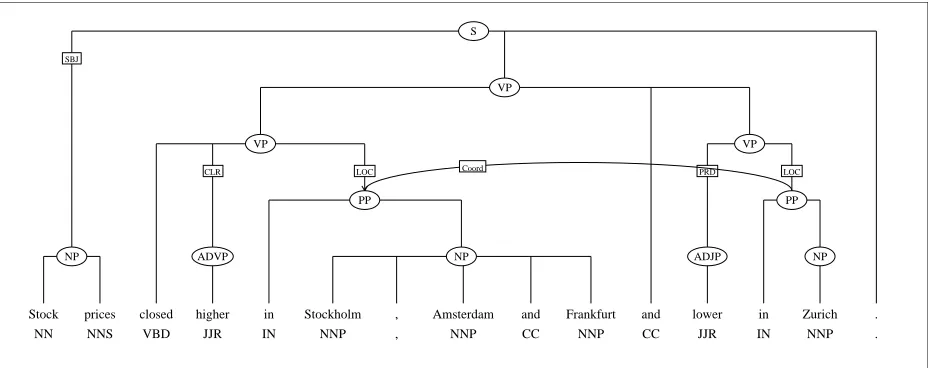
Automatically identifying coordinate structures and the scope of their conjuncts in the Penn Tree-bank is challenging since coordinate structures as a whole and their conjuncts are not explicitly marked in the annotation by special phrasal or lexical nodes. Figure 1 shows an example sentence with two coor-dinate structures, the inside one a coorcoor-dinate noun phrase (NP) with 3 conjuncts, and the outside one a coordinate verb phrase (VP) with two complex conjuncts. These coordinate structures are labeled by ordinary phrasal categories such as VP and NP and can thus not be distinguished at the phrasal level from VPs and NP that do not involve coordination.
There are approaches to improving parsing for co-ordinations, but most of these approaches are re-stricted to very narrow definitions such as coordi-nations of noun compounds such as “oil and gas re-sources” (Nakov and Hearst, 2005), coordinations of symmetrical NPs (Hogan, 2007; Shimbo and Hara, 2007), or coordinations of “A CC B” where A and B are conjuncts, and CC is an overt conjunction (K¨ubler et al., 2009). To our knowledge, there is no attempt at covering all coordination types.
One goal of this paper is to demonstrate a wide range of coordination phenomena that have to be taken into account in a thorough treatment of co-ordinations. We additionally present a proposal for an enhanced annotation of coordination for the Penn Treebank. The annotation is focused on punctuation and allows for an in-depth investigation of coordi-nations, for example for linguistic treatments, but also for work on coordination detection, from which many NLP applications can profit.
The structure of this paper is as follows. In section 2, we look at syntactic treatments of coordination, and we have a look at the Penn Treebank guidelines. Section 3 is dedicated to the presentation of a “style-book” for the enhanced annotation of coordination that we advocate in the present paper. We outline our annotation decisions and the issues that we en-countered. Section 4 contains an empirical analysis of the coordinations in the PTB, made possible by the new annotation. Finally, section 5 concludes the paper.
2 Related Work
2.1 Coordination in Linguistics
Coordinations are complex syntactic structures that consist of two or more elements (conjuncts), with one or more conjuncts typically, but not always preceded by a coordinating conjunction such as
and, or, neither...nor, and but.
How-ever, see section 3 for examples of coordinations that lack coordinating conjunctions altogether. Coordinate structures can conjoin lexical and phrasal material of any kind and typically exhibit syntactic parallelism in the sense that each conjunct belongs to the same lexical or phrasal category. However, coordinations of unlike categories such
as Loch Ness is a lake in Scotland
and famous for its monster are also
possible. The conjuncts are typically syntactic
constituents; in fact, coordinate structures are
among the classic constructions used to test for constituency. However, there are well-known cases
of non-constituent conjunctions such as Sandy
gave a record to Sue and a book to Leslie and gapping structures with one or more
elliptical conjuncts such as Leslie likes
bagels and Sandy donuts. Incidentally,
the coordinate structure in Figure 1 consitutes an example of non-constituent conjunction since the
second conjunct lower in Zurich does not
form a single constituent. The PTB treats this
conjunct as a VP. However, note that the conjunct is not headed by a verb; rather the verb is elided.
Stock NN
prices NNS
closed VBD
higher JJR
in IN
Stockholm NNP
, ,
Amsterdam NNP
and CC
Frankfurt NNP
and CC
lower JJR
in IN
Zurich NNP
. .
NP ADVP NP
PP
CLR LOC
VP
ADJP NP
PP
PRD LOC
VP VP
SBJ
S
[image:3.612.76.541.71.255.2]Coord
Figure 1: An example with two embedded coordinations.
more than two conjuncts, which have been largely ignored in computational modeling of language thus far.
Since supervised models for statistical parsing re-quire annotated training material, we will propose a more fine-grained annotation scheme for punctu-ation than has thus far been incorporated into ex-isting treebanks. The present paper focuses on En-glish only and will use the Penn Treebank Bracket-ing Guidelines as the annotation scheme for which such more fine-grained annotations will be pro-posed. However, the proposed modifications can be easily imported to other treebanks for English such as CCGBank or treebanks for other language, and we conjecture that they would lead to improved language models for coordinate structures for those treebanks as well.
In order to properly ground the discussion, we will now review Penn Treebank Bracketing Guide-lines.
2.2 Penn Treebank Guidelines
The Penn Treebank Bracketing Guidelines (Bies et al., 1995, sec. 7) describe extensively how to
treat coordination in terms of bracketing. The
guidelines state that coordinate structures are
an-notated on the lowest level possible. One word
conjuncts are coordinated on the word level. An example for this is shown in Figure 1 in the
co-ordinated NP Stockholm , Amsterdam and
Frankfurt. In gapped structures, symmetrical
elements in the conjuncts are marked using gap-coindexation. In the example in Figure 1, the coin-dexation is shown as a secondary edge from the prepositional phrase (PP) in the second conjunct to the PP in the first one.
The guidelines also discuss multi-word
co-ordinating conjunctions such as as well as
or instead of and discontinuous conjunctions
such as not only ...but or not ...but
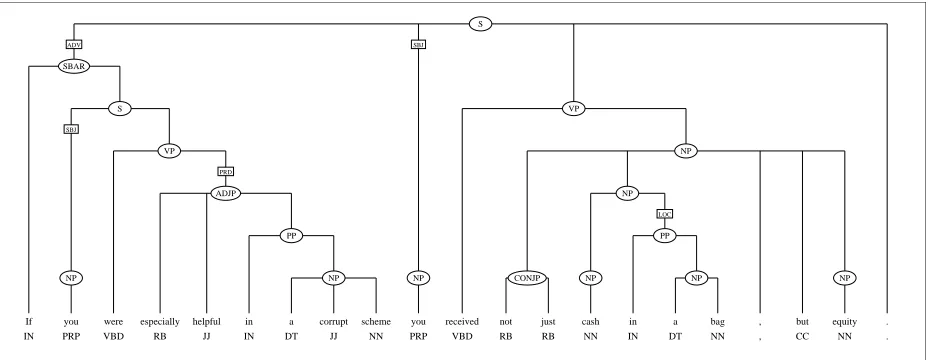
instead. Multi-word coordinating conjunctions, including discontinuous ones, are grouped into CONJP constituents. Single word portions of dis-continuous conjunctions are not marked as such. Figure 2 shows an example of a discontinous coordi-nating conjunction in which the first part is projected to aCONJP while the second part is a single word and thus not projected.
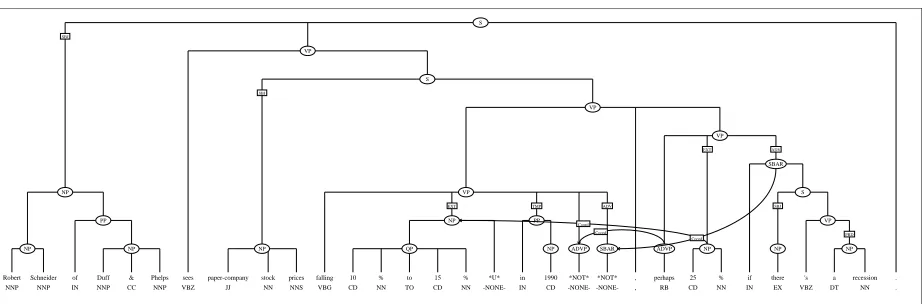
The manual does not mention coordinate struc-tures with more than 2 conjuncts or without overt conjunctions, and the only examples in which the comma takes over the role of a coordinating con-junction refer to “difficult cases” such as the sen-tence in Figure 3, in which symmetry is enforced by
anti-placeholders*NOT*.
3 Annotation of Coordinating Punctuation
If IN
you PRP
were VBD
especially RB
helpful JJ
in IN
a DT
corrupt JJ
scheme NN
you PRP
received VBD
not RB
just RB
cash NN
in IN
a DT
bag NN
, ,
but CC
equity NN
. .
NP NP
PP ADJP
PRD
VP
SBJ
S SBAR
NP CONJP NP NP
PP
LOC
NP
NP NP
VP
ADV SBJ
[image:4.612.77.541.71.251.2]S
Figure 2: An example with a multi-word conjunction.
annotations in the treebank.
3.1 Annotation principles
The principal guidelines for the enhanced annotation
of coordination are as follows. Lettbe a punctuation
token and lettlandtrbe the tokens immediately on
the left and the right oft(disregarding coordinating
conjunctions). We annotatetas coordinating iff
1. tis attached to the lowest nodetcwhich
domi-nates bothtlandtr, and
2a. in the symmetrical case: the non-terminals
di-rectly dominated bytcwhich also dominatetl,
resp.tr, have the same label;
2b. in the asymmetrical case: tc is labeled UCP
(coordination of unlike constituents) – or tc
isS, and the two non-terminals dominating tl
andtr are different (since coordination of
un-like clausal constituents is grouped under anS
rather than aUCP).
In cases where there are no nodes between tand
tc, we check the POS tags of tl and tR for
equal-ity. In theory, these two rules, given the syntactic annotation, should be sufficient to find all cases of coordination. However, in practice, the situation is more complicated, as shown in the next subsection.
For example, in Figure 1, the comma is labeled as coordination since the two words to the left and right are directly dominated by an NP, and they both have the same POS tag, NNP, and thus follow rule
2a. The comma in Figure 2 is also annotated as a coordination following 2a since the words to the left and right are both dominated by NPs, as is the node dominating all words in question. We present ex-amples for symmetrical coordinations on the clausal and phrasal level in (1).
(1) a. Richard Stoltzman has taken a [J J R
gentler] , [ADJ P more
audience-friendly approach]. (PTB 3968)
b. The two leaders are expected to discuss
[N P changes sweeping the East bloc]
as well as[N P[N P human-rights issues]
, [N P regional disputes] and [N P
eco-nomic cooperation]]. (PTB 6798)
c. These critics are backed by several
aca-demic studies showing that the adoption of poison pills reduces shareholder
val-ues not merely [P P in the short run] ,
but also[P P over longer periods]. (PTB
5056)
d. Our pilot simply [V P laughed] , [V P
fired up the burner] and [V P with
an-other blast of flame lifted us , oh , a
good 12-inches above the water level]
. (PTB 4465)
e. [SHe believes in what he plays], and[S
he plays superbly]. (PTB 3973)
f. [S Dow Jones industrials 2596.72 , off
17.01];[S transportation 1190.43 , off
Robert NNP
Schneider NNP
of IN
Duff NNP
& CC
Phelps NNP
sees VBZ
paper-company JJ
stock NN
prices NNS
falling VBG
10 CD
% NN
to TO
15 CD
% NN
*U*
-NONE-in IN
1990 CD
*NOT*
-NONE-*NOT*
-NONE-, ,
perhaps RB
25 CD
% NN
if IN
there EX
's VBZ
a DT
recession NN
. .
NP NP
PP NP
NP QP
NP
NP PP
ADVP SBAR
EXT TMP ADV
VP
ADVP NP NP NP
PRD
VP
SBJ
S SBAR
EXT ADV
VP VP
SBJ
S VP
SBJ
S
Coord Coord
[image:5.612.79.540.68.220.2]Coord
Figure 3: A difficult coordination example.
(PTB 13082)
The examples in (2) show cases of coordination of unlike constituents. These cases are covered by the rule 2b described above; in the first two sentences,
all conjuncts are dominated byUCP, and the last
sen-tence is an example of a clausal coordination, that is
projected to anSnode.
(2) a. Assuming final enactment this month ,
the prohibition will take effect [ADV P
96 days later], or[P Pin early February]
. (PTB 6499)
b. My wife and I will stay [P P through
the skiing season], or [SBAR until the
money runs out] – whichever comes
first . (PTB 15255)
c. This perhaps was perceived as [N P a
“ bold ” stance] , and thus [ADJ P
suspicious]. (PTB 18051)
d. [SMr. Trotter ’s painting showed a wall
of wood boards with painted ribbons
tacked down in a rectangle] ; [SIN V
tucked behind the ribbons were en-velopes , folded , faded and crumpled
papers and currency]. (PTB 8698)
The example in (3) shows a comma that has two
different functions: The comma beforeand
delim-its the relative clause modifying oral orders,
and at the same time marks the coordination. Since we are interested in all cases of coordination, such multi-functional punctuation marks are annotated as coordinations if that is one of their functions.
(3) The affected practices include[N P the
plac-ing of oral orders , which is the way most
public customer orders are placed], and[N P
trading between affiliated brokers] , even
though in some cases trading with affiliates may be the only way to obtain the best exe-cution for a client . (PTB 15541)
3.2 Problematic Cases
Coordination vs. apposition In many cases, ap-positions show the same characteristics as the rules above. An apposition is not restricted to be of the same category as the constituent it modifies, but in many cases, it is. These cases are the main reason for the manual annotation since they cannot be dis-tinguished automatically. Thus, if the second phrase defines or modifies the first one, we do not annotate the intervening commas as coordination. An exam-ple for an apposition that follows the rules above is given in (4).
(4) The last two months have been the whole ball
game , ” says [N P Steven Norwitz], [N P a
vice president]. (PTB 15034)
The same holds for cases in which a temporal NP modifies another NP, such as in example (5). Here,
the NPTassis modified by the temporal NPJune
10 , 1988.
(5) – : Letter from Eduard Shevardnadze to
U.N. Secretary-General Perez de Cuellar ,
reported in [N P Tass] , [N P−T M P June 10
There are cases, especially ones in which the sec-ond phrase is negated, for which it is difficult to de-cide between coordination and apposition. The sen-tence in (6) shows an example. For these cases, we decided to treat them as coordination.
(6) He is[N P a mechanical engineer], [N P not
an atmospheric chemist]. (PTB 7158)
Ambiguous punctuation Commas before
coordi-nating conjunctions are typically signs of coordina-tion. Note that the usage of commas in the Penn Treebank is not very regular, and cases of “A, B, and C” can be found along with cases of “A, B and C” and cases of “A, and B”, as shown in the examples in (7). All these cases are covered by rule 2a.
(7) a. Describing itself as “ asset rich , ” Sea
Containers said it will move
immedi-ately to sell [N P two ports] , [N P
var-ious ferries],[N P ferry services], [N P
containers], and[N P other investments]
. (PTB 6105)
b. Stocks closed higher in [N P Hong
Kong],[N P Manila],[N P Singapore],
[N P Sydney]and[N P Wellington], but
were lower in Seoul . (PTB 4369)
c. [N P Sidley & Austin , a leading
Chicago-based law firm] , and [N P
Ashurst Morris Crisp , a midsized
Lon-don firm of solicitors] , are scheduled
today to announce plans to open a joint office in Tokyo . (PTB 5367)
However, there are also cases in which the comma before a coordinating conjunction is clearly not part of the coordination, but rather belongs to the preced-ing constituent, such as in the examples in (8). In these cases, the syntactic annotation shows that the comma is not a coordination comma by attaching it low to the preceding constituent; we do not annotate these commas as coordination phenomena.
(8) a. Berthold[V P is based in Wildbad , West
Germany ,]and[V P also has operations
in Belgium]. (PTB 4988)
b. Under the plan , Gillette South Africa
will sell[N P manufacturing facilities in
Springs , South Africa ,] and [N P its
business in toiletries and plastic bags]to
Twins Pharmaceuticals Ltd. , an affili-ate of Anglo American Corp. , a South African company . (PTB 6154)
c. [SLast week ’s uncertainty in the stock
market and a weaker dollar triggered
a flight to safety] [P RN , he said ,] [S
but yesterday the market lacked such
stimuli]. (PTB 8252)
d. [S I want white America to talk about
it , too ,] but [S I ’m convinced that
the grapevine is what ’s happening]. ”
(PTB 10130)
Another ambiguous case can be found in coordi-nate structures on the clausal level, which often does not use overt coordinating conjunctions, but rather commas or semicolons. These cases of coordination are difficult to distinguish automatically from other types of parataxis. The examples in (9) we regard as coordinations while the examples in (10) are not since the relation between them is elaborative.
(9) a. [S In 1980 , 18 % of federal
prosecu-tions concluded at trial] ; [S in 1987 ,
only 9 % did]. (PTB 12113)
b. [S Various ministries decided the
prod-ucts businessmen could produce and
how much] ; and [S
government-owned banks controlled the financing of projects and monitored whether
compa-nies came through on promised plans].
(PTB 12355)
(10) a. [S This does n’t necessarily mean
larger firms have an advantage] ; [S
Mr. Pearce said GM works with a
number of smaller firms it regards
highly]. (PTB 12108)
b. [S Senator Sasser of Tennessee is
chairman of the Appropriations
sub-committee on military construction];
[SMr. Bush ’s $ 87 million request for
Tennessee increased to $ 109 million]
. (PTB 12223)
ap-positions. While the first example in (11) cannot be distinguished from coordination based on our anno-tation guidelines (cf. sec. 3.1) and the syntactic an-notation, the syntactic annotation for the other two sentences shows that these are not considered cases of coordination, either by grouping the coordinating
conjunction under a parenthetical node (PRN) or
un-der a fragment (FRAG).
(11) a. The NASD , which operates the
Nas-daq computer system on which 5,200 OTC issues trade , compiles short
in-terest data in[N P [N P two categories]
: [N P the approximately two-thirds ,
and generally biggest , Nasdaq stocks that trade on the National Market Sys-tem ; and the one-third , and generally smaller , Nasdaq stocks that are n’t a
part of the system]]. (PTB 21080)
b. Martha was [ADJ P pleased , [P RN
but nowhere near as much as Mr.
Engelken]]. (PTB 14598)
c. The HUD scandals will simply [V P
continue , [F RAG but under new
mismanagement]]. (PTB 15629)
Coordination in NP premodification The Penn
Treebank Bracketing Guidelines (Marcus et al., 1993) state that generally conjuncts are projected to the phrase level before they are coordinated. There is one exception: premodifiers in NPs, which are only projected if they consist of more than one word. In such cases, it is not obvious from the tree that there is a coordination. But even if there is no ex-plicit marking of coordination in the syntactic anal-ysis, we do annotate the coordination. Examples are shown in (12).
(12) a. Yesterday , it received a [ADJ P $
15 million] , [J J three-year] contract
from Drexel Burnham Lambert . (PTB 6485)
b. There ’s nothing in the least
contradic-tory in all this , and it would be nice to think that Washington could tolerate a [ADJ P reasonably sophisticated], [J J
complex]view . (PTB 8018)
c. Perhaps the shock would have been
less if they ’d fixed to another [N N
full av. per sent.
total coord. total coord.
, 28 853 3 924 1.22 0.17
; 684 547 0.03 0.02
[image:7.612.333.520.71.142.2]CCs 14 267 0.60
Table 1: Annotation of punctuation
low-tax] , [V BN deregulated] , [J J
supply-side]economy . (PTB 10463)
4 Properties of the Annotation
For the empirical analysis presented here, we use ap-proximately half the Penn Treebank. The data set has a size of 23 678 sentences and 605 064 words in total, with an average length of 25.6 words per sentence.
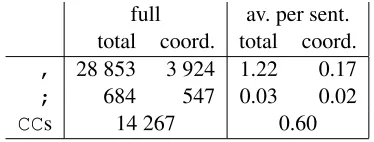
Table 1 shows some basic statistics, more specfi-cally:
1. the numbers of annotated commas, semicolons,
and coordinating conjunctions (CC) and their
total numbers over the entire data set, and
2. the average numbers of annotated commas,
semicolons, and coordinating conjunctions
(CC) and their average number per sentence.
The numbers show that approximately 14% of all commas and 80% of all semicolons are used in
co-ordinate structures. CCs constitute only 2.36% of
all words. If we count CCs as well as the
punctu-ation signs that are annotated as being part of a co-ordination, the number rises to 3.10% of all words. These numbers show that we cannot assume that all sentence-internal punctuation is related to coordina-tion, but that the use of commas and semicolons to separate conjuncts is not a marginal phenomenon.
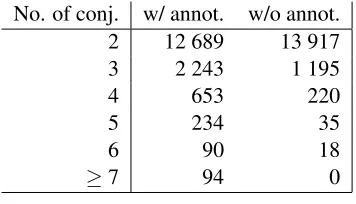
Table 2 offers a first look at the distribution of the number of conjuncts that occur in coordinate
structures. Our present investigation focuses
ex-clusively on noun phrase coordination. Given that, in principle, our annotation marks all conjunctions, and given that our annotation guidelines state that all conjuncts must be sisters, it is rather straight-forward to determine the number of conjuncts of a coordination: We simply count the separators
be-tween conjuncts, i.e. CCs and conjunction
*
-NONE-Describing VBG
itself PRP
as IN
`` ``
asset NN
rich JJ
, ,
'' ''
Sea NNP
Containers NNP
said VBD
0
-NONE-it PRP
will MD
move VB
immediately RB
*
-NONE-to TO
sell VB
two CD
ports NNS
, ,
various JJ
ferries NNS
, ,
ferry NN
services NNS
, ,
containers NNS
, ,
and CC
other JJ
investments NNS
. .
NP NP ADJP
PP CLR VP SBJ
S
NP NP ADVP NP NP NP NP NP NP
NP VP
VP SBJ
S TMP
VP VP SBJ
S SBAR VP SBJ
S
[image:8.612.69.541.70.227.2]* *
Figure 4: An example with more than two conjuncts.
No. of conj. w/ annot. w/o annot.
2 12 689 13 917
3 2 243 1 195
4 653 220
5 234 35
6 90 18
≥7 94 0
Table 2: Number of conjuncts belowNX/NP
adjacent separators as singles (in order to count se-quences of “A, and B” as single separator). The number of conjuncts is then the number of separa-tors plus one. Without annotation, i.e. when only
consideringCC, we find that 2 882 sentences (12%
out of the total of 23 678 sentences) have coordi-nations consisting of more than two conjuncts. If we additionally consider the coordination punctua-tion, this number rises significantly to 4 764 (20%). When looking at noun phrase coordination, more
precisely, at coordination below NX and NP, the
added value of our enhanced coordination annota-tion is especially apparent: It is clear from the num-bers in Table 2 that we would miss a high number of coordinations, especially multi-conjunct structures, without the annotation and that this additional num-ber of coordinations can be found reliably using our enhanced annotation.
As an example for a coordination that would be difficult to identify correctly, consider sentence (7-a). The syntactic annotation is shown in Fig. 4.
While theCCtag on the lastandwould allow for the
identification of the coordination ofcontainers,
and other investments, all NPs which are
in front of those two could not be recognized as part of the coordination. A more detailed investigation of coordinate structures beyond noun phrases that would also include an assessment of the scope of coordinations is left for future work.
5 Conclusion
In this paper, we have listed a wide range of coor-dination phenomena that have to be taken into con-sideration for an exhaustive treatment of
coordina-tion. We have presented a new annotation layer
for the Penn Treebank which allows for a thorough treatment of coordination by clarifying the status of punctuation. Furthermore, in an empirical analy-sis, we have demonstrated the utility of our anno-tation, showing that it allows for the detection of a large number of coordinations which cannot be de-tected when only coordinating conjunctions are con-sidered.
[image:8.612.97.275.273.375.2]References
Ann Bies, Mark Ferguson, Karen Katz, and Robert Mac-Intyre, 1995. Bracketing Guidelines for Treebank II Style Penn Treebank Project. University of Pennsylva-nia.
Sabine Brants, Stefanie Dipper, Silvia Hansen, Wolf-gang Lezius, and George Smith. 2002. The TIGER treebank. In Erhard Hinrichs and Kiril Simov, edi-tors,Proceedings of the First Workshop on Treebanks and Linguistic Theories (TLT 2002), pages 24–41, So-zopol, Bulgaria.
Katharina Hartmann. 2000. Right Node Raising and Gapping. John Benjamins, Amsterdam, The Nether-lands.
Erhard W. Hinrichs, Julia Bartels, Yasuhiro Kawata, Valia Kordoni, and Heike Telljohann. 2000. The Verbmobil treebanks. InProceedings of KONVENS 2000, 5. Kon-ferenz zur Verarbeitung nat¨urlicher Sprache, pages 107–112, Ilmenau, Germany.
Deirdre Hogan. 2007. Coordinate noun phrase disam-biguation in a generative parsing model. In Proceed-ings of the 45th Annual Meeting of the Association of Computational Linguistics, pages 680–687, Prague, Czech Republic.
Sandra K¨ubler, Erhard W. Hinrichs, Wolfgang Maier, and Eva Klett. 2009. Parsing coordinations. In Proceed-ings of the 12th Conference of the European Chapter of the ACL (EACL), pages 406–414, Athens, Greece. Mitchell P. Marcus, Beatrice Santorini, and Mary Ann
Marcinkiewicz. 1993. Building a large annotated cor-pus of English: The Penn Treebank. Computational Linguistics, 19(2):313–330. Special Issue on Using Large Corpora: II.
Preslav Nakov and Marti Hearst. 2005. Using the web as an implicit training set: Application to structural ambi-guity resolution. InProceedings of Human Language Technology Conference and Conference on Empirical Methods in Natural Language Processing, pages 835– 842, Vancouver, Canada.
Masashi Shimbo and Kazuo Hara. 2007. A discrim-inative learning model for coordinate conjunctions. In Proceedings of the 2007 Joint Conference on Em-pirical Methods in Natural Language Processing and Computational Natural Language Learning (EMNLP-CoNLL), pages 610–619, Prague, Czech Republic. Wojciech Skut, Thorsten Brants, Brigitte Krenn, and
Hans Uszkoreit. 1998. A linguistically interpreted corpus of German newspaper texts. In ESSLLI Workshop on Recent Advances in Corpus Annotation, Saarbr¨ucken, Germany.
Heike Telljohann, Erhard Hinrichs, and Sandra K¨ubler. 2004. The T¨uBa-D/Z treebank: Annotating Ger-man with a context-free backbone. In Proceedings
of the Fourth International Conference on Language Resources and Evaluation (LREC), pages 2229–2235, Lisbon, Portugal.