Proceedings of The 9th International Natural Language Generation conference, pages 94–98,
Category-Driven Content Selection
Rania Mohamed Sayed Universit´e de Lorraine
Nancy (France) [email protected]
Laura Perez-Beltrachini CNRS/LORIA Nancy (France) [email protected]
Claire Gardent CNRS/LORIA Nancy (France) [email protected]
Abstract
In this paper, we introduce a content selection method where the communicative goal is to describe entities of different categories (e.g., astronauts, universities or monuments). We argue that this method provides an interesting basis both for generating descriptions of enti-ties and for semi-automatically constructing a benchmark on which to train, test and compare data-to-text generation systems.
1 Introduction
With the development of the Linked Open Data framework (LOD1 ), a considerable amount of
RDF(S) data is now available on the Web. While this data contains a wide range of interesting fac-tual and encyclopedic knowledge, the RDF(S) for-mat in which it is encoded makes it difficult to ac-cess by lay users. Natural Language Generation (NLG) would provide a natural means of address-ing this shortcomaddress-ing. It would permit, for instance, enriching existing texts with encyclopaedic informa-tion drawn from linked data sources such as DBPe-dia; or automatically creating a wikipedia stub for an instance of an ontology from the associated linked data. Conversely, because of its well-defined syntax and semantics, the RDF(S) format in which linked data is encoded provides a natural ground on which to develop, test and compare Natural Language Gen-eration (NLG) systems.
In this paper, we focus on content selection from RDF data where the communicative goal is to de-scribe entities of various categories (e.g., astronauts
1http://lod-cloud.net/
or monuments). We introduce a content selec-tion method which, given an entity, retrieves from DBPedia an RDF subgraph that encodes relevant and coherent knowledge about this entity. Our ap-proach differs from previous work in that it lever-ages the categorial information provided by large scale knowledge bases about entities of a given type. Using n-gram models of the RDF(S) properties oc-curring in the RDF(S) graphs associated with enti-ties of the same category , we select for a given en-tity of categoryC, a subgraph with maximal n-gram probability that is, a subgraph which contains prop-erties that are true of that entity, that are typical of that category and that support the generation of a coherent text.
2 Method
Given an entityeof category C and its associated DBPediaentity graphGe, our task is to select a
(tar-get) subgraphTeofGesuch that:
• Te is relevant: the DBPedia properties
con-tained in Te are commonly (directly or
indi-rectly) associated with entities of typeC
• Te maximisesglobal coherence: DBPedia
en-tries that often co-occur in typeC are selected together
• Te supportslocal coherence: the set of
DBPe-dia triples contained inTe capture a sequence
of entity-based transitions which supports the generation of locally coherent texts i.e., texts such that the propositions they contain are re-lated through shared entities.
Category Nb.Entities Nb.Triples Nb.Properties
Astronaut 110 1664033 4167
Monument 500 818145 6521
[image:2.612.331.519.71.301.2]University 500 969541 7441
Table 1:Category Graphs
To provide a content selection process which im-plements these constraints, we proceeds in three main steps.
First, we build n-gram models of properties for DBPedia categories. That is, we define the probabil-ity of 1-, 2- and 3-grams of DBPedia properties for a given category.
Second, we extract from DBPedia, entity graphs of depth four.
Third, we use the n-gram models of DBPedia properties and Integer Linear Programming (ILP) to identify subtrees of entity graphs with maximal probability. Intuitively, we select subtrees of the entity graph which are relevant (the properties they contain are frequent for that category), which are lo-cally coherent (the tree constraints ensure that the selected triples are related by entity sharing) and that are globally coherent (the use of bi- and tri-gram probabilities supports the selection of properties that frequently co-occur in the graphs of entities of that category).
2.1 Building n-gram models of DBPedia properties.
To build the n-gram models, we extract from DB-Pedia the graphs associated with all entities of those categories up to depth 4. Table 1 shows some statis-tics for these graphs. We build the n-gram models using the SRILM toolkit. To experiment with var-ious versions of n-gram information, we create for each category, 1-, 2- and 3-grams of DBPedia prop-erties.
2.2 Building Entity Graphs.
For each of the three categories, we then extract from DBPedia the graphs associated with 5 entities considering RDF triples up to depth two. Table 2 shows the statistics for each entity depending on the depth of the graph.
Entity Depth1 Depth2
Astronaut
e1 14 24
e2 21 32
e3 16 28
e4 12 24
e5 15 22
Monument
e1 13 18
e2 20 21
e3 7 14
e4 6 14
e5 4 11
University
e1 6 20
e2 13 21
e3 6 10
e4 9 16
e5 27 34
Table 2:Entity Graphs
2.3 Selecting DBPedia Subgraphs
To retrieve subtrees of DBPedia subgraphs which are maximally coherent, we use an the following ILP model.
Representing tuples Given an entity graphGefor
the DBPedia entityeof categoryC(e.g. Astronaut), for each triple t = (s, p, o) inGe, we introduce a
binary variablexps,osuch that:
xt=xps,o=
(
1 if the tuple is preserved
0 otherwise
Because we use 2- and 3-grams to capture global coherence (properties that often co-occur together), we also have variables for bi-grams and trigrams of tuples. For bigrams, these variables capture triples which share an entity (either the object of one is the subject of the other or they share the same subject). So for each bigram of triplest1 = (s1, p1, o1)and
t2 = (s2, p2, o2)inGesuch thato1 = s2,o2 =s1
or s1 = s2, we introduce a binary variable yt1,t2
such that:
yt1,t2 =
(
1 if the pair of triples is preserved
0 otherwise
Similarly, there is a trigram binary variable zt1,t2,t3 for each connected set of triplest1, t2, t3 in
zt1,t2,t3 =
(
1 if the trigram of triples is preserved
0 otherwise
Maximising Relevance and Coherence To max-imise relevance and coherence, we seek to find a subtree of the input graphGewhich maximises the
following objective function:
S(X) = Pxxt . P(p)
+PyYti,tj . B(ti, tj)
+PzZti,tj,tk . T(ti, tj, tk) (1)
whereP(p), the unigram probability ofpin enti-ties of categoryC, is defined as follows, letTcbe the
set of triples occurring in the entity graphs (depth 2) of all DBPedia entities of categoryC. LetPcbe the
set of properties occurring inTcand letcount(p,C)
be the number of timepoccurs inTc, then:
P(p) = Pcount(p,C)
icount(pi,C)
Similarly,B(ti, tj)andT(ti, tj, tk)are the 2- and
3-gram probabilityP(t2|t1)andP(t3|t1t2).
Consistency Constraints We ensure consistency between the unary and the binary variables so that if a bigram is selected then so are the corresponding triples:
∀i, j, yi,j ≤xi
∀i, j, yi,j ≤xj
yi,j+ (1−xi) + (1−xj)≥1
Ensuring Local Coherence (Tree Shape) Solu-tions are constrained to be trees by requiring that each object has at most one subject (eq. 2) and all tuples are connected (eq. 3).
∀o∈X,X
s,p
xp
s,o ≤ 1 (2)
∀o∈X,X
s,p
xps,o − |X1 | X
u,p
xpo,u ≥ 0 (3)
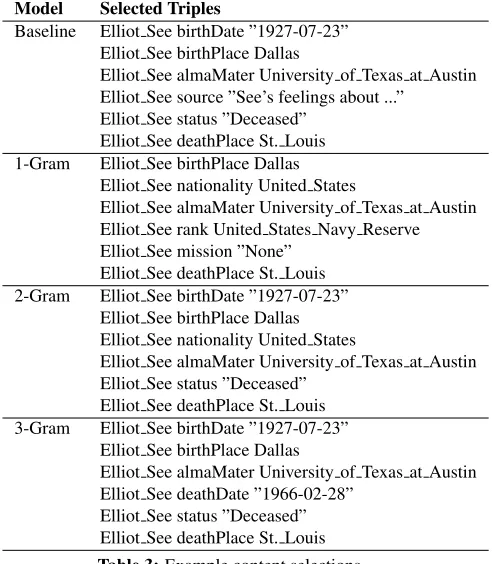
Model Selected Triples
Baseline Elliot See birthDate ”1927-07-23” Elliot See birthPlace Dallas
Elliot See almaMater University of Texas at Austin Elliot See source ”See’s feelings about ...”
Elliot See status ”Deceased” Elliot See deathPlace St. Louis 1-Gram Elliot See birthPlace Dallas
Elliot See nationality United States
Elliot See almaMater University of Texas at Austin Elliot See rank United States Navy Reserve Elliot See mission ”None”
Elliot See deathPlace St. Louis 2-Gram Elliot See birthDate ”1927-07-23”
Elliot See birthPlace Dallas Elliot See nationality United States
Elliot See almaMater University of Texas at Austin Elliot See status ”Deceased”
Elliot See deathPlace St. Louis 3-Gram Elliot See birthDate ”1927-07-23”
Elliot See birthPlace Dallas
Elliot See almaMater University of Texas at Austin Elliot See deathDate ”1966-02-28”
[image:3.612.312.558.74.356.2]Elliot See status ”Deceased” Elliot See deathPlace St. Louis Table 3:Example content selections
whereX is the set of words that occur in the so-lution (except the root node). This constraint makes sure that ifohas a child then it also has a head. The first part of Eq 3 counts the number of head proper-ties. The second part counts the children ofpwhich could be greater than 0. It is therefore normalised withX to make it less than 1. And then the differ-ence should be greater than 0.
Restricting the size of the resulting tree Solu-tions are constrained to containαtuples.
X
x
xps,o = α (4)
[image:3.612.80.301.645.730.2]3 Discussion
Table 3 shows content selections which illustrate the main differences between four models, a baseline model with uniform n-gram probability versus a un-igram, a bigram and a 3-gram model.
Dead Man’s Plack location England England capital London
England establishedEvent Acts of Union 1707 England religion Church of England
Dead Man’s Plack dedicatedTo Athelwald
Dead Man’s Plack monumentName ”Dead Man’s Plack” Dead Man’s Plack material Rock
Table 4:Output of Depth 2
“source” which are generic rather than specific to the type of entity being described.
The 1-gram model is similar to the baseline in that it often generates solutions which are simple enu-merations of facts belonging to various topics (birth place, nationality, place of study, rank in the army, space mission, death place). Contrary to the base-line solutions however, each selected fact is strongly characteristic of the entity type.
The 2- and 3-gram models tend to yield more co-herent solutions in that they often contain sets of topically related properties (e.g., birth date and birth place; death date and date place).
4 Conclusion
We have presented a method for content selection from DBPedia data which supports the selection of semantically varied content units of different sizes. While the approach yields good results, one short-coming is that most of the selected subtrees are trees of depth 1 and that moreover, trees of depth 2 have limited coherence. For instance, the 1-gram model generates the solution shown in Table 4 where the triples about England are not particularly relevant to the description of the Deam Man’s Plack’s monu-ment. More generally, bi- and 3-grams mostly seem to trigger the selection of 2- and 3-grams that are directly related to the target entity rather than chains of triples. We are currently investigating whether the use of interpolated models could help resolve this is-sue.
Another important point we are currently inves-tigating concerns the creation of a benchmark for Natural Language Generation. Most existing work on data-to-text generation rely on a parallel or com-parable data-to-text corpus.
To generate from the frames produced by a dialog system, (DeVault et al., 2008) describes an approach in which a probabilistic Tree Adjoining Grammar is
induced from a training set aligning frames and sen-tences and used to generate using a beam search that uses weighted features learned from the training data to rank alternative expansions at each step.
More recently, data-to-text generators (Angeli et al., 2010; Chen and Mooney, 2008; Wong and Mooney, 2007; Konstas and Lapata, 2012b; Kon-stas and Lapata, 2012a) were trained and developed on data-to-text corpora from various domains in-cluding the air travel domain (Dahl et al., 1994), weather forecasts (Liang et al., 2009; Belz, 2008) and sportscasting (Chen and Mooney, 2008).
Creating such data-to-text corpora is however dif-ficult, time consuming and non generic. Contrary to parsing where resources such as the Penn Tree-bank succeeded in boosting research, natural lan-guage generation still suffers from a lack of common reference on which to train and evaluate parsers. Us-ing crowdsourcUs-ing and the content selection method presented here, we plan to construct a large bench-mark on which data-to-text generators can be trained and tested.
5 Acknowledgments
We thank the French National Research Agency for funding the research presented in this paper in the context of the WebNLG project.
References
Gabor Angeli, Percy Liang, and Dan Klein. 2010. A simple domain-independent probabilistic approach to generation. InProceedings of the 2010 Conference on Empirical Methods in Natural Language Processing, pages 502–512. Association for Computational Lin-guistics.
Anja Belz. 2008. Automatic generation of weather forecast texts using comprehensive probabilis-tic generation-space models. Natural Language Engi-neering, 14(4):431–455.
David L Chen and Raymond J Mooney. 2008. Learning to sportscast: a test of grounded language acquisition. InProceedings of the 25th international conference on Machine learning, pages 128–135. ACM.
Human Language Technology, pages 43–48. Associa-tion for ComputaAssocia-tional Linguistics.
David DeVault, David Traum, and Ron Artstein. 2008. Making grammar-based generation easier to deploy in dialogue systems. In Proceedings of the 9th SIGdial Workshop on Discourse and Dialogue, pages 198–207. Association for Computational Linguistics.
Ioannis Konstas and Mirella Lapata. 2012a. Concept-to-text generation via discriminative reranking. In Pro-ceedings of the 50th Annual Meeting of the Association for Computational Linguistics: Long Papers-Volume 1, pages 369–378. Association for Computational Lin-guistics.
Ioannis Konstas and Mirella Lapata. 2012b. Unsu-pervised concept-to-text generation with hypergraphs. In Proceedings of the 2012 Conference of the North American Chapter of the Association for Computa-tional Linguistics: Human Language Technologies, pages 752–761. Association for Computational Lin-guistics.
Percy Liang, Michael I Jordan, and Dan Klein. 2009. Learning semantic correspondences with less supervi-sion. In Proceedings of the Joint Conference of the 47th Annual Meeting of the ACL and the 4th Interna-tional Joint Conference on Natural Language Process-ing of the AFNLP: Volume 1-Volume 1, pages 91–99. Association for Computational Linguistics.