Annotating genericity: a survey, a scheme, and a corpus
Annemarie Friedrich1 Alexis Palmer2
1Department of Computational Linguistics, Universit¨at des Saarlandes, Germany
{afried,melissap,pinkal}@coli.uni-saarland.de
2Institut f¨ur Maschinelle Sprachverarbeitung, Universit¨at Stuttgart, Germany
Melissa Peate Sørensen1 Manfred Pinkal1
Abstract
Genericsare linguistic expressions that make statements about or refer to kinds, or that re-port regularities of events. Non-generic ex-pressions make statements about particular in-dividuals or specific episodes. Generics are treated extensively in semantic theory (Krifka et al., 1995). In practice, it is often hard to de-cide whether a referring expression isgeneric
or non-generic, and to date there is no data set which is both large and satisfactorily an-notated. Such a data set would be valuable for creating automatic systems for identify-ing generic expressions, in turn facilitatidentify-ing knowledge extraction from natural language text. In this paper we provide the next steps for such an annotation endeavor. Our contri-butions are: (1) we survey the most impor-tant previous projects annotating genericity, focusing on resources for English; (2) with a new agreement study we identify problems in the annotation scheme of the largest currently-available resource (ACE-2005); and (3) we in-troduce a linguistically-motivated annotation scheme for marking both clauses and their subjects with regard to their genericity. (4) We present a corpus of MASC (Ide et al., 2010) and Wikipedia texts annotated according to our scheme, achieving substantial agreement.
1 Introduction
This paper addresses the question of distinguishing clauses or noun phrases (NPs) that convey informa-tion about particular entities or situainforma-tions, as in ex-ample (1a), from those which convey general infor-mation about kinds, see example (1b).
(1) (a) Simba is in danger. (non-generic) (b) Lions live for 10–14 years. (generic)
Making this distinction is important for NLP tasks that aim to disentangle information about particu-lar events or entities from general information about classes, kinds, or particular individuals, such as question answering or knowledge base population. Our present work targets the current lack of a large and satisfactorily-annotated data set for genericity, which is a prerequisite for research aiming to auto-matically identify these linguistic phenomena.
Krifka et al. (1995) report the central results in semantic theory ongenericity. Several phenomena have been studied within this research field: one is
reference to a kind, which is a NP-level property. The form of the NP itself (definite, indefinite, ...) is not sufficient to make this distinction (Carlson, 1977; Chierchia, 1998); the interpretation of the NP depends on the clause in which it appears, see (2).
(2) The lion is a predatory cat. (kind-referring) The lion escaped from the zoo. (non-generic) Characterizing sentences are another phe-nomenon studied under the heading of genericity. They may belexically characterizing, as in (3a) and (3b), orhabitualas in (3c) and (3d). Habitual sen-tences describe regularly occurring episodes rather than specific ones. Characterizing sentences as in (3) may relate to a kind (lions), or to a particular individual (John).
(3) (a) Lions have manes. (b) John is tall. (c) Lions eat meat. (d) John drives to work.
Statements about kinds, such as example (3a), are not rendered false by the existence of counter-examples. If we encountered a vegetarian lion, it would still be true that atypicallion eats meat. Such sentences have been analyzed as referring to a kind instead of a set of entities (Carlson, 1977), or as con-taining a ‘generic’ quantifier (Krifka et al., 1995). Similarly, habitual sentences such as (3d) are not rendered false by exceptions.
As the linguistic manifestations of both generic and non-generic clauses (and NPs) are quite diverse, automatic discrimination between generic and non-generic information is a highly-challenging task, and annotated resources are necessary for making progress. Existing corpora for genericity focus on different aspects of genericity or related phenomena. In this paper we provide a comprehensive sur-vey of existing resources for computational treat-ment of genericity (Section 2). Section 3 presents an agreement study for ACE-2005, the largest an-notation project regarding genericity of NPs to date, highlighting problems in their annotation scheme.
In Section 4, we introduce a linguistically moti-vated annotation scheme for marking genericity. We focus both on whether a clause makes a character-izing statement about a kind and whether its sub-ject refers to a kind, eliminating some of the uncer-tainties in some previously-proposed schemes. Our scheme does not address whether a clause is habit-ual or not, leaving this question to future work. We apply our scheme to several sections of the Man-ually Annotated SubCorpus (MASC) of the Open American National Corpus (Ide et al., 2010) and to Wikipedia texts, mostly reaching substantial agree-ment.
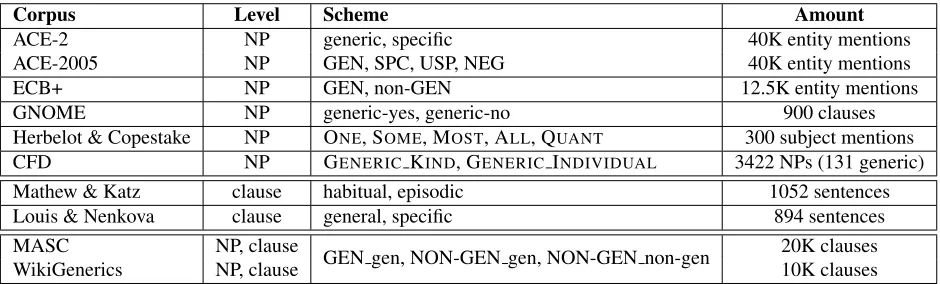
2 Survey: annotating genericity in English Existing resources treat both NP- (Section 2.1) and clause-level (Section 2.2) phenomena related to genericity. For each approach, we explain the anno-tation scheme, discuss its relation to theoretical con-cepts, and describe the data labeled. Table 1 gives a summary.
2.1 NP-level annotations
Section 2.1.1 describes corpora from the Automatic Content Extraction (ACE) program (Doddington et
al., 2004); other NP-level approaches are described in Section 2.1.2.
2.1.1 ACE entity class annotations
The research objective of the ACE program (1999-2008) was the detection and characterization of entities, relations and events in natural text (Lin-guistic Data Consortium, 2000). All entity mentions receive anentity classlabel indicating their generic-ity status. Of the corpora described here, the ACE corpora have been the most widely used for recent research on automatically identifying generic NPs (Reiter and Frank, 2010). The annotation guidelines developed over time; we describe both the initial guidelines of ACE-2 and those from ACE-2005.
The ACE-2 corpus (Mitchell et al., 2003) in-cludes 40106 annotated entity mentions in 520 newswire and broadcast documents. The annota-tion guidelines give no formal definiannota-tion of generic-ity; annotators are asked to determine whether each entity refers to “any member of the set in ques-tion” (generic) or rather “some particular, identi-fiable member of that set” (specific/non-generic).1 This leads to a mix of constructions being marked as generic: types of entities (Good students do all the reading), generalizations across a set of entities (Purple houses are really ugly), hypothetical enti-ties (If a person steps over the line,...) and negated mentions (I saw no one). Suggested attributes of entities are marked as generic (John seems to be a nice person), but a ‘positive assertion test’ leads to marking both NPs (Joeanda nice guy) as specific in examples like (Joe is a nice guy). Neither of these two cases (be a nice person / be a nice guy) is in fact an entity mention; they are rather predicative uses.
The guidelines for genericity were redefined for annotation of theACE-2005 Multilingual Training Corpus(Walker et al., 2006), which contains news, broadcast news, broadcast conversation, forum and weblog texts as well as transcribed conversational telephone speech. In contrast to 2, the ACE-2005 annotation manual2clearly defines mentions as kind-referring or not, using the labels GEN (generic)
1See “Entity Detection Tracking and Metonymy Annotation Guidelines, Version 2.5.1”, available from LDC:https:// catalog.ldc.upenn.edu/docs/LDC2003T11/
Corpus Level Scheme Amount
ACE-2 NP generic, specific 40K entity mentions
ACE-2005 NP GEN, SPC, USP, NEG 40K entity mentions
ECB+ NP GEN, non-GEN 12.5K entity mentions
GNOME NP generic-yes, generic-no 900 clauses
Herbelot & Copestake NP ONE, SOME, MOST, ALL, QUANT 300 subject mentions
CFD NP GENERIC KIND, GENERIC INDIVIDUAL 3422 NPs (131 generic) Mathew & Katz clause habitual, episodic 1052 sentences Louis & Nenkova clause general, specific 894 sentences MASC NP, clause GEN gen, NON-GEN gen, NON-GEN non-gen 20K clauses
[image:3.612.72.542.59.201.2]WikiGenerics NP, clause 10K clauses
Table 1:Survey of genericity-annotated corporafor English, including our new corpus.
and SPC (specific/non-generic) respectively. The new guidelines also introduce two additional entity class labels for non-attributive mentions. Neg-atively quantified entities that refer to the empty set of the kind mentioned (There are no confirmed suspects yet) receive the label NEG. The label USP (underspecified) is used for non-generic nonspe-cific reference, these cases include quantified NPs in modal, future, conditional, hypothetical, negated, uncertain or question contexts. USP also covers ‘truly ambiguous cases’ that have both generic and non-generic readings (The economic boom is pro-viding new opportunities for women in New Delhi), and cases where the author mentions an entity whose identity would be ‘difficult to locate’ (Officials re-ported ...). In our opinion, the latter interferes with the definition of SPC as marking cases where the entity referred to is a particular object in the real world, even if the author does not know its identity (At least four people were injured). The breadth of the USP category causes problems with consistency of application (see Section 3).
The ACE annotation scheme has also been ap-plied in theNewsreaderproject.3 The ECB+
cor-pus (Cybulska and Vossen, 2014) is an extension of EventCorefBank (ECB), a corpus of news arti-cles marked with event coreference information (Be-jan and Harabagiu, 2010). ECB+ annotates en-tity mentions according to ACE-2005, but collapses the three non-GEN labels into a single category. Roughly 12500 event participant mentions are an-notated, some doubly and some singly. Agreement statistics for genericity are not reported.
3www.newsreader-project.eu
2.1.2 Other corpora annotated at the NP-level
The resources surveyed here apply carefully-defined notions of genericity but are too small to be feasible machine learning training data.
The question of whether an NP is generic or not arises in the research context of coreference res-olution. Some approaches mark coreference only for non-generic mentions (Hovy et al., 2006; Hin-richs et al., 2004); others include generic mentions (Poesio, 2004), or take care not to mix coreference chains between generic and non-generic mentions (Bj¨orkenstam and Bystr¨om, 2012). Bj¨orkelund et al. (2014) mark genericity in a corpus of German with both coreference and information-status anno-tations. Nedoluzhko (2013) survey the treatment of genericity phenomena within coreference reso-lution research; they provide a complete overview. In short, they argue that a consistent definition of genericity is lacking and report on their annotation scheme for Czech as applied to the Prague Depen-dency TreeBank (B¨ohmov´a et al., 2003).
The GNOME corpus (Poesio, 2004) is a coref-erence corpus with genericity annotations; NPs are marked with the attributes generic-yes or
generic-no. Poesio et al. report that their an-notators found it hard to decide how to mark ref-erences to substances (A table made of wood) and quantified NPs. Similar to our experience, they found it helpful to have annotators first try to identify generic sentences, and then determine this attribute of the NP. They report an agreement of κ = 0.82
Coming from a formal semantic perspective, Herbelot and Copestake (2010) and Herbelot and Copestake (2011) describe an approach to treating
ambiguously quantified NPs. This annotation ef-fort aims to produce resources for the task of de-termining the extent to which the semantic proper-ties ascribed to a given NP in context apply to the members of that class. For example, the statement
Cats are mammals describes a property ofall cats, whereCats have four legsis true only for most cats. The scheme, which includes the labels ONE, SOME,
MOST, ALL and QUANT (for explicitly quantified
NPs), is applied to 300 subject-verb-object triples from sentences randomly extracted from Wikipedia. Annotators are shown the sentence and the triple. κ
ranges from 0.88 and 0.81 for QUANT and ONEto
values between 0.44 and 0.51 for the other classes. Bhatia et al. (2014b) present an annotation scheme for Communicative Functions of Defi-niteness, intended to cover the many semantic and pragmatic functions conveyed by choices regarding definiteness across languages of the world. The scheme has been applied to 3422 English NPs con-tained in texts from four genres. Their typol-ogy includes two categories relevant to our sur-vey: GENERIC KIND LEVEL applies to utterances
predicating over an entire class, like Dinosaurs are extinct. GENERIC INDIVIDUAL LEVEL is
for predications applying to the individual mem-bers of a class or kind, such as Cats have fur. Across 1202 annotated NPs for an inter-annotator agreement study, the two inter-annotators used the GENERIC INDIVIDUAL LEVEL label 45 times
and 30 times, respectively, with agreement in 29 cases. Neither used the GENERIC KIND LEVEL.
The entire corpus contains just 131 NPs labeled with GENERIC INDIVIDUAL LEVELand none with
GENERIC KIND LEVEL(Bhatia et al., 2014a).
The question of genericity has also been ad-dressed in cognitive science (Prasada, 2000). Gel-man and Tardif (1998) study the usage of generic NPs cross-linguistically for English and Chinese in child-directed speech. They annotate kind-referring NPs as generic. They report agreement as the frac-tion of items on which the annotators agreed at over 99%, but given that their data set has fewer than 1% generic NPs, this statistic does not allow us to esti-mate how well annotators agreed.
2.2 Clause-level annotations
The two resources described in this section are the only we know of which mark phenomena related to genericity on clauses of text.
Annotating habituality. Mathew and Katz (2009) conduct a study on automatically distinguish-inghabitualfromepisodicsentences. Habitual sen-tences are taken to be sensen-tences whose main verb is lexically dynamic, but which do not refer to particular events (see for example (3)), and may have generic or non-generic subjects. Their singly-annotated data set, from which they excluded verb types with skewed class distributions, comprises 1052 examples covering 57 verb stems. Their data set is not publicly available.
General vs. specific sentences. Louis and Nenkova (2011) describe a method for automatic classification of sentences as general or specific.
General sentences are loosely defined as those which make “broad statements about a topic,” while
specific sentences convey more detailed informa-tion. This distinction is not immediately related to the phenomena treated as generics in the literature. Kind-referring subjects can occur in both general
(4a) andspecific (4b) sentences; generalsentences can also have non-kind-referring subjects (4c).
(4) (a) Climatologists and policy makers, ..., need to ponder such complexities... (general) (b) Solid silicon compounds are already
famil-iar – as rocks, glass, ... (specific)
(c) A handful of serious attempts have been made to eliminate ... diseases. (general)
3 ACE-2005: an agreement study
Intuitions about NP genericity are most reliable for subject position as other argument positions in-volve additional difficulties (Link, 1995). To get a better sense of the difficulty of annotating subjects compared to that for other argument positions, we compute agreement over mentions whose (manually marked) head is the grammatical subject of some other node in a dependency graph (including any de-pendency type containingsubj). We obtain depen-dency graphs using the Stanford parser (Klein and Manning, 2002).
An additional complication in entity mention an-notation is determining the mention span. Because spans are not pre-marked in the ACE corpora but identified independently by each annotator, we com-puteκonly over all exactly-matching entity mention spans for the two annotators. For all mentions, anno-tators mark about 90% of spans marked by the other annotator. For subject mentions, this number is even higher, at about 95%. The spans of the remaining mentions overlap for the two annotators. We exclude them from this study as we cannot be sure that the two mention spans refer to the same entity.
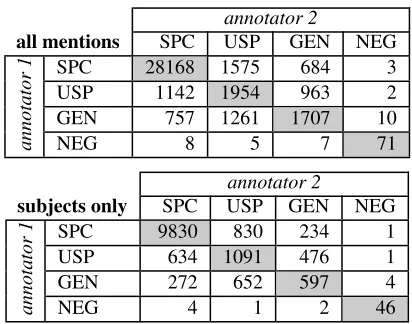
Discussion. Table 2 shows the confusion matrices of labels for the all-mentions-case and the subjects-only case. In both cases, confusion between SPC and GEN is acceptable, but confusion between USP and both SPC and GEN is rather high. For example, in the case of subjects, annotator 1 tags 652 men-tions as GEN that annotator 2 marks USP, but the two of them only agree on 597 mentions to be GEN. Although it may be useful to create a separate cat-egory for unclear or underspecified cases, the defi-nition of USP is not yet clear-cut and compounded with lack ofspecificity, which refers to whether the speaker presumably knows the referent’s identity or not. Even if the identity of a referent may be ‘diffi-cult to locate’ (as inOfficials reported...). The clause certainly does not make a statement about thekind
‘official’; instead, it expresses an existential state-ment (There are officials who reported...). The def-inition of SPC states that the reader does not neces-sarily have to know the identity of the entity, possi-bly making the distinction hard for annotators.
Another difficult case are noun modifiers in com-pounds (e.g. a subway system); these are marked as GEN in the corpus. Using the automatic parses,
annotator 2
all mentions SPC USP GEN NEG
SPC 28168 1575 684 3
annotator
1
USP 1142 1954 963 2
GEN 757 1261 1707 10
NEG 8 5 7 71
annotator 2
subjects only SPC USP GEN NEG
SPC 9830 830 234 1
annotator
1
USP 634 1091 476 1
GEN 272 652 597 4
[image:5.612.323.529.57.219.2]NEG 4 1 2 46
Table 2:Confusion matricesof entity class tags for ACE 2005 for mentions where annotators agree on spans.
we find that 9.5% of all mentions marked GEN in the adjudicated corpus are one-token mentions mod-ifying another noun via annndependency relation. Genericity as reference to kinds is a discourse phe-nomenon and thus defined as an attribute of refer-ring expressions. Because nominal modifiers do
notintroduce discourse referents, they should not be treated on the genericity annotation layer.
The data shows moderate agreement for the first two passes of entity class annotation (κ = 0.53for all mentions and κ = 0.50 for subject mentions). Note thatκscores are not directly comparable across different annotation projects (see also Section 5), we give the above scores for the sake of completeness. Observed and expected agreement are 0.83 and 0.65 for the all-mentions case and 0.79 and 0.58 for sub-ject mentions. This indicates that the all-mentions case may contain some trivial cases, one of which is the case of nominal modifiers described above.
In summary, the ACE scheme problematically fails to treat subject NPs differently from NPs in other syntactic positions, and ‘fuzzy’ points in the guidelines, particularly concerning the USP label, contribute to disagreements between annotators.
4 Annotating genericity as reference to kinds on NP- and clause-level
port on a particular event or state, or do they re-port on some regularity? These different types of clauses have different entailment properties, and dif-fer in how they contribute to the temporal structure of the discourse. In this work, we focus on separat-ing generic clauses from other types of clauses. We approach the problem from a linguistic perspective rather than focusing on any particular content ex-traction task, arguing that any generally applicable annotation scheme must be based on solid theoreti-cal foundations. We believe our annotation scheme is a step toward solving the problems of marking genericity in natural text. We apply our annotation scheme to two text corpora4, reaching substantial agreement on Wikipedia texts.
4.1 Annotation scheme
The definition of our annotation scheme is guided by the following questions: (a) does a clause’s subject refer to a kind rather than a particular individual; (b) if so, does the clause make a characterizing state-ment about the kind or its members, or does it report a particular episode related to the kind?
Task NP: genericity of subject. In this step, an-notators decide whether the subject of the clause refers to a kind (generic) or to a particular individ-ual (non-generic) as in (5d). In English, definite singular NPs (5a) or bare plural NPs (5b) can refer-ence kinds. Indefinite singular NPs (5c) can refer to arbitrary members of a kind; these are also marked
generic.
(5) (a) The lion is a predatory cat. (generic) (b) Lions have manes. (generic)
(c) A lion may eat up to 30kg in one sitting. (generic)
(d) Simba the lion flees into exile. (non-generic)
The labelnon-genericalso includes cases of non-specific reference if the reader can infer that the clause makes a statement about some particular in-dividual (or group of inin-dividuals), even if the iden-tity is unknown, as (6a). This is precisely where the ACE guidelines are somewhat unclear, mixing annotation of genericity and specificity. We aim to
4The annotated corpora are freely available from http://sitent.coli.uni-saarland.de
convey and mark this difference clearly. In (6b), the determiner ‘some’ could be added without changing the meaning significantly, showing that the bare plu-ral here is existential, not generic (Carlson, 1977).
(6) (a) A lion must have eaten the rabbit. ( non-specific,non-generic)
(b) Lions are in this cage. (non-generic) (c) Dinosaurs are extinct. (generic)
Task Cl: genericity of clause. We definegeneric
clauses as making characterizing statements about kinds. This includes both clauses predicating some-thing directly of the ‘kind individual’ itself (6c) and clauses that predicate something of the members of a kind, such as (5b) and (5c). According to our defi-nition,genericsentences may be lexically character-izing, as in (5a) or (5b), or they may describe some-thing that members of the kind do regularly, as in (5c). The latter type of sentences are called habitu-als. The subject of agenericclause must necessarily begeneric. In addition, episodic events, classified as
non-genericclauses, can have agenericNP as their subject, as in example (7). Note that we mark any clause about particular individuals asnon-generic, including habituals making a statement about par-ticular individuals (8). The question of whether a clause with anon-genericsubject is habitual or not is another interesting related question, but for the moment, we leave this to future work and concen-trate on the distinction of whether a clause relates to kinds.
(7) In September 2013 the blobfish was voted the “World’s Ugliest Animal”. (generic subject,
non-genericclause)
(8) John cycles to work. (non-generic)
Task Cl+NP. Using the information from Tasks NP and Cl, we automatically derive a combination label from the following set for eachclause:
• GEN gen: agenericclause, subject isgeneric
by definition;
• NON-GEN non-gen: a non-generic clause with anon-genericsubject;
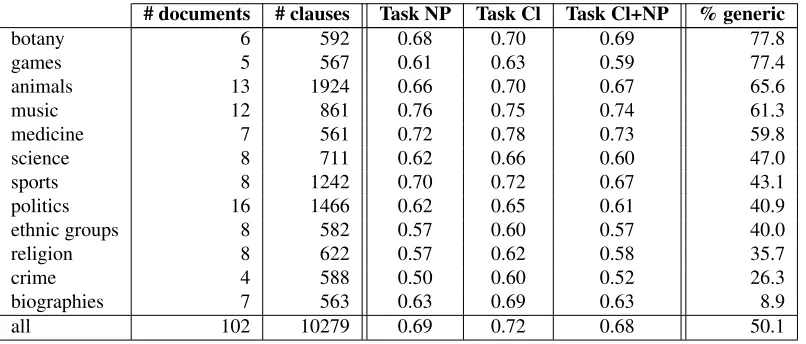
# documents # clauses Task NP Task Cl Task Cl+NP % generic
botany 6 592 0.68 0.70 0.69 77.8
games 5 567 0.61 0.63 0.59 77.4
animals 13 1924 0.66 0.70 0.67 65.6
music 12 861 0.76 0.75 0.74 61.3
medicine 7 561 0.72 0.78 0.73 59.8
science 8 711 0.62 0.66 0.60 47.0
sports 8 1242 0.70 0.72 0.67 43.1
politics 16 1466 0.62 0.65 0.61 40.9
ethnic groups 8 582 0.57 0.60 0.57 40.0
religion 8 622 0.57 0.62 0.58 35.7
crime 4 588 0.50 0.60 0.52 26.3
biographies 7 563 0.63 0.69 0.63 8.9
[image:7.612.107.510.59.231.2]all 102 10279 0.69 0.72 0.68 50.1
Table 3:IAA on WikiGenerics.Fleiss’κfor three annotators that marked the entire data set. % generic = percentage of clauses marked as generic in Task Cl according to the majority vote gold standard.
4.2 Corpus data: MASC/WikiGenerics
We apply the annotation scheme explained above to two corpora comprising texts of a wide range of gen-res and domains. We annotate several sections of the Manually Annotated SubCorpus (MASC) of the Open American National Corpus (Ide et al., 2010). In addition, we collect 102 texts from Wikipedia (WikiGenericscorpus) from a variety of categories (see Table 3). Our aim is to create a corpus that is balanced in the sense that it contains many generic and non-generic sentences, and also many different varieties of generic sentences. The corpus contains (among others) sentences about animals (9a), rule-like knowledge about sports and games (9b), and clauses describing abstract concepts (9c).
(9) (a) Blobfish are typically shorter than 30 cm. (b) The offensive team must line up in a legal
formation before they can snap the ball. (c) A dictatorship is a type of authoritarianism.
Note that we mark complete texts: the genericity of some sentences clearly depends on their context. For example, (9b) isgenericas the text describes the rules of a game rather than a specific instance of the game.
We use the discourse parser SPADE (Soricut and Marcu, 2003) to segment the first 70 sentences of each Wikipedia article into clauses, which are the basis for annotation. Subjects are not pre-marked and do not necessarily have to have their mention spans in the same segment, as illustrated in (10).
(10) (a) Blobfish look funny (GEN gen) (b) and were voted the most ugly animal.
(NON-GEN gen)
Annotators were allowed to skip clauses that do not contain a finite verb, which constitute about 5% of all pre-marked clauses. These clauses are mostly headlines consisting only of an NP.
4.3 Inter-annotator agreement
Our aim is to create a gold standard via majority vot-ing. Annotators were given a written manual and a short training on documents not included in the corpus. The WikiGenerics corpus was marked com-pletely by three paid annotators (students of compu-tational linguistics), and agreement is given in Ta-ble 3 in terms of Fleiss’κ (Fleiss, 1971). We ob-serve substantial agreement in almost all categories, and moderate agreement in only three categories: games, ethnic groups and organized crime. The cat-egories ethnic groups and organized crime were es-pecially hard to annotate because they contain many cases where it is not clear whether a mention refers to a very large particular group or whether this group rather counts as reference to a kind, as in (11).
(11) The Bari also known as the Karo ethnic groups in South Sudan occupy the Savanna lands of the White Nile Valley.
section # clauses Task NP (subject) Task Cl (clause) Task Cl+NP (clause) % generics
essays‡ 1590 0.55 0.56 0.54 27.9
travel† 1922 0.38 0.45 0.41 19.0
letters† 1944 0.33 0.41 0.40 14.2
journal† 1927 0.42 0.52 0.48 13.0
jokes† 3376 0.56 0.63 0.58 11.6
blog† 2723 0.09 0.13 0.14 10.4
news‡ 2557 0.25 0.33 0.29 3.4
fiction†* 4124 0.50 0.59 0.54 2.5
Table 4:IAA for MASC. The sections were marked by different pairings of annotators:†Cohen’sκfor 2 annotators; ‡Fleiss’κfor 3 annotators. *fiction: agreement for 70% of data that was marked by the same two annotators. % generic = percentage of clauses marked as generic in Task Cl according to the majority vote gold standard.
clauses on which the two annotators of the first step disagreed, without seeing the annotations of the first step. Hence, this does not constitute an adjudication step. Two sections, essays and news, were marked completely by three annotators. Five paid annota-tors, all students of computational linguistics, par-ticipated in the annotation of MASC. The various MASC sections show a larger variation both in the percentage of generic clauses and in the agreement numbers. News and fiction contain almost no gener-ics, while essays, travel, and letters contain notable numbers. Agreement on the blog section is surpris-ingly low. One annotator rarely used the category
generichere, while the other annotator did. Manual inspection showed that this section contains many intrinsically ambigous instances of ‘you’ and ‘one’. The third annotator agrees well with the annotator who marked more clauses as generic.
Discussion. In general,κ numbers are difficult to compare, as the expected agreement depends on the distribution of labels (Di Eugenio and Glass, 2004). If the distribution is skewed, the expected agreement is high and it is thus harder to reach a highκscore. We give the percentage of clauses labeled as generic in Task Cl. A small percentage but a relatively high
κ score (as in the jokes section) means that in this category, it was apparently easier for the annotators to agree. For example, in the fiction genre, there are very few generics, but a high agreement was reached nonetheless. In the narratives of this subcorpus, the generics apparently ‘stand out’ clearly.
In this study, substantial agreement was reached on Wikipedia texts using our annotation scheme. The lower agreement reached on some MASC
sec-tions indicates that the annotation task is harder for some text types, and this difficulty is only partially explained by the skewedness of the label distribu-tion: some genres simply contain more borderline cases than others.
5 Discussion and future work
We have proposed an annotation scheme for labeling clauses with regard to whether they make a charac-terizing statement about kinds, and NPs with regard to whether they refer to kinds or not. Our scheme aims at a linguistically motivated annotation in order to advance our understanding of generics and to see to what extent existing linguistic theories can be ap-plied to natural text of various genres and domains.
Across all of the surveyed annotation studies and also in our own experience, agreement on the task of annotating genericity was moderate to substantial, however,κ-scores need to be interpreted in relation to the distribution of labels and are not directly com-parable across different annotation projects. An-notating genericity is not an easy task even for trained annotators, as there are many borderline cases, which occur frequently in some texts and very infrequently in others. As future work, we want to investigate whether it is possible to reliably label such ‘underspecified’ cases, redefining ACE’s USP class in a way that disentangles the annotation of genericity and specificity.
Acknowledgments. We thank Andrea Horbach for helpful comments, and our annotators Fernando Ardente, Christine Bocionek, Ambika Kirkland, Ruth K¨uhn and Kleo Mavridou. This research was supported in part by the MMCI Cluster of Excel-lence, and the first author is supported by an IBM PhD Fellowship.
References
Cosmin Adrian Bejan and Sanda Harabagiu. 2010. Un-supervised event coreference resolution with rich lin-guistic features. InProceedings of ACL.
Archna Bhatia, Chu-Cheng Lin, Nathan Schneider, Yu-lia Tsvetkov, Fatima Talib Al-Raisi, Laleh Roostapour, Jordan Bender, Abhimanu Kumar, Lori Levin, Mandy Simons, et al. 2014a. Automatic classification of communicative functions of definiteness. Proceedings of COLING, pages 1059–1070.
Archna Bhatia, Mandy Simons, Lori Levin, Yulia Tsvetkov, Chris Dyer, and Jordan Bender. 2014b. A unified annotation scheme for the semantic/pragmatic components of definiteness. InProceedings of LREC. Anders Bj¨orkelund, Kerstin Eckart, Arndt Riester, Nadja Schauffler, and Katrin Schweitzer. 2014. The ex-tended DIRNDL corpus as a resource for coreference and bridging resolution. InProceedings of the Ninth International Conference on Language Resources and Evaluation (LREC’14).
Kristina Nilsson Bj¨orkenstam and Emil Bystr¨om. 2012. SUC-CORE: SUC 2.0 Annotated with NP Corefer-ence. Proceedings of SLTC.
Alena B¨ohmov´a, Jan Hajiˇc, Eva Hajiˇcov´a, and Barbora Hladk´a. 2003. The prague dependency treebank. In
Treebanks, pages 103–127. Springer.
Gregory Norman Carlson. 1977. Reference to kinds in English. Ph.D. thesis.
Gennaro Chierchia. 1998. Reference to kinds across lan-guage. Natural language semantics, 6(4):339–405. Jacob Cohen. 1960. A coefficient of agreement for
nom-inal scales. Educational and Psychological Measure-ment, pages 37–46.
Agata Cybulska and Piek Vossen. 2014. Using a sledge-hammer to crack a nut? lexical diversity and event coreference resolution. InProceedings of LREC. Barbara Di Eugenio and Michael Glass. 2004. The kappa
statistic: A second look. Computational Linguistics, 30(1):95–101.
George R Doddington, Alexis Mitchell, Mark A Przy-bocki, Lance A Ramshaw, Stephanie Strassel, and Ralph M Weischedel. 2004. The Automatic Content Extraction (ACE) Program-Tasks, Data, and Evalua-tion. InProceedings of LREC.
Joseph L Fleiss. 1971. Measuring nominal scale agree-ment among many raters. Psychological Bulletin, 76(5):378.
Annemarie Friedrich and Alexis Palmer. 2014. Situation entity annotation. InProceedings of the 8th Linguistic Annotation Workshop (LAW VIII), page 149.
Susan A Gelman and Twila Tardif. 1998. A cross-linguistic comparison of generic noun phrases in En-glish and Mandarin.Cognition, 66(3):215–248. Aurelie Herbelot and Ann Copestake. 2010.
Annotat-ing underquantification. InProceedings of the Fourth Linguistic Annotation Workshop.
Aurelie Herbelot and Ann Copestake. 2011. Formal-ising and specifying underquantification. In Proceed-ings of the International Conference on Computational Semantics.
Erhard Hinrichs, Sandra K¨ubler, Karin Naumann, Heike Telljohann, and Julia Trushkina. 2004. Recent de-velopments in linguistic annotations of the T¨uBa-D/Z treebank. In Proceedings of the Third Workshop on Treebanks and Linguistic Theories, pages 51–62. Eduard Hovy, Mitchell Marcus, Martha Palmer, Lance
Ramshaw, and Ralph Weischedel. 2006. Ontonotes: the 90% solution. In Proceedings of HLT-NAACL: Short Papers, pages 57–60.
Nancy Ide, Christiane Fellbaum, Collin Baker, and Re-becca Passonneau. 2010. The manually annotated sub-corpus: A community resource for and by the peo-ple. InProceedings of ACL: Short papers, pages 68– 73.
Dan Klein and Christopher D Manning. 2002. Fast exact inference with a factored model for natural language parsing. InAdvances in neural information processing systems, pages 3–10.
Manfred Krifka, Francis Jeffrey Pelletier, Gregory N. Carlson, Alice ter Meulen, Godehard Link, and Gen-naro Chierchia. 1995. Genericity: An Introduction.
The Generic Book, pages 1–124.
Linguistic Data Consortium. 2000. Entity Detection and Tracking - Phase 1, ACE Pilot Study Task Defini-tion. https://www.ldc.upenn.edu/collaborations/past-projects/ace/annotation-tasks-and-specifications. Godehard Link. 1995. Generic information and
depen-dent generics. The Generic Book, pages 358–382. Annie Louis and Ani Nenkova. 2011. Automatic
identi-fication of general and specific sentences by leveraging discourse annotations. InProceedings of IJCNLP. Thomas A. Mathew and E. Graham Katz. 2009.
Alexis Mitchell, Stephanie Strassel, Mark Przybocki, JK Davis, George Doddington, Ralph Grishman, Adam Meyers, Ada Brunstein, Lisa Ferro, and Beth Sundheim. 2003. ACE-2 Version 1.0 LDC2003T11. Philadelphia: Linguistic Data Consortium.
Anna Nedoluzhko. 2013. Generic noun phrases and an-notation of coreference and bridging relations in the Prague Dependency Treebank. InProceedings of the 7th Linguistic Annotation Workshop and Interoper-ability with Discourse, pages 103–111.
Massimo Poesio. 2004. Discourse annotation and se-mantic annotation in the GNOME corpus. In Proceed-ings of the ACL Workshop on Discourse Annotation, pages 72–79. Association for Computational Linguis-tics.
Sandeep Prasada. 2000. Acquiring generic knowledge.
Trends in cognitive sciences, 4(2):66–72.
Nils Reiter and Anette Frank. 2010. Identifying generic noun phrases. In Proceedings of ACL, pages 40–49, Uppsala, Sweden.
Radu Soricut and Daniel Marcu. 2003. Sentence level discourse parsing using syntactic and lexical informa-tion. InProceedings of NAACL-HLT, pages 149–156. Christopher Walker, Stephanie Strassel, Julie Medero,