Event Extraction from Trimmed Dependency Graphs
Ekaterina Buyko, Erik Faessler, Joachim Wermter and Udo Hahn
Jena University Language & Information Engineering (JULIE) Lab Friedrich-Schiller-Universit¨at Jena
F¨urstengraben 30, 07743 Jena, Germany
{ekaterina.buyko|erik.faessler|joachim.wermter|udo.hahn}@uni-jena.de
Abstract
We describe the approach to event extrac-tion which the JULIELab Team from FSU Jena (Germany) pursued to solve Task 1 in the “BioNLP’09 Shared Task on Event Ex-traction”. We incorporate manually curated dictionaries and machine learning method-ologies to sort out associated event triggers and arguments on trimmed dependency graph structures. Trimming combines pruning ir-relevant lexical material from a dependency graph and decorating particularly relevant lex-ical material from that graph with more ab-stract conceptual class information. Given that methodological framework, the JULIELab Team scored on 2nd rank among 24 competing teams, with 45.8% precision, 47.5% recall and 46.7% F1-score on all 3,182 events.
1 Introduction
Semantic forms of text analytics for the life sciences have long been equivalent with named entity recog-nition and interpretation, i.e., finding instances of se-mantic classes such as proteins, diseases, or drugs. For a couple of years, this focus has been comple-mented by analytics dealing with relation extraction, i.e., finding instances of relations which link one or more (usually two) arguments, the latter being in-stances of semantic classes, such as the interaction between two proteins (PPIs).
PPI extraction is a complex task since cascades of molecular events are involved which are hard to sort out. Many different approaches have already been tried – pattern-based ones (e.g., by Blaschke
et al. (1999), Hakenberg et al. (2005) or Huang et al. (2004)), rule-based ones (e.g., by Yakushiji et al. (2001), ˇSari´c et al. (2004) or Fundel et al. (2007)), and machine learning-based ones (e.g., by Katrenko and Adriaans (2006), Sætre et al. (2007) or Airola et al. (2008)), yet without conclusive results.
In the following, we present our approach to solve Task 1 within the “BioNLP’09 Shared Task on Event Extraction”.1 Task 1 “Event detection and charac-terization” required to determine the intended rela-tion given a priori supplied protein annotarela-tions. Our approach considers dependency graphs as the cen-tral data structure on which various trimming oper-ations are performed involving syntactic simplifica-tion but also, even more important, semantic enrich-ment by conceptual overlays. A description of the component subtasks is provided in Section 2, while the methodologies intended to solve each subtask are discussed in Section 3. The system pipeline for event extraction reflecting the task decomposition is described in Section 4, while Section 5 provides the evaluation results for our approach.
2 Event Extraction Task
Event extraction is a complex task that can be sub-divided into a number of subtasks depending on whether the focus is on the event itself or on the ar-guments involved:
Event trigger identification deals with the large
variety of alternative verbalizations of the same event type, i.e., whether the event is expressed in
1http://www-tsujii.is.s.u-tokyo.ac.jp/
GENIA/SharedTask/
a verbal or in a nominalized form (e.g., “A is
ex-pressed” and “the expression of A” both refer to the
same event type, viz. expression(A)). Since the same trigger may stand for more than one event type, event trigger ambiguity has to be resolved as well.
Event trigger disambiguation selects the correct
event name from the set of alternative event triggers.
Event typing, finally, deals with the semantic
classification of a disambiguated event name and the assignment to an event type category.2
Argument identification is concerned with
find-ing all necessary participants in an event, i.e., the arguments of the relation.
Argument typing assigns the correct semantic
category (entity class) to each of the determined par-ticipants in an event (which can be considered as in-stances of that class).
Argument ordering assigns each identified
par-ticipant its functional role within the event, mostly Agent (and Patient/Theme).
The sentence “Regulation of jun and fos gene ex-pression in human monocytes by the macrophage colony-stimulating factor”, e.g., contains mentions
of two Gene Expression events with respective THEMEarguments “jun” and “fos”, triggered in the text by the literal phrase “gene expression”.
Task 1 of the “BioNLP’09 Shared Task on Event Extraction” was defined in such a way as to iden-tify a proper relation (event) name and link it with its type, plus one or more associated arguments de-noting proteins. To focus on relation extraction only no automatic named entity recognition and interpre-tation had to be performed (subtask ‘argument typ-ing’ from above); instead candidate proteins were already pre-tagged. The complexity of Task 1 was raised by the condition that not only proteins were allowed to be arguments but also were events.
3 Event Extraction Solution
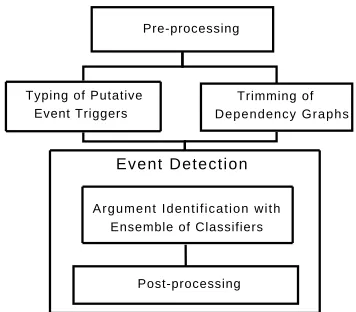
Our event extraction approach is summarized in Fig-ure 1 and consists of three major streams – first, the detection of lexicalized event triggers (cf. Section 3.1), second, the trimming of dependency graphs which involves pruning irrelevant and semantically enriching relevant lexical material (cf. Section 3.2),
2In our approach, event trigger disambiguation already
im-plies event typing.
Pre-processing
Argument Identification with Ensemble of Classifiers
Event Detection
Post-processing
Trimming of Dependency Graphs Typing of Putative
[image:2.612.337.515.58.214.2]Event Triggers
Figure 1: General Architecture of the Event Extraction Solution of the JULIELab Team.
and, third, the identification of arguments for the event under scrutiny (cf. Section 3.3). Event typ-ing results from proper event trigger identification (see Section 3.1.2), which is interlinked with the out-come of the argument identification. We talk about
putative triggers because we consider, in a greedy
manner, all relevant lexical items (see Section 3.1.1) as potential event triggers which might represent an event. Only those event triggers that can eventually be connected to arguments, finally, represent a true event. To achieve this goal we preprocessed both the original training and test data such that we enrich the original training data with automatically predicted event triggers in order to generate more negative ex-amples for a more effective learning of true events.3
3.1 Event Trigger Identification
Looking at the wide variety of potential lexicalized triggers for an event, their lacking discriminative power relative to individual event types and their inherent potential for ambiguity,4 we decided on a dictionary-based approach whose curation princi-ples are described in Section 3.1.1. Our disambigua-tion policy for the ambiguous lexicalized event
trig-3
Although the training data contains cross-sentence event descriptions, our approach to event extraction is restricted to the sentence level only.
4
gers assembled in this suite of dictionaries, one per event type, is discussed in Section 3.1.2.
3.1.1 Manual Curation of the Dictionaries
We started collecting our dictionaries from the original GENIA event corpus (Kim et al., 2008a). The extracted event triggers were then automatically lemmatized5and the resulting lemmata were subse-quently ranked by two students of biology according to their predictive power to act as a trigger for a par-ticular event type. This expert assessment led us to four trigger groups (for each event type these groups were determined separately):
(1) Triggers are important and discriminative for a specific event type. This group contains event trig-gers such as “upregulate” for Positive regulation.
(2) Triggers are important though not fully
dis-criminative for a particular event type; yet, this
defi-ciency can be overcome by other lexical cues within the context of the same sentence. This group with in-context disambiguators contains lexical items such as “proteolyse” for Protein catabolism.
(3) Triggers are non-discriminative for an event type and even cannot be disambiguated by linguistic cues within the context of the same sentence. This group contains lexical items such as “presence” for
Localization and Gene expression.
(4) Triggers are absolutely non-discriminative for an event. This group holds general lexical triggers such as “observe”, “demonstrate” or “function”.
The final dictionaries used for the detection of putative event triggers are a union of the first two groups. They were further extended by biologists with additional lexical material of the first group. The dictionaries thus became event type-specific – they contain all morphological forms of the original lemma, which were automatically generated using the Specialist NLP Tools (2008 release).
We matched the entries from the final set of dic-tionaries with the shared task data using the Ling-pipe Dictionary Chunker.6 After the matching pro-cess, some cleansing had to be done.7
5
We used the lemmatizer from the Specialist NLP Tools (http://lexsrv3.nlm.nih.gov/SPECIALIST/ index.html, 2008 release).
6http://alias-i.com/lingpipe/
7Event triggers were removed which (1) were found within
sentences without any protein annotations, (2) occurred within
3.1.2 Event Trigger Disambiguation
Preliminary experiments indicated that the dis-ambiguation of event triggers might be beneficial for the overall event extraction results since events tend to be expressed via highly ambiguous triggers. Therefore, we performed a disambiguation step pre-ceding the extraction of any argument structures.
It is based on the importance of an event trig-ger ti for a particular event type T as defined by
Imp(tT i ) :=
f(tT i) P
if(tTi), where
f(tT
i )is the frequency
of the event triggerti of the selected event typeT
in a training corpus divided by the total amount of all event triggers of the selected event type T in that training corpus. The frequencies are measured on stemmed event triggers. For example, Imp for the trigger stem “depend” amounts to 0.013 for the event type Positive regulation, while for the event type Regulation it yields 0.036 . If a text span con-tains several event triggers with the same span off-set, the event trigger withmax(Imp)is selected and other putative triggers are discarded. The trigger stem “depend” remains thus only for Regulation.
3.2 Trimming Dependency Graphs
When we consider event (relation) extraction as a se-mantic interpretation task, plain dependency graphs as they result from deep syntactic parsing might not be appropriate to directly extract semantic informa-tion from. This is due to two reasons - they contain a lot of apparently irrelevant lexical nodes (from the semantic perspective of event extraction) and they also contain much too specific lexical nodes that might better be grouped and further enriched se-mantically. Trimming dependency graphs for the purposes of event extraction, therefore, amounts to eliminate semantically irrelevant and to semantically enrich relevant lexical nodes (i.e., overlay with con-cepts). This way, we influence the final representa-tion for the machine learners we employ (in terms of features or kernel-based representations) — we may avoid an overfitting of the feature or kernel spaces with syntactic and lexical data and thus reduce struc-tural information in a linguistically motivated way.
3.2.1 Syntactic Pruning
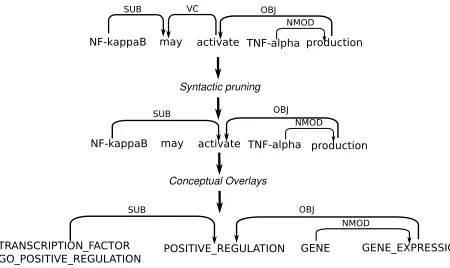
[image:4.612.73.298.293.427.2]Pruning targets auxiliary and modal verbs which govern the main verb in syntactic structures such as passives, past or future tense. We delete the aux-iliars/modals as govenors of the main verbs from the dependency graph and propagate the semantics-preserving dependency relations of these nodes di-rectly to the main verbs. Adhering to the depen-dency tree format and labeling conventions set up for the 2006 and 2007 CONLL shared tasks on de-pendency parsing main verbs are usually connected with the auxiliar by the VC dependency relation (see Figure 2). Accordingly, in our example, the verb “activate” is promoted to the ROOT in the depen-dency graph and governs all nodes that were origi-nally governed by the modal “may”.
Figure 2: Trimming of Dependency Graphs.
3.2.2 Conceptual Decoration
Lexical nodes in the (possibly pruned) depen-dency graphs deemed to be important for argument extraction were then enriched with semantic class annotations, instead of keeping the original lexical (stem) representation (see Figure 2). The rationale behind this decision was to generate more powerful kernel-based or features representations (see Section 3.3.2 and 3.3.1).
The whole process is based on a three-tier task-specific semantic hierarchy of named entity classes. The top rank is constituted by the equivalent classes
Transcription factor, Binding site, and Promoter.
The second rank is occupied by MESH terms, and the third tier assembles the named entity classes
Gene and Protein. Whenever a lexical item is
cat-egorized by one of these categories, the associated
node in the dependency graph is overlaid with that category applying the ranking in cases of conflicts.
We also enriched the gene name mentions with their respective Gene Ontology Annotations from GOA.8 For this purpose, we first categorized GO terms both from the “molecular function” and from the “biological process” branch with respect to their matching event type, e.g., Phosphorylation or Positive regulation. We then mapped all gene name mentions which occurred in the text to their UNIPROTidentifier using the gene name normalizer GENO(Wermter et al., 2009). This identifier links a gene with a set of (curated) GO annotations.
In addition, we inserted semantic information in terms of the event trigger type and the experimen-tal methods. As far as experimenexperimen-tal methods are concerned, we extracted all instances of them an-notated in the GENIA event corpus. One student of biology sorted the experimental methods relative to the event categories under scrutiny. For example “affinity chromatography” was assigned both to the
Gene expression and to the Binding category. For
our purposes, we only included those GO annota-tions and experimental methods which matched the event types to be identified in a sentence.
3.3 Argument Identification and Ordering
The argument identification task can be subdivided into three complexity levels. Level (1) incorpo-rates five event types (Gene expression,
Transcrip-tion, Protein catabolism, LocalizaTranscrip-tion, Phosphory-lation) which involve a single participant with a
THEMErole only. Level (2) is concerned with one
event type (Binding) that provides an n-ary argument structure where all arguments occupy the THEME(n) role. Level (3) comprises three event types
(Posi-tive regulation, Nega(Posi-tive regulation, or an
unspeci-fied Regulation) that represent a regulatory relation between the above-mentioned event classes or pro-teins. These events have usually a binary structure, with a THEMEargument and a CAUSEargument.
For argument extraction, we built sentence-wise pairs of putative triggers and their putative argu-ment(s), the latter involving ontological informa-tion about the event type. For Level (1), we built pairs only with proteins, while for Level (3) we
al-8
lowed all events as possible arguments. For Level (2), Binding events, we generated binary (trigger, protein) pairs as well as triples (trigger, protein1,
protein2) to adequately represent the binding
be-tween two proteins.9 Pairs of mentions not con-nected by a dependency path could not be detected. For the argument extraction we chose two ma-chine learning-based approaches, feature-based and a kernel-based one, as described below.10
3.3.1 Feature-based Classifier
We distinguished three groups of features. First,
lexical features (covering lexical items before,
af-ter and between both mentions (of the event trigger and an argument) as described by Zhou and Zhang (2007)); second, chunking features (concerned with head words of the phrases between two mentions as described by Zhou and Zhang (2007)); third,
de-pendency parse features (considering both the
se-lected dependency levels of the arguments (parents and least common subsumer) as discussed by Ka-trenko and Adriaans (2006), as well as a shortest de-pendency path structure between the arguments as used by Kim et al. (2008b) for walk features).
For the feature-based approach, we chose the Maximum Entropy (ME) classifier from MALLET.11
3.3.2 Graph Kernel Classifier
The graph kernel uses a converted form of depen-dency graphs in which each dependepen-dency node is rep-resented by a set of labels associated with that node. The dependency edges are also represented as nodes in the new graph such that they are connected to the nodes adjacent in the dependency graph. Subgraphs which represent, e.g., the linear order of the words in the sentence can be added, if required. The entire graph is represented in terms of an adjacency matrix which is further processed to contain the summed weights of paths connecting two nodes of the graph (see Airola et al. (2008) for details).
9We did not account for the binding of more than two
pro-teins as this would have led to a combinatory explosion of pos-sible classifications.
10
In our experiments, we used full conceptual overlaying (see Section 3.2) for the kernel-based representation and partial overlaying for the dependency parse features (only gene/protein annotation was exploited here). Graph representations allow for many semantic labels to be associated with a node.
11http://mallet.cs.umass.edu/index.php/
[image:5.612.316.539.58.153.2]Main_Page
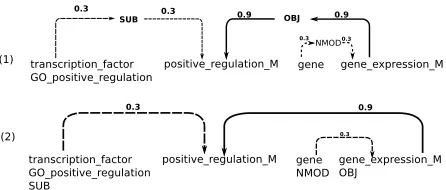
Figure 3: Graph Kernel Representation for a Trimmed Dependency Graph — (1) original representation, (2) representation without graph dependency edge nodes (weights (0.9, 0.3) taken from Airola et al. (2008)).
For our experiments, we tried some variants of the original graph kernel. In the original version each dependency graph edge is represented as a node. That means that connections between graph token nodes are expressed through graph dependency edge
nodes (see Figure 3; (1)). To represent the
connec-tions between original tokens as direct connecconnec-tions in the graph, we removed the edge nodes and each token was assigned the edge label (its dependency label; see Figure 3; (2)). Further variants included encodings for (1) the shortest dependency path (sp) between two mentions (argument and trigger)12 (2) the complete dependency graph (sp-dep), and (3) the complete dependency graph and linear information (sp-dep-lin) (the original configuration from Airola et al. (2008)).
For the graph kernel, we chose the LibSVM (Chang and Lin, 2001) Support Vector Machine as classifier.
3.4 Postprocessing
The postprocessing step varies for the three different Levels (see Section 3.3). For every event trigger of Level (1) (e.g., Gene expression), we generate one event per relation comprising a trigger and its argu-ment. For Level (2) (Binding), we create a Binding event with two arguments only for triples (trigger, protein1, protein2). For the third Level, we create
for each event trigger and its associated arguments e= n×mevents, forn CAUSEarguments and m THEMEarguments.
12
For Binding we extracted the shortest path between two protein mentions if we encounter a triple (trigger, protein1,
4 Pipeline
The event extraction pipeline consists of two ma-jor parts, a pre-processor and the dedicated event extractor. As far as pre-processing is concerned, we imported the sentence splitting, tokenization and GDep parsing results (Sagae and Tsujii, 2007) as prepared by the shared task organizers for all data sets (training, development and test). We processed this data with the OpenNLP POS tagger and Chun-ker, both re-trained on the GENIA corpus (Buyko et al., 2006). Additionally, we enhanced the original tokenization by one which includes hyphenization of lexical items such as in “PMA-dependent”.13
The data was further processed with the gene nor-malizer GENO(Wermter et al., 2009) and a num-ber of regex- and dictionary-based entity taggers (covering promoters, binding sites, and transcrip-tion factors). We also enriched gene name men-tions with their respective Gene Ontology annota-tions (see Section 3.2.2). The MESH thesaurus
(ex-cept chemical and drugs branch) was mapped on the data using the Lingpipe Dictionary Chunker.14
After preprocessing, event extraction was started distinguishing between the event trigger recognition (cf. Section 3.1), the trimming of the dependency graphs (cf. Section 3.2), and the argument extrac-tion proper (cf. Secextrac-tion 3.3).15 We determined in our experiments on the development data the perfor-mance of every classifier type and its variants (for the graph kernel), and of ensembles of the most per-formant (F-Score) graph kernel variant and an ME model.16 We present here the argument extraction
configuration used for the official run.17 For the prediction of Phosphorylation, Localization,
Pro-tein catabolism types we used the graph kernel in
13
This tokenization is more advantageous for the detection of additional event triggers as it allows to generate depen-dency relations from hyphenated terms. For example, in
“PMA-dependent”, “PMA” will be a child of “dependent” linked by
the AMOD dependency relation, and “dependent” receives the original dependency relation of the “PMA-dependent” token.
14http://alias-i.com/lingpipe/
15
For the final configurations of the graph kernel, we opti-mized the C parameter in the spectrum between2−3and23on
the final training data for every event type separately.
16In the ensemble configuration we built the union of positive
instances.
17We achieved with this configuration the best performance
on the development set.
its “sp without dependency-edge-nodes” configura-tion, while for the prediction of Transcription and
Gene expression events we used an ensemble of the
graph kernel in its “sp with dependency-edge-nodes” variant, and an ME model. For the prediction of
Binding we used an ensemble of the graph kernel
(“sp-dep with dependency-edge-nodes”) and an ME model. For the prediction of regulatory events we used ME models for each regulatory type.
5 Results
The baseline against which we compared our ap-proach can be captured in a single rule. We extract for every pair of a putative trigger and a putative ar-gument the shortest dependency path between them. If the shortest dependency path does not contain any direction change, i.e., the argument is either a direct child or a direct parent of the trigger, and if the path does not contain any other intervening event trig-gers, the argument is taken as the THEMErole.
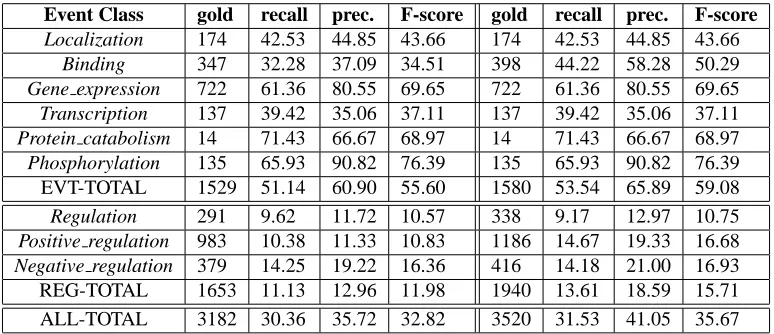
We performed evaluations on the shared task de-velopment and test set. Our baseline achieved com-petitive results of 36.0% precision, 34.0% recall, 35.0% F-score on the development set (see Table 1), and 30.4% precision, 35.7% recall, 32,8% F-score on the test set (see Table 2). In particular the one-argument events, i.e., Gene expression,
Pro-tein catabolism, Phosphorylation are effectively
ex-tracted with an F-score around 70.0%. More com-plex events, in particular events of Level (3), i.e., (Regulation) were less properly dealt with because of their strong internal complexity.
Event Class gold recall prec. F-score
Localization 53 75.47 30.30 43.24
Binding 248 33.47 20.80 25.66
Gene expression 356 76.12 75.07 75.59
Transcription 82 68.29 40.58 50.91
Protein catabolism 21 76.19 66.67 71.11
Phosphorylation 47 76.60 72.00 74.23
Regulation 169 14.20 15.09 14.63
Positive regulation 617 15.40 20.83 17.71
Negative regulation 196 11.73 13.22 12.43
TOTAL 1789 36.00 34.02 34.98
Event Class gold recall prec. F-score gold recall prec. F-score
Localization 174 42.53 44.85 43.66 174 42.53 44.85 43.66
Binding 347 32.28 37.09 34.51 398 44.22 58.28 50.29
Gene expression 722 61.36 80.55 69.65 722 61.36 80.55 69.65
Transcription 137 39.42 35.06 37.11 137 39.42 35.06 37.11
Protein catabolism 14 71.43 66.67 68.97 14 71.43 66.67 68.97
Phosphorylation 135 65.93 90.82 76.39 135 65.93 90.82 76.39
EVT-TOTAL 1529 51.14 60.90 55.60 1580 53.54 65.89 59.08
Regulation 291 9.62 11.72 10.57 338 9.17 12.97 10.75
Positive regulation 983 10.38 11.33 10.83 1186 14.67 19.33 16.68
Negative regulation 379 14.25 19.22 16.36 416 14.18 21.00 16.93
[image:7.612.113.500.59.226.2]REG-TOTAL 1653 11.13 12.96 11.98 1940 13.61 18.59 15.71 ALL-TOTAL 3182 30.36 35.72 32.82 3520 31.53 41.05 35.67
Table 2: Baseline results on the shared task test data. Approximate Span Matching/Approximate Recursive Matching (columns 3-5). Event decomposition, Approximate Span Matching/Approximate Recursive Matching (columns 7-9).
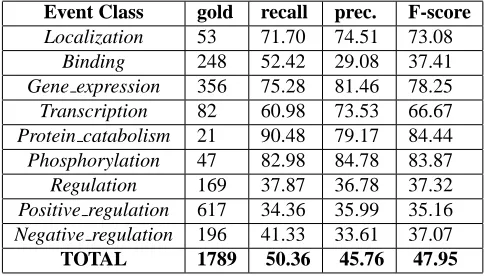
The event extraction approach, in its final config-uration (see Section 4), achieved a performance of 50.4% recall, 45.8% precision and 48.0% F-score on the development set (see Table 4), and 45.8% recall, 47.5% precision and 46.7% F-score on the test set (see Table 3). This approach clearly outperformed the baseline with an increase of 14 percentage points on the test data. In particular, the events of Level (2) and (3) were more properly dealt with than by the baseline. In the event decomposition mode (argu-ment detection is evaluated in a decomposed event) we achieved a performance of 49.4% recall, 56.2% precision, and 52.6% F-score (see Table 3).
Our experiments on the development set showed that the combination of the feature-based and the graph kernel-based approach can boost the results up to 6 percentage points F-score (for the Binding event type). It is interesting that the combination for
Bind-ing increased recall without droppBind-ing precision. The
original graph kernel approach for Binding events performs with 38.3% recall, 27.9% precision and 32.3% F-score on the development set. The com-bined approach comes with a remarkable increase of 14 percentage points in recall. The combination could also boost the recall of the Gene expression and Transcription by 15 percentage points and 5 per-centage points, respectively, without seriously drop-ping the precision (4 points for every type). For the other event types, no improvements were found when we combined both approaches.
5.1 Error Discussion
One expert biologist analyzed 30 abstracts randomly extracted from the development error data. We de-termined seven groups of errrors based on this anal-ysis. The first group contains examples for which an event should be determined, but a false argument was found (e.g., Binding arguments were not prop-erly sorted, or correct and false arguments were de-tected for the same trigger) (44 examples). The sec-ond group comprised examples where no trigger was found (23 examples). Group (3) stands for cases where no events were detected although a trigger was properly identified (14 examples). Group (4) holds examples detected in sentences which did not contain any events (12 examples). Group (5) lists bi-ologically meaningful analyses, actually very close to the gold annotation, especially for the cascaded regulatory events (12 examples), while Group (6) in-corporates examples of a detected event with incor-rect type (1 example). Group (7) gathers misleading gold annotations (10 examples).
This assessment clearly indicates that a major source of errors can be traced to the level of argu-ment identification, in particular for Binding events. The second major source has its offspring at the level of trigger detection (we ignored, for exam-ple, triggers such as “in the presence of ”, “when”, “normal”). About 10% of the errors are due to a slight difference between extracted events and gold events. For example, in the phrase “role for
Event Class gold recall prec. F-score gold recall prec. F-score
Localization 174 43.68 77.55 55.88 174 43.68 77.55 55.88
Binding 347 49.57 35.25 41.20 398 63.57 54.88 58.91
Gene expression 722 64.82 80.27 71.72 722 64.82 80.27 71.72
Transcription 137 35.77 62.03 45.37 137 35.77 62.03 45.37
Protein catabolism 14 78.57 84.62 81.48 14 78.57 84.62 81.48
Phosphorylation 135 76.30 91.15 83.06 135 76.30 91.15 83.06
EVT-TOTAL 1529 57.49 63.97 60.56 1580 60.76 71.27 65.60
Regulation 291 31.27 30.13 30.69 338 35.21 37.54 36.34
Positive regulation 983 34.08 37.18 35.56 1186 40.64 49.33 44.57
Negative regulation 379 40.37 31.16 35.17 416 42.31 39.11 40.65
REG-TOTAL 1653 35.03 34.18 34.60 1940 40.05 44.55 42.18
ALL-TOTAL 3182 45.82 47.52 46.66 3520 49.35 56.20 52.55
Table 3: Offical Event Extraction results on the shared task test data of the JULIELab Team. Approximate Span Matching/Approximate Recursive Matching (columns 3-5). Event decomposition, Approximate Span Match-ing/Approximate Recursive Matching (columns 7-9).
could not extract the gold event Regulation of
Regu-lation (Gene expression (FasL)) associated with the
trigger “role”, but we were able to find the (inside) event Regulation (Gene expression (FasL)) associ-ated with the trigger “regulation”. Interestingly, the typing of events is not an error source in spite of the simple disambiguation approach. Still, our dis-ambiguation strategy is not appropriate for the anal-ysis of double-annotated triggers such as “overex-pression”, “transfection”, etc., which are annotated as Gene expression and Positive regulation and are a major source of errors in Group (2). As Group (6) is an insignificant source of errors in our ran-domly selected data, we focused our error analysis on the especially ambiguous event type
Transcrip-tion. We found from 34 errors that 14 of them were
due to the disambiguation strategy (in particular for triggers “(gene) expression” and “induction”).
6 Conclusion
Our approach to event extraction incorporates man-ually curated dictionaries and machine learning methodologies to sort out associated event triggers and arguments on trimmed dependency graph struc-tures. Trimming combines pruning irrelevant lexi-cal material from a dependency graph and decorat-ing particularly relevant lexical material from that graph with more abstract conceptual class informa-tion. Given that methodological framework, the JULIELab Team scored on 2nd rank among 24
com-Event Class gold recall prec. F-score
Localization 53 71.70 74.51 73.08
Binding 248 52.42 29.08 37.41
Gene expression 356 75.28 81.46 78.25
Transcription 82 60.98 73.53 66.67
Protein catabolism 21 90.48 79.17 84.44
Phosphorylation 47 82.98 84.78 83.87
Regulation 169 37.87 36.78 37.32
Positive regulation 617 34.36 35.99 35.16
Negative regulation 196 41.33 33.61 37.07
TOTAL 1789 50.36 45.76 47.95
Table 4: Event extraction results on the shared task development data of the official run of the JULIELab Team. Approximate Span Matching/Approximate Recur-sive Matching.
peting teams, with 45.8% precision, 47.5% recall and 46.7% F1-score on all 3,182 events.
7 Acknowledgments
We wish to thank Rico Landefeld for his technical support, Tobias Wagner and Rico Pusch for their constant help and great expertise in biological is-sues. This research was partially funded within the BOOTSTREP project under grant FP6-028099 and the CALBC project under grant FP7-231727.
References
[image:8.612.112.501.60.227.2] [image:8.612.312.554.289.427.2]graph kernel for protein-protein interaction extraction. In Proceedings of the Workshop on Current Trends in
Biomedical Natural Language Processing, pages 1–9.
Christian Blaschke, Miguel A. Andrade, Christos Ouzou-nis, and Alfonso Valencia. 1999. Automatic ex-traction of biological information from scientific text: Protein-protein interactions. In ISMB’99 –
Proceed-ings of the 7th International Conference on Intelligent Systems for Molecular Biology, pages 60–67.
Ekaterina Buyko, Joachim Wermter, Michael Poprat, and Udo Hahn. 2006. Automatically adapting an NLP core engine to the biology domain. In Proceedings
of the Joint BioLINK-Bio-Ontologies Meeting. A Joint Meeting of the ISMB Special Interest Group on Bio-Ontologies and the BioLINK Special Interest Group on Text Data M ining in Association with ISMB, pages
65–68. Fortaleza, Brazil, August 5, 2006.
Chih-Chung Chang and Chih-Jen Lin, 2001. LIB-SVM: a library for support vector machines.
Soft-ware available at http://www.csie.ntu.edu. tw/˜cjlin/libsvm.
Katrin Fundel, Robert K¨uffner, and Ralf Zimmer. 2007. Relex-relation extraction using dependency parse trees. Bioinformatics, 23(3):365–371.
J¨org Hakenberg, Ulf Leser, Conrad Plake, Harald Kirsch, and Dietrich Rebholz-Schuhmann. 2005. LLL’05 challenge: Genic interaction extraction - identifica-tion of language patterns based on alignment and finite state automata. In Proceedings of the 4th Learning
Language in Logic Workshop (LLL05), pages 38–45.
Minlie Huang, Xiaoyan Zhu, Donald G. Payan, Kun-bin Qu, and Ming Li. 2004. Discovering patterns to extract protein-protein interactions from full texts.
Bioinformatics, 20(18):3604–3612.
Sophia Katrenko and Pieter W. Adriaans. 2006. Learn-ing relations from biomedical corpora usLearn-ing depen-dency trees. In Karl Tuyls, Ronald L. Westra, Yvan Saeys, and Ann Now´e, editors, KDECB 2006 –
Knowl-edge Discovery and Emergent Complexity in Bioin-formatics. Revised Selected Papers of the 1st Inter-national Workshop., volume 4366 of Lecture Notes in Computer Science, pages 61–80. Ghent, Belgium,
May 10, 2006. Berlin: Springer.
Jin-Dong Kim, Tomoko Ohta, and Jun’ichi Tsujii. 2008a. Corpus annotation for mining biomedical events from literature. BMC Bioinformatics, 9(10).
Seon-Ho Kim, Juntae Yoon, and Jihoon Yang. 2008b. Kernel approaches for genic interaction extraction.
Bioinformatics, 24(1):118–126.
Rune Sætre, Kenji Sagae, and Jun’ichi Tsujii. 2007. Syn-tactic features for protein-protein interaction extrac-tion. In Christopher J. O. Baker and Jian Su, editors,
LBM 2007, volume 319, pages 6.1–6.14.
Kenji Sagae and Jun’ichi Tsujii. 2007. Dependency pars-ing and domain adaptation with LR models and par ser ensembles. In Proceedings of the CoNLL Shared Task
Session of EMNLP-CoNLL 2007, pages 1044–1050.
Jasmin ˇSari´c, Lars J. Jensen, Rossitza Ouzounova, Isabel Rojas, and Peer Bork. 2004. Extracting regulatory gene expression networks from pubmed. In ACL ’04:
Proceedings of the 42nd Annual Meeting on Associa-tion for ComputaAssocia-tional Linguistics, page 191,
Morris-town, NJ, USA. Association for Computational Lin-guistics.
Joachim Wermter, Katrin Tomanek, and Udo Hahn. 2009. High-performance gene name normalization with GeNo. Bioinformatics, 25(6):815–821.
Akane Yakushiji, Yuka Tateisi, Yusuke Miyao, and Jun’ichi Tsujii. 2001. Event extraction from biomed-ical papers using a full parser. In Russ B. Altman, A. Keith Dunker, Lawrence Hunter, Kevin Lauderdale, and Teri E. Klein, editors, PSB 2001 – Proceedings
of the 6th Pacific Symposium on Biocomputing, pages
408–419. Maui, Hawaii, USA. January 3-7, 2001. Sin-gapore: World Scientific Publishing.
Guodong Zhou and Min Zhang. 2007. Extracting re-lation information from text documents by exploring various types of knowledge. Information Processing