Active Learning for Anaphora Resolution
Caroline Gasperin
Computer Laboratory, University of Cambridge 15 JJ Thomson Avenue
Cambridge CB3 0FD, UK
Abstract
In this paper we present our experiments with active learning to improve the performance of our probabilistic anaphora resolution sys-tem. We have adopted entropy-based uncer-tainty measures to select new instances to be added to our training data. The actively se-lected instances, however, were not more suc-cessful in improving the performance of the system than the same amount of randomly se-lected instances. The uncertainty measures we used behave differently from each other when selecting new instances, but none of them achieved remarkable performance. Fur-ther studies on active sample selection for anaphora resolution are necessary.
1 Introduction
Anaphora is the relation between two linguistic ex-pressions in the discourse where the reader is re-ferred back to the first of them when reading the sec-ond later in the text. Anaphora resolution can be un-derstood as the process of identifying an anaphoric relation between two expressions in the text and con-sequently linking the two of them, one being the anaphor and the other being the antecedent. Man-ually annotating corpora with anaphoric links in or-der to use it as training or test data for a corpus-based anaphora resolution system is a particulary difficult and time consuming task, given the complex nature of the phenomenon.
We have developed a probabilistic model for res-olution of non-pronominal anaphora and aim to im-prove its performance by acquiring incrementally
and selectively more training data using active learn-ing. We have adopted an uncertainty-based active learning approach in order to do that, and it uses our probabilistic model as the base classifier.
The uncertainty-based approach has been applied to, for instance, named-entity recognition by Shen et al. (2004) who report at least 80% reduction in an-notation costs, parsing by Tang et al. (2002) who re-ports 67% savings, and parse selection by Baldridge and Osborne (2003) who report 60% savings. We are not aware of any work that has applied active learning to anaphora resolution.
For calculating the uncertainty of an anaphora res-olution model, we feel the need to combine the in-formation about the confindence of the model for the classification of each antecedent candidate as-sociated to a given anaphor. We have tested three entropy-based uncertainty measures in order to se-lect the instances to be added to the training data.
Our training corpus is composed of five full-length scientific articles from the biomedical do-main. We have used this corpus to simulate active learning: we have divided our training data into two parts, one for the initial training and the other for ac-tive learning (simulating unlabelled data), and have compared the classifier performance when trained on a sample selected by active learning to its per-formance when trained on the same amount of ran-domly selected instances.
In the next section we describe our probabilistic model for anaphora resolution. In Section 3 we de-tail our training corpus. In Section?? we describe the strategy we have adopted to select the samples to take part in the active learning, and in Section 5
we describe our experiments.
2 Anaphora resolution model
We have inplemented a probabilistic model for anaphora resolution in the biomedical domain (Gasperin and Briscoe, 2008). This model aims to resolve both coreferent and associative (also called bridging (Poesio and Vieira, 1998)) cases of non-pronominal anaphora. Table 1 shows examples of these types of anaphoric relations. Coreferent are the cases in which the anaphor and the antecedent refer to the same entity in the world, while associa-tive cases are the ones in which the anaphor and an-tecedent refer to different but somehow related en-tities. We only take into account noun phrases re-ferring to biomedical entities, since this was the fo-cus of our resolution model. We consider two types of associative relations: biotype relations, which are anaphoric associative relations between noun phrases that share specific ontological relations in the biomedical domain; and set-member relations, in which the noun phrases share a set-membership relation. It is frequent however that some noun phrases do not have an antecedent, these are con-sidered discourse-new cases, which we also aim to identify.
The probabilistic model results from a simple de-composition process applied to a conditional proba-bility equation that involves several parameters (fea-tures). It is inspired by Ge et al.’s (1998) probabilis-tic model for pronoun resolution. The decomposi-tion makes use of Bayes’ theorem and independence assumptions, and aims to decrease the impact of data sparseness on the model, so that even small train-ing corpora can be viable. The decomposed model can be thought of as a more sophisticated version of the naive-Bayes algorithm, since we consider the dependence among some of the features instead of full independence as in naive Bayes. Probabilistic models can return a confidence measure (probabil-ity) for each decision they make, which allow us to adopt techniques such as active learning for further processing.
Our model seeks to classify the relation between an anaphoric expression and an antecedent candi-date as coreferent, biotype, set-member or neither. It computes the probability of each pair of anaphor
and candidate for each class. The candidate with the highest overall probability for each class is selected as the antecedent for that class, or no antecedent is selected if the probability of no relation overcomes the positive probabilities; in this case, the expression is considered to be new to the discourse.
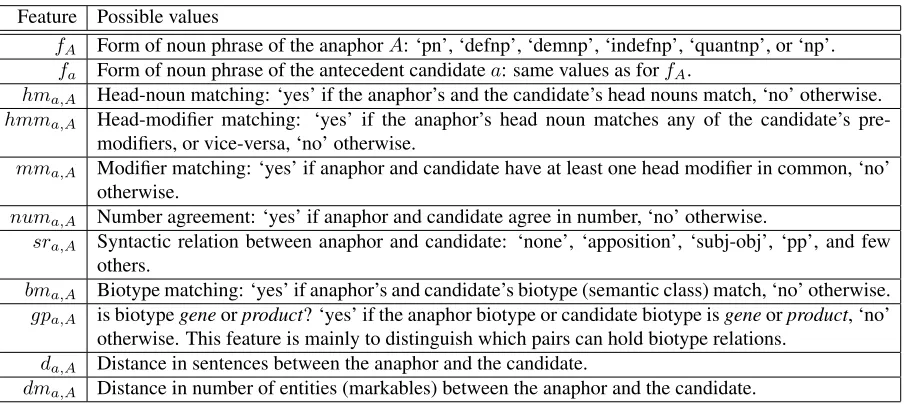
We have chosen 11 features to describe the anaphoric relations between an antecedent candi-date a and an anaphor A. The features are
pre-sented in Table 2. Most features are domain-independent, while one, gpa,A, is specific for the
biomedical domain. Our feature set covers the basic aspects that influence anaphoric relations: the form of the anaphor’s NP, string matching, semantic class matching, number agreement, and distance.
Given these features, we compute the probability
P of an specific class of anaphoric relation C
be-tweena(antecedent candidate) andA(anaphor). For
each pair of a given anaphor and an antecedent can-didate we computePforC=‘coreferent’,C=‘biotype’,
andC=‘set-member’. We also computeC=‘none’, that represents the probability of no relation between the NPs.P can be defined as follows:
P(C=‘class’|fA, fa, hma,A, hmma,A, mma,A,
numa,A, sra, bma,A, gpa,A, da,A, dma,A)
If we were to usePas above we would suffer con-siderably data sparseness. In order to reduce that, we decompose the probabilityP and assume
indepen-dence among some of the features in order to handle the sparseness of the training data. For more detail on the decomposition process refer to (Gasperin and Briscoe, 2008).
Applying Bayes’ rule and selectively applying the chain rule to the above equation, as well as assum-ing independece among some features, we reach the following equation:
P(C|fA, fa, hm, hmm, mm, num, sr, bm, gp, d, dm) =
P(C)P(fA|C)P(fa|C, fA)P(d, dm|C, fA, fa)
P(sr|C, d, dm)P(bm, gp|C)P(num|C, fA, fa)
P(hm, hmm, mm|C, fA, fa, bm)
P(fA)P(fa|fA)P(d, dm|fA, fa)
P(sr|d, dm)P(bm, gp)P(num|fA, fa)
P(hm, hmm,mm|fA, fa, bm)
C “The expression ofreaperhas been shown ...the geneencodes ...
[image:3.612.80.535.52.112.2]B “Drosophila gene Bokinteracts with ... expression ofBok proteinpromotes apoptosis ...” S “...“...ced-4the mammalian anti-apoptotic protein Bcl-2andced-9...the genes...” ...Bcl-2 family...”
Table 1: Examples of coreferent (C), associative biotype (B) and associative set-member (S) anaphoric relations
Feature Possible values
fA Form of noun phrase of the anaphorA: ‘pn’, ‘defnp’, ‘demnp’, ‘indefnp’, ‘quantnp’, or ‘np’. fa Form of noun phrase of the antecedent candidatea: same values as forfA.
hma,A Head-noun matching: ‘yes’ if the anaphor’s and the candidate’s head nouns match, ‘no’ otherwise. hmma,A Head-modifier matching: ‘yes’ if the anaphor’s head noun matches any of the candidate’s
pre-modifiers, or vice-versa, ‘no’ otherwise.
mma,A Modifier matching: ‘yes’ if anaphor and candidate have at least one head modifier in common, ‘no’
otherwise.
numa,A Number agreement: ‘yes’ if anaphor and candidate agree in number, ‘no’ otherwise.
sra,A Syntactic relation between anaphor and candidate: ‘none’, ‘apposition’, ‘subj-obj’, ‘pp’, and few
others.
bma,A Biotype matching: ‘yes’ if anaphor’s and candidate’s biotype (semantic class) match, ‘no’ otherwise.
gpa,A is biotypegeneorproduct? ‘yes’ if the anaphor biotype or candidate biotype isgeneorproduct, ‘no’
otherwise. This feature is mainly to distinguish which pairs can hold biotype relations.
da,A Distance in sentences between the anaphor and the candidate.
dma,A Distance in number of entities (markables) between the anaphor and the candidate.
Table 2: Feature set
This equation is the basis of our resolution model. We collect the statistics to train this model from a corpus annotated with anaphoric relations that we have created. The corpus is described in the next section.
3 Our corpus
There are very few biomedical corpora annotated with anaphora information, and all of them are built from paper abstracts (Cohen et al., 2005), instead of full papers. As anaphora is a phenomenon that de-velops through a text, we believe that short abstracts are not the best source to work with and decided to concentrate on full papers.
In order to collect the statistics to train our model, we have manually annotated anaphoric relations between biomedical entities in 5 full-text articles (approx. 33,300 words)1, which are part of the
Drosophila molecular biology literature. The corpus and annotation process are described in (Gasperin et al., 2007). To the best of our knowledge, this corpus 1Corpus available via the FlySlip project website
http://www.wiki.cl.cam.ac.uk/rowiki/NaturalLanguage/FlySlip
is the first corpus of biomedical full-text articles to be annotated with anaphora information.
Before annotating anaphora, we have prepro-cessed the articles in order to (1) tag gene names, (2) identify all NPs, and (3) classify the NPs accord-ing to their domain type, which we call biotype. To tag all gene names in the corpus, we have applied the gene name recogniser developed by Vlachos et al. (2006). To identify all NPs, their subconstituents (head, modifiers, determiner) and broader pre- and post-modification patterns, we have used the RASP parser (Briscoe et al., 2006). To classify the NPs ac-cording to their type in biomedical terms, we have adopted the Sequence Ontology (SO)2 (Eilbeck and
Lewis, 2004). SO is a fine-grained ontology, which contains the names of practically all entities that par-ticipate in genomic sequences, besides the relations among these entities (e.g. is-a, part-of, derived-from relations). We derived from SO seven biotypes to be used to classify the entities in the text, namely: “gene”, “gene product”, “part of gene”, “part of product”, “gene variant”, “gene subtype”, and “gene
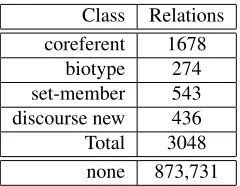
[image:3.612.81.537.145.348.2]Class Relations coreferent 1678
[image:4.612.125.245.53.146.2]biotype 274 set-member 543 discourse new 436 Total 3048 none 873,731
Table 3: Training instances, according to anaphoric class
supertype”. We also created the biotype “other-bio” to be associated with noun phrases that contain a gene name (identified by the gene name recogniser) but whose head noun does not fit any of the other biotypes. All NPs were tagged with their biotypes, and NPs for which no biotypes were found were ex-cluded.
The gene-name tags, NP boundaries and biotypes resulting from the preprocessing phase were revised and corrected by hand before the anaphoric relations were annotated.
For each biotyped NP we annotated its closest coreferent antecedent (if found) and its closest sociative antecedent (if found), from one of the as-sociative classes. From our annotation, we can infer coreference chains by merging the coreferent links between mentions of a same entity.
The annotated relations, and the features derived from them, are used as training data for the proba-bilistic model above. A special characteristic of data annotated with anaphora information is the over-whelming amount of negative instances, which re-sult from the absence of an anaphoric relation be-tween a NP that precedes an anaphoric expression and was not marked as its antecedent (nor marked as part of the same coreference chain of its antecedent). The negative instances outnumber considerably the number of positive instances (annotated cases). Ta-ble 3 presents the distribution of the cases among the classes of anaphoric relations.
To balance the ratio between positive and nega-tive training samples, we have clustered the neganega-tive samples and kept only a portion of each cluster, proportional to its size. All negative samples that have the same values for all features are grouped together (consequently, a cluster is formed by a set of identical samples) and only one-tenth of each
cluster members is kept, resulting in 85,314 negative samples. This way, small clusters (with less than 10 members), which are likely to represent noisy samples (similar to positive ones), are eliminated, and bigger clusters are shrunk; however the shape of the distribution of the negative samples is preserved. For example, our biggest cluster (feature values are: fA=‘pn’, fa=‘pn’, hm=‘no’, hmm=‘no‘,
mm=‘no’, bm=‘yes’, gp=‘yes’, num=‘yes’, sr=‘none’, d=‘16<’, dm=‘50<’) with 33,998 instances is reduced to 3,399 – still considerably more numerous than any positive sample. Other works have used a different strategy to reduce the imbalance between positive and negative samples (Soon et al., 2001; Ng and Cardie, 2002; Strube et al., 2002), where only samples composed by a negative antecedent that is closer than the annotated one are considered. Our strategy is more flexible and is able to the reduce further the number of neg-ative samples. The higher the number of negneg-ative samples, the higher the precision of the resolution, but the lower the recall.
4 Active learning
When trained using all our annotated corpus on a 10-fold cross-validation setting our anaphora resolution model, presented above, reached the results shown in Table 43.
We would like to improve this results without hav-ing to annotate too much more data, therefore we decided to experiment with active learning. We de-fined three entropy-based measures to calculate the uncertanty of our model for each decidion is makes. 3‘Perfect’ scores shows the result of a strict evaluation,
where we consider as correct all pairs that match exactly an antecedent-anaphor pair in the annotated data. On the other hand, column ‘Relaxed’ treats as correct also the pairs where the assigned antecedent is not the exact match in the annotated data but is coreferent with it.
Perfect Relaxed Class
P R F P R F
coreferent 56.3 54.7 55.5 69.4 67.4 68.3 biotype 28.5 35.0 31.4 31.2 37.9 34.2 set-member 35.4 38.2 36.7 38.5 41.5 40.0 discourse new 44.3 53.4 48.4 44.3 53.4 48.4
[image:4.612.313.546.601.677.2]4.1 Uncertainty measures
In order to measure how confident our model is about the class it assigns to each candidate, and con-sequently the one it chooses as the antecedent of an anaphor, we experiment with the following entropy-based measures.
We first compute what we call the “local en-tropy” among the probabilities for each class—
P(C=“coreferent”), P(C=“biotype”),
P(C=“set-member”) and P(C=“none”)—for a given pair
anaphor(A)-candidate(a), which is defined as
LE(A, a) =−X
C
P(C)log2P(C) (2)
whereP(C)represents Equation 1 above, that is, the probability assigned to the anaphor-candidate rela-tion by our probabilistic model for a particular class. The more similar the probabilities are, the more un-certain the model is about the relation, so the higher the local entropy. This measure is similar to others used in previous work for different problems.
We also compute the “global entropy” of the distribution of candidates across classes for each anaphor. The global entropy aims to combine the uncertainty information from all antecedent candi-dates for a given anaphor (instead of considering only a single candidate-anaphor pair as for LE). The higher the global entropy, the higher the uncertainty of the model about the antecedent for an anaphor. The global entropy combines the local entropies for all antecedent candidates of a given anaphor. We propose two versions of the global entropy measure. The first is simply a sum of the local entropies of all candidates available for a given anaphor, it is defined as
GE1(A) =X
a
LE(A, a) (3)
The second version averages the local entropies across all candidates, it is defined as
GE2(A) = P
aLE(A, a)
|a| (4)
where|a|corresponds to the number of candidates available for a given anaphor.
We consider that in general the further away a candidate is from the anaphor, the lower the local
entropy of the pair is (given that when distance in-creases, the probability of the candidate not being the antecedent, P(C=“none”), also increases), and consequently the less it contributes to the global en-tropy. This is the intuition behindGE1(A).
However, in some cases, mainly when the anaphor is a proper name, there can be several can-didates at a long distance from the anaphor that still get a reasonable probability assigned to them due to positive string matching. Therefore we decided to experiment with averaging the sum of the local prob-abilities by the number of candidates, soGE2(A).
5 Experiments
Initially, our training data was divided in 10-folds for cross-validation evaluation of our probabilis-tic model for anaphora resolution. For the active learning experiments we kept the same folds, us-ing one for the initial trainus-ing, eight for the ac-tive learning phase, and the remaining one for test-ing. We have experimented with 10 different initial-training/active-learning/testing splits, selected ran-domly from all combinations of the 10 folds, and the results in this section correspond to the average of the results from the different data splits. A fold contains the positive and negative samples derived from about 270 anaphors, it contains about 7000 candidate-anaphor pairs (an average of about 26 an-tecedent candidates per anaphor). The anaphors that are part of each fold were randomly selected.
model was most uncertain and generated the posi-tive and negaposi-tive instances that were associated to the anaphors.
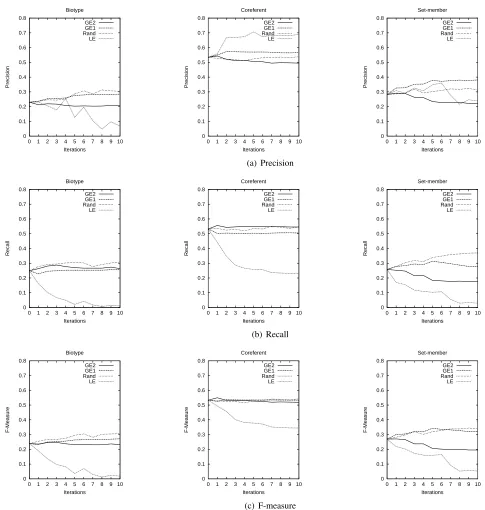
We expected (2), entropy-based sample selection, to achieve better performance than (3), random sam-ple selection, however this has not happened. The graphs in Figure 1 compare the precision, recall and F-measure scores for (2) and (3) along the 10 it-erations for each class of anaphoric relation. The lines corresponding to random sampling plot the re-sults of the experiments done in the same way as for GE1(A) andGE2(A), that is, where 50 anaphors are selected at each iteration, although we also tested random sampling in theLE(A, a)fashion, selecting 1500 candidate-anaphor pairs.
We observe that none of the uncertainty measures that we tested have performed consistently better than random sampling. LE(A, a)presents the most dramatic results, it worsens the general performance of the model for all classes, although it causes a considerable increase in precision for coreferent and set-member cases. GE1(A) and GE2(A) have a less clear pattern, but it is possible to notice that GE1(A) tends to bring improvements in precision while GE2(A) causes the opposite, improvements in recall and drops in precision.
6 Discussion
When looking at the instances selected by each ac-tive learning strategy, we observe the following. LE(A, a), which considers anaphor-candidate pairs, selects mostly negative instances, given the fact that these are highly frequent. This can explain the in-crease in precision and drop in recall for the posi-tive cases (observed for coreferent and set-member, the most frequent positive classes), since that is ex-pected with the increase of negative instances.
GE1(A)andGE2(A)select a proportional num-ber of positive and negative instances, since these measures consider an anaphor and all possible an-tecedent candidates, generating all instances that de-rive from each selected anaphor (usually one or two positive intances and several negative ones). How-ever, we can observe some differences between the impact of usingGE1(A)andGE2(A)to select in-stances. We observe that about 70% of the sam-ples selected byGE1(A)were proper names, while
the distribution of NP types among the samples se-lected by GE2(A) is similar to the original distri-bution in the data. This confirms the problem we expected to have withGE1(A), since exact matches of proper names that occur at a considerable distance from the anaphor still get a higher probability as-signed to them, which does not happen so often with other types of NPs. On the other hand, the correct antecedent of about 30% ofGE2(A)-selected sam-ples were in the same sentence as the anaphor, while the same occurs with only 8% ofGE1(A)-selected samples. GE2(A)behaviour in this case is counter intuitive, since antecedents in the same sentence should be found by the model with lower uncertainty than antecedents further away from the anaphor. An-other counter intuitive behaviour ofGE2(A)is that only 3% of the selected anaphors have no string matching with their antecedents (33% have no head-noun matching), while these cases correspond to about 30% of samples selected by GE1(A) (62% of samples have no head-noun matching). We ex-pected samples involving no string matching to be selected because they are usually the ones the model is mostly uncertain about.
Despite the different behaviour among the mea-sures none was successful in improving the perfor-mance of the model in relation to the perforperfor-mance of random sampling.
While entropy-based measures for sample selec-tion seem the obvious opselec-tion given that we use a probabilistic model, they did not give positive re-sults in our case. A future study of different ways to combine the local entropies is necessary, as well as the study of other non-entropy-based measures for sample selection.
0 0.1 0.2 0.3 0.4 0.5 0.6 0.7 0.8 10 9 8 7 6 5 4 3 2 1 0 Precision Iterations Biotype GE2 GE1 Rand LE 0 0.1 0.2 0.3 0.4 0.5 0.6 0.7 0.8 10 9 8 7 6 5 4 3 2 1 0 Precision Iterations Coreferent GE2 GE1 Rand LE 0 0.1 0.2 0.3 0.4 0.5 0.6 0.7 0.8 10 9 8 7 6 5 4 3 2 1 0 Precision Iterations Set-member GE2 GE1 Rand LE (a) Precision 0 0.1 0.2 0.3 0.4 0.5 0.6 0.7 0.8 10 9 8 7 6 5 4 3 2 1 0 Recall Iterations Biotype GE2 GE1 Rand LE 0 0.1 0.2 0.3 0.4 0.5 0.6 0.7 0.8 10 9 8 7 6 5 4 3 2 1 0 Recall Iterations Coreferent GE2 GE1 Rand LE 0 0.1 0.2 0.3 0.4 0.5 0.6 0.7 0.8 10 9 8 7 6 5 4 3 2 1 0 Recall Iterations Set-member GE2 GE1 Rand LE (b) Recall 0 0.1 0.2 0.3 0.4 0.5 0.6 0.7 0.8 10 9 8 7 6 5 4 3 2 1 0 F-Measure Iterations Biotype GE2 GE1 Rand LE 0 0.1 0.2 0.3 0.4 0.5 0.6 0.7 0.8 10 9 8 7 6 5 4 3 2 1 0 F-Measure Iterations Coreferent GE2 GE1 Rand LE 0 0.1 0.2 0.3 0.4 0.5 0.6 0.7 0.8 10 9 8 7 6 5 4 3 2 1 0 F-Measure Iterations Set-member GE2 GE1 Rand LE (c) F-measure
pair to the others in order to predict the global un-certainty of the model.
Acknowledgments
This work was part of the BBSRC-funded FlySlip project. Caroline Gasperin was funded by a CAPES award from the Brazilian government. Thanks to Ted Briscoe for comments on this manuscript.
References
Jason Baldridge and Miles Osborne. 2003. Active learn-ing for hpsg parse selection. In Walter Daelemans and Miles Osborne, editors,Proceedings of CoNLL-2003, pages 17–24. Edmonton, Canada.
Edward J. Briscoe, John Carroll, and Rebecca Watson. 2006. The second release of the RASP system. In Proceedings of ACL-COLING 06, Sydney, Australia. K. Bretonnel Cohen, Lynne Fox, Philip Ogren, and
Lawrence Hunter. 2005. Corpus design for biomed-ical natural language processsing. InProceedings of the ACL-ISMB Workshop on Linking Biological Liter-ature, Ontologies and Databases, Detroit.
Karen Eilbeck and Suzanna E. Lewis. 2004. Sequence ontology annotation guide. Comparative and Func-tional Genomics, 5:642–647.
Caroline Gasperin and Ted Briscoe. 2008. Statistical anaphora resolution in biomedical texts. In Proceed-ings of COLING 2008, Manchester, UK.
Caroline Gasperin, Nikiforos Karamanis, and Ruth Seal. 2007. Annotation of anaphoric relations in biomedi-cal full-text articles using a domain-relevant scheme. InProceedings of DAARC 2007, pages 19–24, Lagos, Portugal.
Niyu Ge, John Hale, and Eugene Charniak. 1998. A sta-tistical approach to anaphora resolution. In Proceedings of the Sixth Workshop on Very Large Corpora -COLING-ACL’98, Montreal, Canada.
Vincent Ng and Claire Cardie. 2002. Improving machine learning approaches to coreference resolution. In Pro-ceedings of ACL 2002, Philadelphia.
Massimo Poesio and Renata Vieira. 1998. A corpus-based investigation of definite description use. Com-putational Linguistics, 24(2):183–216.
Dan Shen, Jie Zhang, Jian Su, Guodong Zhou, and Chew-Lim Tan. 2004. Multi-criteria-based active learning for named entity recognition. InProceedings of ACL 2004, Barcelona.
Wee Meng Soon, Hwee Tou Ng, and Daniel Chung Yong Lim. 2001. A machine learning approach to corefer-ence resolution of noun phrases. Computational Lin-guistics, 27(4):521–544.
Michael Strube, Stefan Rapp, and Christoph Mller. 2002. The influence of minimum edit distance on refer-ence resolution. InProceedings of the EMNLP 2002, Philadelphia.
Min Tang, Xiaoqiang Luo, and Salim Roukos. 2002. Active learning for statistical natural language pars-ing. In Proceedings of ACL 2002, pages 120–127, Philadelphia, Pennsylvania. Association for Computa-tional Linguistics.