On Learning Subtypes of the Part-Whole Relation: Do Not Mix your
Seeds
Ashwin Ittoo University of Groningen Groningen, The Netherlands
Gosse Bouma University of Groningen Groningen, The Netherlands
Abstract
An important relation in information ex-traction is the part-whole relation. On-tological studies mention several types of this relation. In this paper, we show that the traditional practice of initializ-ing minimally-supervised algorithms with a single set that mixes seeds of different types fails to capture the wide variety of part-whole patterns and tuples. The re-sults obtained with mixed seeds ultimately converge to one of the part-whole relation types. We also demonstrate that all the different types of part-whole relations can still be discovered, regardless of the type characterized by the initializing seeds. We performed our experiments with a state-of-the-art information extraction algorithm.
1 Introduction
A fundamental semantic relation in many dis-ciplines such as linguistics, cognitive science, and conceptual modelling is the part-whole rela-tion, which exists between parts and the wholes they compise (Winston et al., 1987; Gerstl and Pribbenow, 1995). Different types of part-whole relations, classified in various taxonomies, are mentioned in literature (Winston et al., 1987; Odell, 1994; Gerstl and Pribbenow, 1995; Keet and Artale, 2008). The taxonomy of Keet and Ar-tale (2008), for instance, distinguishes part-whole relations based on their transitivity, and on the semantic classes of entities they sub-categorize. Part-whole relations are also crucial for many in-formation extraction (IE) tasks (Girju et al., 2006). Annotated corpora and semantic dictionaries used inIE, such as theACEcorpus1and WordNet (Fell-baum, 1998), include examples of part-whole re-lations. Also, previous relation extraction work,
1http://projects.ldc.upenn.edu/ace/
such as Berland and Charniak (1999) and Girju et al. (2006), have specifically targeted the discovery of part-whole relations from text. Furthermore, part-whole relations are de-facto benchmarks for evaluating the performance of general relation ex-traction systems (Pantel and Pennacchiotti, 2006; Beamer et al., 2008; Pyysalo et al., 2009). How-ever, these relation extraction efforts have over-looked the ontological distinctions between the different types of part-whole relations. They as-sume the existence of a single relation, subsuming the different part-whole relation types.
In this paper, we show that enforcing the onto-logical distinctions between the different types of part-whole relations enable information extraction systems to capture a wider variety of both generic and specialised part-whole lexico-syntactic pat-terns and tuples. Specifically, we address 3 major questions.
1. Is information extraction (IE) harder when learning the individual types of part-whole relations? That is, we determine whether the performance of state-of-the-artIEsystems in learning the individual part-whole relation types increases (due to more coherency in the relations’ linguistic realizations) or drops (due to fewer examples), compared to the tra-ditional practice of considering a single part-whole relation.
2. Are the patterns and tuples discovered when focusing on a specific part-whole relation type confined to that particular type? That is, we investgate whetherIEsystems discover examples representative of the different types by targetting one particular part-whole rela-tion type.
3. Are more distinct examples discovered when IEsystems learn the individual part-whole re-lation types? That is, we determine whether
a wider variety of unique patterns and tuples are extracted whenIE systems target the dif-ferent types of part-whole relations instead of considering a single part-whole relation that subsumes all the different types.
To answer these questions, we bootstrapped a minimally-supervised relation extraction algo-rithm, based on Espresso (Pantel and Pennac-chiotti, 2006), with different seed-sets for the vari-ous types of part-whole relations, and analyzed the harvested tuples and patterns.
2 Previous Work
Investigations on the part-whole relations span across many disciplines, such as conceptual mod-eling (Artale et al., 1996; Keet, 2006; Keet and Artale, 2008), which focus on the ontological aspects, and linguistics and cognitive sciences, which focus on natural language semantics. Sev-eral linguistically-motivated taxonomies (Odell, 1994; Gerstl and Pribbenow, 1995), based on the work of Winston et al. (1987), have been proposed to clarify the semantics of the different part-whole relations types across these various disciplines. Keet and Artale (2008) developed a formal taxon-omy, distinguishing transitive mereological part-whole relations from intransitivemeronymicones. Meronymic relations identified are: 1) member-of, between a physical object (or role) and an ag-gregation, e.g. player-team, 2)constituted-of, be-tween a physical object and an amount of mat-ter e.g. clay-statue, 3) sub-quantity-of, between amounts of matter or units, e.g. oxygen-water orm-km, and 4)participates-in, between an entity and a process e.g. enzyme-reaction. Mereologi-cal relations are: 1)involved-in, between a phase and a process, e.g. chewing-eating, 2) located-in, between an entity and its 2-dimensional re-gion, e.g. city-region, 3)contained-in, between an entity and its 3-dimensional region, e.g.tool-trunk, and 4)structural part-of, between integrals and their (functional) components, e.g. engine-car. This taxonomy further discriminates between part-whole relation types by enforcing semantical selectional restrictions, in the form ofDOLCE on-tology (Gangemi et al., 2002) classes, on their en-tities.
InNLP, information extraction (IE) techniques, for discovering part-whole relations from text have also been developed. Berland and Charniak (1999) use manually-crafted patterns, similar to Hearst
(1992), and on initial “seeds” denoting “whole” objects (e.g. building) to harvest possible “part” objects (e.g. room) from the North Americal News Corpus (NANC) of 1 million words. They rank their results with measures like log-likelihood (Dunning, 1993), and report a maximum accuracy of 70% over their top-20 results. In the super-vised approaches in Girju et al. (2003) and Girju et al. (2006), lexical patterns expressing part-whole relations between WordNet concept pairs are manually extracted from 20,000 sentences of the L.A Times and SemCor corpora (Miller et al., 1993), and used to generate a training cor-pus, with manually-annotated positive and nega-tive examples of part-whole relations. Classifica-tion rules, induced over the training data, achieve a precision of 80.95% and recall of 75.91% in pre-dicting whether an unseen pattern encode a part-whole relation. Van Hage et al. (2006) acquire 503 part-whole pairs from dedicated thesauri (e.g. AGROVOC2) to learn 91 reliable part-whole pat-terns. They substituted the patterns’ “part” ar-guments with known entities to formulate web-search queries. Corresponding “whole” entities were then discovered from documents in the query results with a precision of 74%. The part-whole relation is also a benchmark to evaluate the perfor-mance of general information extraction systems. The Espresso algorithm (Pantel and Pennacchiotti, 2006) achieves a precision of 80% in learning part-whole relations from the Acquaint (TREC-9) cor-pus of nearly 6M words. Despite the reasonable performance of the above IE systems in discov-ering part-whole relations, they overlook the on-tological distinctions between the different rela-tion types. For example, Girju et al. (2003) and Girju et al. (2006) assume a single part-whole re-lation, encompassing all the different types men-tioned in the taxonomy of Winston et al. (1987). Similarly, the minimally-supervised Espresso al-gorithm (Pantel and Pennacchiotti, 2006) is ini-tialized with a single set that mixes seeds of heterogeneous types, such as leader-panel and oxygen-water, which respectively correspond to themember-ofandsub-quantity-ofrelations in the taxonomy of Keet and Artale (2008).
2http://aims.fao.org/website/
3 Methodology
Our aim is to compare the relations harvested when a minimally-supervisedIE algorithm is ini-tialized with separate sets of seeds for each type of part-whole relation, and when it is initialized fol-lowing the traditional practice of a single set that mixes seeds of the different types. To distinguish between types of part-whole relations, we commit to the taxonomy of Keet and Artale (2008) (Keet’s taxonomy), which uses sound ontological for-malisms to unambiguously discrimate the relation types. Also, this taxonomy classifies the various part-whole relations introduced in literature, in-cluding ontologically-motivated mereological re-lations and linguistically-motivated meronymic ones. We adopt a 3-step approach to address our questions from section 1.
1. Define prototypical seeds (part-whole tuples) as follows:
• (Separate) sets of seeds for each type of part-whole relation in Keet’s taxonomy. • A single set that mixes seeds denot-ing all the different part-whole relations types.
2. Part-whole relations extraction from a corpus by initializing a minimally-supervisedIE al-gorithm with the seed-sets
3. Evaluation of the harvested relations to de-termine performance gain/loss, types of part-whole relations extracted, and distinct and unique patterns and tuples discovered.
The corpora and IE algorithm we used, and the seed-sets construction are described below. Re-sults are presented in the next section.
3.1 Corpora
We used the English and Dutch Wikipedia texts since their broad-coverage and size ensures that they include sufficient lexical realizations of the different types of part-whole relations. Wikipedia has also been targeted by recentIEefforts (Nguyen et al., 2007; Wu and Weld, 2007). However, while they exploited the structured features (e.g. in-foboxes), we only consider the unstructured texts. The English corpus size is approximately 470M words (∼80% of the August 2007 dump), while for Dutch, we use the full text collection (Febru-ary 2008 dump) of approximately 110M words.
We parsed the English and Dutch corpora respec-tively with the Stanford3 (Klein and Manning, 2003) and the Alpino4(van Noord, 2006) parsers, and formalized the relations between terms (enti-ties) as dependency paths. A dependency path is the shortest path of lexico-syntactic elements, i.e. shortest lexico-syntactic pattern, connecting enti-ties (proper and common nouns) in their parse-trees. Such a formalization has been successfully employed in previousIEtasks (see Stevenson and Greenwood (2009) for an overview). Compared to traditional surface-pattern representations, used by Pantel and Pennacchiotti (2006), dependency paths abstract from surface texts to capture long range dependencies between terms. They also al-leviate the manual authoring of large numbers of surface patterns. In our formalization, we substi-tute entities in the dependency paths with generic placeholdersPARTandWHOLE. Below, we show two dependency paths (1-b) and (2-b), respectively derived from English and Dutch Wikipedia sen-tences (1-a) and (2-a), and denoting the relations betweensample-song, andalkalo¨ıde-plant.
(1) a. The song “Mao Tse Tung Said” by Alabama 3 contains samples of a speech by Jim Jones
b. WHOLE+nsubj←contains→dobj+PART (2) a. Alle delen van de planten bevatten
al-kalo¨ıden en zijn daarmee giftig (All parts of the plants contain alkaloids and therefore are poisonous)
b. WHOLE+obj1+van+mod+deel+su ← bevat→obj1+PART
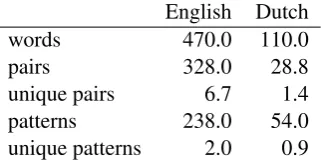
In our experiments, we only consider those en-tity pairs (tuples), patterns, and co-occuring pairs-patterns with a minimum frequency of 10 in the English corpus, and 5 in the Dutch corpus. Statis-tics on the number of tuples and patterns preserved after applying the frequency cut-off are given in Table 1.
3.2 Information Extraction Algorithm
As IE algorithm for extracting part-whole rela-tions from our texts, we relied on Espresso, a minimally-supervised algorithm, as described by Pantel and Pennacchiotti (2006). They show
3
http://nlp.stanford.edu/software/ lex-parser.shtml
4
English Dutch
words 470.0 110.0
pairs 328.0 28.8
unique pairs 6.7 1.4
patterns 238.0 54.0
[image:4.595.74.235.63.145.2]unique patterns 2.0 0.9
Table 1: Corpus Statistics in millions
that the algorithm achieves state-of-the-art perfor-mance when initialized with relatively small seed-sets over the Acquaint corpus (∼6M words). Re-call is improved with web search queries as addi-tional source of information.
Espresso extracts surface patterns connecting the seeds (tuples) in a corpus. The reliability of a patternp, r(p), given a set of input tuplesI, is computed using (3), as its average strength of as-sociation with each tuple,i, weighted by each tu-ple’s reliability,rι(i).
(3) rπ(p) =
P
i∈I
pmi(i,p)
maxpmi×rι(i)
|I|
In this equation,pmi(i, p)is the pointwise mutual information score (Church and Hanks, 1990) be-tween a pattern, p (e.g. consist-of), and a tuple,
i(e.g. engine-car), andmaxpmiis the maximum
PMIscore between all patterns and tuples. The re-liability of the initializing seeds is set to 1.
The top-k most reliable patterns are selected to find new tuples. The reliability of each tuple i,
rι(i)is computed according to (4), wherePis the
set of harvested patterns. The top-m most reliable tuples are used to infer new patterns.
(4) rι(i) =
P
i∈I
pmi(i,p)
maxpmi×rπ(p)
|P|
The recursive discovery of patterns from tuples and vice-versa is repeated until a threshold num-ber of patterns and/or tuples have been extracted. In our implementation, we maintain the core of the original Espresso algorithm, which pertains to es-timating the reliability of patterns and tuples.
Pantel and Pennacchiotti (2006) mention that their method is independent of the way patterns are formulated. Thus, instead of relying on surface patterns, we use dependency paths (as described above). Another difference is that while Pantel and Pennacchiotti (2006) complement their small cor-pus with documents retrieved from the web, we only rely on patterns extracted from our (much
larger) corpora. Finally, we did not apply the dis-counting factor suggested in Pantel and Pennac-chiotti (2006) to correct for the fact thatPMI over-estimates the importance of low-frequency events. Instead, as explained above, we applied a general frequency cut-off.5
3.3 Seed Selection
Initially,we selected seeds from WordNet (Fell-baum, 1998) (for English) and EuroWordNet (Vossen, 1998) (for Dutch) to initialize theIE al-gorithm. However, we found that these pairs, such as acinos-mother of thyme or radarscherm-radarapparatuur (radar screen - radar equipment, hardly co-occured with reasonable frequency in Wikipedia sentences, hindering pattern extraction. We therefore adopted the following strategy.
We searched our corpora for archetypal pat-terns, e.g.contain, which characterize all the dif-ferent types of part-whole relations. The tuples sub-categorized by these patterns in the English texts were automatically6 typed to appropriate DOLCEontology7classes, corresponding to those employed by Keet and Artale for constraining the entity pairs participating in different types of part-whole relations. The types of part-part-whole relations instantiated by the tuples could then be determined based on their ontological classes. Separate sets of 20 tuples, with each set corresponding to a specific relation type in the taxonomy of Keet and Artale (Keet’s taxonomy), were then created. For exam-ple, the English Wikipedia tuple t1 =actor-cast was used as a seed to discover member-of part-whole relations since both its elements were typed to the SOCIALOBJECTclass of theDOLCE ontol-ogy, and according to Keet’s taxonomy, they in-stantiate amember-ofrelation. Seeds for extract-ing relations from the Dutch corpus were defined in a similar way, except that we manually deter-mined their ontological classes based on the class glossary ofDOLCE.
Below, we only report on the member-of and sub-quantity-of meronymic relations, and on the located-in, contained-in and structural part-of mereological relations. We were unable to find sufficient seeds for theconstituted-of meronymic
5
We experimented with the suggested discounting factor forPMI, but were not able to improve over the accuracy scores reported later.
6Using the Java-OWL API, fromhttp://protege.
stanford.edu/plugins/owl/api/
7OWL Version 0.72, downloaded fromhttp://www.
Lg Part Whole # Type
EN grave church 155 contain
NL beeld kerk 120 contain
(statue) (church)
EN city region 3735 located
NL abdij gemeente 36 located (abbey) (community)
EN actor cast 432 member
NL club voetbal bond 178 member (club) (soccer union)
EN engine car 3509 structural NL geheugen computer 14 structural
(memory) (computer)
EN alcohol wine 260 subquant
NL alcohol bier 28 subquant
[image:5.595.72.291.60.305.2](alcohol) (beer)
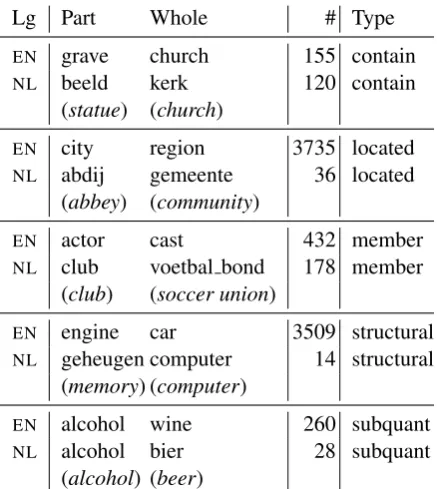
Table 2: Seeds used for learning part-whole rela-tions (contained-in, located-in, member-of, struc-tural part-of, sub-quantity-of).
relations (e.g. clay-statue). Also, we did not ex-periment with the participates-inandinvolved-in relations since their lexical realizations in our cor-pora are sparse, and they contain at least one ver-bal argument, whereas we only targeted patterns connecting nomimals. Sample seeds, their corpus frequency, and the part-whole relation type they instantiate from the English (EN) and Dutch (NL) corpora are illustrated in Table 2. Besides the five specialized seed-sets of 20 prototypical tuples for the aforementioned relations, we also defined ageneralset of mixed seeds, which combines four seeds from each of the specialized sets.
4 Experiments and Evaluation
We initialized ourIEalgorithm with the seed-sets to extract part-whole relations from our corpora. The same parameters as Pantel and Pennacchiotti (2006) were used. That is, the 10 most reliable patterns inferred from the initial seeds are boot-strapped to induce 100 part-whole tuples. In each subsequent iteration, we learn one additional pat-tern and 100 additional tuples. We evaluated our results after 5 iterations since the performance in later iterations was almost constant. The results are discussed next.
meronomic mereological
memb subq cont struc locat gen
EN 0.67 0.74 0.70 0.82 0.75 0.80
NL 0.68 0.60 0.60 0.60 0.70 0.71
Table 3: Precision for seed-sets representing spe-cific types of part-whole relations (member-of, sub-quantity-of, contained-in, structural part-of andlocated-in), and for thegeneralset composed of all types.
4.1 Precision of Extracted Relations
Two human judges manually evaluated the tuples extracted from the English and Dutch corpora per seed-set in each iteration of our algorithm. Tuples that unambiguously instantiated part-whole rela-tions were considered true positives. Those that did not were consideredfalse positives. Ambigu-ous tuples were discarded. The precision of the tuples discovered by the different seed-sets in the last iteration of our algorithm are in Table 3.
[image:5.595.308.532.63.121.2]seeds of heterogeneous part-whole relation types, is comparable to the best results obtained with in-dividual sets of specialized seeds, denoting spe-cific part-whole relations. An evaluation of the patterns and tuples extracted indicated consider-able precision drop between successive iterations of our algorithm. This appears to be due to se-mantic drift(McIntosh and Curran, 2009), where highly-ambiguous patterns promote incorrect tu-ples , which in turn, compound the precision loss.
4.2 Types of Extracted Relations
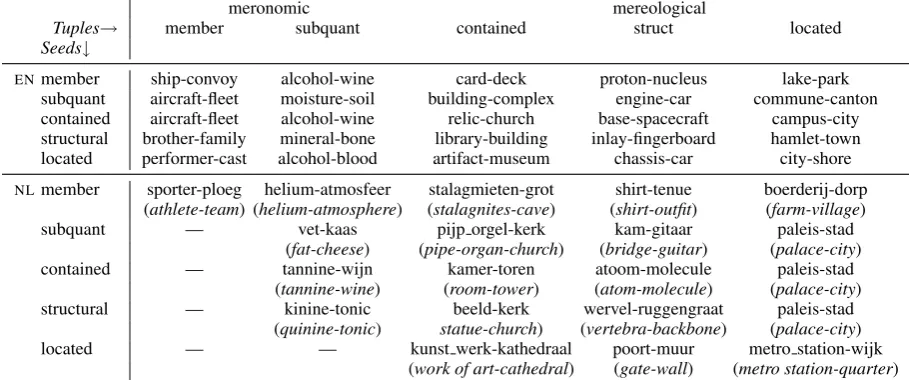
Initializing our algorithm with seeds of a particular type always led to the discovery of tuples charac-terizing other types of part-whole relations in the English corpus. This can be explained by proto-typical patterns, e.g. “include”, generated regard-less of the seeds’ types, and which are highy cor-related with, and hence, trigger tuples denoting other part-whole relation types. An almost sim-ilar observation was made for the Dutch corpus, except that tuples instantiating themember-of re-lation could only be learnt using initial seeds of that particular type (i.e. member-of). Upon in-specting our results, it was found that this phe-nomenon was due to the distinct and specific pat-terns, such as “treedt toe tot” (“become member of”), which linguistically realize themember-of re-lations in the Dutch corpus. Thus, initializing our IE algorithm with seeds that instantiate relations other thanmember-offails to detect these unique patterns, and fails to subsequently discover part-whole tuples describing the member-ofrelations. Our findings are illustrated in Table 4, where each cell lists a tuple of a particular type (column), which was harvested from seeds of a given type (row). These results answer our second question.
4.3 Distinct Patterns and Tuples
We address our third question by comparing the output of our algorithm to determine whether the results obtained by initializing with the individual specialized seeds were (dis)similar and/or distinct. Each result set consisted of maximally 520 tuples (including 20 initializing seeds) and 15 lexico-syntactic patterns, obtained after five iterations.
Tuples extracted from the English corpus using the member-of andcontained-in seed-sets exhib-ited a high degree of similarity, with 465 com-mon tuples discovered by both sets. These iden-tical tuples were also assigned the same ranks (re-liability) in the results generated by the
member-ofandcontained-inseeds, with a Spearman rank correlation of 0.82 between their respective out-puts. This convergence was also reflected in the fact that the member-of and contained-in seeds generated around 80% of common pat-terns. These patterns were mostly prototypi-cal ones indicative of part-whole relations, such as WHOLE+nsubj←include→dobj+PART (“in-clude”) and their cognates involving passive forms and relative clauses. However, the specialized seeds also generated distinct patterns, like “joined as” and “released with” for the member-of and contained-inseeds respectively.
The most distinct tuples and patterns were har-vested with thesub-quantity-of,structural part-of, and located-in seeds. Negative Spearman corre-lation scores were obtained when comparing the results of these three sets among themselves, and with the results of themember-ofand contained-in seeds, indicating insignificant similarity and overlap. Examining the patterns harvested by the sub-quantity-of,structural part-of, andlocated-in seeds revealed a high prominence of specialized and unique patterns, which specifically character-ize these relations. Examples of such patterns in-clude “made with”, “released with” and “found in”, which lexically realize the sub-quantity-of, structural part-of, andlocated-inrelations respec-tively.
For the Dutch corpus, the seeds that generated the most similar tuples were those correspond-ing to thesub-quantity-of,contained-in, and struc-tural part-of relations, with 490 common tuples discovered, and a Spearman rank correlation in the range of 0.89-0.93 between their respective out-puts. As expected, these seeds also led to the dis-covery of a substantial number of common and prototypical part-whole patterns. Examples in-clude “bevat” (“contain”), “omvat” (“comprise”), and their variants. The most distinct results were harvested by thelocated-inandmember-ofseeds, with negative Spearman correlation scores be-tween the output tuples indicating hardly any over-lap. We also found out that the patterns harvested by thelocated-in andmember-ofseeds character-istically pertained to these relations. Example of such patterns include “ligt in” (“lie in”), “is gele-gen in” (“is located in”), and “treedt toe tot” (“be-come member of”), respectively describing the located-inandmember-ofrelations.
meronomic mereological
Tuples→ member subquant contained struct located
Seeds↓
ENmember ship-convoy alcohol-wine card-deck proton-nucleus lake-park subquant aircraft-fleet moisture-soil building-complex engine-car commune-canton contained aircraft-fleet alcohol-wine relic-church base-spacecraft campus-city structural brother-family mineral-bone library-building inlay-fingerboard hamlet-town located performer-cast alcohol-blood artifact-museum chassis-car city-shore
NLmember sporter-ploeg helium-atmosfeer stalagmieten-grot shirt-tenue boerderij-dorp (athlete-team) (helium-atmosphere) (stalagnites-cave) (shirt-outfit) (farm-village)
subquant — vet-kaas pijp orgel-kerk kam-gitaar paleis-stad
(fat-cheese) (pipe-organ-church) (bridge-guitar) (palace-city) contained — tannine-wijn kamer-toren atoom-molecule paleis-stad
(tannine-wine) (room-tower) (atom-molecule) (palace-city) structural — kinine-tonic beeld-kerk wervel-ruggengraat paleis-stad
(quinine-tonic) statue-church) (vertebra-backbone) (palace-city)
located — — kunst werk-kathedraal poort-muur metro station-wijk
[image:7.595.71.526.64.254.2](work of art-cathedral) (gate-wall) (metro station-quarter)
Table 4: Sample tuples found per relation type.
both the English and Dutch corpora by seeds in-stantiating a single particular type of part-whole relation highly correlated with tuples discovered by at least one other type of seeds (member-of and contained-in for English, and sub-quantity-of,contained-inandstructural part-offor Dutch); 2) some part-whole relations are manifested by a wide variety of specialized patterns (sub-quantity-of, structural part-of, andlocated-in for English, andlocated-inandmember-offor Dutch).
Finally, instead of a single set that mixes seeds of different types, we created five such general sets by picking four different seeds from each of the specialized sets, and used them to initialize our algorithm. When examining the results of each of the fivegeneralsets, we found out that they were unstable, and always correlated with the output of a different specialized set.
Based on these findings, we believe that the tra-ditional practice of initializingIE algorithms with generalsets that mix seeds denoting different part-whole relation types leads to inherently unstable results. As we have shown, the relations extracted by combining seeds of heterogeneous types almost always converge to one specific part-whole rela-tion type, which cannot be conclusively predicted. Furthermore,generalseeds are unable to capture the specific and distinct patterns that lexically re-alize the individual types of part-whole relations.
5 Conclusions
In this paper, we have investigated the effect of ontologically-motivated distinctions in part-whole relations on IE systems that learn instances of
these relations from text.
We have shown that learning from specialized seeds-sets, denoting specific types of the part-whole relations, results in precision that is as high as or higher than the precision achieved with a general set that mixes seeds of different types. By comparing the outputs generated by different seed-sets, we observed that the tuples learnt with seeds denoting a specific part-whole relation type are not confined to that particular type. In most case, we are still able to discover tuples across all the different types of part-whole relations, re-gardless of the type instantiated by the initializing seeds. Most importantly, we demonstrated thatIE algorithms initialized with general sets of mixed seeds harvest results that tend to converge towards a specific type of part-whole relation. Conversely, when starting with seeds representing a specific type, it is likely to discover tuples and patterns that are completely distinct from those found by a mixed seed-set.
partic-ularly when learning part-whole relations, which are characterized by many subtypes. Seeds should be defined such that they represent an ontologi-cally well-defined class, for which one may hope to find a coherent set of extraction patterns.
Acknowledgement
Ashwin Ittoo is part of the project “Merging of In-coherent Field Feedback Data into Prioritized De-sign Information (DataFusion)” (http://www. iopdatafusion.org//), sponsored by the Dutch Ministry of Economic Affairs under the IOP-IPCR program.
Gosse Bouma acknowledges support from the Stevin LASSY project (www.let.rug.nl/ ˜vannoord/Lassy/).
References
A. Artale, E. Franconi, N. Guarino, and L. Pazzi. 1996. Part-whole relations in object-centered sys-tems: An overview. Data & Knowledge Engineer-ing, 20(3):347–383.
B. Beamer, A. Rozovskaya, and R. Girju. 2008. Au-tomatic semantic relation extraction with multiple boundary generation. InProceedings of the 23rd na-tional conference on Artificial intelligence-Volume 2, pages 824–829. AAAI Press.
Matthew Berland and Eugene Charniak. 1999. Find-ing parts in very large corpora. InProceedings of the 37th annual meeting of the Association for Compu-tational Linguistics on CompuCompu-tational Linguistics, pages 57–64, Morristown, NJ, USA. Association for Computational Linguistics.
K.W. Church and P. Hanks. 1990. Word association norms, mutual information, and lexicography. Com-putational linguistics, 16(1):22–29.
T. Dunning. 1993. Accurate methods for the statistics of surprise and coincidence. Computational linguis-tics, 19(1):74.
Christiane Fellbaum. 1998. WordNet: An Electronic Lexical Database. MIT, Cambridge.
A. Gangemi, N. Guarino, C. Masolo, A. Oltramari, and L. Schneider. 2002. Sweetening ontologies with DOLCE. Knowledge Engineering and Knowledge Management: Ontologies and the Semantic Web, Lecture Notes in Computer Science, pages 223–233.
P. Gerstl and S. Pribbenow. 1995. Midwinters, end games, and body parts: a classification of part-whole relations. International Journal of Human Com-puter Studies, 43:865–890.
R. Girju, A. Badulescu, and D. Moldovan. 2003. Learning semantic constraints for the automatic dis-covery of part-whole relations. In Proceedings of HLT/NAACL, volume 3, pages 80–87.
R. Girju, A. Badulescu, and D. Moldovan. 2006. Au-tomatic discovery of part-whole relations. Compu-tational Linguistics, 32(1):83–135.
M.A. Hearst. 1992. Automatic acquisition of hy-ponyms from large text corpora. InProceedings of the 14th conference on Computational linguistics-Volume 2, pages 539–545. Association for Compu-tational Linguistics Morristown, NJ, USA.
C.M. Keet and A. Artale. 2008. Representing and reasoning over a taxonomy of part–whole relations.
Applied Ontology, 3(1):91–110.
C.M. Keet. 2006. Part-whole relations in object-role models. On the Move to Meaningful Internet Systems 2006, Lecture Notes in Computer Science, 4278:1118–1127.
D. Klein and C.D. Manning. 2003. Accurate un-lexicalized parsing. In Proceedings of the 41st Annual Meeting on Association for Computational Linguistics-Volume 1, pages 423–430. Associa-tion for ComputaAssocia-tional Linguistics Morristown, NJ, USA.
T. McIntosh and J.R. Curran. 2009. Reducing seman-tic drift with bagging and distributional similarity. In Proceedings of the Joint Conference of the 47th Annual Meeting of the ACL and the 4th International Joint Confe rence on Natural Language Processing of the AFNLP, pages 396–404.
G.A. Miller, C. Leacock, R. Tengi, and R.T. Bunker. 1993. A semantic concordance. In Proceedings of the 3rd DARPA workshop on Human Language Technology, pages 303–308. New Jersey.
D.P.T. Nguyen, Y. Matsuo, and M. Ishizuka. 2007. Re-lation extraction from wikipedia using subtree min-ing. InProceedings of the National Conference on Artificial Intelligence, volume 22, page 1414. Menlo Park, CA; Cambridge, MA; London; AAAI Press; MIT Press; 1999.
J. Odell. 1994. Six different kinds of composition.
Journal of Object-Oriented Programming, 5(8):10– 15.
Patrick Pantel and Marco Pennacchiotti. 2006. Espresso: Leveraging generic patterns for auto-matically harvesting semantic relations. In Pro-ceedings of Conference on Computational Linguis-tics / Association for Computational LinguisLinguis-tics (COLING/ACL-06), pages 113–120, Sydney, Aus-tralia.
Mark Stevenson and Mark Greenwood. 2009. De-pendency pattern models for information extraction.
Research on Language and Computation, 3:13–39.
W.R. Van Hage, H. Kolb, and G. Schreiber. 2006. A method for learning part-whole relations. The Se-mantic Web - ISWC 2006, Lecture Notes in Com-puter Science, 4273:723–735.
Gertjan van Noord. 2006. At last parsing is now oper-ational. In Piet Mertens, Cedrick Fairon, Anne Dis-ter, and Patrick Watrin, editors,TALN06. Verbum Ex Machina. Actes de la 13e conference sur le traite-ment automatique des langues naturelles, pages 20– 42. Presses univ. de Louvain.
P. Vossen, editor. 1998. EuroWordNet A Multilingual Database with Lexical Semantic Networks. Kluwer Academic publishers.
M.E. Winston, R. Chaffin, and D. Herrmann. 1987. A taxonomy of part-whole relations. Cognitive sci-ence, 11(4):417–444.