B
IUT
EE: A Modular Open-Source System for Recognizing Textual
Entailment
Asher Stern
Computer Science Department Bar-Ilan University Ramat-Gan 52900, Israel
Ido Dagan
Computer Science Department Bar-Ilan University Ramat-Gan 52900, Israel
Abstract
This paper introduces BIUTEE1, an open-source system for recognizing textual entail-ment. Its main advantages are its ability to uti-lize various types of knowledge resources, and its extensibility by which new knowledge re-sources and inference components can be eas-ily integrated. These abilities make BIUTEE
an appealing RTE system for two research communities: (1) researchers of end applica-tions, that can benefit from generic textual ference, and (2) RTE researchers, who can in-tegrate their novel algorithms and knowledge resources into our system, saving the time and effort of developing a complete RTE system from scratch. Notable assistance for these re-searchers is provided by a visual tracing tool, by which researchers can refine and “debug” their knowledge resources and inference com-ponents.
1 Introduction
Recognizing Textual Entailment (RTE)is the task of identifying, given two text fragments, whether one of them can be inferred from the other (Dagan et al., 2006). This task generalizes a common problem that arises in many tasks at the semantic level of NLP. For example, inInformation Extraction (IE), a sys-tem may be given a sys-template with variables (e.g., “X is employed by Y”) and has to find text fragments from which this template, with variables replaced by proper entities, can be inferred. In Summariza-tion, a good summary should be inferred from the
1
www.cs.biu.ac.il/˜nlp/downloads/biutee
given text, and, in addition, should not contain du-plicated information, i.e., sentences which can be in-ferred from other sentences in the summary. Detect-ing these inferences can be performed by an RTE system.
Since first introduced, several approaches have been proposed for this task, ranging from shallow lexical similarity methods (e.g., (Clark and Har-rison, 2010; MacKinlay and Baldwin, 2009)), to complex linguistically-motivated methods, which incorporate extensive linguistic analysis (syntactic parsing, coreference resolution, semantic role la-belling, etc.) and a rich inventory of linguistic and world-knowledge resources (e.g., (Iftene, 2008; de Salvo Braz et al., 2005; Bar-Haim et al., 2007)). Building such complex systems requires substantial development efforts, which might become a barrier for new-comers to RTE research. Thus, flexible and extensible publicly available RTE systems are ex-pected to significantly facilitate research in this field. More concretely, two major research communities would benefit from a publicly available RTE system:
1. Higher-level application developers, who would use an RTE system to solve inference tasks in their application. RTE systems for this type of researchers should be adaptable for the application specific data: they should be configurable, trainable, and extensible with inference knowledge that captures application-specific phenomena.
2. Researchers in the RTE community, that would not need to build a complete RTE system for their research. Rather, they may integrate
their novel research components into an ex-isting open-source system. Such research ef-forts might include developing knowledge re-sources, developing inference components for specific phenomena such as temporal infer-ence, or extending RTE to different languages. A flexible and extensible RTE system is ex-pected to encourage researchers to create and share their textual-inference components. A good example from another research area is the Mosessystem forStatistical Machine Transla-tion (SMT) (Koehn et al., 2007), which pro-vides the core SMT components while being extended with new research components by a large scientific community.
Yet, until now rather few and quite limited RTE systems were made publicly available. Moreover, these systems are restricted in the types of knowl-edge resources which they can utilize, and in the scope of their inference algorithms. For example, EDITS2(Kouylekov and Negri, 2010) is a distance-based RTE system, which can exploit only lexical knowledge resources. NutCracker3(Bos and Mark-ert, 2005) is a system based on logical represen-tation and automatic theorem proving, but utilizes only WordNet (Fellbaum, 1998) as a lexical knowl-edge resource.
Therefore, we provide our open-source textual-entailment system, BIUTEE. Our system provides state-of-the-art linguistic analysis tools and exploits various types of manually built and automatically acquired knowledge resources, including lexical, lexical-syntactic and syntactic rewrite rules. Fur-thermore, the system components, including pre-processing utilities, knowledge resources, and even the steps of the inference algorithm, are modu-lar, and can be replaced or extended easily with new components. Extensibility and flexibility are also supported by a plug-in mechanism, by which new inference components can be integrated with-out changing existing code.
Notable support for researchers is provided bya visual tracing tool, Tracer, which visualizes every step of the inference process as shown in Figures 2
2http://edits.fbk.eu/ 3
http://svn.ask.it.usyd.edu.au/trac/ candc/wiki/nutcracker
and 3. We will use this tool to illustrate various in-ference components in the demonstration session.
2 System Description
2.1 Inference algorithm
In this section we provide a high level description of the inference components. Further details of the al-gorithmic components appear in references provided throughout this section.
BIUTEE follows the transformation based paradigm, which recognizes textual entailment by converting the text into the hypothesis via a sequence of transformations. Such a sequence is often referred to as aproof, and is performed, in our system, over the syntactic representation of the text - the text’s parse tree(s). A transformation modifies a given parse tree, resulting in a generation of a new parse tree, which can be further modified by subsequent transformations.
Consider, for example, the following text-hypothesis pair:
Text: ... Obasanjo invited him to step down as president ... and accept political asylum in Nigeria.
Hypothesis: Charles G. Taylor was offered asylum in Nigeria.
This text-hypothesis pair requires two major transformations: (1) substituting “him” by “Charles G. Taylor” via a coreference substitution to an ear-lier mention in the text, and (2) inferring that if “X accept Y” then “X was offered Y”.
BIUTEE allows many types of transformations, by which any hypothesis can be proven from any text. Given a T-H pair, the system finds a proof which generates H from T, and estimates the proof validity. The system returns a score which indicates how likely it is that the obtained proof is valid, i.e., the transformations along the proof preserve entail-ment from the meaning of T.
vehicle. More complicated rules capture the en-tailment relation between predicate-argument struc-tures, like X accept Y → X was offered Y. Entailment rules can also encode syntactic phenomena like the semantic equivalence of ac-tive and passive structures (X Verb[active] Y → Y is Verb[passive] by X). Various knowledge resources, represented as entailment rules, are freely available in BIUTEE’s web-site. The complete formalism of entailment rules, adopted by our system, is described in (Bar-Haim et al., 2007).
Coreference relations are utilized via coreference-substitution transformations: one mention of an tity is replaced by another mention of the same en-tity, based on coreference relations. In the above ex-ample the system could apply such a transformation to substitute “him” with “Charles G. Taylor”.
Since applications of entailment rules and coref-erence substitutions are yet, in most cases, insuffi-cient in transforming T into H, our system allows on-the-fly transformations. These transformations include insertions of missing nodes, flipping parts-of-speech, moving sub-trees, etc. (see (Stern and Dagan, 2011) for a complete list of these transforma-tions). Since these transformations are not justified by given knowledge resources, we use linguistically-motivated features to estimate their validity. For ex-ample, for on-the-fly lexical insertions we consider as features the named-entity annotation of the in-serted word, and its probability estimation according to a unigram language model, which yields lower costs for more frequent words.
Given a (T,H) pair, the system applies a search algorithm (Stern et al., 2012) to find a proofO = (o1, o2, . . . on) that transforms T into H. For each proof stepoithe system calculates acostc(oi). This cost is defined as follows: the system uses a weight-vectorw, which is learned in the training phase. In addition, each transformationoiis represented by a feature vectorf(oi) which characterizes the trans-formation. The cost c(oi) is defined as w ·f(oi). Theproof costis defined as the sum of the costs of the transformations from which it is composed, i.e.:
c(O),
n X
i=1
c(oi) =
n X
i=1
w·f(oi) =w·
n X
i=1
f(oi)
(1) If the proof cost is below a thresholdb, then the
sys-tem concludes that T entails H. The complete de-scription of the cost model, as well as the method for learning the parameterswand bis described in (Stern and Dagan, 2011).
2.2 System flow
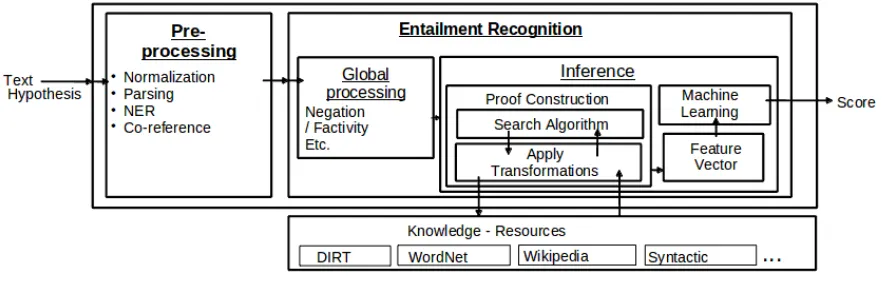
The BIUTEEsystem flow (Figure 1) starts with pre-processing of the text and the hypothesis. BIUTEE provides state-of-the-art pre-processing utilities: Easy-First parser (Goldberg and Elhadad, 2010), Stanford named-entity-recognizer (Finkel et al., 2005) and ArkRef coreference resolver (Haghighi and Klein, 2009), as well as utilities for sentence-splitting and numerical-normalizations. In addition, BIUTEEsupports integration of users’ own utilities by simply implementing the appropriate interfaces. Entailment recognition begins with a global pro-cessing phasein which inference related computa-tions that are not part of the proof are performed. Annotating the negation indicators and their scope in the text and hypothesis is an example of such cal-culation. Next, the system constructs a proof which is a sequence of transformations that transform the text into the hypothesis. Finding such a proof is a sequential process, conducted by the search algo-rithm. In each step of the proof construction the sys-tem examines all possible transformations that can be applied, generates new trees by applying selected transformations, and calculates their costs by con-structing appropriate feature-vectors for them.
New types of transformations can be added to BIUTEEby aplug-inmechanism, without the need to change the code. For example, imagine that a researcher applies BIUTEEon the medical domain. There might be some well-known domain knowl-edge and rules that every medical person knows. Integrating them is directly supported by the plug-in mechanism. A plug-in is a piece of code which im-plements a few interfaces that detect which transfor-mations can be applied, apply them, and construct appropriate feature-vectors for each applied trans-formation. In addition, a plug-in can perform com-putations for the global processing phase.
Eventually, the search algorithm finds a (approx-imately) lowest cost proof. This cost is normalized as a score between0and1, and returned as output.
learn-Figure 1: System architecture
RTE challenge
Median Best BIUTEE
RTE-6 33.72 48.01 49.09
RTE-7 39.89 48.00 42.93
Table 1: Performance (F1) of BIUTEE on RTE chal-lenges, compared to other systems participated in these challenges. Medianand Best indicate the median score and the highest score of all submissions, respectively.
ing algorithm, as described in (Stern and Dagan, 2011). We use aLogistic-Regressionlearning algo-rithm, but, similar to other components, alternative learning-algorithms can be integrated easily by im-plementing an appropriate interface.
2.3 Experimental results
BIUTEE’s performance on the last two RTE chal-lenges (Bentivogli et al., 2011; Bentivogli et al., 2010) is presented in Table 1: BIUTEEis better than the median of all submitted results, and in RTE-6 it outperforms all other systems.
3 Visual Tracing Tool
As a complex system, the final score provided as output, as well as the system’s detailed logging in-formation, do not expose all the decisions and cal-culations performed by the system. In particular, they do not show all the potential transformations that could have been applied, but were rejected by the search algorithm. However, such information is crucial for researchers, who need to observe the us-age and the potential impact of each component of the system.
We address this need by providing an interactive
visual tracing tool, Tracer, which presents detailed information on each proof step, including potential steps that were not included in the final proof. In the demo session, we will use the visual tracing tool to illustrate all of BIUTEE’s components4.
3.1 Modes
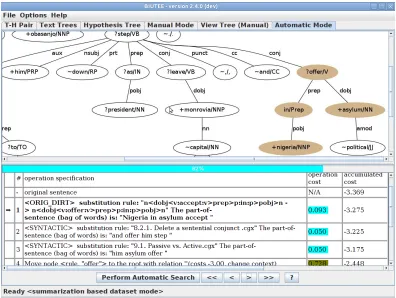
Tracer provides two modes for tracing proof con-struction:automatic modeandmanual mode. In au-tomatic mode, shown in Figure 2, the tool presents the complete process of inference, as conducted by the system’s search: the parse trees, the proof steps, the cost of each step and the final score. For each transformation the tool presents the parse tree before and after applying the transformation, highlighting the impact of this transformation. In manual mode, the user can invoke specific transformations pro-actively, including transformations rejected by the search algorithm for the eventual proof. As shown in Figure 3, the tool provides a list of transformations that match the given parse-tree, from which the user chooses and applies a single transformation at each step. Similar to automatic mode, their impact on the parse tree is shown visually.
3.2 Use cases
Developers of knowledge resources, as well as other types of transformations, can be aided byTraceras follows. Applying an entailment rule is a process of firstmatchingthe rule’s left-hand-side to the text parse-tree (or to any tree along the proof), and then substituting it by the rule’s right-hand-side. To test a
4
[image:4.612.87.528.65.206.2]Figure 2: Entailment Rule application visualized in tracing tool. The upper pane displays the parse-tree generated by applying the rule. The rule description is the first transformation (printed inbold) of the proof, shown in the lower pane. It is followed by transformations 2 and 3, which are syntactic rewrite rules.
rule, the user can provide a text for which it is sup-posed to match, examine the list of potential trans-formations that can be performed on the text’s parse tree, as in Figure 3, and verify that the examined rule has been matched as expected. Next, the user can apply the rule, visually examine its impact on the parse-tree, as in Figure 2, and validate that it op-erates as intended with no side-effects.
The complete inference process depends on the parameters learned in the training phase, as well as on the search algorithm which looks for lowest-cost proof from T to H. Researchers investigating these algorithmic components can be assisted by the trac-ing tool as well. For a given (T,H) pair, the auto-matic mode provides the complete proof found by the system. Then, in the manual mode the researcher can try to construct alternative proofs. If a proof with lower cost can be constructed manually it im-plies a limitation of the search algorithm. On the other hand, if the user can manually construct a
bet-ter linguistically motivated proof, but it turns out that this proof has higher cost than the one found by the system, it implies a limitation of the learning phase which may be caused either by a limitation of the learning method, or due to insufficient training data.
4 Conclusions
In this paper we described BIUTEE, an open-source textual-inference system, and suggested it as a re-search platform in this field. We highlighted key advantages of BIUTEE, which directly support re-searchers’ work: (a) modularity and extensibility, (b) a plug-in mechanism, (c) utilization of entail-ment rules, which can capture diverse types of knowledge, and (d) a visual tracing tool, which vi-sualizes all the details of the inference process.
Acknowledgments
PASCAL-Figure 3: List of available transformations, provided byTracerin the manual mode. The user can manually choose and apply each of these transformations, and observe their impact on the parse-tree.
2 Network of Excellence of the European Com-munity FP7-ICT-2007-1-216886, and the Euro-pean Community’s Seventh Framework Programme (FP7/2007-2013) under grant agreement no. 287923 (EXCITEMENT).
References
Roy Bar-Haim, Ido Dagan, Iddo Greental, and Eyal Shnarch. 2007. Semantic inference at the lexical-syntactic level. InProceedings of AAAI.
Luisa Bentivogli, Peter Clark, Ido Dagan, Hoa Dang, and Danilo Giampiccolo. 2010. The sixth pascal recog-nizing textual entailment challenge. InProceedings of TAC.
Luisa Bentivogli, Peter Clark, Ido Dagan, Hoa Dang, and Danilo Giampiccolo. 2011. The seventh pascal recog-nizing textual entailment challenge. InProceedings of TAC.
Johan Bos and Katja Markert. 2005. Recognising textual entailment with logical inference. InProceedings of EMNLP.
Peter Clark and Phil Harrison. 2010. Blue-lite: a knowledge-based lexical entailment system for rte6. InProceedings of TAC.
Ido Dagan, Oren Glickman, and Bernardo Magnini. 2006. The pascal recognising textual entailment chal-lenge. InQuionero-Candela, J.; Dagan, I.; Magnini, B.; d’Alch-Buc, F. (Eds.) Machine Learning Chal-lenges. Lecture Notes in Computer Science.
Rodrigo de Salvo Braz, Roxana Girju, Vasin Pun-yakanok, Dan Roth, and Mark Sammons. 2005. An inference model for semantic entailment in natural lan-guage. InProceedings of AAAI.
Christiane Fellbaum, editor. 1998. WordNet An Elec-tronic Lexical Database. The MIT Press, May. Jenny Rose Finkel, Trond Grenager, and Christopher
Manning. 2005. Incorporating non-local information into information extraction systems by gibbs sampling. InProceedings of ACL.
Yoav Goldberg and Michael Elhadad. 2010. An effi-cient algorithm for easy-first non-directional depen-dency parsing. InProceedings of NAACL.
Aria Haghighi and Dan Klein. 2009. Simple coreference resolution with rich syntactic and semantic features. In Proceedings of EMNLP.
Adrian Iftene. 2008. Uaic participation at rte4. In Pro-ceedings of TAC.
Philipp Koehn, Hieu Hoang, Alexandra Birch, Chris Callison-Burch, Marcello Federico, Nicola Bertoldi, Brooke Cowan, Wade Shen, Christine Moran, Richard Zens, Chris Dyer, Ondrej Bojar, Alexandra Con-stantin, and Evan Herbst. 2007. Moses: Open source toolkit for statistical machine translation. In Proceed-ings of ACL.
Milen Kouylekov and Matteo Negri. 2010. An open-source package for recognizing textual entailment. In Proceedings of ACL Demo.
Andrew MacKinlay and Timothy Baldwin. 2009. A baseline approach to the rte5 search pilot. In Proceed-ings of TAC.
Asher Stern and Ido Dagan. 2011. A confidence model for syntactically-motivated entailment proofs. In Pro-ceedings of RANLP.
[image:6.612.111.503.65.235.2]