Teaching a Weaker Classifier:
Named Entity Recognition on Upper Case Text
Hai Leong Chieu DSO National Laboratories
20 Science Park Drive Singapore 118230 [email protected]
Hwee Tou Ng
Department of Computer Science School of Computing National University of Singapore
3 Science Drive 2 Singapore 117543 [email protected]
Abstract
This paper describes how a machine-learning named entity recognizer (NER) on upper case text can be improved by us-ing a mixed case NER and some unlabeled text. The mixed case NER can be used to tag some unlabeled mixed case text, which are then used as additional training mate-rial for the upper case NER. We show that this approach reduces the performance gap between the mixed case NER and the upper case NER substantially, by 39% for MUC-6 and 22% for MUC-7 named en-tity test data. Our method is thus useful in improving the accuracy of NERs on up-per case text, such as transcribed text from automatic speech recognizers where case information is missing.
1 Introduction
In this paper, we propose using a mixed case named entity recognizer (NER) that is trained on labeled text, to further train an upper case NER. In the Sixth and Seventh Message Understanding Confer-ences (MUC-6, 1995; MUC-7, 1998), the named entity task consists of labeling named entities with the classes PERSON, ORGANIZATION, LOCA-TION, DATE, TIME, MONEY, and PERCENT. We conducted experiments on upper case named entity recognition, and showed how unlabeled mixed case text can be used to improve the results of an up-per case NER on the official MUC-6 and MUC-7
Mixed Case: Consuela Washington, a longtime House staffer and an expert in securities laws, is a leading candidate to be chairwoman of the Securities and Exchange Commission in the Clinton administration.
Upper Case: CONSUELA WASHINGTON, A
LONGTIME HOUSE STAFFER AND AN EX-PERT IN SECURITIES LAWS, IS A LEADING CANDIDATE TO BE CHAIRWOMAN OF THE
SECURITIES AND EXCHANGE
COMMIS-SION IN THE CLINTON ADMINISTRATION.
Figure 1: Examples of mixed and upper case text
test data. Besides upper case text, this approach can also be applied on transcribed text from auto-matic speech recognizers in Speech Normalized Or-thographic Representation (SNOR) format, or from optical character recognition (OCR) output. For the English language, a word starting with a capital let-ter often designates a named entity. Upper case NERs do not have case information to help them to distinguish named entities from non-named en-tities. When data is sparse, many named entities in the test data would be unknown words. This makes upper case named entity recognition more difficult than mixed case. Even a human would experience greater difficulty in annotating upper case text than mixed case text (Figure 1).
We propose using a mixed case NER to “teach” an upper case NER, by making use of unlabeled mixed case text. With the abundance of mixed case
labeled texts available in so many corpora and on the Internet, it will be easy to apply our approach to improve the performance of NER on upper case text. Our approach does not satisfy the usual as-sumptions of co-training (Blum and Mitchell, 1998). Intuitively, however, one would expect some infor-mation to be gained from mixed case unlabeled text, where case information is helpful in pointing out new words that could be named entities. We show empirically that such an approach can indeed im-prove the performance of an upper case NER.
In Section 5, we show that for MUC-6, this way of using unlabeled text can bring a relative reduc-tion in errors of 38.68% between the upper case and mixed case NERs. For MUC-7 the relative reduction in errors is 22.49%.
2 Related Work
Considerable amount of work has been done in recent years on NERs, partly due to the Mes-sage Understanding Conferences (MUC-6, 1995; MUC-7, 1998). Machine learning methods such as BBN’s IdentiFinder (Bikel, Schwartz, and Weischedel, 1999) and Borthwick’s MENE (Borth-wick, 1999) have shown that machine learning NERs can achieve comparable performance with systems using hand-coded rules. Bikel, Schwartz, and Weischedel (1999) have also shown how mixed case text can be automatically converted to upper case SNOR or OCR format to train NERs to work on such formats. There is also some work on un-supervised learning for mixed case named entity recognition (Collins and Singer, 1999; Cucerzan and Yarowsky, 1999). Collins and Singer (1999) investigated named entity classification using Ad-aboost, CoBoost, and the EM algorithm. However, features were extracted using a parser, and perfor-mance was evaluated differently (the classes were person, organization, location, and noise). Cucerzan and Yarowsky (1999) built a cross language NER, and the performance on English was low compared to supervised single-language NER such as Identi-Finder. We suspect that it will be hard for purely unsupervised methods to perform as well as super-vised ones.
Seeger (2001) gave a comprehensive summary of recent work in learning with labeled and unlabeled
data. There is much recent research on co-training, such as (Blum and Mitchell, 1998; Collins and Singer, 1999; Pierce and Cardie, 2001). Most co-training methods involve using two classifiers built on different sets of features. Instead of using distinct sets of features, Goldman and Zhou (2000) used dif-ferent classification algorithms to do co-training.
Blum and Mitchell (1998) showed that in order for PAC-like guarantees to hold for co-training, fea-tures should be divided into two disjoint sets satis-fying: (1) each set is sufficient for a classifier to learn a concept correctly; and (2) the two sets are conditionally independent of each other. Each set of features can be used to build a classifier, resulting in two independent classifiers, A and B. Classifications by A on unlabeled data can then be used to further train classifier B, and vice versa. Intuitively, the in-dependence assumption is there so that the classifi-cations of A would be informative to B. When the independence assumption is violated, the decisions of A may not be informative to B. In this case, the positive effect of having more data may be offset by the negative effect of introducing noise into the data (classifier A might not be always correct).
Nigam and Ghani (2000) investigated the differ-ence in performance with and without a feature split, and showed that co-training with a feature split gives better performance. However, the comparison they made is between co-training and self-training. In self-training, only one classifier is used to tag unla-beled data, after which the more confidently tagged data is reused to train the same classifier.
to some of the case-based features available to the mixed case system.
Due to the above reason, it is unreasonable to expect the performance of the upper case NER to match that of the mixed case NER. However, we still manage to achieve a considerable reduction of errors between the two NERs when they are tested on the official MUC-6 and MUC-7 test data.
3 System Description
We use the maximum entropy framework to build two classifiers: an upper case NER and a mixed case NER. The upper case NER does not have ac-cess to case information of the training and test data, and hence cannot make use of all the features used by the mixed case NER. We will first describe how the mixed case NER is built. More details of this mixed case NER and its performance are given in (Chieu and Ng, 2002). Our approach is similar to the MENE system of (Borthwick, 1999). Each word is assigned a name class based on its features. Each name class is subdivided into 4 classes, i.e., N begin, N continue, N end, and N unique. Hence, there is a total of 29 classes (7 name classes 4
sub-classes 1 not-a-name class).
3.1 Maximum Entropy
The maximum entropy framework estimates proba-bilities based on the principle of making as few as-sumptions as possible, other than the constraints im-posed. Such constraints are derived from training data, expressing some relationship between features and outcome. The probability distribution that sat-isfies the above property is the one with the high-est entropy. It is unique, agrees with the maximum-likelihood distribution, and has the exponential form (Della Pietra, Della Pietra, and Lafferty, 1997):
"!$#%'&
(
where
refers to the outcome,
the history (or con-text), and
is a normalization function. In addi-tion, each feature function)
(
$
is a binary func-tion. For example, in predicting if a word belongs to a word class,
is either true or false, and
refers to
the surrounding context:
)
(
*,+ if
= true, previous word = the
-otherwise
The parameters
are estimated by a procedure called Generalized Iterative Scaling (GIS) (Darroch and Ratcliff, 1972). This is an iterative method that improves the estimation of the parameters at each iteration.
3.2 Features for Mixed Case NER
The features we used can be divided into 2 classes: local and global. Local features are features that are based on neighboring tokens, as well as the token itself. Global features are extracted from other oc-currences of the same token in the whole document. Features in the maximum entropy framework are binary. Feature selection is implemented using a fea-ture cutoff: feafea-tures seen less than a small count dur-ing traindur-ing will not be used. We group the features used into feature groups. Each group can be made up of many binary features. For each token. , zero,
one, or more of the features in each group are set to 1.
The local feature groups are:
Non-Contextual Feature: This feature is set to
1 for all tokens. This feature imposes constraints that are based on the probability of each name class during training.
Zone: MUC data contains SGML tags, and a
doc-ument is divided into zones (e.g., headlines and text zones). The zone to which a token belongs is used as a feature. For example, in MUC-6, there are four zones (TXT, HL, DATELINE, DD). Hence, for each token, one of the four features zone-TXT, zone-HL, zone-DATELINE, or zone-DD is set to 1, and the other 3 are set to 0.
Case and Zone: If the token. starts with a
cap-ital letter (initCaps), then an additional feature (init-Caps, zone) is set to 1. If it is made up of all capital letters, then (allCaps, zone) is set to 1. If it contains both upper and lower case letters, then (mixedCaps, zone) is set to 1. A token that is allCaps will also be initCaps. This group consists of (3 total number
of possible zones) features.
Case and Zone of .0/
and .21
: Similarly, if .0/
(or .31
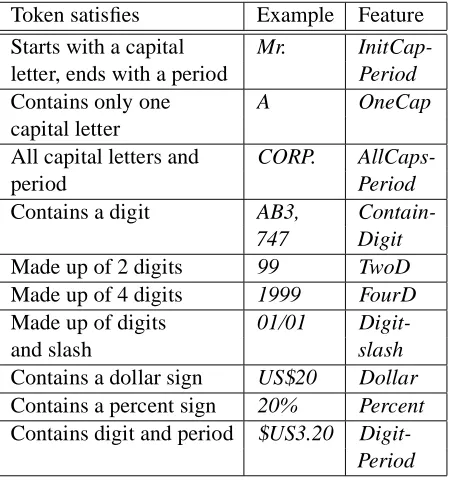
Token satisfies Example Feature Starts with a capital Mr. InitCap-letter, ends with a period Period
Contains only one A OneCap
capital letter
All capital letters and CORP.
AllCaps-period Period
Contains a digit AB3,
Contain-747 Digit
Made up of 2 digits 99 TwoD
Made up of 4 digits 1999 FourD
Made up of digits 01/01
Digit-and slash slash
Contains a dollar sign US$20 Dollar Contains a percent sign 20% Percent Contains digit and period $US3.20
[image:4.612.74.299.71.312.2]Digit-Period
Table 1: Features based on the token string
zone)457698 (or (initCaps, zone):7;<5= ) is set to 1,
etc.
Token Information: This group consists of 10
features based on the string. , as listed in Table 1.
For example, if a token starts with a capital letter and ends with a period (such as Mr.), then the feature InitCapPeriod is set to 1, etc.
First Word: This feature group contains only one
feature firstword. If the token is the first word of a sentence, then this feature is set to 1. Otherwise, it is set to 0.
Lexicon Feature: The string of the token . is
used as a feature. This group contains a large num-ber of features (one for each token string present in the training data). At most one feature in this group will be set to 1. If . is seen infrequently during
training (less than a small count), then. will not
se-lected as a feature and all features in this group are set to 0.
Lexicon Feature of Previous and Next Token:
The string of the previous token . 1
and the next token .>/
is used with the initCaps information of . . If . has initCaps, then a feature (initCaps,
.?/
)4<5768 is set to 1. If. is not initCaps, then
(not-initCaps,.>/
)4568 is set to 1. Same for .01
. In the case where the next token./
is a hyphen, then
.?/A@ is also used as a feature: (initCaps,.B/A@ )457698
is set to 1. This is because in many cases, the use of hyphens can be considered to be optional (e.g., “third-quarter” or “third quarter”).
Out-of-Vocabulary: We derived a lexicon list
from WordNet 1.6, and words that are not found in this list have a feature out-of-vocabulary set to 1.
Dictionaries: Due to the limited amount of
train-ing material, name dictionaries have been found to be useful in the named entity task. The sources of our dictionaries are listed in Table 2. A token
. is tested against the words in each of the four
lists of location names, corporate names, person first names, and person last names. If. is found in a list,
the corresponding feature for that list will be set to 1. For example, if Barry is found in the list of person first names, then the feature PersonFirstName will be set to 1. Similarly, the tokens.C/
and.D1
are tested against each list, and if found, a correspond-ing feature will be set to 1. For example, if.B/
is found in the list of person first names, the feature PersonFirstName4<57698 is set to 1.
Month Names, Days of the Week, and Num-bers: If. is one of January, February, . . . ,
Decem-ber, then the feature MonthName is set to 1. If. is
one of Monday, Tuesday, . . . , Sunday, then the fea-ture DayOfTheWeek is set to 1. If . is a number
string (such as one, two, etc), then the feature Num-berString is set to 1.
Suffixes and Prefixes: This group contains only
two features: Corporate-Suffix and Person-Prefix. Two lists, Corporate-Suffix-List (for corporate suf-fixes) and Person-Prefix-List (for person presuf-fixes), are collected from the training data. For a token.
that is in a consecutive sequence of initCaps tokens
.21 E (GFGFGFH(
.
(GFGFGFH( .?/I
, if any of the tokens from
.?/
to .0/I is in Corporate-Suffix-List, then a
fea-ture Corporate-Suffix is set to 1. If any of the to-kens from .?1 E?1
to .31
is in Person-Prefix-List, then another feature Person-Prefix is set to 1. Note that we check for .>1 E?1
, the word preceding the consecutive sequence of initCaps tokens, since per-son prefixes like Mr., Dr. etc are not part of perper-son names, whereas corporate suffixes like Corp., Inc. etc are part of corporate names.
The global feature groups are:
InitCaps of Other Occurrences: There are 2
posi-Description Source
Location Names http://www.timeanddate.com
http://www.cityguide.travel-guides.com http://www.worldtravelguide.net Corporate Names http://www.fmlx.com
[image:5.612.161.456.70.171.2]Person First Names http://www.census.gov/genealogy/names Person Last Names
Table 2: Sources of Dictionaries
tion (non first-words in the TXT or TEXT zones) in the same document is initCaps or not-initCaps. For a word whose initCaps might be due to its position rather than its meaning (in headlines, first word of a sentence, etc), the case information of other occur-rences might be more accurate than its own.
Corporate Suffixes and Person Prefixes of Other Occurrences: With the same
Corporate-Suffix-List and Person-Prefix-List used in local fea-tures, for a token. seen elsewhere in the same
docu-ment with one of these suffixes (or prefixes), another feature Other-CS (or Other-PP) is set to 1.
Acronyms: Words made up of all capitalized
let-ters in the text zone will be stored as acronyms (e.g., IBM). The system will then look for sequences of initial capitalized words that match the acronyms found in the whole document. Such sequences are given additional features of A begin, A continue, or A end, and the acronym is given a feature A unique. For example, if “FCC” and “Federal Communica-tions Commission” are both found in a document, then “Federal” has A begin set to 1, “Communica-tions” has A continue set to 1, “Commission” has A end set to 1, and “FCC” has A unique set to 1.
Sequence of Initial Caps: In the sentence “Even
News Broadcasting Corp., noted for its accurate re-porting, made the erroneous announcement.”, a NER may mistake “Even News Broadcasting Corp.” as an organization name. However, it is unlikely that other occurrences of “News Broadcasting Corp.” in the same document also co-occur with “Even”. This group of features attempts to capture such informa-tion. For every sequence of initial capitalized words, its longest substring that occurs in the same docu-ment is identified. For this example, since the se-quence “Even News Broadcasting Corp.” only ap-pears once in the document, its longest substring that
occurs in the same document is “News Broadcasting Corp.”. In this case, “News” has an additional fea-ture of I begin set to 1,“Broadcasting” has an addi-tional feature of I continue set to 1, and “Corp.” has an additional feature of I end set to 1.
Unique Occurrences and Zone: This group of
features indicates whether the word. is unique in
the whole document. . needs to be in initCaps to
be considered for this feature. If. is unique, then a
feature (Unique, Zone) is set to 1, where Zone is the document zone where. appears.
3.3 Features for Upper Case NER
All features used for the mixed case NER are used by the upper case NER, except those that require case information.
Among local features, Case and Zone, InitCap-Period, and OneCap are not used by the upper case NER. Among global features, only Other-CS and Other-PP are used for the upper case NER, since the other global features require case information. For Corporate-Suffix and Person-Prefix, as the se-quence of initCaps is not available in upper case text, only the next word (previous word) is tested for Corporate-Suffix (Person-Prefix).
3.4 Testing
During testing, it is possible that the classifier produces a sequence of inadmissible classes (e.g., person begin followed by location unique). To eliminate such sequences, we define a transition probability between word classes J
KLMK
to be equal to 1 if the sequence is admissible, and 0 otherwise. The probability of the classesK
(GFGFGFN(
K
I
assigned to the words in a sentenceO in a document
P
Figure 2: The whole process of re-training the upper case NER. Q signifies that the text is converted to
upper case before processing.
J
K
(GFGFGFN(
K
I
O
(
P
I
L
J
K
L
O
(
P
R
J
K
L
K
L
1
(
where J K
L
O
(
P
is determined by the maximum entropy classifier. A dynamic programming algo-rithm is then used to select the sequence of word classes with the highest probability.
4 Teaching Process
The teaching process is illustrated in Figure 2. This process can be divided into the following steps:
Training NERs. First, a mixed case NER (MNER) is trained from some initial corpusS ,
man-ually tagged with named entities. This corpus is also converted to upper case in order to train another up-per case NER (UNER). UNER is required by our method of example selection.
Baseline Test on Unlabeled Data. Apply the
trained MNER on some unlabeled mixed case texts to produce mixed case texts that are machine-tagged with named entities (text-mner-tagged). Convert the original unlabeled mixed case texts to upper case, and similarly apply the trained UNER on these texts to obtain upper case texts machine-tagged with named entities (text-uner-tagged).
Example Selection. Compare text-mner-tagged
and text-uner-tagged and select tokens in which the classification by MNER differs from that of UNER. The class assigned by MNER is considered to be correct, and will be used as new training data. These tokens are collected into a setSUT.
Retraining for Final Upper Case NER. BothS
andS3T are used to retrain an upper case NER.
How-ever, tokens from S are given a weight of 2 (i.e.,
each token is used twice in the training data), and to-kens fromSDT a weight of 1, sinceS is more reliable
thanS T (human-tagged versus machine-tagged).
5 Experimental Results
For manually labeled data (corpus C), we used only the official training data provided by the MUC-6 and MUC-7 conferences, i.e., using MUC-6 train-ing data and testtrain-ing on MUC-6 test data, and us-ing MUC-7 trainus-ing data and testus-ing on MUC-7 test data.1 The task definitions for 6 and MUC-7 are not exactly identical, so we could not com-bine the training data. The original MUC-6 training data has a total of approximately 160,000 tokens and
1
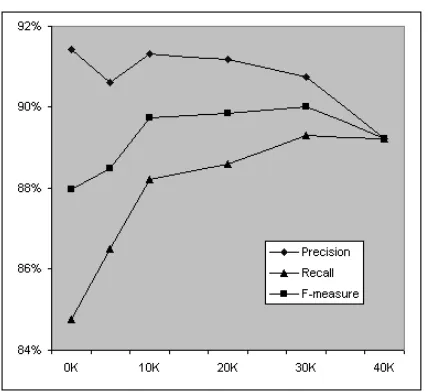
Figure 3: Improvements in F-measure on MUC-6 plotted against amount of selected unlabeled data used
MUC-7 a total of approximately 180,000 tokens. The unlabeled text is drawn from the TREC (Text REtrieval Conference) corpus, 1992 Wall Street Journal section. We have used a total of 4,893 ar-ticles with a total of approximately 2,161,000 to-kens. After example selection, this reduces the num-ber of tokens to approximately 46,000 for MUC-6 and 67,000 for MUC-7.
Figure 3 and Figure 4 show the results for MUC-6 and MUC-7 obtained, plotted against the number of unlabeled instances used. As expected, it increases the recall in each domain, as more names or their contexts are learned from unlabeled data. However, as more unlabeled data is used, precision drops due to the noise introduced in the machine tagged data. For MUC-6, F-measure performance peaked at the point where 30,000 tokens of machine labeled data are added to the original manually tagged 160,000 tokens. For MUC-7, performance peaked at 20,000 tokens of machine labeled data, added to the original manually tagged 180,000 tokens.
The improvements achieved are summarized in Table 3. It is clear from the table that this method of using unlabeled data brings considerable improve-ment for both MUC-6 and MUC-7 named entity task.
[image:7.612.315.528.70.268.2]The result of the teaching process for MUC-6 is a lot better than that of MUC-7. We think that this is
Figure 4: Improvements in F-measure on MUC-7 plotted against amount of selected unlabeled data used
Systems MUC-6 MUC-7
Baseline Upper Case NER 87.97% 79.86% Best Taught Upper Case NER 90.02% 81.52%
Mixed case NER 93.27% 87.24%
[image:7.612.315.548.334.408.2]Reduction in relative error 38.68% 22.49%
Table 3: F-measure on MUC-6 and MUC-7 test data
due to the following reasons:
Better Mixed Case NER for MUC-6 than 7. The mixed case NER trained on the
MUC-6 officially released training data achieved an F-measure of 93.27% on the official MUC-6 test data, while that of MUC-7 (also trained on only the offi-cial MUC-7 training data) achieved an F-measure of only 87.24%. As the mixed case NER is used as the teacher, a bad teacher does not help as much.
Domain Shift in MUC-7. Another possible cause
is that there is a domain shift in MUC-7 for the for-mal test (training articles are aviation disasters cles and test articles are missile/rocket launch arti-cles). The domain of the MUC-7 test data is also very specific, and hence it might exhibit different properties from the training and the unlabeled data.
The Source of Unlabeled Data. The unlabeled
whereas MUC-7 articles are New York Times arti-cles).
6 Conclusion
In this paper, we have shown that the performance of NERs on upper case text can be improved by using a mixed case NER with unlabeled text. Named en-tity recognition on mixed case text is easier than on upper case text, where case information is unavail-able. By using the teaching process, we can reduce the performance gap between mixed and upper case NER by as much as 39% for MUC-6 and 22% for MUC-7. This approach can be used to improve the performance of NERs on speech recognition output, or even for other tasks such as part-of-speech tag-ging, where case information is helpful. With the abundance of unlabeled text available, such an ap-proach requires no additional annotation effort, and hence is easily applicable.
This way of teaching a weaker classifier can also be used in other domains, where the task is to in-fer V W X , and an abundance of unlabeled data
P
ZY
V
(
\[
is available. If one possesses a second classifier
V
(
W X such that
provides addi-tional “useful” information that can be utilized by this second classifier, then one can use this second classifier to automatically tag the unlabeled dataP
, and select fromP
examples that can be used to sup-plement the training data for trainingV]W^X .
References
Daniel M. Bikel, Richard Schwartz, and Ralph M. Weischedel. 1999. An Algorithm that Learns What’s in a Name. Machine Learning, 34(1/2/3):211-231.
Avrim Blum and Tom Mitchell. 1998. Combining La-beled and UnlaLa-beled Data with Co-Training. In
Pro-ceedings of the Eleventh Annual Conference on Com-putational Learning Theory, 92-100.
Andrew Borthwick. 1999. A Maximum Entropy Ap-proach to Named Entity Recognition. Ph.D. disserta-tion. Computer Science Department. New York Uni-versity.
Hai Leong Chieu and Hwee Tou Ng. 2002. Named Entity Recognition: A Maximum Entropy Approach Using Global Information. To appear in Proceedings
of the Nineteenth International Conference on Compu-tational Linguistics.
Michael Collins and Yoram Singer. 1999. Unsupervised Models for Named Entity Classification. In
Proceed-ings of the 1999 Joint SIGDAT Conference on Empiri-cal Methods in Natural Language Processing and Very Large Corpora, 100-110.
Silviu Cucerzan and David Yarowsky. 1999. Lan-guage Independent Named Entity Recognition Com-bining Morphological and Contextual Evidence. In
Proceedings of the 1999 Joint SIGDAT Conference on Empirical Methods in Natural Language Processing and Very Large Corpora, 90-99.
J. N. Darroch and D. Ratcliff. 1972. Generalized Iter-ative Scaling for Log-Linear Models. The Annals of
Mathematical Statistics, 43(5):1470-1480.
Stephen Della Pietra, Vincent Della Pietra, and John Laf-ferty. 1997. Inducing Features of Random Fields.
IEEE Transactions on Pattern Analysis and Machine Intelligence, 19(4):380-393.
Sally Goldman and Yan Zhou. 2000. Enhancing Super-vised Learning with Unlabeled Data. In Proceedings
of the Seventeenth International Conference on Ma-chine Learning, 327-334.
MUC-6. 1995. Proceedings of the Sixth Message
Un-derstanding Conference (MUC-6).
MUC-7. 1998. Proceedings of the Seventh Message
Understanding Conference (MUC-7).
Kamal Nigam and Rayid Ghani. 2000. Analyzing the Effectiveness and Applicability of Co-training. In
Proceedings of the Ninth International Conference on Information and Knowledge Management, 86-93.
David Pierce and Claire Cardie. 2001. Limitations of Co-Training for Natural Language Learning from Large Datasets. In Proceedings of the 2001
Confer-ence on Empirical Methods in Natural Language Pro-cessing, 1-9.