New Perspectives on Institutionalist
Pattern Modeling: Systemism,
Complexity, and Agent-Based Modeling
Gräbner, Claudius and Kapeller, Jakop
19 June 2015
Online at
https://mpra.ub.uni-muenchen.de/77334/
New Perspectives on Institutionalist Pattern Modeling: Systemism, Complexity, and Agent-Based Modeling
Claudius Gräbner and Jakob Kapeller
[[email protected]; [email protected]]
Claudius Gräbner is a research assistant at the Institute for Institutional and Innovation Economics (iino) at the University of Bremen and Jakob Kapeller is a post-doctoral researcher at the Department of Philosophy and Theory of Science as well as the Institute for Comprehensive Analysis of the Economy (ICAE), both at Johannes Kepler University Linz.
Abstract: This paper focuses on the complementarity between original institutional economics, Mario Bunge’s framework of systemism, and the formal tools developed by complexity economists, especially in the context of agent-based modeling. Thereby, we assert that original institutional economics might profit from exploiting this complementarity.
Keywords: Aggregation, Original Institutionalism, Systemism, Agent-Based Computational Economics, Complexity
JEL Classification Codes: B41, B52, C63
Since their emergence, institutional economists have discussed potential philosophical underpinnings of institutionalist theory, as well as the appropriate role for formal modeling tools in economic thinking. In this paper, we use the classic methodological contributions of Gunnar Myrdal (1978) and Charles K. Wilber and Robert S. Harrison (1978) as a starting point to illustrate the affinity between original institutionalism and the concept of systemism as summarized and refined in the writings of the eminent philosopher Mario Bunge. Systemism thereby puts an emphasis on the relations between individual agents or entities, which constitute an aggregate system. Such a relational perspective implies that different ontological levels are mutually interdependent, since individuals are always relationally embedded, allowing for the whole to influence its parts and for the parts to influence the whole. As a consequence, the question of aggregation of individual behavior is seen as an interesting and potentially complicated theoretical problem instead of being understood as merely an arithmetic procedure of “summing up.”
often vague on its epistemological and ontological fundamentals, it has developed a rich toolset of formal models tailored to the analysis of complex social systems. We take the writings of Warren Weaver (1948) on complexity as a vantage point of showing how complexity aligns with systemism and institutional economics. In doing so, we search for potential complementarities between these concepts, and how these complementarities might be exploited. In particular, we discuss the potential of using agent-based models within institutionalist research.
This paper is structured as follows: Section two introduces the philosophical concept of systemism, and illustrates how it aligns to institutional thought and complexity economics as well as possibly provides a unifying framework for these two approaches. Section three tries to develop a specific example of the general argument sketched in section two by referring to the use of agent-based models in institutionalist analysis. Section four contains our conclusions.
Systemism, Complexity, and Institutionalist Pattern Modeling1
Although the label of systemism might seem novel, the corresponding ideas regarding research practice are far from being entirely new. In his various writings on systemism, Mario Bunge provides a series of illustrative examples for “systemist” social research. In this context, Bunge gives due credit to a series of well-known institutional economists, whom he conceives as systemist researchers — in particular, he mentions Gunnar Myrdal (Bunge 2012, 30), Max Weber, Joseph A. Schumpeter, Thorstein Veblen, and K. William Kapp (Bunge 1999, 92-93), as well as John Maynard Keynes and Wassily Leontief (Bunge 2004, 187). Bunge’s observation suggests a clear affinity between the concept of systemism and institutionalist economics.
one-to-many, since different mechanisms can be used to achieve a specific aim. Success on markets, for instance, can be achieved through a variety of mechanisms, hence “markets can be conquered” on different ways, for example, “by force, dumping, free-trade agreements or even honest competition” (Bunge 2004, 194).
Any system can be characterized by a specific composition (the set of nodes), an environment and a certain structure or organization (the collection of relations between the nodes as well as between the nodes and the environment). The latter is a novel and necessary element of any system as well as the source of emergent properties, hence mechanisms. For instance, the degree distribution of the network structure representing scientific communication, which often follows a power-law, is intrinsically related to what Robert K. Merton famously termed the “Matthew Effect”, i.e., the mechanism allocating prestige to different scientists, which is determined by the relative prestige these scientists have accrued in the past (Merton 1968; De Solla Price 1965). Thus, one main contribution of systemism from a practical perspective is its capacity of putting the most interesting aspect of any system and structures therein — e.g., the organization of relations — at the center stage.
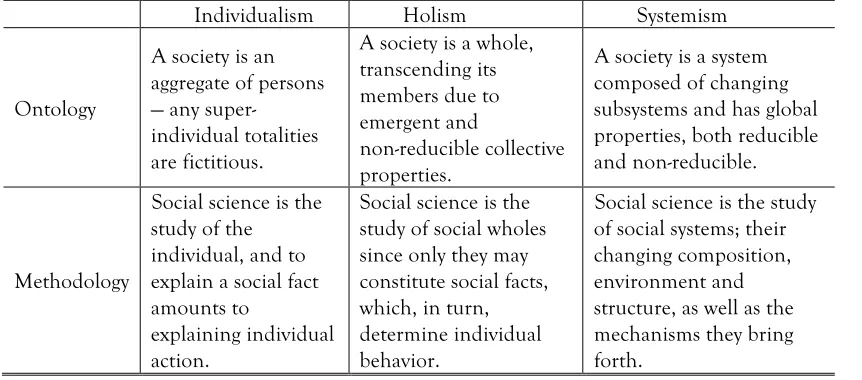
While this basic concept of a system can be applied to a variety of concrete or even conceptual items, for the matter at hand, we can explicitly apply it to social systems like a family, a firm, or a nation. Therefore, novel properties emerge at the level of the whole system (global properties, such as a firm’s success or failure), or at the level of its individual components (relational properties, such as the role assigned to a given employee). By focusing on the relations between individuals, systemism aims to transgress the traditional dichotomy of individualist and holist approaches, and thereby to preserve “the grains of truth” involved in these approaches. Following this argument, Bunge juxtaposes systemism to individualism and holism by referring to three different layers: ontology, methodology, and morals (Bunge 1996, 2000). Table 1 gives a stylized representation of the differences between three distinctive approaches with respect to ontology and methodology, which are in the focus of this paper.
social systems and their constituents are inherently dynamic provides another parallel to the classic account of Wilber and Harrison (1978), who assign an important role to evolutionary thinking. Given this background, it seems fair to say that systemism is an implicit cornerstone of institutionalist theorizing and modeling.
Table 1.Individualism, Holism, and Systemism in Comparison
Individualism Holism Systemism
Ontology
A society is an aggregate of persons — any
super-individual totalities are fictitious.
A society is a whole, transcending its members due to emergent and
non-reducible collective properties.
A society is a system composed of changing subsystems and has global properties, both reducible and non-reducible.
Methodology
Social science is the study of the
individual, and to explain a social fact amounts to
explaining individual action.
Social science is the study of social wholes since only they may constitute social facts, which, in turn, determine individual behavior.
Social science is the study of social systems; their changing composition, environment and structure, as well as the mechanisms they bring forth.
Source: Based on Bunge (1996, 243-268).
Moreover, a close reading of Wilber and Harrison (1978) also suggests that a high priority was given to understanding the relation between different ontological levels of the economy. A similar emphasis can also be found in Bunge, who argues that “social sciences study social systems and their subsystems and supersystems” (1996, 273). He recognizes that any system carries emergent properties as ontological novelties, which may come in two forms: either the system possesses some properties that its parts do not possess (global properties), or the parts possess some properties exactly because they are part of a given system (relational properties). Therefore, the approach to understand emergent properties as ontological novelties is rather a universal take on the question of whether “more is different” (Anderson 1972).
Systemism further posits that different ontological levels in social research — no matter where these levels are exactly located in a given application — are bridged by mechanisms (additionally to within-level mechanisms), which replace those simple aggregation rules that are exemplified by typical formal procedures (e.g., summing up, calculating a mean, classifying, etc.). The question of “aggregation” is explicitly tackled as a potentially interesting theoretical problem and not primarily as a technical difficulty. Thereby, these “bridging” mechanisms can take the form of agency-structure relations (i.e., a bottom-up mechanism or upward causation), or agency-structure-agency relations (i.e., top-down mechanisms or downward causation).
(Hodgson 2002, 2006, 2011), or social emulation (Veblen [1899] 2007). The question of whether there are more formal tools that can help institutionalists understand aggregation via mechanisms, as suggested by systemism, has led to another stream of literature, known as complexity economics. This line of research has developed numerous, mainly formal tools that allow for studying the economy as a complex system. Although the idea of complexity developed independently from systemism and institutionalism, the similarities of the theoretical frameworks are striking. The concept of complexity dates back to, at least, 1948, when Weaver made the important distinction between simple and complex scientific problems. Simple problems include only very few variables and were studied by pre-1900 physics and engineering. All problems, involving living organisms, can never fall into this category as they involve many different aspects and interrelated factors that can hardly be separated (Weaver 1948, 537-538). Weaver distinguished between organized and disorganized complexity. A system consisting of many components shows disorganized complexity if some emergent pattern exists because the linear interactions between the different elements smooth each other out. The Law of Large Numbers can be interpreted as such an emergent pattern. Econometric work generally assumes this kind of complexity when it takes error terms to be identically and independently distributed. By contrast, a system showing organized complexity exhibits patterns that emerge because the interactions of the different elements do not smooth each other out (i.e., are non-linear). In such a case, there is a kind of self-organization of the system, so that the factors are interrelated into an organic whole (Weaver 1948, 539).
While the analytical models of neoclassical economics presume the economy to show disorganized complexity, the perspective of institutionalist modeling expects the economy to be characterized by organized complexity. The strong theoretical affinity between the complexity approach to the economy and the perspective of insitutionalism/systemism suggests numerous potential complementarities. In particular, institutionalists might find some of the formal tools of complexity economics adequate to enhance the generality and the rigor of their verbal pattern models. On the other hand, complexity economics is a very diverse field that lacks a general epistemological and methodological foundation. In this context, systemism might provide both accounts with a common philosophical framework and a general platform for the discussion and development of theoretical arguments.
In the next section, we assess the potential of one particular tool, often related to complexity economics — agent based modeling. We do this in order to enhance and complement institutional pattern modeling aiming to gain a deeper understanding of the systemic properties of complex economic and social systems.
Systemic Analysis: A Plea for Agent-Based Models in Economics
study how this affects the dynamics of the system under observation. While ABMs are considered to be formal models, they differ from the strict analytical framework of conventional economics as the modeler is not forced to make assumptions in such a way that the system stays analytically tractable and exhibits a clear equilibrium. Because the models are solved computationally, assumptions can be made on entirely proper considerations. In particular, agents’ behavior does not have to be represented via convenient equations, but agents are more intuitively specified by attributes and rules implemented in a certain programming language. Such a specification of the agents allows the natural implementation of heuristics, learning behavior, and habits into the methods of the agent objects.
The social embeddedness of agents is considered through an underlying — possibly changing — graph that specifies the neighborhood of an agent, i.e., the set of agents it can interact with. Depending on the degree of realism implemented in crafting the model, such a graph could represent a simple grid or an actual interaction structure among the agents. The advantages, in contrast to conventional economics, are twofold: First, there is a greater degree of freedom regarding the specification of individual behavior. Second, the interdependence of the economic agents is taken into account, so that group formation and dynamic power relations among agents can be explicitly modeled. Both aspects, in turn, allow for introducing more realism in economic modeling.
Because agents’ rules may not only consider the current state of an agent, but also that of other single agents, a group of agents, or the state of the system as a whole, the interdependence of different ontological levels can be directly implemented in an ABM. Another particular feature of ABMs, in comparison with analytical models, is that they refrain from assumptions about fictitious central planning mechanisms, such as the Walrasian auctioneer. Consequently, they allow the study of the economy as a self-organizing system without central control. The overall dynamics is then truly the result of the interactions of its constituent parts and the interplay of different ontological levels.
The resulting models are very diverse. There are ABMs that aim to be as realistic as possible and are extremely complex, while others try to illustrate a certain mechanism or a combination of mechanisms and remain rather abstract. Not all potential ABMs are compatible with institutionalist methodology and theory and, in most cases, the ABMs are only one piece of a broader institutionalist analysis of the problem at hand. Nonetheless, the following example illustrates what institutionalist ABMs could look like, and what role they can play in a broader analysis.
clockwise, the other half anti-clockwise. At every round, each driver has to decide whether he/she wants to drive on the right or on the left. The authors clarify that the experimentation with different decision rules in their ABM helped them identify a surprisingly easy, but very effective decision procedure (Hodgson and Knudson 2004, 23). That is, drivers develop a habit of driving either on the left or right side and the model shows how the presence of habit fosters a convergence to a drive-left or drive-right convention. The model also shows that habit formation alone is not sufficient for the emergence of the convention, but has to be supplemented by a selection mechanism to lead to a stable traffic rule. Due to the modular structure of their ABM, Hodgson and Knudson (2004) were also able to study what happens if habit is substituted by inertia, which resulted in less convergence in terms of traffic rules. Based on these findings, they conclude that the functioning of institutions is best interpreted as influencing habits rather than behavior or preferences. This application illustrates how ABM can be used to study different mechanism and their mutual influences on each other in one coherent model. Other recent examples of papers that successfully make use of ABM to implement an institutional pattern model include the following: Wolfram Elsner and Torsten Heinrich (2009), who focus on the meso-level of the economy, use an ABM to study the group sizes and agency mechanisms that foster cooperative behavior among agents and use their findings to provide a model-based rationale for the existence of a “variety of capitalism” (Peter Hall and John Soskice 2001). Bernhard Rengs and Manuel Wäckerle (2014) build an extensive ABM of the European Monetary Union. They include fundamental institutionalist concepts such as conspicuous consumption in a model that represents both the real and the financial sector of several countries, including their political institutions, and allows for a dynamic analysis of different institutional settings. Manuel Wäckerle, Bernhard Rengs, and Wolfgang Radax (2014) illustrate the impact of trust and leadership on the life cycles of social institutions. Compared to classical game theoretic contributions, their agent-based framework allows them to study the interplay of agency and social structure more explicitly.
Conclusion
incorporates some of these complementary aspects. The above said, of course, does not meant that ABMs substitute a broader analysis, but have to be embedded into an adequate institutionalist process story in order to get epistemic meaningfulness.
A Footnote-to-be
1 The first part of this section draws on Jakob Kapeller (forthcoming).
References
Anderson, Philip W. “More Is Different.” Science 177, 4047 (1972): 393-396.
Bunge, Mario A. Finding Philosophy in Social Science. New Haven, CT: Yale University Press, 1996. Bunge, Mario A. Social Science under Debate. Toronto, Canada: University of Toronto Press, [1998]
1999.
Bunge, Mario A. “How Does It Work: The Search for Explanatory Mechanisms.” Philosophy of the Social Sciences 34, 2 (2004): 182-210.
Bunge, Mario A. Evaluating Philosophies. Dordrecht, The Netherlands: Springer, 2012. De Solla Price, Derek J. “Networks of Scientific Papers.” Science 149, 3683 (1965): 510-515. Elsner, Wolfram and Torsten Heinrich. “A Simple Theory of ‘Meso’: On the Co-evolution of
Institutions and Platform Size, with an Application to Varieties of Capitalism and ‘Medium-Sized’ Countries.” Journal of Socio-Economics 38, 5 (2009): 843-858.
Gruchy, Allan G. Modern Economic Thought: The American Contribution. New York, NY: Prentice-Hall, 1947.
Hall, Peter and David Soskice. Varieties of Capitalism: The Institutional Foundations of Comparative Advantage. Oxford, UK: Oxford University Press.
Hodgson, Geoffrey M. “Reconstitutive Downward Causation.” In Intersubjectivity in Economics. Agents and structures, edited by Edward Fullbrook, pp. 159-180. London: Routledge, 2002. Hodgson, Geoffrey M. “What Are Institutions?” Journal of Economic Issues 40, 1 (2006): 1-25. Hodgson, Geoffrey M. “Downward Causation — Some Second Thoughts.” Created March 1, 2011.
Available at www.geoffrey-hodgson.info/downward-causation.htm. Accessed on May 21, 2013. Hodgson, Geoffrey M. and Thorbjorn Knudsen. “The Complex Evolution of a Simple Traffic
Convention: The Functions and Implications of Habit.” Journal of Economic Behavior & Organization 54, 1 (2004): 19-47.
Kapeller, Jakob. “Beyond Foundations: Systemism in Economic Thinking.” In Advancing the Frontiers in Heterodox Economics: Essays in Honor of Frederic S. Lee, edited by Tae-Hee Jo and Zdravka Todorovka, pp. forthcoming. London: Routledge, forthcoming.
Merton, Robert K. “The Matthew Effect in Science.” Science, 159 (1968): 56-63.
Myrdal, Gunnar. “Institutional Economics.” Journal of Economic Issues 12, 4 (1978): 771-783. Rengs, Bernhard and Manuel Wäckerle. “A Computational Agent-Based Simulation of an
Artificial Monetary Union for Dynamic Comparative Institutional Analysis.” Proceedings of the 2014 IEEE Conference on Computational Intelligence for Financial Engineering & Economics (CIFEr) (2014): 427-434.
2009.
Wäckerle, Manuel, Bernhard Rengs and Wolfgang Radax. “An Agent-Based Model of Institutional Life-Cycles.” Games: Special Issue on Game Theory and Institutional Economics (incl. Evolutionary Games and American Evolutionary Institutionalism of the Veblen-ian Kind) 5, 3 (2014): 160-187. Weaver, Warren. “Science and Complexity.” American Scientist 36 (1948): 536-544.
Wilber, Charles K. and Robert S. Harrison. “The Methodological Basis of Institutional