You talking to me? A Corpus and Algorithm for Conversation
Disentanglement
Micha Elsner and Eugene Charniak
Brown Laboratory for Linguistic Information Processing (BLLIP) Brown University
Providence, RI 02912
{melsner,ec}@@cs.brown.edu
Abstract
When multiple conversations occur simultane-ously, a listener must decide which conversa-tion each utterance is part of in order to inter-pret and respond to it appropriately. We refer to this task as disentanglement. We present a corpus of Internet Relay Chat (IRC) dialogue in which the various conversations have been manually disentangled, and evaluate annota-tor reliability. This is, to our knowledge, the first such corpus for internet chat. We pro-pose a graph-theoretic model for disentangle-ment, using discourse-based features which have not been previously applied to this task. The model’s predicted disentanglements are highly correlated with manual annotations.
1 Motivation
Simultaneous conversations seem to arise naturally in both informal social interactions and multi-party typed chat. Aoki et al. (2006)’s study of voice con-versations among 8-10 people found an average of 1.76 conversations (floors) active at a time, and a maximum of four. In our chat corpus, the average is even higher, at 2.75. The typical conversation, there-fore, is one which is interrupted– frequently.
Disentanglement is the clustering task of dividing a transcript into a set of distinct conversations. It is an essential prerequisite for any kind of higher-level dialogue analysis: for instance, consider the multi-party exchange in figure 1.
Contextually, it is clear that this corresponds to two conversations, and Felicia’s1 response
“excel-1
Real user nicknames are replaced with randomly selected
(Chanel) Felicia: google works :)
(Gale) Arlie: you guys have never worked in a factory before have you
(Gale) Arlie: there’s some real unethical stuff that goes on
(Regine) hands Chanel a trophy
(Arlie) Gale, of course ... thats how they make money
(Gale) and people lose limbs or get killed (Felicia) excellent
Figure 1: Some (abridged) conversation from our corpus.
lent” is intended for Chanel and Regine. A straight-forward reading of the transcript, however, might in-terpret it as a response to Gale’s statement immedi-ately preceding.
Humans are adept at disentanglement, even in complicated environments like crowded cocktail parties or chat rooms; in order to perform this task, they must maintain a complex mental representation of the ongoing discourse. Moreover, they adapt their utterances to some degree to make the task easier (O’Neill and Martin, 2003), which suggests that dis-entanglement is in some sense a “difficult” discourse task.
Disentanglement has two practical applications. One is the analysis of pre-recorded transcripts in order to extract some kind of information, such as question-answer pairs or summaries. These tasks should probably take as as input each separate con-versation, rather than the entire transcript. Another
identifiers for ethical reasons.
application is as part of a user-interface system for active participants in the chat, in which users target a conversation of interest which is then highlighted for them. Aoki et al. (2003) created such a system for speech, which users generally preferred to a conven-tional system– when the disentanglement worked!
Previous attempts to solve the problem (Aoki et al., 2006; Aoki et al., 2003; Camtepe et al., 2005; Acar et al., 2005) have several flaws. They clus-ter speakers, not utclus-terances, and so fail when speak-ers move from one convspeak-ersation to another. Their features are mostly time gaps between one utterance and another, without effective use of utterance con-tent. Moreover, there is no framework for a prin-cipled comparison of results: there are no reliable annotation schemes, no standard corpora, and no agreed-upon metrics.
We attempt to remedy these problems. We present a new corpus of manually annotated chat room data and evaluate annotator reliability. We give a set of metrics describing structural similarity both locally and globally. We propose a model which uses dis-course structure and utterance contents in addition to time gaps. It partitions a chat transcript into dis-tinct conversations, and its output is highly corre-lated with human annotations.
2 Related Work
Two threads of research are direct attempts to solve the disentanglement problem: Aoki et al. (2006), Aoki et al. (2003) for speech and Camtepe et al. (2005), Acar et al. (2005) for chat. We discuss their approaches below. However, we should em-phasize that we cannot compare our results directly with theirs, because none of these studies publish re-sults on human-annotated data. Although Aoki et al. (2006) construct an annotated speech corpus, they give no results for model performance, only user sat-isfaction with their conversational system. Camtepe et al. (2005) and Acar et al. (2005) do give perfor-mance results, but only on synthetic data.
All of the previous approaches treat the problem as one of clustering speakers, rather than utterances. That is, they assume that during the window over which the system operates, a particular speaker is engaging in only one conversation. Camtepe et al. (2005) assume this is true throughout the entire
tran-script; real speakers, by contrast, often participate in many conversations, sequentially or sometimes even simultaneously. Aoki et al. (2003) analyze each thirty-second segment of the transcript separately. This makes the single-conversation restriction some-what less severe, but has the disadvantage of ignor-ing all events which occur outside the segment.
Acar et al. (2005) attempt to deal with this prob-lem by using a fuzzy algorithm to cluster speakers; this assigns each speaker a distribution over conver-sations rather than a hard assignment. However, the algorithm still deals with speakers rather than utter-ances, and cannot determine which conversation any particular utterance is part of.
Another problem with these approaches is the in-formation used for clustering. Aoki et al. (2003) and Camtepe et al. (2005) detect the arrival times of mes-sages, and use them to construct an affinity graph be-tween participants by detecting turn-taking behavior among pairs of speakers. (Turn-taking is typified by short pauses between utterances; speakers aim nei-ther to interrupt nor leave long gaps.) Aoki et al. (2006) find that turn-taking on its own is inadequate. They motivate a richer feature set, which, however, does not yet appear to be implemented. Acar et al. (2005) adds word repetition to their feature set. However, their approach deals with all word repe-titions on an equal basis, and so degrades quickly in the presence of noise words (their term for words which shared across conversations) to almost com-plete failure when only1/2of the words are shared. To motivate our own approach, we examine some linguistic studies of discourse, especially analysis of multi-party conversation. O’Neill and Martin (2003) point out several ways in which multi-party text chat differs from typical two-party conversation. One key difference is the frequency with which participants mention each others’ names. They hypothesize that mentioning is a strategy which participants use to make disentanglement easier, compensating for the lack of cues normally present in face-to-face dia-logue. Mentions (such as Gale’s comments to Ar-lie in figure 1) are very common in our corpus, oc-curring in 36% of comments, and provide a useful feature.
Dur-ing a schism, a new conversation is formed, not necessarily because of a shift in the topic, but be-cause certain participants have refocused their atten-tion onto each other, and away from whoever held the floor in the parent conversation.
Despite these differences, there are still strong similarities between chat and other conversations such as meetings. Our feature set incorporates infor-mation which has proven useful in meeting segmen-tation (Galley et al., 2003) and the task of detect-ing addressees of a specific utterance in a meetdetect-ing (Jovanovic et al., 2006). These include word rep-etitions, utterance topic, and cue words which can indicate the bounds of a segment.
3 Dataset
Our dataset is recorded from the IRC (Internet Re-lay Chat) channel ##LINUX at freenode.net, using
the freely-available gaim client. ##LINUXis an un-official tech support line for the Linux operating sys-tem, selected because it is one of the most active chat rooms on freenode, leading to many simultaneous conversations, and because its content is typically inoffensive. Although it is notionally intended only for tech support, it includes large amounts of social chat as well, such as the conversation about factory work in the example above (figure 1).
The entire dataset contains 52:18 hours of chat, but we devote most of our attention to three anno-tated sections: development (706 utterances; 2:06 hr) and test (800 utts.; 1:39 hr) plus a short pilot sec-tion on which we tested our annotasec-tion system (359 utts.; 0:58 hr).
3.1 Annotation
Our annotators were seven university students with at least some familiarity with the Linux OS, al-though in some cases very slight. Annotation of the test dataset typically took them about two hours. In all, we produced six annotations of the test set2.
Our annotation scheme marks each utterance as part of a single conversation. Annotators are in-structed to create as many, or as few conversations as they need to describe the data. Our instructions state that a conversation can be between any number of
2
One additional annotation was discarded because the anno-tator misunderstood the task.
people, and that, “We mean conversation in the typ-ical sense: a discussion in which the participants are all reacting and paying attention to one another. . . it should be clear that the comments inside a conver-sation fit together.” The annotation system itself is a simple Java program with a graphical interface, in-tended to appear somewhat similar to a typical chat client. Each speaker’s name is displayed in a differ-ent color, and the system displays the elapsed time between comments, marking especially long pauses in red. Annotators group sentences into conversa-tions by clicking and dragging them onto each other.
3.2 Metrics
Before discussing the annotations themselves, we will describe the metrics we use to compare differ-ent annotations; these measure both how much our annotators agree with each other, and how well our model and various baselines perform. Comparing clusterings with different numbers of clusters is a non-trivial task, and metrics for agreement on su-pervised classification, such as theκstatistic, are not applicable.
To measure global similarity between annota-tions, we use one-to-one accuracy. This measure de-scribes how well we can extract whole conversations intact, as required for summarization or information extraction. To compute it, we pair up conversations from the two annotations to maximize the total over-lap3, then report the percentage of overlap found.
If we intend to monitor or participate in the con-versation as it occurs, we will care more about lo-cal judgements. The lolo-cal agreement metric counts agreements and disagreements within a context k. We consider a particular utterance: the previous
k utterances are each in either the same or a dif-ferent conversation. The lock score between two
annotators is their average agreement on these k
same/different judgements, averaged over all utter-ances. For example, loc1 counts pairs of adjacent
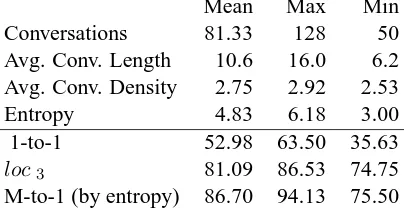
Mean Max Min
Conversations 81.33 128 50
Avg. Conv. Length 10.6 16.0 6.2 Avg. Conv. Density 2.75 2.92 2.53
Entropy 4.83 6.18 3.00
1-to-1 52.98 63.50 35.63
loc3 81.09 86.53 74.75
[image:4.612.76.278.62.167.2]M-to-1 (by entropy) 86.70 94.13 75.50
Table 1: Statistics on 6 annotations of 800 lines of chat transcript. Inter-annotator agreement metrics (below the line) are calculated between distinct pairs of annotations.
3.3 Discussion
A statistical examination of our data (table 1) shows that that it is eminently suitable for disentanglement: the average number of conversations active at a time is 2.75. Our annotators have high agreement on the local metric (average of 81.1%). On the 1-to-1 metric, they disagree more, with a mean overlap of 53.0% and a maximum of only 63.5%. This level of overlap does indicate a useful degree of reliabil-ity, which cannot be achieved with naive heuristics (see section 5). Thus measuring 1-to-1 overlap with our annotations is a reasonable evaluation for com-putational models. However, we feel that the major source of disagreement is one that can be remedied in future annotation schemes: the specificity of the individual annotations.
To measure the level of detail in an annotation, we use the information-theoretic entropy of the random variable which indicates which conversation an ut-terance is in. This quantity is non-negative, increas-ing as the number of conversations grow and their size becomes more balanced. It reaches its maxi-mum,9.64bits for this dataset, when each utterance is placed in a separate conversation. In our anno-tations, it ranges from 3.0 to 6.2. This large vari-ation shows that some annotators are more specific than others, but does not indicate how much they agree on the general structure. To measure this, we introduce the many-to-one accuracy. This measure-ment is asymmetrical, and maps each of the conver-sations of the source annotation to the single
con-3
This is an example of max-weight bipartite matching, and can be computed optimally using, eg, max-flow. The widely used greedy algorithm is a two-approximation, although we have not found large differences in practice.
(Lai) need money
(Astrid) suggest a paypal fund or similar (Lai) Azzie [sic; typo for Astrid?]: my shack guy here said paypal too but i have no local bank acct
(Felicia) second’s Azzie’s suggestion (Gale) we should charge the noobs $1 per question to [Lai’s] paypal
(Felicia) bingo!
(Gale) we’d have the money in 2 days max (Azzie) Lai: hrm, Have you tried to set one up?
(Arlie) the federal reserve system conspir-acy is keeping you down man
(Felicia) Gale: all ubuntu users .. pay up! (Gale) and susers pay double
(Azzie) I certainly would make suse users pay.
(Hildegard) triple.
(Lai) Azzie: not since being offline (Felicia) it doesn’t need to be “in state” either
Figure 2: A schism occurring in our corpus (abridged): not all annotators agree on where the thread about charg-ing for answers to techical questions diverges from the one about setting up Paypal accounts. Either Gale’s or Azzie’s first comment seems to be the schism-inducing utterance.
versation in the target with which it has the great-est overlap, then counts the total percentage of over-lap. This is not a statistic to be optimized (indeed, optimization is trivial: simply make each utterance in the source into its own conversation), but it can give us some intuition about specificity. In partic-ular, if one subdivides a coarse-grained annotation to make a more specific variant, the many-to-one accuracy from fine to coarse remains 1. When we map high-entropy annotations (fine) to lower ones (coarse), we find high many-to-one accuracy, with a mean of 86%, which implies that the more specific annotations have mostly the same large-scale bound-aries as the coarser ones.
of-ten in agreement. If they recognize subdivisions of a large conversation, these subdivisions tend to be contiguous, not mingled together, which is why they have little impact on the local measure.
We find reasons for the annotators’ disagreement about appropriate levels of detail in the linguistic literature. As mentioned, new conversations of-ten break off from old ones in schisms. Aoki et al. (2006) discuss conversational features associated with schisming and the related process of affiliation, by which speakers attach themselves to a conversa-tion. Schisms often branch off from asides or even normal comments (toss-outs) within an existing con-versation. This means that there is no clear begin-ning to the new conversation– at the time when it begins, it is not clear that there are two separate floors, and this will not become clear until distinct sets of speakers and patterns of turn-taking are es-tablished. Speakers, meanwhile, take time to ori-ent themselves to the new conversation. An example schism is shown in Figure 2.
Our annotation scheme requires annotators to mark each utterance as part of a single conversation, and distinct conversations are not related in any way. If a schism occurs, the annotator is faced with two options: if it seems short, they may view it as a mere digression and label it as part of the parent conver-sation. If it seems to deserve a place of its own, they will have to separate it from the parent, but this sev-ers the initial comment (an otherwise unremarkable aside) from its context. One or two of the annota-tors actually remarked that this made the task con-fusing. Our annotators seem to be either “splitters” or “lumpers”– in other words, each annotator seems to aim for a consistent level of detail, but each one has their own idea of what this level should be.
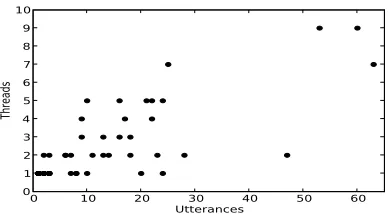
As a final observation about the dataset, we test the appropriateness of the assumption (used in pre-vious work) that each speaker takes part in only one conversation. In our data, the average speaker takes part in about 3.3 conversations (the actual number varies for each annotator). The more talkative a speaker is, the more conversations they participate in, as shown by a plot of conversations versus utter-ances (Figure 3). The assumption is not very accu-rate, especially for speakers with more than 10 utter-ances.
0 10 20 30 40 50 60
Utterances 0
1 2 3 4 5 6 7 8 9 10
[image:5.612.325.520.65.172.2]Threads
Figure 3: Utterances versus conversations participated in per speaker on development data.
4 Model
Our model for disentanglement fits into the general class of graph partitioning algorithms (Roth and Yih, 2004) which have been used for a variety of tasks in NLP, including the related task of meeting segmen-tation (Malioutov and Barzilay, 2006). These algo-rithms operate in two stages: first, a binary classifier marks each pair of items as alike or different, and second, a consistent partition is extracted.4
4.1 Classification
We use a maximum-entropy classifier (Daum´e III, 2004) to decide whether a pair of utterances x and y are in same or different conversations. The most likely class is different, which occurs 57% of the time in development data. We describe the classi-fier’s performance in terms of raw accuracy (cor-rect decisions / total), precision and recall of the same class, and F-score, the harmonic mean of pre-cision and recall. Our classifier uses several types of features (table 2). The chat-specific features yield the highest accuracy and precision. Discourse and content-based features have poor accuracy on their own (worse than the baseline), since they work best on nearby pairs of utterances, and tend to fail on more distant pairs. Paired with the time gap fea-ture, however, they boost accuracy somewhat and produce substantial gains in recall, encouraging the model to group related utterances together.
The time gap, as discussed above, is the most widely used feature in previous work. We
exam-4
Chat-specific (Acc 73: Prec: 73 Rec: 61 F: 66) Time The time between x and y in
sec-onds, bucketed logarithmically. Speaker x and y have the same speaker. Mention x mentions y (or vice versa),
both mention the same name, ei-ther mentions any name.
Discourse (Acc 52: Prec: 47 Rec: 77 F: 58) Cue words Either x or y uses a greeting (“hello” &c), an answer (“yes”, “no” &c), or thanks.
Question Either asks a question (explicitly marked with “?”).
Long Either is long (>10words). Content (Acc 50: Prec: 45 Rec: 74 F: 56) Repeat(i) The number of words shared
between x and y which have unigram probability i, bucketed logarithmically.
Tech Whether both x and y use tech-nical jargon, neither do, or only one does.
Combined (Acc 75: Prec: 73 Rec: 68 F: 71)
Table 2: Feature functions with performance on develop-ment data.
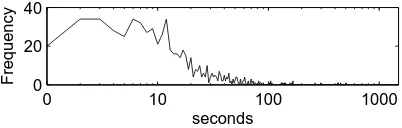
ine the distribution of pauses between utterances in the same conversation. Our choice of a logarithmic bucketing scheme is intended to capture two char-acteristics of the distribution (figure 4). The curve has its maximum at 1-3 seconds, and pauses shorter than a second are less common. This reflects turn-taking behavior among participants; participants in the same conversation prefer to wait for each others’ responses before speaking again. On the other hand, the curve is quite heavy-tailed to the right, leading us to bucket long pauses fairly coarsely.
Our discourse-based features model some
pair-0 10 100 1000
0 20 40
seconds
[image:6.612.78.279.608.672.2]Frequency
Figure 4: Distribution of pause length (log-scaled) be-tween utterances in the same conversation.
wise relationships: questions followed by answers, short comments reacting to longer ones, greetings at the beginning and thanks at the end.
Word repetition is a key feature in nearly every model for segmentation or coherence, so it is no sur-prise that it is useful here. We bucket repeated words by their unigram probability5(measured over the en-tire 52 hours of transcript). The bucketing scheme allows us to deal with “noise words” which are re-peated coincidentally.
The point of the repetition feature is of course to detect sentences with similar topics. We also find that sentences with technical content are more likely to be related than non-technical sentences. We label an utterance as technical if it contains a web address, a long string of digits, or a term present in a guide for novice Linux users6but not in a large news cor-pus (Graff, 1995)7. This is a light-weight way to capture one “semantic dimension” or cluster of re-lated words, in a corpus which is not amenable to full LSA or similar techniques. LSA in text corpora yields a better relatedness measure than simple rep-etition (Foltz et al., 1998), but is ineffective in our corpus because of its wide variety of topics and lack of distinct document boundaries.
Pairs of utterances which are widely separated in the discourse are unlikely to be directly related– even if they are part of the same conversation, the link between them is probably a long chain of in-tervening utterances. Thus, if we run our classifier on a pair of very distant utterances, we expect it to default to the majority class, which in this case will be different, and this will damage our performance in case the two are really part of the same conver-sation. To deal with this, we run our classifier only on utterances separated by 129 seconds or less. This is the last of our logarithmic buckets in which the classifier has a significant advantage over the major-ity baseline. For 99.9% of utterances in an ongoing conversation, the previous utterance in that conver-sation is within this gap, and so the system has a
5
We discard the 50 most frequent words entirely.
6
“Introduction to Linux: A Hands-on Guide”. Machtelt Garrels. Edition 1.25 from http://tldp.org/LDP/intro-linux/html/intro-linux.html .
7Our data came from the LA times, 94-97– helpfully, it
chance of correctly linking the two.
On test data, the classifier has a mean accuracy of
68.2(averaged over annotations). The mean preci-sion of same conversation is 53.3 and the recall is
71.3, with mean F-score of 60. This error rate is high, but the partitioning procedure allows us to re-cover from some of the errors, since if nearby utter-ances are grouped correctly, the bad decisions will be outvoted by good ones.
4.2 Partitioning
The next step in the process is to cluster the utter-ances. We wish to find a set of clusters for which the weighted accuracy of the classifier would be max-imal; this is an example of correlation clustering (Bansal et al., 2004), which is NP-complete8. Find-ing an exact solution proves to be difficult; the prob-lem has a quadratic number of variables (one for each pair of utterances) and a cubic number of tri-angle inequality constraints (three for each triplet). With 800 utterances in our test set, even solving the linear program with CPLEX (Ilog, Inc., 2003) is too expensive to be practical.
Although there are a variety of approximations and local searches, we do not wish to investigate partitioning methods in this paper, so we simply use a greedy search. In this algorithm, we as-sign utterance j by examining all previous utter-ances i within the classifier’s window, and treat-ing the classifier’s judgementpi,j−.5as a vote for
cluster(i). If the maximum vote is greater than 0, we setcluster(j) = argmaxc votec. Otherwisej
is put in a new cluster. Greedy clustering makes at least a reasonable starting point for further efforts, since it is a natural online algorithm– it assigns each utterance as it arrives, without reference to the fu-ture.
At any rate, we should not take our objective func-tion too seriously. Although it is roughly correlated with performance, the high error rate of the classifier makes it unlikely that small changes in objective will mean much. In fact, the objective value of our output solutions are generally higher than those for true
so-8We set up the problem by taking the weight of edgei, jas
the classifier’s decisionpi,j−.5. Roth and Yih (2004) use log
probabilities as weights. Bansal et al. (2004) propose the log odds ratiolog(p/(1−p)). We are unsure of the relative merit
of these approaches.
lutions, which implies we have already reached the limits of what our classifier can tell us.
5 Experiments
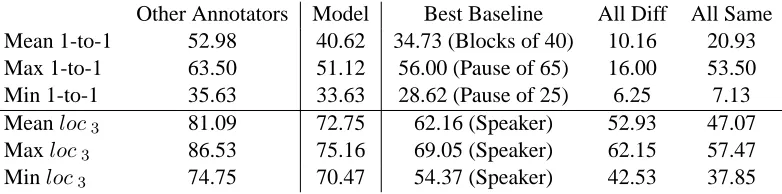
We annotate the 800 line test transcript using our system. The annotation obtained has 63 conversa-tions, with mean length12.70. The average density of conversations is2.9, and the entropy is3.79. This places it within the bounds of our human annota-tions (see table 1), toward the more general end of the spectrum.
As a standard of comparison for our system, we provide results for several baselines– trivial systems which any useful annotation should outperform.
All different Each utterance is a separate conversa-tion.
All same The whole transcript is a single conversa-tion.
Blocks ofk Each consecutive group ofkutterances is a conversation.
Pause ofk Each pause ofkseconds or more sepa-rates two conversations.
Speaker Each speaker’s utterances are treated as a monologue.
For each particular metric, we calculate the best baseline result among all of these. To find the best block size or pause length, we search over multiples of5between 5 and 300. This makes these baselines appear better than they really are, since their perfor-mance is optimized with respect to the test data.
Other Annotators Model Best Baseline All Diff All Same Mean 1-to-1 52.98 40.62 34.73 (Blocks of 40) 10.16 20.93 Max 1-to-1 63.50 51.12 56.00 (Pause of 65) 16.00 53.50 Min 1-to-1 35.63 33.63 28.62 (Pause of 25) 6.25 7.13
Meanloc3 81.09 72.75 62.16 (Speaker) 52.93 47.07
Maxloc3 86.53 75.16 69.05 (Speaker) 62.15 57.47
[image:8.612.76.467.58.155.2]Minloc3 74.75 70.47 54.37 (Speaker) 42.53 37.85
Table 3: Metric values between proposed annotations and human annotations. Model scores typically fall between inter-annotator agreement and baseline performance.
For the local metric, the results are much clearer. There is no overlap in the ranges; for every test an-notation, agreement is highest with other annota-tor, then our model and finally the baselines. The most competitive baseline is one conversation per speaker, which makes sense, since if a speaker makes two comments in a four-utterance window, they are very likely to be related.
The name mention features are critical for our model’s performance. Without this feature, the clas-sifier’s development F-score drops from 71 to 56. The disentanglement system’s test performance de-creases proportionally; mean 1-to-1 falls to 36.08, and mean loc3 to 63.00, essentially baseline
per-formance. On the other hand, mentions are not sufficient; with only name mention and time gap features, mean 1-to-1 is 38.54 and loc3 is 67.14.
For some utterances, of course, name mentions pro-vide the only reasonable clue to the correct deci-sion, which is why humans mention names in the first place. But our system is probably overly depen-dent on them, since they are very reliable compared to our other features.
6 Future Work
Although our annotators are reasonably reliable, it seems clear that they think of conversations as a hi-erarchy, with digressions and schisms. We are in-terested to see an annotation protocol which more closely follows human intuition and explicitly in-cludes these kinds of relationships.
We are also interested to see how well this feature set performs on speech data, as in (Aoki et al., 2003). Spoken conversation is more natural than text chat, but when participants are not face-to-face, disentan-glement remains a problem. On the other hand, spo-ken dialogue contains new sources of information,
such as prosody. Turn-taking behavior is also more distinct, which makes the task easier, but according to (Aoki et al., 2006), it is certainly not sufficient.
Improving the current model will definitely re-quire better features for the classifier. However, we also left the issue of partitioning nearly completely unexplored. If the classifier can indeed be improved, we expect the impact of search errors to increase. Another issue is that human users may prefer more or less specific annotations than our model provides. We have observed that we can produce lower or higher-entropy annotations by changing the classi-fier’s bias to label more edges same or different. But we do not yet know whether this corresponds with human judgements, or merely introduces errors.
7 Conclusion
This work provides a corpus of annotated data for chat disentanglement, which, along with our pro-posed metrics, should allow future researchers to evaluate and compare their results quantitatively9.
Our annotations are consistent with one another, es-pecially with respect to local agreement. We show that features based on discourse patterns and the content of utterances are helpful in disentanglement. The model we present can outperform a variety of baselines.
Acknowledgements
Our thanks to Suman Karumuri, Steve Sloman, Matt Lease, David McClosky, 7 test annotators, 3 pilot annotators, 3 anonymous reviewers and the NSF PIRE grant.
9
References
Evrim Acar, Seyit Ahmet Camtepe, Mukkai S. Kr-ishnamoorthy, and Blent Yener. 2005. Model-ing and multiway analysis of chatroom tensors. In Paul B. Kantor, Gheorghe Muresan, Fred Roberts, Daniel Dajun Zeng, Fei-Yue Wang, Hsinchun Chen, and Ralph C. Merkle, editors, ISI, volume 3495 of
Lecture Notes in Computer Science, pages 256–268.
Springer.
Paul M. Aoki, Matthew Romaine, Margaret H. Szyman-ski, James D. Thornton, Daniel Wilson, and Allison Woodruff. 2003. The mad hatter’s cocktail party: a social mobile audio space supporting multiple simul-taneous conversations. In CHI ’03: Proceedings of the
SIGCHI conference on Human factors in computing systems, pages 425–432, New York, NY, USA. ACM
Press.
Paul M. Aoki, Margaret H. Szymanski, Luke D. Plurkowski, James D. Thornton, Allison Woodruff, and Weilie Yi. 2006. Where’s the “party” in “multi-party”?: analyzing the structure of small-group socia-ble talk. In CSCW ’06: Proceedings of the 2006 20th
anniversary conference on Computer supported coop-erative work, pages 393–402, New York, NY, USA.
ACM Press.
Nikhil Bansal, Avrim Blum, and Shuchi Chawla. 2004. Correlation clustering. Machine Learning,
56(1-3):89–113.
Seyit Ahmet Camtepe, Mark K. Goldberg, Malik Magdon-Ismail, and Mukkai Krishnamoorty. 2005. Detecting conversing groups of chatters: a model, al-gorithms, and tests. In IADIS AC, pages 89–96. Hal Daum´e III. 2004. Notes on CG and LM-BFGS
optimization of logistic regression. Paper available at http://pub.hal3.name#daume04cg-bfgs, implemen-tation available at http://hal3.name/megam/, August. Peter Foltz, Walter Kintsch, and Thomas Landauer.
1998. The measurement of textual coherence with latent semantic analysis. Discourse Processes,
25(2&3):285–307.
Michel Galley, Kathleen McKeown, Eric Fosler-Lussier, and Hongyan Jing. 2003. Discourse segmentation of multi-party conversation. In ACL ’03: Proceedings of
the 41st Annual Meeting on Association for Compu-tational Linguistics, pages 562–569, Morristown, NJ,
USA. Association for Computational Linguistics. David Graff. 1995. North American News Text Corpus.
Linguistic Data Consortium. LDC95T21. Ilog, Inc. 2003. Cplex solver.
Natasa Jovanovic, Rieks op den Akker, and Anton Ni-jholt. 2006. Addressee identification in face-to-face meetings. In EACL. The Association for Computer Linguistics.
Igor Malioutov and Regina Barzilay. 2006. Minimum cut model for spoken lecture segmentation. In ACL. The Association for Computer Linguistics.
Jacki O’Neill and David Martin. 2003. Text chat in ac-tion. In GROUP ’03: Proceedings of the 2003
inter-national ACM SIGGROUP conference on Supporting group work, pages 40–49, New York, NY, USA. ACM
Press.
Dan Roth and Wen-tau Yih. 2004. A linear program-ming formulation for global inference in natural lan-guage tasks. In Proceedings of CoNLL-2004, pages 1–8. Boston, MA, USA.