Trainable Generation of Big-Five Personality Styles
through Data-driven Parameter Estimation
Franc¸ois Mairesse
Cambridge University Engineering Department Trumpington Street
Cambridge, CB2 1PZ, United Kingdom [email protected]
Marilyn Walker
Department of Computer Science University of Sheffield Sheffield, S1 4DP, United Kingdom
Abstract
Previous work on statistical language gen-eration has primarily focused on grammat-icality and naturalness, scoring generation possibilities according to a language model or user feedback. More recent work has investigated data-driven techniques for con-trolling linguistic style without overgenera-tion, by reproducing variation dimensions ex-tracted from corpora. Another line of work has produced handcraftedrule-basedsystems to control specific stylistic dimensions, such as politeness and personality. This paper describes a novel approach that automati-cally learns to produce recognisable varia-tion along a meaningful stylistic dimension— personality—without the computational cost incurred by overgeneration techniques. We present the first evaluation of a data-driven generation method that projects multiple per-sonality traitssimultaneouslyand on a contin-uousscale. We compare our performance to a rule-based generator in the same domain.
1 Introduction
Over the last 20 years, statistical language models (SLMs) have been used successfully in many tasks in natural language processing, and the data avail-able for modeling has steadily grown (Lapata and Keller, 2005). Langkilde and Knight (1998) first applied SLMs to statistical natural language genera-tion (SNLG), showing that high quality paraphrases can be generated from an underspecified representa-tion of meaning, by first applying a very undercon-strained, rule-based overgeneration phase, whose outputs are then ranked by an SLMscoring phase. Since then, research in SNLG has explored a range of models for both dialogue and text generation.
One line of work has primarily focused on gram-maticality and naturalness, scoring the
overgener-ation phase with a SLM, and evaluating against a gold-standard corpus, using string or tree-match metrics (Langkilde-Geary, 2002; Bangalore and Rambow, 2000; Chambers and Allen, 2004; Belz, 2005; Isard et al., 2006).
Another thread investigates SNLG scoring mod-els trained using higher-level linguistic features to replicate human judgments of utterance quality (Rambow et al., 2001; Nakatsu and White, 2006; Stent and Guo, 2005). The error of these scoring models approaches the gold-standard human rank-ing with a relatively small trainrank-ing set.
A third SNLG approach eliminates the overgen-eration phase (Paiva and Evans, 2005). It applies factor analysis to a corpus exhibiting stylistic vari-ation, and then learns which generation parameters to manipulate to correlate with factor measurements. The generator was shown to reproduce intended fac-tor levels across several facfac-tors, thus modelling the stylistic variation as measured in the original corpus. Our goal is a generation technique that can tar-get multiple stylistic effects simultaneously and over a continuous scale, controlling stylistic di-mensions that are commonly understood and thus
meaningful to users and application developers. Our intended applications are output utterances for intelligent training or intervention systems, video game characters, or virtual environment avatars. In previous work, we presented PERSON
-AGE, a psychologically-informed rule-based
genera-tor based on the Big Five personality model, and we showed that PERSONAGEcan project extreme per-sonality on the extraversion scale, i.e. both intro-verted and extraintro-verted personality types (Mairesse and Walker, 2007). We used the Big Five model to develop PERSONAGEfor several reasons. First, the Big Five has been shown in psychology to
Trait High Low Extraversion warm, assertive, sociable, excitement seeking, active,
spontaneous, optimistic, talkative
shy, quiet, reserved, passive, solitary, moody
Emotional stability calm, even-tempered, reliable, peaceful, confident neurotic, anxious, depressed, self-conscious Agreeableness trustworthy, considerate, friendly, generous, helpful unfriendly, selfish, suspicious, uncooperative,
ma-licious
[image:2.612.73.535.58.134.2]Conscientiousness competent, disciplined, dutiful, achievement striving disorganised, impulsive, unreliable, forgetful Openness to experience creative, intellectual, curious, cultured, complex narrow-minded, conservative, ignorant, simple
Table 1: Example adjectives associated with extreme values of the Big Five trait scales.
plain much of the variation in human perceptions of personality differences. Second, we believe that the adjectives used to develop the Big Five model pro-vide an intuitive, meaningful definition of linguis-tic style. Table 1 shows some of the trait adjec-tives associated with the extremes of each Big Five trait. Third, there are many studies linking person-ality to linguistic variables (Pennebaker and King, 1999; Mehl et al., 2006, inter alia). See (Mairesse and Walker, 2007) for more detail.
In this paper, we further test the utility of basing stylistic variation on the Big Five personality model. The Big Five traits are represented by scalar val-ues that range from 1 to 7, with valval-ues normally distributed among humans. While our previous work targeted extreme values of individual traits, here we show that we can target multiple person-ality traits simultaneously and over the continuous
scales of the Big Five model. Section 2 describes a novel parameter-estimation method that automat-ically learns to produce recognisable variation for all Big Five traits, without overgeneration, imple-mented in a new SNLG called PERSONAGE-PE. We show that PERSONAGE-PE generates targets for multiple personality dimensions, using linear and non-linear parameter estimation models to predict generation parameters directly from the scalar tar-gets. Section 3.2 shows that humans accurately per-ceive the intended variation, and Section 3.3 com-pares PERSONAGE-PE (trained) with PERSONAGE
(rule-based; Mairesse and Walker, 2007). We delay a detailed discussion of related work to Section 4, where we summarize and discuss future work.
2 Parameter Estimation Models
The data-driven parameter estimation method con-sists of a development phase and a generation phase (Section 3). The development phase:
1. Uses a base generator to produce multiple utter-ances by randomly varying its parameters;
2. Collects human judgments rating the personality of each utterance;
3. Trains statistical models to predict the parameters from the personality judgments;
7.00 6.00 5.00 4.00 3.00 2.00 1.00
Agreeableness rating
30
20
10
0
Frequency
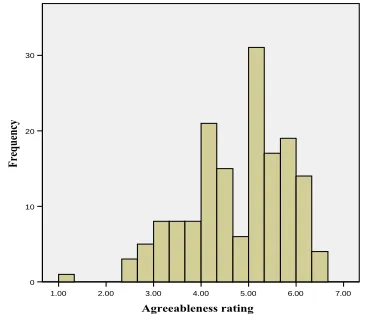
Figure 1: Distribution of average agreeableness ratings from the 2 expert judges for 160 random utterances.
4. Selects the best model for each parameter via cross-validation.
2.1 Base Generator
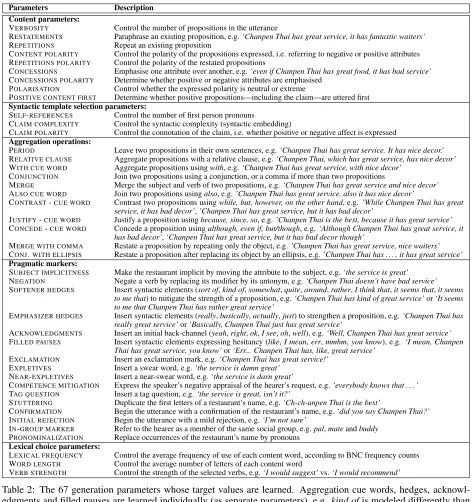
We make minimal assumptions about the input to the generator to favor domain independence. The input is a speech act, a potential content pool that can be used to achieve that speech act, and five scalar personality parameters (1. . .7), specifying values for the continuous scalar dimensions of each trait in the Big Five model. See Table 1. This requires a base generator that generates multiple outputs ex-pressing the same input content by varying linguis-tic parameters related to the Big Five traits. We start with the PERSONAGEgenerator (Mairesse and Walker, 2007), which generates recommendations and comparisons of restaurants. We extend PER -SONAGE with new parameters for a total of 67 pa-rameters in PERSONAGE-PE. See Table 2. These parameters are derived from psychological studies identifying linguistic markers of the Big Five traits (Pennebaker and King, 1999; Mehl et al., 2006, in-ter alia). As PERSONAGE’s input parameters are domain-independent, most parameters range contuously between 0 and 1, while pragmatic marker in-sertion parameters are binary, except for the SUB
[image:2.612.334.517.168.325.2]-Parameters Description Content parameters:
VERBOSITY Control the number of propositions in the utterance
RESTATEMENTS Paraphrase an existing proposition, e.g.‘Chanpen Thai has great service, it has fantastic waiters’
REPETITIONS Repeat an existing proposition
CONTENT POLARITY Control the polarity of the propositions expressed, i.e. referring to negative or positive attributes
REPETITIONS POLARITY Control the polarity of the restated propositions
CONCESSIONS Emphasise one attribute over another, e.g.‘even if Chanpen Thai has great food, it has bad service’
CONCESSIONS POLARITY Determine whether positive or negative attributes are emphasised
POLARISATION Control whether the expressed polarity is neutral or extreme
POSITIVE CONTENT FIRST Determine whether positive propositions—including the claim—are uttered first
Syntactic template selection parameters:
SELF-REFERENCES Control the number of first person pronouns
CLAIM COMPLEXITY Control the syntactic complexity (syntactic embedding)
CLAIM POLARITY Control the connotation of the claim, i.e. whether positive or negative affect is expressed
Aggregation operations:
PERIOD Leave two propositions in their own sentences, e.g.‘Chanpen Thai has great service. It has nice decor.’
RELATIVE CLAUSE Aggregate propositions with a relative clause, e.g.‘Chanpen Thai, which has great service, has nice decor’
WITH CUE WORD Aggregate propositions usingwith, e.g.‘Chanpen Thai has great service, with nice decor’
CONJUNCTION Join two propositions using a conjunction, or a comma if more than two propositions
MERGE Merge the subject and verb of two propositions, e.g.‘Chanpen Thai has great service and nice decor’
ALSO CUE WORD Join two propositions usingalso, e.g.’Chanpen Thai has great service, also it has nice decor’
CONTRAST-CUE WORD Contrast two propositions usingwhile, but, however, on the other hand, e.g.’While Chanpen Thai has great
service, it has bad decor’,’Chanpen Thai has great service, but it has bad decor’
JUSTIFY-CUE WORD Justify a proposition usingbecause, since, so, e.g.’Chanpen Thai is the best, because it has great service’
CONCEDE-CUE WORD Concede a proposition usingalthough, even if, but/though, e.g.‘Although Chanpen Thai has great service, it
has bad decor’,‘Chanpen Thai has great service, but it has bad decor though’
MERGE WITH COMMA Restate a proposition by repeating only the object, e.g.’Chanpen Thai has great service, nice waiters’
CONJ.WITH ELLIPSIS Restate a proposition after replacing its object by an ellipsis, e.g.’Chanpen Thai has . . . , it has great service’
Pragmatic markers:
SUBJECT IMPLICITNESS Make the restaurant implicit by moving the attribute to the subject, e.g.‘the service is great’
NEGATION Negate a verb by replacing its modifier by its antonym, e.g.‘Chanpen Thai doesn’t have bad service’
SOFTENER HEDGES Insert syntactic elements (sort of,kind of,somewhat,quite,around,rather,I think that,it seems that,it seems
to me that) to mitigate the strength of a proposition, e.g.‘Chanpen Thai has kind of great service’or‘It seems to me that Chanpen Thai has rather great service’
EMPHASIZER HEDGES Insert syntactic elements (really,basically,actually,just) to strengthen a proposition, e.g.‘Chanpen Thai has
really great service’or‘Basically, Chanpen Thai just has great service’
ACKNOWLEDGMENTS Insert an initial back-channel (yeah,right,ok,I see,oh,well), e.g.‘Well, Chanpen Thai has great service’
FILLED PAUSES Insert syntactic elements expressing hesitancy (like,I mean,err,mmhm,you know), e.g. ‘I mean, Chanpen
Thai has great service, you know’or‘Err... Chanpen Thai has, like, great service’
EXCLAMATION Insert an exclamation mark, e.g.‘Chanpen Thai has great service!’
EXPLETIVES Insert a swear word, e.g.‘the service is damn great’
NEAR-EXPLETIVES Insert a near-swear word, e.g.‘the service is darn great’
COMPETENCE MITIGATION Express the speaker’s negative appraisal of the hearer’s request, e.g.‘everybody knows that . . . ’
TAG QUESTION Insert a tag question, e.g.‘the service is great, isn’t it?’
STUTTERING Duplicate the first letters of a restaurant’s name, e.g.‘Ch-ch-anpen Thai is the best’
CONFIRMATION Begin the utterance with a confirmation of the restaurant’s name, e.g.‘did you say Chanpen Thai?’
INITIAL REJECTION Begin the utterance with a mild rejection, e.g.‘I’m not sure’
IN-GROUP MARKER Refer to the hearer as a member of the same social group, e.g.pal,mateandbuddy
PRONOMINALIZATION Replace occurrences of the restaurant’s name by pronouns
Lexical choice parameters:
LEXICAL FREQUENCY Control the average frequency of use of each content word, according to BNC frequency counts
WORD LENGTH Control the average number of letters of each content word
[image:3.612.70.543.57.559.2]VERB STRENGTH Control the strength of the selected verbs, e.g.‘I would suggest’vs.‘I would recommend’
Table 2: The 67 generation parameters whose target values are learned. Aggregation cue words, hedges, acknowl-edgments and filled pauses are learned individually (as separate parameters), e.g. kind ofis modeled differently than somewhatin theSOFTENER HEDGEScategory. Parameters are detailed in previous work (Mairesse and Walker, 2007).
NALIZATIONparameters.
2.2 Random Sample Generation and Expert Judgments
We generate a sample of 160randomutterances by varying the parameters in Table 2 with a uniform dis-tribution. This sample is intended to provide enough training material for estimating all 67 parameters for each personality dimension. Following Mairesse
nor-mally distributed; Figure 1 shows the distribution for agreeableness.
2.3 Statistical Model Training
Training data is created for each generation parameter—i.e. the output variable—to train statis-tical models predicting the optimal parameter value from the target personality scores. The models are thus based on the simplifying assumption that the generation parameters are independent. Any person-ality trait whose correlation with a generation deci-sion is below 0.1 is removed from the training data. This has the effect of removing parameters that do not correlate strongly with any trait, which are set to a constant default value at generation time. Since the input parameter values may not be satisfiable depending on the input content, the actual genera-tion decisions made for each utterance are recorded. For example, the CONCESSIONS decision value is the actual number of concessions produced in the utterance. To ensure that the models’ output can control the generator, the generation decision values are normalized to match the input range (0. . .1) of PERSONAGE-PE. Thus the dataset consists of 160 utterances and the corresponding generation deci-sions, each associated with 5 personality ratings av-eraged over both judges.
Parameter estimation models are trained to predict either continuous (e.g. VERBOSITY) or binary (e.g.
EXCLAMATION) generation decisions. We compare various learning algorithms using the Weka toolkit (with default values unless specified; Witten and Frank, 2005). Continuous parameters are modeled with a linear regression model (LR), an M5’ model tree (M5), and a model based on support vector ma-chines with a linear kernel (SVM). As regression models can extrapolate beyond the[0,1]interval, the output parameter values are truncated if needed—at generation time—before being sent to the base gen-erator. Binary parameters are modeled using clas-sifiers that predict whether the parameter isenabled
ordisabled. We test a Naive Bayes classifier (NB), a j48 decision tree (J48), a nearest-neighbor classifier using one neighbor (NN), a Java implementation of the RIPPER rule-based learner (JRIP), the AdaBoost boosting algorithm (ADA), and a support vector ma-chines classifier with a linear kernel (SVM).
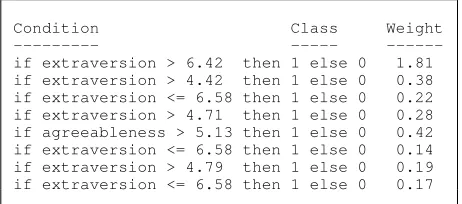
Figures 2, 3 and 4 show the models learned for theEXCLAMATION(binary),STUTTERING (contin-uous), and CONTENT POLARITY (continuous) pa-rameters in Table 2. The models predict generation parameters from input personality scores; note that
Condition Class Weight
--- ---
---if extraversion > 6.42 then 1 else 0 1.81 if extraversion > 4.42 then 1 else 0 0.38 if extraversion <= 6.58 then 1 else 0 0.22 if extraversion > 4.71 then 1 else 0 0.28 if agreeableness > 5.13 then 1 else 0 0.42 if extraversion <= 6.58 then 1 else 0 0.14 if extraversion > 4.79 then 1 else 0 0.19 if extraversion <= 6.58 then 1 else 0 0.17
Figure 2: AdaBoost model predicting theEXCLAMATION
parameter. Given input trait values, the model outputs the class yielding the largest sum of weights for the rules returning that class. Class 0 =disabled, class 1 =enabled.
(normalized) Content polarity = 0.054
- 0.102 * (normalized) emotional stability + 0.970 * (normalized) agreeableness - 0.110 * (normalized) conscientiousness + 0.013 * (normalized) openness to
[image:4.612.313.544.62.164.2]experience
Figure 3: SVM model with a linear kernel predicting the
CONTENT POLARITYparameter.
sometimes the best performing model is non-linear. Given input trait values, the AdaBoost model in Fig-ure 2 outputs the class yielding the largest sum of weights for the rules returning that class. For ex-ample, the first rule of the EXCLAMATION model shows that an extraversion score above 6.42 out of 7 would increase the weight of theenabledclass by 1.81. The fifth rule indicates that a target agreeable-ness above 5.13 would further increase the weight by .42. The STUTTERING model tree in Figure 4 lets us calculate that a low emotional stability (1.0) together with a neutral conscientiousness and open-ness to experience (4.0) yield a parameter value of .62 (see LM2), whereas a neutral emotional stabil-ity decreases the value down to .17. Figure 4 also shows how personality traits that do not affect the parameter are removed, i.e. emotional stability, con-scientiousness and openness to experience are the traits that affect stuttering. The linear model in Fig-ure 3 shows that agreeableness has a strong effect on theCONTENT POLARITYparameter (.97 weight), but emotional stability, conscientiousness and open-ness to experience also have an effect.
2.4 Model Selection
pa-≤3.875 >3.875 Conscientiousness
Emotional stability
≤4.375 >4.375
Stuttering =
-0.0136 * emotional stability + 0.0098 * conscientiousness + 0.0063 * openness to experience + 0.0126
Stuttering =
-0.1531 * emotional stability + 0.004 * conscientiousness + 0.1122 * openness to experience + 0.3129
Stuttering =
[image:5.612.127.482.59.186.2]-0.0142 * emotional stability + 0.004 * conscientiousness + 0.0076 * openness to experience + 0.0576
Figure 4: M5’ model tree predicting theSTUTTERINGparameter.
Continuous parameters LR M5 SVM Content parameters:
VERBOSITY 0.24 0.26 0.21
RESTATEMENTS 0.14 0.14 0.04
REPETITIONS 0.13 0.13 0.08
CONTENT POLARITY 0.46 0.46 0.47
REPETITIONS POLARITY 0.02 0.15 0.06
CONCESSIONS 0.23 0.23 0.12
CONCESSIONS POLARITY -0.01 0.16 0.07
POLARISATION 0.20 0.21 0.20
Syntactic template selection:
CLAIM COMPLEXITY 0.10 0.33 0.26
CLAIM POLARITY 0.04 0.04 0.05
Aggregation operations:
INFER- WITH CUE WORD 0.03 0.03 0.01
INFER- ALSO CUE WORD 0.10 0.10 0.06
JUSTIFY- SINCE CUE WORD 0.03 0.07 0.05
JUSTIFY- SO CUE WORD 0.07 0.07 0.04
JUSTIFY- PERIOD 0.36 0.35 0.21
CONTRAST- PERIOD 0.27 0.26 0.26
RESTATE- MERGE WITH COMMA 0.18 0.18 0.09
CONCEDE- ALTHOUGH CUE WORD 0.08 0.08 0.05
CONCEDE- EVEN IF CUE WORD 0.05 0.05 0.03
Pragmatic markers:
SUBJECT IMPLICITNESS 0.13 0.13 0.04
STUTTERING INSERTION 0.16 0.23 0.17
PRONOMINALIZATION 0.22 0.20 0.17
Lexical choice parameters:
LEXICAL FREQUENCY 0.21 0.21 0.19
WORD LENGTH 0.18 0.18 0.15
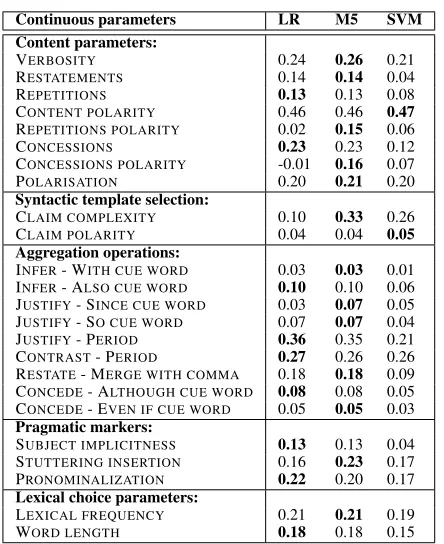
Table 3: Pearson’s correlation between parameter model predictions and continuous parameter values, for differ-ent regression models. Parameters that do not correlate with any trait are omitted. Aggregation operations are as-sociated with a rhetorical relation (e.g. INFER). Results are averaged over a 10-fold cross-validation.
rameters, Table 3 evaluates modeling accuracy by comparing the correlations between the model’s pre-dictions and the actual parameter values in the test folds. Table 4 reports results for binary parameter classifiers, by comparing the F-measures of the en-abled class. Best performing models are identified in bold; parameters that do not correlate with any trait or that produce a poor modeling accuracy are omitted.
The CONTENT POLARITYparameter is modeled
Binary parameters NB J48 NN ADA SVM Pragmatic markers:
SOFTENER HEDGES
kind of 0.00 0.00 0.16 0.11 0.10
rather 0.00 0.00 0.02 0.01 0.01
quite 0.14 0.08 0.09 0.07 0.06
EMPHASIZER HEDGES
basically 0.00 0.00 0.02 0.01 0.01
ACKNOWLEDGMENTS
yeah 0.00 0.00 0.04 0.03 0.03
ok 0.13 0.07 0.06 0.05 0.05
FILLED PAUSES
err 0.32 0.20 0.24 0.22 0.19
EXCLAMATION 0.23 0.34 0.36 0.38 0.34
EXPLETIVES 0.27 0.18 0.24 0.17 0.15
IN-GROUP MARKER 0.40 0.31 0.31 0.24 0.21
TAG QUESTION 0.32 0.21 0.21 0.15 0.13
[image:5.612.75.297.216.488.2]CONFIRMATION 0.00 0.00 0.07 0.04 0.04
Table 4: F-measure of theenabled class for classifica-tion models of binary parameters. Parameters that do not correlate with any trait are omitted. Results are av-eraged over a 10-fold cross-validation. JRIP models are not shown as they never perform best.
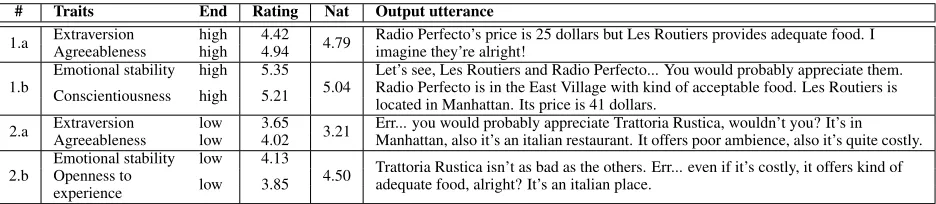
[image:5.612.312.539.221.382.2]# Traits End Rating Nat Output utterance
1.a ExtraversionAgreeableness highhigh 4.424.94 4.79 Radio Perfecto’s price is 25 dollars but Les Routiers provides adequate food. Iimagine they’re alright!
1.b
Emotional stability high 5.35 5.04
Let’s see, Les Routiers and Radio Perfecto... You would probably appreciate them. Radio Perfecto is in the East Village with kind of acceptable food. Les Routiers is located in Manhattan. Its price is 41 dollars.
Conscientiousness high 5.21
2.a Extraversion low 3.65 3.21 Err... you would probably appreciate Trattoria Rustica, wouldn’t you? It’s in Manhattan, also it’s an italian restaurant. It offers poor ambience, also it’s quite costly. Agreeableness low 4.02
2.b
Emotional stability low 4.13
4.50 Trattoria Rustica isn’t as bad as the others. Err... even if it’s costly, it offers kind of adequate food, alright? It’s an italian place.
Openness to
[image:6.612.74.542.60.162.2]low 3.85 experience
Table 5: Example outputs controlled by the parameter estimation models for a comparison (#1) and a recommendation (#2), with the average judges’ ratings (Rating) and naturalness (Nat). Ratings are on a scale from 1 to 7, with 1 = very low (e.g. neurotic or introvert) and 7 = very high on the dimension (e.g. emotionally stable or extraverted).
3 Evaluation Experiment
The generation phase of our parameter estimation SNLG method consists of the following steps:
1. Use the best performing models to predict parame-ter values from the desired personality scores;
2. Generate the output utterance using the predicted parameter values.
We then evaluate the output utterances using naive human judges to rate their perceived personality and naturalness.
3.1 Evaluation Method
Given the best performing model for each genera-tion parameter, we generate 5 utterances for each of 5 recommendation and 5 comparison speech acts. Each utterance targets an extreme value for two traits (either 1 or 7 out of 7) and neutral values for the re-maining three traits (4 out of 7). The goal is for each utterance to projectmultiple traits on acontinuous
scale. To generate a range of alternatives, a Gaus-sian noise with a standard deviation of 10% of the full scale is added to each target value.
Subjects were 24 native English speakers (12 male and 12 female graduate students from a range of disciplines from both the U.K. and the U.S.). Sub-jects evaluate the naturalness and personality of each utterance using the TIPI (Gosling et al., 2003). To limit the experiment’s duration, only the two traits with extreme target values are evaluated for each utterance. Subjects thus answered 5 questions for 50 utterances, two from the TIPI for each extreme trait and one about naturalness (250 judgments in total per subject). Subjects were not told that the utterances were intended to manifest extreme trait values. Table 5 shows several sample outputs and the mean personality ratings from the human judges. For example, utterance 1.a projects a high extraver-sion through the insertion of an exclamation mark
based on the model in Figure 2, whereas utterance 2.a conveys introversion by beginning with the filled pause err. The same utterance also projects a low agreeableness by focusing on negative propositions, through a lowCONTENT POLARITYparameter value as per the model in Figure 3. This evaluation ad-dresses a number of open questions discussed below. Q1: Is the personality projected by models trained on ratings from a few expert judges recognised by a larger sample of naive judges? (Section 3.2) Q2: Can acombinationof multiple traits within a single
utterance be detected by naive judges? (Section 3.2) Q3: How does PERSONAGE-PE compare to PERSON
-AGE, a psychologically-informed rule-based gen-erator for projecting extreme personality? (Sec-tion 3.3)
Q4: Does the parameter estimation SNLG method pro-duce natural utterances? (Section 3.4)
3.2 Parameter Estimation Evaluation
Table 6 shows that extraversion is the dimension modeled most accurately by the parameter estima-tion models, producing a .45 correlaestima-tion with the subjects’ ratings (p < .01). Emotional stability, agreeableness, and openness to experience ratings also correlate strongly with the target scores, with correlations of .39, .36 and .17 respectively (p < .01). Additionally, Table 6 shows that the magni-tude of the correlation increases when considering the perception of a hypothetical average subject, i.e. smoothing individual variation by averaging the rat-ings over all 24 judges, producing a correlationravg
up to .80 for extraversion. These correlations are unexpectedly high; in corpus analyses, significant correlations as low as .05 to .10 are typically ob-served between personality and linguistic markers (Pennebaker and King, 1999; Mehl et al., 2006).
comparison with rule-based results in Section 3.3 suggests that this is not because conscientiousness cannot be exhibited in our domain or manifested in a single utterance, so perhaps this arises from dif-fering perceptions of conscientiousness between the expert and naive judges.
Trait r ravg e
Extraversion .45• .80• 1.89 Emotional stability .39• .64• 2.14 Agreeableness .36• .68• 2.38 Conscientiousness -.01 -.02 2.79 Openness to experience .17• .41• 2.51
•statistically significant correlation
[image:7.612.78.292.146.236.2]p < .05,•p=.07(two-tailed)
Table 6: Pearson’s correlation coefficientrand mean ab-solute errorebetween the target personality scores and the 480 judges’ ratings (20 ratings per trait for 24 judges); ravgis the correlation between the personality scores and the average judges’ ratings.
Table 6 shows that the mean absolute error varies between 1.89 and 2.79 on a scale from 1 to 7. Such large errors result from the decision to ask judges to answer just the TIPI questions for the two traits that were the extreme targets (See Section 3.1), because the judges tend to use the whole scale, with approx-imately normally distributed ratings. This means that although the judges make distinctions leading to high correlations, they do so on a compressed scale. This explains the large correlations despite the mag-nitude of the absolute error.
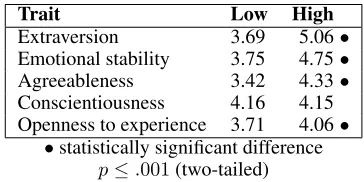
Table 7 shows results evaluating whether utter-ances targeting the extremes of a trait are perceived differently. The ratings differ significantly for all traits but conscientiousness (p ≤ .001). Thus pa-rameter estimation models can be used in applica-tions that only require discrete binary variation.
Trait Low High
Extraversion 3.69 5.06• Emotional stability 3.75 4.75• Agreeableness 3.42 4.33• Conscientiousness 4.16 4.15 Openness to experience 3.71 4.06•
[image:7.612.313.541.426.510.2]•statistically significant difference p≤.001(two-tailed)
Table 7: Average personality ratings for the utterances generated with the low and high target values for each trait on a scale from 1 to 7.
It is important to emphasize that generation pa-rameters were predicted based on 5 target person-ality values. Thus, the results show that individ-ualtraits are perceived even when utterances project
other traits as well, confirming that the Big Five the-ory models independent dimensions and thus pro-vides a useful and meaningful framework for mod-eling variation in language. Additionally, although we do not directly evaluate the perception of mid-range values of personality target scores, the results suggest that mid-range personality is modeled cor-rectly because the neutral target scores do not affect the perception of extreme traits.
3.3 Comparison with Rule-Based Generation
PERSONAGE is a rule-based personality generator based on handcrafted parameter settings derived from psychological studies. Mairesse and Walker (2007) show that this approach generates utterances that are perceptibly different along the extraversion dimension. Table 8 compares the mean ratings of the utterances generated by PERSONAGE-PE with ratings of 20 utterances generated by PERSONAGE
for each extreme of each Big Five scale (40 for ex-traversion, resulting in 240 handcrafted utterances in total). Table 8 shows that the handcrafted parame-ter settings project a significantly more extreme per-sonality for 6 traits out of 10. However, the learned parameter models for neuroticism, disagreeableness, unconscientiousness and openness to experience do not perform significantly worse than the handcrafted generator. These findings are promising as we dis-cuss further in Section 4.
Method Rule-based Learned parameters
Trait Low High Low High
Extraversion 2.96 5.98 3.69◦ 5.05◦ Emotional stability 3.29 5.96 3.75 4.75◦ Agreeableness 3.41 5.66 3.42 4.33◦ Conscientiousness 3.71 5.53 4.16 4.15◦ Openness to experience 2.89 4.21 3.71◦ 4.06
•,◦significant increase or decrease of the variation range over the average rule-based ratings (p < .05, two-tailed)
Table 8: Pair-wise comparison between the ratings of the utterances generated using PERSONAGE-PE with ex-treme target values (Learned Parameters), and the ratings for utterances generated with Mairesse and Walker’s rule-based PERSONAGEgenerator, (Rule-based). Ratings are averaged over all judges.
3.4 Naturalness Evaluation
[image:7.612.91.273.526.617.2]judges are more critical.
Trait Rule-based Random Learned
[image:8.612.83.276.87.109.2]All 4.59 4.38 3.98
Table 9: Average naturalness ratings for utterances gen-erated using (1) PERSONAGE, the rule-based generator, (2) the random utterances (expert judges) and (3) the out-puts of PERSONAGE-PE using the parameter estimation models (Learned, naive judges). The means differ sig-nificantly at the p < .05 level (two-tailed independent sample t-test).
4 Conclusion
We present a new method for generating linguis-tic variation projecting multiple personality traits continuously, by combining and extending previous research in statistical natural language generation (Paiva and Evans, 2005; Rambow et al., 2001; Is-ard et al., 2006; Mairesse and Walker, 2007). While handcrafted rule-based approaches are limited to variation along a small number of discrete points (Hovy, 1988; Walker et al., 1997; Lester et al., 1997; Power et al., 2003; Cassell and Bickmore, 2003; Pi-wek, 2003; Mairesse and Walker, 2007; Rehm and Andr´e, in press), we learn models that predict pa-rameter values for any arbitrary value on the varia-tion dimension scales. Addivaria-tionally, our data-driven approach can be applied to any dimension that is meaningful to human judges, and it provides an ele-gant way to project multiple dimensions simultane-ously, by including the relevant dimensions as fea-tures of the parameter models’ training data.
Isard et al. (2006) and Mairesse and Walker (2007) also propose a personality generation method, in which a data-driven personality model selects the best utterance from a large candidate set. Isard et al.’s technique has not been evaluated, while Mairesse and Walker’s overgenerate and score ap-proach is inefficient. Paiva and Evans’ technique does not overgenerate (2005), but it requires a search for the optimal generation decisions according to the learned models. Our approach does not require any search or overgeneration, as parameter estima-tion models predict the generaestima-tion decisions directly from the target variation dimensions. This tech-nique is therefore beneficial for real-time genera-tion. Moreover the variation dimensions of Paiva and Evans’ data-driven technique are extracted from a corpus: there is thus no guarantee that they can be easily interpreted by humans, and that they gen-eralise to other corpora. Previous work has shown that modeling the relation between personality and
language is far from trivial (Pennebaker and King, 1999; Argamon et al., 2005; Oberlander and Now-son, 2006; Mairesse et al., 2007), suggesting that the control of personality is a harder problem than the control of data-driven variation dimensions.
We present the first human perceptual evaluation of a data-driven stylistic variation method. In terms of our research questions in Section 3.1, we show that models trained on expert judges to project mul-tiple traits in a single utterance generate utterances whose personality is recognized by naive judges. There is only one other similar evaluation of an SNLG (Rambow et al., 2001). Our models perform only slightly worse than a handcrafted rule-based generator in the same domain. These findings are promising as (1) parameter estimation models are able to target any combination of traits over the full range of the Big Five scales; (2) they do not benefit from psychological knowledge, i.e. they are trained on randomly generated utterances.
This work also has several limitations that should be addressed in future work. Even though the parameters of PERSONAGE-PE were suggested by psychological studies (Mairesse and Walker, 2007), some of them are not modeled successfully by our approach, and thus omitted from Tables 3 and 4. This could be due to the relatively small develop-ment dataset size (160 utterances to optimize 67 pa-rameters), or to the implementation of some param-eters. The strong parameter-independence assump-tion could also be responsible, but we are not aware of any state of the art implementation for learn-ing multiple dependent variables, and this approach could further aggravate data sparsity issues.
References
S. Argamon, S. Dhawle, M. Koppel, and J. Pennebaker. Lexical predictors of personality type. InProceedings of the Joint Annual Meeting of the Interface and the Classification Society of North America, 2005.
S. Bangalore and O. Rambow. Exploiting a probabilistic hierarchical model for generation. In Proceedings of the 18th International Conference on Computational Linguistics (COLING), pages 42–48, 2000.
A. Belz. Corpus-driven generation of weather forecasts. InProceedings of the 3rd Corpus Linguistics Confer-ence, 2005.
J. Cassell and T. Bickmore. Negotiated collusion: Mod-eling social language and its relationship effects in in-telligent agents.User Modeling and User-Adapted In-teraction, 13:89–132, 2003.
N. Chambers and J. Allen. Stochastic language genera-tion in a dialogue system: Toward a domain indepen-dent generator. InProceedings 5th SIGdial Workshop on Discourse and Dialogue, 2004.
S. D. Gosling, P. J. Rentfrow, and W. B. Swann. A very brief measure of the big five personality domains. Journal of Research in Personality, 37:504–528, 2003.
E. Hovy.Generating Natural Language under Pragmatic Constraints. Lawrence Erlbaum Associates, 1988.
A. Isard, C. Brockmann, and J. Oberlander. Individuality and alignment in generated dialogues. InProceedings of the 4th International Natural Language Generation Conference (INLG), pages 22–29, 2006.
I. Langkilde and K. Knight. Generation that exploits corpus-based statistical knowledge. InProceedings of the 36th Annual Meeting of the Association for Com-putational Linguistics (ACL), pages 704–710, 1998.
I. Langkilde-Geary. An empirical verification of coverage and correctness for a general-purpose sentence genera-tor. InProceedings of the 1st International Conference on Natural Language Generation, 2002.
M. Lapata and F. Keller. Web-based models for natu-ral language processing.ACM Transactions on Speech and Language Processing, 2:1–31, 2005.
J. Lester, S. Converse, S. Kahler, S. Barlow, B. Stone, and R. Bhogal. The persona effect: affective impact of animated pedagogical agents. Proceedings of the SIGCHI conference on Human factors in computing systems, pages 359–366, 1997.
F. Mairesse and M. A. Walker. PERSONAGE: Personal-ity generation for dialogue. InProceedings of the 45th Annual Meeting of the Association for Computational Linguistics (ACL), pages 496–503, 2007.
F. Mairesse, M. A. Walker, M. R. Mehl, and R. K. Moore. Using linguistic cues for the automatic recognition of personality in conversation and text. Journal of Artifi-cial Intelligence Research (JAIR), 30:457–500, 2007.
M. R. Mehl, S. D. Gosling, and J. W. Pennebaker. Person-ality in its natural habitat: Manifestations and implicit folk theories of personality in daily life. Journal of Personality and Social Psychology, 90:862–877, 2006.
C. Nakatsu and M. White. Learning to say it well: Reranking realizations by predicted synthesis quality. InProceedings of the 44th Annual Meeting of the As-sociation for Computational Linguistics (ACL), pages 1113–1120, 2006.
J. Oberlander and S. Nowson. Whose thumb is it any-way? classifying author personality from weblog text. InProceedings of the 44th Annual Meeting of the As-sociation for Computational Linguistics (ACL), 2006.
D. S. Paiva and R. Evans. Empirically-based control of natural language generation. In Proceedings of the 43rd Annual Meeting of the Association for Compu-tational Linguistics (ACL), pages 58–65, 2005.
J. W. Pennebaker and L. A. King. Linguistic styles: Lan-guage use as an individual difference. Journal of Per-sonality and Social Psychology, 77:1296–1312, 1999.
P. Piwek. A flexible pragmatics-driven language gener-ator for animated agents. In Proceedings of Annual Meeting of the European Chapter of the Association for Computational Linguistics (EACL), 2003.
R. Power, D. Scott, and N. Bouayad-Agha. Generating texts with style. In Proceedings of the 4th Interna-tional Conference on Intelligent Text Processing and Computational Linguistics, 2003.
O. Rambow, M. Rogati, and M. A. Walker. Evaluating a trainable sentence planner for a spoken dialogue travel system. InProceedings of the 39th Annual Meeting of the Association for Computational Linguistics (ACL), 2001.
M. Rehm and E. Andr´e. From annotated multi-modal corpora to simulated human-like behaviors. In I. Wachsmuth and G. Knoblich, editors, Model-ing Communication with Robots and Virtual Humans. Springer, Berlin, Heidelberg, in press.
A. Stent and H. Guo. A new data-driven approach for multimedia presentation generation. InProc. Eu-roIMSA, 2005.
M. A. Walker, J. E. Cahn, and S. J. Whittaker. Improvis-ing lImprovis-inguistic style: Social and affective bases for agent personality. InProceedings of the 1st Conference on Autonomous Agents, pages 96–105, 1997.