A Prosodic Analysis of Discourse Segments in
Direction- Giving Monologues
Julia Hirschberg
AT&T Laboratories, 2C-409
600 Mountain Avenue
Murray Hill, NJ 07974
Christine H. Nakatani*
Harvard University
33 Oxford Street
Cambridge, MA 02138
A b s t r a c t
This paper reports on corpus-based research
into the relationship between intonational vari- ation and discourse structure. We examine the
effects of speaking style (read versus sponta- neous) and of discourse segmentation method
(text-alone versus text-and-speech) on the na- ture of this relationship. We also compare
the acoustic-prosodic features of initial, me- dial, and final utterances in a discourse seg- ment.
1 I n t r o d u c t i o n
This paper presents empirical support for the as- sumption long held by computational linguists, that intonation can provide valuable cues for discourse processing. The relationship between intonational variation and discourse structure has been explored in a new corpus of direction-giving monologues. We examine the effects of speaking style (read versus spontaneous) and of discourse segmentation method (text-alone versus text-and-speech) on the nature of this relationship. We also compare the acoustic- prosodic features of initial, medial, and final utter- ances in a discourse segment. A better understand- ing of the role of intonation in conveying discourse structure will enable improvements in the natural- ness of intonational variation in text-to-speech sys- tems as well as in algorithms for recognizing dis- course structure in speech-understanding systems.
2 T h e o r e t i c a l a n d E m p i r i c a l F o u n d a t i o n s
It has long been assumed in computational lin- guistics that discourse structure plays an impor- tant role in Natural Language Understanding tasks such as identifying speaker intentions and resolving anaphoric reference. Previous research has found
*The second author was partially supported by NSF Grants No. IRI-90-09018, No. IRI-93-08173, and No. CDA-94-01024 at Harvard University and by AT&T Bell Laboratories.
that discourse structural information can be inferred from orthographic cues in text, such as paragraph- ing and punctuation; from linguistic cues in text or speech, such as c u e PHI~.ASES 1 (Cohen, 1984; Reichman, 1985; Grosz and Sidner, 1986; Passon- neau and Litman, 1993; Passonneau and Litman, to appear) and other lexical cues (Hinkelman and Allen, 1989); from variation in referring expres- sions (Linde, 1979; Levy, 1984; Grosz and Sidner, 1986; Webber, 1988; Song and Cohen, 1991; Passon- neau and Litman, 1993), tense, and aspect (Schu- bert and Hwang, 1990; Song and Cohen, 1991); from knowledge of the domain, especially for task- oriented discourses (Grosz, 1978); and from speaker intentions (Carberry, 1990; Litman and Hirschberg, 1990; Lochbaum, 1994). Recent methods for auto- matic recognition of discourse structure from text have incorporated thesaurus-based and other in- formation retrieval techniques to identify changes in topic (Morris and Hirst, 1991; Yarowsky, 1991; Iwafiska et al., 1991; Hearst, 1994; Reynar, 1994).
Parallel investigations on prosodic/acoustic cues to discourse structure have investigated the contri- butions of features such as pitch range, pausal du- ration, amplitude, speaking rate, and intonational contour to signaling topic change. Variation in pitch range has often been seen as conveying 'topic struc- ture' in discourse. Brown et al. (1980) found that subjects typically started new topics relatively high in their pitch range and finished topics by com- pressing their range. Silverman (1987) found that manipulation of pitch range alone, or in conjunc- tion with pausal duration between utterances, facil- itated the disambiguation of ambiguous topic struc- tures. Avesani and Vayra (1988) also found variation in pitch range in professional recordings which ap- peared to correlate with topic structure, and Ayers (1992) found that pitch range correlates with hierar- chical topic structure more closely in read than spon- taneous conversational speech. Duration of pause between utterances or phrases has also been identi-
fled as an indicator of topic structure, with longer pauses marking major topic shifts (Lehiste, 1979; Brown, Currie, and Kenworthy, 1980; Avesani and Vayra, 1988; Passonneau and Litman, 1993); Wood- bury (1987), however, found no such correlation in his data. Amplitude was also found to increase at the start of a new topic and decrease at the end (Brown, Currie, and Kenworthy, 1980). Swerts and colleagues (1992) found that melody and duration can pre-signal the end of a discourse unit, in ad- dition to marking the discourse-unit-final utterance itself. And speaking rate has been found to cor- relate with structural variation; in several studies (Lehiste, 1980; Brubaker, 1972; Butterworth, 1975) segment-initial utterances exhibited slower rates, and segment-final, faster rates. Swerts and Osten- dorf (1995), however, report negative rate results.
In general, these studies have lacked an independently-motivated notion of discourse struc- ture. With few exceptions, they rely on intuitive analyses of topic structure; operational definitions of discourse-level properties (e.g., interpreting para- graph breaks as discourse segment boundaries); or 'theory-neutral' discourse segmentations, where sub- jects are given instructions to simply mark changes in topic. Recent studies have focused on the ques- tion of whether discourse structure itself can be em- pirically determined in a reliable manner, a pre- requisite to investigating linguistic cues to its exis- tence. An intention-based theory of discourse was used in (Hirschberg and Grosz, 1992; Grosz and Hirschberg, 1992) to identify intonational correlates of discourse structure in news stories read by a professional speaker. Discourse structural elements were determined by experts in the Grosz and Sidner (1986) theory of discourse structure, based on either text alone or text and speech. This study revealed strong correlations of aspects of pitch range, ampli- tude, and timing with features of global and local structure for both segmentation methods. Passon- neau and Litman (to appear) analyzed correlations of pause, as well as cue phrases and referential re- lations, with discourse structure; their segmenters were asked to identify speakers' communicative "ac- tions". The present study addresses issues of speak- ing style and segmentation method while exploring in more detail than previous studies the prosodic pa- rameters that characterize initial, medial, and final utterances in a discourse segment.
3 M e t h o d s
3.1 T h e B o s t o n D i r e c t i o n s C o r p u s
The current investigation of discourse and intonation is based on analysis of a corpus of spontaneous and read speech, the Boston Directions Corpus. 2 This
2The Boston Directions Corpus was designed and col- lected in collaboration with Barbara Grosz.
corpus comprises elicited monologues produced by multiple non-professional speakers, who were given written instructions to perform a series of nine in- creasingly complex direction-giving tasks. Speakers first explained simple routes such as getting from one station to another on the subway, and progressed gradually to the most complex task of planning a round-trip journey from Harvard Square to several Boston tourist sights. Thus, the tasks were de- signed to require increasing levels of planning com- plexity. The speakers were provided with various maps, and could write notes to themselves as well as trace routes on the maps. For the duration of the experiment, the speakers were in face-to-face con- tact with a silent partner (a confederate) who traced on her map the routes described by the speakers. The speech was subsequently orthographically tran- scribed, with false starts and other speech errors re- paired or omitted; subjects returned several weeks after their first recording to read aloud from tran- scriptions of their own directions.
3.2 A c o u s t i c - P r o s o d i c A n a l y s i s
For this paper, the spontaneous and read recordings for one male speaker were acoustically analyzed; fun- damental frequency and energy were calculated us- ing Entropic speech analysis software. The prosodic transcription, a more abstract representation of the intonational prominences, phrasing, and melodic contours, was obtained by hand-labeling. We em- ployed the ToBI standard for prosodic transcription (Pitrelli, Beckman, and Hirschberg, 1994), which is based upon Pierrehumbert's theory of Ameri- can English intonation (Pierrehumbert, 1980). The ToBI transcription provided us with a breakdown of the speech sample into minor or INTERMEDIATE PHRASES (Pierrehumbert, 1980; Beckman and Pier- rehumbert, 1986). This level of prosodic phrase served as our primary unit of analysis for measur- ing both speech and discourse properties. The por- tion of the corpus we report on consists of 494 and 552 intermediate phrases for read and spontaneous speech, respectively.
3.3 D i s c o u r s e S e g m e n t a t i o n
In our research, the Grosz and Sidner (1986) the- ory of discourse structure, hereafter G&S, provides a foundation for segmenting discourses into con- stituent parts. According to this model, at least three components of discourse structure must be dis- tinguished. The utterances composing the discourse divide into segments that may be embedded rela- tive to one another. These segments and the em- bedding relationships between them form the LIN- GUISTIC STRUCTURE. The embedding relationships reflect changes in the ATTENTIONAL STATE, the dy- namic record of the entities and attributes that are salient during a particular part of the discourse. Changes in linguistic structure, and hence atten-
tional state, depend on the discourse's INTENTIONAL STRUCTURE; this structure comprises the intentions or DISCOURSE SEGMENT PURPOSES (DSPs) under- lying the discourse and relations between DSPs.
Two methods of discourse segmentation were em- ployed by subjects who had expertise in the G~:S theory. Following Hirschberg and Grosz (1992), three subjects labeled from text alone (group T) and three labeled from text and speech (group S). Other than this difference in input modality, all subjects received identical written instructions. The text for each task was presented with line breaks correspond- ing to intermediate phrase boundaries (i.e., ToBI BREAK INDICES of level 3 or higher (Pitrelli, Beck- man, and Hirschberg, 1994)). In the instructions, subjects were essentially asked to analyze the lin- guistic and intentional structures by segmenting the discourse, identifying the DSPs, and specifying the hierarchical relationships among segments.
4
R e s u l t s
4.1 D i s c o u r s e S e g m e n t a t i o n
4.1.1 R a w A g r e e m e n t
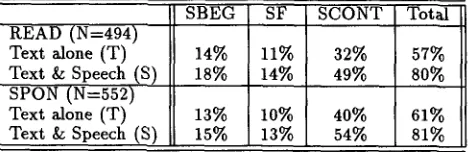
Labels on which all labelers in the group agreed are termed the CONSENSUS LABELS. 3 The consen- sus labels for segment-initial (SBEG), segment-final (SF), and segment-medial (SCONT, defined as nei- ther SBEG nor SF) phrase labels are given in Ta- ble 1. 4
Table h Percentage of Consensus Labels by Segment Boundary Type
SBEG SF SCONT Total
READ (N=494)
Text alone (T) 14% 11% 32% 57%
Text & Speech (S) 18% 14% 49% 80% SPON (N=552)
Text alone (T) 13% 10% 40% 61%
Text & Speech (S) 15% 13% 54% 81%
Note that group T and group S segmentations differ significantly, in contrast to earlier findings of ttirschberg and Grosz (1992) on a corpus of read- aloud news stories and in support of informal find- ings of Swerts (1995). Table 1 shows that group S produced significantly more consensus boundaries for both read (p<.001, X=58.8, df=l) and spon- taneous (p<.001,
X=55.4,
d f = l ) speech than did3Use of consensus labels is a conservative measure of labeler agreement. Results in (Passonneau and Litman, 1993) and (Swerts, 1995) show that with a larger num- ber of labelers, notions of BOUNDARY STRENGTH can be employed.
4Consensus percentages for the three types in Table 1 do not necessarily sum to the total consensus agreement percentage, since a phrase is both segment-initial and segment-final when it makes up a segment by itself.
group T. When the read and spontaneous data are pooled, group S agreed upon significantly more SBEG boundaries (p<.05,
X=4.7,
d f = l ) as well as SF boundaries (p<.05,X=4.4,
d f = l ) than did group T. Further, it is not the case that text-alone seg- menters simply chose to place fewer boundaries in the discourse; if this were so, then we would expect a high percentage of SCONT consensus labels where no SBEGs or SFs were identified. Instead, we find that the number of consensus SCONTs was signifi- cantly higher for text-and-speech labelings than for text-alone (p<.001, X=49.1, d f = l ) . It appears that the speech signal can help disambiguate among al- ternate segmentations of the same text. Finally, the data in Table 1 show that spontaneous speech can be segmented as reliably as its read counterpart, con- trary to Ayer's results (1992).4.1.2 I n t e r - l a b e l e r R e l i a b i l i t y
Comparisons of inter-labeler reliability, that is, the reproducibility of a coding scheme given multiple labelers, provide another perspective on the segmen- tation data. How best to measure inter-labeler re- liability for discourse segmentation tasks, especially for hierarchical segmentation, is an open research question (Passonneau and Litman, to appear; Car- letta, 1995; Flammia and Zue, 1995; Rotondo, 1984; Swerts, 1995). For comparative purposes, we ex- plored several measures proposed in the literature, namely, COCHRAN'S Q and the KAPPA (~) COEF- FICIENT (Siegel and Castellan, 1988). Cochran's Q, originally proposed in (Hirschberg and Grosz, 1992) to measure the likelihood that similarity among la- belings was due to chance, was not useful in the cur- rent study; all tests of similarity using this metric (pairwise, or comparing all labelers) gave probabil- ity near zero. We concluded that this statistic did not serve, for example, to capture the differences observed between labelings from text alone versus labelings from text and speech.
Recent discourse annotation studies (Isard and Carletta, 1995; Flammia and Zue, 1995) have mea- sured reliability using the g coefficient, which factors out chance agreement taking the expected distribu- tion of categories into account. This coefficient is defined as
P o - P~
1 - P s
where
Po
represents the observed agreement and [image:3.612.85.319.453.529.2]of .45 for five labelers and of .68 for the three m o s t similar labelers.
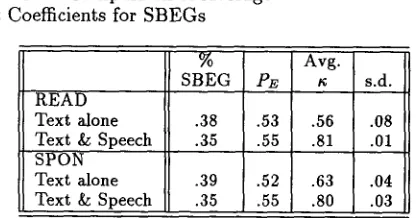
An i m p o r t a n t issue in applying the t~ coefficient is how one calculates the expected agreement us- ing prior distributions of categories. We first calcu- lated the prior probabilities for our d a t a based sim- ply on the distribution of SBEG versus non-SBEG labels for all labelers on one of the nine direction- giving tasks in this study, with separate calculations for the read and spontaneous versions. This task, which represented a b o u t 8% of the d a t a for b o t h speaking styles, was chosen because it was midway in planning complexity and in length a m o n g all the tasks. Using these distributions, we calculated x co- efficients for each pair of labelers in each condition for the remaining eight tasks in our corpus. T h e observed percentage of S B E G labels, prior distribu- tion for SBEG, average of the pairwise ~ scores, and standard deviations for those scores are presented in Table 2.
Table 3: C o m p a r i s o n of Weighted Average Coefficients and E x t r a for Each Condition Using F l a m m i a ' s Metric
READ Text alone Text & Speech SPON
Text alone Text & Speech
% Weighted
Average Low High
0.51 .22 .67
0.70 .48 .87
0.53 .19 .60
0.74 .63 1.00
Once again, averaged scores of .7 or better for text-and-speech labelings, for b o t h speaking styles, indicate markedly higher inter-labeler reliability than do scores for text-alone labelings, which av- eraged .51 and .53.
Table 2: C o m p a r i s o n of Average t¢ Coefficients for SBEGs
% Avg.
SBEG P~ a s.d.
-READ
Text alone .38 .53 .56 .08
Text & Speech .35 .55 .81 .01 SPON
Text alone .39 .52 .63 .04
Text & Speech .35 .55 .80 .03
The average g scores for group T segmenters indi- cate weak inter-labeler reliability. In contrast, aver- age t~ scores for group S are .8 or better, indicating a high degree of inter-labeler reliability. Thus, ap- plication of this s o m e w h a t stricter reliability metric confirms t h a t the availability of speech critically in- fluences how listeners perceive discourse structure.
The calculation of reliability for SBEG versus non- SBEG labeling in effect tests the similarity of lin- earized segmentations and does not speak to the is- sue of how similar the labelings are in terms of hier- archical structure. F l a m m i a has proposed a m e t h o d for generalizing the use of the g coefficient for hi- erarchical segmentation t h a t gives an u p p e r - b o u n d estimate on inter-labeler agreement. 5 We applied this metric to our segmentation data, calculating weighted averages for pairwise ~ scores averaged for each task. Results for each condition, together with the lowest and highest average ~ scores over the tasks, are presented in Table 3.
5Flammia uses a flexible definition of segment match to calculate pairwise observed agreement: roughly, a seg- ment in one segmentation is matched if both its SBEG and SF correspond to segment boundary locations in the other segmentation.
4.2 I n t o n a t i o n a l F e a t u r e s o f S e g m e n t s
4.2.1 P h r a s e Classes a n d F e a t u r e s
For purposes of intonational analysis, we take advantage of the high degree of agreement a m o n g our discourse labelers and include in each seg- m e n t b o u n d a r y class (SBEG, SF, and S C O N T ) only the phrases whose classification all subjects agreed upon. We t e r m these the CONSENSUS-LABELED PHRASES, and compare their features to those of all phrases not in the relevant class (i.e., non-consensus- labeled phrases and consensus-labeled phrases of the other types). Note t h a t there were one-third fewer consensus-labeled phrases for text-alone labelings than for text-and-speech (see Table 1). We exam- ined the following acoustic and prosodic features of SBEG, S C O N T , and SF consensus-labeled phrases: f0 m a x i m u m and f0 average; 6 r m s (energy) max- i m u m and r m s average; speaking rate (measured in syllables per second); and duration of preced- ing and subsequent silent pauses. As for the seg- m e n t a t i o n analyses, we c o m p a r e d intonational cor- relates of segment b o u n d a r y types not only for group S versus group T, but also for spontaneous versus read speech. While correlates have been identified in read speech, they have been observed in sponta- neous speech only rarely and descriptively.
6We calculated f0 maximum in two ways: as simple f0 peak within the intermediate phrase and also as f0 max- imum measured at the rms maximum of the sonorant portion of the nuclear-accented syllable in the interme- diate phrase (HIGH F0 in the ToBI framework (Pitrelli, Beckman, and Hirschberg, 1994)). The latter measure proved more robust, so we report results based on this metric. The same applies to measurement of rms maxi- mum. Average f0 and rms were calculated over the entire intermediate phrase.
[image:4.612.319.520.123.214.2] [image:4.612.69.277.322.431.2]Table 4: Acoustic-Prosodic Correlates of Consensus Labelings from Text Alone
S B E G Read Spon S C O N T
Read Spon
Max F0 (at HighF0)
Avg FO (phrasal)
Max R M S (at HighF0)
Avg RMS (phrasal)
Rate
~wer lower SF
Read lower lower lower lower
Spon lower ~wer lower lower
Preceding Pause
Subsequent Pause
higher higher higher higher longer shorter
higher higher higher higher longer shorter
lower** lower** lower shorter ? shorter ?
slower* shorter* shorter ?
faster *? shorter longer faster ? shorter longer
Table 5: Acoustic-Prosodic Correlates of Consensus Labelings from Text and Speech
S B E G Read Spon S C O N T
Read Spon SF
Read
Spon
Max F0 (at HighF0)
higher higher
lower lower
lower lower
Avg F0 (phrasal)
higher higher
lower ?
lower lower
Max RMS (at HighFO)
higher higher
lower lower
Avg RMS ] (phrasal)
higher higher
lower
Rate
slower ?
lower faster* lower faster
Preceding Subsequent Pause Pause
longer shorter longer shorter
shorter t shorter t shorter ? shorter ?
shorter longer shorter longer
4.2.2 G l o b a l I n t o n a t i o n a l C o r r e l a t e s
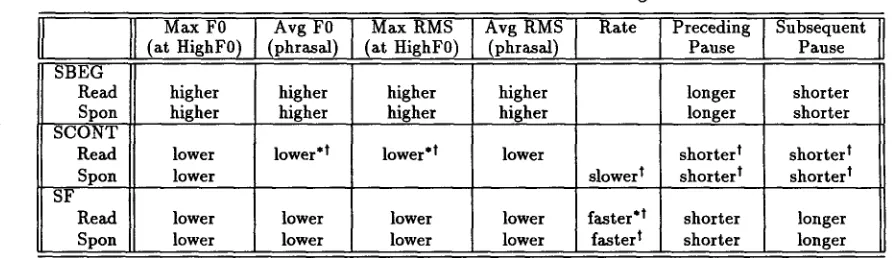
We found strong correlations for consensus SBEG, SCONT, and SF phrases for all conditions. Results for group T are given in Table 4, and for group S, in Table 5. ~
Consensus SBEG phrases in all conditions pos- sess significantly higher m a x i m u m and average f0, higher m a x i m u m and average rms, shorter subse- quent pause, and longer preceding pause. For con- sensus S C O N T phrases, we found some differences between read and spontaneous speech for both la- beling methods. Features for group T included sig- nificantly lower f0 m a x i m u m and average and lower rms m a x i m u m and average for read speech, but only lower f0 m a x i m u m for the spontaneous condition. Group S features for S C O N T were identical to group T except for the absence of a correlation for maxi- m u m rms. While S C O N T phrases for both speak- ing styles exhibited significantly shorter preceding and subsequent pauses than other phrases, only the spontaneous condition showed a significantly slower rate. For consensus SF phrases, we again found simi- lar patterns for both speaking styles and both label-
7T-tests were used to test for statistical significance of difference in the means of two classes of phrases. Results reported are significant at the .005 level or better, except where '*' indicates significance at the .03 level or better. Results were calculated using one-tailed t-tests, except w h e r e ' t ' indicates a two-tailed test.
ing methods, namely lower f0 m a x i m u m and aver- age, lower rms m a x i m u m and average, faster speak- ing rate, shorter preceding pauses, and longer sub- sequent pauses.
While it m a y appear somewhat surprising that results for b o t h labeling m e t h o d s m a t c h so closely, in fact, correlations for text-and-speech labels pre- sented in Table 5 were almost invariably statistically stronger than those for text-alone labels presented in Table 4. These more robust results for text-and- speech labelings occur even though the data set of consensus labels is considerably larger than the data set of consensus text-alone labelings.
4.2.3 Local I n t o n a t i o n a l Correlates
With a view toward automatically segmenting a spoken discourse, we would like to directly clas- sify phrases of all three discourse categories. But S C O N T and SF phrases exhibit similar prominence features and appear distinct from each other only in terms of timing differences. A second issue is whether such classification can be done 'on-line.' To address both of these issues, we made
pairwise
[image:5.612.81.527.98.227.2]Table 6: Acoustic-Prosodic Change from Preceding Phrase for Consensus Labelings from Text and Speech
SBEG versus SCONT Read Sport SCONT versus SF
Read Spon SBEG versus SF
Read Spon
II Max F0 Change (at HighF0s)
Max DB Change (at HighF0s)
Rate Change
increase increase
increase increase
increase* increase* increase
increase increase
increase increase decrease* t
ate phrase, s
First, note that SBEG is distinguished from both SCONT and SF in terms of f0 change and db change from prior phrase; that is, while SBEG phrases are distinguished on a variety of measures from all other phrases (including non-consensus-labeled phrases) in Table 5, this table shows that SBEGs are also distin- guishable directly from each of the other consensus- labeled categories. Second, while SCONT and SF appear to share prominence features in Table 5, Ta- ble 6 reveals differences between SCONT and SF in amount of f0 and db change. Thus, in addition to lending themselves to on-line processing, local mea- sures may also capture valuable prominence cues to distinguish between segment-medial and segment- final phrases.
5 C o n c l u s i o n
Although this paper reports results from only a sin- gle speaker, the findings are promising. We have demonstrated that a theory-based method for dis- course analysis can provide reliable segmentations of spontaneous as well as read speech. In addition, the availability of speech in the text-and-speech labeling method led to significantly higher reliability scores. The stronger correlations found for intonational fea- tures of the text-and-speech labelings suggest not only that discourse labelers make use of prosody in their analyses, but also that obtaining such data can lead to more robust modeling of the relationship be- tween intonation and discourse structure.
The following preliminary results can be con- sidered for incorporation in such a model. First, segment-initial utterances differ from medial and fi-
8We present results only for text-and-speech label- ings; results for text-alone were quite similar. Note that 'increase' means that there is a significantly greater in- crease in f0, rms, or rate from prior to current phrase for category 1 than for category 2 of the comparison, and 'decrease' means that there is a significantly greater de- crease. T-tests again were one-tailed unless marked by t, and significance levels were .002 or better except those marked by *, which were at .01 or better.
nal utterances in both prominence and rhythmic properties. Segment-medial and segment-final ut- terances are distinguished more clearly by rhythmic features, primarily pause. Finally, all correlations found for global parameters can also be computed based on relative change in acoustic-prosodic param- eters in a window of two phrases.
Ongoing research is addressing the development of automatic classification algorithms for discourse boundary type; the role of prosody in conveying hier- archical relationships among discourse segments; in- dividual speaker differences; and discourse segmen- tation methods that can be used by naive subjects.
R e f e r e n c e s
Avesani, Cinzia and Mario Vayra. 1988. Dis- corso, segmenti di discorso e un' ipotesi sull' in- tonazione. In Corso eli stampa negli Atti del Con- vegno Inlernazionale "Sull'Interpunzione', Val- leechi, Firenze, Maggio, pages 8-53.
Ayers, Gayle M. 1992. Discourse functions of pitch range in spontaneous and read speech. Paper pre- sented at the Linguistic Society of America An- nual Meeting.
Beckman, Mary and Janet Pierrehumbert. 1986. Intonational structure in Japanese and English. Phonology Yearbook, 3:15-70.
Brown, G., K. Currie, and J. Kenworthy. 1980. Questions of Intonation. University Park Press, Baltimore.
Brubaker, R. S. 1972. Rate and pause character- istics of oral reading. Journal of Psycholinguistic Research, 1(2):141-147.
Butterworth, B. 1975. Hesitation and semantic planning in speech. Journal of Psycholinguistic Research, 4:75-87.
Carberry, Sandra. 1990. Plan Recognition in Nat- ural Language Dialogue. MIT Press, Cambridge MA.
[image:6.612.119.478.100.223.2]Carletta, Jean C. 1996. Assessing agreement on classification tasks: the kappa statistic. Compu- tational Linguistics, 22(2), To appear.
Cohen, Robin. 1984. A computational theory of the function of clue words in argument understand- ing. In Proceedings of the lOth International Con- ference on Computational Linguistics, pages 251- 255, Stanford.
Flammia, Giovanni and Victor Zue. 1995. Empir- ical evaluation of human performance and agree- ment in parsing discourse constituents in spoken dialogue. In Proceedings of EUROSPEECH-95,
Volume 3, pages 1965-1968. Madrid.
Grosz, B. and J. Hirschberg. 1992. Some intona- tional characteristics of discourse structure. In
Proceedings of the 2nd International Conference on Spoken Language Processing, pages 429-432, Banff, October.
Grosz, Barbara. 1978. Discourse analysis. In D. Walker, editor, Understanding Spoken Lan- guage. Elsevier, pages 235-268.
Grosz, Barbara J. and Candace L. Sidner. 1986. At- tention, intentions, and the structure of discourse.
Computational Linguistics, 12(3):175-204.
Hearst, Marti A. 1994. Context and Structure in Automated Full-Text Information Access. Ph.D. thesis, University of California at Berkeley. Avail- able as Report No. UCB/CSD-94/836.
Hinkelman, E. and J. Allen. 1989. Two constraints on speech act ambiguity. In Proceedings of the 27th Annual Meeting of the Association for Com- putational Linguistics, pages 212-219, Vancouver.
Hirschberg, J. and B. Grosz. 1992. Intonational features of local and global discourse structure. In Proceedings of the Speech and Natural Lan- guage Workshop, pages 441-446, Harriman NY, DARPA, Morgan Kaufmann, February.
Isard, Amy and Jean Carletta. 1995. Transaction and action coding in the map task corpus. Re- search paper HCRC/RP-65, March, Human Com- munication Research Centre, University of Edin- burgh, Edinburgh.
Iwafiska, Lucia, Douglas Appelt, Damaris Ayuso, Kathy Dahlgren, Bonnie Glover Stalls, Ralph Gr- ishman, George Krupka, Christine Montgomery, and Ellen Riloff. 1991. Computational aspects of discourse in the context of Muc-3. In Proceedings of the Third Message Understanding Conference (Mac-3), pages 256-282, San Mateo, CA, Morgan Kaufmann, May.
Lehiste, I. 1979. Perception of sentence and paragraph boundaries. In B. Lindblom and S. Oehman, editors, Frontiers of Speech Research.
Academic Press, London, pages 191-201.
Lehiste, I. 1980. Phonetic characteristics of dis- course. Paper presented at the Meeting of the Committee on Speech Research, Acoustical Soci- ety of Japan.
Levy, Elena. 1984. Communicating Thematic Struc- ture in Narrative Discourse: The Use of Referring Terms and Gestures. Ph.D. thesis, The University of Chicago, Chicago, June.
Linde, C. 1979. Focus of attention and the choice of pronouns in discourse. In T. Givon, editor, Syntax and Semantics, Vol. 12: Discourse and Syntax.
The Academic Press, New York, pages 337-354. Litman, Diane and Julia Hirschberg. 1990. Dis-
ambiguating cue phrases in text and speech. In Proceedings of the 13th International Confer- ence on Computational Linguistics, pages 251- 256, Helsinki, August.
Lochbaum, Karen. 1994. Using Collaborative Plans to Model the Intentional Structure of Discourse.
Ph.D. thesis, Harvard University. Available as Tech Report TR-25-94.
Morris, J. and G. Hirst. 1991. Lexical cohesion computed by thesaural relations as an indicator of the structure of text. Computational Linguis- tics, 17:21-48.
Passonneau, R. and D. Litman. 1993. Feasibility of automated discourse segmentation. In Proceed- ings of the 31st Annual Meeting of the Associ- ation for Computational Linguistics, pages 148- 155, Columbus.
Passonneau, Rebecca J. and Diane J. Litman. To Appear. Empirical analysis of three dimensions of spoken discourse: Segmentation, coherence and linguistic devices. In E. Hovy and D. Scott, ed- itors, Burning Issues in Discourse. Springer Vet- lag.
Pierrehumbert, Janet B. 1980. The Phonology and Phonetics of English Intonation. Ph.D. thesis, Massachusetts Institute of Technology, Septem- ber. Distributed by the Indiana University Lin- guistics Club.
Pitrelli, John, Mary Beckman, and Julia Hirschberg. 1994. Evaluation of prosodic transcription label- ing reliability in the ToBI framework. In Proceed- ings of the 3rd International Conference on Spo- ken Language Processing, volume 2, pages 123- 126, Yokohama.
Reichman, R. 1985. Getting Computers to Talk Like You and Me: Discourse Context, Focus, and Se- mantics. Bradford. The Massachusetts Institute of Technology, Cambridge.
Rotondo, John A. 1984. Clustering analysis of sub- jective partitions of text. Discourse Processes,
7:69-88.
Schubert, L. K. and C. H. Hwang. 1990. Picking ref- erence events from tense trees. In Proceedings of the Speech and Natural Language Workshop, pages 34-41, Hidden Valley PA. DARPA.
Siegel, S. and Jr. Castellan, N. John. 1988. Non- parametric Statistics for the Behavioral Sciences.
McGraw-Hill, New York, second edition.
Silverman, K. 1987. The Structure and Processing of Fundamental Frequency Contours. Ph.D. the- sis, Cambridge University, Cambridge UK. Song, F. and R. Cohen. 1991. Tense interpretation
in the context of narrative. In Proceedings of the 9th National Conference of the American Associ- ation for Artificial Intelligence, pages 131-136. Swerts, M., R. Gelyukens, and J. Terken. 1992.
Prosodic correlates of discourse units in sponta- neous speech. In Proceedings of the International
Conference on Spoken Language Processing, pages 421-428, Banff, Canada, October.
Swerts, Marc. 1995. Combining statistical and pho- netic analyses of spontaneous discourse segmen- tation. In Proceedings of the XIIth International Congress of Phonetic Sciences, volume 4, pages 208-211, Stockholm, August.
Swerts, Marc and Mari Ostendorf. 1995. Dis- course prosody in human-machine interactions. In
Proceedings ESCA Workshop on Spoken Dialogue Systems: Theories and Applications, pages 205- 208, Visgo, Denmark, May/June.
Webber, B. 1988. Discourse deixis: Reference to discourse segments. In Proceedings of the 26th Annual Meeting of the Association for Computa- tional Linguistics, pages 113-122, Buffalo. Woodbury, Anthony C. 1987. Rhetorical struc-
ture in a central Alaskan Yupik Eskimo tradi- tional narrative. In J. Sherzer and A. Woodbury, editors, Native American Discourse: Poetics and Rhetoric, pages 176-239, Cambridge University Press, Cambridge UK.
Yarowsky, David. 1991. Personal communication, December.