Microblogs as Parallel Corpora
Wang Ling123 Guang Xiang2 Chris Dyer2 Alan Black2 Isabel Trancoso13 (1)L2F Spoken Systems Lab, INESC-ID, Lisbon, Portugal
(2)Language Technologies Institute, Carnegie Mellon University, Pittsburgh, PA, USA (3)Instituto Superior T´ecnico, Lisbon, Portugal
{lingwang,guangx,cdyer,awb}@cs.cmu.edu
Abstract
In the ever-expanding sea of microblog data, there is a surprising amount of naturally occurring par-allel text: some users create post multilingual mes-sages targeting international audiences while oth-ers “retweet” translations. We present an efficient method for detecting these messages and extract-ing parallel segments from them. We have been able to extract over 1M Chinese-English parallel segments from Sina Weibo (the Chinese counter-part of Twitter) using only their public APIs. As a supplement to existing parallel training data, our automatically extracted parallel data yields sub-stantial translation quality improvements in trans-lating microblog text and modest improvements in translating edited news commentary. The re-sources in described in this paper are available at http://www.cs.cmu.edu/∼lingwang/utopia.
1 Introduction
Microblogs such as Twitter and Facebook have gained tremendous popularity in the past 10 years. In addition to being an important form of commu-nication for many people, they often contain ex-tremely current, even breaking, information about world events. However, the writing style of mi-croblogs tends to be quite colloquial, with fre-quent orthographic innovation (R U still with me or what?) and nonstandard abbreviations (idk! shm)—quite unlike the style found in more tra-ditional, edited genres. This poses considerable problems for traditional NLP tools, which were developed with other domains in mind, which of-ten make strong assumptions about orthographic uniformity (i.e., there is just one way to spellyou). One approach to cope with this problem is to an-notate in-domain data (Gimpel et al., 2011).
Machine translation suffers acutely from the domain-mismatch problem caused by microblog text. On one hand, standard models are probably suboptimal since they (like many models) assume orthographic uniformity in the input. However, more acutely, the data used to develop these sys-tems and train their models is drawn from formal and carefully edited domains, such as parallel web pages and translated legal documents. MT training data seldom looks anything like microblog text.
This paper introduces a method for finding nat-urally occurring parallel microblog text, which helps address the domain-mismatch problem. Our method is inspired by the perhaps surpris-ing observation that a reasonable number of mi-croblog users tweet “in parallel” in two or more languages. For instance, the American entertainer Snoop Dogg regularly posts parallel messages on Sina Weibo (Mainland China’s equivalent of Twit-ter), for example,watup Kenny Mayne!! - Kenny Mayne,最近这么样啊!!, where an English
message and its Chinese translation are in the same post, separated by a dash. Our method is able to identify and extract such translations. Briefly, this requires determining if a tweet contains more than one language, if these multilingual utterances contain translated material (or are due to some-thing else, such as code switching), and what the translated spans are.
The paper is organized as follows. Section 2 describes the related work in parallel data extrac-tion. Section 3 presents our model to extract par-allel data within the same document. Section 4 describes our extraction pipeline. Section 5 de-scribes the data we gathered from both Sina Weibo (Chinese-English) and Twitter (Chinese-English and Arabic-English). We then present experiments showing that our harvested data not only substan-tially improves translations of microblog text with
existing (and arguably inappropriate) translation models, but that it improves the translation of more traditional MT genres, like newswire. We conclude in Section 6.
2 Related Work
Automatic collection of parallel data is a well-studied problem. Approaches to finding par-allel web documents automatically have been particularly important (Resnik and Smith, 2003; Fukushima et al., 2006; Li and Liu, 2008; Uszko-reit et al., 2010; Ture and Lin, 2012). These broadly work by identifying promising candidates using simple features, such as URL similarity or “gist translations” and then identifying truly par-allel segments with more expensive classifiers. More specialized resources were developed using manual procedures to leverage special features of very large collections, such as Europarl (Koehn, 2005).
Mining parallel or comparable messages from microblogs has mainly relied on Cross-Lingual In-formation Retrieval techniques (CLIR). Jelh et al. (2012) attempt to find pairs of tweets in Twitter us-ing Arabic tweets as search queries in a CLIR sys-tem. Afterwards, the model described in (Xu et al., 2001) is applied to retrieve a set of ranked trans-lation candidates for each Arabic tweet, which are then used as parallel candidates.
The work on mining parenthetical transla-tions (Lin et al., 2008), which attempts to find translations within the same document, has some similarities with our work, since parenthetical translations are within the same document. How-ever, parenthetical translations are generally used to translate names or terms, which is more lim-ited than our work which extracts whole sentence translations.
Finally, crowd-sourcing techniques to obtain translations have been previously studied and ap-plied to build datasets for casual domains (Zbib et al., 2012; Post et al., 2012). These approaches require remunerated workers to translate the mes-sages, and the amount of messages translated per day is limited. We aim to propose a method that acquires large amounts of parallel data for free. The drawback is that there is a margin of error in the parallel segment identification and alignment. However, our system can be tuned for precision or for recall.
3 Parallel Segment Retrieval
We will first abstract from the domain of Mi-croblogs and focus on the task of retrieving par-allel segments from single documents. Prior work on finding parallel data attempts to reason about the probability that pairs of documents(x,y) are
parallel. In contrast, we only consider one doc-ument at a time, defined by x = x1, x2, . . . , xn,
and consisting of n tokens, and need to
deter-mine whether there is parallel data in x, and if so, where are the parallelsegmentsand their lan-guages. For simplicity, we assume that there are at most 2 continuous segments that are parallel.
As representation for the parallel seg-ments within the document, we use the tuple
([p, q], l,[u, v], r,a). The word indexes[p, q]and [u, v]are used to identify the left segment (from
p to q) and right segment (from u to v), which are parallel. We shall refer[p, q]and[u, v]as the spans of the left and right segments. To avoid overlaps, we set the constraintp ≤ q < u ≤ v.
Then, we use landr to identify the language of
the left and right segments, respectively. Finally,a represents the word alignment between the words in the left and the right segments.
The main problem we address is to find the parallel data when the boundaries of the parallel segments are not defined explicitly. If we knew the indexes[p, q]and[u, v], we could simply run
a language detector for these segments to find l
and r. Then, we would use an word alignment
model (Brown et al., 1993; Vogel et al., 1996), with sources =xp, . . . , xq, targett=xu, . . . , xv
and lexical tableθl,r to calculate the Viterbi
align-menta. Finally, from the probability of the word alignments, we can determine whether the seg-ments are parallel.
Thus, our model will attempt to find the opti-mal values for the segments[p, q][u, v], languages
l, rand word alignmentsajointly. However, there
a brute force algorithm. We shall describe our model to solve the first problem in 3.1 and our dynamic programming approach to make the in-ference tractable in 3.2.
3.1 Model
We propose a simple (non-probabilistic) three-factor model that models the spans of the parallel segments, their languages, and word alignments jointly. This model is defined as follows:
S([u, v], r,[p, q],l,a|x) =
SSα([p, q],[u, v]|x)×
SLβ(l, r|[p, q],[u, v],x)×
STγ(a|[p, q], l,[u, v], r,x)
Each of the components is weighted by the pa-rametersα,β andγ. We set these values
empiri-callyα= 0.3,β = 0.3andγ = 0.4, and leave the
optimization of these parameters as future work. We discuss the components of this model in turn. Span scoreSS. We define the score of
hypothe-sized pair of spans[p, q],[u, v]as:
SS([p, q],[u, v]|x) =
(q−p+ 1) + (v−u+ 1)
P
0<p0≤q0<u0≤v0≤n(q0−p0+ 1) + (v0−u0+ 1)× ψ([p, q],[u, v],x)
The first factor is a distribution over all spans that assigns higher probability to segmentations that cover more words in the document. It is highest for segmentations that cover all the words in the document (this is desirable since there are many sentence pairs that can be extracted but we want to find the largest sentence pair in the document). The functionψtakes on values of0or1
depend-ing on whether certain constraints are violated, these include: parenthetical constraints that en-force that spans must not break text within par-enthetical characters and language constraints that ensure that we do break a sequence of Mandarin characters, Arabic words or Latin words.
Language score SL. The language score
SL(l, r|[p, q],[u, v],x)indicates whether the
lan-guage labelsl, r are appropriate to the document
contents:
SL(l, r|[p, q],[u, v],x) =
Pq
i=pL(l, xi) +
Pv
i=uL(r, xi)
n
whereL(l, x)is a language detection function that yields1if the wordxiis in languagel, and0
oth-erwise. We build the function simply by consid-ering all words that are composed of Latin char-acters as English, Arabic charchar-acters as Arabic and Han characters as Mandarin. This approach is not perfect, but it is simple and works reasonably well for our purposes.
Translation score ST. The translation score
ST(a | [p, q], l,[u, v], r) indicates whether [p, q]
is a reasonable translation of[u, v]with the align-menta. We rely on IBM Model 1 probabilities for this score:
ST(a|[p, q], l,[u, v], r,x) =
1
(q−p+ 1)v−u+2
v
Y
i=u
PM1(xi |xai).
The lexical tables PM1 for the various language
pairs are trained a priori using available parallel corpora. While IBM Model 1 produces worse alignments than other models, in our problem, we need to efficiently consider all possible spans, lan-guage pairs and word alignments, which makes the problem intractable. We will show that dy-namic programing can be used to make this prob-lem tractable, using Model 1. Furthermore, IBM Model 1 has shown good performance for sen-tence alignment systems previously (Xu et al., 2005; Braune and Fraser, 2010).
3.2 Inference
Our goal is to find the spans, language pair and alignments such that:
arg max
[p,q],l,[u,v],r,a
S([p, q], l,[u, v], r,a|x) (1)
A high score indicates that the predicted bispan is likely to correspond to a valid parallel span, so we set a constant thresholdτ to determine whether a
document has parallel data, i.e., the value ofz:
z∗ = max
[u,v],r,[p,q],l,aS([u, v], r,[p, q], l,a|x)> τ Naively maximizing Eq. 1 would require
O(|x|6)operations, which is too inefficient to be practical on large datasets. To process millions of documents, this process would need to be op-timized.
an iterative approach to compute the Viterbi word alignments for IBM Model 1 using dynamic pro-gramming.
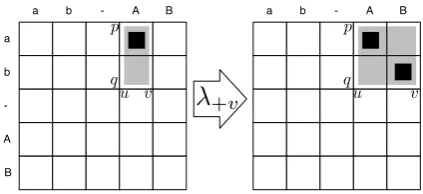
Dynamic programming search. The insight we use to improve the runtime is that the Viterbi word alignment of a bispan can be reused to cal-culate the Viterbi word alignments of larger bis-pans. The algorithm operates on a4-dimensional
chart of bispans. It starts with the minimal valid span (i.e., [0,0],[1,1]) and progressively builds larger spans from smaller ones. Let Ap,q,u,v
rep-resent the Viterbi alignment (underST) of the
bis-pan [p, q],[u, v]. The algorithm uses the
follow-ing recursions defined in terms of four operations
λ{+v,+u,+p,+q}that manipulate a single dimension
of the bispan to construct larger spans:
• Ap,q,u,v+1 = λ+v(Ap,q,u,v) adds one token to
the end of the right span with indexv+ 1 and
find the viterbi alignment for that token. This requires iterating over all the tokens in the left span, [p, q] and possibly updating their
align-ments. See Fig. 1 for an illustration.
• Ap,q,u+1,v =λ+u(Ap,q,u,v)removes the first
to-ken of the right span with indexu, so we only need to remove the alignment fromu, which can be done in timeO(1).
• Ap,q+1,u,v = λ+q(Ap,q,u,v) adds one token to
the end of the left span with index q + 1, we
need to check for each word in the right span, if aligning to the word in indexq+1yields a better
translation probability. This update requiresn−
q+ 1operations.
• Ap+1,q,u,v = λ+p(Ap,q,u,v) removes the first
token of the left span with index p. After
re-moving the token, we need to find new align-ments for all tokens that were aligned to p.
Thus, the number of operations for this update isK×(q−p+ 1), whereK is the number of
words that were aligned top. In the best case, no
words are aligned to the token inp, and we can
simply remove it. In the worst case, if all target words were aligned top, this update will result
in the recalculation of all Viterbi Alignments. The algorithm proceeds until all valid cells have been computed. One important aspect is that the update functions differ in complexity, so the se-quence of updates we apply will impact the per-formance of the system. Most spans are reach-able using any of the four update functions. For instance, the span A2,3,4,5 can be reached us-ingλ+v(A2,3,4,4),λ+u(A2,3,3,5),λ+q(A2,2,4,5)or
λ+p(A1,3,4,5). However, we want to use λ+u
a b - A B
a
b
-A
B
a b - A B
p
q u v
p
q
u v
[image:4.595.310.522.65.162.2]λ
+vFigure 1: Illustration of the λ+v operator. The
light gray boxes show the parallel span and the dark boxes show the span’s Viterbi alignment. In this example, the parallel message contains a “translation” ofa btoA B.
whenever possible, since it only requires one op-eration, although that is not always possible. For instance, the stateA2,2,2,4 cannot be reached us-ing λ+u, since the state A2,2,1,4 is not valid, be-cause the spans overlap. If this happens, incre-mentally more expensive updates need to be used, such asλ+v, thenλ+q, which are in the same order
of complexity. Finally, we want to minimize the use ofλ+p, which is quadratic in the worst case.
Thus, we use the following recursive formulation that guarantees the optimal outcome:
Ap,q,u,v =
λ+u(Ap,q,u−1,v) ifu > q+ 1
λ+v(Ap,q,u,v−1) else ifv > q+ 1
λ+p(Ap−1,q,u,v) else ifq=p+ 1
λ+q(Ap,q−1,u,v) otherwise
This transition function applies the cheapest possible update to reach stateAp,q,u,v.
Complexity analysis. We can see that λ+u
is only needed in the following the cases
[0,1][2,2],[1,2][3,3],· · · ,[n − 2, n − 1][n, n].
Since, this update is quadratic in the worst case, the complexity of this operations is
O(n3). The update λ+q, is applied to the cases
[∗,1][2,2],[∗,2][3,3],· · · ,[∗, n−1],[n, n], where
∗denotes any number within the span constraints but not present in previous updates. Since, the update is linear and we need to iterate through all tokens twice, this update takes O(n3)
opera-tions. The update λ+v is applied for the cases
[∗,1][2,∗],[∗,2][3,∗],· · · ,[∗, n−1],[n,∗]. Thus,
with three degrees of freedom and a linear update, it runs inO(n4)time. Finally, updateλ
+uruns in
executions of all updates, we observe that the or-der of magnitude of our exact inference process is
O(n4). Note that for exact inference, it is not pos-sible to get a lower order of magnitude, since we need to at least iterate through all possible span values once, which takesO(n4)time.
4 Parallel Data Extraction
We will now describe our method to extract par-allel data from Microblogs. The target domains in this work are Twitter and Sina Weibo, and the main language pair is Chinese-English. Fur-thermore, we also run the system for the Arabic-English language pair using the Twitter data.
For the Twitter domain, we use a previously crawled dataset from the years 2008 to 2013, where one million tweets are crawled every day. In total, we processed 1.6 billion tweets.
Regarding Sina Weibo, we built a crawler that continuously collects tweets from Weibo. We start from one seed user and collect his posts, and then we find the users he follows that we have not con-sidered, and repeat. Due to the rate limiting es-tablished by the Weibo API1, we are restricted in
terms of number of requests every hour, which greatly limits the amount of messages we can col-lect. Furthermore, each request can only fetch up to 100 posts from a user, and subsequent pages of 100 posts require additional API calls. Thus, to optimize the number of parallel posts we can col-lect per request, we only crawl all messages from users that have at least 10 parallel tweets in their first 100 posts. The number of parallel messages is estimated by running our alignment model, and checking ifτ > φ, where φwas set empirically
initially, and optimized after obtaining annotated data, which will be detailed in 5.1. Using this process, we crawled 65 million tweets from Sina Weibo within 4 months.
In both cases, we first filter the collection of tweets for messages containing at least one trigram in each language of the target language pair, deter-mined by their Unicode ranges. This means that for the Chinese-English language pair, we only keep tweets with more than 3 Mandarin charac-ters and 3 latin words. Furthermore, based on the work in (Jelh et al., 2012), if a tweet Ais
iden-tified as a retweet, meaning that it references an-other tweetB, we also consider the hypothesis that
these tweets may be mutual translations. Thus, if
A andB contain trigrams in different languages,
1http://open.weibo.com/wiki/API文档/en
these are also considered for the extraction of par-allel data. This is done by concatenating tweetsA
andB, and adding the constraint that[p, q]must
be withinAand[u, v]must be withinB. Finally,
identical duplicate tweets are removed.
After filtering, we obtained 1124k ZH-EN tweets from Sina Weibo, 868k ZH-EN and 136k AR-EN tweets from Twitter. These language pairs are not definite, since we simply check if there is a trigram in each language.
Finally, we run our alignment model described in section 3, and obtain the parallel segments and their scores, which measure how likely those seg-ments are parallel. In this process, lexical tables for EN-ZH language pair used by Model 1 were built using the FBIS dataset (LDC2003E14) for both directions, a corpus of 300K sentence pairs from the news domain. Likewise, for the EN-AR language pair, we use a fraction of the NIST dataset, by removing the data originated from UN, which leads to approximately 1M sentence pairs.
5 Experiments
We evaluate our method in two ways. First, intrin-sically, by observing how well our method identi-fies tweets containing parallel data, the language pair and what their spans are. Second, extrinsi-cally, by looking at how well the data improves a translation task. This methodology is similar to that of Smith et al. (2010).
5.1 Parallel Data Extraction
Data. Our method needs to determine if a given tweet contains parallel data, and if so, what is the language pair of the data, and what segments are parallel. Thus, we had a native Mandarin speaker, also fluent in English, to annotate 2000 tweets sampled from crawled Weibo tweets. One important question of answer is what portion of the Microblogs contains parallel data. Thus, we also use the random sample Twitter and annotated 1200 samples, identifying whether each sample contains parallel data, for the EN-ZH and AR-EN filtered tweets.
Metrics. To test the accuracy of the scoreS, we
ordered all 2000 samples by score. Then, we cal-culate the precision, recall and accuracy at increas-ing intervals of10%of the top samples. We count
as a true positive (tp) if we correctly identify a par-allel tweet, and as a false positive (f p) spuriously
detect a parallel tweet. Finally, a true negative (tn)
tweet, and a false negative (f n) if we miss a par-allel tweet. Then, we set the precision as tp
tp+f p,
recall as tp
tp+f n and accuracy as
tp+tn
tp+f p+tn+f n. For
language identification, we calculate the accuracy based on the number of instances that were iden-tified with the correct language pair. Finally, to evaluate the segment alignment, we use the Word Error Rate (WER) metric, without substitutions, where we compare the left and right spans of our system and the respective spans of the reference. We count an insertion error (I) for each word in
our system’s spans that is not present in the refer-ence span and a deletion error (D) for each word
in the reference span that is not present in our sys-tem’s spans. Thus, we set W ER = DN+I, where
N is the number of tokens in the tweet. To com-pute this score for the whole test set, we comcom-pute the average of theW ERfor each sample.
Results. The precision, recall and accuracy curves are shown in Figure 2. The quality of the parallel sentence detection did not vary signifi-cantly with different setups, so we will only show the results for the best setup, which is the baseline model with span constraints.
0.2 0.3 0.4 0.5 0.6 0.7 0.8 0.9 1
10% 20% 30% 40% 50% 60% 70% 80% 90% 100%
[image:6.595.73.291.406.538.2]Precision Recall Accuracy
Figure 2: Precision, recall and accuracy curves for parallel data detection. The y-axis denotes the scores for each metric, and the x-axis denotes the percentage of the highest scoring sentence pairs that are kept.
From the precision and recall curves, we ob-serve that most of the parallel data can be found at the top 30% of the filtered tweets, where 5 in 6 tweets are detected correctly as parallel, and only 1 in every 6 parallel sentences is lost. We will de-note the score threshold at this point asφ, which is a good threshold to estimate on whether the tweet is parallel. However, this parameter can be tuned for precision or recall. We also see that in total,
30% of the filtered tweets are parallel. If we gen-eralize this ratio for the complete set with 1124k tweets, we can expect approximately 337k paral-lel sentences. Finally, since 65 million tweets were extracted to generate the 337k tweets, we estimate that approximately 1 parallel tweet can be found for every 200 tweets we process using our tar-geted approach. On the other hand, from the 1200 tweets from Twitter, we found that 27 had parallel data in the ZH-EN pair, if we extrapolate for the whole 868k filtered tweets, we expect that we can find 19530. 19530 parallel sentences from 1.6 bil-lion tweets crawled randomly, represents 0.001% of the total corpora. For AR-EN, a similar re-sult was obtained where we expect 12407 tweets out of the 1.6 billion to be parallel. This shows that targeted approaches can substantially reduce the crawling effort required to find parallel tweets. Still, considering that billions of tweets are posted daily, this is a substantial source of parallel data. The remainder of the tests will be performed on the Weibo dataset, which contains more parallel data. Tests on the Twitter data will be conducted as future work, when we process Twitter data on a larger scale to obtain more parallel sentences.
For the language identification task, we had an accuracy of 99.9%, since distinguishing English and Mandarin is trivial. The small percentage of errors originated from other latin languages (Ex: French) due to our naive language detector.
As for the segment alignment task. Our base-line system with no constraints obtains a WER of 12.86%, and this can be improved to 11.66% by adding constraints to possible spans. This shows that, on average, approximately 1 in 9 words on the parallel segments is incorrect. However, trans-lation models are generally robust to such kinds of errors and can learn good translations even in the presence of imperfect sentence pairs.
Among the 578 tweets that are parallel, 496 were extracted within the same tweet and 82 were extracted from retweets. Thus, we see that the ma-jority of the parallel data comes from within the same tweet.
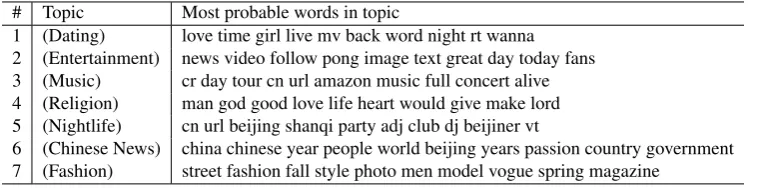
# Topic Most probable words in topic
1 (Dating) love time girl live mv back word night rt wanna 2 (Entertainment) news video follow pong image text great day today fans 3 (Music) cr day tour cn url amazon music full concert alive 4 (Religion) man god good love life heart would give make lord 5 (Nightlife) cn url beijing shanqi party adj club dj beijiner vt
[image:7.595.112.492.62.156.2]6 (Chinese News) china chinese year people world beijing years passion country government 7 (Fashion) street fashion fall style photo men model vogue spring magazine
Table 1: Most probable words inferred using LDA in several topics from the parallel data extracted from Weibo. Topic labels (in parentheses) were assigned manually for illustration purposes.
variety of topics, both formal (Chinese news, reli-gion) and informal (entertainment, music). Example sentence pairs. To gain some perspec-tive on the type of sentence pairs we are extract-ing, we will illustrate some sentence pairs we crawled and aligned automatically. Table 2 con-tains 5 English-Mandarin and 4 English-Arabic sentence pairs that were extracted automatically. These were chosen, since they contain some as-pects that are characteristic of the text present in Microblogs and Social Media. These are:
• Abbreviations - In most sentence pairs exam-ples, we can witness the use of abbreviated forms of English words, such as wanna, TMI,
4andimma. These can be normalized aswant to, too much information, for and I am going to, respectively. In sentence 5, we observe that this phenomena also occurs in Mandarin. We find thatTMDis a popular way to write他妈的
whose Pinyin rendering ist¯a m¯a de. The mean-ing of this expression depends on the context it is used, and can convey a similar connotation as adding the intensifierthe hell to an English sentence.
• Jargon - Another common phenomena is the appearance of words that are only used in sub-communities. For instance, in sentence pair 4, we the jargon wordcdayis used, which is a col-loquial variant forbirthday.
• Emoticons- In sentence 8, we observe the pres-ence of the emoticon :), which is frequently used in this media. We found that emoticons are either translated as they are or simply removed, in most cases.
• Syntax errors- In the domain of microblogs, it is also common that users do not write strictly syntactic sentences, for instance, in sentence pair 7, the sentence onni this gift only 4 u, is clearly not syntactically correct. Firstly, onni
is a named entity, yet it is not capitalized. Sec-ondly, a comma should followonni. Thirdly, the
verbisshould be used aftergift. Having exam-ples of these sentences in the training set, with common mistakes (intentional or not), might become a key factor in training MT systems that can be robust to such errors.
• Dialects- We can observe a much broader range of dialects in our data, since there are no di-alect standards in microblogs. For instance, in sentence pair 6, we observe an arabic word (in bold) used in the spoken Arabic dialect used in some countries along the shores of the Persian Gulf, which means meansthe next. In standard Arabic, a significantly different form is used. We can also see in sentence pair 9 that our aligner does not alway make the correct choice when determining spans. In this case, the segment
RT @MARYAMALKHAWAJA:was included in the English segment spuriously, since it does not cor-respond to anything in the Arabic counterpart.
5.2 Machine Translation Experiments
We report on machine translation experiments us-ing our harvested data in two domains: edited news and microblogs.
News translation. For the news test, we cre-ated a new test set from a crawl of the Chinese-English documents on the Project Syndicate web-site2, which contains news commentary articles.
We chose to use this data set, rather than more standard NIST test sets to ensure that we had re-cent documents in the test set (the most rere-cent NIST test sets contain documents published in 2007, well before our microblog data was created). We extracted 1386 parallel sentences for tuning and another 1386 sentences for testing, from the manually aligned segments. For this test set, we used 8 million sentences from the full NIST par-allel dataset as the language model training data. We shall call this test setSyndicate.
ENGLISH MANDARIN
1 iwannalive in a wes anderson world 我想要生活在Wes Anderson的世界里
2 Chicken soup, corn never truly digests.TMI. 鸡汤吧,玉米神马的从来没有真正消化过.恶心
3 To DanielVeulemanyea iknw immawork on that 对DanielVeuleman说,是的我知道,我正在向那方面努力 4 msg 4Warren G hiscdayis today 1yrolder. 发信息给Warren G,今天是他的生日,又老了一岁了。 5 Wherethe hellhave you been all these years? 这些年你TMD到哪去了
ENGLISH ARABIC
6 It’sgonnabe a warm week!
Qk
øAJË@ ¨
ñJ.B@
7 onni this gift only4 u½Ë ¡
®
¯
éKYêË@
è
Yë ú
Gð
@
8 sunset in aqaba:) (:
éJ.
®ªË@ ú
¯ Ò
Ë@ H.ðQ
«
9 RT @MARYAMALKHAWAJA: there is a call@Y
«
£A JÓ
èY« ú
¯
H@QëA ¢ÖÏ Z@Y K ¼A Jë
for widespread protests in #bahraintmrwTable 2: Examples of English-Mandarin and English-Arabic sentence pairs. The English-Mandarin sentences were extracted from Sina Weibo and the English-Arabic sentences were extracted from Twitter. Some messages have been shorted to fit into the table. Some interesting aspects of these sentence pairs are marked in bold.
Microblog translation. To carry out the mi-croblog translation experiments, we need a high quality parallel test set. Since we are not aware of such a test set, we created one by manually se-lecting parallel messages from Weibo. Our proce-dure was as follows. We selected 2000 candidate Weibo posts from users who have a high num-ber of parallel tweets according to our automatic method (at least 2 in every 5 tweets). To these, we added another 2000 messages from our targeted Weibo crawl, but these had no requirement on the proportion of parallel tweets they had produced. We identified 2374 parallel segments, of which we used 1187 for development and 1187 for testing. We refer to this test set asWeibo.3
Obviously, we removed the development and test sets from our training data. Furthermore, to ensure that our training data was not too similar to the test set in the Weibo translation task, we fil-tered the training data to remove near duplicates by computing edit distance between each paral-lel sentence in the heldout set and each training instance. If either the source or the target sides of the a training instance had an edit distance of less than 10%, we removed it.4 As for the
lan-guage models, we collected a further 10M tweets from Twitter for the English language model and another 10M tweets from Weibo for the Chinese language model.
3We acknowledge that self-translated messages are prob-ably not a typically representative sample of all microblog messages. However, we do not have the resources to produce a carefully curated test set with a more broadly representative distribution. Still, we believe these results are informative as long as this is kept in mind.
4Approximately 150,000 training instances removed.
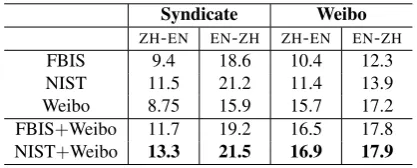
Syndicate Weibo
ZH-EN EN-ZH ZH-EN EN-ZH
FBIS 9.4 18.6 10.4 12.3
NIST 11.5 21.2 11.4 13.9
Weibo 8.75 15.9 15.7 17.2
[image:8.595.74.525.62.219.2]FBIS+Weibo 11.7 19.2 16.5 17.8 NIST+Weibo 13.3 21.5 16.9 17.9
Table 3: BLEUscores for different datasets in
dif-ferent translation directions (left to right), broken with different training corpora (top to bottom).
Baselines. We report results on these test sets us-ing different trainus-ing data. First, we use the FBIS dataset which contains 300K high quality sentence pairs, mostly in the broadcast news domain. Sec-ond, we use the full 2012 NIST Chinese-English dataset (approximately 8M sentence pairs, includ-ing FBIS). Finally, we use our crawled data (re-ferred as Weibo) by itself and also combined with the two previous training sets.
Setup. We use the Moses phrase-based MT sys-tem with standard features (Koehn et al., 2003). For reordering, we use the MSD reordering model (Axelrod et al., 2005). As the language model, we use a 5-gram model with Kneser-Ney smoothing. The weights were tuned using MERT (Och, 2003). Results are presented with BLEU-4 (Papineni et al., 2002).
[image:8.595.312.521.301.385.2]Syndicate(test) Weibo(test)
FBIS NIST Weibo FBIS NIST Weibo
obama (83) barack (59) democracies (15) 2012 (24) showstudio (9) submissions (4) barack (59) namo (6) imbalances (13) alanis (13) crue (9) ivillage (4) princeton (40) mitt (6) mahmoud (12) crue (9) overexposed (8) scola (3)
ecb (8) guant (6) millennium (9) showstudio (9) tweetmeian (5) rbst (3) bernanke (8) fairtrade (6) regimes (8) overexposed (8) tvd (5) curitiba (3)
romney (7) hollande (5) wolfowitz (7) itunes (8) iheartradio (5) zeman (2) gaddafi (7) wikileaks (4) revolutions (7) havoc (8) xoxo (4) @yaptv (2) merkel (7) wilders (3) qaddafi (7) sammy (6) snoop (4) witnessing (2)
[image:9.595.97.504.62.200.2]fats (7) rant (3) geopolitical (7) obama (6) shinoda (4) whoohooo (2) dialogue (7) esm (3) genome (7) lol (6) scrapbook (4) wbr (2)
Table 4: The most frequent out-of-vocabulary (OOV) words and their counts for the two English-source test sets with three different training sets.
perform better than our extracted parallel data. This is to be expected, since our dataset was ex-tracted from an extremely different domain. How-ever, by combining the Weibo parallel data with this standard data, improvements in BLEU are ob-tained. Error analysis indicates that one major fac-tor is that names from current events, such as Rom-neyandWikileaksdo not occur in the older NIST and FBIS datasets, but they are represented in the Weibo dataset. Furthermore, we also note that the system built on the Weibo dataset does not per-form substantially worse than the one trained on the FBIS dataset, a further indication that harvest-ing parallel microblog data yields a diverse collec-tion of translated material.
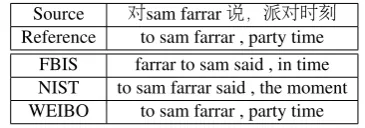
For the Weibo test set, a significant improve-ment over the news datasets can be achieved us-ing our crawled parallel data. Once again newer terms, such asiTunes, are one of the reasons older datasets perform less well. However, in this case, the top OOV words of the news domain datasets are not the most accurate representation of cov-erage problems in this domain. This is because many frequent words in microblogs, e.g., nonstan-dard abbreviations, like uand 4 are found in the news domain as words, albeit with different mean-ings. Thus, the OOV table gives an incomplete picture of the translation problems when using the news domain corpora to translate microblogs. Also, some structural errors occur when training with the news domain datasets, one such example is shown in table 5, where the character 说is in-correctly translated tosaid. This occurs because this type of constructions is infrequent in news datasets. Furthermore, we can see that compound expressions, such as the translation from 派对时
刻toparty timeare also learned.
Finally, we observe that combining the datasets
Source 对sam farrar说,派对时刻 Reference to sam farrar , party time
[image:9.595.324.507.257.321.2]FBIS farrar to sam said , in time NIST to sam farrar said , the moment WEIBO to sam farrar , party time
Table 5: Translation Examples using different training sets.
yields another gain over individual datasets, both in theSyndicateand in theWeibotest sets.
6 Conclusion
We presented a framework to crawl parallel data from microblogs. We find parallel data from sin-gle posts, with translations of the same sentence in two languages. We show that a considerable amount of parallel sentence pairs can be crawled from microblogs and these can be used to improve Machine Translation by updating our translation tables with translations of newer terms. Further-more, the in-domain data can substantially im-prove the translation quality on microblog data.
The resources described in this paper and fur-ther developments are available to the general pub-lic athttp://www.cs.cmu.edu/∼lingwang/utopia.
Acknowledgements
References
[Axelrod et al.2005] Amittai Axelrod, Ra Birch Mayne, Chris Callison-burch, Miles Osborne, and David Talbot. 2005. Edinburgh system description for the 2005 iwslt speech translation evaluation. In Pro-ceedings of the International Workshop on Spoken Language Translation (IWSLT.
[Blei et al.2003] David M. Blei, Andrew Y. Ng, and Michael I. Jordan. 2003. Latent dirichlet allocation. J. Mach. Learn. Res., 3:993–1022, March.
[Braune and Fraser2010] Fabienne Braune and Alexan-der Fraser. 2010. Improved unsupervised sentence alignment for symmetrical and asymmetrical paral-lel corpora. InProceedings of the 23rd International Conference on Computational Linguistics: Posters, COLING ’10, pages 81–89, Stroudsburg, PA, USA. Association for Computational Linguistics.
[Brown et al.1993] Peter F. Brown, Vincent J. Della Pietra, Stephen A. Della Pietra, and Robert L. Mer-cer. 1993. The mathematics of statistical machine translation: parameter estimation. Comput. Lin-guist., 19:263–311, June.
[Fukushima et al.2006] Ken’ichi Fukushima, Kenjiro Taura, and Takashi Chikayama. 2006. A fast and accurate method for detecting English-Japanese par-allel texts. InProceedings of the Workshop on Mul-tilingual Language Resources and Interoperability, pages 60–67, Sydney, Australia, July. Association for Computational Linguistics.
[Gimpel et al.2011] Kevin Gimpel, Nathan Schneider, Brendan O’Connor, Dipanjan Das, Daniel Mills, Ja-cob Eisenstein, Michael Heilman, Dani Yogatama, Jeffrey Flanigan, and Noah A. Smith. 2011. Part-of-speech tagging for twitter: annotation, features, and experiments. In Proceedings of the 49th An-nual Meeting of the Association for Computational Linguistics: Human Language Technologies: short papers - Volume 2, HLT ’11, pages 42–47, Strouds-burg, PA, USA. Association for Computational Lin-guistics.
[Jelh et al.2012] Laura Jelh, Felix Hiebel, and Stefan Riezler. 2012. Twitter translation using translation-based cross-lingual retrieval. InProceedings of the Seventh Workshop on Statistical Machine Transla-tion, pages 410–421, Montr´eal, Canada, June. Asso-ciation for Computational Linguistics.
[Koehn et al.2003] Philipp Koehn, Franz Josef Och, and Daniel Marcu. 2003. Statistical phrase-based translation. InProceedings of the 2003 Conference of the North American Chapter of the Association for Computational Linguistics on Human Language Technology - Volume 1, NAACL ’03, pages 48–54, Morristown, NJ, USA. Association for Computa-tional Linguistics.
[Koehn2005] Philipp Koehn. 2005. Europarl: A Par-allel Corpus for Statistical Machine Translation. In Proceedings of the tenth Machine Translation Sum-mit, pages 79–86, Phuket, Thailand. AAMT, AAMT. [Li and Liu2008] Bo Li and Juan Liu. 2008. Mining Chinese-English parallel corpora from the web. In
Proceedings of the 3rd International Joint Confer-ence on Natural Language Processing (IJCNLP). [Lin et al.2008] Dekang Lin, Shaojun Zhao, Benjamin
Van Durme, and Marius Pas¸ca. 2008. Mining par-enthetical translations from the web by word align-ment. InProceedings of ACL-08: HLT, pages 994– 1002, Columbus, Ohio, June. Association for Com-putational Linguistics.
[Och2003] Franz Josef Och. 2003. Minimum error rate training in statistical machine translation. In Pro-ceedings of the 41st Annual Meeting on Association for Computational Linguistics - Volume 1, ACL ’03, pages 160–167, Stroudsburg, PA, USA. Association for Computational Linguistics.
[Papineni et al.2002] Kishore Papineni, Salim Roukos, Todd Ward, and Wei-Jing Zhu. 2002. Bleu: a method for automatic evaluation of machine trans-lation. InProceedings of the 40th Annual Meeting on Association for Computational Linguistics, ACL ’02, pages 311–318, Stroudsburg, PA, USA. Associ-ation for ComputAssoci-ational Linguistics.
[Post et al.2012] Matt Post, Chris Callison-Burch, and Miles Osborne. 2012. Constructing parallel cor-pora for six indian languages via crowdsourcing. In Proceedings of the Seventh Workshop on Statisti-cal Machine Translation, pages 401–409, Montr´eal, Canada, June. Association for Computational Lin-guistics.
[Resnik and Smith2003] Philip Resnik and Noah A. Smith. 2003. The web as a parallel corpus. Compu-tational Linguistics, 29:349–380.
[Smith et al.2010] Jason R. Smith, Chris Quirk, and Kristina Toutanova. 2010. Extracting parallel sen-tences from comparable corpora using document level alignment. InProceedings of the 2010 Annual Conference of the North American Chapter of the Association for Computational Linguistics.
[Ture and Lin2012] Ferhan Ture and Jimmy Lin. 2012. Why not grab a free lunch? mining large corpora for parallel sentences to improve translation modeling. InProceedings of the 2012 Conference of the North American Chapter of the Association for Computa-tional Linguistics: Human Language Technologies, pages 626–630, Montr´eal, Canada, June. Associa-tion for ComputaAssocia-tional Linguistics.
[Uszkoreit et al.2010] Jakob Uszkoreit, Jay Ponte, Ashok C. Popat, and Moshe Dubiner. 2010. Large scale parallel document mining for machine transla-tion. InProceedings of the 23rd International Con-ference on Computational Linguistics, pages 1101– 1109.
[Vogel et al.1996] Stephan Vogel, Hermann Ney, and Christoph Tillmann. 1996. Hmm-based word align-ment in statistical translation. InProceedings of the 16th conference on Computational linguistics - Vol-ume 2, COLING ’96, pages 836–841, Stroudsburg, PA, USA. Association for Computational Linguis-tics.
for cross-lingual information retrieval. In Proceed-ings of the 24th annual international ACM SIGIR conference on Research and development in infor-mation retrieval, SIGIR ’01, pages 105–110, New York, NY, USA. ACM.
[Xu et al.2005] Jia Xu, Richard Zens, and Hermann Ney. 2005. Sentence segmentation using ibm word alignment model 1. InProceedings of EAMT 2005 (10th Annual Conference of the European Associa-tion for Machine TranslaAssocia-tion, pages 280–287. [Zbib et al.2012] Rabih Zbib, Erika Malchiodi, Jacob