Latent Semantic Matching: Application to Cross-language Text
Categorization without Alignment Information
Tsutomu Hirao
and
Tomoharu Iwata
and
Masaaki Nagata
NTT Communication Science Laboratories, NTT Corporation
2-4, Hikaridai, Seika-cho, Soraku-gun, Kyoto, 619-0237, Japan
{
hirao.tsutomu,iwata.tomoharu,nagata.masaaki
}
@lab.ntt.co.jp
Abstract
Unsupervised object matching (UOM) is
a promising approach to cross-language
natural language processing such as
bilin-gual lexicon acquisition, parallel corpus
construction, and cross-language text
cat-egorization, because it does not require
labor-intensive linguistic resources.
How-ever, UOM only finds one-to-one
corre-spondences from data sets with the same
number of instances in source and target
domains, and this prevents us from
ap-plying UOM to real-world cross-language
natural language processing tasks. To
al-leviate these limitations, we proposes
la-tent semantic matching
, which embeds
objects in both source and target
lan-guage domains into a shared latent topic
space. We demonstrate the effectiveness
of our method on cross-language text
cat-egorization. The results show that our
method outperforms conventional
unsu-pervised object matching methods.
1 Introduction
Unsupervised object matching is a method for
finding one-to-one correspondences between
ob-jects across different domains without knowledge
about the relation between the domains.
Kernel-ized sorting (Novi et al., 2010) and canonical
cor-relation analysis based methods (Haghighi et al.,
2008; Tripathi et al., 2010) are two such
exam-ples of unsupervised object matching, which have
been shown to be quite useful for cross-language
natural language processing (NLP) tasks. One of
the most important properties of the unsupervised
object matching is that it does not require any
lin-guistic resources which connects between the
lan-guages. This distinguishes it from other
cross-language NLP methods such as machine
transla-tion based and projectransla-tion based approaches
(Du-mais et al., 1996; Gliozzo and Strapparava, 2005;
Platt et al., 2010), which we need bilingual
dictio-naries or parallel sentences.
When we apply unsupervised object matching
methods to cross-language NLP tasks, there are
two critical problems. The first is that they only
find one-to-one matching. The second is they
re-quire the same size of source- and target-data. For
example, the correct translation of a word is not
always unique. French words ‘
maison
’, ‘
appart-ment
’ and ‘
domicile
’ can be regarded as
transla-tion of an English word ‘home’. In additransla-tion,
En-glish vocabulary size is not equal to that of French.
These discussions motivate us to introduce a
shared space in which both source and target
do-main objects will reside. If we can obtain such
a shared space, we can match objects within the
space, because we can use standard distance
met-rics on this space. This will also enable us to use
various kinds of non-strict matching. For
exam-ple,
k
-nearest objects in the source domain will be
retrieved for a query object in the target domain.
In this paper, we propose a simple but effective
method to find the shared space by assuming that
two languages have common latent topics, which
we call
latent semantic matching
. With latent
se-mantic matching, we first find latent topics in two
domains independently. Then, the topics in two
domains are aligned by kernelized sorting, and
ob-jects are embedded in a shared latent topic space.
Latent topic representations are successfully used
in a wide range of NLP tasks, such as information
retrieval and text classification, because they
rep-resent intrinsic information of documents
(Deer-wester et al., 1990). By matching latent topics,
we can find relation between source and target
do-mains, and additionally we can handle different
numbers of objects in two domains.
We compared latent semantic matching with
conventional unsupervised object matching
ods on the task of cross-language text
categoriza-tion,
i.e.
classifying target side unlabeled
docu-ments by label information obtained from source
side documents. The results show that, with more
source side documents, our method achieved the
highest classification accuracy.
2 Related work
Many cross-language text processing methods
have been proposed that require correspondences
between source and target languages. For
exam-ple, (Dumais et al., 1996) proposed cross-lingual
latent semantic indexing, and (Platt et al., 2010)
employed oriented principle component analysis
and canonical correlation analysis (CCA). They
concatenate the document pairs (source document
and its translation) obtained from a
document-level parallel corpus. They then apply
multi-variate analysis to acquire the translingual
projec-tion. There are extensions of latent Dirichlet
allo-cation (LDA) (Blei et al., 2003) for cross-language
analysis, such as multilingual topic models
(Boyd-Graber and Blei, 2009), joint LDA (Jagadeesh
and Daume III, 2010) and multilingual LDA
(Xi-aochuan et al., 2011). They require a bilingual
dic-tionary or document-level parallel corpora.
Unsupervised object matching methods have
been proposed recently (Novi et al., 2010;
Haghighi et al., 2008; Yamada and Sugiyama,
2011). These methods are promising in terms of
language portability because they do not require
external language resources. (Novi et al., 2010)
proposed kernelized sorting (KS); it finds
one-to-one correspondences between objects in different
domains by permuting a set to maximize the
de-pendence between two sets. Here, the
Hilbert-Schmidt independence criterion is used for
mea-suring dependence. (Djuric et al., 2012) proposed
convex kernelized sorting as an extension of KS.
(Yamada and Sugiyama, 2011) proposed
least-squares object matching which maximizes the
squared-loss mutual information between matched
pairs. (Haghighi et al., 2008) proposed another
framework, matching CCA (MCCA), based on a
probabilistic interpretation of CCA (Bach and
Jor-dan, 2005). MCCA simultaneously finds latent
variables that represent correspondences and
la-tent features so that the lala-tent features of
corre-sponding examples exhibit the maximum
correla-tion. However, these unsupervised object
match-ing methods have limitations. They require that
the source and target domains have the same data
size, and they find one-to-one correspondences.
There are critical weaknesses of these methods
when we attempt to apply them to real world
cross-language NLP applications.
3 Latent Semantic Matching
We propose latent semantic matching to find a
shared latent space by assuming that two
lan-guages have common latent topics. Our method
consists of following four steps: (1) for both
source and target domains, we map the documents
to a
K-dimensional latent topic space
indepen-dently, (2) we find the one-to-one correspondences
between topics across source and target domains
by unsupervised object matching, (3) we permute
topics of the target side according to the
corre-spondences, while fixing the topics of the source
side, and (4) finally, we map documents in the
source and target domains to a shared latent space
by using permuted and fixed topics.
3.1 Topic Extraction as Dimension Reduction
Suppose that we have
N
documents in the source
domain.
s
n
=(
s
ni
)
I
i
=1
is the
nth document
rep-resented as a multi-dimensional column vector in
the domain,
i.e.
each document is represented as
a bag-of-words vector. Here, each element of the
vectors indicates the TF
·
IDF score of the
corre-sponding word in the document.
I
is the size of the
feature set,
i.e.,
the vocabulary size in the source
domain. Also, we have
M
documents in the
tar-get domain.
t
m
=(
tmj
)
J
j
=1
is the
mth document
represented as a multi-dimensional vector.
J
is
the vocabulary size in the target domain. Thus,
the data set in the source domain is represented by
an
I
×
N
matrix,
S
=(
s
1
,
· · ·
,
s
N
)
, the data set
in the target is represented by a
J
×
M
matrix,
T
=(
t
1
,
· · ·
,
t
M
)
.
We factorize these matrices using nonnegative
matrix factorization (Lee and Seung, 2000) to find
topics as follows:
S
≈
W
S
H
S
,
(1)
T
≈
W
T
H
T
.
(2)
W
S
is an
I
×
K
matrix that represents a set of
top-ics,
i.e.
each column vector denotes word weights
for each topic.
H
S
is a
K
×
N
matrix that
de-notes a set of latent semantic representations of
×
×
×
≈
≈
≈
W
S
H
S
π
*=
0 0 1 0
0 1 0 0
0 0 0 1
1 0 0 0
ment.Iis the size of feature set,i.e.,the size of vocabulary in the source domain. Also, we haveMdocuments in a target domain.tm= (tmj)J
j=1is them-th document represented
as a multi-dimensional vector.Jis the size of vocabulary in the target domain. Thus, the data set in the source domain is represented as theI×Nmatrix,S, the data set in the target is represented as theJ×Mmatrix,T.
Here, we assume that these matrices are approximated as the product of low rank matrices as follows:
S≈WSHS, (1)
T≈WTHT (2)
WSisI×Kmatrix, which represents a set of topic propor-tions in the source domain,i.e.,each column vector denotes topic proportion.HSisK×Nmatrix, which denotes a set of documents in theK-dimensional latent space which cor-responds to the source domain,i.e.,each row vector denotes the document in the latent space. Thek(1≤k≤K)-th basis in the latent space corresponds to thek-th topic proportion.
WTisI×Kmatrix, which represents a set of topic pro-portions in the target domain.HTisK×Nmatrix, which denotes a set of documents in the latent topic space with di-mentionalyK.Kis less thanI,J. In this paper, we employ Non-negative Matrix Factorization (NMF) [Lee and Seung, 2000] to factorize the original matrices.
According to the factorization of the original matrices, we can map the documents in the source and target domain to latent topic space with dimentionalyK, independently. 3.2 Finding Optimal Topic Alignments by
Unsupervised Object Matching To connect the different latent space, the basis of the space have to be aligned each other. That is, topic proportion ex-tracted from the source language must be aligned that from the target language. This is reasonable consideration because we can assume the same latent concept for both language. For example, a topic proportion obtained from English docu-ments can be aligned a topic proportion obtained from French documents. For allkandk!,k-th column vector inWSare alignedk!-th column vector inWT.
However, we can not measure similarity between the topic proportions because we do not have any language resources such as dictionary. Therefore, we utilize unsupervised ob-ject matching method to find one-to-one correspondences be-tween topic proportions. In this paper, we employ Kernelized Sorting (KS) [Noviet al., 2010]. Of cource, we can replace KS to another unsupervised object matching sush as MCCA [Haghighiet al., 2008], LSOM [Yamada and Sugiyama, 2011].
KS finds the best one-to-one matching by followings:
π∗ = arg max π∈ΠK
tr( ¯GSπTG¯Tπ), s.t.π1K= 1KandπT1K= 1K. (3)
πisK×Kmatrix which represents one-to-one correspon-dence between topic proportion,i.e.,πij= 1indicatesi-th topic proportion in the source language corresponds toj-th
one of the target language.Πindicates set of all possible
K×Kmatrices which store one-to-one corresponrence.G denotesK×Kkernel matrix obtained from topic proportion, Gij=K(WT
i,:, W:,j), andG¯is the centerd matrix ofG.K(,) is a kernel function.1KisK-dimensional column vector of all ones.π∗is obtained by iterative procedure. According to
π∗, we can permutate the basis of the latent space obtained from source language. See fig hoge.
S≈WSHS. (4) On the other hand, we can directly fomulate objective func-tion ofunsupervised mapping. If the topic proportions are aligned each other, the correlation matrix (or gram matrix) obtained from source language is proportional to one from target language:
||GS−αGT||2= 0. (5)
αdenotes the hyperparameter for tuning the socore range be-tween two gram matrices.
By minimize the error of the matrix factorization (equa-tion (1),(2)) and the difference between correla(equa-tion matrices (equation (6)), the objective function is defined as follow:
E=%S−WSHS%2
+%T−WTHT%2
+β||GS−αGT||2. (6) βis cost parameter between first, second argu-ment and third arguargu-ment. The optimal parameters (WS, WT, HS, HT) are obtained by minimizing the objective function. To mimimize the objective, gradient de-scend can be used. but However that is not convex function, we only obtained local optimal. Thefore, we employed above two step procedure??????
This objective function is not convex. That means we can only obtain local optimal parameters. By min-imizing equation (6), we can obtain a set of parameter (WS, WT, HS, HT) for unsupervised mapping. we could be employed gradient based algorithm but, as the first step, we employ former two step optimization procedure. 3.3 Cross-lingual Text Categorization via
Unsupervised Mapping
m-th document in the target domain (tm) is mapped to the
source domain as follows,
s(tm) =HT$:,mWS. (7) Here,HT:,mdenotes them-th column vector ofHT,s(tm) isIdimentional vector.
When each document in the source domain has a class labelyn, we can train a classifier on the training data set {sn, yn}N
n=1. Therefore, the class label of the mapped
docu-ment in the target domains(tm)is assigned by the classifier.
In the later experiments, we employk(= 10)-NN as a classi-fier.
ment.Iis the size of feature set,i.e.,the size of vocabulary in the source domain. Also, we haveMdocuments in a target domain.tm= (tmj)J
j=1is them-th document represented
as a multi-dimensional vector.Jis the size of vocabulary in the target domain. Thus, the data set in the source domain is represented as theI×Nmatrix,S, the data set in the target is represented as theJ×Mmatrix,T.
Here, we assume that these matrices are approximated as the product of low rank matrices as follows:
S≈WSHS, (1)
T≈WTHT (2)
WSisI×Kmatrix, which represents a set of topic propor-tions in the source domain,i.e.,each column vector denotes topic proportion.HSisK×Nmatrix, which denotes a set of documents in theK-dimensional latent space which cor-responds to the source domain,i.e.,each row vector denotes the document in the latent space. Thek(1≤k≤K)-th basis in the latent space corresponds to thek-th topic proportion.
WTisI×Kmatrix, which represents a set of topic pro-portions in the target domain.HTisK×Nmatrix, which denotes a set of documents in the latent topic space with di-mentionalyK.Kis less thanI,J. In this paper, we employ Non-negative Matrix Factorization (NMF) [Lee and Seung, 2000] to factorize the original matrices.
According to the factorization of the original matrices, we can map the documents in the source and target domain to latent topic space with dimentionalyK, independently.
3.2 Finding Optimal Topic Alignments by Unsupervised Object Matching
To connect the different latent space, the basis of the space have to be aligned each other. That is, topic proportion ex-tracted from the source language must be aligned that from the target language. This is reasonable consideration because we can assume the same latent concept for both language. For example, a topic proportion obtained from English docu-ments can be aligned a topic proportion obtained from French documents. For allkandk!,k-th column vector inWSare
alignedk!-th column vector inWT.
However, we can not measure similarity between the topic proportions because we do not have any language resources such as dictionary. Therefore, we utilize unsupervised ob-ject matching method to find one-to-one correspondences be-tween topic proportions. In this paper, we employ Kernelized Sorting (KS) [Noviet al., 2010]. Of cource, we can replace KS to another unsupervised object matching sush as MCCA [Haghighiet al., 2008], LSOM [Yamada and Sugiyama, 2011].
KS finds the best one-to-one matching by followings: π∗ = arg max
π∈ΠK
tr( ¯GSπTG¯Tπ), s.t.π1K= 1KandπT1K= 1K. (3) πisK×Kmatrix which represents one-to-one correspon-dence between topic proportion,i.e.,πij= 1indicatesi-th topic proportion in the source language corresponds toj-th
one of the target language.Πindicates set of all possible
K×Kmatrices which store one-to-one corresponrence.G
denotesK×Kkernel matrix obtained from topic proportion,
Gij=K(WT
i,:, W:,j), andG¯is the centerd matrix ofG.K(,)
is a kernel function.1KisK-dimensional column vector of all ones.π∗is obtained by iterative procedure. According to π∗, we can permutate the basis of the latent space obtained from source language. See fig hoge.
S≈WSHS. (4) On the other hand, we can directly fomulate objective func-tion ofunsupervised mapping. If the topic proportions are aligned each other, the correlation matrix (or gram matrix) obtained from source language is proportional to one from target language:
||GS−αGT||2= 0. (5) αdenotes the hyperparameter for tuning the socore range be-tween two gram matrices.
By minimize the error of the matrix factorization (equa-tion (1),(2)) and the difference between correla(equa-tion matrices (equation (6)), the objective function is defined as follow:
E=%S−WSHS%2
+%T−WTHT%2
+β||GS−αGT||2. (6)
βis cost parameter between first, second argu-ment and third arguargu-ment. The optimal parameters (WS, WT, HS, HT) are obtained by minimizing the
objective function. To mimimize the objective, gradient de-scend can be used. but However that is not convex function, we only obtained local optimal. Thefore, we employed above two step procedure??????
This objective function is not convex. That means we can only obtain local optimal parameters. By min-imizing equation (6), we can obtain a set of parameter (WS, WT, HS, HT) for unsupervised mapping. we could
be employed gradient based algorithm but, as the first step, we employ former two step optimization procedure.
3.3 Cross-lingual Text Categorization via Unsupervised Mapping
m-th document in the target domain (tm) is mapped to the source domain as follows,
s(tm) =HT$:,mWS. (7) Here,HT:,mdenotes them-th column vector ofHT,s(tm)
isIdimentional vector.
When each document in the source domain has a class labelyn, we can train a classifier on the training data set
{sn, yn}N
n=1. Therefore, the class label of the mapped
docu-ment in the target domains(tm)is assigned by the classifier. In the later experiments, we employk(= 10)-NN as a classi-fier.
ment.Iis the size of feature set,i.e.,the size of vocabulary in the source domain. Also, we haveMdocuments in a target domain.tm= (tmj)J
j=1is them-th document represented
as a multi-dimensional vector.Jis the size of vocabulary in the target domain. Thus, the data set in the source domain is represented as theI×Nmatrix,S, the data set in the target is represented as theJ×Mmatrix,T.
Here, we assume that these matrices are approximated as the product of low rank matrices as follows:
S≈WSHS, (1)
T≈WTHT (2)
WSisI×Kmatrix, which represents a set of topic propor-tions in the source domain,i.e.,each column vector denotes topic proportion.HSisK×Nmatrix, which denotes a set of documents in theK-dimensional latent space which cor-responds to the source domain,i.e.,each row vector denotes the document in the latent space. Thek(1≤k≤K)-th basis in the latent space corresponds to thek-th topic proportion.
WTisI×Kmatrix, which represents a set of topic pro-portions in the target domain.HTisK×Nmatrix, which denotes a set of documents in the latent topic space with di-mentionalyK.Kis less thanI,J. In this paper, we employ Non-negative Matrix Factorization (NMF) [Lee and Seung, 2000] to factorize the original matrices.
According to the factorization of the original matrices, we can map the documents in the source and target domain to latent topic space with dimentionalyK, independently.
3.2 Finding Optimal Topic Alignments by Unsupervised Object Matching
To connect the different latent space, the basis of the space have to be aligned each other. That is, topic proportion ex-tracted from the source language must be aligned that from the target language. This is reasonable consideration because we can assume the same latent concept for both language. For example, a topic proportion obtained from English docu-ments can be aligned a topic proportion obtained from French documents. For allkandk!,k-th column vector inWSare
alignedk!-th column vector inWT.
However, we can not measure similarity between the topic proportions because we do not have any language resources such as dictionary. Therefore, we utilize unsupervised ob-ject matching method to find one-to-one correspondences be-tween topic proportions. In this paper, we employ Kernelized Sorting (KS) [Noviet al., 2010]. Of cource, we can replace KS to another unsupervised object matching sush as MCCA [Haghighiet al., 2008], LSOM [Yamada and Sugiyama, 2011].
KS finds the best one-to-one matching by followings: π∗ = arg max
π∈ΠK
tr( ¯GSπTG¯Tπ), s.t.π1K= 1KandπT1K= 1K. (3) πisK×Kmatrix which represents one-to-one correspon-dence between topic proportion,i.e.,πij= 1indicatesi-th topic proportion in the source language corresponds toj-th
one of the target language.Πindicates set of all possible
K×Kmatrices which store one-to-one corresponrence.G
denotesK×Kkernel matrix obtained from topic proportion,
Gij=K(WT
i,:, W:,j), andG¯is the centerd matrix ofG.K(,)
is a kernel function.1KisK-dimensional column vector of all ones.π∗is obtained by iterative procedure. According to π∗, we can permutate the basis of the latent space obtained from source language. See fig hoge.
S≈WSHS. (4) On the other hand, we can directly fomulate objective func-tion ofunsupervised mapping. If the topic proportions are aligned each other, the correlation matrix (or gram matrix) obtained from source language is proportional to one from target language:
||GS−αGT||2= 0. (5) αdenotes the hyperparameter for tuning the socore range be-tween two gram matrices.
By minimize the error of the matrix factorization (equa-tion (1),(2)) and the difference between correla(equa-tion matrices (equation (6)), the objective function is defined as follow:
E=%S−WSHS%2
+%T−WTHT%2
+β||GS−αGT||2. (6)
βis cost parameter between first, second argu-ment and third arguargu-ment. The optimal parameters (WS, WT, HS, HT) are obtained by minimizing the
objective function. To mimimize the objective, gradient de-scend can be used. but However that is not convex function, we only obtained local optimal. Thefore, we employed above two step procedure??????
This objective function is not convex. That means we can only obtain local optimal parameters. By min-imizing equation (6), we can obtain a set of parameter (WS, WT, HS, HT) for unsupervised mapping. we could
be employed gradient based algorithm but, as the first step, we employ former two step optimization procedure.
3.3 Cross-lingual Text Categorization via Unsupervised Mapping
m-th document in the target domain (tm) is mapped to the source domain as follows,
s(tm) =HT$:,mWS. (7) Here,HT:,mdenotes them-th column vector ofHT,s(tm)
isIdimentional vector.
When each document in the source domain has a class labelyn, we can train a classifier on the training data set
{sn, yn}N
n=1. Therefore, the class label of the mapped
docu-ment in the target domains(tm)is assigned by the classifier. In the later experiments, we employk(= 10)-NN as a classi-fier.
ment.Iis the size of feature set,i.e.,the size of vocabulary in the source domain. Also, we haveMdocuments in a target domain.tm= (tmj)J
j=1is them-th document represented
as a multi-dimensional vector.Jis the size of vocabulary in the target domain. Thus, the data set in the source domain is represented as theI×Nmatrix,S, the data set in the target is represented as theJ×Mmatrix,T.
Here, we assume that these matrices are approximated as the product of low rank matrices as follows:
S≈WSHS, (1)
T≈WTHT (2)
WSisI×Kmatrix, which represents a set of topic propor-tions in the source domain,i.e.,each column vector denotes topic proportion.HSisK×Nmatrix, which denotes a set of documents in theK-dimensional latent space which cor-responds to the source domain,i.e.,each row vector denotes the document in the latent space. Thek(1≤k≤K)-th basis in the latent space corresponds to thek-th topic proportion.
WTisI×Kmatrix, which represents a set of topic pro-portions in the target domain.HTisK×Nmatrix, which denotes a set of documents in the latent topic space with di-mentionalyK.Kis less thanI,J. In this paper, we employ Non-negative Matrix Factorization (NMF) [Lee and Seung, 2000] to factorize the original matrices.
According to the factorization of the original matrices, we can map the documents in the source and target domain to latent topic space with dimentionalyK, independently.
3.2 Finding Optimal Topic Alignments by Unsupervised Object Matching
To connect the different latent space, the basis of the space have to be aligned each other. That is, topic proportion ex-tracted from the source language must be aligned that from the target language. This is reasonable consideration because we can assume the same latent concept for both language. For example, a topic proportion obtained from English docu-ments can be aligned a topic proportion obtained from French documents. For allkandk!,k-th column vector inWSare
alignedk!-th column vector inWT.
However, we can not measure similarity between the topic proportions because we do not have any language resources such as dictionary. Therefore, we utilize unsupervised ob-ject matching method to find one-to-one correspondences be-tween topic proportions. In this paper, we employ Kernelized Sorting (KS) [Noviet al., 2010]. Of cource, we can replace KS to another unsupervised object matching sush as MCCA [Haghighiet al., 2008], LSOM [Yamada and Sugiyama, 2011].
KS finds the best one-to-one matching by followings: π∗ = arg max
π∈ΠK
tr( ¯GSπTG¯Tπ), s.t.π1K= 1KandπT1K= 1K. (3) πisK×Kmatrix which represents one-to-one correspon-dence between topic proportion,i.e.,πij= 1indicatesi-th topic proportion in the source language corresponds toj-th
one of the target language.Πindicates set of all possible
K×Kmatrices which store one-to-one corresponrence.G
denotesK×Kkernel matrix obtained from topic proportion,
Gij=K(WT
i,:, W:,j), andG¯is the centerd matrix ofG.K(,)
is a kernel function.1KisK-dimensional column vector of all ones.π∗is obtained by iterative procedure. According to π∗, we can permutate the basis of the latent space obtained from source language. See fig hoge.
S≈WSHS. (4) On the other hand, we can directly fomulate objective func-tion ofunsupervised mapping. If the topic proportions are aligned each other, the correlation matrix (or gram matrix) obtained from source language is proportional to one from target language:
||GS−αGT||2= 0. (5) αdenotes the hyperparameter for tuning the socore range be-tween two gram matrices.
By minimize the error of the matrix factorization (equa-tion (1),(2)) and the difference between correla(equa-tion matrices (equation (6)), the objective function is defined as follow:
E=%S−WSHS%2
+%T−WTHT%2
+β||GS−αGT||2. (6)
βis cost parameter between first, second argu-ment and third arguargu-ment. The optimal parameters (WS, WT, HS, HT) are obtained by minimizing the
objective function. To mimimize the objective, gradient de-scend can be used. but However that is not convex function, we only obtained local optimal. Thefore, we employed above two step procedure??????
This objective function is not convex. That means we can only obtain local optimal parameters. By min-imizing equation (6), we can obtain a set of parameter (WS, WT, HS, HT) for unsupervised mapping. we could
be employed gradient based algorithm but, as the first step, we employ former two step optimization procedure.
3.3 Cross-lingual Text Categorization via Unsupervised Mapping
m-th document in the target domain (tm) is mapped to the source domain as follows,
s(tm) =HT$:,mWS. (7) Here,HT:,mdenotes them-th column vector ofHT,s(tm)
isIdimentional vector.
When each document in the source domain has a class labelyn, we can train a classifier on the training data set
{sn, yn}N
n=1. Therefore, the class label of the mapped
docu-ment in the target domains(tm)is assigned by the classifier. In the later experiments, we employk(= 10)-NN as a classi-fier.
ment.Iis the size of feature set,i.e.,the size of vocabulary in the source domain. Also, we haveMdocuments in a target domain.tm= (tmj)J
j=1is them-th document represented
as a multi-dimensional vector.Jis the size of vocabulary in the target domain. Thus, the data set in the source domain is represented as theI×Nmatrix,S, the data set in the target is represented as theJ×Mmatrix,T.
Here, we assume that these matrices are approximated as the product of low rank matrices as follows:
S≈WSHS, (1)
T≈WTHT (2)
WSisI×Kmatrix, which represents a set of topic propor-tions in the source domain,i.e.,each column vector denotes topic proportion.HSisK×Nmatrix, which denotes a set of documents in theK-dimensional latent space which cor-responds to the source domain,i.e.,each row vector denotes the document in the latent space. Thek(1≤k≤K)-th basis in the latent space corresponds to thek-th topic proportion.
WTisI×Kmatrix, which represents a set of topic pro-portions in the target domain.HTisK×Nmatrix, which denotes a set of documents in the latent topic space with di-mentionalyK.Kis less thanI,J. In this paper, we employ Non-negative Matrix Factorization (NMF) [Lee and Seung, 2000] to factorize the original matrices.
According to the factorization of the original matrices, we can map the documents in the source and target domain to latent topic space with dimentionalyK, independently.
3.2 Finding Optimal Topic Alignments by Unsupervised Object Matching
To connect the different latent space, the basis of the space have to be aligned each other. That is, topic proportion ex-tracted from the source language must be aligned that from the target language. This is reasonable consideration because we can assume the same latent concept for both language. For example, a topic proportion obtained from English docu-ments can be aligned a topic proportion obtained from French documents. For allkandk!,k-th column vector inWSare
alignedk!-th column vector inWT.
However, we can not measure similarity between the topic proportions because we do not have any language resources such as dictionary. Therefore, we utilize unsupervised ob-ject matching method to find one-to-one correspondences be-tween topic proportions. In this paper, we employ Kernelized Sorting (KS) [Noviet al., 2010]. Of cource, we can replace KS to another unsupervised object matching sush as MCCA [Haghighiet al., 2008], LSOM [Yamada and Sugiyama, 2011].
KS finds the best one-to-one matching by followings: π∗ = arg max
π∈ΠK
tr( ¯GSπTG¯Tπ), s.t.π1K= 1KandπT1K= 1K. (3) πisK×Kmatrix which represents one-to-one correspon-dence between topic proportion,i.e.,πij= 1indicatesi-th topic proportion in the source language corresponds toj-th
one of the target language.Πindicates set of all possible
K×Kmatrices which store one-to-one corresponrence.G
denotesK×Kkernel matrix obtained from topic proportion,
Gij=K(WT
i,:, W:,j), andG¯is the centerd matrix ofG.K(,)
is a kernel function.1KisK-dimensional column vector of all ones.π∗is obtained by iterative procedure. According to π∗, we can permutate the basis of the latent space obtained from source language. See fig hoge.
S≈WSHS. (4) On the other hand, we can directly fomulate objective func-tion ofunsupervised mapping. If the topic proportions are aligned each other, the correlation matrix (or gram matrix) obtained from source language is proportional to one from target language:
||GS−αGT||2= 0. (5) αdenotes the hyperparameter for tuning the socore range be-tween two gram matrices.
By minimize the error of the matrix factorization (equa-tion (1),(2)) and the difference between correla(equa-tion matrices (equation (6)), the objective function is defined as follow:
E=%S−WSHS%2
+%T−WTHT%2
+β||GS−αGT||2. (6)
βis cost parameter between first, second argu-ment and third arguargu-ment. The optimal parameters (WS, WT, HS, HT) are obtained by minimizing the
objective function. To mimimize the objective, gradient de-scend can be used. but However that is not convex function, we only obtained local optimal. Thefore, we employed above two step procedure??????
This objective function is not convex. That means we can only obtain local optimal parameters. By min-imizing equation (6), we can obtain a set of parameter (WS, WT, HS, HT) for unsupervised mapping. we could
be employed gradient based algorithm but, as the first step, we employ former two step optimization procedure.
3.3 Cross-lingual Text Categorization via Unsupervised Mapping
m-th document in the target domain (tm) is mapped to the source domain as follows,
s(tm) =HT$:,mWS. (7) Here,HT:,mdenotes them-th column vector ofHT,s(tm)
isIdimentional vector.
When each document in the source domain has a class labelyn, we can train a classifier on the training data set
{sn, yn}N
n=1. Therefore, the class label of the mapped
docu-ment in the target domains(tm)is assigned by the classifier. In the later experiments, we employk(= 10)-NN as a classi-fier.
W
T
H
T
[image:3.595.345.489.61.145.2]M
I
N
J
K
K
K
T
S
T
Figure 1: Topic alignments.
vector denotes an embedding of a document in the
K-dimensional latent space. Similarly,
W
T
is an
I
×
K
matrix that represents a set of topics in the
target domain, and
H
T
is a
K
×
M
matrix that
denotes a set of latent semantic representations of
target documents.
K
is less than
I
and
J
.
By factorizing the original matrices, we can
in-dependently map the documents in the source and
target domains to the latent topic spaces whose
di-mensionality is
K.
3.2 Finding Optimal Topic Alignments by
Unsupervised Object Matching
To connect the different latent spaces, topics
ex-tracted from the source language must be aligned
to one from the target language. This is reasonable
because we can assume that both languages share
the same latent concept.
However, we cannot quantify the similarity
be-tween the topics because we do not have any
ex-ternal language resources such as a dictionary.
Therefore, we utilize unsupervised object
match-ing method to find one-to-one correspondences
between topics. In this paper, we employ
kernel-ized sorting (KS) (Novi et al., 2010). KS finds the
best one-to-one matching as follows:
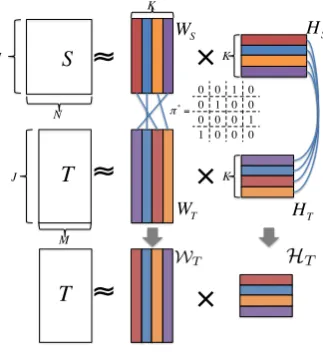
π
∗
=
arg max
π
∈
ΠK
tr(
G
S
π
⊤
G
T
π
)
,
s.t.
π
1
K
=
1
K
and
π
⊤
1
K
=
1
K
.
(3)
Here,
π
is a
K
×
K
matrix that represents the
one-to-one correspondence between topics,
i.e.
πij
=1
indicates that the
ith topic in the source language
corresponds to the
jth one of the target language.
Overall Average
KS
0.252
±
0.112
CKS
0.249
±
0.033
LSOM
0.278
±
0.086
LSM(300) 0.298
±
0.077
LSM(600)
0.359
±
0.062
Table 1: Average accuracy over all language pairs
Π
K
indicates the set of all possible matrices
stor-ing one-to-one correspondences.
G
denotes the
K
×
K
kernel matrix obtained from topic
pro-portion,
G
ij
=
K
(
W
i,
⊤
:
,
W
:
,j
)
, and
G
is the centered
matrix of
G
.
K
(
,
)
is a kernel function.
1
K
is a
K-dimensional column vector of all ones.
π
∗
is
obtained by iterative procedure.
According to
π
∗
, we obtain permuted matrices,
W
T
=
W
T
π
∗
and
H
T
=
π
∗⊤
H
T
, and the product
of permuted matrices is the same with that of
un-permuted matrices as follows:
T
≈
W
T
H
T
=
W
T
H
T
.
(4)
Fig. 1 shows the topic alignment procedure.
Since documents from both domains are
repre-sented in a shared latent space, we can directly
cal-culate the similarity between the
nth document in
the source domain and the
mth document in the
target domain based on
H
T
:
,m
(mth column
vec-tor of
H
T
) and
H
S
:
,n
(
n
th column vector of
H
S).
4 Cross-language Text Categorization
via Latent Semantic Matching
Cross-language text categorization is the task of
exploiting labeled documents in the source
lan-guage (e.g. English) to classify documents in
the target language (e.g. French). Suppose we
have training data set
{
s
n, yn
}
N
n
=1
in the source
language domain.
y
n
∈
Y
is the class label
for the
nth document. We can train a classifier
in the
K-dimensional latent space with data set
{
H
S
⊤
:
,n
, y
n
}
N
n
=1
.
H
S
⊤
:
,n
is the projected vector of
s
n. Also, the
mth document in the target language
domain
t
m
is projected into the latent space as
H
⊤
T
:
,m
. Here, the documents in both domains are
projected into the same size latent space and the
basis vectors of the spaces are aligned. Therefore,
we can classify a document in the target domain
[image:3.595.99.261.63.240.2]Books
English
Hack, Parent, tale, subversion, Interesting, centre, Paper, T., prejudice, Murphy
German
Lydia, Sebastian, Seelenbrecher, Patient, Fitzek, Patrick, Fiktion, Patientenakte, Realitt, Klinik
Electronics
English
SD800, Angle, Digital, Optical, Silver, understnad, camra, 7.1MP, P3N, 10MP
German
*****, 550D, 600D, Objektiv, Canon, ablichten, Body, Werkzeug, Kamera, einliet
Kitchen
English
Briel, Electra-Craft, Chamonix, machine, Due, crema, supervisor, technician, espresso, tamp
German
ESGE, Prierkopf, Zauberstab, Gummikupplung, Suppe/Sauce, Braun , Bolognese, prieren, Testsieger, Topf
Music
English
Amy, Poison, Doherty, Schottin, Mid, Prince, Song, ausdrucksstark , Tempo, knocking
German
Norah, mini, ’Little, ’Rome, ’Come, Gardot, Lana, listenings , dreamlike, digipak
Watch
English
watch, indicate, timex, HRM, month, icon, Timex, datum, troubleshooting, reasonable
[image:4.595.68.531.68.265.2]German
Orient, Diver, Lnette, Leuchtpunkt, Zahlenringes, Handgelenksdurchmesser, Stoppsekunde, Uhrforum,
Konsumbereiche, Schwingungen/Std
Table 2: Examples of aligned latent topics
5 Experimental Evaluation
5.1 Experimental Settings
We compared our method, latent semantic
ing (LSM), with three unsupervised object
match-ing methods: Kernelized Sortmatch-ing (KS), Convex
Kernelized Sorting (CKS), Least-Squares Object
Matching (LSOM). We set the number of the
la-tent topics
K
to 100 and employed the
k-nearest
neighbor method (k
=10
) as the classifier.
For, KS, CKS and LSOM, we find the
one-to-one correspondence between documents in the
source language and documents in the target
lan-guage. Then, we assign class labels of the target
documents according to the correspondence.
In order to build a corpus with various
lan-guage pairs for evaluation, we crawled product
reviews from Amazon U.S., German, France and
Japan with five categories: ‘Books’, ‘Electronics’,
‘Music’, ‘Kitchen’, ‘Watch’. The corpus is
nei-ther sentence level parallel nor comparable. For
each category, we randomly select 60 documents
as the test data (M
=300
) for all methods and 60
documents as the training data (N
=300
) for KS,
CKS, LSOM and LSM(300). We also compared
latent semantic matching with 120 training
docu-ments for each category (N
=600
), and called this
method LSM(600). Note that since KS, CKS and
LSOM require that the data sizes are the same for
source and target domains, they cannot use
train-ing data more than test data. To avoid local
opti-mum solutions of NMF, we executed our methods
with 100 different initialization values and chose
the solution that achieved the best objective
func-tion of KS.
5.2 Results and Discussion
Table 1 shows average accuracies with standard
division over all language pairs. From the table,
classification accuracy of all methods significantly
outperformed random classifier (accuracy=0.2).
The results showed the effectiveness of both
un-supervised object matching and latent semantic
matching. When comparing LSM(300) with KS,
CKS and LSOM, LSM(300) obtained better
re-sults than these unsupervised object matching
methods. The result supports the effectiveness of
the latent topic matching. Moreover, LSM(600)
achieved the highest accuracy. There are large
dif-ferences between LSM(600) and the others. This
result implies not only the effectiveness of the
la-tent topic matching but also increasing the number
of source side documents (labeled training data)
contributes to improving classification accuracy.
This is natural in terms of supervised learning but
only our method can deal with source side
docu-ments that are larger in number.
6 Conclusion
As an extension of unsupervised object matching,
this paper proposed latent semantic matching that
considers the shared latent space between two
lan-guage domains. To generate such a space,
top-ics of the target space are permuted by
exploit-ing unsupervised object matchexploit-ing. We can
mea-sure distances between objects by standard
met-rics, which enable us retrieving k-nearest objects
in the source domain for a query object in the
tar-get domain. This is a significant advantage over
conventional unsupervised object matching
meth-ods. We used Amazon review corpus to
demon-strate the effectiveness of our method on
cross-language text categorization. The results showed
that our method outperformed conventional object
matching methods with the same number of
train-ing samples. Moreover, our method achieved even
higher performance by utilizing more documents
in the source domain.
Acknowledgements
The authors would like to thank Nemanja Djuric
for providing code for Convex Kernelized Sorting
and the three anonymous reviewers for thoughtful
suggestions.
References
Francis Bach and Michael Jordan. 2005. A
probabilis-tic interpretation of canonical correlation analysis.
Technical report, Department of Statistics,
Univer-sity of California, Berkeley.
David Blei, Andrew Ng, and Michael Jordan. 2003.
Latent Dirichlet allocation.
JMLR
, 3(Jan.):993–
1022.
Jordan Boyd-Graber and David Blei. 2009.
Multilin-gual topic model for unaligned text. In
Proc. of the
25th UAI
, pages 75–82.
Scott Deerwester, Susan T. Dumais, George W.
Fur-nas, Thomas K. Landauer, and Richard Harshman.
1990. Indexing by latent semantic analysis.
Jour-nal of the American Society for Information Science
,
41(6):391–407.
Nemanja Djuric, Mihajlo Grbovic, and Slobodan
Vucetic. 2012. Convex kernelized sorting. In
Proc.
of the 26th AAAI
, pages 893–899.
Susan Dumais, Lanauer Thomas, and Michael Littman.
1996. Automatic cross-linguistic information
re-trieval using latent semantic indexing. In
Proc.
of the Workshop on Cross-Linguistic Information
Retieval in SIGIR
, pages 16–23.
Alfio Gliozzo and Carlo Strapparava. 2005. Cross
lan-guage text categorization by acquiring multilingual
domain models from comparable corpora. In
Proc.
of the ACL Workshop on Building and Using
Paral-lel Texts
, pages 9–16.
Aria Haghighi, Percy Liang, Taylor Berg-Kirkpatrick,
and Dan Klein. 2008. Learning bilingual lexicons
from monolingual corpora. In
Proc. of ACL-08:
HLT
, pages 771–779.
Jagarlamudi Jagadeesh and Hal Daume III. 2010.
Ex-tracting multilingual topics from unaligned corpora.
In
Proc of the 32nd ECIR
, pages 444–456.
Daniel Lee and Sebastian Seung. 2000. Algorithm
for non-negative matrix factorization. In
Advances
in Neural Information Processing Systems 13
, pages
556–562.
Quadrianto Novi, Smola Alexander, Song Le, and
Tuytelaars Tinne. 2010. Kernelized sorting.
IEEE
Trans. on Pattern Analysis and Machine
Intelli-gence
, 32(10):1809–1821.
Jhon Platt, Kristina Toutanova, and Wen-tau Yih. 2010.
Translingual document representation from
discrim-inative projections. In
Proc. of the 2010 Conference
on EMNLP
, pages 251–261.
Abhishek Tripathi, Arto Klami, and Sami Virpioja.
2010. Bilingual sentence matching using kernel
CCA. In
Proc. of the 2010 IEEE International
Workshop on MLSP
, pages 130–135.
Ni Xiaochuan, Sun Lian-Tao, Hu Jian, and Chen
Zheng. 2011. Cross lingual text classification by
mining multilingual topics from wikipedia. In
Proc.
of the 4th WSDM
, pages 375–384.
Makoto Yamada and Masashi Sugiyama. 2011.
Cross-domain object matching with model selection. In