Phase-Field Simulation of the Effect of Elastic Inhomogeneity
on Microstructure Evolution in Ni-Based Superalloys
Yuhki Tsukada
1;*, Yoshinori Murata
1, Toshiyuki Koyama
2and Masahiko Morinaga
11
Department of Materials, Physics and Energy Engineering, Graduate School of Engineering, Nagoya University, Nagoya 464-8603, Japan
2National Institute for Materials Science, Tsukuba 305-0047, Japan
Phase-field simulation is performed to examine the effect of elastic inhomogeneity between the and0 phases on microstructure evolution of the0phase in Ni-based superalloys. For solving the elastic equilibrium equation numerically in the elastically inhomogeneous system, an iterative approach is used. In this simulation, both elastic anisotropy and shear modulus are varied independently based on the elastic constants of a practical Ni-based superalloy. Four different types of anti-phase domains in the0phase are also considered in this simulation. The variation of elastic anisotropy affected significantly the manner of both morphology of the0phase and distribution function of the0particle size, whereas the variation of shear modulus did not affect them. [doi:10.2320/matertrans.MBW200826]
(Received October 20, 2008; Accepted February 10, 2009; Published March 25, 2009)
Keywords: phase-field model, nickel-based alloys, elastic inhomogeneity
1. Introduction
Ni-based superalloys consisting of the 0 phase (L1
2 structure) precipitated in thephase with face-centered cubic lattice are applied to gas turbine materials because of their excellent mechanical properties such as creep strength at high
temperatures. It is necessary to control the 0 volume
fraction, morphology and size distribution of the (þ0) two-phase microstructure, since the mechanical properties of the superalloys are strongly related to them.
In recent years, the phase-field model has been applied for simulating microstructure evolution in Ni-Al alloys.1–4)The
phase-field model describes a microstructure using a set of conserved or non-conserved field variables. The micro-structure evolution can be simulated by a set of equations governing the evolution of the fields under the condition of achieving the minimum of the total free energy of the system. In previous works on Ni-based alloys,1,2,4) the difference
in elastic constants between the and 0 phases (elastic inhomogeneity) have not been considered in the calculation of the elastic strain energy, because the elastic inhomoge-neity is less than 7% in the wide range of temperatures in Ni-Al binary system.5) However, it is important to understand the effect of the elastic inhomogeneity on the microstructure evolution, because the elastic inhomogeneity has become about 13% in a practical Ni-based superalloy at high temperatures.6)
There are some models considering the elastic
inhomoge-neity in the phase-field model.7,8) For example, Hu and
Chen8) proposed a very efficient phase-field model for
elastically inhomogeneous systems, in which an iterative approach is used for solving the elastic equilibrium equation numerically. They concluded that it required a rather strong elastic inhomogeneity (>50%) to produce precipitate mor-phology different dramatically from one obtained in elasti-cally homogeneous systems. However, the effect of the elastic inhomogeneity in Ni-based alloys should be assessed in the condition taking into account the four types of
anti-phase domains existing in the0phase, because Wanget al.1)
reported that the ordered nature of the precipitate played an important role in the microstructure evolution.
The purpose of this study is to examine the effect of the elastic inhomogeneity on microstructure evolution of the0 phase in Ni-based superalloys by the phase-field simulation. In the elastic energy calculation, the elastic constants are based on a practical alloy and the iterative approach is used for solving the local displacement vector. Four different types of anti-phase domains in the0phase are also considered in this simulation.
2. Calculation Model
In order to simulate microstructure change of theand0 phases, the volume fraction of the0 phase fðr;tÞand four artificial order parameters iðr;tÞði¼1;2;3;4Þ, which de-scribe the four different domains in the L12 phase structure, are chosen as field variables. These field variables vary spatially (r) and temporally (t). Usually, alloy composition cðr;tÞis used as a field variable,1–4)butfðr;tÞis used instead ofcðr;tÞin this study, because fðr;tÞis suitable to treat the multi-component systems when the phase-field model is applied to the practical Ni-based alloys. The temporal evolution of the field variables is given by solving the following Cahn-Hilliard and Ginzburg-Landau equations:
@fðr;tÞ @t ¼Mr
2 Gsys
fðr;tÞ; ð1Þ
@iðr;tÞ
@t ¼ L
Gsys
iðr;tÞ
ði¼1;2;3;4Þ; ð2Þ
whereGsys is the total free energy of the system,M is the
diffusion mobility and L is the structural relaxation coef-ficient. The total free energy of the system is given by,
Gsys¼
Z
r
½Gchemðf; iÞ þEgradðiÞ þEstrðiÞdr; ð3Þ
whereGchemis the chemical free energy density,Egradis the
gradient energy density and Estr is the elastic strain energy
density. The chemical free energy density is expressed as, *Graduate Student, Nagoya University
Gchem¼ f1hðiÞgGmchemðfmÞ
þhðiÞGpchemðfpÞ þwgðiÞ; ð4Þ
wherewis the double-well potential height.3,4)In this study,
the chemical free energy density of the matrix and the0 precipitate,Gm
chemandG p
chem, are given as,
Gmchem¼1
2W1f 2
; ð5Þ
Gpchem¼1
2W2ð1fÞ
2; ð6Þ
where W1 and W2 are the coefficients determined by the
Gibbs energy calculation based on the sub-lattice model using the thermodynamic database. The functions hðiÞand gðiÞare selected as,
hðiÞ ¼
X4
i¼1
½3ið1015iþ62iÞ; ð7Þ
gðiÞ ¼
X4
i¼1
½2ið1iÞ2 þ
X4
i¼1 X4
j6¼i
2i2j: ð8Þ
Employing the description proposed by Kim et al.,9) the
interface region is regarded as a mixture of the and 0 phases with different volume fractions of the 0 phase but with equal chemical potentials:
f ¼ f1hðiÞgfmþhðiÞfp
@Gmchem
@f
f¼fm ¼ @G
p chem
@f
f¼fp
: ð9Þ
The gradient energy density is estimated from the artificial order parameters as,
Egrad¼
1
2 X4
i¼1
ðriÞ2; ð10Þ
where is the gradient energy coefficient of the order
parameter.10)The elastic strain energy density arising from
the lattice misfit between the and 0 phases is estimated based on the micromechanics:11,12)
Estr¼
1 2Cijkl"
el ijðr;tÞ"
el
klðr;tÞ: ð11Þ
The elastic strain,"elkl, is expressed as,
"elklðr;tÞ ¼"cklðr;tÞ "0klðr;tÞ; ð12Þ
where "c
kl and "0kl represent the constrained strain and
eigenstrain, respectively. The eigenstrain is expressed as,
"0klðr;tÞ ¼"0klfhðiÞ hðiÞg; ð13Þ
and
"0 ¼amap
am
; ð14Þ
where"0represents the lattice misfit andklis the Kronecker
delta function. In eq. (14), am and ap are the lattice
parameters of the matrix and the 0 precipitate, respec-tively. In eq. (12), the constrained strain can be expressed as,
"cklðrÞ ¼1 2
@ukðrÞ
@rl þ
@ulðrÞ
@rk
; ð15Þ
whereurepresents the local displacement vector.
The Hooke’s law gives the local elastic stress as el
ijðrÞ ¼Cijkl"elklðrÞ, and the local elastic constants Cijkl is
assumed to beCijkl¼ f1hðiÞgCmijklþhðiÞC
p
ijklin eq. (11),
whereCm
ijkl andC
p
ijkl represent the elastic constants of the
matrix and the 0 precipitate, respectively. From the local mechanical equilibrium equation, i.e.,@el
ij=@rj¼0, the local displacement vector in eq. (15) is solved in Fourier space by applying the iterative approach.8)The number of iterations
depends on the degree of the elastic inhomogeneity.
3. Results
Phase-field simulation at a temperature of 1373 K was performed by solving the two sets of eqs. (1) and (2) numerically, using the explicit method under the periodic boundary conditions. The coefficients of the chemical free energy density in eqs. (5) and (6) were determined asW1¼ 1:20103 and W
2¼1:45103Jmol1 based on the
Gibbs energy calculation using the thermodynamic data-base.13) By fitting to the interfacial energy density, which
has the value of 14.2 mJm2 in Ni-Al binary alloys,14)the
double-well potential height and the gradient energy coef-ficient were determined as w¼1:7107Jm3 and
¼
2:11010Jm1, respectively. Elastic constants of the
TMS-26 alloy at 1373 K (Cm
11¼184, C12m ¼135, Cm44¼ 88:1, C11p ¼209, C12p ¼142, C44p ¼90:4GPa)6) were em-ployed in this simulation, and the volume fraction of the0 phase in the equilibrium state was set to be 55%.6)The lattice misfit was set to be"0¼ 0:003, which is close to the value for TMS-26 alloy.6)Except for the elastic constants, physical constants for Ni-Al binary system were employed in this study, because the focus of this study is to examine the effect of the elastic inhomogeneity on the microstructure evolution qualitatively. The simulation was started from the super-saturated solid solution with a random noise of the field variables (f; i).
3.1 Morphology
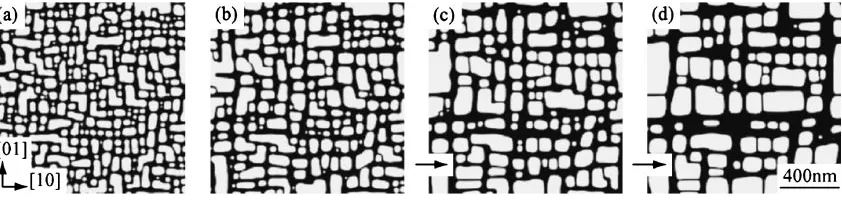
Figure 1 shows 2D morphological evolution of the 0
phase in the late stage of coarsening at 1373 K calculated from the phase-field simulation using the elastic constants of the TMS-26 alloy. The0phase is expressed as white area in Fig. 1. The cuboidal shape of the0phase arranged along the h10i crystallographic direction of the matrix is observed due to the anisotropic elastic interaction. Furthermore, the coalescence of the neighboring0phases with the same order parameter is observed as marked by arrows in Figs. 1(c) and (d), the coalescence of which has been also reported from the simulation in Ni-Al alloys.4)
ðBm;BpÞ ¼ ð319;351Þ,ðGm;GpÞ ¼ ð176;180Þandðm; pÞ ¼
ð3:59;2:69Þ. Here, the superscripts m and p represent the elastic constants of the and0phases, respectively.
Figure 2 shows the results of the phase-field simulation obtained in the late stage of coarsening of the 0 phase,
indicating the dependence of the 0 morphology on the
anisotropy in theand0phases. The anisotropy is varied in five sets asðm; pÞ ¼ ð6:07;2:17Þ, (4.51, 2.40), (3.59, 2.69), (2.98, 3.07), (2.55, 3.57). In this simulation, both bulk and shear modulus are kept to be constant. It is observed in Fig. 2 that the cuboidal0phase shows irregularity when the ratio of p to m becomes large (see Fig. 2(e)). Figure 3 shows the
simulation results obtained in the late stage of coarsening of the0phase, indicating the dependence of the0morphology
on the shear modulus in the and 0 phases. The shear
modulus is varied in five sets as (¼Cp44=Cm
44¼0:90, 1.02, 1.16, 1.32, 1.74). In this simulation, both bulk modulus and anisotropy are kept to be constant. It is found that the elastic inhomogeneity caused by the different ratios of the shear
modulus in the and 0 phases affects scarcely the
morphology of the0phase.
3.2 Particle size distribution
From the simulation results, scaled particle size distribu-tion of the0 phase was obtained by measuring the fraction
of the0 particles having a radius (r) within a size interval which was normalized by the average radius (r). The particle size distribution is obtained from the result for each time step. In this study, according to a similar way to Vaithyanathan and Chen,2) averaged particle size distribution was
con-structed from the results for four different time steps corre-sponding to Fig. 1. Figure 4 shows the scaled particle size distributions obtained from simulation results for five differ-ent conditions corresponding to Fig. 2, in which the aniso-tropy in the and0phases are changed independently. It is shown that the spectrum becomes broad with increasing the ratio ofptom, while the radius showing the maximum size
distribution (hereafter called as peak radius) does not change and it is almost at 0.75 in the normalized radius. Figure 5 shows the scaled particle size distributions obtained from simulation results for five different conditions corresponding to Fig. 3, in which only the ratio of the shear modulus in the and0phases is changed independently. From Fig. 5, it is found that both the peak radius and the spectrum shape are not affected by the variation of the shear modulus.
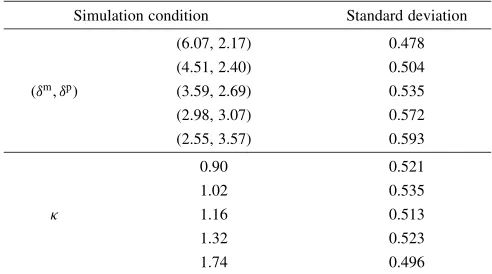
The effect of the elastic inhomogeneity on the standard deviation of the particle size distribution is summarized in Table 1. It is obvious that the variation of the anisotropy broadens the spectrum of particle size distribution but that the variation of the shear modulus does not affect it.
Fig. 1 Morphological evolution of the0phase calculated from 2D phase-field simulation at 1373 K using the elastic constants of a practical Ni-based superalloy. (a)t¼10000, (b)t¼20000, (c)t¼40000and (d)t¼80000. All time expressed here are dimensionless time steps.
Fig. 2 Dependence of the0phase morphology on elastic anisotropy in thematrix and0precipitate. (m; p): (a) (6.07, 2.17), (b) (4.51,
2.40), (c) (3.59, 2.69), (d) (2.98, 3.07) and (e) (2.55, 3.57).is2C44=ðC11C12Þ.
Fig. 3 Dependence of the0 phase morphology on shear modulus in the matrix and0precipitate. (a)¼0:90, (b)¼1:02, (c) ¼1:16, (d)¼1:32and (e)¼1:74.isCp44=Cm
[image:3.595.89.510.72.172.2] [image:3.595.86.514.224.314.2] [image:3.595.84.513.356.446.2]4. Discussion
From the phase-field simulation based on the variation of only the anisotropy in the and0 phases, it is found that
the 0 phase shows unstable shape as shown in Fig. 2(e)
when the ratio of p tom becomes large. In the previous
work, Hu and Chen8)showed that elastic energy became low
when hard precipitates were surrounded by soft matrix comparing to that soft precipitates were surrounded by hard matrix. The simulation condition of Fig. 2(e) is the case that the Young’s modulus of the 0 phase is just slightly larger than that of the phase. This condition seems to be
the reason why the cuboidal 0 phase became unstable in
Fig. 2(e).
Furthermore, the variation of the anisotropy affected the particle size distribution as shown in Fig. 4 and Table 1. Vaithyanathan and Chen2) studied the effect of precipitate
volume fraction on the particle size distribution and showed that the increase in volume fraction of the 0 phase shifts the peak radius to smaller normalized radius and leads to broadening of the distribution. In the particle size distribu-tions obtained in this study, the peak radius is similar, i.e., r=rrðtÞ ¼0:70:8(see Figs. 4 and 5), which is consistent with the position reported by Vaithyanathan and Chen,2)when the
volume fraction of the precipitate is about 55%. It is interesting that the variation of the anisotropy affected only width of the distribution spectrum without changing the peak radius as shown in Table 1. It should be emphasized that the difference of about 20% in elastic constants between the
and 0 phases affected both precipitate morphology and
particle size distribution (see Figs. 2 and 4).
The effect of the difference in the shear modulus between the matrix and the precipitate has been also reported previously,7,8)but it was examined based on the same elastic
constants for both the matrix and the precipitate. In this study, however, the elastic constants for each phase are based on the practical ones for TMS-26, and the variation of the shear modulus did not affect both morphology and particle size distribution of the 0 phase. This is probably because the anisotropy in the two phases affected mainly the stability of the 0 morphology. In other words, under the conditions of the variation of the shear modulus employing in this study,
the cuboidal 0 phase was stable by the effect of the
anisotropy in the and0phases.
Fig. 4 Scaled particle size distributions obtained from simulation results for five different conditions corresponding to Fig. 2, varying only elastic anisotropy in thematrix and0precipitate. (m; p): (a) (6.07, 2.17), (b) (4.51, 2.40), (c) (3.59, 2.69), (d) (2.98, 3.07) and
(e) (2.55, 3.57). In all cases, averaged results are shown which are obtained from simulation results for four different time steps corresponding to Fig. 1.
[image:4.595.92.511.71.176.2]Fig. 5 Scaled particle size distributions obtained from simulation results for five different conditions corresponding to Fig. 3, varying only shear modulus in thematrix and0precipitate. (a)¼0:90, (b)¼1:02, (c)¼1:16, (d)¼1:32and (e)¼1:74. In all cases, averaged results are shown which are obtained from simulation results for four different time steps corresponding to Fig. 1.
Table 1 Standard deviation of size distribution curves of the0particles obtained from different simulation results as shown in Figs. 4 and 5.
Simulation condition Standard deviation
(6.07, 2.17) 0.478 (4.51, 2.40) 0.504 (m; p) (3.59, 2.69) 0.535
(2.98, 3.07) 0.572 (2.55, 3.57) 0.593
0.90 0.521
1.02 0.535
1.16 0.513
1.32 0.523
[image:4.595.93.511.255.360.2] [image:4.595.45.291.455.592.2]It is known that the elastic interactions affect the shape of the particle size distribution.2) However, as long as we
know, this is the first simulation showing that the elastic inhomogeneity affects the width of the size distribution spectrum.
5. Conclusions
2D phase-field simulation was carried out to examine the effect of elastic inhomogeneity on the microstructure evolution in Ni-based superalloys. Based on the elastic constants of a Ni-based superalloy, both anisotropy and shear modulus in the and0 phases were varied independently. The variation of the anisotropy affected the morphology of the 0 phase and caused the cuboidal shape unstable when the ratio of p to m was large. Furthermore, the variation of the anisotropy affected only width of the distribution spectrum of the 0 particle size without changing the peak radius. On the other hand, the variation of the shear modulus did not affect both morphology and particle size distribution of the0 phase.
REFERENCES
1) Y. Wang, D. Banerjee, C. C. Su and A. G. Khachaturyan: Acta Mater.
46(1998) 2983–3001.
2) V. Vaithyanathan and L. Q. Chen: Acta Mater.50(2002) 4061–4073. 3) J. Z. Zhu, T. Wang, S. H. Zhou, Z. K. Liu and L. Q. Chen: Acta Mater.
52(2004) 833–840.
4) J. Z. Zhu, T. Wang, A. J. Ardell, S. H. Zhou, Z. K. Liu and L. Q. Chen: Acta Mater.52(2004) 2837–2845.
5) S. V. Prikhodko, J. D. Carnes, D. G. Isaak, H. Yang and A. J. Ardell: Metall. Mater. Tran. A30(1999) 2403–2408.
6) K. Tanaka, T. Kajikawa, T. Ichitsubo, M. Osawa, T. Yokokawa and H. Harada: Mater. Sci. Forum475–479(2005) 619–622.
7) P. H. Leo, J. S. Lowengrub and H. J. Jou: Acta Mater.46(1998) 2113– 2130.
8) S. Y. Hu and L. Q. Chen: Acta Mater.49(2001) 1879–1890. 9) S. G. Kim, W. T. Kim and T. Suzuki: Phys. Rev. E60(1999) 7186–
7197.
10) J. W. Cahn and J. E. Hilliard: J. Chem. Phys.28(1958) 258–267. 11) A. G. Khachaturyan:Theory of structural transformations in solids,
(Wiley, New York, 1983).
12) T. Mura: Micromechanics of Defects in Solids, 2nd revised ed., (Kluwer Academic, 1991).
13) I. Ansara, N. Dupin, H. L. Lukas and B. Sundman: J. Alloy. Compd.
247(1997) 20–30.