Clairlib: A Toolkit for Natural Language Processing, Information Retrieval,
and Network Analysis
Amjad Abu-Jbara
EECS Department University of Michigan
Ann Arbor, MI, USA [email protected]
Dragomir Radev
EECS Department and School of Information University of Michigan
Ann Arbor, MI, USA [email protected]
Abstract
In this paper we present Clairlib, an open-source toolkit for Natural Language Process-ing, Information Retrieval, and Network Anal-ysis. Clairlib provides an integrated frame-work intended to simplify a number of generic tasks within and across those three areas. It has a command-line interface, a graphical in-terface, and a documented API. Clairlib is compatible with all the common platforms and operating systems. In addition to its own func-tionality, it provides interfaces to external soft-ware and corpora. Clairlib comes with a com-prehensive documentation and a rich set of tu-torials and visual demos.
1 Introduction
The development of software packages and code li-braries that implement algorithms and perform tasks in scientific areas is of great advantage for both re-searchers and educators. The availability of these tools saves the researchers a lot of the time and the effort needed to implement the new approaches they propose and conduct experiments to verify their hy-potheses. Educators also find these tools useful in class demonstrations and for setting up practical pro-gramming assignments and projects for their stu-dents.
A large number of systems have been developed over the years to solve problems and perform tasks in Natural Language Processing, Information Re-trieval, or Network Analysis. Many of these sys-tems perform specific tasks such as parsing, Graph Partitioning, co-reference resolution, web crawling etc. Some other systems are frameworks for per-forming generic tasks in one area of focus such as
NLTK (Bird and Loper, 2004) and GATE (Cun-ningham et al., 2002) for Natural Language Pro-cessing; Pajek (Batagelj and Mrvar, 2003) and GUESS (Adar, 2006) for Network Analysis and Vi-sualization; and Lemur1for Language Modeling and Information Retrieval.
This paper presents Clairlib, an open-source toolkit that contains a suit of modules for generic tasks in Natural Language Processing (NLP), Infor-mation Retrieval (IR), and Network Analysis (NA). While many systems have been developed to address tasks or subtasks in one of these areas as we have just mentioned, Clairlib provides one integrated en-vironment that addresses tasks in the three areas. This makes it useful for a wide range of applications within and across the three domains.
Clairlib is designed to meet the needs of re-searchers and educators with varying purposes and backgrounds. For this purpose, Clairlib provides three different interfaces to its functionality: a graphical interface, a command-line interface, and an application programming interface (API).
Clairlib is developed and maintained by the Com-putational Linguistics and Information Retrieval (CLAIR) group at the University of Michigan. The first version of Clairlib was released in the year 2007. It has been heavily developed since then until it witnessed a qualitative leap by adding the Graphi-cal Interface and many new features to the latest ver-sion that we are presenting here.
Clairlib core modules are written in Perl. The GUI was written in Java. The Perl back-end and the Java front-end are efficiently tied together through a communication module. Clairlib is compatible with
1http://www.lemurproject.org/
all the common platforms and operating systems. The only requirements are a Perl interpreter and Java Runtime Environment (JRE).
Clairlib has been used in several research projects to implement systems and conduct experiments. It also has been used in several academic courses.
The rest of this paper is organized as follows. In Section 2, we describe the structure of Clairlib. In Section 3, we present its functionality. Section 4 presents some usage examples. We conclude in Sec-tion 5.
2 System Overview
Clairlib consists of three main components: the core library, the command-line interface, and the graph-ical user interface. The three components were de-signed and connected together in a manner that aims to achieve simplicity, integration, and ease of use. In the following subsections, we briefly describe each of the three components.
2.1 Modules
The core of Clairlib is a collection of more than 100 modules organized in a shallow hierarchy, each of which performs a specific task or implements a cer-tain algorithm. A set of core modules define the data structures and perform the basic processing tasks. For example, Clair::Document defines a data struc-ture for holding textual data in various formats, and performs the basic text processing tasks such as tok-enization, stemming, tag stripping, etc.
Another set of modules perform more specific tasks in the three areas of focus (NLP, IR, and NA). For example, Clair::Bio::GIN::Interaction is de-voted to protein-protein interaction extraction from biomedical text.
A third set contains modules that interface Clair-lib to external tools. For example, Clair::Utils::Parse provides an interface to Charniak parser (Charniak, 2000), Stanford parser (Klein and Manning, 2003), and Chunklink2.
Each module has a well-defined API. The API is oriented to developers to help them write applica-tions and build systems on top of Clairlib modules; and to researchers to help them write applications and setup custom experiments for their research.
2http://ilk.uvt.nl/team/sabine/chunklink/README.html
2.2 Command-line Interface
The command-line interface provides an easy access to many of the tasks that Clairlib modules imple-ment. It provides more than 50 different commands. Each command is documented and demonstrated in one or more tutorials. The function of each com-mand can be customized by passing arguments with the command. For example, the command
partition.pl -graph graph.net -method GirvanNewman -n 4
uses the GrivanNewman algorithm to divide a given graph into 4 partitions.
2.3 Graphical User Interface
The graphical user interface (GUI) is an impor-tant feature that has been recently added to Clairlib and constituted a quantum leap in its development. The main purpose of the GUI is to make the rich set of Clairlib functionalities easier to access by a larger number of users from various levels and back-grounds especially students and users with limited or no programming experience.
It is also intended to help students do their assign-ments, projects, and research experiments in an in-teractive environment. We believe that visual tools facilitate understanding and make learning a more enjoyable experience for many students. Focusing on this purpose, the GUI is tuned for simplicity and ease of use more than high computational efficiency. Therefore, while it is suitable for small and medium scale projects, it is not guaranteed to work efficiently for large projects that involve large datasets and re-quire heavy processing. The command-line inter-face is a better choice for large projects.
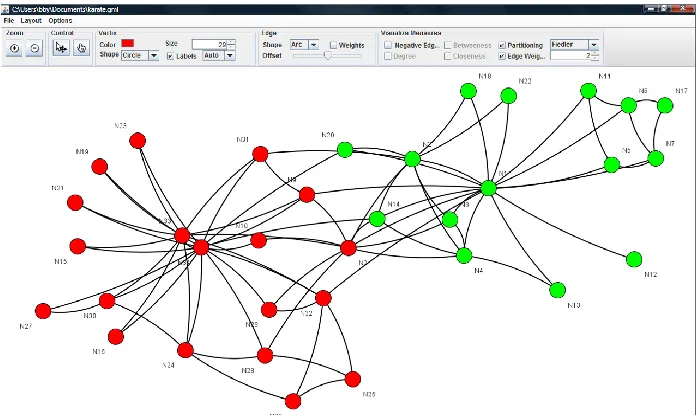
The GUI consists of three components: the Net-work Editor/Visualizer/Analyzer, the Text Proces-sor, and the Corpus Processor. The Network com-ponent allows the user to 1) build a new network using a set of drawing and editing tools, 2) open existing networks stored in files in several different formats, 3) visualize a network and interact with it, 4) compute different statistics for a network such as diameter, clustering coefficient, degree distribution, etc., and 5) perform several operations on a network such as random walk, label propagation, partition-ing, etc. This component uses the open source li-brary, JUNG3to visualize networks. Figure 1 shows
Figure 1: A screenshot for the network visualization component of Clairlib
a screenshot for the Network Visualizer.
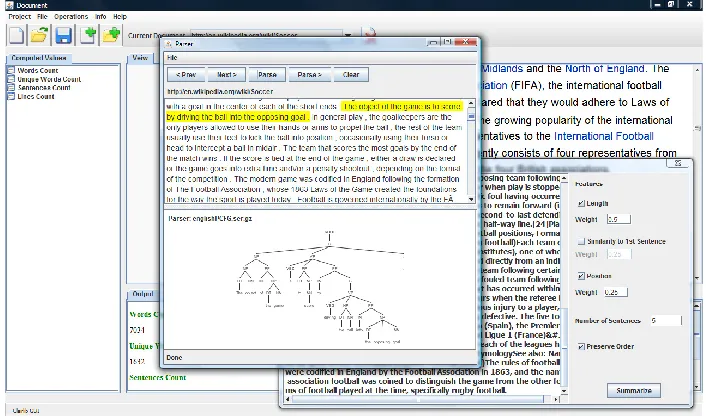
The Text Processing component allows users to process textual data published on the internet or im-ported from a file stored on the disk. It can process data in plain, html, or PDF format. Most of the text processing capabilities implemented in Clairlib core library are available through this component. Fig-ure 2 shows a screenshot of the text processing com-ponent.
The Corpus Processing component allows users to build a corpus of textual data out of a collection of files in plain, HTML, or PDF format; or by crawl-ing a website. Several tasks could be performed on a corpus such as indexing, querying, summarization, information extraction, hyperlink network construc-tion, etc.
Although these components can be run indepen-dently, they are very integrated and designed to eas-ily interact with each other. For example, a user can crawl a website using the Corpus component, then switch to the Text Processing component to extract the text from the web documents and stem all the words, then switch back to the Corpus component to build a document similarity graph. The graph can then be taken to the Network component to be visu-alized and analyzed.
2.4 Documentation
Clairlib comes with an extensive documentation. The documentation contains the installation infor-mation for different platforms, a description of all Clairlib components and modules, and a lot of usage examples. In addition to this documentation, Clair-lib provides three other resources:
API Reference
The API Reference provides a complete descrip-tion of each module in the library. It describes each subroutine, the task it performs, the arguments it takes, the value it returns, etc. This reference is use-ful for developers who want to use Clairlib modules in their own applications and systems. The API Ref-erence is published on the internet.
Tutorials
Tutorials teach users how to use Clairlib by ex-amples. Each tutorial addresses a specific task and provides a set of instructions to complete the task using Clairlib command-line tools or its API.
Visual Demos
Figure 2: A screenshot for the text processing component of Clairlib
3 Functionality
Clairlib provides modules and tools for a broad spec-trum of tasks. Most of the functionalities are native to Clairlib. Some functionalities, however, are im-ported from other open-source packages or external software. This section lists the main functionalities categorized by their areas.
3.1 Natural Language Processing
NLP functionalities include Tokenization, Sen-tence Segmentation, Stemming, HTML Tags Strip-ping, Syntactic Parsing, Dependency Parsing, Part-of-Speech Tagging, Document Classification, LexRank, Summarization, Synthetic Corpus Gen-eration, N-grams Extraction, XML Parsing, XML Tree Building, Text Similarity, Political Text Analy-sis, and Protein Name Tagging.
3.2 Information Retrieval
IR functionalities include Web Crawling, Indexing, TF-IDF, PageRank, Phrase Based Retrieval, Fuzzy OR Queries, Latent Semantic Indexing, Web Search, Automatic Link Extraction, and Protein-Protein In-teraction Extraction.
3.3 Network Analysis
Network Analysis functionalities include Network Statistics, Random Network Generation, Network Visualization, Network Partitioning, Community
Finding, Random Walks, Flow Networks, Signed Networks, and Semi-supervised Graph-based Clas-sification. Network Statistics include Centralities, Clustering Coefficient, Shortest Paths, Diameter, Triangles, Triplets, etc.
Some of these functionalities are implemented us-ing several approaches. For example, Clairlib have implementations for 5 graph partitioning algorithms. This makes Clairlib a useful tool for conducting ex-periments for comparative studies.
4 Uses of Clairlib
The diverse set of domains that Clairlib covers and the different types of interfaces it provides make it suitable for use in many contexts. In this section, we highlight some of its uses.
Education
Clairlib contains visual tools that instructors can use to do class demonstrations to help their students un-derstand the basic concepts and the algorithms they face during their study. For example, the random walk simulator can be used to teach the students how random walk works by showing a sample network and then walk randomly step-by-step through it and show the students how the probabilities change after each step.
Instruc-tors may ask their students to do experiments with a dataset using Clairlib, write applications that use the API, extend an existing module, or contribute new modules to Clairlib. One example could be to ask the students to a build a simple information retrieval system that indexes a collection of documents and executes search queries on it.
Clairlib has been used to create assignments and projects in NLP and IR classes at the University of Michigan and Columbia University. The experience was positive for both the instructors and the stu-dents. The instructors were able to design assign-ments that cover several aspects of the course and can be done in a reasonable amount of time. The stu-dents used the API to accomplish their assignments and projects. This helped them focus on the impor-tant concepts rather than diving into fine program-ming details.
Research
Clairlib contains implementations for many algo-rithms and approaches that solve common problems. It also comes with a number of corpora and anno-tated datasets. This makes it a good resource for re-searchers to build systems and conduct experiments. Clairlib was successfully used in several research projects. Examples include Political Text Analy-sis (Hassan et al., 2008), Scientific Paper Summa-rization (Qazvinian and Radev, 2009), Blog Net-works Analysis (Hassan et al., 2009), Protein In-teraction Extraction (Ozgur and Radev, 2009), and Citation-Based Summarization (Abu-Jbara and Radev, 2011).
4.1 Examples
In this subsection, we present some examples where Clairlib has been used.
Example: Protein-Protein Interaction Extraction
This is an example of a project that builds an information extraction system and uses Clairlib as its main processing component (Ozgur and Radev, 2009). This system is now part of a larger bioinfor-matics project, NCIBI.
The system uses Clairlib to process a biomedical article: 1) splits it into sentences using the segmen-tation module, 2) parses each sentence using the
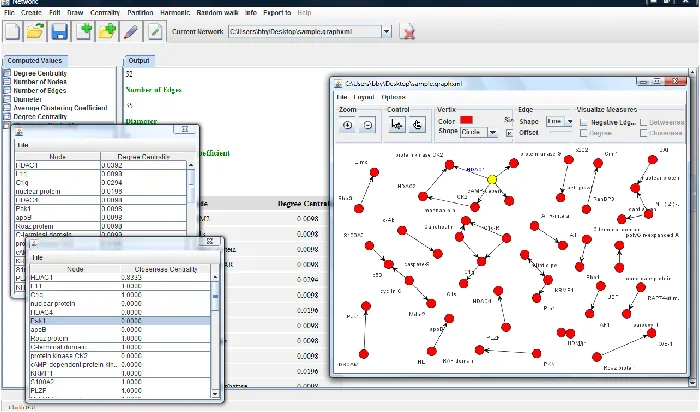
in-terface to the Stanford Dependency Parser, 3) tags the protein names, 4) extracts protein-protein inter-actions using a specific Clairlib module devoted to this task, and then 5) it builds a protein interaction network in which nodes are proteins and edges rep-resent interaction relations. Figure 3 shows an ex-ample protein interaction network extracted from the abstracts of a collection of biomedical articles from PubMed. This network is then analyzed to compute node centralities and the basic network statistics.
Example: Scientific Paper Summarization Using Citation Networks
This is an example of a research work that used Clairlib to implement an approach and con-duct experiments to support the research hypothe-sis. Qazvinian and Radev (2009) used Clairlib to implement their method for citation-based summa-rization. Given a set of sentences that cite a paper, they use Clairlib to 1) construct a cosine similarity network out of these sentences, 2) find communities of similar sentences using Clairlib community find-ing module, 3) run Clairlib LexRank module to rank the sentences, 4) extract the sentence with the high-est rank from each community, and finally 5) return the set of extracted sentences as a summary para-graph.
Example: Text Classification
This is an example of a teaching assignment that was used in an introductory course on information retrieval at the University of Michigan. Students were given the 20-newsgroups corpus (a large set of news articles labeled by their topic and split into training and testing sets) and were asked to use Clairlib API to: 1) stem the text of the documents, 2) convert each document into a feature vector based on word frequencies, 2) train a multi-class Percep-tron or Naive Bayes classifier on the documents in the training set, and finally 3) classify the documents in the testing set using the trained classifier.
5 Conclusions
command-Figure 3: Clairlib used to construct and analyze a protein network extracted from biomedical articles
line interface, and graphical user interface for the convenience of users with varying purposes and backgrounds. Clairlib is well-documented, easy to learn, and simple to use. It has been tested for vari-ous types of tasks in varivari-ous environments.
Clairlib is an open source project and we welcome all the contributions. Readers who are interested in contributing to Clairlib are encouraged to contact the authors.
Acknowledgements
We would like to thank Mark Hodges, Anthony Fader, Mark Joseph, Joshua Gerrish, Mark Schaller, Jonathan dePeri, Bryan Gibson, Chen Huang, Arzu-can Ozgur, and Prem Ganeshkumar who contributed to the development of Clairlib.
This work was supported in part by grants R01-LM008106 and U54-DA021519 from the US National Institutes of Health, U54 DA021519, IDM 0329043, DHB 0527513, 0534323, and 0527513 from the National Science Foundation, and W911NF-09-C-0141 from IARPA.
References
R. Gaizauskas, P. J. Rodgers and K. Humphreys 2001. Visual Tools for Natural Language Processing. Jour-nal of Visual Languages and Computing, Volume 12, Issue 4, Pages 375-412.
Arzucan Ozgor and Dragomir Radev 2009. Supervised classification for extracting biomedical events. Pro-ceedings of the BioNLP’09 Workshop Shared Task on Event Extraction at NAACL-HLT, Boulder, Colorado, USA, pages 111-114
Ahmed Hassan, Dragomir R. Radev, Junghoo Cho, Am-ruta Joshi. 2009. Content Based Recommendation and Summarization in the Blogosphere. ICWSM-2009.
Vahed Qazvinian, Dragomir Radev. 2008. Scientific Paper Summarization Using Citation Summary Net-works. COLING 2008.
Ahmed Hassan, Anthony Fader, Michael Crespin, Kevin Quinn, Burt Monroe, Michael Colaresi and Dragomir Radev. 2008. Tracking the Dynamic Evolution of Par-ticipants Salience in a Discussion.COLING 2008. Eugene Charniak. 2000. A Maximum-Entropy-Inspired
Parser. Proceedings of NAACL-2000.
Dan Klein and Christopher Manning. 2003. Accurate Unlexicalized Parsing.Proceedings of ACL-2003. Amjad Abu-Jbara and Dragomir Radev 2011.
Coher-ent Citation-based Summarization of SciCoher-entific Papers Proceedings of ACL-2011.
H. Cunningham and D. Maynard and K. Bontcheva and V. Tablan 2002. GATE: A Framework and Graphical Development Environment for Robust NLP Tools and Applications Proceedings of ACL-2002, Philadelphia. Steven Bird and Edward Loper. 2004. NLTK: The
Natu-ral Language Toolkit Proceedings of ACL-2004. V. Batagelj and A. Mrvar 2003. Pajek - Analysis and
Visualization of Large Networks Springer, Berlin. Eytan Adar. 2006. GUESS: A Language and Interface
[image:6.612.131.481.57.263.2]