International tax planning by
multinationals: Simulating a
tax-minimising intercompany response to
the OECD’s recommendation on BEPS
Action 4
Kayis-Kumar, Ann
31 March 2016
Online at
https://mpra.ub.uni-muenchen.de/72828/
363
multinationals: simulating a
tax‑minimising intercompany
response to the OECD’s
recommendation on BEPS Action 4
Ann Kayis-Kumar*
Abstract
In October 2015, the OECD/G20 presented their final report on the Base Erosion and Profit Shifting (BEPS) Project. This article presents a unique analysis of the OECD/G20’s recommendation on Action 4 by utilising tax optimisation modelling to simulate and examine a hypothetical multinational enterprise’s (MNE’s) behavioural response to this recommendation.
The literature to date has primarily focused on the “debt bias”, which arises from the distortion in the tax treatment between debt and equity financing. The BEPS Project is no exception, despite acknowledging that the “mobility and fungibility of money makes it possible for multinational groups to achieve favourable tax results”, the focus has remained on the debt bias. Prior work by the author introduced a broader conception
* BCom(Finance)/LLB(Hons) (UNSW), PhD (UNSW, in progress), School of Taxation and Business Law, UNSW Australia, Solicitor of the Supreme Court of New South Wales and High Court of Australia ([email protected]). The author is thankful to her PhD supervisors, Professor Neil Warren and Professor John Taylor, for their insights and ongoing support.
of funding biases; specifically, the tax‑induced cross‑border “funding bias”. The funding bias includes intercompany licensing and leasing activities in addition to debt and equity financing.
These four forms of fungible intercompany financing are built into the tax optimisation model developed by this article. This model presents a unique contribution to the literature by simulating complex cross‑border intercompany tax planning strategies. This facilitates a formal analysis of one of the most significant challenges presented by the mobility and fungibility of capital, namely, anticipating how an MNE structures its internal affairs in a tax‑minimising manner given the current tax regime — and designing improvements to tax laws accordingly.
1. Introduction
For nearly a century, tax authorities have been developing international principles for tax treaties in attempts to address the problem of international tax coordination, with their focus evolving into designing international principles to prevent both the double taxation and double non‑taxation of multinational enterprises’ (MNEs’) income.1 The
advent of the global digital economy has heightened opportunities for aggressive tax planning by MNEs and has spurred harmful tax competition between governments. Further, despite criticisms of aggressive tax planning behaviour by MNEs, the philosophical framework of neoliberal capitalism appears to justify this behaviour.2
The Organisation for Economic Co‑operation and Development (OECD) has developed, inter alia, best practice approaches to designing rules to prevent base erosion and profit shifting (BEPS) using interest deductions.3 While the OECD makes
a distinction between combating BEPS and reducing distortions between the tax treatment of debt and equity,4 it is clear that both the OECD’s BEPS project and the
thin capitalisation rules’ raisons d’être is primarily concerned with protecting national tax revenue bases. Further, it is the decision of the revenue authorities to create a cross‑border tax‑induced debt bias which actually results in said tax base erosion.5
Given that cross‑border intercompany transactions account for more than 60% of global trade in terms of value,6 and remain largely absent from a group’s consolidated
accounts (and therefore beyond public scrutiny), there is an urgent imperative
1 “The issue of international tax coordination has often been seen mainly as a problem of alleviating double taxation. This problem arises because most countries insist on their right to tax all income originating within their borders as well as all income earned by their residents. However, since some countries have found it in their interest to play the role of ‘tax havens’, the international tax coordination problem may often be one of preventing tax evasion rather than a problem of double taxation”: PB Sørensen, “Issues in the theory of international tax coordination” (Bank of Finland Discussion Papers No 4/90, 20 February 1990), 7–8.
2 The profit motive provides the justification for internalising benefits while externalising costs, which includes the minimisation of taxation.
3 Both interest and financial payments economically equivalent to interest, and other expense incurred in connection with the raising of financing such as arrangement and guarantee fees are being targeted. Upon exploring the “fixed ratio”, “deemed interest”, “interest cap” rules, the global group‑wide test and a combined approach, the OECD recommended the “fixed ratio” approach in its final report: OECD, BEPS Action 4: interest deductions and other financial payments (final report, 5 October 2015).
4 OECD, BEPS Action 4: interest deductions and other financial payments (final report, 5 October 2015), 47.
5 D Hanlon, “Thin capitalisation legislation and the Australia/United States Double Tax Convention: can they work together?” (2000) 3(1) Journal of Australian Taxation 4.
for a strong conceptual basis in the tax treatment of cross‑border intercompany transactions.
1.1 Scope and assumptions
Even though the cross‑border issue cannot be isolated from the rest of the tax system,7 the focus of this study is on cross‑border tax‑induced distortions because
increased international capital mobility has created unprecedented opportunities for tax arbitrage in this context.8 While there are many ways in which MNEs can shift
profits to low‑tax jurisdictions, this research focuses on intercompany transactions since these activities are seen as among the most significant9 and least transparent.10
An underlying assumption in this article is that, as long as an MNE can benefit from tax planning opportunities presented by existing or proposed rules including, inter alia, the arm’s length standard, thin capitalisation rules, fixed ratio rules, debt/equity rules, withholding taxes and foreign tax relief, there is a tax incentive to adjust its behaviour to maximise overall deductions in higher‑tax jurisdictions to minimise the group‑wide tax liability and, in turn, maximise the overall net profit after tax.
The author recognises that not all MNEs will fall within this category in practice. Accordingly, this study is only concerned with MNEs that are responsive to cross‑border tax‑induced distortions.
It is assumed that MNEs which exhibit tax planning behaviour make tax decisions as a global group with the objective of minimising total tax payable worldwide. In other words, such an MNE exhibits “utility‑optimising” behaviour in the context of minimising tax. Such tax planning is generally encouraged by tax professionals11 and
is statutorily, administratively and judicially condoned.12
7 H Grubert and R Altshuler, “Corporate taxes in the world economy: reforming the taxation of cross‑border income”, in: J Diamond and G Zodrow (eds), Fundamental tax reform: issues, choices, and implications (Cambridge, MA: MIT Press, 2008), 319–321.
8 R De Mooij, M Keen and V Perry, “Taking a bite out of Apple? Fixing international corporate taxation” on VoxEU.org CEPR’s policy portal (14 September 2014). Available at www.voxeu.org/ article/fixing‑international‑corporate‑taxation.
9 OECD, Dealing effectively with the challenges of transfer pricing (Paris: OECD Publishing, 1 March 2012).
10 KS Markle and DA Shakelford, “Cross‑country comparisons of the effects of leverage, intangible assets, and tax havens on corporate income taxes” (2012) 65 Tax Law Review 415, 415. 11 TP Seto, “Four principles of optimal tax system design” (Legal Studies Paper No 2008‑36, Loyola
Law School, March 2013), 10–11.
Accordingly, the behaviourally distortive effects of existing and proposed tax rules relating to cross‑border intercompany activities are of primary concern in this study. Specifically, the focus of this article is on MNEs’ cross‑border intercompany transactions relating to passive or highly mobile income; specifically, how tax distortions affect MNE decisions on the funding mix between intercompany financing, licensing and leasing activities. This article also assumes that the marginal investor in a small, open economy (such as Australia) is a foreign investor.
A further premise that is the focus of a subsequent article is that countries can gain insight for developing their own tax regimes by examining the tax regimes of other countries. This provides the basis for exploring the practical implementation of the allowance for corporate equity (ACE) as adopted in Belgium and Italy — and considering whether an ACE‑variant may be a suitable reform alternative.
Section 2 begins by observing that linear programming using optimisation modelling is a relatively underutilised technique in analysing MNEs’ potential behavioural responses to international tax laws and proposed reforms. In particular, this section explores the literature on whether optimisation modelling is suitable in the context of international tax planning by an MNE. This is supplemented by an analysis of the importance of the model making a distinction between economic rent taxation and pure profit shifting.
Sections 3 and 4 of this article establish and operationalise the optimisation model, specifically: developing the objective function; defining constraints and limitations in sections 3.1–3.3; applying both the objective function and constraints to the baseline model in sections 4.1–4.2; and overlaying additional parameters in section 4.3. Section 4.4 presents an evaluation of the OECD’s recommendation, simulating both a unilateral and a multilateral implementation of this reform proposal, in comparison to the current tax regime.
Finally, section 5 summarises the findings of this article and includes areas for further research.
2. Applying optimisation modelling to the multinational
tax planning context
2.1 Suitability of optimisation modelling
There is a growing theoretical literature on the relationship between tax planning and investment locations, and its implications for tax policies.13 There is also a rich
literature which utilises empirical data in this context, extensively considering the relationship between MNE leverage and taxation with US, Canadian and European Union (particularly German) data.14 Generally, quantitative evaluations are conducted
utilising regression‑based evaluation methods and general equilibrium modelling.
Substantially less developed is the literature on the effect of taxation on leverage in a multilateral context.15 Huizinga, Laeven and Nicodème present the primary
exploration of whether MNEs make multilateral capital structure decisions based on the tax rates faced by various subsidiaries.16 Under their model, the MNE’s objective
is to maximise its overall firm value. However, the model has five key limitations; first, it is limited to intercompany debt and equity financing, excluding the possible use of royalty financing.17 Second, since it utilises the Amadeus database for its regression
analysis, it is limited in scope to European company data.18 Third, it suggests that
withholding taxes can be excluded from the effective tax burden by MNEs by triangular arbitrage involving a conduit company in a tax haven — however, this is
Rico” (1998) 80 Review of Economics and Statistics, 365–373; A Haufler and G Schjelderup, “Corporate tax systems and cross‑country profit shifting” (2000) 52 Oxford Economic Papers, 306–325; J Mintz and M Smart, “Income shifting, investment, and tax competition: theory and evidence from provincial taxation in Canada” (2004) 88 Journal of Public Economics 1149–1168; S Bucovetsky and A Haufler, “Tax competition when firms choose their organizational form: should tax loopholes for multinationals be closed?” (Technical Report 1625, CESifo, 2005); J Slemrod and JD Wilson, “Tax competition with parasitic tax havens” (Technical Report, University of Michigan 2006).
14 Substantial literature review by H Huizing, L Laeven and G Nicodème, “Capital structure and international debt shifting” (Economic Paper No 263, European Economy, December 2006), 3; see further references cited therein.
15 “… unlike previous research, our modeling and our empirical work take a fully multilateral approach and is the first to study the effect of taxation on leverage in a nxn countries context. The main contribution of our paper is to explore in an international context the possibility that multinationals set the capital structure of individual subsidiaries by taking into account the tax rate faced by all other subsidiaries of the firm. Our finding that subsidiary leverage within a multinational firm responds to bilateral tax rate differences vis‑à‑vis both the parent firm and other foreign subsidiaries provides direct support for this multilateral approach”: H Huizinga, L Laeven and G Nicodème, “Capital structure and international debt shifting” (Economic Paper No 263, European Economy, December 2006), 3–4.
16 H Huizinga, L Laeven and G Nicodème, “Capital structure and international debt shifting” (Economic Paper No 263, European Economy, December 2006), 8.
17 H Huizinga, L Laeven and G Nicodème, “Capital structure and international debt shifting” (Economic Paper No 263, European Economy, December 2006), 7. For completeness, no other models in the literature consider the “funding bias”, but are instead limited to the “debt bias”: see, for example, KA Froot and JR Hines, “Interest allocation rules, financing patterns, and the operations of U.S. multinational” (Working Paper No 4924, NBER Working Paper Series, November 1994), 14.
deduced rather than explicitly modelled. Fourth, Huizinga, Laeven and Nicodème apply a static model which may overly simplify the complexity of the tax system.19
Fifth, it assumes that cross‑border effective tax rates are a function of the statutory corporate income tax rates and withholding taxes.20
Even less attention has been directed to economic modelling frameworks beyond general equilibrium modelling. However, many types of mathematical models can be utilised in practice to solve “real‑world” problems,21 and a prominent approach in the
business context is optimisation modelling (such that costs are minimised or profits are maximised).22
Linear programming has origins in economics23 and is primarily concerned with the
optimal allocation of scarce resources.24 Presently, linear programming is the most
prominent technique in operations research, widely used by executive management.25
Solving a linear programming problem requires converting it into a mathematical model, formulated by reference to two key components. First, it is necessary to describe the “objective function” (denoted as “Z” below), which represents how the “decision variables” (denoted as “x1”, etc below) affect the cost or value to be optimised
(whether through minimisation or maximisation), where c1, c2, … cn are constants.
This can be expressed as follows:26
Minimise (or Maximise): Z = c x1 1 +c x2 2 + ...+c xn n
Second, the “constraints” — which set out the limitations — need to be determined. The objective function and the constraints have a linear relationship, such that the effect of changing a “decision variable” is proportional to its magnitude.
19 R Miniaci, P Panteghini, ML Parisi, “Debt shifting in Europe” (Working Paper WP11/21, Oxford University Centre for Business Taxation, 15 November 2011), 2.
20 R Miniaci, P Panteghini, ML Parisi, “Debt shifting in Europe” (Working Paper WP11/21, Oxford University Centre for Business Taxation, 15 November 2011), 22.
21 E Castillo, AJ Conejo, P Pedregal, R García and N Alguacil, Building and solving mathematical programming models in engineering and science (New York, United States: John Wiley and Sons Ltd, 2001).
22 PS Iyer, Operations Research (India: Tata McGraw‑Hill Education, 2008), 3.
23 PG Ciarlet, B Miara and J Thomas, Introduction to numerical linear algebra and optimisation (Great Britain: Cambridge University Press, 1989).
24 DT Phillips, A Ravindran and JJ Solberg, Operations research: principles and practice (USA: John Wiley & Sons, Inc., 1976), 13.
Applied in the context of observing how an MNE may structure its internal affairs in a tax‑minimising manner, the linear programming problem expresses the “objective function” as minimising the total tax payable for the MNE (defined in section 3.2 and applied in section 4.1). The “decision variables” represents the profit in each jurisdiction in which the MNE has a subsidiary and the “constants” are those respective jurisdictions’ corporate income tax rates. Further, given the focus of this article on “pure” profit shifting by a tax‑minimising MNE through intercompany financing, the “constraints” and other limitations consist of: first, the flows from intercompany transactions that can increase or decrease the profit figures for each jurisdiction; and second, the tax laws applicable to the MNE, which can be fine‑tuned to particular jurisdictions’ specific tax rules (defined in section 3.3 and applied in section 4.2).
However, optimisation modelling using linear programming remains largely unexplored in the context of anticipating MNE behaviour. This is a particularly significant gap because some literature does exist suggesting that international tax planning decisions can be approximated as linear programming problems. Specifically, only two papers have been authored in this area: first, Brada and Buus; and second, Vasarhelyi and Moon. For completeness, the features of each paper are briefly outlined below.
Brada and Buus focus on cross‑border intercompany transfer pricing issues; specifically, whether it is possible to identify subsidiaries within an MNE which engage in profit shifting. They note that empirical studies are rare in this area since transfer pricing is considered to be a confidential issue for most MNEs.27 Further, they note that the
extensive literature modelling optimal tax systems does not deal with MNEs utilising transfer pricing to profit shift.28 Nonetheless, Brada and Buus provide mathematical
proof that the basic tax optimisation task of MNEs can be conceptualised as a linear programming problem.29 For completeness, in a subsequent paper, Brada and Buus
proposed that VAT be used as a solution to reach a Pareto‑optimal state that would prevent harmful tax competition and tax‑evasive transfer pricing. However, this proposal was yet to be tested and Buus and Brada’s work on this topic has since ceased.
More recently, Vasarhelyi and Moon, as part of the doctoral dissertation of the latter author, presented the suitability of linear programming for solving international tax
27 J Brada and T Buus, “Detection of possible tax‑evasive transfer pricing in multinational enterprises” (2009) 4(2) European Financial and Accounting Journal 65, 65.
28 T Buus and J Brada, “VAT and tax credits: a way to eliminate tax‑evasive use of transfer prices?” (2010) 5(1) European Financial and Accounting Journal 28, 45.
planning problems on the basis that these problems are concerned with the optimal allocation of tax subject to relevant tax laws and other limitations:30
“International tax planning optimisation problems can be formulated as linear functions to maximize or minimize a particular objective function.”
However, Vasarhelyi and Moon’s work on this topic has also since ceased. They developed a single‑period model, with a six‑jurisdiction MNE subject thin capitalisation rules with two constraint functions only. Withholding taxes were assumed zero, foreign tax relief was not considered, none of the parameters were flexed and the model focused on optimal firm policy only, not considering the government perspective.
Accordingly, this paper presents a unique contribution to the literature by developing a tax optimisation model which considers four forms of fungible intercompany financing across four jurisdictions to simulate complex cross‑border intercompany tax planning strategies. This facilitates a formal analysis of one of the most significant challenges presented by the mobility and fungibility of capital.
The issue of whether an MNE would consider certain types of intercompany transactions to be fungible is explored in more detail in a previous work by the author.31 That paper outlines various scenarios where a hypothetical MNE establishes
different structures using these various types of funding to obtain the same tax outcomes, thereby suggesting intercompany fungibility.32
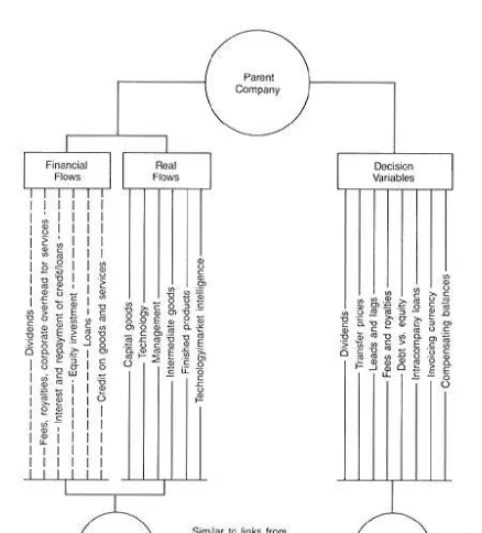
Both MNEs and independent firms have a plethora of options available for the cross‑border flow of funds. However, unlike independent firms, MNEs are uniquely advantaged by having greater control over the mode and timing of these flows, described as “financial flows” in Figure 1 below.33
30 MA Vasarhelyi and D Moon, “Optimizing tax allocation among countries in the multinational entity: a tale of many contingencies” (Presentation delivered at the TTN Taxation Seminar New York 2011, Morgan Lewis Bockius LLP: New York, NY, 16 May 2011), 6.
31 A Kayis‑Kumar, “Taxing cross‑border intercompany transactions: are financing activities fungible?” (2015) 30(3) Australian Tax Forum 627.
32 A Kayis‑Kumar, “Taxing cross‑border intercompany transactions: are financing activities fungible?” (2015) 30(3) Australian Tax Forum 627, 643–647.
Figure 1
As noted by Mintz and Weichenrieder, “… taxes that are levied on investment income (dividends, capital gains, rents, royalties and interest) influence multinational cross‑border activity most profoundly”.34 While finance leasing payments appear to
beyond scope of their above analysis, Mintz and Weichenrieder specifically refer to the ease of cross‑border income shifting through leasing arrangements.35
For completeness, the author acknowledges that there are three key carve‑outs to this characterisation that certain types of debt, equity, licencing and leasing are “fungible”. First, this analysis is confined to “pure” profit shifting, as opposed to applying in the context of real economic flows. For example, dealings with relatively immobile assets
34 JM Mintz and AJ Weichenrieder, The indirect side of direct investment: multinational company finance and taxation (Cambridge, Massachusetts: MIT Press, 2010), 18.
such as land are beyond the scope of this characterisation. Second, fungibility does not apply to all classes of intercompany debt, equity, licencing and leasing — only those that are economically equivalent. In this context, is it instructive to contrast a financing lease payment as opposed to an operating lease payment, whereby the former would be reasonably characterised as economically equivalent to interest. Third, this model assumes that it will be possible for the MNE to switch between methods of financing upon changes to tax laws. However, this may not be possible in all cases, particularly where doing so would give rise to potentially adverse tax implications and other costs.
2.2 Importance of modelling pure profit shifting
Devereux and Mintz observe that, from an economic efficiency perspective,36 it is
preferable for MNEs to be subject to economic rent taxation37 because rent taxes are
neutral38 and avoid a number of decision‑making distortions.39 Admittedly, there
are difficulties and uncertainties40 in determining pure profits, which provides an
explanation for why corporate taxation is predominantly based on corporate income rather than pure profits.41
Currently, the debt‑to‑equity rules set limits on the amount of debt, rather than the interest rate changed on debt. However, a partial ACE (such as a cross‑border ACE‑CBIT as proposed by the author in a previous article42) would effectively cap the
deductibility of interest, thereby extracting an economic rent while bypassing issues associated with transfer pricing.
On the other hand, the current international tax framework incentivises the location of expenses in higher‑tax jurisdictions and income in low‑ or no‑tax jurisdictions as it
36 SE Bärsch, Taxation of hybrid financial instruments and the remuneration derived therefrom in an international and cross‑border context: issues and options for reform (Germany: Springer, 2013), 24.
37 J Mintz, “The corporation tax: a survey” (1995) 16(4) Fiscal Studies 23, 34.
38 RM Bird, “Why tax corporations?” (Working Paper No 96‑2, Technical Committee on Business Taxation, December 1996), 5.
39 MP Devereux, “Trade‑offs in the design of taxes on corporate profit” (Paper presented at the Oxford Sydney Conference, Ross Parsons Centre: The University of Sydney, 30–31 March 2012), 3–4; see also, H Grubert and R Altshuler, “Fixing the system: an analysis of alternative proposals for the reform of international tax” (2013) 66(3) National Tax Journal 671, 674–5.
40 J Mintz, “The corporation tax: a survey” (1995) 16(4) Fiscal Studies 23, 35.
41 RS Avi‑Yonah, “Corporations, society, and the state: a defense of the corporate tax” (2004) 90(5) Virginia Law Review 1193, 1211; MP Devereux and PB Sørensen, “The corporate income tax: international trends and options for fundamental reform” (Economic Paper No 264, European Economy, December 2006), 23.
can result in significant tax minimisation. It is possible to achieve this by interposing subsidiaries in low‑tax jurisdictions such as Ireland or The Netherlands, and then utilise tax treaties to shift income onto tax havens such as Bermuda or the British Virgin Islands,43 where profits can be stored for years. This is further exacerbated
by the plethora of jurisdictions for MNEs to choose from, many of which are engaged in a “race to the bottom” on corporate income tax rates. Of course, broader based corporate taxes with lower rates promote efficiency, investment and growth. However, if governments narrow their tax bases to attract the rerouting of flows of capital through, rather than to, their economy, then this quickly exits the realm of productive competition and enters the terrain of harmful tax competition.44
As observed by Markle and Shakelford:45
“We cannot observe how a firm structures its internal affairs in a tax‑optimal manner. For example, we can observe firms’ using leverage to lower their global tax liabilities through external debt financing, but we cannot observe their using internal debt to generate interest deductions in high‑tax countries and interest income in low‑tax countries … intrafirm transactions are nontrivial and may even exceed the avoidance opportunities with third parties.”
For example, if a subsidiary is a private company, it does not necessarily need to disclose even comprehensive financial statements in the source jurisdiction.46 In
the Australian context, this has been recently targeted by the Tax Laws Amendment (Combating Multinational Tax Avoidance) Act 2015 (Cth). This transparency measure introduces a wider reporting requirement on the lodgment of general purpose financial statements with the ATO.47
43 Somewhat relevantly, one of the British Virgin Islands is reputedly the model for Stevenson’s “Treasure Island”.
44 See further: Australian Government, The Senate Economics References Committee, ‘Corporate tax avoidance: Part I – You cannot tax what you cannot see’ (18 August 2015); and, Australian Government, The Senate Economics References Committee, ‘Corporate tax avoidance: Part II – Gaming the system’ (22 April 2016). Available at www.aph.gov.au/Parliamentary_Business/ Committees/Senate/Economics/Corporate_Tax_Avoidance/Submissions, which contains 70 submissions from academics, practitioners, businesses and policymakers.
45 KS Markle and DA Shakelford, “Cross‑country comparisons of the effects of leverage, intangible assets, and tax havens on corporate income taxes” (2012) 65 Tax Law Review 415, 417–432. 46 For example, in the financial year ending 2014, Google Australia Pty Ltd’s disclosure omitted
itemising over $35m in expenses from its financial statement and the corresponding notes, not even categorising these expenses as “COGS” and/or “Other expenses”.
Even though it marks a trend towards increased transparency, this reform is not immune to administrative and technical issues. Most notably is the criticism that it potentially conflates tax and accounting concepts by hinging on accounting consolidation concepts rather than tax consolidation.48
Further, consolidated accounts undergo intercompany eliminations.49 While some
MNEs provide some detail regarding their intercompany transactions in their segment reports, this is not a requirement across the board. This is particularly problematic because, as observed by Balakrishnan et al, “tax aggressive firms are characterized by lower transparency”.50
Accordingly, in the absence of a requirement to fully disclose their intercompany transactions in financial statements, cross‑referencing the information reported to taxing authorities compared to that reported in financial statements is a highly challenging task. Commentators such as De Simone and Stomberg observe that “[f] inancial reporting for income taxes is so complex that even sophisticated financial statement users often ignore detailed tax disclosures” and “taxation is often viewed by the market as beyond meaningful analysis”.51
This is exacerbated by the different tax treatment of cross‑border intercompany interest, dividends, royalties and lease payments — despite their fungibility — and their capacity to erode the tax base of a source country. An unequal tax treatment of these activities creates distortions, which incentivises tax planning behavioural responses by MNEs. While a previous article by the author has focused on this consideration that there is an absence of tax neutrality in the tax treatment of these different types of passive investment income,52 little attention has been devoted to this
area of the international literature. Accordingly, this absence of neutrality in the tax treatment of cross‑border intercompany debt, equity, licensing and leasing expenses — or “cross‑border funding neutrality” — is the focus of this article.
48 See further, A White, C Colley and C Aboud, “New requirements for non‑reporting entities” (Greenwoods & Freehills, 11 Jan 2016). Available at www.greenwoods.com.au/insights/riposte/ 11‑january‑2016‑new‑requirements‑for‑non‑reporting‑entities.
49 In preparing consolidated financial statements, all intercompany transactions, balances and unrealised gains and losses resulting from intercompany transactions and dividends are eliminated in full on consolidation.
50 K Balakrishnan, J Blouin and W Guay, “Does tax aggressiveness reduce financial reporting transparency?” (Working Paper, Wharton School, University of Pennsylvania, 20 September 2011), 3.
51 L De Simone and B Stomberg, “Do investors differentially value tax avoidance of income mobile firms?” (Working Paper, University of Texas at Austin, June 2012), 2.
3. Establishing the tax optimisation model
Utilising linear programming in a quantitative analysis facilitates a deeper understanding of the interplay of effects determining tax‑induced distortions than may not be observable with a qualitative analysis alone.
This article establishes a model which facilitates hypothetical scenario analysis, presenting firm‑specific illustrative examples to demonstrate the tax effects of various cross‑border intercompany instruments at different rates of return and degrees of leverage to examine the extent of cross‑border funding neutrality in both the existing system, variations of the existing system and proposed reform options.
This hypothetical approach is preferable due to the accessibility issues associated with collecting various revenue authorities’ corporate tax return data and the limitations of using accounting data. Even if accounting data was gathered through annual reports, this approach is problematic given the difference between accounting profit and taxable income. Specifically, MNEs start with accounting profit and then make adjustments to accounting profit53 to reach their taxable profit.54 Accordingly, it is
difficult to glean intercompany tax‑related information from financial statements.
Further, this is exacerbated by recent amendments to the Corporations Act 2001 (Cth), enacted 28 June 2010, which have removed the requirement for companies to include full unconsolidated parent entity financial statements in their group annual financial reports under Ch 2M of the Corporations Act 2001, where consolidated financial statements are required.55 This renders it even more difficult to discern
intercompany tax‑related information. Also, there is currently no requirement to produce “general purpose” financial reports in subsidiary locations where the MNE determines that that subsidiary is not a “reporting entity”. Further, given the gaps in reporting requirements and the fact that some items are off‑balance sheet to begin with, it is highly difficult to undertaken a meaningful analysis of data from financial statements in this context. This is exacerbated by the absence of official data about MNEs’ non‑portfolio investment activities, despite their significance to the Australian economy.56
53 Net profit before tax pursuant to the relevant accounting standards. 54 This is discerned through applying the relevant tax regulations.
55 APRA requests that “APRA reporting” MNEs continue producing their general purpose financial reports to them, though this is on a voluntary basis: Australian Government, Australian Prudential Regulation Authority, ‘Letter from APRA to Chief Executive Officers (or equivalents) of all APRA regulated groups’ (1 September 2010); available at: http://www.apra.gov.au/GI/ Documents/Letter‑for‑Website_Parent‑Entity‑Financial‑Statements‑September‑2010.pdf. 56 A McDonnell, H Russell, G Sablok, J Burgess, P Stanton, T Bartram, B Boyle and K Manning
These issues are bypassed by developing a hypothetical model of an MNE from which to conduct scenario analysis, thereby making observable how a utility‑optimising MNE structures its internal affairs in a tax‑minimising manner. The remainder of this section 3 outlines and justifies the optimisation model.
3.1 Developing the tax optimisation model
This section expresses MNEs’ decisions to utilise various conduit financing structures to minimise taxation for the overall group in the form of an algorithmic expression. This is conceptualised as the “objective function” to the optimisation model developed using the IBM® ILOG® CPLEX® for Microsoft® Excel (CPLEX) software.57 Microsoft
Excel is utilised to generate the data, delineate the parameters and output the solution in a multidimensional format, while the CPLEX software is used to express and solve the optimisation problem.
The hypothetical MNE modelled by this article has entities in four jurisdictions: two high‑tax jurisdictions (one capital‑exporter and one capital‑importer; specifically, a US parent and Australian subsidiary); and two lower‑tax jurisdictions (one non‑treaty country and one treaty country, in Hong Kong and Singapore, respectively).58
Given its focus on intercompany funding options, this optimisation model focuses on funding constraints and regulatory limitations directly relevant to intercompany funding decisions. This ensures the model is flexible in relation to representing both funding structure decisions and regulations influencing those decisions.
The baseline model in the optimisation problem consists of the current global tax framework and its treatment of fungible funding options. It is necessary to develop a baseline model because modelling in this area has not yet focused on the fungibility of intercompany funding options, as highlighted in section 2.1. So far, the predominant
57 CPLEX is a sophisticated software appropriate for both building and solving optimisation problems, and for interfacing with Microsoft Excel; “IBM® ILOG® CPLEX® for Microsoft® Excel is an extension to IBM ILOG CPLEX that allows you to use Microsoft Excel format to define your optimization problems and solve them. Thus a business user or educator who is already familiar with Excel can enter their optimization problems in that format and solve them, without having to learn a new interface or command language. CPLEX is a tool for solving linear optimization problems, commonly referred to as Linear Programming (LP) problems”: IBM ILOG CPLEX V12.1 IBM ILOG CPLEX for Microsoft: Excel user’s manual, 12. Available at ftp://public.dhe. ibm.com/software/websphere/ilog/docs/optimization/cplex/cplex_excel_user.pdf.
focus in the literature has been on an economy‑wide scale59 with firms identified with,
for example, one unit of capital with different firm types linked to different types of capital whereby MNEs dispose of as unit of mobile capital.60 Even when the analysis
is constrained to a single MNE, models developed have focused on, for example, the model‑firm approach61 or determining the MNE’s optimal after‑tax income by
reference to labour, capital and production62 or have only considered debt financing
without exploring its economic equivalents.63
Rather than projecting MNEs’ decisions over time, this article considers behavioural implications of different rules at a given point‑in‑time. A key disadvantage of a single‑MNE one‑period model approach is that the results are heavily dependent on the particular characteristics of the hypothetical MNE. To that end, a consideration of various types of MNEs is beyond the scope of this study.64 However, this model can
take into account different funding situations or planning options so it has the ability to engage in detailed scenario/“what‑if ” analysis. This enables validation testing to be conducted to anticipate MNE behaviour and quantify the impact on the total tax payable by the MNE of different reform options. As observed by Jacobs and Spengel, the technique of sensitivity analysis is used in all important studies on international tax burden comparisons regardless of the methodical approach and the underlying model.65
59 See, for example, OH Jacobs and C Spengel, “The effective average tax burden in the European Union and the USA: a computer‑based calculation and comparison with the model of the European tax analyzer” (ZEW Discussion Paper No 99‑54, Centre for European Economic Research (ZEW) and University of Mannheim, September 1999).
60 A Haufler and M Runkel, “Firms’ financial choices and thin capitalization rules under corporate tax competition” (2012) 56(6) European Economic Review 1087, 1090.
61 OH Jacobs and C Spengel, “The effective average tax burden in the European Union and the USA: a computer‑based calculation and comparison with the model of the European tax analyzer” (ZEW Discussion Paper No 99‑54, Centre for European Economic Research (ZEW) and University of Mannheim, September 1999), 9.
62 See further: C Sommer, Separate accounting or unitary apportionment? The fairy tale of arm’s length pricing and general equilibrium analysis of multinational enterprise behavior under the formulary taxation alternative (Lohmar: Köln, Reihe Steuer, Wirtschaft und Recht, 2011). 63 M Mardan, “Why countries differ in thin capitalization rules: the role of financial development”
(CESifo Working Paper Series No 5295, CESifo Group Munich, 2015), 9: in Mardan’s model, each MNE’s headquarters chooses the amount of internal loans that maximises the overall profits of the MNE such that the MNE’s overall profits are: πj = (1−t1)θjf K( j)+t rD1 Ej
1 ( 1j, j( )) 2 Ij ( Ij)
t min rD φ z t rD C D
+ − −
64 This limitation has been echoed in the literature; see for example: J Brada and T Buus, “Detection of possible tax‑evasive transfer pricing in multinational enterprises” (2009) 4(2) European Financial and Accounting Journal 65, 69.
This model also extends the analysis of behavioural implications beyond the limited perspective of a single MNE by also considering optimal government policy. This was not contemplated by the literature in this area. More generally, the literature on transfer pricing contains very few papers considering both optimisation problems jointly, with Raimondos‑Møller and Scharf presenting a notable exception.66
So, instead of a multi‑stage model, it is more useful to apply multiple scenarios and sub‑scenarios within a simple one‑period model for a hypothetical MNE. This framework will be “flexed” by adjusting the values of various parameters to test the relative impact of a change in specific tax laws. This facilitates a comparison between the baseline model and alternative reform options proposed both in this article and subsequent articles by the author. Validation testing will consist of representing algorithmically the alternative reform options by incorporating their different funding constraints and regulatory limitations. This aims to provide an objective assessment of each reforms’ impact on MNE intercompany tax minimisation behaviour.
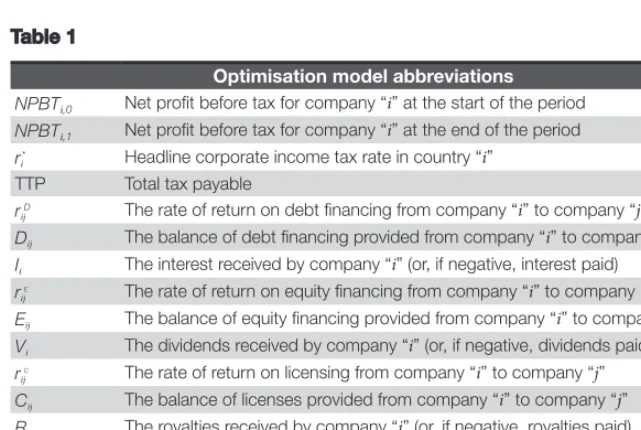
[image:18.462.57.378.284.499.2]For ease of reference, the abbreviations used throughout sections 3 and 4 are summarised in Table 1 below:
Table 1
Optimisation model abbreviations
NPBTi,0 Net profit before tax for company “i” at the start of the period
NPBTi,1 Net profit before tax for company “i” at the end of the period
ri* Headline corporate income tax rate in country “i”
TTP Total tax payable rij
D The rate of return on debt financing from company “
i” to company “j” Dij The balance of debt financing provided from company “i” to company “j” Ii The interest received by company “i” (or, if negative, interest paid)
rije The rate of return on equity financing from company “
i” to company “j” Eij The balance of equity financing provided from company “i” to company “j”
Vi The dividends received by company “i” (or, if negative, dividends paid)
rij
c The rate of return on licensing from company “
i” to company “j” Cij The balance of licenses provided from company “i” to company “j”
Ri The royalties received by company “i” (or, if negative, royalties paid) rij
s The rate of return on leasing from company “
i” to company “j” Sij The balance of leases provided from company “i” to company “j”
Pi The lease payments received by company “i” (or, if negative, lease payments)
3.2 Defining the objective function
Since this model is only concerned with the intercompany activities conducted to minimise tax, the only relevant constraints relate to these intercompany transactions. NPBTi,0 is the amount of net profit before tax (NPBT) of company i at the beginning of
the period; NPBTi,1 is the amount of NPBT of company i at the end of the period; ri*is the tax rate67 defined by the government of country i. For simplicity, the “real” NPBT
is a constant for each entity in each jurisdiction and is given (NPBTi,0). The impact of
the sum of intercompany transactions’ in each affiliate on NPBT is denoted as follows:
NPBTi,1 = NPBTi,0 + Ii +Vi +Ri +Pi (1)
Provided NPBTi t,+1 > 0,TTP > 0. However, if NPBTi t,+1 ≤ 0, thenTTP = 0. For
completeness, if NPBTi t,+1 > 0 then, TTP = NPBTi t,+1 ×ri*
Importantly, this model assumes that there are no tax losses, so TTP ≥ 0.
The general optimisation problem is the minimisation of the objective function by adjusting the design variables and at the same time satisfying the constraints. In the present analysis, the objective function is total tax payable (TTP) for the corporate group.
Minimise: TTP NPBTi t r i
n
i
= + ×
=
∑
, 1 *1 (2)
As illustrated in an earlier article by the author,68 the preliminary iteration of the
model is set with NPBT at $100 for both affiliates in the high‑tax jurisdictions and with NPBT as $0 for the affiliate in the lower‑tax jurisdiction.
3.3 Defining the constraints and other limitations
The four categories of fungible intercompany funding that constitute the focus of this article are debt financing (D), equity financing (E), licensing (C) and leasing (S).69
Accordingly, this optimisation problem is subject to the following four primary constraints:
67 While the “effective tax rate” would arguably be preferable, for simplicity the headline corporate income tax rate is used in this iteration of the model.
68 A Kayis‑Kumar, “Taxing cross‑border intercompany transactions: are financing activities fungible?” (2015) 30(3) Australian Tax Forum 627, 644–646.
Ii Dij rijD i i j
n = × = ≠
∑
1, (3)Interest (Ii) is received by company i, where Dijis the debt provided by company i to
company j; rijDis the rate of return on debt financing.
Vi Eij rijE i i j
n = × = ≠
∑
1, (4)Dividends (Vi) are received by company i, where Eij is the equity provided by company
to company j; rijEis the rate of return on equity financing.
Ri Cij rijC i i j
n = × = ≠
∑
1, (5)Royalties (Ri) are received by company i, where Cij is the license provided by company
i to company j; rijCis the rate of return on licencing.
Pi Sij rijS i i j
n = × = ≠
∑
1, (6)Lease payments (Pi) are received by company i, where Sij is the lease provided by
company i to company j; rijSis the rate of return on leasing.
This optimisation problem can then be remodelled by layering additional parameters that reflect the tax laws applicable to each reform variation, as further detailed in the below section 4.
For example, it is possible to include thin capitalisation rules, which apply in both the subsidiaries in the US and Australia. This is factored into the model by considering that the ratio of debt to equity for each company should be kept at less than 1.5, assuming the debt‑to‑equity ratio is 1.5:1 for both the US parent and Australian subsidiary.70
This can be expressed algorithmically as follows:
Dij −1 5. ×Eij ≤ 0 (7)
With the above algorithm, it is possible to target both or either inbound and outbound investment. Given the exponential increase in the implementation and maintenance
of thin capitalisation reforms, these rules are an exemplar of twentieth‑century tax policy convergence.
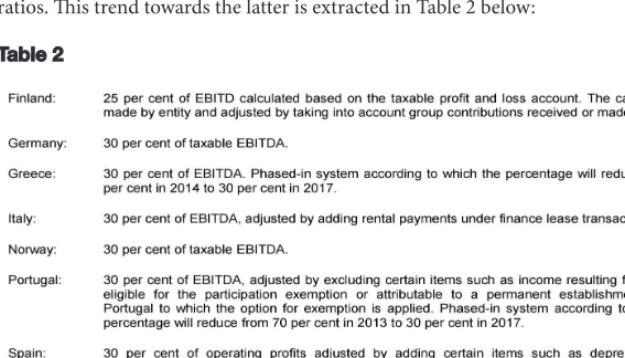
However, just as the rise of thin capitalisation rules can be attributed to the convergence — mostly of tax systems in Western democracies — so too can the possibly impending decline of thin capitalisation rules. As observed in the OECD’s BEPS final report on Action 4, there is currently a trend away from thin capitalisation71
[image:21.462.48.361.166.345.2]rules’ fixed debt‑to‑equity ratios to instead applying fixed net interest‑to‑EBITDA ratios. This trend towards the latter is extracted in Table 2 below:
Table 2
In line with this trend, the best practice approach recommended in the OECD’s final BEPS report on Action 4 (the OECD’s recommendation) was a fixed net interest‑to‑EBITDA ratio (fixed ratio rule). This would be in place of existing rules limiting the deductibility of interest, such as thin capitalisation rules. For completeness, a subsequent article by the author explores the implementation of a cross‑border ACE‑CBIT as an alternative to rules which only mitigate the “symptom” of thin capitalisation.72
The OECD’s recommendation, which is thought to be a better approach to combatting BEPS than existing thin capitalisation regimes, only provides deductibility to interest and payments economically equivalent to interest to the extent that the net interest expense‑to‑EBITDA ratio is less than the allowable threshold (or “benchmark fixed
71 For completeness, EBITDA is Earnings Before Interest, Tax, Depreciation and Amortisation. 72 For an analysis of the economic theory, please see A Kayis‑Kumar, “Thin capitalisation rules:
ratio”). The suggested corridor for the benchmark fixed ratio is between 10% and 30%. However, as noted in Table 2, the majority of countries which current adopt fixed ratio rules to restrict interest relief utilise a 30% benchmark ratio.73 Accordingly,
this article assumes the use of a 30% benchmark ratio for the fixed ratio rule.
Unlike thin capitalisation rules, which reference the levels of debt and equity, a fixed ratio based on the level of interest expense and earnings appears to be a more robust base protection technique. Despite the complexities arising in the calculation of the EBITDA, this model adopts the simplifying assumption that the NPBT measure used in the model developed by this article is effectively the same.
For simplicity, this iteration also assumes that the amount of intercompany transfers between each company ranges from a minimum of $0 to a maximum of $1,000. This is expressed as follows:
0 1000
0 1000
0 1000
0 1000
≤ ≤
≤ ≤
≤ ≤
≤ ≤
D
E
C
S ij ij ij ij
(8)
4. Operationalising the tax optimisation model
As mentioned in the above section 3.1, the hypothetical MNE modelled by this article has entities in four jurisdictions: two high‑tax jurisdictions (one capital‑exporter and one capital‑importer; specifically, a US parent and Australian subsidiary); and, two lower‑tax jurisdictions (one non‑treaty country and one treaty country, in Hong Kong and Singapore, respectively).
This section applies the optimisation problem formulaically using a two‑step approach: first, expressing the objective function; and second, applying the parallel and alternative constraints.
4.1 Baseline model: applying the objective function
First, the objective function is the minimisation of TTP. Once the current headline corporate income tax rates (ri*) are included, the objective function is denoted as:
Minimise: TTP = 0 39. × NPBTA,1 +0 17. × NPBTB,1 +0 30. ×NPBTC,1
For completeness, the current headline corporate income tax rates for the US, Singapore and Australia are 39%, 17% and 30%, respectively.
As other jurisdictions are added to the model, this will need to be reflected in the objective function. For example, the addition of a conduit subsidiary in Hong Kong in the below section 4.3.3 will result in the following revised objective function:
Minimise:
TTP = 0 39. ×NPBTA,1 + 0 17. × NPBTB,1 +0 30. ×NPBTC,1 + 0 165. ×NPBTD,1
This reflects Hong Kong’s current headline corporate income tax rate of 16.5%.
4.2 Baseline model: applying the constraints and other limitations
This formulation is limited to the cross‑border intercompany setting among otherwise fungible forms of debt, equity, licencing and leasing payments, as outlined in the above section 2.1. Given their fungibility, the rate of return is uniform across these funding types. The constraints are represented formulaically below, separated by category of funding; namely, debt financing, equity financing, licensing and finance leasing assuming that all rates of return (r) are 10% for each entity within the MNE.
As a consequence, this model also assumes that an increase in the profitability of the MNE does not generate shareholder pressure to increase the rate of return on equity (in the form of increased dividends on intercompany equity financing). However, this shareholder pressure is more likely to arise in a widely held company rather than a wholly owned subsidiary that prioritises global tax‑minimisation. On the other hand, the latter situation applies to the model developed by this article. Nonetheless, the model is designed so that “r” can later be adjusted to simulate the impact of tax rules which directly influence the particular cost of capital (such as an ACE reform), enabling a more complex analysis of MNE behaviour in future iterations.
The baseline model constraints are expressed algorithmically as follows:
Intercompany debt financing (D) resulting in interest payments (I):
I D D D D
I D D
A AB AC BA CA
B BA BC
= × + × + × + × = × + ×
0 10 0 10 0 10 0 10
0 10 0 10
. . . .
. . ++ × + ×
= × + × + × + ×
0 10 0 10
0 10 0 10 0 10 0 10
. .
. . . .
D D
I D D D D
AB CB
C CA CB AC BC
V E E E E
V E E
A AB AC BA CA
B BA BC
= × + × + × + × = × + ×
0 10 0 10 0 10 0 10
0 10 0 10
. . . .
. . ++ × + ×
= × + × + × + ×
0 10 0 10
0 10 0 10 0 10 0 10
. .
. . . .
E E
V E E E E
AB CB
C CA CB AC BC
Intercompany licensing (C) resulting in royalty payments (R):
R C C C C
R C C
A AB AC BA CA
B BA BC
= × + × + × + × = × + ×
0 10 0 10 0 10 0 10
0 10 0 10
. . . .
. . ++ × + ×
= × + × + × + ×
0 10 0 10
0 10 0 10 0 10 0 10
. .
. . . .
C C
R C C C C
AB CB
C CA CB AC BC
Intercompany leasing (S) resulting in lease payments (P):
P S S S S
P S S
A AB AC BA CA
B BA BC
= × + × + × + × = × + ×
0 10 0 10 0 10 0 10
0 10 0 10
. . . .
. . ++ × + ×
= × + × + × + ×
0 10 0 10
0 10 0 10 0 10 0 10
. .
. . . .
S S
P S S S S
AB CB
C CA CB AC BC
4.3 Overlaying parameters: applying concurrent and/or alternative
constraints
This section incrementally adds concurrent and/or alternative tax rules (or “parameters”) to simulate the impact of various rules on MNEs’ tax planning behaviour. This scenario analysis makes it possible to address the question of what the most likely behavioural responses would be to alternative rates of taxes being levied on otherwise fungible intercompany activities and to what extent alternative reform proposals developed by this article could ameliorate the distortions leading to said behavioural responses. These implications can be examined and cross‑referenced in the context of both the standalone entity and the overall group.
This enables a more complex analysis to be conducted which also highlights the breadth of the problem; specifically, that the literature has thus far been too focused on modification of one parameter at a time. Further research by the author includes a comparison of the results of this article with a simulation of ACE‑variants, both in theory and in practice.
The parameters developed by this article are as follows: ■ parameter 1: withholding taxes
■ parameter 2: foreign tax credits ■ parameter 3: conduit in Hong Kong
For completeness, parameters such as the PE rules and the controlled foreign company (CFC) regime are beyond the scope of this iteration of the model. Recently examined in the OECD’s BEPS final report on action 3,74 CFC rules play a unique role in the
international tax system, particularly given their focus on passive income in low‑tax jurisdictions. However, given the primary concern of this article is in relation to thin capitalisation rules and the OECD’s BEPS final report on Action 4, the CFC rules which would otherwise be applicable are excluded from this iteration of the model. Instead, subsequent articles by the author will build in additional complexities, including but not limited, to CFC rules.
4.3.1 Withholding taxes
Unlike most of the other parameters built into the model, withholding tax rates are beyond the unilateral control of governments. Each tax treaty — and, by extension, each withholding tax rate within each treaty — is the result of a distinct and separate bilateral negotiation process. Since the rate limits on withholding taxes cannot be unilaterally increased, this parameter is conceptualised as a “supernational parameter”.
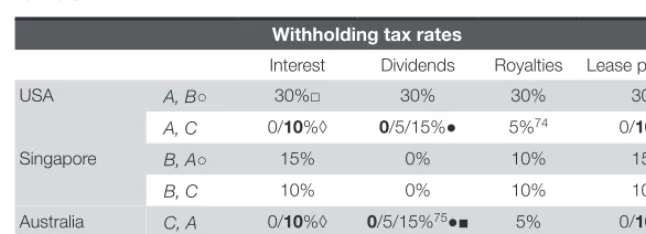
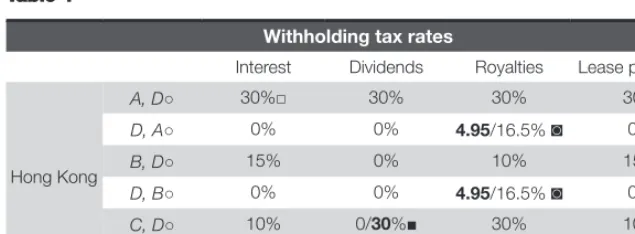
Specific withholding tax rates apply for each of the types of intercompany flows examined in this model. Table 3 below indicates the withholding tax rates for each type of intercompany funding applicable for each jurisdiction (with notation in the second column representing a flow from country “j” to country “i”, given the notation of the underlying transfer would be “ij”).
Table 3
Withholding tax rates
Interest Dividends Royalties Lease payments
USA A, B○ 30%□ 30% 30% 30%
A, C 0/10%◊ 0/5/15%● 5%74 0/10%◊
Singapore B, A○ 15% 0% 10% 15%
B, C 10% 0% 10% 10%
Australia C, A 0/10%◊ 0/5/15%75●■ 5% 0/10%◊
C, B 10% 0/15%■ 10% 10%76
Key:○ represents absence of a comprehensive tax treaty; ◊ government authorities/financial institutions are afforded a withholding tax exemption; □ interest on certain “portfolio debt” obligations are exempt from withholding tax; ♦ withholding tax exemption applies to interest paid in relation to either a sale on credit of goods, merchandise or services, or a sale on credit of industrial, commercial or scientific equipment; ● higher withholding rates apply if there is a lower level of participation;78
■ relates to different rates arising from imputation system; the higher rate applies to unfranked dividends.
75 For completeness, the Australia–United States DTA was amended in 2003, reducing the rate of royalty withholding tax from 10% to 5%; see further: Protocol amending the Convention between the Government of Australia and the Government of the United States of America for the Avoidance of Double Taxation and the Prevention of Fiscal Evasion with Respect to Taxes on Income, Australia–United States of America, signed on 27 September 2001, [2003] ATS 14 (entered into force 12 May 2003).
76 Australia–United States DTA, Article 10 amended in 2003; “While the top withholding rates are similar across jurisdictions, substantial concessions are available to investors from the US and the UK, including a zero withholding tax rate on unfranked dividends which may be available where the investor beneficially holds an 80% or greater stake in an Australian company”: R Tang and J Wan, “Tax treaties for Asian Century”, The Australian Financial Review (Sydney) 7 November 2012.
77 “Section 128AC was introduced by the Taxation Laws Amendment Act (No 2) 1986 … The mischief to be remedied was the loss of revenue by the use of non‑traditional methods of finance where a resident enters into a hire‑purchase agreement or finance lease arrangement with a non‑resident … The EM recognises the dual purpose served by the agreements in question, namely, purchase and financing the purchase. Consistent with this objective, the section deemed that part of the hire payments that were equivalent to interest in the financing arrangement to be interest for withholding tax purposes”: Australian Taxation Office, Income tax: withholding tax implications of cross border leasing arrangements (2 December 1998) TR 98/12, 12; available atwww.ato .gov.au/law/view/document?docid=TXR/TR9821/NAT/ATO/00001&PiT=20100630000001. 78 However, the differences between direct and portfolio investment are beyond the scope of this
For completeness, in Table 3 where one form of intercompany funding may be subject to varying rates of withholding tax, the rate most likely to apply is highlighted in bold. For example, assuming a high level of participation, the withholding tax rate of dividends from Co C and Co A would be 0%. It is important to note the difference in tax treatment between franked and unfranked dividends in the context of Australia’s imputation system which, in the first instance, this model assumes are unfranked.
For the purposes of the optimisation model, the existence of withholding tax gives rise to a potentially increased TTP. This necessitates a modification to the objective function, as follows:
Minimise: TTP Dij rjiWHT Eij rjiWHT Cij rjiWHT Sij rjiWHT
I V R P
=+
(
× + × + × + ×)
where rjiWHTrepresents the potential marginal increase in TTP, which is a function of the rates of return (r, assumed to be 10% in the baseline iteration for all types of funding) multiplied by the respective “relative value” for each decision variable (denoted as WHT, with each “relative value” shown in Table 3).
A run‑time test indicates that the MNE will funnel all funds through a combination of the decision variable with the lowest withholding tax rate and the jurisdiction with the lowest corporate income tax rate. This can be further validated by a two‑fold analysis; first, anecdotal evidence from leading tax practitioners suggests that this reflects MNEs’ behaviour. Second, from the perspective of the MNE as a group, withholding taxes increase the cost of capital of the funding type by the amount of the tax rate withheld.79
This relationship can be expressed as follows:
rWHT = r(1 + τ)
where rWHT
is the cost of capital following the imposition of withholding taxes, r is the rate of return prior to the imposition of withholding taxes, τ is the withholding tax rate.
4.3.2 Foreign tax credits
To avoid double taxation, foreign income may be exempt from tax under the relevant jurisdiction’s foreign tax credit (FTC) regime. Each jurisdiction unilaterally controls its FTC system, rendering this a parameter.
It is noteworthy that FTC systems and rates differ markedly between jurisdictions. For example, even though passive income is included within the FTC calculations for USA,80 Singapore and Australia,81 Australia’s FTC regime was replaced in 2008 with
a foreign income tax offset (FITO) pursuant to Div 770 of the Income Tax Assessment Act 1997 (Cth).82 Also, even though Singapore has not entered into a comprehensive
double tax treaty with the USA, as indicated in Table 3, Singapore’s unilateral tax credit system provides similar relief to a FTC.83
However, the purpose of this model is not to replicate the nuances of each jurisdiction’s unique system. Rather, this model aims to algorithmically express the top‑level design of FTC’s. While some jurisdictions (including Singapore) calculate their FTC’s on a “country‑by‑country” basis, this is not built into the model in the first instance. Further, since this model offers a single‑period analysis, carry‑backs or carry‑forwards are not relevant. For simplicity, controlled foreign companies, pooling, other types of tax credits etc are beyond the scope of this section.
In order to convert the FTC regime into an algorithmic expression, it is instructive to first articulate the operation of this system. The FTC is limited to the domestic tax liability that would be due on the foreign source income.84 Specifically, a jurisdiction’s
FTC is the lower of: (A) the amount of tax attributable to the foreign source income; or (B) the actual amount of foreign tax paid.
80 “The separate income baskets help discourage US corporations from moving offshore highly mobile investments (such as international shipping, financial services, and portfolio loans) that can easily be located in low‑tax countries.”: Rousslang DJ, ‘Foreign tax credit’, in: Cordes JJ, Ebel RD and Gravelle J (eds.) The Encyclopedia of Taxation & Tax Policy (Washington DC, USA: The Urban Insitute, 2nd ed, 2005), 157. [NOTE: this has changed in 2007 amendments to only two baskets, one of which is still passive income].
81 “All types of income are treated the same for the purposes of working out the foreign income tax offset”: ATO, Guide to foreign income tax offset rules (NAT 72923, July 2014), http://law.ato.gov .au/atolaw/view.htm?docid=SAV/FOROFFSET/00001&PiT=20130701000001.
82 “The FITO differs from the FTC in that it applies to both Australian and foreign residents and is not subject to quarantining rules”: Barkoczy S, Foundations of Taxation Law (Sydney, Australia: CCH Australia Limited, 6th ed, 2014), 930.
83 “Effective Year of Assessment (YA) 2009, a UTC will be granted on all foreign‑sourced income received in Singapore by Singapore tax residents from jurisdictions that do not have DTAs with Singapore”: Singaporean Government, Inland Revenue Authority of Singapore, Foreign Tax Credit (21 March 2016); available at: https://www.iras.gov.sg/irashome/Businesses/Companies/ Working‑out‑Corporate‑Income‑Taxes/Claiming‑Reliefs/Foreign‑Tax‑Credit/.
In other words, if the amount of tax attributable to the foreign source income (A) exceeds the actual amount of foreign tax paid (B), then TTP will increase by the difference; namely, A – B. If, however, the actual amount of foreign tax paid (B) exceeds the amount of tax attributable to the foreign source income (A), then TTP will remain unchanged, because there will be no increase to domestic tax liability.
For the purposes of the optimisation model, FTC can be built into the objective function with the addition of the following notation:
Minimise: TTP Dijk Eijk Cijk Sijk rijk rijkFTC rijk rkjiWHT k
j i
=+
∑
(
+ + +)
(
× − ×)
≠ ≠
∑
j
where ijk represents the inclusion of all three jurisdictions, rijk is the initial rate of
return (assuming the “tax attributable” is calculated on the gross‑up, this is the same as the initial rate of return of 10%), rijkFTCrepresents the amount of tax attributable to the foreign source income, rkjiWHTrepresents the actual amount of foreign tax paid.
4.3.3 Conduit in Hong Kong
It is instructive to observe MNE behaviour when interacting with a non‑treaty, low tax jurisdiction. Accordingly, this model includes a Hong Kong subsidiary (Co. D), which has a headline corporate income tax rate of 16.5%.
It is also necessary to build all of the previous parameters into this variation of the model. Regarding the withholding tax parameter, as indicated in Table 4, Hong Kong has not entered into comprehensive double tax treaties with any of the jurisdictions in the baseline model. Hong Kong allows substantially the same withholding tax rates (at or near 0%) for both treaty and non‑treaty countries. However, the FTC regime does not apply to any of the baseline jurisdictions.85
Table 4
Withholding tax rates
Interest Dividends Royalties Lease payments
Hong Kong
A, D○ 30%□ 30% 30% 30%
D, A○ 0% 0% 4.95/16.5% ◙ 0%
B, D○ 15% 0% 10% 15%
D, B○ 0% 0% 4.95/16.5% ◙ 0%
C, D○ 10% 0/30%■ 30% 10%
D, C○ 0% 0% 4.95/16.5% ◙ 0%
Key: ○ represents absence of a comprehensive tax treaty; ◊ government authorities/financial institutions are afforded a withholding tax exemption; □ interest on certain “portfolio debt” obligations are exempt from withholding tax; ♦ withholding tax exemption applies to interest paid in relation to either a sale on credit of goods, merchandise or services, or a sale on credit of industrial, commercial or scientific equipment; ● higher withholding rates apply if there is a lower level of participation; ■ relates to different rates arising from imputation system; the higher rate applies to unfranked dividends; ◙ the higher rate applies if the royalties are received by or accrued to a non‑resident from an associate.
4.3.4 OECD’s recommendation: fixed ratio rule
The purpose of this section 4.3.4 is not to provide an extensive analysis of the OECD’s recommendation.86 Rather, it only provides an algorithmic expression of the fixed
ratio rule outlined in the above section 3.3. This acts as proxy for the OECD’s proposed reform.
Accordingly, the OECD’s recommendation can be expressed algorithmically as follows:
Ii +Pi ≤ ( %30 ×NPBTi t,+1)
An absolute value inequality is used because this rule is concerned with interest outflows, which are denoted with negative values. Translating this absolute value inequality to render it suitable for the modelling software requires expressing it in the form of the following two constraints:
Ii + Pi −30%×NPBTi t,+1 ≤ 0
−Ii −Pi −30%×NPBTi t,+1 ≤ 0
4.4 Findings and analysis: how would an MNE respond to the
OECD’s recommendation for a fixed ratio rule?
This section presents the results of incrementally adding both concurrent and alternative tax rules (or “parameters”) to simulate three scenarios; first, the current tax regime. Second, the OECD’s recommendation being adopted by Australia. Third, OECD’s recommendation being adopted by both Australia and the USA.
4.4.1 Unilateral fixed ratio rule
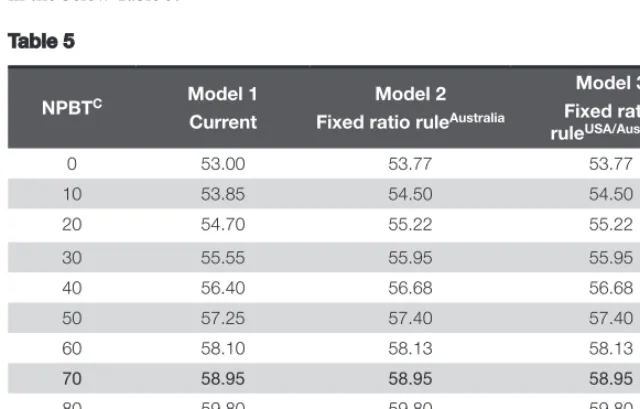
Assuming that the OECD recommendation was adopted by Australia in place of the existing thin capitalisation rules, this reform would result in an increase in TTP for the most tax aggressive MNEs, albeit nominally. Specifically, there would be a maximum 1.45% increase in TTP for the most tax‑aggressive MNE (where NPBTC=0), as shown
[image:31.462.43.363.306.511.2]in the below Table 5.
Table 5
NPBTC Model 1
Current
Model 2 Fixed ratio ruleAustralia
Model 3 Fixed ratio ruleUSA/Australia
0 53.00 53.77 53.77
10 53.85 54.50 54.50
20 54.70 55.22 55.22
30 55.55 55.95 55.95
40 56.40 56.68 56.68
50 57.25 57.40 57.40
60 58.10 58.13 58.13
70 58.95 58.95 58.95
80 59.80 59.80 59.80
90 60.65 60.65 60.65
100 61.50 61.50 61.50
In terms of capital structure and funding mix, the US entity is not impacted by Australia’s unilateral adoption of the OECD recommendation. Australia sees no change to the magnitude of outflows, with the MNE simply switching the funding mix utilised in Australia from finance lease payments to a combination of royalty and interest payments to attain the same tax payable result in Australia. Despite the fact that the fixed ratio rule allows greater interest relief at higher levels of MNE profitability, since the tax‑minimising MNE aims to minimise global TTP, it simply maximises its use of the fixed ratio rule in Australia and obtains an additional deduction by introducing the requirement to make royalty payments from Australia to Singapore. This is in contrast to the baseline model, where the Singaporean entity received no funding. As such, Singapore becomes a new beneficiary because it starts to obtain the majority of NPBT from the most tax‑aggressive MNEs through royalty payments (from NPBTC=0–60).
4.4.2 Multilateral fixed ratio rule