Utilizing Dependency Language Models for Graph-based Dependency
Parsing Models
Wenliang Chen, Min Zhang∗
, and Haizhou Li
Human Language Technology, Institute for Infocomm Research, Singapore
{wechen, mzhang, hli}@i2r.a-star.edu.sg
Abstract
Most previous graph-based parsing models in-crease decoding complexity when they use high-order features due to exact-inference de-coding. In this paper, we present an approach to enriching high-order feature representations for graph-based dependency parsing models using a dependency language model and beam search. The dependency language model is built on a large-amount of additional auto-parsed data that is processed by a baseline parser. Based on the dependency language model, we represent a set of features for the parsing model. Finally, the features are effi-ciently integrated into the parsing model dur-ing decoddur-ing usdur-ing beam search. Our ap-proach has two advantages. Firstly we utilize rich high-order features defined over a view of large scope and additional large raw cor-pus. Secondly our approach does not increase the decoding complexity. We evaluate the pro-posed approach on English and Chinese data. The experimental results show that our new parser achieves the best accuracy on the Chi-nese data and comparable accuracy with the best known systems on the English data.
1 Introduction
In recent years, there are many data-driven mod-els that have been proposed for dependency parsing (McDonald and Nivre, 2007). Among them, graph-based dependency parsing models have achieved state-of-the-art performance for a wide range of lan-guages as shown in recent CoNLL shared tasks
∗
Corresponding author
(Buchholz and Marsi, 2006; Nivre et al., 2007). In the graph-based models, dependency parsing is treated as a structured prediction problem in which the graphs are usually represented as factored struc-tures. The information of the factored structures de-cides the features that the models can utilize. There are several previous studies that exploit high-order features that lead to significant improvements.
McDonald et al. (2005) and Covington (2001) develop models that represent first-order features over a single arc in graphs. By extending the first-order model, McDonald and Pereira (2006) and Car-reras (2007) exploit second-order features over two adjacent arcs in second-order models. Koo and Collins (2010) further propose a third-order model that uses third-order features. These models utilize higher-order feature representations and achieve bet-ter performance than the first-order models. But this achievement is at the cost of the higher decoding complexity, from O(n2) to O(n4), where n is the length of the input sentence. Thus, it is very hard to develop higher-order models further in this way.
How to enrich high-order feature representations without increasing the decoding complexity for graph-based models becomes a very challenging problem in the dependency parsing task. In this pa-per, we solve this issue by enriching the feature rep-resentations for a graph-based model using a depen-dency language model (DLM) (Shen et al., 2008). The N-gram DLM has the ability to predict the next child based on the N-1 immediate previous children and their head (Shen et al., 2008). The basic idea behind is that we use the DLM to evaluate whether a valid dependency tree (McDonald and Nivre, 2007)
is well-formed from a view of large scope. The pars-ing model searches for the final dependency trees by considering the original scores and the scores of DLM.
In our approach, the DLM is built on a large amount of auto-parsed data, which is processed by an original first-order parser (McDonald et al., 2005). We represent the features based on the DLM. The DLM-based features can capture the N-gram in-formation of the parent-children structures for the parsing model. Then, they are integrated directly in the decoding algorithms using beam-search. Our new parsing model can utilize rich high-order fea-ture representations but without increasing the com-plexity.
To demonstrate the effectiveness of the proposed approach, we conduct experiments on English and Chinese data. The results indicate that the approach greatly improves the accuracy. In summary, we make the following contributions:
• We utilize the dependency language model to enhance the graph-based parsing model. The DLM-based features are integrated directly into the beam-search decoder.
• The new parsing model uses the rich high-order features defined over a view of large scope and and additional large raw corpus, but without in-creasing the decoding complexity.
• Our parser achieves the best accuracy on the Chinese data and comparable accuracy with the best known systems on the English data.
2 Dependency language model
Language models play a very important role for sta-tistical machine translation (SMT). The standard N-gram based language model predicts the next word based on theN−1immediate previous words. How-ever, the traditional N-gram language model can not capture long-distance word relations. To over-come this problem, Shen et al. (2008) proposed a dependency language model (DLM) to exploit long-distance word relations for SMT. The N-gram DLM predicts the next child of a head based on theN−1 immediate previous children and the head itself. In this paper, we define a DLM, which is similar to the one of Shen et al. (2008), to score entire dependency trees.
An input sentence is denoted by x =
(x0, x1, ..., xi, ..., xn), where x0 = ROOT and
does not depend on any other token inx and each token xi refers to a word. Let y be a depen-dency tree forxandH(y)be a set that includes the words that have at least one dependent. For each
xh ∈H(y), we have a dependency structureDh =
(xLk, ...xL1, xh, xR1...xRm), wherexLk, ...xL1 are
the children on the left side from the farthest to the nearest andxR1...xRmare the children on the right side from the nearest to the farthest. Probability
P(Dh)is defined as follows:
P(Dh) =PL(Dh)×PR(Dh) (1)
Here PL and PR are left and right side generative probabilities respectively. Suppose, we use a N-gram dependency language model. PLis defined as follows:
PL(Dh) ≈ PLc(xL1|xh)
×PLc(xL2|xL1, xh)
×... (2)
×PLc(xLk|xL(k−1), ..., xL(k−N+1), xh)
where the approximation is based on thenth order Markov assumption. The right side probability is similar. For a dependency tree, we calculate the probability as follows:
P(y) = Y
xh∈H(y)
P(Dh) (3)
In this paper, we use a linear model to calculate the scores for the parsing models (defined in Section 3.1). Accordingly, we reform Equation 3. We define
fDLM as a high-dimensional feature representation which is based on arbitrary features ofPLc,PRcand
x. Then, the DLM score of treeyis in turn computed as the inner product of fDLM with a corresponding weight vector wDLM.
scoreDLM(y) =fDLM ·wDLM (4)
3 Parsing with dependency language model
3.1 Graph-based parsing model
The graph-based parsing model aims to search for the maximum spanning tree (MST) in a graph (Mc-Donald et al., 2005). We write (xi, xj) ∈ y if there is a dependency in tree y from word xi to word xj (xi is the head and xj is the depen-dent). A graph, denoted by Gx, consists of a set of nodesVx = {x0, x1, ..., xi, ..., xn} and a set of arcs (edges)Ex = {(xi, xj)|i 6= j, xi ∈ Vx, xj ∈
(Vx −x0)}, where the nodes in Vx are the words inx. LetT(Gx) be the set of all the subgraphs of
Gx that are valid dependency trees (McDonald and Nivre, 2007) for sentencex.
The formulation defines the score of a depen-dency treey ∈ T(Gx) to be the sum of the edge scores,
s(x, y) =X
g∈y
score(w, x, g) (5)
where g is a spanning subgraph of y. g can be a single dependency or adjacent dependencies. Then
y is represented as a set of factors. The model scores each factor using a weight vector w that con-tains the weights for the features to be learned dur-ing traindur-ing usdur-ing the Margin Infused Relaxed Algo-rithm (MIRA) (Crammer and Singer, 2003; McDon-ald and Pereira, 2006). The scoring function is
score(w, x, g) =f(x, g)·w (6)
where f(x, g) is a high-dimensional feature repre-sentation which is based on arbitrary features ofg
andx.
The parsing model finds a maximum spanning
tree (MST), which is the highest scoring tree in
T(Gx). The task of the decoding algorithm for a given sentencexis to findy∗
,
y∗
= arg max
y∈T(Gx)
s(x, y) = arg max
y∈T(Gx)
X
g∈y
score(w, x, g)
3.2 Add DLM scores
In our approach, we consider the scores of the DLM when searching for the maximum spanning tree. Then for a given sentencex, we findy∗
DLM,
y∗
DLM = arg max y∈T(Gx)
(X
g∈y
score(w, x, g)+scoreDLM(y))
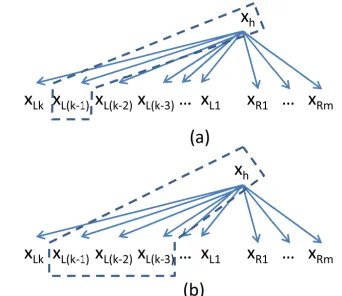
After adding the DLM scores, the new parsing model can capture richer information. Figure 1 illus-trates the changes. In the original first-order parsing model, we only utilize the information of single arc (xh,xL(k−1)) forxL(k−1) as shown in Figure 1-(a). If we use 3-gram DLM, we can utilize the additional information of the two previous children (nearer to
[image:3.612.337.508.195.343.2]xhthanxL(k−1)): xL(k−2)andxL(k−3) as shown in Figure 1-(b).
Figure 1: Adding the DLM scores to the parsing model
3.3 DLM-based feature templates
We define DLM-based features for Dh =
(xLk, ...xL1, xh, xR1...xRm). For each childxchon the left side, we have PLc(xch|HIS), where HIS refers to the N −1 immediate previous right chil-dren and headxh. Similarly, we havePRc(xch|HIS) for each child on the right side. LetPu(xch|HIS) (Pu(ch)in short) be one of the above probabilities. We use the map function Φ(Pu(ch)) to obtain the predefined discrete value (defined in Section 5.3). The feature templates are outlined in Table 1, where TYPErefers to one of the types:PL or PR, h pos refers to the part-of-speech tag ofxh, h word refers to the lexical form ofxh, ch pos refers to the part-of-speech tag ofxch, and ch word refers to the lexical form ofxch.
4 Decoding
<Φ(Pu(ch)),TYPE>
<Φ(Pu(ch)),TYPE, h pos >
<Φ(Pu(ch)),TYPE, h word >
<Φ(Pu(ch)),TYPE, ch pos >
<Φ(Pu(ch)),TYPE, ch word >
<Φ(Pu(ch)),TYPE, h pos, ch pos >
[image:4.612.96.283.57.144.2]<Φ(Pu(ch)),TYPE, h word, ch word >
Table 1: DLM-based feature templates
in which we add the DLM-based features in the de-coding algorithm directly.
4.1 Rescoring
We add the DLM-based features into the decoding procedure by using the rescoring technique used in (Shen et al., 2008). We can use an original parser to produce the K-best list. This method has the po-tential to be very fast. However, because the perfor-mance of this method is restricted to the K-best list, we may have to set K to a high number in order to find the best parsing tree (with DLM) or a tree ac-ceptably close to the best (Shen et al., 2008).
4.2 Intersect
Then, we add the DLM-based features in the decod-ing algorithm directly. The DLM-based features are generated online during decoding.
For our parser, we use the decoding algorithm of McDonald et al. (2005). The algorithm was ex-tensions of the parsing algorithm of (Eisner, 1996), which was a modified version of the CKY chart parsing algorithm. Here, we describe how to add the DLM-based features in the first-order algorithm. The second-order and higher-order algorithms can be extended by the similar way.
The parsing algorithm independently parses the left and right dependents of a word and combines them later. There are two types of chart items (Mc-Donald and Pereira, 2006): 1) a complete item in which the words are unable to accept more depen-dents in a certain direction; and 2) an incomplete
item in which the words can accept more dependents
in a certain direction. In the algorithm, we create both types of chart items with two directions for all the word pairs in a given sentence. The direction of a dependency is from the head to the dependent. The right (left) direction indicates the dependent is on the right (left) side of the head. Larger chart items are
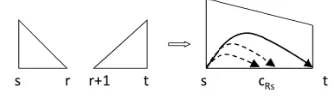
[image:4.612.355.489.331.446.2]created from pairs of smaller ones in a bottom-up style. In the following figures, complete items are represented by triangles and incomplete items are represented by trapezoids. Figure 2 illustrates the cubic parsing actions of the algorithm (Eisner, 1996) in the right direction, wheres, r, andtrefer to the start and end indices of the chart items. In Figure 2-(a), all the items on the left side are complete and the algorithm creates the incomplete item (trapezoid on the right side) ofs– t. This action builds a de-pendency relation fromstot. In Figure 2-(b), the item ofs–r is incomplete and the item ofr –tis complete. Then the algorithm creates the complete item ofs–t. In this action, all the children ofrare generated. In Figure 2, the longer vertical edge in a triangle or a trapezoid corresponds to the subroot of the structure (spanning chart). For example,sis the subroot of the spans–tin Figure 2-(a). For the left direction case, the actions are similar.
Figure 2: Cubic parsing actions of Eisner (Eisner, 1996)
Then, we add the DLM-based features into the parsing actions. Because the parsing algorithm is in the bottom-up style, the nearer children are gen-erated earlier than the farther ones of the same head. Thus, we calculate the left or right side probabil-ity for a new child when a new dependency rela-tion is built. For Figure 2-(a), we add the features of
PRc(xt|HIS). Figure 3 shows the structure, where
cRsrefers to the current children (nearer thanxt) of
xs. In the figure, HIS includescRsandxs.
[image:4.612.340.507.634.682.2]We use beam search to choose the one having the overall best score as the final parse, where K spans are built at each step (Zhang and Clark, 2008). At each step, we perform the parsing actions in the cur-rent beam and then choose the best K resulting spans for the next step. The time complexity of the new de-coding algorithm isO(Kn3)while the original one isO(n3), wherenis the length of the input sentence. With the rich feature set in Table 1, the running time of Intersect is longer than the time of Rescoring. But Intersect considers more combination of spans with the DLM-based features than Rescoring that is only given a K-best list.
5 Implementation Details
5.1 Baseline parser
We implement our parsers based on the MSTParser1, a freely available implementation of the graph-based model proposed by (McDonald and Pereira, 2006). We train a first-order parser on the training data (de-scribed in Section 6.1) with the features defined in McDonald et al. (2005). We call this first-order parser Baseline parser.
5.2 Build dependency language models
We use a large amount of unannotated data to build the dependency language model. We first perform word segmentation (if needed) and part-of-speech tagging. After that, we obtain the word-segmented sentences with the part-of-speech tags. Then the sentences are parsed by the Baseline parser. Finally, we obtain the auto-parsed data.
Given the dependency trees, we estimate the prob-ability distribution by relative frequency:
Pu(xch|HIS) =
count(xch,HIS) P
x0
ch
count(x0
ch,HIS)
(7)
No smoothing is performed because we use the mapping function for the feature representations.
5.3 Mapping function
We can define different mapping functions for the feature representations. Here, we use a simple way. First, the probabilities are sorted in decreasing order. LetN o(Pu(ch))be the position number ofPu(ch) in the sorted list. The mapping function is:
1
http://mstparser.sourceforge.net
Φ(Pu(ch)) =
P H ifN o(Pu(ch))≤TOP10
P M if TOP10< N o(Pu(ch))≤TOP30
P L if TOP30< N o(Pu(ch))
P O ifPu(ch)) = 0
where TOP10 and TOP 30 refer to the position bers of top 10% and top 30% respectively. The num-bers, 10% and 30%, are tuned on the development sets in the experiments.
6 Experiments
We conducted experiments on English and Chinese data.
6.1 Data sets
For English, we used the Penn Treebank (Marcus et al., 1993) in our experiments. We created a stan-dard data split: sections 2-21 for training, section 22 for development, and section 23 for testing. Tool “Penn2Malt”2was used to convert the data into de-pendency structures using a standard set of head rules (Yamada and Matsumoto, 2003). Following the work of (Koo et al., 2008), we used the MX-POST (Ratnaparkhi, 1996) tagger trained on training data to provide part-of-speech tags for the develop-ment and the test set, and used 10-way jackknifing to generate part-of-speech tags for the training set. For the unannotated data, we used the BLLIP corpus (Charniak et al., 2000) that contains about 43 million words of WSJ text.3 We used the MXPOST tagger trained on training data to assign part-of-speech tags and used the Baseline parser to process the sentences of the BLLIP corpus.
For Chinese, we used the Chinese Treebank (CTB) version 4.04in the experiments. We also used the “Penn2Malt” tool to convert the data and cre-ated a data split: files 1-270 and files 400-931 for training, files 271-300 for testing, and files 301-325 for development. We used gold standard segmenta-tion and part-of-speech tags in the CTB. The data partition and part-of-speech settings were chosen to match previous work (Chen et al., 2008; Yu et al., 2008; Chen et al., 2009). For the unannotated data, we used the XIN CMN portion of Chinese Giga-word5 Version 2.0 (LDC2009T14) (Huang, 2009),
2http://w3.msi.vxu.se/˜nivre/research/Penn2Malt.html 3
We ensured that the text used for extracting subtrees did not include the sentences of the Penn Treebank.
4
http://www.cis.upenn.edu/˜chinese/.
5
which has approximately 311 million words whose segmentation and POS tags are given. We discarded the annotations due to the differences in annotation policy between CTB and this corpus. We used the MMA system (Kruengkrai et al., 2009) trained on the training data to perform word segmentation and POS tagging and used the Baseline parser to parse all the sentences in the data.
6.2 Features for basic and enhanced parsers
The previous studies have defined four types of features: (FT1) the first-order features defined in McDonald et al. (2005), (FT2SB) the second-order parent-siblings features defined in McDonald and Pereira (2006), (FT2GC) the second-order parent-child-grandchild features defined in Carreras (2007), and (FT3) the third-order features defined in (Koo and Collins, 2010).
We used the first- and second-order parsers of the MSTParser as the basic parsers. Then we en-hanced them with other higher-order features us-ing beam-search. Table 2 shows the feature set-tings of the systems, where MST1/2 refers to the ba-sic first-/second-order parser and MSTB1/2 refers to the enhanced first-/second-order parser. MSTB1 and MSTB2 used the same feature setting, but used dif-ferent order models. This resulted in the difference of using FT2SB (beam-search in MSTB1 vs exact-inference in MSTB2). We used these four parsers as the Baselines in the experiments.
System Features MST1 (FT1)
MSTB1 (FT1)+(FT2SB+FT2GC+FT3) MST2 (FT1+FT2SB)
MSTB2 (FT1+FT2SB)+(FT2GC+FT3)
Table 2: Baseline parsers
We measured the parser quality by the unlabeled attachment score (UAS), i.e., the percentage of to-kens (excluding all punctuation toto-kens) with the cor-rect HEAD. In the following experiments, we used “Inter” to refer to the parser with Intersect, and “Rescore” to refer to the parser with Rescoring.
6.3 Development experiments
Since the setting of K (for beam search) affects our parsers, we studied its influence on the development
set for English. We added the DLM-based features to MST1. Figure 4 shows the UAS curves on the development set, where K is beam size for Inter-sect and K-best for Rescoring, the X-axis represents K, and the Y-axis represents the UAS scores. The parsing performance generally increased as the K increased. The parser with Intersect always outper-formed the one with Rescoring.
0.912 0.914 0.916 0.918 0.92 0.922 0.924 0.926 0.928
1 2 4 8 16
UAS
K Rescore
[image:6.612.363.491.180.274.2]Inter
Figure 4: The influence of K on the development data
K 1 2 4 8 16
English 157.1 247.4 351.9 462.3 578.2
Table 3: The parsing times on the development set (sec-onds for all the sentences)
Table 3 shows the parsing times of Intersect on the development set for English. By comparing the curves of Figure 4, we can see that, while using larger K reduced the parsing speed, it improved the performance of our parsers. In the rest of the ex-periments, we set K=8 in order to obtain the high accuracy with reasonable speed and used Intersect to add the DLM-based features.
N 0 1 2 3 4
English 91.30 91.87 92.52 92.72 92.72 Chinese 87.36 87.96 89.33 89.92 90.40
Table 4: Effect of different N-gram DLMs
6.4 Main results on English data
We evaluated the systems on the testing data for English. The results are shown in Table 5, where -DLM refers to adding the -DLM-based features to the Baselines. The parsers using the DLM-based fea-tures consistently outperformed the Baselines. For the basic models (MST1/2), we obtained absolute improvements of 0.94 and 0.63 points respectively. For the enhanced models (MSTB1/2), we found that there were 0.63 and 0.66 points improvements re-spectively. The improvements were significant in McNemar’s Test (p <10−5
)(Nivre et al., 2004).
Order1 UAS Order2 UAS
MST1 90.95 MST2 91.71
MST-DLM1 91.89 MST-DLM2 92.34
MSTB1 91.92 MSTB2 92.10
MSTB-DLM1 92.55 MSTB-DLM2 92.76
Table 5: Main results for English
6.5 Main results on Chinese data
The results are shown in Table 6, where the abbrevi-ations used are the same as those in Table 5. As in the English experiments, the parsers using the DLM-based features consistently outperformed the Base-lines. For the basic models (MST1/2), we obtained absolute improvements of 4.28 and 3.51 points re-spectively. For the enhanced models (MSTB1/2), we got 3.00 and 2.93 points improvements respec-tively. We obtained large improvements on the Chi-nese data. The reasons may be that we use the very large amount of data and 4-gram DLM that captures high-order information. The improvements were significant in McNemar’s Test (p <10−7
).
Order1 UAS Order2 UAS
MST1 86.38 MST2 88.11
MST-DLM1 90.66 MST-DLM2 91.62
MSTB1 88.38 MSTB2 88.66
MSTB-DLM1 91.38 MSTB-DLM2 91.59
Table 6: Main results for Chinese
6.6 Compare with previous work on English
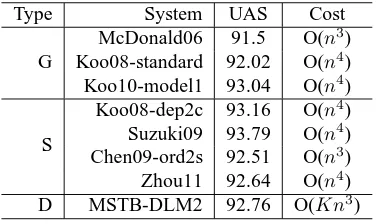
Table 7 shows the performance of the graph-based systems that were compared, where McDonald06 refers to the second-order parser of McDonald
and Pereira (2006), Koo08-standard refers to the second-order parser with the features defined in Koo et al. (2008), Koo10-model1 refers to the third-order parser with model1 of Koo and Collins (2010), Koo08-dep2c refers to the second-order parser with cluster-based features of (Koo et al., 2008), Suzuki09 refers to the parser of Suzuki et al. (2009), Chen09-ord2s refers to the second-order parser with subtree-based features of Chen et al. (2009), and Zhou11 refers to the second-order parser with web-derived selectional preference features of Zhou et al. (2011).
The results showed that our MSTB-DLM2 ob-tained the comparable accuracy with the previous state-of-the-art systems. Koo10-model1 (Koo and Collins, 2010) used the third-order features and achieved the best reported result among the super-vised parsers. Suzuki2009 (Suzuki et al., 2009) re-ported the best rere-ported result by combining a Semi-supervised Structured Conditional Model (Suzuki and Isozaki, 2008) with the method of (Koo et al., 2008). However, their decoding complexities were higher than ours and we believe that the performance of our parser can be further enhanced by integrating their methods with our parser.
Type System UAS Cost
G
McDonald06 91.5 O(n3
) Koo08-standard 92.02 O(n4
) Koo10-model1 93.04 O(n4
)
S
Koo08-dep2c 93.16 O(n4
) Suzuki09 93.79 O(n4
) Chen09-ord2s 92.51 O(n3
) Zhou11 92.64 O(n4
) D MSTB-DLM2 92.76 O(Kn3
[image:7.612.332.520.406.518.2])
Table 7: Relevant results for English. G denotes the su-pervised graph-based parsers, S denotes the graph-based parsers with semi-supervised methods, D denotes our new parsers
6.7 Compare with previous work on Chinese
best reported so far and significantly higher than the previous scores.
System UAS Chen08 86.52
[image:8.612.134.241.97.175.2]Yu08 87.26 Zhao09 87.0 Chen09-ord2s 89.43 MSTB-DLM2 91.59
Table 8: Relevant results for Chinese
7 Analysis
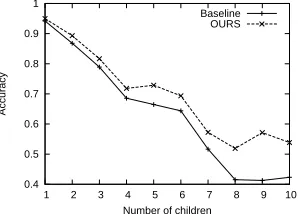
Dependency parsers tend to perform worse on heads which have many children. Here, we studied the ef-fect of DLM-based features for this structure. We calculated the number of children for each head and listed the accuracy changes for different numbers. We compared the MST-DLM1 and MST1 systems on the English data. The accuracy is the percentage of heads having all the correct children.
Figure 5 shows the results for English, where the X-axis represents the number of children, the Y-axis represents the accuracies, OURS refers to MST-DLM1, and Baseline refers to MST1. For example, for heads having two children, Baseline obtained 89.04% accuracy while OURS obtained 89.32%. From the figure, we found that OURS achieved bet-ter performance consistently in all cases and when the larger the number of children became, the more significant the performance improvement was.
0.4 0.5 0.6 0.7 0.8 0.9 1
1 2 3 4 5 6 7 8 9 10
Accuracy
Number of children Baseline
OURS
Figure 5: Improvement relative to numbers of children
8 Related work
Several previous studies related to our work have been conducted.
Koo et al. (2008) used a clustering algorithm to produce word clusters on a large amount of unan-notated data and represented new features based on the clusters for dependency parsing models. Chen et al. (2009) proposed an approach that extracted partial tree structures from a large amount of data and used them as the additional features to im-prove dependency parsing. They approaches were still restricted in a small number of arcs in the graphs. Suzuki et al. (2009) presented a semi-supervised learning approach. They extended a Semi-supervised Structured Conditional Model (SS-SCM)(Suzuki and Isozaki, 2008) to the dependency parsing problem and combined their method with the approach of Koo et al. (2008). In future work, we may consider apply their methods on our parsers to improve further.
Another group of methods are the
co-training/self-training techniques. McClosky et al. (2006) presented a self-training approach for phrase structure parsing. Sagae and Tsujii (2007) used the co-training technique to improve perfor-mance. First, two parsers were used to parse the sentences in unannotated data. Then they selected some sentences which have the same trees produced by those two parsers. They retrained a parser on newly parsed sentences and the original labeled data. We are able to use the output of our systems for co-training/self-training techniques.
9 Conclusion
We have presented an approach to utilizing the de-pendency language model to improve graph-based dependency parsing. We represent new features based on the dependency language model and in-tegrate them in the decoding algorithm directly us-ing beam-search. Our approach enriches the feature representations but without increasing the decoding complexity. When tested on both English and Chi-nese data, our parsers provided very competitive per-formance compared with the best systems on the En-glish data and achieved the best performance on the Chinese data in the literature.
References
[image:8.612.115.264.499.606.2]CoNLL-X. SIGNLL.
Xavier Carreras. 2007. Experiments with a higher-order projective dependency parser. In Proceedings of the
CoNLL Shared Task Session of EMNLP-CoNLL 2007,
pages 957–961, Prague, Czech Republic, June. Asso-ciation for Computational Linguistics.
Eugene Charniak, Don Blaheta, Niyu Ge, Keith Hall, John Hale, and Mark Johnson. 2000. BLLIP 1987-89 WSJ Corpus Release 1, LDC2000T43. Linguistic
Data Consortium.
Wenliang Chen, Daisuke Kawahara, Kiyotaka Uchimoto, Yujie Zhang, and Hitoshi Isahara. 2008. Dependency parsing with short dependency relations in unlabeled data. In Proceedings of IJCNLP 2008.
Wenliang Chen, Jun’ichi Kazama, Kiyotaka Uchimoto, and Kentaro Torisawa. 2009. Improving dependency parsing with subtrees from auto-parsed data. In
Pro-ceedings of EMNLP 2009, pages 570–579, Singapore,
August.
Michael A. Covington. 2001. A dundamental algorithm for dependency parsing. In Proceedings of the 39th
Annual ACM Southeast Conference, pages 95–102.
Koby Crammer and Yoram Singer. 2003. Ultraconser-vative online algorithms for multiclass problems. J.
Mach. Learn. Res., 3:951–991.
J. Eisner. 1996. Three new probabilistic models for de-pendency parsing: An exploration. In Proceedings of
COLING1996, pages 340–345.
Chu-Ren Huang. 2009. Tagged Chinese Gigaword Ver-sion 2.0, LDC2009T14. Linguistic Data Consortium. Terry Koo and Michael Collins. 2010. Efficient
third-order dependency parsers. In Proceedings of ACL
2010, pages 1–11, Uppsala, Sweden, July. Association
for Computational Linguistics.
T. Koo, X. Carreras, and M. Collins. 2008. Simple semi-supervised dependency parsing. In Proceedings
of ACL-08: HLT, Columbus, Ohio, June.
Canasai Kruengkrai, Kiyotaka Uchimoto, Jun’ichi Kazama, Yiou Wang, Kentaro Torisawa, and Hitoshi Isahara. 2009. An error-driven word-character hybrid model for joint Chinese word segmentation and POS tagging. In Proceedings of ACL-IJCNLP2009, pages 513–521, Suntec, Singapore, August. Association for Computational Linguistics.
Mitchell P. Marcus, Beatrice Santorini, and Mary Ann Marcinkiewicz. 1993. Building a large annotated cor-pus of English: the Penn Treebank. Computational
Linguisticss, 19(2):313–330.
D. McClosky, E. Charniak, and M. Johnson. 2006. Reranking and self-training for parser adaptation. In
Proceedings of Coling-ACL, pages 337–344.
R. McDonald and J. Nivre. 2007. Characterizing the errors of data-driven dependency parsing models. In
Proceedings of EMNLP-CoNLL, pages 122–131.
Ryan McDonald and Fernando Pereira. 2006. On-line learning of approximate dependency parsing algo-rithms. In Proceedings of EACL 2006, pages 81–88. Ryan McDonald, Koby Crammer, and Fernando Pereira.
2005. Online large-margin training of dependency parsers. In Proceedings of ACL 2005, pages 91–98. Association for Computational Linguistics.
J. Nivre, J. Hall, and J. Nilsson. 2004. Memory-based dependency parsing. In Proc. of CoNLL 2004, pages 49–56.
J. Nivre, J. Hall, S. K¨ubler, R. McDonald, J. Nilsson, S. Riedel, and D. Yuret. 2007. The CoNLL 2007 shared task on dependency parsing. In Proceedings
of the CoNLL Shared Task Session of EMNLP-CoNLL 2007, pages 915–932.
Adwait Ratnaparkhi. 1996. A maximum entropy model for part-of-speech tagging. In Proceedings of EMNLP
1996, pages 133–142.
K. Sagae and J. Tsujii. 2007. Dependency parsing and domain adaptation with LR models and parser ensem-bles. In Proceedings of the CoNLL Shared Task
Ses-sion of EMNLP-CoNLL 2007, pages 1044–1050.
Libin Shen, Jinxi Xu, and Ralph Weischedel. 2008. A new string-to-dependency machine translation algo-rithm with a target dependency language model. In
Proceedings of ACL-08: HLT, pages 577–585,
Colum-bus, Ohio, June. Association for Computational Lin-guistics.
Jun Suzuki and Hideki Isozaki. 2008. Semi-supervised sequential labeling and segmentation using giga-word scale unlabeled data. In Proceedings of ACL-08: HLT, pages 665–673, Columbus, Ohio, June. Association for Computational Linguistics.
Jun Suzuki, Hideki Isozaki, Xavier Carreras, and Michael Collins. 2009. An empirical study of semi-supervised structured conditional models for dependency parsing. In Proceedings of EMNLP2009, pages 551–560, Sin-gapore, August. Association for Computational Lin-guistics.
Hiroyasu Yamada and Yuji Matsumoto. 2003. Statistical dependency analysis with support vector machines. In
Proceedings of IWPT 2003, pages 195–206.
K. Yu, D. Kawahara, and S. Kurohashi. 2008. Chi-nese dependency parsing with large scale automati-cally constructed case structures. In Proceedings of
Coling 2008, pages 1049–1056, Manchester, UK,
Au-gust.
Y. Zhang and S. Clark. 2008. A tale of two parsers: In-vestigating and combining graph-based and transition-based dependency parsing. In Proceedings of EMNLP
2008, pages 562–571, Honolulu, Hawaii, October.
us-ing a bilus-ingual lexicon. In Proceedings of
ACL-IJCNLP2009, pages 55–63, Suntec, Singapore,
Au-gust. Association for Computational Linguistics. Guangyou Zhou, Jun Zhao, Kang Liu, and Li Cai. 2011.
Exploiting web-derived selectional preference to im-prove statistical dependency parsing. In Proceedings
of ACL-HLT2011, pages 1556–1565, Portland,