A thesis submitted in partial fulfilment of the requirements for the degree of
Master of Engineering at the
University of Canterbury Christchurch
New Zealand
by
ABSTRACT
MULTIOBJECTIVE EVALUATION OF CONSTRUCTION METHODS ALTERNATIVES
Multiobjective evaluation methods are used to analyse alternative construction methods in order to select the construction method which is most appropriate given available resources to achieve or partially achieve technical, economic and social objectives.
A hypothetical project using four alternative methods of construction is evaluated with respect to nine objectives to test whether weighting methods, attribute rating methods and final evaluation procedures are practical for application to choice of construction methods.
The direct weight assessment methods tested are those using ranking and rating weighting. The attribute rating methods tested are use of maximum and minimum values of an objective, anchoring of one extreme objective value and anchoring of two extreme objective values. The final evaluation procedures tested are; weighted summation, weighted summation with elimination and weighted summation with pre-evaluation weights and performance weights.
The results of this work indicate that the use of the multiobjective evaluation procedure with the following steps is practical. The objectives set must have clear definitions and measurement scales. Relative value weights are derived using the ranking procedure.
Comparison of the alternative construction the methods to estimate their achievement objectives. Maximum and minimum values
methods is made by analysing with respect to the decision of an objective are used to transform the objectives' achievement scores into attribute ratings. Weighted summation with pre-evaluation weights and objectives' performance weights is used to select the best method.
ACKNOWLEDGEMENTS
I would especially like to thank my supervisor, Dr David Scott, for the advice I have received throughout this research work.
TABLE OF CONTENTS
Abstract
Acknowledgements
Contents
Chapter 1: Introduction
1.1 The Problem 1.2 Aim of the Work 1.3 Outline of the Work
Chapter 2: Literature Review (Technology Choice)
2.1 General
2.2 The Need For Change 2.3 Choice Options
2.4 Work Done On Technological Choice 2.5 The Need for Evaluation
Chapter 3: Evaluation Concept
3.1 The Construction Project (Overview) 3.2 Conceptual Framework For Evaluation 3.3 Evaluation
Chapter
4:
Evaluation Methods Review 4.1 Introduction4.2 Multiobjective Decision Theory 4.3 Multiobjective Procedure
4.4 Examples of Multiobjective Methods 4.5 Decision By Elimination (Exclusion) 4.6 Summary and Discussion
Chapter 5: Rapid Rural Appraisal Methods
5 .1 5.2 5.3 5.4 5.5 5.6
A Review Of an Information Gathering Technique
Introduction.
The Problem (of Information Gathering Techniques) Rapid Rural Appraisal (RRA)
RRA Principles
RRA Methods, Tools and Techniques
Considerations and Areas of Application
Chapter 6:
Evaluation Procedure
54
6.1 General
54
6.2
Project Attributes (Definition)54
6.3 Weighting (Importance) 55
6.4 Alternatives (Options) 56
6.5 Performance Scores 57
6.6
Attribute Performance Ratings 576.7 Evaluation Procedures for Determining the
Alternatives Total Relative Worth 58
6.8 Summary 60
Chapter 7:
Procedure Analysis
617.1 Introduction 61
7.2 Choice Analysis 61
7.3 Analysis of Influence of Outcomes on Importance 63
7.4 Approaches 66
7.5 Possible Practical Approaches 67
7.6 Calculation of Relative Importance 68
7.7 Summary 74
Chapter 8:
Application (The Derivation of Performance Scores)
758.1 The Project Investigated 75
8.2 Description Of The Work 75
8.3 Construction Methods Options 76
8.4 Productivity of Factor Inputs 78
8.5 Duration of the Work 80
8.6 Cost of Input Factors 82
8.7 Discussion of Input Data 87
8.8 Summary 90
Chapter 9:
Presentation and Discussion of Results
919.1 General 91
9.2 Objectives 91
9.3 Weighting Methods 94
9.4 Performance Scores 96
9.5 Attribute Performance Ratings 97
9.6 Alternatives Total Worth 101
Chapter 10: Conclusions and Recommendations for Further Study 109
10.1 Conclusion 109
10.2 Recommendations for Further Study 112
10.3 General Conclusion 113
References Bibliography Appendix 1
Work Content
Productivity of Inputs in Road Construction Per Task Unit Cost Estimates
Inputs in Road Construction Per Task Appendix 2
Objectives Description
114
117
118
118 119 123 124 130
1,1 THE PROBLEM
Lack of adequate infrastructure development and maintenance is a major constraint on most economic activities required to overcome many problems of development. This means that constructiori services required to provide the infrastructure play a very important part in any development process.
Due to the desire to bring developing countries have providing the infrastructure. industry has been operating
about fast national development, most already made considerable progress in However, in most cases, the construction in a framework transferred from the industrialised Countries. The transferred construction technology has not taken into account the technical and socio-economic conditions of the countries to which it is transferred. In some instances, it has been felt that the construction industry did not effectively utilise resources, particularly the abundant and relatively cheap labour resource. This is evidenced by problems and difficulties in construction implementation. Consequently ways and means have to be considered to overcome these problems and get maximum benefits from the available resources and enable the construction services to serve more of the development needs.
1.1.1
ConstructionMethods
development of viable labour based and intermediate construction methods based on technical and price comparisons.
1,1,2 Development Needs - Multiple Objectives
Previously, ideas of technical change in developing countries have involved the introduction of new "superior" systems and organisations to replace "ineffective" existing ones. The technical changes were based on engineering efficiency (defined mainly from the point of view of industrialised countries) without considering the socio-economic factors unique to the developing countries. Recently most development agencies have come to view development, especially rural development, as a process whereby the total (rural) system is to be taken into account. This is achieved by understanding the nature of the (rural) development problems, existing social technical structures and the beneficiaries of the development.
Sustained development and growth (the major development goal) can only emanate from local development. In the investigation of viable construction methods, it becomes necessary to take into account that the need for appropriate construction methods is brought about by the overall development need. All
construction projects) should objectives to enable sustainable
development activities (including relate to appropriate development development and growth. Typically construction projects take up
expenditure which could be used
a high percentage of development for both technical efficiency and for improvements in social and
is therefore in itself
economic welfare. multiobjective and
The construction project the development of the construction methods should be oriented to multiple objectives.
Examples of objectives employment, development dependence on foreign income.
include; minimisation of human resources imports and a more
of cost, generation of through training, less equitable distribution of
1.2 THE AIM OF THE WORK
This work concentrates on the multiobjective aspect of the development and choice of construction methods. In particular road construction methods are considered. Due
commit resources to a project evaluations to be done prior
to scarcity of resources, decisions to require feasibility studies and economic to decisions being made. Consequently consistent project evaluation methods have been developed to assist choice between many proposed schemes. This work will aim to validate available methods of project evaluation as suitable and effective decision making methods for the construction industry and in particular for the choice of construction methods.
1.3 OUTLINE OF THE WORK
1.3.1
The first part of this work (Chapter3) develops the conceptual framework for evaluation., The conceptual framework gives an understanding of the basic components that describe construction technology, what needs to be evaluated and what can be evaluated. The following are some of the considerations that make a conceptual evaluation framework necessary.
1 The multiple objectives being conflict, e.g. minimisation of of employment.
considered may sometimes be in cost may conflict with maximisation
2 The scarcity of resources may also limit the objectives that might be considered.
3 The accuracy and reliability of any data input necessary for an evaluation must be defined. The development of a conceptual evaluation framework is necessary to help determine the suitability of potential evaluation methods.
1.3.2
The possibilities of using the evaluation methods and difficulties that may be encountered in implementing such methods are investigated in Chapters 4 & 5.
1.3.3
From the review of evaluation methods, an evaluation procedure is proposed in Chapter 6.
1.3.4
CHAPTER 2
LITERATURE REVIEW - TECHNOLOGY CHOICE
2.1 GENERAL
The importance of technology choice in Developing Countries (DCs) is a subject that has received a great deal of interest in recent years due to problems and difficulties of construction encountered. Subsequently a substantial amount of work on the subject has been done and is thus a subject of considerable literature.
Due to the desire to bring about development as quickly as possible, the construction sector in DCs have had to operate in a transferred framework from industrialised countries. This has led to many constraints and a hold back in the development of the domestic sector. Thus the search for successful construction technology, imported, adapted or developed, given the wide range of technologies available has received considerable attention. International Development Agencies like the !LO, IBRD and the World Bank plus both academic and engineering concerns have all contributed to the study of the problem of technology choice. Some of the work done in this field is briefly reviewed below. From this review, an indication of where this work fits in will be described.
2.2 THE NEED FOR CHANGE
Basically to apply a technology which is appropriate for a particular project given its requirements, conditions and circumstances is an undisputed engineering principle. In the industrialised countries (!Cs) the technology choice is one of choosing from among a set of feasible alternatives given a proven developed construction sector (though not just as simply stated). In the DCs given the existing socio-economic environment and problems in the developing construction industry, the feasible set is itself an issue. A number of reasons or forces on the need for an appropriate technology choice especially in the context of
2,2,1 Employment
Employment is by far the major force on the need for appropriate technologies. Most of the DC's are what can be termed as labour surplus countries as evidenced by high unemployment and underemployment. The construction industry in most DC's is a near carbon copy of IC's and thus based on assumptions of machine based methods. Though supposedly with an oversupply of labour, studies show that employment in construction per 1000 population in DC's is much lower than in IC's.
(ILO). The productivity and skill of the labour (underemployment) is also low. Thus there is a need to increase employment and skills for locals. (EDMONDS 1984) Construction being technologically flexible and the high unemployment has lead to a growing appreciation of the potential role of the industry in helping alleviate unemployment. (WORLD BANK 1983) Thus the need for employment generation, equitable income distribution and social welfare has been a driving force at a search for labour based methods. This has been as due to the fact that the activities of construction are to a great extent especially so in DC's controlled by the central governments.
2,2,2 The Planning Process
Most construction projects are growth related (e.g. roads) to develop the necessary infrastructure. The planning process has usually emphasised the output objectives a great deal with little or simplified input on technological details. Thus most development plans usually describe the expected outputs e.g. kilometres of road without the attention to the inputs required to produce the outputs. Failure to achieve planned targets with increasing gaps between expectations and achievements has resulted in a desire to find solutions to constraints affecting the industry and practical measures (the technological choice) to enable it to meet the demands placed on it. (BHALLA 1983, EDMONDS 1984) The solution is not more money especially with a growing debt situation but a reorganisation of the use of available construction resources. Thus in the DC's
like the World Bank, a shift in
with the influence of lending-.agencies emphasis to the study of technological details is being recommended. To some extent the planning process aims
~~
2,2,3 Economic Growth
The creation of fixed assets or capital by construction enable other economic activities to take place. Thus construction is used by governments as a regulator for promoting or suppressing economic growth. (WB 1983) The construction industry in DC's is patterned after the one in IC's which does not necessarily mean
developing country. The differences in resulted in many problems to overcome
it is the most suited to the operating environments have in order to implement the construction programmes. Thus the need for a better framework for construction.
2,2,4 Balance of Trade (Foreign Exchange}
The construction industry has a significant contribution to the economic balance of trade by importation and exportation of plant, materials and services. In IC's, the balance of trade is usually in their favour. The capital used in DC's in most cases is usually imported. Construction equipment accounts for a big percentage of all imported equipment in DC's with the amounts growing every year. 'The need to alleviate the trade imbalance by more use of locally available resources has lead to a rethink on construction technology. (WB 1983)
2,2,5 Development of Local Construction Sector
The desire for fast development has meant a dependence on foreign based and owned contractors. With increasing foreign controlled costs and no developed local industry, there has been a requirement for strengthening local industry development. This can only be done by strengthening of or adaptive change on existing structures as opposed to increased spending on imports while guiding local contractors. Activities at which local contractors are good, e.g. rural road construction, are shift in emphasis from given priority over large scale projects.
expensive trunk roads, which already have extent, to minor roads and maintenance has appropriate technology. (WB1983)
A
been also
technological transfers which mean wholesale transfer of technology developed elsewhere. DC's have gone for sophisticated equipment in the earnest belief that this would result in technological transformation (transfer of technology). In actual practice, due to the socio-economic environment, operational and management techniques and technical skills have proved that imported technologies are not necessarily good. (EDMONDS 1984, GUPTA 1981)
2.2,6 The Local Construction Industry
By nature of contracting, whereby continuity of work is not assured and too many contractors are chasing too few jobs, insistence on too much equipment results in underutilisation and by implication a surplus of imported machinery. Thus a tendency to more labour based methods. (EDMONDS 1981) Insistence on equipment as indispensable, results in a diversity of makes and types. Inadequate maintenance facilities and the resultant short life make some equipment inappropriate. Investing in equipment with insufficient foreign exchange to meet running costs makes little sense. (UEZE-UZOMAKA 1981) Given the level of sophistication of local contractors, both technically and financially, methods employed elsewhere may not be appropriate. (WORLD BANK 1983)
The above points show the necessity to look for options to make the construction sector meet more of the needs of their countries.
2,3 CHOICE OPTIONS
2,3,1 Contractual Framework
Though described as a conservative industry, (SCOTT 1983) especially in the IC's, the contractual procedures are developed, modified and improved in relation to the emerging needs of the industry itself and the change in social and economic circumstances. The contractual framework in most DC's can best be described as undefined with attempted similarities to foreign systems. The transferred approach (well proven in their home environment) and modelled after foreign needs has few concessions to local customs, experience and needs.
The compartmentalization of construction procedures, i.e. the responsibilities for design and construction, inhibit the technical and management innovation. (EDMONDS 1984) Thus though perfect in the IC's setting with capable contractors, limitations in resources in DC's mean that compartmentalization tends to slow down projects. Experience that compartmentalization should not be so rigid tend to enable chances for innovation, Such practices as labour only contracts and contract supervision aimed at training and helping local contractors means that engineers have a chance to implement innovative construction methods.
2,3,2 Standards and Specifications
2.3.3 Execution
The structure for execution of contracts can be divided into large contractors, medium contractors and small contractors. The large contractors usually are of three types i.e. international contractors, joint ventures and local contractors usually working on large contracts. The large contractors operating in a competitive market with a high demand for skills have a vested interest in restricting membership and are therefore resistant to change. Also as most are multinational, they operate as those in IC's with an emphasis on labour saving. (WB 1983, EDMONDS 1984) Small contractors are a difficult group to define and are usually not associated with continuous ventures due to the easy entry-easy exit nature of construction. The technical and managerial experience of most small contractors is limited and soi~ their tendency to innovate. (AUSTEN 1980) Their relatively small sizes and usually informal company structures, make it difficult for them to obtain the necessary resources for the pursuit of technological change and it may not give them much market power over the others. However viewed in the context of a national construction industry, development and attempts in most DC's to promote technological development, can be a preoccupation of government agencies. (WB1983)
In execution the biggest option for change is in the medium-sized ethnic contracting and government direct labour units. These are usually adequately managed; most with professional staff. Their sizes make their commitment to construction long term and they can gain most advantage from construction innovation.
2,3,4 Financing
The source of finance is also a major determinant of technology. Some of the financial sources common in DC's and their scope for innovation
World Bank and Regional Development Banks In recent years they have had an interest in the development of local contracting sectors with the insistence on appropriate technology especially for rural roads.
Local financing With pressing needs and shortage of resources especially for projects that do not attract foreign donors, it offers the best opportunity for innovation. Longer durations associated with such labour based methods and thus spreading of payments over a longer period ensure that financing can be more favourable to the clients. In fact when considered on bid present value, the late payments are a reduction in cost. (PERRY 1981)
2,3,5 Labour
In many instances, appropriate technology infers making more use of labour based methods. However, though not all road construction activities can be executed economically using labour based methods, the methods are viable for a wider range of activities than presently used. There has been a reluctance to discriminate between labour based methods and plain inefficiency. Overmanning inefficiencies have given rise to a feeling that labour based methods are by nature inefficient. (EDMONDS 1981) The other problem is assumed cheap labour availability especially in the rural areas given the high unemployment. Planning is much more difficult when the casual nature of employment and seasonal variations make construction seem not a lucrative employment but a transition to other jobs.
2,3,6 Machinery
Machinery usage presents a significant scope for innovation viewed in the context of the capabilities of the industry and resource endowment. Most of the machinery is imported. There is a diversity of types and makes of machinery found in construction sites, with attendant operating and maintenance difficulties, coupled with skill requirements. The productivity of this equipment is sometimes as low as ten percent of the maximum quoted by the manufacturer. In cases it has been noted that management of machines is harder than labour management. (McCUTCHEON
1980)
Given the high cost of machinery and scarcity of work per contractor, establishment of rental agencies, preferably government sponsored contractor development agencies, would provide a pool of equipment. The type of equipment purchased should be viewed critically vis a vis their performance and initial and operating costs. Quasistandardisation would also facilitate establishment of adequate spare parts, servicing facilities and operator
Ideally given the overall
and mechanical training. (EDMONDS 1984) objectives of appropriate technology, cheap machinery accommodating substantially more labour as well as requiring less skill, should be the aim.
2.3.7 The Role of the Government
The majority of the jobs done have government bodies as clients. The government also has regulatory control over the private jobs through control of labour relations and general trade. Thus government policies are able to provide sufficient effect on the choice of technology. Given the importance of appropriate technology and the wide range of options available, the major need is to overcome the obstacles in implementing them.
2,4 WORK DONE ON TECHNOLOGICAL CHOICE
2,4,1 Viability
Emphasis on appropriate technology stems mostly from the fact that methods used in DC's are inappropriately capital intensive and that labour based methods could be used effectively and efficiently. There is also the fact that labour based methods are useful alternatives in labour creation, with distributional and poverty alleviation objectives. Consequently, a lot of literature has been concerned with the establishment of the technical and economical viability of these methods. (EDMONDS 1981) That is trying to establish a set of feasible techniques from which to choose. The studies have investigated most areas of civil engineering, including roads, buildings and irrigation
projects, (e.g. KRISHNAN 1983). Some significant conclusions can be drawn from these studies.
Labour can be used to a great extent while still compatible with technical and economic efficiency. There exists a range of technically and economically feasible methods varying from the most labour intensive through intermediate techniques to the most equipment intensive depending on the project circumstances. Traditional labour intensive civil works are inefficient and economically inferior to capital intensive works except at extremely low wage levels. This is generally because tools, equipment, techniques and organisation are invariably inefficient. For labour based methods to succeed, better management as applied to capital intensive work is required. (HOWE 1980) Thus there is a general consensus that in most cases a choice among methods does exist, However studies of the institutional framework in which these methods are to be implemented find that implementation of labour based methods is not very common. (SCOTT 1983) This has been in part due to constraints and a number of studies have been directed at an effort to remove these constraints.
2,4,2 Managerial and Organisation Structure
the World bank and governments which have labour based methods. A number of studies have also been done on the subject of the construction industry in relation to managerial practices. (WB 1983)
2.4.3
ToolsFor labour based methods, the main means of production are the tools and light equipment used by the workers. The use of traditional tools is a major cause of inefficiency. Well designed hand tools can significantly increase the productivity of workers while at the same time making the work less arduous. A number of designs and improvements to traditional tools have been proposed. For major government programmes, tendering for the supply of hand tools by design specifications has been proposed and tried. As an example the wheelbarrow; one of the most useful pieces of equipment for haulage. Experimentation has produced a number of designs from the traditional handcart to conventional wheelbarrows. (HOWE 1980)
2.4,4
MachineryIt is granted that labour is not efficient in all construction purposes, e.g. road construction compaction and long distance hauling. Development and adaptation of machinery to supplement labour based method has received considerable interest. (HOWE 1980, GUPTA 1981) Application of appropriate machinery is a major part of methods
innovation. Appropriate technology should be aimed at choosing labour-machinery mixes to satisfy project requirements. However, most machinery is imported, and in some cases may not be appropriate. There is a considerable need to improve existing methods and efficiency.
considerable success. Experiments have implements like bullock carts usually traditional modes. Experimental work of
been made with animal drawn with improvements to the ILO has shown, that under the right conditions, animals can be a most appropriate source of power for haulage in road construction. (HOWE
&
BARWELL 1980) Although studies and soundly based ideas have shown the potential for improved machinery technology, the implementation of development and testing has been slow. Where implemented they have especially improved construction efficiency.2,4,5 Contractual Procedures
A lot of work has been done to study the construction process in DC's. (WB 1983) This has usually been done within the framework of the adopted foreign standards. The studies show that mostly no concessions are made to the different national objectives, physical and socio-economic operating environment or construction industry development needs. Despite the studies, only limited attempts have been made to modify contract procedures to suit local conditions.
2,4,6 Specifications
Some work has on the construction of especially in
While there
been DC's
done
where appropriate technology
cheap rural roads is most applicable. have been suggestions
standards, despite the studies, specifications is applied.
2,4,7 Classification of Contractors
made, for very little
example of the
in compaction ingenuity in
2.4.8 Engineers
Although there is an availability common. Engineers' decisions on biased in favour of equipment.
of methods, their use is not very the labour-equipment ratio are usually This is due to education and training and engineers would not benefit from making proposals which imply delayed execution or slower than anticipated progress while exploring alternative techniques. (KADEN 1981) With increased experience of labour based methods and the shortcomings of other methods, the question of appropriate technology divorced from labour creation objectives is becoming more favourable. Seminars and workshops on technology choice have served to provide a good education for engineers.
2.4.9 Private Contractors
The implementation of appropriate methods to private contractors in the long run.
should prove to be profitable A great deal depends on education of the private sector which might require government suggested to help implement intervention. Some measures have been
appropriate methods, These include:
Surcharge Increase in cost if the use of local methods should be preferred e.g. labour based methods are
cost is up to 10 percent more than already exists in World Bank sponsored advantage is given to local contractors.
Increased tariffs on imported equipment.
acceptable if the increase in equipment based methods. This projects where a 7.5 percent
Adjustment of the market rate of interest. Low interest rates imposed by governments in some cases, given high inflation rates· imply a negative real interest on loans and thus equipment and adoption of capital intensive technologies become more attractive.
2.4.10 Economics of Capital/Labour Substitution
distortions to explain technology choice. Thus with the assumption that market prices are a poor guide to resource allocation, shadow costs have been used in evaluating the real social cost of employing resources, especially labour. However desirable, the concept of productive efficiency should not be the sole basis for technological choice. Some methods which are inefficient under normal economic criteria may be regarded as socially desirable preferences. (BHALLA 1983) An evaluation of technology choice should consider trade-offs between the various objectives.
2.4.11 Case Studies
The ILO, IBRD, World Bank and other authorities in this field have made a number of case studies. These have ranged from simple projects to comprehensive studies of the whole industry. The case studies, though not reviewed separately here, have in many cases formed the basis for the arguments developed for the choice of construction methods reviewed elsewhere above.
2.5
THE NEED FOR EVALUATIONThe concept of appropriate technology implies a satisfactory engineering solution which accords with the capabilities of a society. The underlying philosophy and motivation is the ability to solve problems in a way that fits cultures and resources. Appropriate technology does not specify particular levels of technology e.g. labour based, but rather that a technological problem i-t should be critically analysed and a solution that takes full recognition of the peculiarities of the situation should be evolved. (NILSON 1981) Most authors in the literature reviewed suggest the desirability of adopting a more rational framework for the choice process of the best method to be used. This framework suggests stronger capabilities for evaluating and selecting from alternative technologies. The authors also agree that there is scope to remove the constraints hindering the development of the construction industry and the consensus is that any decision should be based on objective criteria. The transition from indiscriminate choices, usually made on assumptions, to a more realistic multi-objective framework, which incorporate realistic trade-offs before the f
the multiplicity of objectives. decision models can help.
There are a number of areas where
2,5,1 Information and Understanding
Given the complexity and general evaluation will help towards a
lack of understanding of the problem, proper solution. It is not always appropriate to pump in more money or call for a labour intensive programme if such a choice is not compatible with the conditions and economy of the particular situation, Management by trial and error, using solutions developed elsewhere, tend to lead to failure leaving countries in a situation where there is an increasing deficit.
Any effort to even marginally improve understanding of how more or less technology is chosen is bound to have a high payoff. The evaluation framework would add understanding to the factors affecting technology generation and help to identify areas in which understanding is particularly weak or the potential for policy intervention is particularly good. A decision model will also help to identify the potential benefits, risks and liabilities based on the technical requirements and attributes of the methods. The areas identified may just call for simple changes that can increase the benefits.
Evaluation will also serve as a measurement tool for construction methods and a way to systematically analyse and plan for specific construction operations.
CHAPTER 3
EVALUATION CONCEPT
The previous chapter outlined research done on the construction industry and the need for evaluation. This chapter develops the evaluation concept.
3.1 THE CONSTRUCTION PROJECT (Overview)
To evaluate construction techniques, it is necessary to understand the basic components that describe construction technology. By identifying the basic variables or components that describe construction technology and their relationships it is possible to develop an evaluation framework for technology choice.
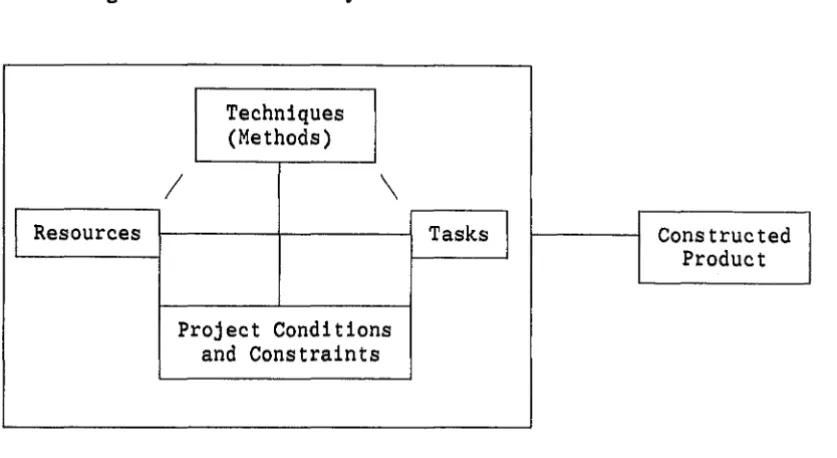
Construction technology can be described as a system which is a combination of tasks, resources, conditions and methods that produce the constructed product. These components all act in relation to the project environment to constitute the
components can further be broken down 1988)
Fig 3.1 Construction system
Techniques
(Methods)
I
\
finished product. (Fig 3.1). The into different elements. (TATUM
I
Resources
Tasks
I
Constructed
Product
[image:25.598.90.509.500.729.2]3,1,1 Tasks
These are the activities that must be performed in construction operations, e.g. earthworks. Though the tasks are important in determining technology, they are basically the same for any method used.
3,1,2 Resources
Essentially the most important of the components that determine the project and the source of major construction problems in DC's. Resources can be subdivided to two major components
viz:-i) materials or permanent work resources and ii) construction applied resources.
3,1,2,1 Materials
Materials quantities and other permanent works define the scope of the project. Consequently they have important implications for construction methods and provide restraints for construction operations, (e.g. placing hot asphalt). As observed in the literature search, materials also offer a great scope for innovation in construction. However, research on the use of different materials is not yet fully developed or accepted.
3,1,2,2 Construction Applied Resources
Applied resources are additions to materials to produce the constructed product.
the
The applied resources are the most important, of the construction especially in roadworks, in the determination
methods. They contain several elements which are types of resources. Among these
are:-People
Often a keyconstruction operations.
Equipment - Machinery and Tools The type, cost and availability is used to define construction methods, e.g. capital intensive.
Money and Time - Usually the fundamental resources in delivering the project in the time required to complete construction with the amount of funds available.
3.1.3 Construction Methods
Construction methods define the way in which applied resources transform materials into the constructed product. These are by far the major focus of technology choice through methods improvement, innovation and productivity increase.
3.1.4 Project Conditions
Project requirements and constraints differ drastically among projects. They are the source of each project's uniqueness and thus a major determinant of the method chosen. Of the available construction alternatives, only a limited number may fit within the project conditions for use on the specific project. Many influences form the project conditions and constraints.
capabilities, practices and the
Among these are project objectives, resources available in the area, regulatory policies, climatic and physical conditions and.overall socio-economic environment. The socio-socio-economic environment is conditioned by
the general structure and state of the economy, political organisation and the traditions affecting the manner in which business is carried out. (WORLD BANK 1983)
3.1.5 Evaluation
The above components, which are linked and interrelated, describe the total construction technology. However, though the major aim of this thesis is methods choice, all the other components act to influence that choice and are thus considered in the evaluation system.
3,2 CONCEPTUAL FRAMEWORK FOR EVALUATION
Fortunately for construction, a wide range of factor combinations can be used to suit each finished product. Normally selecting the most appropriate alternative is done by relying on experience and intuition. Compared to other types of economic activities construction work involves the risky allocation of resources under very uncertain conditions. (WORLD BANK 1983). With each project being unique, the organisation of logistics and technical inputs have to be determined for each project. The addition of multi-objectives to the project i.e. socio-economic and construction goals, requires a rational framework for making decisions. The aim of this work is the formulation of an evaluation framework within which the major factors that influence the methods can be analysed. The analysis of alternatives will determine the most effective way of achieving the multi-objectives and their impacts as viewed by decision makers. It should be noted that it is not a substitute for experience. Rather, it provides a rational framework to capture experience and test intuition. The preferred alternative is given confidence by evaluation
alternatives. The evaluation
when compared method will
to the outcomes of other act as a decision model portraying the interaction of the different objectives.
3,2,1 Evaluation Framework
The first step in modelling the evaluation framework is the development of alternatives. This is determined by the work categories required. For every work category,
are to be determined are earthworks.
general alternatives generated. Fig
from which the outcomes 3.2 shows an example for
Fig. 3,2 Alternatives for earthworks
ACTIVITY ALTERNATIVES
Earthworks Excavation, transportation, spreading by man
Excavation and loading by man, hauling by trailer, spreading by man
Excavation and loading by machine, hauling by trucks
[image:28.603.107.526.622.733.2]Analysing each and every alternative until their values are known is not viable as usually the resources and time to perform this analysis is not available.
A specific situation is required to fine tune the alternatives. The first alternatives may help in identifying what sort of problems may be expected and what data is to be collected.
3.2.2 Method Choice
Project characteristics provide a critical constraint on method choice. Availability of methods as feasible options does not necessarily mean that they are viable. There is a need to determine the major factors affecting the specific project viability and their possible effects both qualitative and quantitative. Consequently by taking into account the logistical and technical inputs of the project, their influences and outcomes, it is possible to have a definite choice of two or three viable alternatives. The following inputs are required.
3.2.2.1 Size and Location of the Project
Viewed in terms of resource mobilisation and availability at location.
3.2.2,2 Local Conditions
Climatic, geographical and geological conditions greatly influence the method choice especially for roadworks. Climatic conditions influence the working sequence and the number of unworkable days due to rainfall. They are also an influence on working hours as qeveloped by local custom. As most materials are won on or around the worksite geographical and geological conditions influence the work. The terrain often influences the volume of earthworks required and places limitations on the work ability of both men and machines.
3.2.2.3 Labour
are proved wrong may make some labour based alternatives unattractive. The logistics for importing manual labour from other areas including
transportation and housing may be forbidding.
3,2,2,4 Equipment
Availability, productivity and costs are affected by numerous factors including terrain, type of work, availability of skilled operators and servicing facilities.
3,2,2,5 Political Policies
Government policies and regulations in force at the time.
3,2,2,6 Interest Rates
Interest rates determine the cost of capital goods.
3,2,2,7 Currency Exchange Rates
Currency exchange rates for imported inputs.
3,2,3 Alternatives
With the determination of the inputs, constraints and problems both logistical and technical, it is possible to come up with two or more alternatives that can be employed to fulfil the project requirements. Apart from the technical inputs which are covered by the design, most of
3,3 EVALUATION
3,3,1 Aim
The major aim of this evaluation is to determine the project's total worth as viewed by decision maker~. As noted earlier, construction, especially in DC's, may be used to fulfil multiple objectives. Thus there is a need to determine whether the frequently called for·solutions are effective in satisfying the desired objectives in the best way, e.g. labour based methods to alleviate unemployment and to develop the local construction industry. The following are some of the major issues that arise in an evaluation method.
i) How to compare different objectives which have different values both qualitative and quantitative.
ii) When compared to measures of effectiveness like cost-time, can the other measures be analysed at a comparable level. iii) The nature and intensiveness of the evaluation.
To solve these issues, developed evaluation methods are investigated for suitability. The methods are discussed in the next chapters.
3,3,2
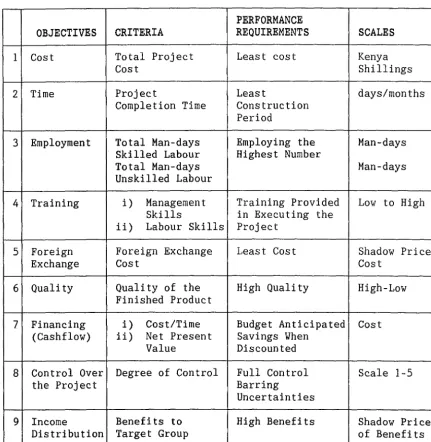
Proposed Objectives (Decision Criteria)To use an evaluation method to assess alternatives it is necessary to develop the objectives or decision criteria. The list of objectives should be developed based on experience and giving adequate allowances for regional policy assumptions and local considerations. Thus the objectives may be different depending on the project nature and the environment. The following objectives are chosen as the decision criteria for this work. The objectives are definitely not exhaustive but were chosen to reflect both universal project objectives and objectives of particular concern to less industrialised countries.
3,3,2,1
Cost3,3,2,2 Time
Alternative methods differ in the time required to complete construction. Time is also important in relation to coordination with other activities. Even where a specified completion time is not rated too highly, the coordination of all activities must be taken into account.
3,3,2,3 Finance
Cost and time perhaps play the the most important role in financing the project. As most projects are financed by government agencies, payments to contractors are subject to government cashflows and mostly budget anticipated. To ensure smooth uninterrupted output, it is best to programme cash flows to a level that is probable given the source of finance. Also as noted earlier, barring cost escalation, payment over a long period is a saving, especially for multi year contracts, when considered on a net present value.
3,3,2,4 Employment
Due to the ability to vary factor inputs, construction can be used to provide gainful employment to alleviate unemployment. This has been a major force in the use of more labour based methods. However, to rate employment in any evaluation, some considerations have to be taken into account.
i) Type of employment
As much of the demand is often met by taking unskilled labour from rural areas, will the employment adjust to the labour needs of agriculture, especially in planting and harvesting seasons and other economic activities (WORLD BANK 1983).
ii) Intersectoral linkages
3,2,2,5 Retain Foreign Exchange Within the Country
Lack of external currency and the need for facilities requires the use of resources within the country. However specific situations must be individually evaluated. Foreign exchange for items such as spare parts is vital if maximum use is to be made of already available plant.
3,3,2,6 Quality
If a choice of materials is included in the choice of techniques, the available options are far wider than if the materials are constant. Assuming the materials
choice is the finished
are constant, quality. The
the important aspect of method quality differs for different alternatives within limits for the same material depending on limitations or capacities of input, plant or labour. The rating of quality as an objective differs, especially for rural roads where the major issue is providing effective facilities where they are non-existent or inefficient.
3,3,2,7 Income Distribution
Economic distribution between regions of the country and among the population is a major objective of the political process. In construction methods, the distribution objective can be achieved through employment and entrepreneurship, As in employment it has been noted that mechanised methods tend to be associated with relatively high wages while labour intensive techniques generate low incomes among those that they employ. (STEWART 1983) Also depending on socio-economic conditions like opportunity cost of labour, local patterns of income use and consumer goods capacity, labour payments may enhance the internal market or cause an inflationary process over the economy of the low income sector that it aims to help. The distributional objective has to be viewed in the context of the particular region.
3,3,2,8 Training (Technology Transfer)
hindrance to the development of a local contracting industry. (EDMONDS, WORLD BANK 1983) With the increased costs of foreign contractors it is necessary to increase the capabilities of the local construction industry by improvement of the human resources through training. Any alternative should be considered in the context of training for more demanding jobs. The training should be viewed in the wider scope of industry development.
3.3.2,9 Control over the Project
This is considered given the organisational capabilities of the implementing agency. This occurs over both extremes of methods considered i.e. labour intensive and
large project, a large labour
capital force
intensive methods. For a
organisational control in order to Alternatively where projects are awarded
may ensure
require effective
considerable production. to big foreign consultants and contractors the local body may not be able to control or even understand it.
3.3.3 Summary
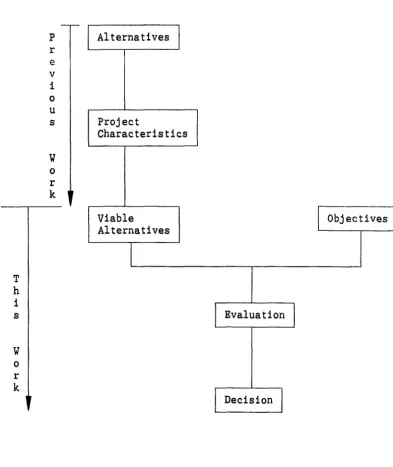
As noted earlier, although these objectives are not exhaustive, they allow generalisation in the context of this work. The major aim is to investigate the viability of evaluation methods for construction technology. Through the evaluation, an attempt will be made to portray the factors that bring about methods choice and their potential impacts. The values will be selected for general applicability over a range of project conditions. Figure 3.3 shows the flow diagram for the evaluation model. The previous work done has dealt with the development of viable alternatives using price information. This work concentrates on the validation of evaluation methods for practical application; an evaluation framework from which an alternative can be selected from a set of viable alternatives.
T
h i
s
w
0 r
k
p r
e
v i 0 u s
w
0
r k
Fig. 3.3 Flow diagram for evaluation model
Alternatives
Project
Characteristics
Viable Objectives
Alternatives
Evaluation
[image:35.600.102.495.107.574.2]CHAPTER 4
EVALUATION METHODS REVIEW
4.1 INTRODUCTION
The major aim of this work is to investigate existing methods of project evaluation, to test their validity and evaluate their suitability and effectiveness as decision making methods for the construction industry. Following from this a suitable procedure for evaluating construction projects with respect to technical and social economic objectives will be formulated and tested. In particular, selection of the most appropriate construction method will be considered. The method will be designed to:
1 Determine and evaluate the effects of using a particular method. 2 Rank the project attributes being considered in terms of their
relative importance.
3 Set out procedures for evaluation of the performance of individual project options with respect to the attributes being considered. The method should be able to define:
1 The relationships among the objectives in describing the problem and as the decision variables.
2 The treatment of constraints on establishing the resource limits. 3 The method of ranking and selecting the alternative construction
methods.
In addition to the above, the following should be considered: 1 The ease of use of the designed method by the users.
2 The practicability and reliability of the method for decision making.
4,2 METHODS REVIEW
4,2,1
Multiobjective Decision Theory
complexity of decision making, it has become evident that the overall performance of an alternative is not dependent on a single criterion but on a variety of criteria. This has given rise to multiobjective decision theories which aim to efficiently satisfy the multiple objectives and their consequences. The alternative chosen is that which best satisfies the multiple objectives.
As noted previously, (chapters 2 and 3) the planning and management of the allocation of resources in construction is almost, or should be, always multiobjective in scope. The major interests in the multi-objective approach, especially in resource allocation, are:
1 Providing decision makers with consistent and simple ways of sorting alternatives (projects) which have a significant proportion of unquantifiable costs and benefits. (SCOTT 1987) This is achieved by widening the range of objectives considered beyond those that are easily expressed in terms of money.
2 Fostering the explicit quantification of trade-offs among the different objectives. (COHON
&
MARKS 1975)3 Helping to make value judgements in a rational and consistent way by providing sufficient information so that an informed decision can be made. (COHON & MARKS 1975)
Basically the multiobjective decision methods should be able to provide sufficient information for making decisions and the reasons for accepting them. The problem should be appropriately structured with objectives which are appropriate to the decision situation. The multiobjective methods help the conscious application of a systematic decision making process.
4,3 PROCEDURE
The multiobjective procedure can be considered as having three main parts, (D'AVIGNON 1986, SCOTT 1987)
4,3,1 Problem Definition
4.3.1.1 Definition of the goals, objectives or purpose which the system is to fulfil
The goal, usually in the form of a basic statement helps keep the general problem in mind. The establishment or selection of objectives define the way in which the general goal is to be pursued.
4.3.1.2 Formulation of performance criteria
The performance criteria allow an assessment of the degree of realisation of the objectives. Ideally the criteria should be one dimensional with respect to the objective i.e. it should delimit one single aspect of the objective and should be measurable. It should allow the ordering of the different attainable levels as an objective. However, being measurable does not mean being quantifiable. (D'AVIGNON 1986) Measurement levels such as bad or best can be used.
4.3.1.3 Alternatives
The set of alternatives to be evaluated has to be identified, specified or developed. The set of alternatives can be described basically as either;
(a) a number of specific alternatives such as a list of projects to be appraised, or
(b) a set of alternatives characterised by variables modelled to meet the objectives such as a set of construction methods
ranging from capital based to labour based methods.
The performance of the alternatives in terms of the different objectives is usually the context of the decision.
4.3.2 Evaluation
The second stage is the evaluation process. Each alternative is specifically assessed in terms of the objective's criteria. This results in alternative versus criteria combinations i.e. the performance of alternatives for each particular objective. The aim of the appraisal is to determine the achievement of each alternative in terms of the multiple objectives. To evaluate
statistical and technical data may be used.
have to be comparable i.e. comparable the different objectives does not
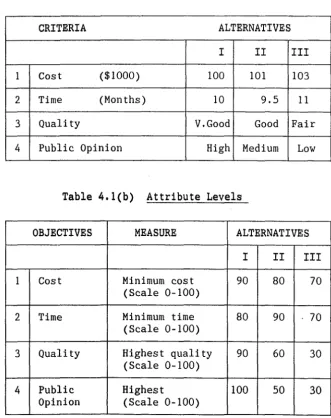
criteria. (e.g. Table 4.l(a)). Performance scores vary from factual, public opinion. Therefore the evaluation e.g. cost, to subjective, e.g.
of the achievement of an alternative in relation to particular objectives on scales comprising a finite number of levels can be justified. i.e. Translate performance scores into a scale e.g. 0 to 10. This forms specific distributional evaluations which form evaluation tableaus (D'AVIGNON 1986) or attribute levels (DUCKSTEIN 1980), (e.g. Table 4.l(b)) The attributes are a means of translating objective performance scores into a scale measure so as to facilitate the inclusion of weights in determining the total relative worth of an alternative.
Table 4,l(a) Alternative vs Criteria Combination
CRITERIA ALTERNATIVES
I II III
1 Cost ($1000) 100 101 103
2 Time (Months) 10 9.5 11
3 Quality V.Good Good Fair
4 Public Opinion High Medium Low
Table 4,l(b) Attribute Levels
OBJECTIVES MEASURE ALTERNATIVES
I II III
1 Cost Minimum cost 90 80 70
(Scale 0-100)
2 Time Minimum time 80 90 · 70 (Scale 0-100)
3 Quality Highest quality 90 60 30 (Scale 0-100)
4 Public Highest 100 50 30
[image:39.600.145.476.338.756.2]4.3.3 Decision Proposals
Having determined the scores of the alternatives in the evaluation process, the next step is to make decisions and proposals. Different types of decisions and proposals are possible depending on who is the decision maker. (D'AVIGNON 1986) Typically the major decisions are:
4,3,3,1 Description of the alternatives
The evaluation process and the results (performance scores) present as a systematic and formal description of the alternatives and their consequences. For some problems, particularly when there is discussion by a committee, this is enough to make a decision.
4,3,3,2 Ordering the alternatives
The alternatives are put into an order with respect to other alternatives. This could be by sorting or ranking of the alternatives. Sorting the alternatives is by assigning them into different classes defined by some characteristic properties. For example the alternatives could be sorted into those accepted or those rejected. In ranking the alternatives are put into an order in relation to other alternatives.
4,3,3,3 Selecting alternatives
This involves the selecting of the best or most satisfactory solution from the set of alternatives. In most cases the existing methods have been developed for the problem of selecting one alternative.
To derive the decision proposals, especially the ordering and selection, information about the preferences of the decision maker is required and a scheme to aggregate the results. When applied to engineering projects multiobjective methods can be useful at both the management and technical levels. Where the engineer is not the decision maker, the management provides goal definition and makes the final choice. The
4,3,4
Aggregation MethodsA number of methods exist that enable the comparison of alternatives. The assumption is, that with respect to the preferences of the decision maker, every alternative can be compared, even if two alternatives differ considerably with respect to some objectives.
4,3,4,1
Utility TheoryThe utility of the alternative with respect to each objective is calculated. In the utility functions it is assumed that every objective is independent of the remaining objectives. Thus the utility of one objective can be measured without taking into account the remaining objectives. (D'AVIGNON 1986) This independence condition justifies the prioritising of alternatives by the use of total utility (or additive utility functions). By comparison of alternatives' utflities, the alternatives can be ranked or selected. However, generally when assessing the utility parameters, the estimation of weights for the objectives is required.
This theory can be illustrated in the following way. alternatives A and B
Given two
Let ai and bi the performance scores of alternatives A and B respectively for objective i with 1, ....•. n, objectives and wi
=
derived weighting of objective i.Define u[A
1] and u[B1] u[A2] and u[B2]
u[An] and u[Bn]
where u[Ai] and u[Bi] for i 1, .•.... n, is the utility of alternative A or B with respect to objective i.
Independence implies that it is possible to derive u[A
1] or u[Bi] for
Aggregating u[Ai] = U[A] and u[Bi] = U[B]
e.g. by adding to get the total utility for alternative A and B
Thus for comparing A and B
A>
B if U[A]>
U[B]A - B if U[A] U[B]
4,3,4,2 Dominance
i.e. A is better than B i.e. A is comparable to B
The concept of dominance is used as a method of prioritising. A
multiobjective alternative X
1. is said to dominate X'. if X. is at least l l
as good as alternative X'i with respect to every objective. The concept of dominance is usually used with multiobjective programming techniques. However the results are a set of non-dominated solutions and further ordering has to be made. This means that with just the dominance concept, the result is a set of technically feasible non-inferior alternatives. Since none of the remaining
other, no ordering e.g. xl
>
x2 can be made. Assume a set of six alternativesx
1 .•...•
x
6 Using the dominance concept results in say;x
1,
x
3 andx
6 as the non-dominated solutions.alternatives dominates the For example
To derive a relationship like
x
1
>
x
3>
x
6, where greater than implies better than, dominance is not enough and another method of choice has to be used e.g. utility theory. The concept of dominance is reasonable where a problem consists of finding the set of best alternatives.4,3,4,3 Distance to a target point
The preferences are translated by means of a desired target point Z = (t
1 ••••• tn) for n objectives. Z is referred to as the ideal vector. The set of alternatives can then be put into an order with respect to
the distance D to that point. and the target point Z, or how
A way of computing distance D between X close the alternative is to the ideal solution, is by the use of vector geometry.
where: t. ideal value for objective i'
l
t'. worst value for objective i'
l
w. weights derived for objective i
l
x. alternative's performance score for objective i
l
D,
l a measure of deviation from the ideal value
The alternative with the minimum distance from the ideal is selected. This represents a reasonable compromise between the objectives.
4,3,4,4 Objective ordering or lexicographic ordering
This requires that the objective function be ordered in a priority sequence. By sequentially optimizing the objective functions beginning with the highest priority, one objective starts to play a role for the comparison of alternatives if these alternatives have identical evaluations with respect to all the more important objectives.
e.g. Assume two alternatives X and Y with n objectives J:···n with 1 being most important and n being least important.
Let X. Y. for all objectives 1 ••.••. i
l l
then X
>
Y if Xj>
Yj, irrespective of k, 1, m etc . .Hence objective j starts to play a role in the comparison of the alternatives.
4,3,5 Idea of Weights
In the methods of choice described above it is evident that apart from objectives have also
for the objectives. comparing alternatives, the
provide a value judgement (whether actually derived or
to be compared to The idea of weights just ordering the objectives from least commonly used to elicit preferences with a multiobjective problem. The important to most important) is
amongst objectives when confronted
objectives can then be ranked with respect to some weight or scaling constant. The difficulties
estimation of adequate weights.
4.4
EXAMPLES OF MULTIOBJECTIVE METHODSA number of multiobjective methods exist. These methods cover a broad spectrum of analytical sophistication and range from simple non-mathematical techniques to complex computer based programming. Bishop
(1976), in a review of multiobjective methods, categorised them into:
4.4.1
Visual TechniquesVisual techniques require little or no quantitative analysis. These are especially useful where the objectives have spatial significance.
4.4.2
Rating and Ranking MethodsRating and alternatives.
ranking methods-providing
4,4,3
Matrix and Linear Scoring Methodsa direct comparison of
Matrix and linear scoring methods usually adopt a model that incorporates both performance measures and preference weightings.
4,4,4
Trade-off Displays and AnalysisThese aim to organise quantitative information on the performance effectiveness of alternatives in either graphical or tabular forms which aid comparisons amongst alternatives.
4,4.5
Multiobjective Programmingsubclasses of techniques attempts to identify the non-inferior set through different approaches.
The general multiobjective methods are described above. They are applied in different problem contexts with unique resources and constraints. Because of the similarities