B. J. McKenzie
University of Canterbury, Christchurch, New Zealand
Postal Address:
Dr. B.J.McKenzie,
Department of Computer Science, University of Canterbury,
Private Bag, Christchurch, New Zealand.
Electronic mail address (uucp):
B. J. McKenzie
University of Canterbury, Christchurch, New Zealand
SUMMARY
Techniques for increasing the throughput of a peephole optimizer for intermediate code
are presented. An analysis of the optimations to be performed enables an efficient
matching and replacement algorithm to be found which minimizes rescanning after a
successful replacement. The optimizer uses procedural interfaces; both for the input
from the front end phase of the compiler and for the output to the back end. The result
is a library module which may optionally be loaded with various other phases of the
compiler to provide a flexible range of options regarding compiler size, quality of
generated code and compilation speed.
KEY WORDS: intermediate code, peephole optimization,
deterministic finite automata, procedural interfaces, compilers
INTRODUCTION
It has become increasingly popular in the area of compiler construction to use some
form of intermediate code to communicate between the front end (source language
specific) and back end (target machine specific) phases of a compiler. Such a design
results in a clean interface between these two phases of the compiler as well as
expediting portability. It is common to share the same intermediate language for a
number of different source languages [1], or a number of different target machine
languages [2], or even both [3, 4]. Such a sharing allows tasks which are common to
all front and back ends to be isolated in modules that can be shared by all without
duplication of effort. Machine independent optimization [5] is an example of such a
common task and this paper focuses on the peephole optimizer in the Amsterdam
The ACK is a toolkit for the construction of compilers and cross-compilers for
Algol-like languages (e.g. Pascal, C, Occam, Basic, Modula-2), and byte-addressable target
machines (e.g. 680x0, pdp, vax, 8086). It uses a stack based intermediate language
called EM [4], which is encoded in a binary file for communication between phases of
the compiler. Generation of these encoded binary files is simplified by the provision of
a library of routines, (one for each distinct form of an EM instruction,) that control the
encoding and output of the binary EM code. Similarly a library for reading an encoded
EM file provides a routine that reads and decodes the next EM instruction into a C
structure variable. To ease debugging of new tools, versions of these libraries which
deal with human readable text files are also available.
EXISTING PEEPHOLE OPTIMIZER
The design of the existing peephole optimizer is described in some detail in [7]. This
optmizer reads and stores the EM instructions corresponding to a complete procedure
and then breaks this up into a series of basic blocks delimited by labels. For each such
block it makes repeated passes searching for optimizations until a complete pass makes
no replacements. Finally the blocks are output. There are currently 580 optimizations
described by a table of templates of which the following is a typical example:
loc adi w loc adi w ® loc $1+$3 adi w
This example asserts that the sequence of EM instructions, loc adi loc adi (where
loc is load constant and adi is add integer), when both the adi instructions have
arguments with value equal to the word size (w), can be replaced by a single loc
instruction which has an argument with value the sum of the two replaced l o c
instructions' arguments and a single a d i instruction. The search for possible
optimizations thus includes both the search through the block of EM instructions for a
pattern of EM instructions corresponding to the left hand side of the template as well as
To search for potential optimizations the next three EM instruction opcodes are hashed
and the resulting value used to index a chained bucket of all possible templates that
could match. These are searched in turn attempting to match the LHS instructions of the
template. Upon a complete match any associated conditions (which have been encoded
in tables) are checked. If this is also successful any expressions required by the RHS
are evaluated (again using tables) and the LHS instructions replaced by the RHS
instructions. Scanning for subsequent optimizations continues from the beginning of
the replacement.
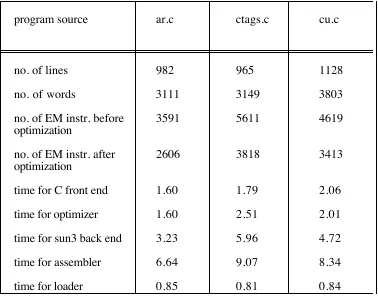
Table 1 presents timings for the phases using the C language front end and sun3 back
end while compiling the source of three Unix commands. All times are the sum of the
user and system cpu times under SunOS 3.5 on a Sun 3/60 and are averaged over 5
runs. The statistics regarding the source files are after pre-processing and removal of
empty lines. It can be seen that the peephole optimizer consumes a significant
proportion of the processing resources; perhaps surprisingly similar to that consumed
program source ar.c ctags.c cu.c
no. of lines 982 965 1128
no. of words 3111 3149 3803
no. of EM instr. before 3591 5611 4619
optimization
no. of EM instr. after 2606 3818 3413
optimization
time for C front end 1.60 1.79 2.06
time for optimizer 1.60 2.51 2.01
time for sun3 back end 3.23 5.96 4.72
time for assembler 6.64 9.07 8.34
[image:5.595.101.479.59.355.2]time for loader 0.85 0.81 0.84
Table 1. Statistics regarding phases of ACK pipeline on Sun 3/60
Figure 1 graphs gives the number of passes required by the peephole optimizer for each
basic block summed over all three sources files. It also shows the frequency
distribution of the sizes of the basic blocks both before and after optimization.
From this it can be seen that there is a significant reduction in the number of EM
instructions, but also that it requires a number of passes through the block to achieve
this reduction. The last pass through each block is essentially wasted as it achieves no
improvement in the EM code. This effect becomes more pronounced as the number of
optimization patterns is increased as shown by figure 2 where the optimization time is
graphed against the number of optimized patterns used. This is a result of the increased
possibility that a replacement will be made requiring a further pass through the block
RATIONALE FOR THE NEW OPTIMIZER
The analysis of the statistics presented in the previous section suggests that an algorithm
that can both reduce the overhead in detecting optimizations and reduce the requirement
of repeatedly re-scanning the basic blocks should increase the throughput of the
optimizer.
One way to reduce the re-scan would be to limit the re-scan by buffering the output and
after each successful replacement calculating how many instructions are required to be
backed up before continuing. For example, a primitive method of doing this would be
to back-up LÐ1 instructions1 where L is the length of the longest LHS of the patterns.
In practice this primitive estimate can be improved for optimizations with non-null
replacements as there is some context information available to limit the back-up.
Suppose the pattern:
a1a2 am® b1 bn
has just been successfully matched and replaced. There are four possible forms for
LHS's that require back-up; these LHS's and the amount of back-up they require
(including the replacement itself) are:
LHS pattern back-up required
a) c1 ci b1 bn d1 dj 0£i 0£j n+i
b) c1 ci b1 bj 0£i 1£j<n n+i
c) bi bn c1 cj 1<i£n 0£j n-i+1
d) bi bj 1<i<j<n n-i+1
For each replacement an analysis of all possible LHS's can be made to determine
conformance with one of the above four forms and the back-up limited to the maximum
of the back-ups required.
An analysis of the optimization patterns shows that the size of the back-up ranges from
2 to 13 instructions with a mean of 4.85. More importantly, if the analysis is restricted
to those optimizations actually made during the compilation of the three source files
considered in table 1, this results in a range from 2 to 8 with an mean back-up of 3.96.
This means that the overhead resulting from re-scanning is reduced substantially from
the previous method of re-scanning the block completely if a replacement is made.
ALGORITHMS AND DATA STRUCTURES
New data structures suitable for the matching and replacement of patterns are
represented in figure 3. All matching takes place in the fixed size buffer consisting of an
array of structures, each structure representing a single decoded EM instruction. The
EM instructions are read as required from the input, decoded and then stored in a
structure of the buffer.
This enables easy access to the instruction's opcode while searching for possible
matches and to its argument (if any) while any expression is being evaluated. The
instruction stream in the buffer can be divided into three distinct regions:
a) those instructions that have already been searched for optimizations,
b) those instructions that constitute a valid prefix for one or more patterns, and
c) those instructions that have been backed-up over after a previous replacement or
failure.
The final region may contain no instructions (indicated by end=0) in which case
and decoded from the input stream and deposited in the next available structure in the
buffer.
The matching process can be controlled by a deterministic finite automaton (DFA) built
from the opcodes that constitute the LHS patterns of the optimizations. Figure 4 shows
the structure of such a DFA given the following 5 optimization patterns:
loc adi w loc sbi w ® loc $1-$3 adi w
inc dec ®
inc loc adi w ® loc $2+1 adi w
inc loc sbi w ® loc $2-1 sbi w
dec loc adi w ® loc $2-1 adi w
dec loc sbi w ® loc $2+1 sbi w
Patterns are recognized by starting in state 0 and making transitions in the DFA based
on the next instruction's opcode in the matching buffer. The final states, (indicated by
double circles in the diagram,) correspond to complete LHS patterns; in these states the
success of the match is determined by evaluating any expressions associated with each
optimization with the same LHS opcodes. If none of these expressions is satisfied the
state will not be regarded as a final state and the matching process continues. If one
succeeds then the replacement RHS is constructed in the separate replacement buffer
(whose length is known to be that of the longest RHS) using the still available LHS
arguments if required. The replacement instructions can then be copied in the matching
buffer; if necessary instructions in the back-up region are moved to make room or close
up any gap. The need for such a move can be determined when the DFA is constructed,
Figure 5 shows the same DFA as figure 4 but also includes the failure transitions
calculated using the methods from the previous section. These are labelled with the
amount of back-up required before scanning continues. To simplify the diagram, failure
transitions from states that require no back-up and continue scanning from state 0 are
not shown. The figure also shows for each final state the back-up required after a
successful replacement1.
The 580 optimization patterns result in a DFA with 699 states. An attempt was made to
encode these states as a series of nested C switch statements but this exposed various
size restrictions in such constructs in a number of available C compilers. Instead, the
DFA was encoded in tables using row displacement encoding [8]. Because of the
extremely sparse nature of the DFA transition function, such encoding was extremely
successful with the 698 transitions being encoded in just 755 table entries.
After each transition to a new state, an array of functions was consulted to determine if
the new state was a final state. If this yielded a non-null entry the retrieved function was
called to check the corresponding expressions, if any, for all patterns with the same
LHS opcodes. These were written as a series of C if statements; the body of the if
statement contained code to construct the replacement instructions and perform any
subsequent copying and back-up required before returning to state 0 to continue the
search. If none of the if statements were valid or the new state was not a final state then
the tables encoded the necessary adjustments to the buffer pointers and the state to
continue from.
EFFECTIVNESS OF THE NEW OPTIMIZER
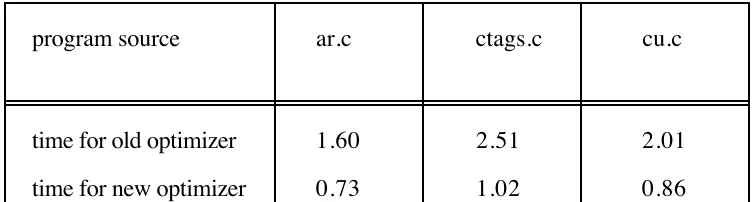
A measure of the effectiveness of the new optimizer is presented in table 2, where the
times for optimizing the three example source files are presented.
program source ar.c ctags.c cu.c
time for old optimizer 1.60 2.51 2.01
[image:10.595.99.477.189.290.2]time for new optimizer 0.73 1.02 0.86
Table 2. Timing of old and new optimizers in Sun 3/60 cpu secs.
Averaged over the three source files these figures give throughputs of 2300 and 5300
EM instructions per second for the old and new optimizers respectively, so the
throughput has been improved by a factor of 2.3. The effect of the number of patterns
on optimization time for the old and new optimizers is presented in figure6. It will be
noted that the new optimizer's time is almost independent of the number of optimization
being matched.
The instructions in the matching buffer can be flushed to the output stream whenever an
instruction that is not in any LHS pattern is read or generated by an output replacement.
In general it is not possible to calculate the largest possible size required for the
matching buffer as it is possible to construct combinations of pathological input streams
and optimization patterns that would require a matching buffer that could hold the
complete input stream before it was flushed. In practice, however, only a very modest
size buffer is required. While optimizing the three example source programs containing
a total of 12821 EM instructions the buffer was flushed 2671 times. The mean length of
instructions respectively while that of the sum of these is 3.6 instructions. The
maximum lengths for these same queues at flushing are 23, 1, 7 and 24 . The mean
length of the sum of these queues before each transition in the DFA is 4.6 .
Furthermore, if the buffer ever does become full, it is possible to perform a "half
flush". This involves writing out half the instructions waiting in the output queue and
then moving left all the remaining output, patterns and back-up instructions and pointers
before matching continues. The only effect of such a flush is to possibly miss some
optimizations as it limits the back-up possible after a subsequent optimization. In the
current version of the optimizer the buffer is able to hold 200 instructions and no such
half flush occurred during the optimization of the three test files. Even if such a flush
did occur it would still only result in missed optimization opportunities if (cumulative)
back-ups of the order of 100 instructions were required which is highly unlikely. An
alternative strategy would be to allow an extra passes over the intermediate code in the
exceptional situations where a half-flush occurred.
OPTIMIZER AS OPTIONAL LIBRARY
It was noted in the introduction that generation of encoded EM files by front ends was
simplified by the provision of a library of generating routines, one for each distinct EM
instruction. To generate a loc 5 instruction for example, the front end need only make
the call C_loc(5) and ensure that the corresponding library is included when the front
end is loaded.
The design of the new optimizer was carefully chosen to ensure that it was possible to
provide a similar procedural interface. This was provided via a call of the form
O_loc(5), for example, to output a loc 5 instruction to the optimizer. Each such
buffer before calling the DFA matching routine. The state of the DFA is kept between
calls to the DFA routine and the DFA loop continues to make transitions, replacements
and back-ups until a new instruction is required in the matching buffer. At this point it
returns and will continue only when called again from another O_xxx routine acting like
a co-routine.
Such a structure allows the optimizer to be conveniently packaged as a library which
allows a number of flexible alternatives.
In its simplest form the library can be used to build a simple stand-alone optimizer by
providing a main program loop that reads EM instructions (using the reading EM library
routines) and then calls the O_xxx routines of the optimizer library. This is then loaded
with the EM reading, optimizing and writing routines to build a program that has the
same functionality as the old optimizer in the ACK pipeline.
program source ar.c ctags.c cu.c throughput
(secs) (secs) (secs) (lines/sec)
front end + old
optimizer 3.20 4.30 4.07 266
front end + new
optimizer 2.37 2.79 2.95 379
combined front end
[image:12.595.101.477.456.629.2]and optimizer 1.95 2.19 2.38 472
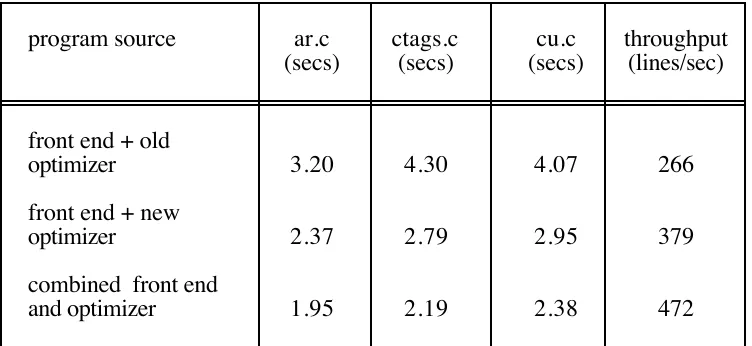
Table 3. Timing for phases of ACK pipeline on Sun 3/60
Alternatively, the front-end sources can be pre-processed to change every C_xxx
program. This results in a front-end that produces optimized EM instructions directly
without the overhead of encoding, writing, reading and decoding the EM files between
the phases. Table 3 presents the timing for such a C language front-end using the three
example source files as input. The final column of this table gives the throughput
measured in C source lines per cpu second accumulated over the three files. This shows
that the throughput achieved by the combined front-end is 1.77 times that of the
separate front-end plus old optimizer and 1.25 times that when the new optimizer is
executed as a separate pass.
Further flexible combinations are also possible. Any step in the ACK pipeline that
outputs EM instructions can be changed to output an optimized stream of EM
instructions instead by pre-processing the sources and loading the new library. For
example, experiments were conducted with fast code expander back-ends that generate
machine code directly by expanding each EM instruction to a group of machine
instructions. These were constructed using the same procedural interface used by the
EM writing library and so could be loaded directly with the front-ends to produce a
complete compiler. These ran extremely fast but the quality of the code produced
suffered as a result of the front-ends generating EM code under the assumption that the
peephole optimizer would always remove obvious inefficiencies. Again, by
pre-processing the front-end sources and loading the optimizer library the peephole
optimization can be added to these compilers resulting in a substantial improvement in
the size and speed of the generated code with very little effect on the throughput of the
compiler.
CONCLUSIONS
The redesign of a peephole optimizer in the context of the Amsterdam Compiler Kit has
been described. By detailed analysis at the time the optimizer is constructed of the
failure and successful replacement. This achieved substantial improvements in the
throughput of the optimizer. The redesigned optimizer was constructed within the
context of a Deterministic Finite Automata using a fixed sized matching buffer. This
was augmented with code to test any restrictions among the arguments of the
intermediate instructions before any successful patterns were matched and replaced in
the buffer. By providing a procedural interface, packaged as a library, flexible
combinations of front and back-ends could be achieved. The resulting reduction in the
overheads in dealing with a file-based intermediate instruction stream resulted in
substantial improvements in the throughput of the ACK pipeline.
ACKNOWLEDGEMENTS
This work was begun while the author was on leave at the Vrije Universiteit,
Amsterdam, The Netherlands. Thanks are due to Andy Tanenbaum, Ceriel Jacobs and
Dick Grune for helpful discussions about this and other problems. I thank Tim Bell and
Rod Harries for useful comments on this paper. The idea of an extra pass after a
REFERENCES
1. JOHNSTON, S.C. A tour through the portable C compiler AT&T Bell Laboratories, Murray Hill, N.J.
2. AMMANN, U., The Zurich implementation in: Barron D.W. (1981) Pascal - The Language and its Implementation Chichester: Wiley pp. 63-82
3. STEEL, T.B., JR. UNCOL: The myth and the fact. Annu. Rev. Autom. Program. 2 (1960), 325-344.
4. TANENBAUM, A.S., STEVENSON, J.W., AND VAN STAVEREN, H. Description of an experimental machine architecture for use with block structured languages. Inf. Rapp. 54, Vrije Univ., Amsterdam, 1980.
5. DAVIDSON, J.W., AND FRASER, C. W. The design and application of a retargetable peephole optimizer. TOPLAS 2, 2 (April. 1980), 191-202.
6. TANENBAUM, A.S., VAN STAVEREN, H., AND STEVENSON, J.W. A practical toolkit for making portable compilers. Commun. ACM 26, 9 (Sept. 1983), 654-660.
7. TANENBAUM, A.S., VAN STAVEREN, H., AND STEVENSON, J.W. Using peephole optimization on intermediate code. TOPLAS 4, 1 (Jan. 1982), 21-36.