INCREACING AGOENE COMPOUND OF
Allium sativum
L.
USING
(UV) LIGHT
IN VITRO
Dr. Hashim K. Mohammed Al-oubaidi* Zainab Salim Hussain
*College of Sciense, Al-Mustansiriya Univercity, Baghdad / Iraq
ABSTRACT
The present study was conducted in order to increase the production of some Secondary metabolic compounds (essential oils) of Allium sativum L. In Vitro. Secondary metabolic compounds quantitative and qualitative analysis using chromatography device with high performance liquid HPLC and compared with the mother plant. In order to increase the production of secondary metabolites, (UV) light used with exposure (0, 10, 20, 30) min. The results showed that the (10) min exposure to UV light led to high significant in agoene compound.
KEYWORDS: Allium sativum L., UV, agoene.
INTRODUCTION
Plants are an important source of food and equipped with a large number of chemicals that include pharmaceuticals, pesticides, vaccinated, perfumes and colors. In spite of advances in production methods, are still a source of compounds are very complex or expensive price when production in other methods (Safadi et al., 1989). Provided different applications for the tissue culture access to economically important compounds, Discosmoand Misawa, (1995) including pharmaceutical compounds that are difficult to prepare at the laboratory as well as high cost when manufactured (Matlob et al., 1989). There are a lot of benefits that are associated with the production of such vehicles in this way in comparison with whole plant and get these compound with height degree of purity of Textile farms than those extraction from the plant and full production is fast and is not supported on the season and do not need large space for culture (Al-zubaidi et al., 1996), (Taiz and Zeiger, 2002). Garlic is considered
Volume 3, Issue 9, 1196-159. Research Article ISSN 2277– 7105
Article Received on 08 September 2014,
Revised on 02 Oct 2014, Accepted on 26 Oct 2014
*Correspondence for
Author
Dr. Hashim K.
Mohammed Al-oubaidi
College of Sciense,
Al-Mustansiriya Univercity,
Garlic used fresh or dried or pressed to extract juice, to be used in food preparation and seasoning for fish meat because of its flavor desired because it contains volatile substances. It well-known medical use expectorant and antipyretic (Shafei, 2001). And also advises eating garlic in the treatment of sore throat and hoarseness (Al-zubaidi, et al., 1996). Garlic cloves containing in structure sulfa compounds that protect the liver cells from the effects of carbon Ttrakloraid substance that helps the accumulation of fat in the liver (McQuestion, 2006). The agoene compound that found in garlic works to kill the fungi that infect the skin (Safadi et al., 1998). Garlic is known as a factor for lowering high blood pressure, and antipyretic of high blood cholesterol (McNeil, 2005). The aim of the research tissue culture technique employing the possibility of increasing secondary metabolites in garlic plant, which is the medical and pharmaceutical materials intervention in many pharmaceutical industries through the use of UV light as physical stimulate to increase these compounds.
Plant materials and Sterilization
Garlic plants Allium sativum L. were collected on 15/09/2012 from market in Baghdad, Iraq. The gloves were cut out, rinsed with running tap water for 1 hr., then transferred to laminar air flow-cabinet where submerged in (99)% ethanol for one minute, Washed with sterilized DDH2O, then rinsed with sodium hypochlorite at the concentrations (1.2)% for (5) min. Then washed with DDH2O three times for five minutes and planted in vials of Agriculture (universal tubes) (Pierik, 1987).
Callus induction
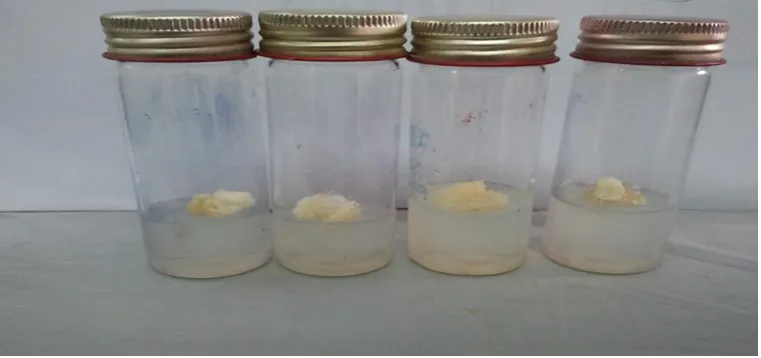
MS medium of callus induction was prepared (Murashing, and Skoog, 1962). That had 2 mg/l of (2,4-D), and 1 mg/l of (BA) tabel (1), after that callus exposure to different periods time for UV light (0,10,20,30) min. with short wave length ranging (100-280) nm. At 10 replicate to each duration of exposure of UV light, then incubated in the light condition, the illumination intensity was 1000 lux for 16 hours\ a day at a temperature of 1 ± 25 C° Purohit, 1999).
Measuring fresh and dry weight of callus
Extraction and analysis of violate oil from Allium sativum L.
The wet callus (2 g) were crushed and extracted with petroleum ether for 4hrs in a Soxhlet apparatus. The extract was concentrated under reduced pressure. 1 ml concentrated extract was dissolved in 20 ml petroleum ether, 2 ml methanol acid and 2 ml of KOH added. The mixture was shaken for 2 min and allowed to stand for 10 min. The upper layer was removed and washed with water. This oil was analyzed by HPLC according the optimum condition as given above (Salkind and Ramsey, 2007).
Estimate the increase or decrease in the secondary metabolite compounds by device (HPLC).
High-performance liquid chromatography (HPLC) was used, the samples was performed with the HPLC system equipped with two shimadzu reciprocating pumps, a variable UV-VIS detector shimazeu data processors, to estimate the increase or the decrease in the secondary metabolites compounds of Allium sativum L. and compare these increases or decreases with the mother plant .The readings were measured at the wave lengths and by the time of the detention of the Rt solutions to the standard samples under study (Lawson and Hughes., 2003). The concentrations of active substances were quantified by comparing the area of package material standard package with an area of the model under the same conditions by using the following law (Budhiraja, 2003):
concentration Area of sample
of sample (mg/l) = --- X conc. of standard X dilution Factor Area of standard
Statistical analysis and Experimental design
Experiments are designed according to the design of full randomization Completely Randomize Design (CRD) to study the effect of various treatments in the studied traits, and compared the differences between the test averages according to Least Significant Differences (LSD) probability of 5% (Salkind and Ramsey, 2007).
RESULTS
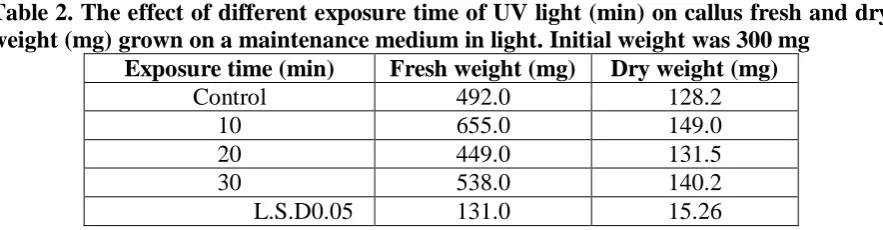
reached to (492) mg. The results in the same table showed that the highest callus dry weight (149.0) mg at (10) min that had high significant than the other treatments except the treatments (30) min which gave (140.2) mg. while the lowest callus dry weight was found at the control treatment which reached to (128.2) mg which had no significant difference than other treatments.
The effect of exposure duration to (UV) light (min) on producing secondary metabolites from callus by HPLC technique
The results in (Table 3) showed that exposure to UV light caused increasing the concentrations of secondary metabolites in most treatments than the mother plant but these increases were not signification in all compounds except agoene which scored a significant increase reached (37.61) mg when exposed to UV light for 10 minutes.
Fig 1. Effect different exposure time of UV light (min) on producing secondary metabolites from callus by HPLC technique.
Table 1. Components of media for callus induction
Consternations (mg/l) Components
Complete power MS
30000 Sucrose
2 2-4 D
0.5 NAA
1.0 BA
100 Glycine
100 Myo-inositol
[image:4.595.108.489.313.492.2]Table 2. The effect of different exposure time of UV light (min) on callus fresh and dry weight (mg) grown on a maintenance medium in light. Initial weight was 300 mg
Dry weight (mg) Fresh weight (mg)
Exposure time (min)
128.2 492.0 Control 149.0 655.0 10 131.5 449.0 20 140.2 538.0 30 15.26 131.0 L.S.D0.05
Table3. The effect of time exposure to UV light (min.) in the production of secondary metabolites from callus and appreciation quantitative and qualitative by use HPLC.
DISCUSSION
The results showed that there were high significant on callus fresh and dry weight (mg) grown on a maintenance medium in light. The effect of different exposure time to UV light on producing secondary metabolites from callus by HPLC technique, the results showed there were agreed with Alqudsi, (2004) stated the UV light stimulate increasing in the mass of most secondary metabolites of Allium sativum L. because UV light act damage in The genetic material in the cell, Therefore, plant lose the stored genetic codes that regulate its vital operations Moreover, those rays break chlorophyll which without it plant cannot receive the sun's energy that necessary to complete the process of photosynthesis, And thus affect the growth of plant cells, To reduce the devastating impact of UV light some plant act to produce large amount from secondary metabolites that act Protection plant from UV light (Alqudsi, 2004).
U.V light
Secondary metabolites Control
10 min 20 min 30 Min Garlic gloves LSD 0.05
s-allylcystin 47.3 44.3 55.3 35.7 12,5 N.S y-gltomylcystin 23.0 26.2 22.2 24.7 3.3 N.S Allicin 18.3 26.0 24.4 29.4 16.7 N.S Vinyl-[4H]-1,
Time (1-10) min.
Fig. (2): HPLC for control treatment of UV light
Time (1-10) min.
Time (1-10) min.
Fig. (4): HPLC after 20 min of UV light
Time (1-10) min.
Fig. (5): HPLC after 30 min of UV light CONCLUSION
RECOMMENDATION
Use another stimulate to increase (essential oil) of Allium sativum L.
ACKNOWLEDGEMENT
I would like to express my sincere appreciation to my supervisor Assistance Prof. Dr. Hashim K. Mohammed for his patient guidance in the whole research work , his kind help for my daily life in Al- Mustansiriyah University, Baghdad, Iraq.
REFERENCES
1. Alkatib, Joseph Mansour (2000). Classification of seed plants, Press House Books for Printing and Publishing / University of Mosul, Iraq. Alqudsi, Adel solltan salman (2004). Produce some of secondary metabolites from Solanum nigrum by tissue clture, Gollage of Agriculture, Department of Horticulture, University of Cairo, Egypt.
2. Alzubaidi, Zuhair Najib and Baban, Hoda Abdel-Karim, and Falih, Kazem Knight (1996). Guide herbal remedy Iraqi Medical, Inc. August Print Art Co., Ltd. / Baghdad. Iraq. 3. Budhiraja RP. Separation Chemistry. New Age International Ltd, Publishers, New Delhi,
2004; 171:239.
4. Discosmo F.and Misawa M. (1995). Plant cell and tissue culture: Alternatives for metabolite production. Biotechnology Advances, 13(3):425-453.
5. Lawson, L.D.; Wan, Z.J. and Hughes, B.G. (2003). Identification and HPLC quantification of the sulfides and thiosulfates in commercial qarlic product. Planta Medica. 1991; 57:363-370.
6. Matlob, Adnan Nasir, Mohammed, Izz al-Din Sultan, Abdul Karim Saleh (1989). The production of vegetables, the first part, the second edition, the University of Mosul. 7. Murashing, T. and Skoog. (1962). A revised medium for rapid growth and bioassays with
tobacco tissue. physiol. Plant, 15:373-497.
8. McNeil (2005). Nanotechnology for the biologist. J. Leukoc. Biol, 2005; 78: 585–94. 9. McQuestion, M. (2006). Evidence-based skin care management in radiation therapy.
Semin Oncol Nurs, 2006;22: 163-73.
10.Pacheco AC, Cabral DS, Fermino ÉS and Aleman CC. (2013). Salicylic acid-induced changes to growth, flowering and flavonoids production in marigold plants, Journal of Medicinal Plant Research. Academic Journals, São Paulo, Brasil.
12.Purohit S.S.Agriculture Biotechnology (1999). Published by Updesh Purohit for Agrobios, India: 833.
13.Safadi, Bassam Ali, Nizar Mido Arabi, Mohammed Emad El-Din (1998). Improve resistance to disease, garlic and white mold productivity and storage capacity using gamma-ray. A final report on scientific research / Department of Agriculture / Atomic Energy Commission. Damascus.
14.Shafei, Darwish (2001). Food& herbs, Journal of Yarmouk. Numbers 73, 74.
15.Salkind, N.J. and Ramsey, P.H. (2007). Encyclopedia of Measurement and Statistics, Sage research methods.