www.wjpr.net Vol 3, Issue 9, 2014. 605
OPTIMIZATION OF VALSARTAN TABLET FORMULATION
BY 2
3FACTORIAL DESIGN
K. P. R. Chowdary*, K. Ravi Shankar and P. Suneel Kumar
Vikas Institute of Pharmaceutical Sciences, Nidigatla Road, Rajahmundry- 533103
ABSTRACT
Valsartan, a widely prescribed anti hypertensive drug belongs to class II under BCS classification and exhibit low and variable oral bioavailability due to its poor aqueous solubility. It needs enhancement in the dissolution rate in its formulation development. Complexation with β-cyclodextrin (βCD), use of Primojel and PVP K 30 are tried for enhancing the dissolution rate of valsartan in its formulation development. The objective of the present study is optimization of valsartan tablet formulation employing Primojel, βCD and PVP K 30 by 23 factorial design. Formulation of valsartan tablets with NLT 85% dissolution in 10 min employing Primojel, βCD and PVP K 30 was optimized by 23 factorial design. Eight valsartan tablet formulations were prepared using selected combinations of the three factors as per 23 factorial design. Valsartan tablets were prepared by direct compression method and were evaluated for drug content, hardness, friability, and disintegration time and dissolution rate characteristics. The dissolution rate (K1) values were analysed as per ANOVA of 23 factorial design to find the significance of the individual and combined effects of the three factors (βCD, Primojel and PVP K 30) involved on the dissolution rate of valsartan tablets formulated. ANOVA of K1 values indicated that the individual and combined effects of the three factors, βCD, Primojel and PVP K 30 in influencing the dissolution rate of valsartan tablets are highly significant (P < 0.01).
Valsartan tablet formulations PFa and PFac disintegrated rapidly with in 1min and gave very rapid dissolution of valsartan, 100% in 10 min. Higher levels of βCD and lower levels of Primojel gave low dissolution rates of valsartan tablets. The increasing order of dissolution rate (K1) observed with various formulations was PF a = PFac > PFab > PFabc >PFbc> PFb > PFc > PF1. The polynomial equation describing the relationship between the response i.e. percent
Volume 3, Issue 9, 605-614. Research Article ISSN 2277– 7105
Article Received on 14 August 2014,
Revised on 11 August 2014, Accepted on 06 Oct 2014
*Correspondence for
Author
Dr. K. P. R. Chowdary
Vikas Institute of
Pharmaceutical Sciences,
Nidigatla Road,
www.wjpr.net Vol 3, Issue 9, 2014. 606 drug dissolved in 10min (Y) and the levels of Primojel (X1) , βCD (X2) and PVP K 30 (X3) based on the observed results is Y = 56.146 + 37.478(X1) + 1.676(X2) – 5.288(X1 X2) + 1.563(X3) - 2.942(X1 X3) – 1.123(X2 X3) - 0258(X1 X2 X3). Based on the above polynomial equation, the optimized valsartan tablet formulation with NLT 85% dissolution in 10 min could be formulated employing Primojel at 26.77% of drug content, βCD at 1:3 ratio of drug: βCD and PVP K 30 at 1% of drug content. The optimized valsartan tablet formulation gave 87.23% dissolution in 10min fulfilling the target dissolution set. The dissolution profile of the optimized valsartan tablet formulation was similar to that of a commercial brand (Valent 40). Hence formulation of valsartan tablets with NLT 85% dissolution in 10 min could be optimized by 23 factorial design.
KEYWORDS: Valsartan tablets, Optimization, β-cyclodextrin, Primojel, PVP K 30,
Factorial Design
INTRODUCTION
About 95% of all new potential therapeutic drugs (APIs) exhibit low and variable oral bioavailability due to their poor aqueous solubility at physiological pH and consequent low dissolution rate. These drugs are classified as class II drugs under BCS with low solubility and high permeability characters. These BCS class II drugs pose challenging problems in their pharmaceutical product development process. Valsartan, a widely prescribed anti hypertensive drug belongs to class II under BCS classification and exhibit low and variable oral bioavailability due to its poor aqueous solubility. Because of poor aqueous solubility and dissolution rate it poses challenging problems in its tablet formulation development. It needs enhancement in the dissolution rate in its formulation development.
www.wjpr.net Vol 3, Issue 9, 2014. 607 were tried in the present study for enhancing the dissolution rate of valsartan in its formulation development. Formulation of valsartan tablets with NLT 85% dissolution in 10 min employing Primojel, βCD and PVP K 30 was optimized by 23 factorial design.
Optimization [6] of pharmaceutical formulations involves choosing and combining ingredients that will result in a formulation whose attributes confirm with certain prerequisite requirements. The choice of the nature and qualities of additives (excipients) to be used in a new formulation shall be on a rational basis. The application of formulation optimization techniques is relatively new to the practice of pharmacy. In general the procedure consists of preparing a series of formulations, varying the concentrations of the formulation ingredients in some systematic manner. These formulations are then evaluated according to one or more attributes, such as hardness, dissolution, appearance, stability, taste and so on. Based on the results of these tests, a particular formulation (or series of formulations) may be predicted to be optimal. The optimization procedure is facilitated by applying factorial designs and by the fitting of an empirical polynomial equation to the experimental results. The predicted optimal formulation has to be prepared and evaluated to confirm its quality. The objective of the present study is optimization of valsartan tablet formulation employing Primojel, βCD and PVP K 30 by 23 factorial design.
EXPERIMENTAL
MATERIALS: Valsartan was a gift sample from M/s Hetero Drugs Ltd., Hyderabad.
Primojel, PVP K 30 and β-cyclodextrin were gift samples from M/s Natco Pharma Ltd., Hyderabad. Talc and magnesium stearate were procured from commercial sources. Valent 40 (film coated tablets each containing 40mg of valsartan manufactured by M/s Lupin Ltd, B.No. A305373; Mfg Dt.11/2013; Exp. Dt. 10/2015) were procured from local market. All other materials used were of pharmacopoeial grade.
METHODS
Estimation of Valsartan: An UV Spectrophotometric method based on the measurement of
www.wjpr.net Vol 3, Issue 9, 2014. 608 Formulation of Valsartan Tablets
For optimization of valsartan tablets as per 23 factorial design the βCD, Primojel and PVP K 30 are considered as the three factors. The two levels of the factor A (Primojel) are 2% and 30% of drug content; the two levels of the factor B (βCD) are 1:1 and 1:5 ratio of drug: βCD and the two levels of factor C (PVP) are 0 and 2% of drug content. Eight valsartan tablet formulations employing selected combinations of the three factors i.e. Primojel , βCD and PVP K 30 as per 23 factorial design were formulated and prepared by direct compression method.
Preparation of Valsartan Tablets
Valsartan (80 mg) tablets were prepared by direct compression method as per the formula given in Table 1.The required quantities of valsartan, βCD, Primojel and PVP K 30 as per the formula in each case were blended thoroughly in a closed polyethene bag. Talc and magnesium stearate were the added by passing through mesh no.80 and blended. The blend of ingredients was then compressed directly into tablets using an 8- station RIMEK tablet punching machine employing 9mm or 12mm round and flat punches.
Evaluation of Tablets
All the valsartan tablets prepared were evaluated for drug content, hardness, friability, disintegration time and dissolution rate as follows.
Hardness: The hardness of prepared tablets was determined by using Monsanto hardness tester and measured in terms of kg/cm2.
Friability: The friability of the tablets was measured in a Roche friabilator using the formula
Friability (%) = [(Initial weight- Final weight) / (Initial weight)] x 100
Drug Content: Weighed tablets (5) were powdered using a glass mortar and pestle. An accurately weighed quantity of powder equivalent to 20 mg of valsartan was taken into 100 ml volumetric flask, dissolved in phosphate buffer of pH 6.8 and the solution was filtered through Whatman filter paper no.41. The filtrate was collected and suitably diluted with phosphate buffer of pH 6.8 and assayed for valsartan at 250 nm.
www.wjpr.net Vol 3, Issue 9, 2014. 609 Dissolution Rate Study: Dissolution rate of valsartan tablets prepared was studied in phosphate buffer of pH 6.8 (900 ml) employing eight station dissolution rate test apparatus (LABINDIA, DS 8000) using paddle stirrer at 50 rpm and at a temperature of 37°C ± 1°C. One tablet was used in each test. Samples of dissolution fluid (5 ml) were withdrawn through a filter at different time intervals and assayed for valsartan at 250 nm. The sample of dissolution fluid withdrawn at each time was replaced with fresh drug free dissolution fluid and a suitable correction was made for the amount of drug present in the samples withdrawn in calculating percent dissolved at various times. Each dissolution experiment was run in triplicate (n=3).
Analysis of Data: The dissolution data were analyzed as per zero order and first order kinetic
models. Dissolution efficiency (DE 30) values were estimated as suggested by Khan [7]. Dissolution rate (K1) values were analyzed as per ANOVA of 23 factorial experiments.
RESULTS AND DISCUSSION
The objective of the present study is to optimize the valsartan tablet formulation employing βCD , Primojel and PVP K 30 by 23
factorial design to achieve NLT 85% dissolution in 10 min. For optimization of valsartan tablets as per 23 factorial design the βCD, Primojel and PVP K 30 are considered as the three factors. The two levels of the factor A (Primojel) are 2% and 30% of drug content; the two levels of the factor B (βCD) are 1:1 and 1:5 ratio of drug: βCD and the two levels of factor C (PVP) are 0 and 2% of drug content. Eight valsartan tablet formulations employing selected combinations of the three factors i.e. Primojel, βCD and PVP K 30 as per 23 factorial design were prepared. The tablets were prepared by direct compression method as per the formulae given in Table 1 and were evaluated for drug content, hardness, friability, disintegration time and dissolution rate characteristics. The dissolution rate (K1) values were analysed as per ANOVA of 23 factorial design to find out the significance of the individual and combined effects of the three factors involved on the dissolution rate of valsartan tablets formulated.
www.wjpr.net Vol 3, Issue 9, 2014. 610 Valsartan tablet formulations PFa , PFac, PFabc disintegrated rapidly with in 1min. All other tablets disintegrated rather slowly in about 1-10 min. As βCD level was increased the disintegration time was increased, whereas as Primojel concentration was increased the disintegration time was reduced. However, all the valsartan tablets prepared fulfilled the official (IP 2010) requirements with regard to drug content, hardness, friability and disintegration time specified for uncoated tablets.
Dissolution rate of valsartan tablets prepared was studied in phosphate buffer pH 6.8. The dissolution profiles of the tablets are shown in Fig.1 and the dissolution parameters are given in Table 3. Dissolution of valsartan from all the tablets prepared followed first order kinetics with coefficient of determination (R2) values above 0.952. The first order dissolution rate constant (K1) values were estimated from the slope of the first order linear plots. Much variation was observed in the dissolution rate (K1) and DE30 values of the tablets prepared due to formulation variables. ANOVA of K1 values (Table 4) indicated that the individual and combined effects of the three factors, βCD, Primojel and PVP K 30 in influencing the dissolution rate of valsartan the tablets are highly significant (P < 0.01).
Valsartan tablet formulations PFa and PFac gave very rapid dissolution of valsartan than others. These tablets (PFa and PFac) gave 100% in 10min. Higher levels of βCD and lower levels of Primojel gave low dissolution of valsartan tablets. The increasing order of dissolution rate (K1) observed with various formulations was PF a = PFac > PFab > PFabc >PFbc> PFb > PFc > PF1.
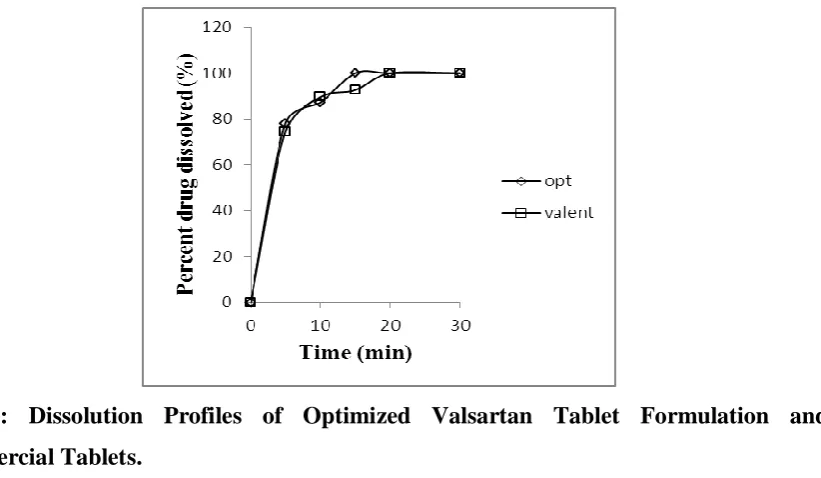
www.wjpr.net Vol 3, Issue 9, 2014. 611 given in Table 3. The hardness of the optimized valsartan tablets was 5. 0 kg/sq.cm. Friability (percent weight loss) was less than 0.83%. Disintegration time of the tablets was 20 sec. The optimized valsartan tablet formulation gave 87.23% dissolution in 10min fulfilling the target dissolution set. The dissolution results also indicated validity of the optimization technique employed. For comparison the dissolution rate of a commercial brand of valsartan tablets (Valent 40) was also studied. The dissolution profiles of optimized valsartan tablet formulation developed and commercial brand are shown in Fig.2. The dissolution profiles of both the products are similar and hence the optimized formulation was considered as similar to the commercial product. Hence formulation of valsartan tablets with NLT 85% dissolution in 10 min could be optimized by 23 factorial design.
Table 1: Formulae of Valsartan Tablets Prepared Employing Βcd, Primojel And PVP K
30as Per 23 Factorial Design.
Table 2: Physical Parameters of Valsartan Tablets Prepared Employing βCD, Primojel
and PVP K 30 as per 23 Factorial Design
Formulation Hardness
(Kg/cm2)
Friability (% Wt loss)
Disintegration Time(min-sec)
Drug Content (mg/tablet)
PF1 4.5 0.75 9-20 98.2
PFa 4.5 0.65 0-20 99.5
PFb 5.0 0.92 6-20 99.8
PFab 5.0 0.82 3-25 98.5
PFc 4.5 0.73 9-0 98.4
PFac 5.0 0.68 0-25 99.6
PFbc 5.0 0.91 1-45 99.7
PFabc 4.5 0.80 1-00 98.9
OPT 5.0 0.83 0-25 98.6
Ingredient (mg/tab) PF1 PFa PFb PFab PFc PFac PFbc PFabc OPT
Valsartan 80 80 80 80 80 80 80 80 80
βCD 80 80 400 400 80 80 400 400 240
Primojel 1.6 24 1.6 24 1.6 24 1.6 24 21.42
PVP K 30 - - - - 1.6 1.6 1.6 1.6 0.8
www.wjpr.net Vol 3, Issue 9, 2014. 612 Table 3: Dissolution Parameters of Valsartan Tablets Prepared Employing βCD,
Primojel and PVP K 30 as per 23 Factorial Design
Formulation PD10
(%)
T50
(min)
T90
(min)
DE30 (%)
( ± s d)
K1 X 102 (min-1)
( ± s d) PF1 9.09 60 >60 12.99±0.04 0.89±0.57
PFa 100 0.5 2.5 91.66±0 78.2±0
PFb 24.75 17.5 47.5 42.74±0.01 2.72±1.35 PFab 95.54 1 7 88.48±0.25 25.86±0.09
PFc 19.84 27.5 >60 26.90±0.02 1.75±0.24
PFac 100 2.5 4 91.66±0 78.2±0
PFbc 32.04 13 44.5 53.29±0.36 6.50±1.20 PFabc 90.01 2 10 85.30±0.04 18.22±0.04
OPT 87.23 2.8 12.5 85.91±0.02 24.54±0.03
Table 4: ANOVA of Dissolution Rates (K1) of Valsartan Tablets Prepared Employing
βCD, Primojel and PVP K 30 as per 23
Factorial Design.
Sourceof Variation DF SS MSS F-ratio
Total 23 39828.21 1731.661 _ Treatment 7 39827.53 5689.647 134219.5
Error 16 0.678 0.0423 _
PFa 1 13341.56 13341.56 314729.1 PFb 1 4192.852 4192.852 98909.97 PFab 1 5301.454 5301.454 125061.9
PFc 1 3.375 3.375 79.61
PFac 1 56.549 56.549 1334.0
PFbc 1 8.354 8.354 197.08
PFabc 1 41.817 41.817 986.48
[image:8.595.91.493.106.275.2]F 0.05(1, 16) = 4.49; F 0.05 (7, 16) = 2.66 F 0.01(1, 16) = 8.53; F 0.01(7, 16) = 4.03
Fig.1: Dissolution Profiles of Valsartan Tablets Prepared Employing βCD, Primojel and
[image:8.595.144.453.521.700.2]www.wjpr.net Vol 3, Issue 9, 2014. 613 Fig. 2: Dissolution Profiles of Optimized Valsartan Tablet Formulation and
Commercial Tablets.
CONCLUSIONS
1. ANOVA of K1 values indicated that the individual and combined effects of the three factors, βCD, Primojel and PVP K 30 in influencing the dissolution rate of valsartan the tablets are highly significant (P < 0.01).
2. Valsartan tablet formulations PFa and PFac disintegrated rapidly with in 1min and gave very rapid dissolution of valsartan, 100% in 10 min.
3. Higher levels of βCD and lower levels of Primojel gave low dissolution rates of valsartan tablets.
4. The increasing order of dissolution rate (K1) observed with various formulations was PF a = PFac > PFab > PFabc >PFbc> PFb > PFc > PF1.
5. The polynomial equation describing the relationship between the response i.e. percent drug dissolved in 10min (Y) and the levels of Primojel (X1) , βCD (X2) and PVP K 30 (X3) based on the observed results is Y = 56.146 + 37.478(X1) + 1.676(X2) – 5.288(X1 X2) + 1.563(X3) - 2.942(X1 X3) – 1.123(X2 X3) - 0258(X1 X2 X3).
6. Based on the above polynomial equation, the optimized valsartan tablet formulation with NLT 85% dissolution in 10 min could be formulated employing Primojel at 26.77% of drug content, βCD at 1:3ratio of drug: βCD and PVP K 30 at 1% of drug content.
7. The optimized valsartan tablet formulation gave 87.23% dissolution in 10min fulfilling the target dissolution set.
[image:9.595.108.519.68.307.2]www.wjpr.net Vol 3, Issue 9, 2014. 614 9. Hence formulation of valsartan tablets with NLT 85% dissolution in 10 min could be
optimized by 23 factorial design.
REFERENCES
1. Chowdary, K. P. R and Madhavi, BLR, Novel Drug Delivery Technologies for Insoluble Drugs, Indian Drugs, 2005; 42(9): 557-562.
2. Fromming, K.H. and Szejtli, J. Cyclodextrins in Pharmacy. Kluwer Academic Publications, Dordrecghi, 1994; 20.
3. Duchene, D. Woussidjewe, D. and Dumitriu, S. Polysaccharides in Medical Applications. Marcel Dekker, New York, 1996; 575- 602.
4. HariHar Prasad. M, Duraivel. S. Effect of Different Binders and Super Disintegrants on Formulation of Glimepiride Immediate Release Tablets by Wet Granulation Method, IJPCR,2012; 4(4): 44-47
5. Karthik Neduri, Vijaya Kumar Bontha, Sateesh Kumar Vemula, Different Techniques to Enhance the Dissolution Rate of Lovastatin: Formulation and Evaluation, Asian Journal of Pharmaceutical and Clinical Research, 2013; 6(1); 56-60.
6. Bolton .S, Pharmaceutical Statistics, New York, NY, Marcel Decker Inc, 2nd Edition, 1990; 532-570.