2016
Independent | Impartial | Free
Office of the Ombudsman Annual Report 2016
2017 © Office of the Ombudsman
Office of the Ombudsman 18 Lower Leeson Street Dublin 2
Postcode: D02 HE97
Telephone: 01 - 639 5600 / LoCall: 1890 22 30 30 E Mail: [email protected]
Website: www.ombudsman.ie Twitter: @officeombudsman
Report Number 33
Designed by:
CATALYSTO
Office of the Ombudsman Annual Report 2016
2
Contents
Chapter 1: Introduction from the Ombudsman -
Putting it Right
06
1.1 Introduction 07
Chapter 2: Putting it Right through Complaints and
Investigations 10
2.1 Role of the Ombudsman 11
2.2 Complaints Received and Completed: Analysis 12 2.3 Putting it Right through Complaints under the Disability Act 14 2.4 Section 7 Notices - Failures to Cooperate with the Ombudsman 15 2.5 Putting it Right by dealing with systemic problems 15
2.6 Putting it Right through Investigations 19
Chapter 3: Putting it Right- Ombudsman Case Studies 22
3.1 Department changes its mind four years after accepting €18,000 grant application 23 3.2 Ombudsman finds farmer’s €27,000 ‘late’ application made in time 24 3.3 Department sought repayment of €25,000 from man after his land flooded 24 3.4 Department wrong not to backdate man’s Invalidity Pension 25 3.5 Woman’s €20,000 social welfare bill turns into a refund 26 3.6 Child’s poor A&E treatment resolved after meeting with hospital 26 3.7 Series of errors in hospital’s treatment of new mother 27 3.8 Man incorrectly identified as threat to staff on hospital computer system 28 3.9 Complaints about the Cross Border Healthcare Scheme 29 3.10 Man unfairly charged penalties on ‘second-home tax’ 31 3.11 Council reaches agreement with man after garden wall built in wrong place 32 3.12 SUSI accepts late application after technical difficulties 32 3.13 Student’s step-father not given equal treatment in grant scheme 33
Chapter 4: Putting it Right by Improving Public Services 34
4.1 The Ombudsman’s Casebook 35
4.2 Putting it Right around the country 36
Monthly Visits to Citizens Information Centres 38
Participation at Exhibitions 38
4.3 Putting it Right by extending the Ombudsman’s jurisdiction to all public services 39
Direct Provision 39
Prisons 40
Clinical Judgement 41
4.4 Guidance to public service providers on ‘Making an Apology’ 42
Chapter 5: Putting it Right by Improving our Services
44
5.1 Strategic Statement 2016-2018 45
5.2 Section 42 of the Human Rights and Equality Act 2014 46 5.3 Delivering our service efficiently: ICT developments 47
5.4 Quality Assessment and Review Process 48
Office of the Ombudsman Annual Report 2016
4
Report to the Oireachtas
I hereby submit the Annual Report of the Office of the Ombudsman to the Dáil and Seanad pursuant to the provisions of Section 6(7) of the Ombudsman Act 1980 (as amended). This is the 33rd Annual Report submitted in relation to the work of the Office of the Ombudsman since it was established in 1984.
Peter Tyndall
Ombudsman
Ms Jacqui McCrum
Director General
6 Chapter 5: Putting it Right by Improving our Services
Introduction from the
Ombudsman - Putting it Right
Chapter 1: Introduction from the
Ombudsman - Putting it Right
1.1 Introduction
Putting it right is at the heart of the work of my Office. In the first instance, this is about individuals who have complained about public services and not had a response they are happy with. We will look at their complaint and if we find that things have gone wrong, we will aim to put them back in the position they would have been in had the failings not occurred. If we find that there has not been a failure on the part of the public service provider, we aim to offer a better explanation of the events leading to their dissatisfaction.
When we look at complaints that reveal failings, we also try to establish why things have gone wrong. If it is a one-off failure, then other than providing redress for the individual, there may be nothing more to be done. However, quite often, it is evident that what
happened to one individual could easily happen to others. This might be because of failings by an individual, who did not have the necessary training or support, in which case we will ask the body to take steps to address these shortcomings, in other instances, there may be flaws in processes or procedures which need to be changed, and we will work with the body to ensure that these changes happen. Finally, on some occasions it will be obvious that the legislation governing a particular activity is inadvertently causing injustice, and we will draw this to the attention of the relevant Government Department to ask for changes to be made.
The work of my Office in putting things right is a key feature of this Annual Report. We refer to our work with a number of providers of public services where multiple complaints led us to extend our consideration and where significant improvements were made to stop unfair outcomes in the future.
8 Chapter 1: Introduction from the Ombudsman-Putting It Right
My Office enjoys excellent co-operation from the vast majority of public service providers and I would like to thank them for working with us to improve their services. One
consequence of this way of working is that wider learning opportunities might be lost. To avoid this, my Office continues to produce quarterly ‘Ombudsman Casebooks’ and uses this report to highlight important cases. The work of improving public services is also at the heart of our new three year strategic plan.
I am keen to see more people complaining to my Office in the future. To this end, we have engaged in extensive outreach work during the year with regular complaints clinics in Cork, Galway and Limerick as well as a range of one off events. We have recently begun visiting Direct Provision Centres as we are now dealing with complaints from their residents. This is a long awaited development and I am pleased that it has now commenced. We are also coming towards the end of a programme of ICT development which will make it easier than ever for people to complain on-line. This also ties in to work we are doing to make our services more efficient while offering excellent services to our complainants.
I want to acknowledge the support of my Senior Investigators, Tom Morgan and Sean Garvey during 2016. I want to thank them and all the staff of the Office of the Ombudsman for their tremendous efforts in dealing with the demands for our services.
My thanks also to Orla Cafferky, Liam Lyster, Dave Nutley, Paul Howe and Peter Mahony for their assistance in compiling, editing and publishing this Report.
As I mentioned, the Office is continuing to develop and grow. Consequently, I am grateful for the support of the Information Communications Technology and Corporate Services teams who provide essential shared services for the continuing developmental requirements of the Office.
Finally, I want to thank the Director General of the Office, Jacqui McCrum, for her
commitment and support throughout the year. The Office has unquestionably benefitted from Jacqui’s extensive experience and energy during the first full year in her role.
Peter Tyndall
Ombudsman
10 Chapter 5: Putting it Right by Improving our Services
Putting it Right through
Complaints and Investigations
Chapter 2: Putting it Right through
Complaints and Investigations
2.1 Role of the Ombudsman
As Ombudsman my main role is to examine complaints from people who feel they have been unfairly treated by certain public service providers, including:
government departments
local authorities
the Health Service Executive (HSE)
public hospitals
publicly funded third-level education institutions
nursing homes.
The services of my Office are free to use. We examine complaints in a fair, independent and impartial way. Before bringing a complaint to my Office the person who has been adversely affected must usually have tried to resolve the complaint with the service provider
complained about.
When considering complaints we will consider if the action complained about, for example a decision or failure to act, was made:
without proper authority
on irrelevant grounds
in a negligent or careless manner
based on wrong or incomplete information
in a way that improperly discriminated against the individual
based on bad administrative practice or
in a way that did not demonstrate fair or sound administration.
12 Chapter 2: Putting it Right through Complaints and Investigations
If I uphold a complaint I will recommend appropriate redress. I may also make
recommendations which aim to reduce the likelihood of others being similarly affected in the future.
As Ombudsman I can also examine complaints under the Disability Act 2005. These
complaints relate to access to information and services by people with disabilities. I report on complaints under the Disability Act later in this Chapter.
I am appointed by the President and report to the Oireachtas only.
2.2 Complaints Received and Completed: Analysis
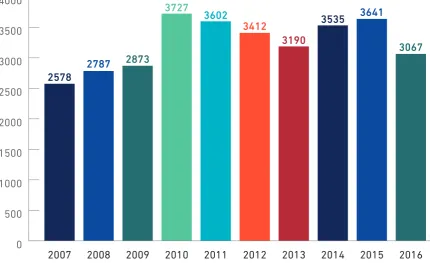
In 2016, the total number of complaints received by my Office about public service providers within my jurisdiction was 3,067. 79% of these cases were closed within 3 months and 96% were closed within 12 months.
My Office continually strives to improve our service and procedures. In particular we are doing more of our work with both complainants and service providers within our remit by telephone which speeds up our communication and we also have appointed sectoral experts in areas such as health to assist with early intervention to either resolve cases or to allocate them more quickly and appropriately.
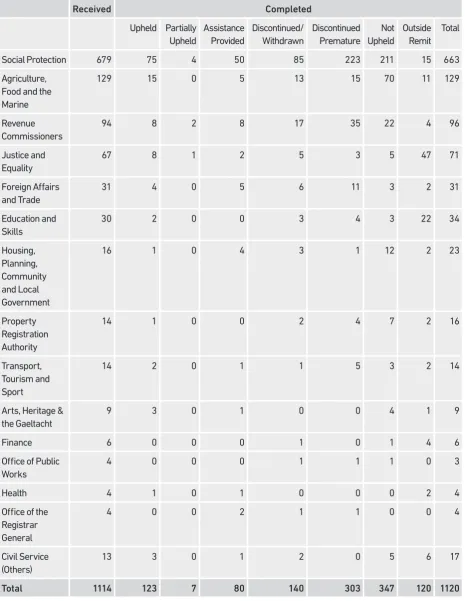
Of the 1,676 cases within my jurisdiction that were substantively examined, 23% of cases were fully upheld, 4% were partially upheld, 19% assistance was provided and 54% were not upheld. Overall, in 46% of cases members of the public directly benefitted from contacting the Office but even where complaints are not upheld, we are often able to provide an explanation or reassurance.
An additional 1,434 complaints were either discontinued, withdrawn or outside remit. Usually in these cases the complainant has not yet completed steps to resolve their complaint with the public service provider and we redirect them back to the local service, inviting them to come back to us if the case is not resolved. In cases that are outside remit we try to provide contact details for the appropriate body who can consider their complaint.
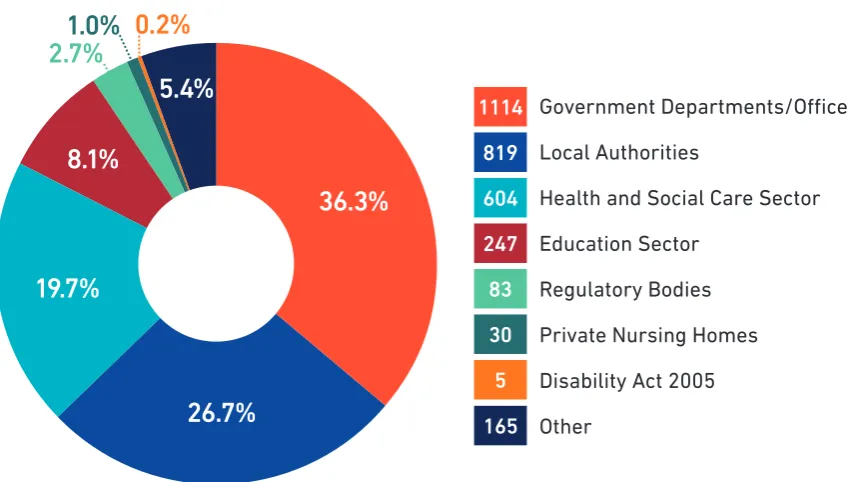
The Government Departments/Offices sector is the largest source of complaints (at 36.3% compared to 38.4% in 2015), followed by Local Authorities (26.7% compared to 27.6% in 2015) and the Health and Social Care Sector (19.7% compared to 17% in 2015). (This is broadly consistent with the volume of interactions that these bodies have with service users).
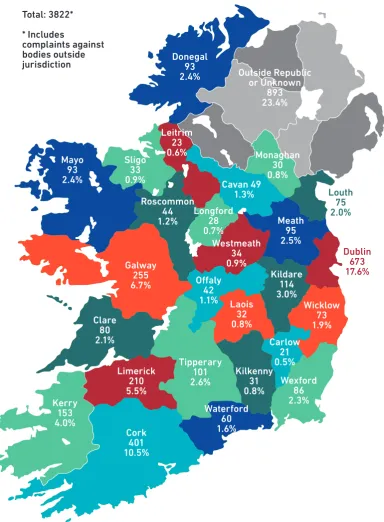
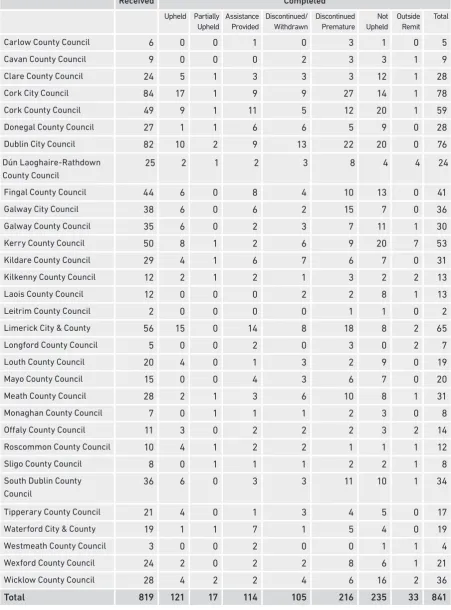
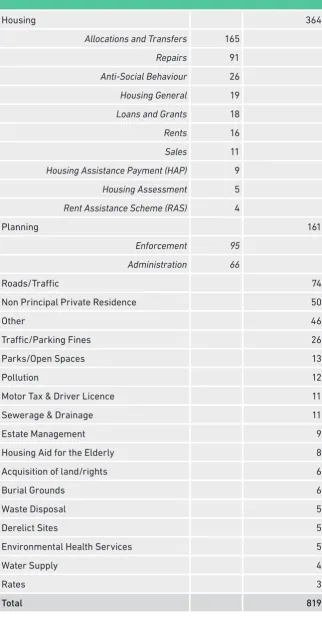
84 of the 819 Local Authority complaints were against Cork City Council, 82 were against Dublin City Council, 56 were against Limerick City and County Council, 50 against Kerry County Council, and 49 against Cork County Council. This is the first time Cork City Council has been higher than Dublin City Council. We will be working with Cork City Council to establish the reasons for this high number of complaints and explore with it how they can be reduced.
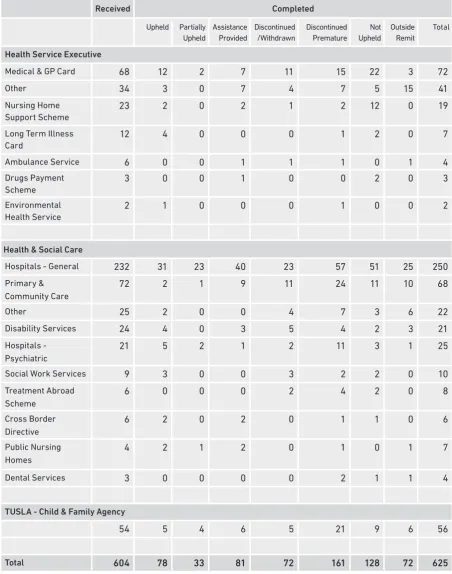
232 of the 604 complaints against the Health and Social Care Sector were against hospitals. 72 related to Primary and Community Care, 68 involved medical or GP cards and 54 were received against Tusla.
A total of 83 complaints were received against Regulatory Bodies, 247 against education bodies such as universities and institutes of technology (including 87 against Student Universal Support Ireland [SUSI]) and 57 against the State Examinations Commission [SEC]), and 165 against other public service providers that first came within my jurisdiction in May 2013. My Office completed 25 of 30 complaints received against private nursing homes during 2016, which was the first full year they were subject to examination. Of the 25 completed, 4 were outside my remit to examine, 8 were premature, 7 were withdrawn, 2 were not upheld, 2 were upheld and 2 partially upheld or assistance provided.
Complaints Received in 2016 by Sector
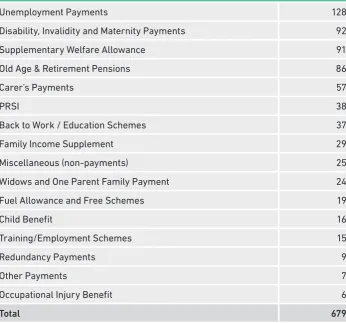
Government Departments/Offices 1114 36.3%
Local Authorities 819 26.7%
Health and Social Care Sector 604 19.7%
Education Sector 247 8.1%
Regulatory Bodies 83 2.7%
Private Nursing Homes 30 1.0%
Disability Act 2005 5 0.2%
Other 165 5.4%
Total 3067 100.0%
‘’We are deeply touched and impressed with your kind,
respectable and independent treatment of the matter.
For that we say a big thanks to you and your office.’’
14 Chapter 2: Putting it Right through Complaints and Investigations
2.3 Putting it Right through Complaints under the
Disability Act
The Disability Act 2005 imposes significant obligations on Government Departments and other public service providers to work proactively towards the improvement of the quality of life of people with disabilities. A complaint can be made to the Ombudsman regarding a public service provider’s failure to comply with Part 3 of the Disability Act. Specifically, the Ombudsman may investigate complaints about access by people with disabilities to public buildings, services and information.
As I have reported in previous years, the low number of complaints about Part 3 of the Disability Act is disappointing (5 received in 2016). It is vitally important that people with disabilities are informed as to their rights on access to services and information and that they are aware of their right of recourse to me as Ombudsman to examine their unresolved complaints. It is also crucial that both professional and non-professional people involved in the disability sector are knowledgeable about the Disability Act 2005.
It is important to note, however that many complaints about services for disabled people come to my Office in the usual way, for example, complaints about the Housing Adaptation Grant for People with a Disability or the DARE scheme.
Disability Act – Complaints Received and Completed in 2016
Received Completed
Upheld Partially Upheld
Assistance Provided
Discontinued /Withdrawn
Discontinued Premature
Not Upheld
Outside Remit
Total
Complaints Handling (S.38 to S.39)
3 1 0 2 0 0 1 0 4
Access to Services (S.26)
2 0 0 0 0 1 1 0 2
2.4 Section 7 Notices - Failures to Cooperate with the
Ombudsman
Section 7 of the Ombudsman Act 1980 (as amended) confers very significant powers on the Ombudsman in terms of acquiring documents and information necessary for the examination or investigation of complaints. Under the Act, there is a legal obligation placed on “any person who, in the opinion of the Ombudsman, is in possession of information, or has a document or thing in his power or control, that is relevant to the examination or investigation” to provide that material to the Ombudsman.
In almost every case the information I need is provided to my Office without the necessity to issue a section 7 notice. My Annual Report is used to publish the number of occasions where I have issued a section 7 notice.
During 2016 my Office was required to issue two section 7 notices:
One notice related to information I sought from the Property Services Appeals Board which the Board has refused to provide to me. Regretfully, I have had to issue proceedings in the Circuit Court seeking direction that the Board complies with my request.
The other one related to a complaint concerning St. Margaret’s Centre Sisters of Charity, a voluntary nursing home. This complaint was subsequently brought to a satisfactory conclusion.
2.5 Putting it Right by dealing with systemic problems
Much of my Office’s work involves examining individual complaints about public services and, where we find fault, putting it right for that individual. However, where an individual complaint raises broader systemic issues I will work with the service provider to resolve the issue and so benefit many future users of the service. I have outlined some of this work during 2016 below.
State Examinations Commission: Complaints about assistance refused at
Leaving Certificate examinations
16 Chapter 2: Putting it Right through Complaints and Investigations
The majority of complaints I receive relate to students with specific learning difficulties (SLDs). Many complained they were not informed of the reasons for the refusals, while others complained that the result of their appeal was not made known until the month before the exams commenced, sometimes even the week before. What particularly upset students was that most of them had been provided with accommodations when sitting their Junior Certificate exams and they had an expectation that they would be provided with the same for the Leaving Certificate.
In 2016, I received a total of 52 complaints about the RACE scheme. The majority were received in May, leaving very little time for students to prepare themselves for the
eventuality that they were either going to be provided with or denied the accommodations they sought. Complainants, who are almost always parents, highlighted that this was a cause of enormous stress for students in the month before their Leaving Certificate examinations. Given the time sensitive nature of these complaints I put in place a fast-track complaints examination process with the cooperation of the SEC. The majority of complaints were concluded within a few days. 21 were upheld.
Over the past two years I have been in regular discussion with the SEC, identifying systemic issues of concern arising from case examinations.
The SEC has responded positively by:
i. taking steps to simplify and speed up the process for assessing RACE applications
ii. introducing a system to ensure students fully understand the reason their application
was declined, and
iii. agreeing to allow students, who are awarded RACE accommodations for their Junior
Certificate examinations, to keep those accommodations for their Leaving Certificate examinations.
As a consequence I expect to see fewer complaints in the future.
Procedural Improvements to the DARE and HEAR education schemes
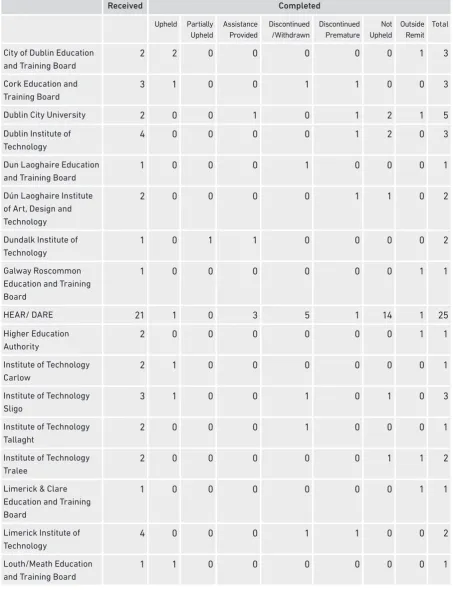
In 2016, I received 21 complaints from students who applied for the DARE or HEAR schemes. My Office has a very good relationship with the DARE/ HEAR administration which has enabled me to resolve the complaints I receive. I highlighted some systemic weaknesses in the application process to the administrators which were acknowledged and I am pleased to say they resulted in improvements to the scheme. These include:
Some students had complained to me that the online form was difficult to complete and, as a result, they had been disqualified from the schemes. I raised these issues with the IUA and I am pleased to say that the online form has been amended to reduce the possibility of errors being made.
Detailed reasons are now being given to candidates whose applications were refused.
Where an error in the original application led to an unfair refusal candidates are now given an opportunity to correct certain application details at appeal stage.
Student Universal Support Ireland (SUSI): Refusal of Funding and Claims
for Repayment of Funding
In 2016 I received 87 complaints from students in relation to grant applications to SUSI for further and higher education courses. Most of the complaints concerned a refusal of funding while, in a small number of cases, SUSI had sought repayment of grants after SUSI realised it had incorrectly granted funding.
In the ‘overpayment’ cases the students had completed their applications correctly and fully disclosed their circumstances to SUSI. From my examination of the cases it was clear that the overpayments had arisen as a result of errors made by SUSI. In some cases repayment of grants was sought 2-3 years after the funding had been given, or after the funding had been used by students to pay accommodation expenses and fees to colleges. I considered it unfair to now expect the students to find or borrow the money required to repay the funding. I met with SUSI and the Department of Education and Skills to discuss these cases. As a result, I am pleased to say that the Department and SUSI decided not to pursue repayment of the funding.
Our examination of a number of other complaints highlighted anomalies in the conditions required to be eligible for funding under the SUSI scheme.
18 Chapter 2: Putting it Right through Complaints and Investigations
Similarly the Student Grant Scheme has been amended so that recipients of Family Income Supplement are considered to be holders of an eligible payment whether they are the principal earner in the household or the dependant adult.
Students who do not have Irish Citizenship but were born to non-EU citizens who acquired Irish Citizenship, have now been added as eligible students.
‘Second chance students’ who attended a post-leaving certificate foundation (NFQ level 5) course were not eligible for SUSI funding in the first year of their NFQ level 5 course, as they were not considered to be ‘progressing in education’. Such students are now considered to be eligible students provided they meet all other qualifying conditions.
I would like to acknowledge the cooperation of SUSI and the Department in addressing these issues.
Complaints about the Department of Social Protection seeking repayment
of welfare payments
During 2015 and 2016, I noticed an increase in the number of complaints to my Office from people who had been, or who were currently, in receipt of social welfare payments and who had received notice from the Department of Social Protection that they had been overpaid. The Department was demanding repayment from them. The periods during which the overpayments accrued ranged from relatively recently to over 20 years ago. The amounts also ranged from €1,000 to over €100,000.
An examination of these complaints raised significant concerns so I decided to initiate a systemic examination of the Department’s processes in raising and collecting overpayment debts from claimants.
My Office examined local overpayment files held in two Dublin Intreo Offices. In October 2016, I sent a report of our findings to the Department for its consideration and response.
During 2016, my Office examined other individual complaints received from overpaid social welfare claimants. A total of 55 overpayment complaints have been examined. 25 have been finalised and closed. Of those closed, I upheld 15 (60%) and the overpayments were written-off by the Department.
The Department of Social Protection has strong powers of recovery in the case of
overpayments made to social welfare claimants. In my discussions with the Department, among other things, I placed an emphasis on:
‘Poverty proofing’ – to ensure that the rate of overpayment recovery does not cause undue hardship for claimants
Minimum standard of documentation – all documentation pertinent to the identification and raising of an overpayment debt must be maintained
My systemic examination of social welfare processes for recovering overpayments is continuing in 2017. I am grateful to the Department for its cooperation.
Confusion over the Cross Border Healthcare scheme
In 2016 I received a small number of complaints about the Cross Border Healthcare scheme. The scheme gives people resident in Ireland the option of having public health treatment in another EU country. People in Ireland often avail of the scheme due to long waiting-lists for some publicly funded treatments here. The scheme is administered by the HSE which reimburses the cost of the treatment. Reimbursement is made in line with published rates available from the HSE’s National Contact Point. The cost of treatment is paid in advance by the patient.
The complaints I received were from people who were confused about how the scheme operated or who had difficulties when trying to reclaim the money they spent on their treatment. Very often they were from vulnerable people who were seriously ill and who had to travel outside the country to receive much needed medical treatment.
The Cross Border Healthcare scheme is different to another scheme which is in existence, the Treatment Abroad Scheme. In general, the Treatment Abroad Scheme covers treatments that are not available in Ireland. The Cross Border Healthcare scheme covers treatments that are publicly funded and available in Ireland. (In 2016, I commenced an investigation into the Treatment Abroad Scheme. See later in the Chapter for further information).
In December 2016 I highlighted the issues involved in these complaints. I also worked with the HSE to resolve these complaints and to amend some of the HSE’s procedures to make it easier for people to understand the scheme. I have summarised three of these complaints in Chapter 3 which contains a number summaries of cases my Office dealt with in 2016.
2.6 Putting it Right through Investigations
Almost all the complaints my Office deals with are resolved quickly and informally. I would like to thank the vast majority of public service providers who co-operate with my Office when we receive complaints. In a very small number of cases it is necessary for me to go to a formal investigation stage which can result in my Office making findings and recommendations to the service provider.
20 Chapter 2: Putting it Right through Complaints and Investigations
Investigation into complaint handling and issues identified in complaints
about the Child and Family Agency (TUSLA)
In June 2016 I commenced a systemic investigation into the way complaints are handled within the Child and Family Agency (TUSLA). The investigation examined whether
appropriate policies and procedures are in place and whether these are being properly followed, having regard to TUSLA’s obligation to adhere to fair procedure and natural justice. The investigation involved a review and analysis of key cases which have already been examined by my Office. In addition I examined a random sample of TUSLA complaint files nationally in an effort to assess the adequacy of local complaint handling in cases which had not come to the Ombudsman.
As part of the investigation process my Office also hosted a half day seminar for TUSLA social workers and complaint handlers from around the country on 6 December 2016. Approximately 30 people attended. At the seminar, presentations were made on the work of the Ombudsman and the purpose of the investigation. Feedback was also received from attendees on their day to day work and an anonymous survey questionnaire was completed by the attendees. The output from the seminar will also be covered in the investigation report. The results of the investigation are due to be published early in 2017 and will be available on my Office’s website.
Investigation into the administration of the Magdalen Laundries
Restorative Justice Ex Gratia Scheme
The Magdalen Laundries Restorative Justice Ex Gratia Scheme is administered by the Department of Justice and Equality. The Scheme, which was approved by Government, relates to twelve specific institutions. It is not open to my Office to seek to add any institutions to those approved by the Government.
Applicants who were refused redress under the Scheme had the right to complain to my Office. In most cases which came before my Office the original decision was considered to be correct. In a small number of cases the Department agreed to admit applicants to the Scheme who were originally refused. This followed an analysis of those cases by my Office and a request for a review of the original decision.
In a small number of other cases a request for a review was not acceded to. I decided to initiate an investigation into the administration of the Scheme. This was notified to the Department in December 2016. The investigation report will be published in the second half of 2017.
“Thank you for all your help and support and result during
our complaint against the DSP.
Thank you again”
Investigation into the Treatment Abroad Scheme (TAS)
The HSE administers an EU scheme, the Treatment Abroad Scheme, which provides for patients to receive medical treatment in another EU / EEA state, when it is either not
available in Ireland, or not available within a reasonable timeframe. A referral for treatment abroad must be made by a patient’s Irish based treating consultant and submitted with an application for approval by the TAS scheme administration section of the HSE. The referring consultant must specify the treatment a patient is to receive and certify that the treatment will work. The scheme allows for the referral of public patients to access treatment in the public healthcare system of another EU / EEA member state.
Having examined a number of complaints from patients whose applications for approval under the TAS scheme were refused I became concerned that some patients had been adversely affected because of the administrative process. I decided to initiate a formal investigation into the Treatment Abroad Scheme. The investigation commenced in 2016. A number of patients and a patient representative organisation have been consulted. Key management in the HSE and the Department of Health have been interviewed. A number of medical consultants have also been interviewed. I intend to complete the investigation and publish my findings in 2017.
Mobility Allowance and Motorised Transport Grant Schemes: Update
In 2013 the Department of Health decided to discontinue the Mobility Allowance (MA) and Motorised Transport Grant (MTG) schemes to new applicants following the conclusion of my predecessor’s investigation and subsequent Special Reports by my Office which found the schemes to be in breach of Equal Status legislation. In February 2013 it was announced that a new unified statutory replacement scheme would be put in place. I have previously expressed my concern at the long delay in finalising this new legislation.
The MTG scheme has not operated since its closure. However, since 2013 payments of up to €208.50 have continued to be made by the Health Service Executive to 4,700 people who were in receipt of MA prior to the closure.
In the meantime, the Department of Health has been working on drafting the Health (Transport Support) Bill which will provide for the replacement scheme. According to the Government’s Legislative Programme the Bill is due for publication during the 2017 Spring/ Summer Session.
“I thank you for both, your assistance, and patience, and
must commend you, for the calm and reasonable way you
approached the complex matters which I put to you.”
22 Chapter 5: Putting it Right by Improving our Services
Putting it Right - Ombudsman
Case Studies
Chapter 3: Putting it Right - Ombudsman
Case Studies
In Chapter 2 I summarised the complaints my Office received in 2016. In 27.6% of cases I either upheld or partially upheld the complaint against the service provider. In this Chapter I present summaries of just some of the complaints that I upheld.
AGRICULTURE
3.1 Department changes its mind four years after
accepting €18,000 grant application
Background
A man complained to the Ombudsman when the Department of Agriculture, Food and the Marine initially approved his application for a grant under the Reconstitution/Forest scheme and then four years later revised its decision. On the basis of the initial approval the man had replanted an area of forest at a cost to him of €18,255.
Examination
One of the conditions of the scheme is that the applicant must advise the Department of any previous damage to the forest prior to making an application. The Department said the reason it had changed its decision was that it became aware that the forest area had been damaged by fire prior to the man’s application. However the man said that when he submitted his application in May 2009, he made the Department aware that the forest had been damaged and submitted a report from An Garda Síochána confirming the date of the fire.
Outcome
24 Chapter 3: Putting it right- Ombudsman Case Studies
The Ombudsman considered that the Department had approved the application in the knowledge that there was a breach of the terms and conditions of the scheme. The Department agreed to revise its decision and approved the grant.
3.2 Ombudsman finds farmer’s €27,000 ‘late’ application
made in time
Background
A farmer complained to the Ombudsman when the Department of Agriculture, Food and the Marine failed to approve his and his wife’s 2007 applications under the Farm Improvement Scheme (FIS). The man was informed of the Department’s decision to refuse their applications and his right to appeal the decision only when his solicitor wrote to the Minster for Agriculture in 2011. The Department claimed that it received the applications after the closing date of 21 October 2007. However, the man said he had evidence that the applications were made in time.
Examination
The farmer provided evidence to the Agriculture Appeals Office to show that the applications had been hand-delivered to the Department’s regional office on 18 October 2007. This included a statement from the Teagasc official who delivered the applications, details of the official’s travel claim in respect of the trip to the regional office on 18 October 2007 and a copy of the Teagasc daybook (which contained details of the applications delivered that day). However, the Agriculture Appeals Office concluded that, on the balance of probabilities, the applications were received after the closing date because they were date stamped as received on 22 October 2007.
Outcome
The Ombudsman examined the evidence and asked the Department to reconsider its decision as he felt that there was compelling evidence, including information provided by a State agency, to support the farmer’s claim that the applications had been made in time. The Department reviewed its decision and agreed to pay the farmer and his wife €27,100 in respect of their applications.
3.3 Department sought repayment of €25,000 from man
after his land flooded
Background
Examination
The Department maintained that the man knew that his land was prone to flooding when he made the application for the grant in 2004. It also maintained that the man was partially responsible for damage to the forest.
The Ombudsman discovered that the Department had inspected the man’s land and had been made aware that the land may be prone to flooding prior to granting the man’s application. In addition, the Ombudsman was satisfied that the Department’s definition of ‘force majeure’ applied in this particular case and therefore, the man was not responsible for the destruction of the forest.
Outcome
The Ombudsman decided that the Department had acted unfairly in seeking recovery of the money. The Department agreed not to pursue the repayment.
Full details of this case are on the Office of the Ombudsman’s website.
SOCIAL PROTECTION
3.4 Department wrong not to backdate man’s Invalidity
Pension
Background
A man who had a disability since 2011 was granted Disability Allowance by the Department of Social Protection later that year. In 2013 the Department granted his application for Invalidity Pension. The man then asked that his application for Invalidity Pension be
backdated to November 2011, when he first became disabled. However the Department and subsequently the Social Welfare Appeals Office refused.
Examination
Disability Allowance is means tested and the man received an allowance of approximately €5 per week. However, under the Invalidity Pension scheme the man would have received €190 per week. The man said that the Department’s staff in its local office had incorrectly advised him to apply for Disability Allowance rather than Invalidity Pension in 2011.
The Department had written to him prior to his application for Disability Allowance
suggesting that he may qualify for Invalidity Pension. However, the man has extremely poor literacy skills and had visited the local office to discuss his application and get advice.
26 Chapter 3: Putting it right- Ombudsman Case Studies
Outcome
After reviewing the evidence, the Social Welfare Appeals Office revised its decision. The man’s Invalidity Pension was backdated to 2011 and he received arrears of nearly €11,788 (which included a deduction for the amount of Disability Allowance he had already received).
3.5 Woman’s €20,000 social welfare bill turns into a
refund
Background
A woman complained to the Ombudsman after she wrote to the local office of the
Department of Social Protection and failed to receive a response. The woman had received correspondence from her local office saying that an overpayment of €19,900 had been made to her. The woman was unaware of how this debt arose and had written to the Department for an explanation.
Examination
The Ombudsman contacted the Department’s local office and asked it to respond to the woman’s correspondence. While responding to the Ombudsman the Department also reviewed the woman’s social welfare payments. It discovered that her application had not been processed correctly. The woman’s income had been recalculated a number of times resulting in different outcomes, while in considering her husband’s income the Department had failed to take account of an illness that reduced his income.
Outcome
Following the review, Department discovered that not only had there been no overpayment but that the woman was entitled to a refund of approximately €700.
HEALTH
3.6 Poor A&E treatment resolved after meeting with
hospital
Background
Examination
In January 2015, the woman formally complained to the hospital. She set out her concerns, and asked that her son’s care and treatment plan be reviewed. She referred to the
satisfactory approach adopted in the other hospital. The woman also complained about the behaviour of certain medical staff in the hospital and a number of extremely upsetting incidents her son had endured.
Initially the hospital’s response was encouraging. It promised to arrange a full review of her son’s medical care and treatment plan, to be led by a Consultant from another hospital. It also promised to investigate her allegations relating to the interaction between clinical staff and her son, as well as the family. However, the woman received no further contact from the hospital despite contacting it several times seeking updates and action.
Outcome
The Ombudsman contacted the newly appointed General Manager of the hospital, who intervened, promptly convening a meeting between the hospital and the woman. The woman told the Ombudsman that she and her son were happy with the outcome from the meeting. She said that her son’s admissions to A&E in the hospital had improved and were “very positive and consistent”.
3.7 Series of errors in hospital’s treatment of new mother
Background
A woman who had recently given birth at the Midland Regional Hospital Mullingar was suffering from bleeding and an ongoing pain when she attended for an ultrasound scan. After the scan she was not contacted by the hospital and she subsequently had to attend the Emergency Department. She underwent a procedure to remove some tissue from her uterus and it was discovered that she had developed an infection.
The woman never received a six week follow-up appointment.
A discharge summary was never sent to her GP.
During her readmission to hospital the woman was never informed that she could keep her new baby with her.
Eventually the woman received an apology from the hospital consultant but felt the full extent of her complaint had not been understood by the hospital.
Examination
The Ombudsman’s examination showed that:
28 Chapter 3: Putting it right- Ombudsman Case Studies
the ultrasound scan results had been sent to a junior doctor who was no longer involved in the woman’s care.
a copy of the report was issued to the consultant but he did not receive it until much later.
three letters sent by the woman’s GP to the hospital never received a reply.
Outcome
The hospital has since sent the discharge summary to the GP and apologised to the woman for the upset and distress caused.
The Ombudsman’s examination has led to a number of improvements in the hospital:
the process for issuing discharge letters and follow-up appointments has become more streamlined and they are now prepared on the ward.
a ‘Birth Afterthoughts’ Service has started where a new mother can meet with a senior midwife and discuss any issues of concern.
the processes around the digital radiology system, which was new at the time, have improved.
3.8 Man incorrectly identified as threat to staff on hospital
computer system
Background
A man complained to the Ombudsman after a security guard was called to be present with him when he attended the Emergency Department of Mayo University Hospital. He discovered it was because information, which said that he was a threat to staff, had been recorded on the hospital’s electronic patient information system.
Examination
The hospital could not explain why the information was on its computer system or identify who put the information on the system as it did not record who had made the entry. It was clear the man had never been a threat to staff. The hospital apologised to the man and removed the information.
Outcome
The Ombudsman accepted that the hospital had responded appropriately to the complaint and that its report on the incident was comprehensive. The hospital again apologised and offered to meet the man to discuss his complaint in order to ensure he felt comfortable attending the hospital in the future should he need to do so.
3.9 Complaints about the Cross Border Healthcare
Scheme
The Cross Border Healthcare scheme gives people resident in Ireland the option of having public health treatment in another EU country. People in Ireland often avail of the scheme due to long waiting-lists for some publicly funded treatments. The scheme is administered by the HSE which reimburses the cost of the treatment. Reimbursement is made in line with published rates available from the HSE’s National Contact Point. The cost of treatment is paid in advance by the patient.
I received a number of complaints about the scheme in 2016.
The complaints relate to confusion over the administrative ‘code’ used for treatments or confusion over reimbursement for in-patient and out-patient care. In-patient (or overnight) treatment requires prior approval by the HSE before travelling, and there is an associated code and an agreed cost for each specific treatment. Out-patient (or day care) does not require prior approval.
Case Study 1: Pensioner denied full refund of cross-border hip
replacement operation
In one case a 74 year-old woman complained to the Ombudsman when the HSE did not refund the full cost of her hip operation. The woman had waited over two years on the public waiting list for the operation and had decided to travel to Northern Ireland for treatment under the Cross Border Healthcare scheme. She had paid the full cost of the operation in advance (€12,500 which she had borrowed from a relative) and then sought to reclaim the money from the HSE. However, the pensioner complained to the Ombudsman when the HSE repaid only €10,900 of the cost involved.
The HSE explained that the original approval was based on the information provided by the woman’s consultant. She had originally been approved for a ‘non-standard’ hip replacement operation. After the woman’s surgery, the Northern Ireland consultant had not confirmed that she had received the more expensive ‘non-standard’ surgery. The HSE made a
payment for a less expensive ‘standard’ hip replacement operation but committed to having the woman’s medical chart independently assessed to check whether the more complicated procedure had been provided. When the woman contacted the HSE the independent
30 Chapter 3: Putting it right- Ombudsman Case Studies
HSE apologised to the woman and refunded her the shortfall amounting to €1,600.
Case Study 2: Wrong scheme - wrong information
In another case, a woman who had previously been approved for in-patient lymphoedema treatment (to control swelling on her legs following cancer treatment) under the Treatment Abroad Scheme (TAS) was initially refused further treatment under that scheme. She was then incorrectly advised to apply for treatment under the Cross Border Healthcare scheme before eventually being approved for treatment under the Treatment Abroad Scheme.
The woman was not informed that she could have appealed the HSE’s initial decision to refuse her TAS application. Instead, the HSE told her to apply for treatment under the Cross Border Healthcare (CBH) scheme. According to the HSE, the treatment she needed was available on an out-patient basis in Ireland. This was incorrect. While out-patient care is available here for some lymphoedema patients, the woman required a more intensive form of in-patient treatment for her condition which is not currently available in Ireland. Therefore, her application should have been considered under the Treatment Abroad Scheme rather than the Cross Border Healthcare scheme.
After paying in advance for her treatment abroad under the CBH, she was advised by the HSE that she needed to submit a ‘treating code’. However, there are no HSE treating codes for out-patient care abroad. In desperation the woman turned to her private healthcare which provided a contribution towards the costs. After she complained to the Ombudsman the HSE agreed to refund the balance to her (€2,900). The HSE also agreed to approve future lymphoedema treatment for the woman under the Treatment Abroad Scheme and to consider applications for other patients in a similar situation.
Case Study 3: Difference in day care costs versus in-patient care
A third case involved a man who had received approval from the HSE for in-patient treatment (involving an overnight stay) for carpal tunnel syndrome in both his hands. The man paid in advance for his in-patient care in a Northern Ireland hospital at a cost of nearly €7,000 but was well enough to leave the hospital on the same day as his operation. Therefore, he was deemed to be a day patient and should have received a refund from the hospital. However, when the man sought a refund from the hospital it was refused. The hospital said that the cost was the same whether he went home the same day or remained overnight.
In this case, the HSE could not have been expected to know that the man would be
discharged as a day patient having issued approval for him to receive in-patient care. The HSE, in consultation with the Office of the Ombudsman, has altered its approval letter to inform patients of the range of possibilities under the scheme and about their entitlements.
LOCAL AUTHORITY
3.10 Man unfairly charged penalties on ‘second-home tax’
In recent years I have received a number of complaints about the Non Principal Private Residence charge (also known as the ‘second-home’ tax). Many of these came from home owners living abroad who claim they were not aware of the charge. I upheld such complaints in a very limited number of circumstances such as the ones set out in this next case.
Background
A man was charged €6,230 in late payment penalties by Cork City Council for failing to pay his Non Principal Private Residence charge (NPPR) on time for a house he owned in Cork. The man and his wife live in Australia and rarely visited Ireland. He bought the property before the tax was introduced in 2009 and said that he was unaware that such a payment was due. The man rented the property out and had engaged an auctioneer to deal with any maintenance issues that might arise during the tenancy. He had no objection to paying the €1,000 charge but sought to have the late payment penalty removed.
Examination
NPPR was a tax applied from 2009-2013 in respect of a residential property that was not the owner’s only or main residence in those years. It was a self-declaration tax and the onus was on the owner to register the property and pay the tax. The Ombudsman agreed a framework with Local Authorities in relation to NPPR charges. They provided that if a property owner, living abroad, satisfied a number of conditions they would be is eligible for a 50% reduction in late payment penalties.
The man was not notified of his liability by the Council before the penalties accrued. He rarely visited Ireland, did not own more than one property liable for NPPR, and he did not have his property managed by an agent.
The Council accepted that the Auctioneer had a very limited role in dealing with maintenance issues and did not manage the property.
Outcome
32 Chapter 3: Putting it right- Ombudsman Case Studies
3.11 Council reaches agreement with man after garden
wall built in wrong place
Background
A man discovered that a boundary wall at the end of his garden had been built in the wrong place. He wanted to renovate his garden but part of the garden was now in the physical possession of Kildare County Council which had purchased the neighbouring property.
Examination
He had purchased his home in 2002. At the time, the wall at the end of his garden was completely overgrown. He had cleared the overgrown hedge and discovered that the wall was in the wrong position. The Council purchased the neighbouring property in 2008 - six years after the man purchased his house. The dividing wall pre-existed the Council’s purchase of the land.
Outcome
The Ombudsman was pleased that the Council agreed to undertake remedial works and to share the cost of re-siting and rebuilding the boundary wall. This allowed the man access to his full garden.
EDUCATION
In Chapter 2 I referred to a number of complaints I received about Student Universal Support Ireland (SUSI). My staff have worked with SUSI to address the issues raised in these complaints and I would like to acknowledge the cooperation of SUSI and the
Department of Education and Skills in addressing these issues. I set out summaries of two of the complaints my Office resolved during 2016.
3.12 SUSI accepts late application after technical
difficulties
Background
A student complained when, unlike many other students, he did not receive a reminder from SUSI to renew his higher education grant. As a result, SUSI refused his late application for the grant and he was left with no money to pay college registration fees, etc.
Examination
Outcome
As a result of the technical difficulties experienced within SUSI it agreed to accept a late application form from the student.
3.13 Student’s step-father not given equal treatment in
grant scheme
Background
A student complained to the Ombudsman when her application for a means-tested student grant was refused by SUSI. The income of an applicant’s parent or guardian can be
considered in assessing the household income. However, in this case, SUSI said that the income of the girl’s step-father could not be included as a ‘step-father’ was not included in the definition of ‘parent or guardian’ in its legislation. The student complained that the grant was designed to support students from low-income households and that students from households with exactly the same means would be eligible for the grant if their ‘natural’ parents were still married and living together.
Examination
The student had applied for the ‘Special Rate Grant’. For a student to be eligible, the household income must be below a specified amount and the student’s parent or guardian must be in receipt of a ‘qualifying payment’ which includes certain social welfare payments.
In the student’s case the family’s income was below the threshold and the family was in receipt of a social welfare payment - Family Income Supplement (FIS). However, the FIS was being paid in the name of the step-father on behalf of the family. SUSI took the view that as her step-father was excluded from the definition of ‘parent’ and as the FIS was in his name, the student’s mother was not in receipt of a qualifying payment. Therefore the student was not eligible for the Special Rate Grant.
When the Ombudsman contacted the Department of Social Protection it said that even though FIS is payable to one applicant, a husband and wife are deemed to be joint
applicants, with each having the same obligations and responsibilities under the scheme. In the circumstances, the Ombudsman considered it unfair to refuse the application for the student grant.
Outcome
Following the Ombudsman’s discussions with the Department of Social Protection and the Department of Education and Skills, the student was awarded a payment of €2,890.
34 Chapter 5: Putting it Right by Improving our Services
Putting it Right by Improving
Public Services
Chapter 4: Putting it Right by Improving
Public Services
One of our strategic objectives is to drive improvements in the wider public service. We do this is a number of ways. If there is learning from the individual complaints we examine then we highlight this to the service provider involved. Sometimes a single complaint or group of complaints can highlight a systemic issue which, if resolved, can benefit a large number of people dealing with the service provider and avoid similar complaints arising in the future. We discussed some of the systemic issues we discovered in 2016 in Chapter 2. We also share learning from complaints we examine in a number of other ways, for example, through The Ombudsman’s Casebook, in meetings with local service providers and by issuing general guidance to service providers.
4.1 The Ombudsman’s Casebook
Since becoming Ombudsman I have been working to make the learning from cases considered by my Office much more widely available.
One of the ways of doing this has been through The Ombudsman’s Casebook, a quarterly publication.
The quarterly Casebook provides summaries of cases we have dealt with over the previous months in the Office. It describes complaints across all the areas the Office deals with, such as Health, Social Welfare, Education, Local Government, Agriculture, Taxation and Nursing Homes.
It is circulated in digital format to over 2,500 officials in public service providers, members of the Oireachtas and other public representatives. It is also available on my website, www. ombudsman.ie.
36 Chapter 4: Putting it Right by Improving Public Services
I published the ninth edition of The Ombudsman’s Casebook in December 2016. I also published a special Kerry edition of the Casebook, summarising complaints I received from that county, to coincide with our Kerry Outreach Event in September 2016. In October 2016 I published a special ‘Local Authority’ edition of the Casebook summarising complaints I receive about local authority issues such as Housing and Planning. This Casebook was widely circulated to key officials across the local authority sector. The aim is to learn from what works and does not work in the local authority sector.
4.2 Putting it Right around the country
While complaints can be made to my Office by letter, email, online and in person at our Dublin office I am aware that many people want to meet in person outside Dublin and need assistance with their complaint. I also wish to engage with public representatives and the many providers of public services located around the country. With that in mind we have carried out a number of ‘regional’ events in 2016.
Kerry Outreach Event 2016
On 22 and 23 September 2016 my Office organised a major outreach event in Tralee, County Kerry. The event consisted of a number of initiatives over the two days:
i. Conference: ‘Learning from the Kingdom’s Complaints: How complaints can improve public services’
This half-day conference was attended by key officials from public service providers in Kerry such as the HSE, hospitals and local authorities. A number of local TDs and representatives from voluntary groups also attended. I, and two of my officials, set out the type of complaints we receive from Kerry; the aim of the quarterly publication The
Ombudsman Casebook; and how we can work together to improve the delivery of public services. We had an extremely positive discussion with those who attended which should benefit the work of us all in the future.
ii. Meetings with local public service providers
While in Kerry I also met with senior management in University Hospital Kerry, Kerry County Council and the Intreo Centre in Tralee. We discussed the issues facing public service providers in Kerry and, in the case of University Hospital Kerry, the recommendations in my investigation report – Learning To Get Better.
iii. Training session for staff of Citizens Information Centres in Kerry
Citizens Information Centres (CICs) provide an excellent service to people around the country, including providing advice and assistance to the public in their dealings with public service providers under my jurisdiction. In Kerry we took the opportunity to explain to staff of Kerry CICs the type of complaints we can deal with and how they can take complaints from the public on our behalf. Again this event was extremely useful and we look forward to working closely with the CICs in the future to benefit the public.
iv. Complaint-taking service for the public
Staff from my Office held a full day clinic in Tralee, to take complaints from the public and provide advice and assistance to callers. I was pleased that we were able to help quite a number of people and visitors commented on the benefits of being able to meet our staff and use our services in person.
I am pleased to say that we received extremely positive feedback from those we met and we plan to arrange a similar event in another part of the country in 2017.
38 Chapter 4: Putting it Right by Improving Public Services
Visits to the Citizens Information Centres (CICs)
To improve access to people living outside Dublin, staff from my Office visit Citizen
Information Centres (CICs) to take complaints from members of the public. Monthly visits to Cork, Limerick and Galway continue to provide a valuable local service, easily accessible to people living there.
During 2016, Ombudsman staff were available on 35 occasions to provide advice and assistance and to take complaints from the public.
Limerick CIC in 2016
37 complaints were received.
Galway CIC in 2016
41 complaints were received.
Cork CIC in 2016
84 complaints were received.
Our visits to the CICs also gave us the opportunity to provide assistance to nearly 200 other people whose complaints were not within our remit or where they had not taken up the matter with the public service provider in the first instance.
Training for CIC Staff
Apart from our monthly visits we provided information and guidance to CIC staff in Galway, Limerick and Cork on complaint taking and on the role of the Ombudsman. This training enabled CIC staff to provide advice to CIC visitors on how to make a complaint and on whether to refer a complaint to the Ombudsman.
Participation at Exhibitions
1. Cork Adult Education & Training Exhibition
The Office has had a long standing presence at this two-day exhibition held every September. Attendance has been extremely useful in promoting the role and function of the Office in the Southern region.
2. 50Plus Shows in Galway and Dublin
The 50Plus show is a popular event attracting approximately 23,000 people over three days. Staff members were present at shows in Galway and Dublin and to answer questions about the role of the Office and provide advice and assistance to members of the public.
Claire Kelly, Rebecca Connolly and Orla Cafferky from the Office of the Ombudsman at the 50plus expo in Dublin
4.3 Putting it Right by extending the Ombudsman’s
jurisdiction to all public services
Direct Provision
As I reported in my 2015 Annual Report (page 20) the barrier preventing me from taking complaints about the day to day administration of direct provision centres was being removed. This was finalised in April 2017.
In advance of this, my Office set up a dedicated project team and began to undertake a comprehensive preparatory programme in late 2016 which continued into early 2017. This included the preparation of a detailed Direct Provision ‘Factsheet’ which explains the work of my Office and how residents and others can submit complaints about the administration of direct provision centres.
40 Chapter 4: Putting it Right by Improving Public Services
Direct Provision Factsheet
I would like to thank the Tánaiste and the staff in the Department for their work in relation to this issue.
Prisons
In my view, the legal constraint which prevents my Office from taking complaints about the Irish prison service should be removed.
In April 2016, the then Inspector of Prisons (IOP), Judge Michael Reilly (RIP), published a report which was highly critical of the current prison service complaints system. He said it is not truly independent and is not in line with Ireland’s international obligations.
Following the report, the Tánaiste and Minister for Justice and Equality, Frances Fitzgerald, announced that prisoners should be able to have their complaints independently
investigated by my Office. I warmly welcomed this announcement.
A range of other preparatory work is being undertaken by my Office in anticipation of the extension. This includes a number of meetings with senior officials from the Irish Prison Service (IPS) and the Department of Justice and Equality in relation to a review of and improvement in the current local complaint handling systems within prisons. I wish to place on record my appreciation for the open positive engagement displayed by the IPS and the Department in its dealings with my Office.
‘Ombudsman Behind Bars’ seminar: Complaints about the Prison Service
In anticipation of prison complaints coming under my remit, I was very pleased to be able to host the Prisons Seminar, ‘Ombudsman Behind Bars’, in conjunction with the Ombudsman Association Annual Meeting and Conference. This seminar highlighted the need for an independent complaints system, and explored the experience of other ombudsmen in this area.
The keynote speaker was the late Judge Michael Reilly, Inspector of Prisons in Ireland, who recommended the Ombudsman should be able to examine complaints from prisoners. Also speaking was Howard Sapers, Correctional Investigator for Canada, Dr. Niall Muldoon, Ombudsman for Children, and Niki Maclean, Director of the Scottish Public Services
Ombudsman.
The seminar was attended by key representatives from the prison community, including the Department of Justice, Prison Officers Association, prison governors, Prison Visitors Committees and NGOs.
The seminar was extremely well received by those who attended. I wish to thank all the speakers and participants, and in particular I would like to pay tribute to the commitment and dedication of the late Judge Reilly in his role as Inspector of Prisons.
Clinical Judgement
Under the Ombudsman Act 1980, as amended, I am prevented from pursuing complaints against private nursing homes or the Health Service Executive where the action complained of relates solely to a ‘clinical judgement’ decision.
It can be seen from care and treatment cases which my Office has published over the years that the constraint means that I cannot examine many such complaints in a comprehensive manner. This is frustrating for complainants and leaves them with many unanswered questions.
42 Chapter 4: Putting it Right by Improving Public Services
4.4 Guidance to Public Service Providers on Making an
Apology
My Office has produced a number of guidance documents aimed at assisting public service providers improve delivery of services. In 2016 I issued a ‘Guide to Making a Meaningful Apology’.
Many people who complain to my Office about public services tell me that what they are looking for is for the service provider to acknowledge that something went wrong and to receive a meaningful apology. People tell us they want to be listened to. They want to be reassured that lessons have been learned and that the same mistake does not happen again.
The Guide explains what a meaningful apology is, what people want from an apology as well as the benefits of getting apologies right. I have found that, on many occasions, complaints could have been avoided if an apology had been given by front line staff or a senior
manager.
The Guide is available on my website.
“You have achieved a great deal in having changes
implemented that will be of benefit to other elderly, frail
people. It’s very comforting to know that there is an
organisation we can turn to for help when we cannot resolve
matters ourselves.”
-A Complainant
“I and my family cannot thank you enough for all you have
done for us. You persevered with my uncle’s case and you got
us results and answers. We genuinely appreciate all the time
and effort you put into it”.
44 Chapter 5: Putting it Right by Improving our Services
Putting it Right by Improving
our Services
Chapter 5: Putting it Right by Improving our
Services
5.1 Strategic Plan and Values 2016-2018
The 2016 – 2018 Statement of Strategy provides a roadmap for realising a three-year
growth strategy for my Office. The following high level objectives were identified as primary enablers in the achievement of my Office’s vision:
We will drive improvements in the wider public service
We will deliver a customer focused service that reflects our core values.
We will develop and enhance our management and administrative frameworks to
enable and underpin our objectives of improving the wider public service and delivering an excellent customer focused service.
My Office also identified organisational values, which set out the qualities that my staff are expected to demonstrate when carrying out their duties, namely:
Fairness
Independence
Innovation
Customer Focus
Empathy
46 Chapter 5: Putting it Right by Improving our Services
The values were promoted throughout the organisation by a dedicated committee represented by staff at all grades. The values are central to my Office’s work and are embedded in our practices and systems.
The significant progress made by my staff in respect of the Strategic Statement’s Key Objectives is evident throughout the contents of this Annual Report. Business Plans supporting these goals have been devised at the beginning of each successive year. The implementation of those plans, and their context within the overall Strategic Statement, have been monitored internally and reviewed on a quarterly basis. This has allowed the Management Team to assess and measure progress and to implement adjustments to their respective Business Plans where necessary.
In 2017 I look forward to:
enhanced management information in order to more effectively identify and analyse trends,
further streamlining the process through which members of the public can complain about public service providers and
realising the benefits from our investment in technology for new case and document management systems.
5.2 Section 42 of the Human Rights and Equality
Commission Act 2014
The Irish Human Rights and Equality Commission Act 2014 introduces a positive duty on public service providers to have due regard to human rights and equality issues.
My Office has responsibility to promote equality, prevent discrimination and protect the human rights of our employees, complainants, services users and everyone affected by our policies and plans. This is a legal obligation, called the Public Sector Duty, which emanates from Section 42 of the Irish Human Rights and Equality Commission Act 2014. However, the role of my Office stretches beyond a consideration of this legality to consider whether actions of public service providers are just and whether they are fair. Securing equality of opportunity and respect for human rights is at the heart of the work of my Office.
My Office is committed to providing a service to all clients that respects their human rights and their right to equal treatment. This is equally applicable to how we interact with our own staff as it is essential in fostering a healthy work environment that promotes engagement, openness and dignity in the work place. Our approach is underlined by our core organisational values of independence, customer focus and fairness, which are evident in both the culture of our Office and our internal policies and practices. We have been
5.3 Delivering our services efficiently: ICT Developments
Up to date ICT systems and infrastructure are critical to delivering on our objectives to provide a customer focused service and improve