AN EFFICIENT PROTOCOL FOR THE SYNTHESIS OF
1,2,4-TRIAZOLO[1,5-
A
]PYRIMIDINES
J. P. Chandrani and K. J. Ganatra*
M. V. M. Science College, Rajkot-360 005.
ABSTRACT
An efficient protocol for the synthesis of diversified
1,2,4-triazolo[1,5-a]pyrimidine derivatives was undertaken by using
5-amino,1,2,4-triazole as a building block via one-pot Biginelli synthesis. The
synthesized analogues were fully characterized by known
spectroscopic techniques like FT-IR, 1H NMR, 13C NMR, and mass
spectroscopy.
KEYWORDS: An Efficient protocol, 1,2,4-triazolo[1,5-a]pyrimidine, 5-amino,1,2,4-triazole, Spectroscopic techniques.
INTRODUCTION
In 1893 Pietro Biginelli reported one-pot cyclocondensation reaction of b-ketone ester with
aldehydes and urea in the presence of acid and it provides the most covenant and
straightforward route for the synthesis Dihydropyrimidines. However this protocol often
provides poor to moderate yields (20–50%). Recently, due to the various therapeutic and
pharmacological properties such as antitumor potency[1,2], inhibition of KDR kinase[3],
antifungal effect[4] and macrophage activation[5], the Biginelli reaction has received renewed
interest. In order to enhance the efficiency of the Biginelli reaction, various catalysts and
reaction conditions have been studied and many improved procedures catalyzed by different
Lewis and protic acids such as CeCl3[6], Cu(OTf)2[7]a, Cu(BF4)2[7]b, Mg(ClO4)2[8]a, heteropoly
acids[8]b, Y(NO3)3[8]c, Ziegler–Natta[8]d, PhB(OH)2[9]a, propane phosphonic acid anhydride[9]b.
As part of our continued interest in the Biginelli reaction[10], Herein, we report a facile and
efficient multi-component synthesis of 1,2,4-triazolo[1,5-a]pyrimidine in excellent yields.
The use of 3-amino-1,2,4-triazole, aldehydes and ethyl 3-oxo hexanoate in the presence of
Volume 6, Issue 16, 800-805. Research Article ISSN 2277– 7105
Article Received on 10 October 2017,
Revised on 30 October 2017, Accepted on 20 Nov. 2017
DOI: 10.20959/wjpr201716-10226
*Corresponding Author
Dr. K. J. Ganatra
M. V. M. Science College,
containing an appropriate 1,3-bifunctional synthon has been undertaken. The structures of all
the newly synthesized compounds were elucidated by FT-IR, mass spectra, 1H NMR, 13C
NMR and elemental analysis.
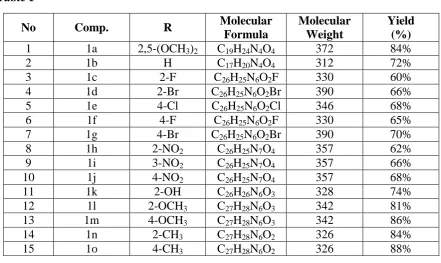
[Insert table I here]
MATERIALS AND METHODS
Melting points were determined in open capillary tubes and are uncorrected. Formation of the
compounds was routinely checked by TLC on silica gel-G plates of 0.5 mm thickness and
spots were located by iodine. IR spectra were recorded Shimadzu FT-IR-8400 instrument
using KBr pellet method. Mass spectra were recorded on Shimadzu GC-MS-QP-2010 model
using Direct Injection Probe technique. 1H NMR and 13C NMR was determined in DMSO-d6
solution on a Bruker Ac 400 MHz spectrometer. Elemental analysis of the all the synthesized
compounds was carried out on Elemental Vario EL III Carlo Erba 1108 model and the results
are in agreements with the structures assigned.
General procedure for the synthesis of ethyl
7-(2,6-dimethoxyphenyl)-5-propyl-4,7-dihydro-[1,2,4]triazolo[1,5-a]pyrimidine-6-carboxylate
A mixture of the 3-aminotriazole (0.01 mol), ethyl-3-oxohexanoate (0.01 mol) and an
appropriate aromatic aldehyde (0.01 mol) with the addition of catalytic amount of
dimethylformamide was fused on an oil bath for 20-25 min at 140ºC. After cooling, methanol
(~10 mL) was added. The reaction mixture was allowed to stand overnight and then filtered
to give the solid triazolopyrimidine products, which were crystallized from ethanol and
subsequently dried in air.
Ethyl 7-(2,6-dimethoxyphenyl)-5-propyl-4,7-dihydro-[1,2,4]triazolo[1,5-a ]pyrimidine-6-carboxylate (1a)
Yield: 84%; mp 119-122ºC; IR (cm-1): 2935, 1699, 1581, 1552, 1496, 1462, 1219, 1022, 871;
1
H NMR (DMSO-d6) δ ppm: 0.973 (t, 3H, Ha), 1.031-1.066 (t, 3H), 1.615-1.633 (m, 2H),
2.88 (m, 2H), 3.624 (s, 3H), 3.656 (s, 3H), 3.917-3.930 (m, 2H) 6.459 (s, 1H), 6.708-6.716
(d, 1H), 6.782-6.811 (dd, 1H), 6.863-6.884 (d, 1H), 7.570 (s, 1H), 10.68 (s, 1H),13.143 (s,
1H); MS: m/z 373; Anal. Calcd. for C19H24N4O4: C, 61.28; H, 6.50; N, 15.04. Found: C,
Ethyl 7-phenyl-5-propyl-4,7-dihydro-[1,2,4]triazolo[1,5-a]pyrimidine-6-carboxylate (1b) Yield: 72%; mp 106-108ºC; IR (cm-1): 3030, 2922, 2874, 1695, 1604, 1551, 1511,
1485,1442, 1411, 1332, 1245, 1027, 690; 1H NMR (DMSO-d6) δ ppm: 0.90-0.95 (m, 6H),
1.54-1.57 (d, 2H), 2.51-2.58 (m, 2H), 3.58-3.87 (m, 2H), 5.22 (s, 1H), 6.77-6.79 (d, 1H),
7.24-7.26 (d, 2H), 7.40-7.42 (d, 2H), 10.69 (s, 1H), 13.15 (s, 1H); MS: m/z 312; Anal. Calcd.
for C17H20N4O2: C, 65.37; H, 6.45; N, 17.94. Found: C, 65.48; H, 6.54; N, 17.96%.
Ethyl 7-(4-bromophenyl)-5-propyl-4,7-dihydro-[1,2,4]triazolo[1,5-a]pyrimidine-6-carboxylate (1g)
Yield: 70%; mp 117-119ºC; IR (cm-1): 3024, 2922, 2868, 1690, 1618, 1550, 1510, 1479,
1442, 1413, 1329, 1280, 1247, 1033, 696; 1H NMR (DMSO-d6) δ ppm: 0.92-0.95 (m, 6H),
1.54-1.57 (d, 2H), 2.51-2.57 (m, 2H), 3.39-3.90 (m, 2H), 5.17 (s, 1H), 7.27-7.28 (d, 2H),
7.46-7.48 (d, 2H), 10.60 (s, 1H), 13.16 (s, 1H); MS: m/z 392; Anal. Calcd. for C17H19BrN4O2:
C, 52.19; H, 4.89; N, 14.32. Found: C, 52.22; H, 4.93; N, 14.46%.
RESULTS AND DISCUSSION
In order to develop efficient synthesis, we first examined the reaction in different solvents
including acetonitrile, ethanol, dioxane, toluene and solvent-free at 100 C. The best results
were obtained under solvent-free conditions. The reaction with aromatic aldehydes carrying
electron-donating substituents gave the corresponding triazolopyrimidines in good yields
with the use of catalytic amount of dimethylformamide.
[Insert Scheme-I here]
Table 1
CONCLUSION
In nutshell, an efficient method for the preparation of substituted triazolopyrimidine catalyzed
by dimethylformamide under neutral and solvent-free conditions. Moderate to good yields of
the corresponding to triazolopyrimidine were obtained from readily available starting
materials.
ACKNOWLEDGEMENTS
The authors are thankful to the Department of Chemistry, Saurashtra University, Rajkot, for
providing the analytical services. I also wish to acknowledge Principal, M. V. M. Science
College, Rajkot for providing research facility.
CONFLICT OF INTEREST
The authors have reported no conflict of interest.
REFERENCE
1. Zhang N, Semiramis AK, Thai N, Jay A, Richard H, Judy L, James G, Carl B. (Synthesis
and SAR of [1, 2, 4] triazolo [1, 5-a] pyrimidines, a class of anticancer agents with a
unique mechanism of tubulin inhibition). Journal of medicinal chemistry, 2007; 50(2):
319-327.
No Comp. R Molecular
Formula
Molecular Weight
Yield (%) 1 1a 2,5-(OCH3)2 C19H24N4O4 372 84%
2 1b H C17H20N4O4 312 72%
3 1c 2-F C26H25N6O2F 330 60%
4 1d 2-Br C26H25N6O2Br 390 66%
5 1e 4-Cl C26H25N6O2Cl 346 68%
6 1f 4-F C26H25N6O2F 330 65%
7 1g 4-Br C26H25N6O2Br 390 70%
8 1h 2-NO2 C26H25N7O4 357 62%
9 1i 3-NO2 C26H25N7O4 357 66%
10 1j 4-NO2 C26H25N7O4 357 68%
11 1k 2-OH C26H26N6O3 328 74%
12 1l 2-OCH3 C27H28N6O3 342 81%
13 1m 4-OCH3 C27H28N6O3 342 86%
14 1n 2-CH3 C27H28N6O2 326 84%
2. Zhao XL, Yan FZ, Guo SC, Song HS, Wang D, Gong P. (Synthesis and Anti-tumor
Activities of Novel [1, 2, 4] triazolo [1, 5-a] pyrimidines). Molecules, 2007; 12(5):
1136-1146.
3. Fraley ME, Hoffman WF, Rubino RS. (Synthesis and initial SAR studies of 3,
6-disubstituted pyrazolo [1, 5-a] pyrimidines: a new class of KDR kinase inhibitors).
Bioorganic and Medicinal Chemistry Letter, 2002; 12: 2767.
4. Borthakur SK, Borthakur S, Goswami D, Boruah P, Kalita PK. (Synthesis and Antifungal
Activities of Some New 5, 7‐Disubstituted [1, 2, 4] Triazolo [1, 5‐a] Pyrimidin‐6‐one
Derivatives). Journal of Heterocyclic Chemistry, 2016; 53(6): 2079-2083.
5. Zhou L, Jamila I, Patrick S, Kris T, Goldman M, Olivier P. (Inhibition of the CD40
pathway of monocyte activation by triazolopyrimidine). Clinical immunology, 1999;
93(3): 232-238.
6. Bose DS, Fatima L, Mereyala HB. (Green Chemistry Approaches to the Synthesis of
5-Alkoxycarbonyl-4-aryl-3,4- dihydropyrimidin-2(1H)-ones by a Three-Component
Coupling of One-Pot Condensation Reaction: Comparison of Ethanol, Water, and
Solvent-free Conditions). Journal of Organic Chemistry, 2003; 68: 587.
7. (a)Paraskar AS, Dewkar GK, Sudalai A. (Cu (OTf)2: a reusable catalyst for high-yield
synthesis of 3, 4-dihydropyrimidin-2 (1H)-ones). Tetrahedron Letter, 2003; 44: 3305; (b)
Kamal A, Krishnaji T, Azhar MA. (Copper (II) tetrafluoroborate as a mild and efficient
catalyst for the one-pot synthesis of 3, 4-dihydropyrimidin-2 (1H)-ones under solvent-free
conditions). Catalytic Communication, 2007; 8: 1929.
8. Zhang X, Li Y, Liu CJ. Wang, Journal of Molecular Catalysis, 2006; 207: 253; (b) Rafiee
E, Shahbazi F, Journal of Molecular Catalysis, 2006; 57: 250; (c) Nandurkar NS,
Bhanushali MJ, Bhor MD, Bhanage BM, (Y (NO 3) 3· 6H 2 O: a novel and reusable
catalyst for one pot synthesis of 3, 4-dihydropyrimidin-2 (1H)-ones under solvent-free
conditions). Journal of Molecular Catalysis, 2007; 14: 271; (d) Kumar A, Maurya RA,
(Synthesis of 3, 4-dihydropyrimidin-2 (1H)-ones using Ziegler–Natta catalyst system
under solvent free conditions). Journal of Molecular Catalysis, 2007; 53: 272.
9. Debache A, Boumoud B, Amimour M, Belfaitah A, Rhouati S, Carboni B,
(Phenylboronic acid as a mild and efficient catalyst for Biginelli reaction) Tetrahedron
Letter, 2006; 47: 5697; (b) Zumpe FL, Flu. BM, Schmitz K, Lender A, (One-pot synthesis
catalyzed by triphenylphosphine as Lewis base). Tetrahedron Letter, 2008; 49: 6119; (d)
Suzuki I, Iwata Y, Takeda K, (Biginelli reactions catalyzed by hydrazine type
organocatalyst). Tetrahedron Letter, 2008; 49: 3238.