Mark
et
in
g
A
N
H
U
R
A
D
A
Y
AN H UR A DA
Y
Create Relationships and Revenue
with Winning Email Marketing Campaigns
A Step-by-Step Guide
Email delivers signifi cant ROI, increases brand loyalty, and is one of the most powerful tools in your marketing arsenal when used properly. Are you getting the most out of your current efforts? Are your campaigns profi table? Are you building brand equity? Are you integrating campaigns with other channels? Renowned email marketers Jeanniey Mullen and David L. Daniels offer a fresh, insightful look at modern email marketing in today’s customer-centric marketplace. They’ll alert you to the newest concepts, hottest trends, most budget-friendly tools, and best practices— while they help you build, deploy, and manage a smart, day-by-day plan for success.
• Leverage eight different ways to use email for better results • Use website analytics to improve your email efforts
• Create multichannel marketing strategies from your email database • Set up high-impact video- and audio-enabled emails
• Develop email strategies for mobile devices and social networks • Track, measure, analyze, and report your results
You’ll also fi nd:
• What not to do when you send an email
• Straightforward tools for adding email to your current marketing plan and getting budget approval
• Online resources, cheat sheets, a glossary, and much more
• Real-world “From the Trenches” case studies that illustrate successes to learn from and mistakes to avoid
$29.99 US $32.99 CAN
ISBN 978-0-470-38673-6
Mullen Daniels
www.sybex.com
www.sybex.com/go/emailmarketinghouraday COMPUTERS/Internet/General
About the Authors
Jeanniey Mullen is the Executive Vice President and Chief Marketing Offi cer for Zinio and VIVmag and is also the
founder and Chairperson of the Email Experience Council. She is an expert in the email and online marketing world and has more than two decades of experience helping B2B and B2C clients such as IBM, Yahoo!, and American Express harness the power of a digital dialog to drive revenue, improve brand impact, and enhance customer relationships.
David L. Daniels is a multichannel marketing consultant who has been the leading analyst voice shaping the email
marketing industry. David currently serves as Vice President and principal analyst with Forrester Research. Prior to his role as an industry analyst, David held senior level positions at Apple, Urban Outfi tters/Anthropologie, MicroWarehouse, Genesis Direct/ProTeam, and CDA Computer Sales.
Praise for
Email Marketing:
An Hour a Day
“You don’t have to quit your day job to start or radically improve your email marketing program. Just set this book and a decent pen next to wherever you brew your coffee. You and your bottom line will be glad you did.”
—Tom Gerace, CEO and founder, Gather.com
“Jeanniey and David have written a book in which the power of email marketing becomes simple to understand and easy to implement.”
—Dr. Ramesh A. Lakshmi-Ratan, Executive Vice-President and Chief Operating Offi cer, Direct Marketing Association
“Common wisdom advises that ‘the money is in the list.’ That is absolutely true if you provide the proper experience. This book gives you real-world advice on planning campaigns for maximum impact, how to measure and improve your campaign’s effectiveness, and how to do it based on your budget and resources.”
—Bryan Eisenberg, New York Times author of Waiting For Your Cats to Bark?
Marketing
J e a n n i e y M u l l e n
a n d
D a v i d D a n i e l s
A N H U R A D A Y
A N H U R A D A Y
SERIOUS SKILLS.
86736ffirs.indd i
Advance Praise for
Email Marketing: An Hour a Day
“ Email Marketing: An Hour a Day is one of the best overall guides I’ve seen for bring-ing marketers quickly and painlessly to a place where email can be a truly strategic marketing channel. It is, quite simply, the on-ramp for the next generation of sophis-ticated email marketers.”
— Bill Nussey, CEO, Silverpop; author of The Quiet Revolution in Email Marketing
“ David and Jeanniey have taken their years of knowledge of the email marketing industry and stuffed them into a readable book jam-packed with little a-ha! nuggets that are certain to improve any email effort. Written to contain layers of information for all levels of email marketers, beginner to advanced, this book ensures that you will take away from it what you put into it.”
— Jordan Ayan, chairman and founder of SubscriberMail; author of Aha! 10 Ways to Free Your Creative Spirit and Find Your Great Ideas and The Practical Guide to Email Marketing: Strategies and Tactics for Inbox Success
“ There is so much unnecessary mystery around email marketing. David and Jeanniey have put the myths to rest and given marketers a straightforward and actionable primer on how to build a fantastic, customer-centric email marketing program. If you read only one book on this topic, this should be it!”
— Dan Springer, CEO, Responsys; board of directors for ITI, E-LOAN, and the Randall Museum
“ The world-renowned expertise of Daniels and Mullen is at its best here, because they break down the mysteries of email marketing into digestible nuggets that make it easy for every busy marketer to consume.”
— Alan Chapell, Esq., chairman and founder of Chapell and Associates
“ Email marketing is a powerful tool. It is also complicated. Just when you get your strategy right, your reputation is challenged. When you fi x that, your creative for-mats are not adhering to best practices. Email marketing could possibly be one of the most challenging and complex marketing channels out there. Knowing where to go and how to focus are key. Jeanniey Mullen and David Daniels have taken our collec-tive challenges head-on and provide you with the solutions you need to know in this book. Read this book, and you will immediately have a better handle on your email marketing efforts.”
—Matt Blumberg, CEO, Return Path
86736ffirs.indd i
“ David and Jeanniey are tremendous advocates for the responsible and effective use of email marketing. These impressive thought leaders understand that email market-ing is the backbone of all digital communications. When others predicted the demise of email, both of these industry champions defended the medium and pointed out its evolving value to marketers and subscribers alike. Their insights are thought-provoking, are humorous, and always deliver value to marketers. I read every word that both authors write.”
—Scott Dorsey, CEO, ExactTarget
“ Technology evangelists are a rare breed. They not only need to be the experts in their fi elds—on top of every new innovation, thought, and trend—but they also need to be able to express their knowledge with enthusiasm, passion, energy, clarity, and excitement. It doesn’t hurt if they are entertaining as all get out as well. I’ve shared more stages, rental cars, airplanes, and bar stools with David and Jeanniey than I care to remember, and I can tell you these two are the best in the business. What the heck…buy the book and fi nd out for yourself. You won’t be sorry, and you’ll be a much smarter person on the last page than you were when you started on page one.”
— Bill McCloskey, chairman, cofounder, and chief evangelist, Email Data Source, Inc.
“ For any marketing channel to stay viable, it has to constantly improve. I am impressed with the enthusiasm and fresh ideas that David and Jeanniey continue to bring to the email industry. In Email Marketing: An Hour a Day, David and Jeanniey do not disappoint, because this book offers compelling and proven tactics to advance the effectiveness of email as well as practical guidance on how to prioritize and inte-grate emerging channels such as social and mobile communications. It’s a must-have for any marketer.”
—John Rizzi, CEO, e-Dialog
“ While there are many books on email marketing, few come with the credentials and real-world breadth of exposure that David and Jeanniey bring to this research. Balancing vast experiences in the email marketing space with a very broad analyst reality of the dynamics in the channels, vendors, and market dynamics, they’ve devel-oped a book that provides a baseline understanding of the email channel in a very logical fl ow and that provides the relevant context that helps marketers understand how to improve this ever-evolving channel. As two of the leading thought leaders in the email marketing space, this is a great contribution to our industry and a worthy read for anyone doing email marketing in their business.”
—David Baker, vice president of Email Solutions, Razorfi sh
86736ffirs.indd ii
Marketing
An Hour a Day
J e a n n i e y M u l l e n
D a v i d D a n i e l s
86736ffirs.indd iii
Senior Acquisitions Editor: Willem Knibbe
Development Editor: Jim Compton
Technical Editor: Jared Blank
Production Editor: Melissa Lopez
Copy Editor: Kim Wimpsett
Production Manager: Tim Tate
Vice President and Executive Group Publisher: Richard Swadley
Vice President and Executive Publisher: Joseph B. Wikert
Vice President and Publisher: Neil Edde
Compositor: Maureen Forys, Happenstance Type-O-Rama
Proofreader: David Fine, WordOne
Indexer: Jack Lewis
Cover Designer: Ryan Sneed
Cover Image: © Thomas Northcut / Digital Vision / GETTY IMAGES INC
Copyright © 2009 by Wiley Publishing, Inc., Indianapolis, Indiana
Published simultaneously in Canada
ISBN: 978-0-470-38673-6
No part of this publication may be reproduced, stored in a retrieval system or transmitted in any form or by any means, electronic, mechani-cal, photocopying, recording, scanning or otherwise, except as permitted under Sections 107 or 108 of the 1976 United States Copyright Act, without either the prior written permission of the Publisher, or authorization through payment of the appropriate per-copy fee to the Copyright Clearance Center, 222 Rosewood Drive, Danvers, MA 01923, (978) 750-8400, fax (978) 646-8600. Requests to the Publisher for permission should be addressed to the Legal Department, Wiley Publishing, Inc., 10475 Crosspoint Blvd., Indianapolis, IN 46256, (317) 572-3447, fax (317) 572-4355, or online at http://www.wiley.com/go/permissions.
Limit of Liability/Disclaimer of Warranty: The publisher and the author make no representations or warranties with respect to the accuracy or completeness of the contents of this work and specifically disclaim all warranties, including without limitation warranties of fitness for a par-ticular purpose. No warranty may be created or extended by sales or promotional materials. The advice and strategies contained herein may not be suitable for every situation. This work is sold with the understanding that the publisher is not engaged in rendering legal, accounting, or other professional services. If professional assistance is required, the services of a competent professional person should be sought. Neither the publisher nor the author shall be liable for damages arising herefrom. The fact that an organization or Web site is referred to in this work as a citation and/or a potential source of further information does not mean that the author or the publisher endorses the information the organiza-tion or Web site may provide or recommendaorganiza-tions it may make. Further, readers should be aware that Internet Web sites listed in this work may have changed or disappeared between when this work was written and when it is read.
For general information on our other products and services or to obtain technical support, please contact our Customer Care Department within the U.S. at (800) 762-2974, outside the U.S. at (317) 572-3993 or fax (317) 572-4002.
Wiley also publishes its books in a variety of electronic formats. Some content that appears in print may not be available in electronic books.
Library of Congress Cataloging-in-Publication Data Mullen, Jeanniey.
Email marketing : an hour a day / Jeanniey Mullen, David Daniels. p. cm.
ISBN 978-0-470-38673-6 (pbk.)
1. Internet marketing. 2. Telemarketing. 3. Electronic mail messages. I. Daniels, David , 1970- II. Title. HF5415.1265.M853 2009
658.8’72—dc22
2008040281
TRADEMARKS: Wiley, the Wiley logo, and the Sybex logo are trademarks or registered trademarks of John Wiley & Sons, Inc. and/or its affiliates, in the United States and other countries, and may not be used without written permission. All other trademarks are the property of their respective owners. Wiley Publishing, Inc., is not associated with any product or vendor mentioned in this book.
10 9 8 7 6 5 4 3 2 1
86736ffirs.indd iv
Dear Reader,
Thank you for choosing Email Marketing: An Hour a Day. This book is part of a family of pre-mium-quality Sybex books, all of which are written by outstanding authors who combine practi-cal experience with a gift for teaching.
Sybex was founded in 1976. More than 30 years later, we’re still committed to producing consistently exceptional books. With each of our titles, we’re working hard to set a new standard for the industry. From the paper we print on to the authors we work with, our goal is to bring you the best books available.
I hope you see all that refl ected in these pages. I’d be very interested to hear your com-ments and get your feedback on how we’re doing. Feel free to let me know what you think about this or any other Sybex book by sending me an email at [email protected], or if you think you’ve found a technical error in this book, please visit http://sybex.custhelp.com. Customer feedback is critical to our efforts at Sybex.
Best regards,
Neil Edde
Vice President and Publisher Sybex, an imprint of Wiley
86736ffirs.indd v
Acknowledgments
The email marketing is one of the most supportive and tight-knit marketing com-munities there is. Every person in this fi eld truly works to ensure their own programs are fantastic yet is quick to lend a hand (or a case study) to a fellow email marketer in need. Being part of this industry gives you a sense of pride that is unmatched. With that said, there are so many people we owe thanks to for making this book the work of art that it has turned out to be. So, with no further ado, here they are.
First and foremost, a tremendous amount of thanks goes to our families (Chris, Giovanna, Kristina, Cherry, Ashley, and Ethan) for putting up with us while we took on this project. It truly has been a labor of love.
David would like to especially thank his parents and stepfather, authors and educators alike, for instilling the passion of continuous improvement and the value of authoring a published book. David is also grateful to his brother Marc who started and shaped David’s direct marketing and online commerce journey back in the 1980s.
Jeanniey would like to extend a special thank you to her parents, whose pro-vided encouragement in whatever it was she set her mind out to do has helped build her undying spirit and perseverance in every endeavor.
Also a special thanks to David Schatsky at JupiterResearch, a Forrester Research Company, and the Email Experience Council for their generous offering of the use of data and their support of our efforts in undertaking such a project. Thanks to the entire Zinio and VIV teams for their continued support during the completion of this book at a time when we were also undertaking the transformation of the publishing world.
For those of you in the email world—a huge thanks to all of you. But a very special thanks to those who helped make this book so powerful, including the following:
Kathryn Waters, Stephanie Jackson, Andrea Allman, and Ali Swerdlow—not only great friends but the bestest girls in email
Jared Blank, the best tech editor out there
86736ffirs.indd vi
Alan Chappell, of Chappell & Associates, our favorite privacy attorney Dylan Boyd, Boba Fett, and the team at eROI
Lisa Harmon and Aaron Smith from Smith-Harmon
David Atlas, Charles Styles, and Jordan Cohen at Goodmail Systems Des Cahill, Eric Mott, and Ray Everett-Church
Josh Baer, Quinn Jolie, Dave Hendricks, Lana McGilvray, and the entire Datran Media crew
Lizzie Maughn and her amazing team at Think Eyetracking, who knew where we really ever looked
Matt Blumberg and the knowledgeable Return Path team
Chip House, Morgan Stewart, Jeff Rohrs, and the entire crew at ExactTarget
David Baker, Chris Baggot, Bill McCloskey, Jeanne Jennings, Reggie Brady, and the entire old-school team of email marketing experts that contributed to this whole phenomenon Loren McDonald and the team at Silverpop
Craig Spiezle of Microsoft and of Authentication and Online Trust Alliance (AOTA) fame Willem Knibbe, Jim Compton, Kim Wimpsett, Melissa Lopez, Pete Gaughan, and the entire team at Wiley
And to MP for knowing how to inspire a great fi nal product
Lastly, we’d like to acknowledge you for taking the time to pick this book up and begin the journey that we believe will make you a master of email marketing.
86736ffirs.indd vii
About the Authors
Jeanniey Mullen
is executive vice president and chief marketing offi cer for Zinio, the global leader for digital publishing products and services. She holds the same position for VIV Magazine, the fi rst fully interactive and all-digital lifestyle magazine for women. An accomplished expert in the email and online marketing world, Jeanniey is recognized as a pioneer and visionary, advocat-ing for and drivadvocat-ing change that redefi nes the impact of various marketadvocat-ing channels. Prior to Zinio and VIV, Jeanniey was the senior partner and global executive director of the Email Marketing and Digital Dialogue Practice at OgilvyOne Worldwide. In 2005, Jeanniey founded the Email Experience Council and currently maintains her role as its executive director.A digital entrepreneur, Jeanniey founded and ran her own interactive agency as well as an online entertainment marketing company from 2001 to 2004. Prior to that, Jeanniey started the fi rst agency-run email marketing division at Grey Direct. Jeanniey also held a number of roles at JCPenney, spanning an eight-year period.
Jeanniey is known as one of the most well-respected voices in the world of email, digital publishing, and online consumer brand awareness. She is a columnist for ClickZ, has pub-lished numerous white papers and best practices guides, and has been quoted in the Wall Street Journal and New York Times numerous times. She is on the board of advisors for a number of online marketing companies and events and is a frequent keynote speaker for various compa-nies and organizations including the Direct Marketing Association, Shop.org, OMMA, IBM, NaturesMade, and the American Association of Publishing.
David Daniels
is a tenured multichannel marketer, consultant, and researcher, and since 2000 he has been the leading analyst voice shaping the email marketing industry. David currently serves as vice president and principal analyst at Forrester Research, which acquired JupiterResearch in July 2008. Prior to Forrester’s acquisition of JupiterResearch, David served as vice president and research director of the company’s successful Operations and Industries product grouping where he authored and collaborated on market research that informed, evaluated, and accurately forecast the future of the broader online economy. David’s compass-setting research studies on email marketing are famil-iar and cited throughout the industry. With 20 years of experience in direct-to-consumer marketing, Daniels is recognized as a thought leader in his domain, is a frequent keynote speaker, and is often quoted in the Wall Street Journal, the New York Times, and other major media outlets.Outside of serving as the leading email marketing market analyst, David founded the Email Measurement Accuracy Coalition in 2006, and in 2008 it became the Email Experience Council’s Email Measurement Accuracy Roundtable, which David co-chairs. David is also a board advisor to a variety of industry associations and events including the Authentication and Online Trust Alliance (AOTA) and MediaPost’s Email Insider Summit.
Prior to joining JupiterResearch, David served as president of his own marketing and operations consulting fi rm (1 World Design). Before striking out on his own, David held senior-level positions at Apple Computer, Urban Outfi tters / Anthropologie, MicroWarehouse, Genesis Direct / ProTeam, and CDA Computer Sales, which was one of the fi rst personal computer cata-log marketers and merchants on CompuServe.
86736ffirs.indd viii
Contents
Foreword xv
Introduction xvii
Chapter 1 Understanding Email Marketing Today
1
How We Got Here. . . 2
What Email Means to Your Audience . . . 5
The Five Types of Email . . . 6
Awareness 8 Consideration 9 Conversion 10
Product Usage 10
Loyalty 12
Understanding the Economic Impact of Email . . . 14
Test Your Knowledge. . . 15
Chapter 2 The Five Critical Elements of Every Email You Create
17
Creating Brand Impact . . . 18
Determining How Much Brand Equity Your Emails Carry 19
Adding Intelligence to Your Design . . . 22
Basic Elements of Intelligent Email 22
Using This Insight to Your Advantage 24
Driving the Purchase . . . 26
Waging the War Against Email ADD 28
Beyond the Email Content: What You Need to Know 29
Creating Transactional/Service Messages . . . 30
Adding Viral Marketing Elements. . . 34
Two Ways to Define Success of Your Viral Marketing Efforts 35 Best Practices for Creating a Buzz Using Viral Efforts or Word of Mouth 36
Test Your Knowledge. . . 37
Chapter 3 Getting Ready to Build Your Email Marketing Efforts
39
Aligning Your Strategy with Your Tools . . . 40
Determining Your Tools: A Ten-Point Strategy 40
Evaluating Vendors . . . 44
A Checklist to Maximize Your Vendor Selection Process 45
86736ftoc.indd ix
x
C
ON
T
E
N
T
S
■
Organizational Readiness: Resources Required for Success . . . 49
Budgeting for the Future . . . 52
Justification: Selling Your Boss on the Return on Investing in Email . 53 Test Your Knowledge. . . 55
Chapter 4 What Happens Once You Send Your Email
57
Defining the Analytics Framework . . . 58Start with Your Email Marketing Plan, and Expand It to Include Your Company Growth Plan 59 What to Do If Something Goes Wrong . . . 64
So, What Do You Do When It Happens to You? 67 Revisiting Your Budget . . . 68
The Email Marketing Database and Future Multichannel Efforts . . . 70
Phase 1: Awareness 71 Phase 2: Engagement 71 Phase 3: Consideration 71 Phase 4: The Buy 72 Making the Most of Your Email in a Multichannel Environment 72 What This Means When You Are Setting Up Your Initial Email Database 72 The Top Five Ways You Can Mess Things Up If You Are Not Really Careful . . . 74
Test Your Knowledge. . . 75
Chapter 5 Eight Key Drivers of Your Email Campaign
77
Key Driver 1: Email Address Acquisition . . . 78Your Website 78 Other Channels 82 Third-Party Sources 84 Welcome to the Campaign! 87 Key Driver 2: Creative/Copy . . . 88
The From Line 89 Subject Lines 89 The Spam Check 90 The Width of Your Email Template 91 The Length of Your Email Template: Work Above the Fold 92 Email Creative Best Practices 92 Key Driver 3: Making the Data Work . . . 93
Key Driver 4: Multichannel Integration. . . 95
Key Driver 5: Technology (Delivery, Deployment, and Design). . . 96
Key Driver 6: Reporting/Analytics . . . 98
86736ftoc.indd x
xi
■
CO
N
T
E
N
TS
Key Driver 7: Privacy/Governmental Control . . . 100
State Registries 101
Privacy Policy Best Practices 101
Key Driver 8: Reactivation . . . 104
Test Your Knowledge. . . 105
Chapter 6 Preparing Your Email Marketing Strategy
107
Week 1: Preparing Your Resource Arsenal . . . 108
Monday: Getting Smart (the Seven Essential Truths About Email Marketing) 109
Tuesday: Evaluating Tools and Resources 112
Wednesday: Budgeting 116
Thursday: Related Marketing Initiatives 119
Friday: Getting the Boss to Sign the Check 123
Week 2: Building the Blueprint for Success . . . 124
Monday: Evaluating Your Current House File and File Size Needs 125
Tuesday: Creating the Acquisition Plans 126
Wednesday: Focusing on the Opt-in Process and Customer Preference Centers 128
Thursday: Reviewing the Opt-out Process 132
Friday: Making Sure Your Landing Pages Are a Good Place to Land 133
Week 3: Counting Down to “Go Time” . . . 138
Monday: Mapping Out a Realistic Strategy 139
Tuesday: Defining Your Data Transfer Process 142 Wednesday: Making Sure Your Tracking Links Will Work 144 Thursday: Checking for the Deliverability Basics 147
Friday: Testing for Actionability 151
Week 4: Testing Your Way to the First Campaign. . . 152
Monday: Choosing the Subject Line Strategy 152 Tuesday: Making Sure Your Content Can Be Seen 153 Wednesday: Ensuring Personalization Is Accurate 156 Thursday: Remembering That Emails Get Forwarded and Saved 158 Friday: Going Through the Success Checklist One More Time 159
Test Your Knowledge. . . 159
Chapter 7 Month 2: Ensuring Success as You Launch Your Campaign
161
Week 1: Sending Your First Campaign . . . 162
Monday: What to Do Once You Hit Send 162
Tuesday: Reading Reports 163
Wednesday: Managing Customer Service Replies 166 Thursday: Matching Your Response Rates to Your Forecast and Plan 167 Friday: Keeping Your Database Clean and Your Reputation Strong 169
Week 2: Creating a Plan to Optimize Your Results . . . 171
Monday: What Your Reports Are Really Saying 171 Tuesday: Analyzing the Effectiveness of Your Creative 173 Wednesday: Pulling Together the Comprehensive Report 178 Thursday: Optimizing the Opt-in Points on Your Website 180
Friday: Creating Your Test 184
86736ftoc.indd xi
xii
C
ON
T
E
N
T
S
■
Week 3: Measuring Email’s Impact on Other Channels . . . 187
Monday: Measuring the Role of Email in a Customer’s Purchase 188 Tuesday: Determining the Value of Your Email Addresses and Campaigns 193 Wednesday: Increasing Email Sending Costs to Improve Top-Line Results 196 Thursday: Exploring Web Analytics and Email Integration 198 Friday: Finding and Targeting Your Advocates 202
Week 4: Promoting Your Email Results Within Your Organization . 206
Monday: Affecting Email Used in Other Parts of Your Organization 206 Tuesday: Sharing Results with Your Online Peers 209 Wednesday: Sharing Results with Your Offline Peers 210 Thursday: Using Your Email Results for PR Purposes 211
Friday: Looking Ahead to Dynamic Content 213
Test Your Knowledge. . . 214
Chapter 8 Month 3: Adding Bells and Whistles
215
Week 1: Using Email as a Feedback Tool. . . 216
Monday: Leveraging Email Surveys 216
Tuesday: Designing an Email Survey 217
Wednesday: Polls in Emails 220
Thursday: Email Focus Groups 221
Friday: Email-Driven Testimonials 222
Week 2: Creating Video- and Audio-Enabled Emails . . . 226
Monday: Deciding Whether Using Audio or Video Is Right for Your Emails 227 Tuesday: Building the Five Layered Emails 228
Wednesday: Making Your Video Email Viral 230
Thursday: Making Your Video Email an Integrated
Part of a Larger Campaign 232
Friday: Allowing Your Reader to Create Their Own Video Email 233
Week 3: Creating Mobile Email . . . 234
Monday: Why Your Email Needs to be Mobile 235
Tuesday: The Mobile Email Creative 236
Wednesday: How Many Readers in Your Database
Are Reading “on the Run”? 239
Thursday: Defining Your Mobile Email Preference Center 240 Friday: Making Your Current Email Strategy Work in a Mobile World 241
Week 4: Creating Social Email . . . 243
Monday: When Email Is Used on Social Networks 244 Tuesday: Response Guidelines for Social Email 245 Wednesday: Reviewing Results for Social Email 247 Thursday: Social Messaging: Thinking Inside the Box 249 Friday: Keeping the Use of Social Email in “Check” 251
Test Your Knowledge. . . 252
Chapter 9 Getting Ready for Year 2 and Beyond
253
Iterative Financial Analysis: Analytics Over Time. . . 254
A Top-Down View of Annual Performance 254
86736ftoc.indd xii
xiii
■
CO
N
T
E
N
TS
Analyzing Individual Subscriber Segment Performance 255
List Health 255
Financial Performance/Budget to Plan Performance 255
The Necessity of Rebudgeting 256
ESP Refresh: Evaluating Your ESP and Technology Partners . . . 257
Assessing Future Trends . . . 260
Journey On . . . 261
Appendix A Vendor Resource List
263
Associations, Events, and Publications . . . 264Email Service Providers . . . 264
Delivery Service Providers and Reputation and Accreditation Management Services . . . 265
Market Research, Agencies, and Consultants . . . 265
Technology Vendors . . . 266
Web Analytics Vendors . . . 266
Appendix B Email Checklists
267
Email Design . . . 268Content 268 Subject Line 268 Preheader/Header 268 Preview Pane 268 Message Construct 269 Recovery Module 269 Footer 269 Code QA Testing . . . 269
Precheck HTML File 269
Precheck Text File 270
Conduct Rendering Testing 271
Glossary
273
Index 284
86736ftoc.indd xiii
86736flast.indd xiv
Foreword
It is not the strongest of the species that survive, nor the most intelligent, but the one most responsive to change.
—Charles Darwin
We live in a world where our mere survival
is based on our ability not only to invent but also to continuously reinvent ourselves as we fi nd new and better ways to adapt to the world around us. Electricity, the telephone, the printing press—all are life-changing inventions that enabled our society to modify the way we experienced living. These inventions enabled us to reinvent the manner in which we approached each element of our daily rituals. Without a con-tinuous stream of inventions, the human race cannot continue to evolve.There have been many life-altering inventions during the past 200 years. Many of us have been fortunate enough to live during times of great invention and change rather than simply reading about them in a history book. Beginning with the fi rst Internet experiments in the early 1970s, we were witness to one of the world’s great evolutions in communications: the invention of email, an electronic mode of immediate conversation. Since that time, this communication vehicle has become a necessity, adopted by the mainstream population. JupiterResearch forecasts and data indicate that 88 percent of the U.S. online population uses some form of electronic communication, which equates to 77 million people in the United States using this new inven-tion. That’s a staggering number, because it represents three-quarters of the total households in the United States. And while email has been a driver of communication change, it has also rein-vented the way we market and advertise to consumers. No longer do we rely on a one-way mes-sage push with a hope for engagement. We are not constrained to guessing about the relevancy and impact our mass message has. Email as a marketing tool has opened up a world of possibili-ties by enabling a two-way dialogue, personalized messaging, and data-driven analysis. This channel has grown to $1.2 billion in 2007 and is expected to continue to swell to $2.1 billion in 2012.
Recent statistics report that 60 percent of consumers admit they have made immediate purchases from email marketing messages. In 2008, the same reports concluded that 44 percent of consumers stated email marketing messages drove online purchases in the past year and 41 percent reported the same for offl ine purchases.
The message is clear. This new invention called email is a powerful personal and busi-ness tool. It’s one that will live in the same life-altering invention ranks as the telephone. Understanding how to harness and direct email as a marketing vehicle is critical to every busi-ness in any industry. This book will get you started down that path.
To understand this craft called email marketing, I direct you to the two most highly regarded of its evangelists and experts, Jeanniey Mullen and David Daniels. Jeanniey and David not only theorize about email’s role in our world, but they also apply their efforts to re-create
86736flast.indd xv
xvi
F
OR
E
W
OR
D
■
successes that power insights and drive growth. I can say this to you fi rsthand, because I experi-ence these successes daily through the marketing and advertising message employed by Jeanniey and her team at my companies VIVmag and Zinio. I assure you, email marketing is no small feat, yet Jeanniey and David make it look simple and fun.
As you read this book, you will be immediately drawn into the world of email marketing through Jeanniey and David’s wit and charm. Their personalities come shining through, even as they discuss and educate you on the smallest details of the trade. This book speaks to the specif-ics of email marketing, but it opens your mind to a greater manner of viewing relationships with the consumer.
It is with great pleasure that I write this foreword. I hope you fi nd this book as invigorat-ing, enlighteninvigorat-ing, and enjoyable as I did.
Very best, David Gilmour Chairman, VIVmag Chairman, Zinio
About David Gilmour
Canadian-born David Gilmour has enjoyed phenomenal success throughout his entrepreneurial career. In 1969, Gilmour and long-time partner Peter Munk founded the South Pacifi c Hotel Corporation (SPHC), which quickly became the largest hotel chain in the South Pacifi c. A decade later, the chain was sold, and the partners formed Barrick Gold Corporation, now the most profi table and largest gold-mining fi rm in the world. They followed this by forming a real estate company called Horsham Corporation, which became TrizecHahn and today is one of the larg-est publicly traded REIT companies in North America. Gilmour is also the founder of FIJI Water LLC, which in 2004 was the fastest-growing premium beverage in the United States, when he divested himself of the company.
In 1990, Gilmour and his wife, Jill, also opened the Wakaya Club, an exclusive resort on Wakaya Island, Fiji. In 2006, Gilmour founded VIV Publishing LLC, whose fi rst product is an entirely new concept in women’s magazines—a health and lifestyle publication called VIV dis-tributed exclusively in digital form.
Gilmour was presented with the U.S. State Department’s 2004 Award for Corporate Excellence (ACE) by Secretary of State Colin Powell in recognition of the international growth and success of FIJI Water together with its philanthropic endeavors in Fiji. Gilmour was also awarded “The Order of Fiji” by the president of Fiji, Ratu Sir Kamisese Mara, in 1998 for his commercial and philanthropic achievements in the Fiji Islands.
86736flast.indd xvi
Introduction
When you stop and think about it, the concept of email as a communication
vehicle is a revolutionary one. Long before email became a marketing tool,
it was a communication device. The impact that email has had on our
cul-ture and our lives is tremendous. Yet, many people forget the vast change in
communication that email has produced and think of email marketing
sim-ply as a cheap or fast way to sell a product. Email deserves a much higher
level of respect.
This book is your guide to understanding the full marketing potential and impact that email can offer to you or your company. It strives to broaden your mind about the opportunities this amazing communication channel offers, and it provides ways to redefi ne the strategic uses of email as an effective marketing vehicle. And it also, we hope, conveys some of the passion and fervor that the two of us feel about our discipline and hope to share. We have dedicated more than a decade of our lives to evangelizing the role that email currently plays and has the potential to play in our personal and business worlds. Throughout this book, you will be presented with a plethora of real-world and timely examples of what works and does not work, documents and checklists to help you plan your strategy, and questions that will challenge and encourage you to redefi ne and rethink your approach to leveraging email as a communication and marketing vehicle.
The structure of this book was carefully designed to enable every reader, whether a new-comer to the discipline or a veteran, to walk away feeling a sense of broader understanding and appreciation for email marketing. Our biggest challenge was making sure that all the collective intelligence and insights appropriately educate you in a way that also inspires you to take what you read and build upon it. Just providing simple case studies, examples, and checklists would have been a disservice. Those of you who have experience on the front lines of email marketing know, all too well, how challenging of a craft it is. Email marketers need to understand the stra-tegic elements that drive results and how to avoid the technical faux pas, as well as how to design creative, analyze results, and navigate trends. Email marketing is one of those rare trades that requires specifi c expertise in many broad categories. Therefore, this book offers an organized and unique approach to crafting a successful email program from start to fi nish. As you read, you will fi nd yourself being challenged to question your current actions and compare them to our recommendations. As you apply your skills, you will be able to quickly defi ne those areas that will help you excel. This book was designed with the ultimate goal of making you, the reader, successful in your efforts. We want to inspire you to be the best email marketer you can be.
86736flast.indd xvii
xviii
I
NTR
O
D
U
C
T
IO
N
■
This book strives to provide you with information easily applicable to your specifi c needs. If it takes you more than ten seconds to understand how this relates to your business or effort, we have failed. There are success stories and failure stories in this book. We think you need to understand both what to do and what to avoid. You should be able to learn as much from our failures as our successes. We want you to walk away from reading this book completely fulfi lled.
Who Should Buy This Book
Anyone who wants to send or is currently sending an email marketing campaign should buy this book. In fact, anyone who works for a company where email marketing is being used should buy this book. It doesn’t matter which of these describes you:
F
• amiliar with the basics of email marketing C
• urrently sending email marketing campaigns W
• orking for a company with a small budget T
• he only person doing any type of marketing E
• mployed by a large or sophisticated company where email plays a small or insignificant role A
• n experienced email marketer looking to take things to the next level
This book was written to allow the email marketer at any level to increase their level of understanding. It will also expand the perception and increase the level of respect that email marketing gets for any reader who may not currently be on the front lines of email.
If the authors could wish for one thing to happen once you fi nish reading this book, it would be that you share this book with a friend or colleague who may not understand or respect what you do. Those of you who work in the fi eld are all too familiar with the cocktail party situ-ation where someone asks you what your job is, and you say, “Email marketing.” The reply often is, “Oh, so you send spam?” The next time you hear that, give them this book, and ask them to email us. We understand there is so much more to email marketing, and we appreciate it as well. We are here to help you share in our enthusiasm and help us grow this industry’s level of impact even more by enabling better conversations using email.
What’s Inside
Here is a glance at what’s in each chapter:
Chapter 1: Understanding Email Marketing Today begins with a basic overview of the email marketing industry: the origins of email and its uses, the evolution of the channel into a marketing vehicle, and some of the basic elements of email marketing.
Chapter 2: The Five Critical Elements of Every Email You Create provides an overview of the fi ve key roles that email marketing plays in the broader context of marketing and advertising. In this chapter, there is a clear outline of how email marketing can and should be used to achieve different goals.
86736flast.indd xviii
xix
■
INTR
O
D
U
C
TI
O
N
Chapter 3: Getting Ready to Build Your Email Marketing Efforts enables you to start at the beginning of the road of creating successful email marketing campaigns. It covers everything from budgeting effectively to ensuring you have the right tools to the basics of strategy design, and then carefully moves you into a comprehensive role of email market-ing mastery. This chapter ensures you effectively consider all critical aspects of campaign design.
Chapter 4: What Happens Once You Send Your Email is critical to read. It ensures you know what can happen to derail your campaign but, more important, what you can do to avoid it or deal with the sometimes inevitable. This chapter is one of our favorites!
Chapter 5: Eight Key Drivers of Your Email Campaign equips you with the tactics you typically pick up in bits and pieces from industry trade publications. It provides you with checklists and best practices you can literally rip out and save. You will refer to this chap-ter over and over again to ensure you have the right elements in place and are following the critical government and compliance requirements.
Chapter 6: Month 1: Preparing Your Email Marketing Strategy gets into the good stuff. This chapter devotes a large amount of time to helping you build or optimize your email marketing strategy. By leveraging many of the current email campaigns in the market right now, you will be able to evaluate and apply those elements that will match your company’s capabilities as well as defi ciencies.
Chapter 7: Month 2: Ensuring Success as You Launch Your Campaign dives deep into the details of driving results. While Chapter 6 is built for creative and broad thinkers, Chapter 7 fi ts the cravings of those who love and want details. These details are often critical to driving a campaign result that delivers a strong return on investment. This is not a chapter to breeze over. It is a chapter to spend time with and fully digest.
Chapter 8: Month 3: Adding Bells and Whistles kicks it into high gear. Now that your campaign is out the door and you have some results, this chapter persuades even the most advanced email marketers to rethink their efforts and expand email into new areas. It provides insight into the ways in which consumers have adapted technology into their lives and the most important roles email plays as a personal management vehicle. This chapter is one the bloggers will blog about for years to come.
Chapter 9: Getting Ready for Year 2 and Beyond brings us back to the realities of the real world and sets expectations for what will come next. This chapter will keep you on the right track to ensuring your email marketing efforts not only succeed but are suffi ciently supported for continued growth.
In addition, you’ll fi nd a remarkably thorough glossary, which will get you up to speed on all the terminology you’ll encounter in this book and in other print and online discussions of email marketing; and two appendixes, which list the URLs for every vendor and other resource mentioned in the book and provide two checklists from a series created by the DMA/EEC’s Email Design Roundtable.
86736flast.indd xix
xx
I
NTR
O
D
U
C
T
IO
N
■
Finally, from this book’s web page at www.emailmarketinganhouraday.com you can download several Excel spreadsheets for calculations discussed in the book as well as a remarkable PDF example of dynamically generated content discussed in Chapter 8.
Throughout the entire book we offer guidance that will hold true regardless of how the technology, the economy, or even the industry changes. We are thrilled to be able to share our passion with you and encourage you to share those areas of the book you enjoy with others. Oh yeah, we love feedback. Good or bad, critical or supportive, we want to hear from you. Please make sure to drop us a line when you can. Thanks, and enjoy your reading!
How to Contact the Authors
We welcome feedback from you about this book or about books you’d like to see from us in the future. You can reach us by writing to [email protected]. You can also reach us via our profi les on LinkedIn or Facebook or at either of our day jobs.
Wiley strives to keep you supplied with the latest tools and information you need for your work. Please check its website at www.wiley.com, where we’ll post additional content and updates that supplement this book should the need arise. Enter Email Marketing, An Hour A Day in the Search box (or type the book’s ISBN—9780470386736), and click Go to get to the book’s update page.
86736flast.indd xx
1
■
U
ND
E
R
S
T
A
ND
IN
G
E
M
AI
L
MARK
E
TIN
G
T
O
D
A
Y
1
Understanding Email
Marketing Today
Email marketing means different things to
differ-ent people. Some see it as a critical communication
link between consumers and the brands they trust
and love; others see it as a thinly veiled, intrusive
marketing tool. Either way, the email marketing
you conduct today faces stiff competition from the
email communication that is now the backbone
of our digital lifestyles. This chapter starts with a
brief history of email marketing and then looks at
the value email marketing offers companies today.
Chapter Contents
How We Got Here
What Email Means to Your Audience The Five Types of Email
Understanding the Economic Impact of Email
86736c01.indd 1
2
CH
A
P
T
E
R
1:
U
N
D
E
R
S
T
A
N
D
IN
G E
M
A
IL M
A
R
K
E
T
IN
G T
O
D
A
Y
■
How We Got Here
In the early 20th century, noted English mathematician and philosopher Alfred North Whitehead said, “Fundamental progress has to do with the reinterpretation of basic ideas.” The progress in communication, both in scope and velocity, that is embodied by the prevalence of email is at its core a reinterpretation of a new way to communicate through the written word.
Email is progress. It is an integrated and indispensable part of all our lives. Its widespread distribution, made possible by the advent of the Internet, lowered the eco-nomic barrier to global communication and has made it a vital link to our families, friends, and communities. Just like the printing press 500 years before it, email is an effective and effi cient means of mass distribution. Email also provides an easy way to conduct personal one-on-one dialogue.
Email is the most popular form of asynchronous communication; it touches hun-dreds of millions of people around the world every day. Consider for a moment that, as of 2008, 73 percent of the North American population has email. In the United States, consumers spend as many hours online as they spend watching television. And out of all the many benefi ts that such pervasive Internet connectivity affords us, the primary activity that individuals use the Internet for is communicating with others via email. According to the JupiterResearch/Ipsos Insight Individual User Survey (July 2006), 87 percent of consumers in the United States cites email as the top reason for connecting to the Internet.
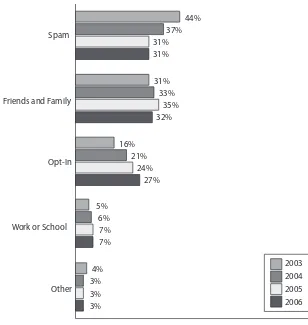
Seventy percent of U.S. Internet users has two personal email accounts, indicat-ing that we need more than one email address to keep up with the many benefi ts of its purpose. The pervasiveness of email is underscored by the volume of messages a person receives. On average, each day email users in the United States receive 41 mes-sages in their primary personal inboxes, with 37 percent saying they receive 31 or more messages daily. Based on the composition of messages they receive in these accounts (Figure 1.1), email users get an average of 10 promotional messages per day in their primary personal inboxes. These numbers are in addition to hundreds of email com-munications that people receive each week at work.
Wr i t e T h i s D o w n:
Today email is considered the backbone of all digital communications.Wr i t e T h i s D o w n:
In 2007, 234 trillion emails were sent. (Source: Omniture)86736c01.indd 2
3
■
H
O
W W
E G
O
T H
E
R
E
Spam
Friends and Family
Work or School Opt-In
Other
44% 37% 31% 31%
31% 33%
35% 32%
16% 21%
24% 27%
5% 6% 7% 7%
4% 3% 3% 3%
2003 2004 2005 2006
0% 20% 40% 60% 80% 100% Mean Percentage of Email Received
(User Perceived) SOURCE
: J
UP
ITER
R
ES
EA
RC
[image:25.639.56.364.55.380.2]H
Figure 1.1 Share of email by type in a consumer’s primary personal inbox, 2003–2006
To summarize those statistics, the share of opt-in permission email in the con-sumer’s primary personal inbox is increasing, and the amount of spam in the inbox is decreasing. According to JupiterResearch, opt-in permission email—mail that ers have explicitly signed up for—accounted for 16 percent of the email in the consum-er’s primary personal inbox in 2003 and increased to 27 percent in 2006. During that same time period, the share of spam decreased from 44 percent to 31 percent.
N o t e:
See the glossary for a complete definition of opt-in and other email marketing terminology you’ll encounter in this book.Email has brought tremendous effi ciency to our lives. For example, it lets us confi rm our purchases and it enables us to communicate with merchants. Spending in online retail in the United States will grow at a combined annual growth rate (CAGR)
86736c01.indd 3
4
CH
A
P
T
E
R
1:
U
N
D
E
R
S
T
A
N
D
IN
G E
M
A
IL M
A
R
K
E
T
IN
G T
O
D
A
Y
■
of 11 percent to reach $215 billion in 2012, which will generate 5 billion pre- and post-sale email contacts for U.S. retailers by that same year. Consumers can easily archive their transactions, and email can be a more effi cient form of customer service than calling a merchant and sitting on hold. The value that we place on email cannot be dismissed.
With the massive amounts of email that we now receive and rely on daily to communicate, you might wonder, How did we get here? How did email become so powerful that it has changed the way the world communicates?
It did not start with Al Gore creating the Internet; he simply brought the U.S. Congress’s attention—and funding—to this new communication medium when it was still in its infancy. Email originated with a group of inspired and hardworking indi-viduals as a forum where professors, technology luminaries, and government offi cials could share ideals and conversations. As with all great ideas, their efforts started small and have now created a connected, global, worldwide society.
We can trace the roots of the commercial Internet and email marketing to 1969, during the Cold War, when the U.S. Defense Department created ARPANET, a com-puter-based messaging system designed to survive a nuclear attack. In its earliest form, this network was nothing more than what is commonly known as a fi le system where one person could post a note for another person to see in a folder.
By the early 1980s, the network had expanded to a small group of universities, all sharing the power of connected digital messaging. Getting connected to an early Internet service like Usenet was no simple matter (Figure 1.2). The computers they used in those early days were “mainframes,” much bigger but much less powerful than the desktops and laptops we have today. At about the same time, the development of increasingly smaller and more powerful microprocessor chips was beginning to make the fi rst personal computers available to the masses. As we all know, the PC quickly became essential to businesses of all kinds, as modern user-friendly software was devel-oped. In the late 1980s, the fi rst commercial providers emerged, such as CompuServe and MCI, and the consumer face of what would be forever known as the Internet soon followed.
This new phenomenon in personal connectivity quickly resulted in conversa-tions around the water cooler such as, “Are you online?” and, “You can fi nd me in the moondance Usenet group.” This created a new world of communication, opening the Internet up not just for personal communication but for businesses as well. Email mar-keting soon emerged as one of the most profi table and effective forms of marmar-keting.
Wr i t e T h i s D o w n:
In 2006, 49 percent of all personal communication in the United Kingdom was written via email. (Source: Forrester)86736c01.indd 4
5
■
W
H
A
T E
M
A
IL M
E
A
N
S T
O Y
O
U
R A
U
D
IE
N
C
E
CD/DVD .iso
.rar .rar .rar .rar .rar .rar
.rar .rar .rar
.rar .rar .rar .rar
.rar .rar .rar
.rar .rar .rar
.rar .yenc
.rar .yenc
.rar .yenc .rar
.rar .yenc
.rar .yenc
.rar .yenc
.rar .yenc
.rar .yenc
.rar .yenc
.par2 .yenc
.par2 .yenc
.par2 .yenc .par2 .par2 .par2
Convert to Binary Image
Split and Compress
Create Parity Files Prepare for UploadEncode Again to
alt.binaries.*
Upload to Newsgroup
Figure 1.2 The complicated process of uploading content and messages to Usenet
Wr i t e T h i s D o w n:
Ray Tomlinson of BBN is credited with inventing email in 1972. In those early days, it is estimated that there were only a few hundred email addresses.Over the past ten years, email marketing has grown into one of the most fl exible and in-demand applications and disciplines of the Internet economy. According to a study by comScore in August 2007, the worldwide web mail market includes more than half a billion people. The Radicati Group projected that there were nearly 1.2 billion hosted email inboxes worldwide as of October 2007, a number that is expected to rise to 1.6 billion by 2011. Email is still an emerging marketing medium, and the industry is young. It’s not too late to start leveraging email, and you can use this book to opti-mize your current practices.
Although few people might have expected it in the beginning, email is now an integrated part of hundreds of millions of lives. It is more than marketing; it is a link to family, friends, and community. It is the lifeblood of the Internet.
What Email Means to Your Audience
Now that you know the history of email and its potential growth implications, you are ready to consider what email and email marketing mean to your audience. This is a critical element to master. Most consumers do not think in terms of marketing emails they receive and personal emails they receive; they differentiate in terms of personal value and relevancy. In fact, the term email marketing may not even resonate with your
86736c01.indd 5
6
CH
A
P
T
E
R
1:
U
N
D
E
R
S
T
A
N
D
IN
G E
M
A
IL M
A
R
K
E
T
IN
G T
O
D
A
Y
■
reader. Consumers love email messages that they feel enhance their lives; here’s what one said at a presentation we gave:
My favorite types of emails are the notices from my online photo-sharing program letting me know my friends have posted new photos. It makes me feel really connected to them and makes me happy.
Participant, Email Experience Council keynote presentation: “The Value of Email, in the Eyes of the User,” 2008
To a smart marketer, understanding and embracing the way our readers consume and relate to email are critical in helping drive success for our marketing programs.
The Five Types of Email
Spending time improving the “in-business” tactical elements will not signifi cantly improve your email marketing efforts if you have not fi rst effectively defi ned why you are embarking on an email marketing campaign, what the ultimate message you want to resonate with your reader is, and how your reader will be able to demonstrate that they have not only understood your message but also acted on it.
Are you ready for the fi ve key types of email you need to know about to create a marketing success? OK then, let’s get down to business.
We believe that out of all the thousands of types of emails you can design, or hundreds of thousands of permutations of creative, i.e. images and markting copy, for your messages, you will ever create only fi ve key types of email messages:
A
• wareness C
• onsideration C
• onversion P
• roduct usage R
• etention and loyalty
As shown in Figure 1.3, these types represent different stages in the overall email campaign. Although the stages are generally distinct, they may overlap over time as your customer and prospects move through the various stages.
As outlined in Table 1.1, each type plays a unique role in helping a company drive home its brand or marketing message with a customer; each incites one of fi ve types of actions. You can effectively choose which type of emails you should send to a customer only once you have identifi ed why you are sending that customer an email. To help you understand this point better, the next sections explain in more depth the fi ve types of email that can be sent.
86736c01.indd 6
7
■
T
H
E F
IV
E T
Y
P
E
S O
F E
M
A
IL
Awareness
Consideration
Conversion
Product Usage
Loyalty
Figure 1.3 The five types of email
씰Table 1.1 How the Five Types of Email Work
Type Communication Goal Email Purpose Example of Email Usage Awareness To make customer aware
of Company X by building imagery
To bridge media (online and offline) to identify interest
Ad placement in email publications (and other email-based initiatives), or using co-registration to deliver high brand-value messaging to the inbox Consideration To bring Company X into the
consideration set (top two or three brands in the category) by consistently promoting the tangible benefits
To accelerate interest and qualification through ben-efits immersion
Capture opt-in from media interest; use email to push people through the tunnel to conversion faster Conversion To close the deal through
a dialogue that overcomes barriers to purchase
To drive customers to sales channels (for example, call center) for conversion
Embed a click-to-call-in email communications that drive customers to call center Product
Usage
To stimulate interest in other products and services
To drive engagement with brand, establish advo-cacy, and set the stage to up-sell/cross-sell
Dynamically populate email offers based on busi-ness rules
Loyalty To broaden and deepen the relationship to promote renewals
To foster and deepen the relationship for lifetime value (LTV) impact
Deliver value-added infor-mation (for example, win-ter driving tips for an auto company) via email
86736c01.indd 7
8
CH
A
P
T
E
R
1:
U
N
D
E
R
S
T
A
N
D
IN
G E
M
A
IL M
A
R
K
E
T
IN
G T
O
D
A
Y
■
Awareness
Forget email marketing for a second, and think about the goal of creating brand or product awareness with your consumer. At this stage, you are simply trying to create awareness that you exist in a consumer’s mind-set.
Now let’s get back to email. Think about how your email campaign—from segmentation to creative and copy design to the call to action and even reporting analysis—will change if the main goal of the email is not to sell but to drive awareness of a brand, product, or service. Awareness-focused emails often do not work alone. They are meant to drive a recipient to another location, offl ine or online, to get more information, or to be engaged with the brand or product. Apple does this really well, as you can see in Figure 1.4. Recently, Apple launched its latest version of the iPhone. You can see from this creative that the iPhone is not going to be ready for one month. Therefore, the purpose of this email is simply to make consumers aware of something they may be interested in and put the thought into their heads that more messaging is coming so that they will be more receptive to the next message.
The main goal of our fi rst-tier email programs is to drive someone to the call center to get more engaged with one of our representatives.
We don’t expect a closed sale on fi rst contact.
Syd Jones, director, IBM
Figure 1.4 An awareness-building email from Apple before the release of the iPhone
86736c01.indd 8
9
■
T
H
E F
IV
E T
Y
P
E
S O
F E
M
A
IL
Consideration
Once you have a consumer’s attention (usually at the point where they have been exposed to your product or service multiple times), you need to think about a new type of email: email messages that create and drive consideration. Unlike awareness-related emails, consideration emails contain educational elements that actively move the reader toward taking an action to buy or try your product. These emails focus on specifi c benefi ts of the product and in many cases provide a means for people to self-qualify themselves as viable prospects. Chapter 2 discusses the most successful elements of these types of emails.
Zinio Labs, the innovation division of Zinio, which is the digital publishing services company that one of the authors works for, creates new ways to read digital publications in a mobile environment. When Zinio comes out with a new product, it is often free to test. The purpose of its emails is to drive consumer awareness and consid-eration for a new way to read publications. The email in Figure 1.5 is a great example of a message sent with the latest upgrade of its mobile application.
Drive all the potential candidates you want; if they aren’t qualifi ed, I consider it a waste of marketing dollars.
Fiona Connel, account director, Ogilvy One Worldwide
Figure 1.5 Zinio Labs consideration email
86736c01.indd 9
10
CH
A
P
T
E
R
1:
U
N
D
E
R
S
T
A
N
D
IN
G E
M
A
IL M
A
R
K
E
T
IN
G T
O
D
A
Y
■
Conversion
Conversion emails are the most common form of email marketing messages that a per-son receives (outside of perper-sonal communications).
These messages are your standard, hard-hitting, “Buy it now” and “Sign up today” emails. But email marketer, beware! These emails can be the worst perform-ers when you evaluate your return on investment (ROI). Convperform-ersion emails work well when the reader is already in the mood and mind-set to purchase something from your company. Send this message to them at any other time, and you run the risk of alienat-ing them from engagalienat-ing in a future conversation.
Most companies that send conversion-based emails effectively either have a well-known product or service or are offering something price-sensitive or as an impulse buy. Catalog companies typically send these types of emails to subscribers who have purchased from them in the past. Travel and leisure companies also send many of these types of emails in an attempt to get people to buy when they are in the mood. Figure 1.6 shows a great example of a direct-marketing conversion email from Hotels.com.
Product Usage
After the initial sale has been made, many email marketers get lazy, stop working, or fl ip the responsibility of emails to another department within the company. Don’t fall into this trap!
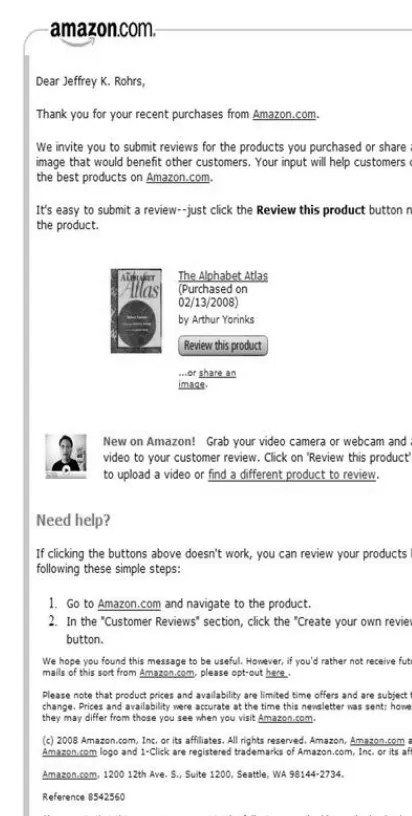
For example, when you purchase something from Amazon, you immediately receive a confi rmation email. Inside that email are some recommendations of other products that people who bought the same thing you did also purchased. A week later, you receive an email asking you to complete a survey about how happy you are with the product you have purchased and, again, subtly recommending products “others like you” have tried. This sneaky but clever service-oriented approach to the email cross-sell/up-sell works more times than you can imagine.
The bottom line is, once someone purchases your product, they are going to use it. And whether they like the product or not, they will be talking about their experi-ence, possibly online. Your best bet is to keep the lines of communication and infl uence open and capitalize on this effort; by sending emails as they are using the product, you can help soothe upset consumers or expand the reach of loyalists.
Wr i t e T h i s D o w n:
The secret of an effective conversion email is that it is sent only after you receive a “buying signal” from your reader. Even in the world of email, these buying signals exist; you just need to know what to look for.86736c01.indd 10
11
■
T
H
E F
IV
E T
Y
P
E
S O
F E
M
A
IL
Figure 1.6 Hotels.com conversion email
Wr i t e T h i s D o w n:
Consumers are 127 percent more likely to purchase something else from your company immediately after they have completed their initial purchase. (Source: DMA)If you are looking for a leader in this category, look no further than Amazon. The email shown in Figure 1.7 is a fantastic example of not only confi rming a purchase but also inviting feedback and setting someone up for a cross-sell and/or up-sell email. Conversion emails do a fantastic job of creating a feeling of a true reciprocal relation-ship between the customer and the company. Pair this with the recent good feeling a customer gets when they buy something they love, and you have the makings of a win-win situation.
86736c01.indd 11
12
CH
A
P
T
E
R
1:
U
N
D
E
R
S
T
A
N
D
IN
G E
M
A
IL M
A
R
K
E
T
IN
G T
O
D
A
Y
■
[image:34.639.107.313.54.462.2]
Figure 1.7 Usage email from Amazon
Loyalty
Similar to usage emails, loyalty emails are sent only after a sale or transaction has taken place between you and your customer. The difference is that usage emails drive the customer to use the product or service they just purchased, and the emails encour-age the reader to share their resulting feedback with friends and family. This helps capitalize on the “high” of buying something they value to leverage viral marketing. Loyalty emails, however, have a much longer life span. They need to keep someone engaged with your product or service for the life of your relationship with them (or until it is time to make the next purchase).
86736c01.indd 12
13
■
T
H
E F
IV
E T
Y
P
E
S O
F E
M
A
IL
Is this type of email important? One thing is for certain: With more than 41 emails popping into your consumer’s inbox on a daily basis, you need loyalty email to keep your brand on your consumer’s mind.
The role of loyalty emails is simple: keep your company and your company’s sense of value on top of the consumer’s mind. Often referred to as e-newsletters, loy-alty emails don’t sell, they celebrate!
My monthly email newsletter is a critical component of reducing attri-tion and driving exhilaraattri-tion.
Richard Maggiotto, CEO, Zinio
[image:35.639.56.394.281.597.2]Wome