Editor: terry R. Payne, University of Liverpool, [email protected]
A G E N T S
Adaptable,
Organization-Aware,
Service-Oriented Computing
Huib Aldewereld, Utrecht University
Julian Padget, University of Bath
Wamberto Vasconcelos, University of Aberdeen
Javier Vázquez-Salceda, Polytechnic University of Catalonia
Paul Sergeant, Calico Jack
Athanasios Staikopoulos, Trinity College Dublin
requirements, does of course not make it easier to use or to control. In particular, business processes demand resilience and real-time adaptation in the face of changing business requirements, incorpo-ration of alternative services, and fi nding suitable substitutes when those needed are unavailable.
The European Union-funded Alive project (http:// www.ist-alive.eu) is prototyping ideas, driven by commercial and industrial use cases, that utilize re-search in organizational modeling, software agents, model-driven engineering, artifi cial intelligence, the Semantic Web, and Web services to construct tools and demonstrators to address these needs. This article outlines the Alive architecture for service-oriented computing, describes some of the innova-tive tools we have developed and illustrates it all with a detailed run-through from one of our use cases.
New Trends in Service-Oriented Applications
The promising advances in service orientation have spawned a vision for the technologies that will power the Internet over the next few years and the new functionalities they will require. From Web 3.0 to the future Internet, from cloud computing to the Internet of things, we can see an emerging trend of distributed networked applica-tions, some of them based on software services. Such applications can be dynamically deployed,
modifi ed, and composed so as to create radically new types of distributed software applications that will shape the Web of the future.
To fulfi ll the vision, these applications must be able to communicate, reconfi gure at runtime, adapt to their environment, and dynamically combine sets of simple, specialized, independent services into more complex, added-value business services. This requires profound changes in the way we de-sign, deploy, and manage software systems, replac-ing existreplac-ing waterfall-like engineerreplac-ing techniques with approaches that integrate functionalities and behaviors into running systems that consist of ac-tive, distributed, interdependent processes.
Approaches (and associated methodologies and tools) for designing and engineering the new gen-eration of open software should, we believe, pos-sess several key features:
• They should scale up to tackle large-scale appli-cations consisting of hundreds or thousands of components.
• Due to the sheer size of the applications being built, they should support self-governing software—that is, the engineered applications should “look after themselves.” Approaches should thus explicitly factor in feedback loops that enable the connection of runtime phenom-ena with design-time models and artifacts. • To increase application transparency,
ap-proaches should accommodate humans in the feedback and governance loops, allowing for potential human intervention in the software governance processes.
• Approaches should allow alterna-tive points of entry in the design process, both to accommodate ex-isting systems—and let developers add missing parts gradually—as well as different development styles and needs.
• They should provide a methodol-ogy to support and guide the use of (semi-)automatic tools.
• They should factor in and incor-porate existing open standards, al-lowing for extensions to be easily integrated.
The goal of the Alive project is to put forward new solutions to address these challenges.
The Alive Approach
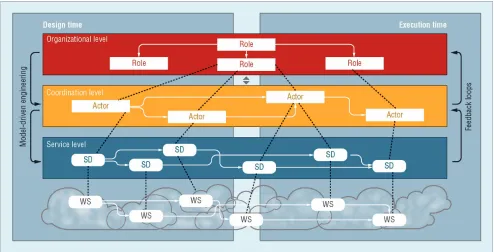
The Alive architecture combines model-driven development (MDD) with coor-dination and organizational mecha-nisms, providing support for highly dynamic and open systems of services. Alive’s approach extends current trends in engineering by defining three levels in the design and management of distributed systems: the service,
coordination, and organization levels (see Figure 1).
The service level supports the semantic description (SD) of services and the selection of the most appro-priate Web service (WS) for a given task based on the semantic informa-tion contained in the service descrip-tion. This effectively supports higher level, dynamic service composition. For highly dynamic services, the se-mantic description eases the process of finding equivalent services when a previously identified service is un-available or when more suitable ser-vices are registered subsequently. This level is also responsible for mon-itoring service activity.
The coordination level specifies the patterns of interaction between services, transforming the organiza-tional representation (including in-formation flows, constraints, tasks and agents) coming from the orga-nizational level into coordination plans. Using proven planning tools, we provide a mechanism to auto-matically synthesize (linear) plans to achieve organizational goals.
We enact these plans in a distributed fashion, making use of the service level, and analyze via logs the plans already executed to give feedback to the planning process and subse-quently the organization level.
[image:2.567.43.537.75.327.2]The organizational level provides context for coordination and services through an explicit representation of the system’s organizational structure. We achieve this by modeling the or-ganizational stakeholders and their relationships. Hence, we can derive formal goals, requirements, and re-strictions governing actors. Addition-ally, there are tools and mechanisms for the verifying and analyzing orga-nizational specifications. We can also handle changes to the organizational structure (such as reorganization or changes to the rules of governance) arising from proposals by either the coordination or the service level. Finally, this level provides methods for norm-oriented organizational design, supporting flexible behav-ioral governance in scenarios where traditional approaches do not fit well.
We bind these three levels to-gether using model-driven engineer-ing (MDE), both at design time and execution time. This provides au-tomatic transformations from the models at each of the three levels to multiple target platforms, realizing a form of feed-forward from design to implementation. At execution time, connections between the levels in the opposite direction, realize feedback from implementation to design, with events at the service level feeding into the coordination (leading to replan-ning) and organizational (leading to reorganization) levels.
This multilevel approach makes the Alive framework especially suit-able for scenarios where changes are likely to occur at either an abstract or concrete level. It also meets the needs of highly dynamic services, with new services entering the system and existing services leaving it over the lifetime of the service composition’s execution. For example, when there is a significant change in, say, the orga-nizational structure, the service-level
orchestration is automatically reorga-nized, effectively combining the exist-ing services in new ways to reflect the organizational changes. Another ex-ample is the automatic adaptation of more abstract levels when more con-crete ones suffer significant changes (such as due to the repeated failure of a service). Furthermore, the Alive framework lets more concrete levels adapt within themselves, while keep-ing the system’s overall goals and objectives clear.
The Alive Tools
To support the Alive architecture, we used the Eclipse Modeling Frame-work to create a range of tools, which we have combined into a single pack-age called ALIVEclipse. The tool-set integrates design tools for model creation and the specification of sys-tem functionalities, coupled with the runtime tools required to deploy an Alive system. ALIVEclipse contains editors for modeling organizations (to provide context), actions (to in-dicate system capabilities), tasks (to
indicate action relations and depen-dencies), plans (to represent abstract workflows), agents (to represent the acting components on the coordina-tion level), and service descripcoordina-tions (to detail the available functionalities provided by a service).
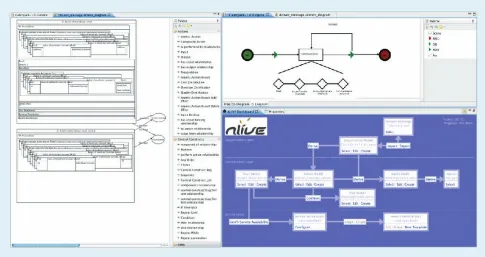
[image:3.567.34.519.76.333.2]Figure 2 shows an example screen-shot taken from the design phase. The development methodology is di-rectly supported by a dashboard that guides system engineers through the design process (see the bottom-right pane). Because all the models in Alive are metamodel-based, translations between the different models are rela-tively easy. The toolset contains a full set of model-to-model transforma-tions to generate parts of the mod-els based on other modmod-els available. Also, the toolset contains model-to-text transformations to, for example, generate the code for the agents and services. The upper-right pane shows the interaction structure (a workflow on a high -level of abstraction that is part of the organization model). The left-hand pane shows a part of the
actions model, specifying the details of a deliver messages action.
For execution, ALIVEclipse sup-ports the remote set-up, deployment, and running of Alive systems. More-over, it contains components to eval-uate and manage a running system by means of event logs and monitoring (to view the output of a running sys-tem) and the workflow visualization and analysis tools (to visualize and evaluate the system functionalities).
An Alive Scenario
To illustrate aspects of the Alive ap-proach, we examine a service com-munications router (SCR) taken from a scenario provided by Alive partner Calico Jack. In the sample scenario, Bob is in Second Life. He wants to contact Alice so he uses Second Life’s instant messaging (IM) facility. Al-ice is not currently in Second Life, but she is in Bob’s LinkedIn network. She’s working away from the office. How do we deliver the message?
At the organizational level, the SCR requires expressions of roles and access permissions for commu-nication channels, such as those al-lowing game friends access to in-game voice over IP (VoIP) and IM, and real-world telecommunications.
At the coordination level, the SCR re-quires reasoning to determine service selection for specific situations. This reasoning might introduce external resources, such as a representation of the user’s diary and professional net-work. At the service level, the SCR requires specification of both in-game and real-world communication chan-nels and redundancy—for example, using multiple SMS delivery services, IM, VoIP, email, and so on.
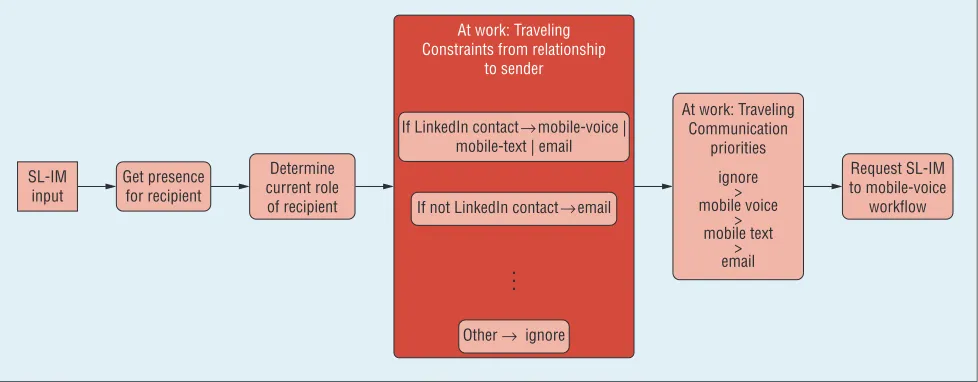
More concretely, at the organi-zational level in our example, Alice allows in-game friends to communi-cate with her via in-game IM, SMS (on her real-world mobile phone), and real-world email. At the coordina-tion level, a communicacoordina-tion request within Second Life from Bob to Alice is routed to Alice’s alternative chan-nels because she is not currently in Second Life. At the service level, if Bob cannot send Alice an SMS mes-sage via VoIP (for example, due to a lack of software credits), then a dynamic reconfiguration is required to reroute his IM to Alice through Bob’s real-life email and on to Alice’s real-life email (see Figure 3).
Our framework uses the recipient’s presence information to determine his or her likely current role. This lets
us use the normative roles govern-ing communication with the recipi-ent in that role (in this case working but traveling). In this example, the salient rules are based on relation-ships in the LinkedIn business social network—being a contact within this network will permit mobile communi-cation while the recipient is in the role “At work: Traveling.” Originators who are not LinkedIn contacts will only be permitted email communication.
As Figure 3 shows, once the set of possible communication channels have been determined (mobile voice, mobile text, and email), the most suitable be-comes the highest prioritized option and then a request is made to construct a workflow for delivering the message from originator’s SL-IM channel the recipient’s mobile-voice channel.
[image:4.567.47.536.80.271.2]The upper-right pane in Figure 2 shows the interaction structure diagram for this example and the expansion of the landmarks of the communication process. Landmarks, a key part of the modeling process, identify sets of condi-tions that hold at that point in the pro-cess. Figure 3 expands on these land-marks, capturing finer-grained actions, including the constraints on the com-munication imposed by the relationship between the sender and recipient.
Figure 3. Service communications router. Dynamic reconfiguration allows for the expansion of communication landmarks. In this case, because Bob and Alice have an established LinkedIn relationship, his instant message (IM) will be rerouted to Alice’s real-life email through his real-life email.
At work: Traveling Constraints from relationship
to sender
If LinkedIn contact→mobile-voice |
mobile-text | email
If not LinkedIn contact→email
.. .
Other → ignore
Determine current role of recipient Get presence
for recipient SL-IM
input
At work: Traveling Communication
priorities ignore
> mobile voice
> mobile text
Request SL-IM to mobile-voice
Figure 4 illustrates how we map the requirements to the levels of the Alive architecture, starting from the high-level organizational workflow, the identification of candidate work-flows at the coordination level, and finally the actual execution at the ser-vice level, including the fail-over from workflow 1 that uses VoIP to work-flow 2 using plain old telephony ser-vices (POTS). Here an exception oc-curs because the recipient is away from the office, which the coordi nation level resolves using the SMS delivery workflow—which is permitted because
Bob and Alice have a LinkedIn relationship—and the task is completed. This process shows how the Alive ar-chitecture demonstrates resilience and adaptation in mapping designs onto a changing real-world environment.
The Alive Consortium
The Alive consortium consists of the Polytechnic University of Catalonia (Spain), Utrecht University (the Neth-erlands), University of Bath (UK), Trinity College Dublin (Ireland), Uni-versity of Aberdeen (UK), Thales B.V. Nederland (the Netherlands), Tech
Media Telecom Factory SL (Spain), and Calico Jack (UK). In addition to the use-case scenario we describe here, the project explores interactive community displays to demonstrate dynamic orchestration of services for citizens and dynamic crisis manage-ment to evaluate crisis managemanage-ment policies.
Acknowlegdments
The Alive project (Coordination, Organi-zation and Model Driven Approaches for Dynamic, Flexible, Robust Software and Services), FP7-215890, is funded by the Eu-ropean Union’s Framework 7 Program (be-tween February 2008 and October 2010).
Huib Aldewereld is a post-doctoral re-searcher at Utrecht University. Contact him at [email protected].
Julian Padget is a senior lecturer at the University of Bath. Contact him at jap@ cs.bath.ac.uk.
Wamberto Vasconcelos is a senior lec-turer at the University of Aberdeen. Contact him at [email protected].
Javier Vázquez-salceda is a post-doctoral researcher at the Polytechnic University of Catalonia (UPC). Contact him at jvazquez@ lsi.upc.edu.
Paul sergeant is the CEO of Calico Jack. Contact him at [email protected].
[image:5.567.43.348.402.713.2]Athanasios staikopoulos is a post-doctoral researcher at Trinity College Dublin. Contact him at athanasios.staikopoulos@ cs.tcd.ie.
Figure 4. Service communications router. The Alive framework maps workflows onto a changing real-world environment.
Organization Get recipient
status
Determine recipient
role
Request exceptional
role
Coordination
Get IM text TTS VoIP
Workflow 1
Get IM text IM to English TTS POTS
Workflow 2: Failover
? Get IM text SMS
Workflow 3: Failover
Services
Get IM text IM to English IM to English
TTS X Get IM text IM to English TTS X Get IM text SMS
Aliv
e
SCR
API
From: Bob To: Alice “Hi Alice!”
From: Bob To: Alice “Hi Alice!” SL-IM
client