www.wjpr.net Vol 7, Issue 9, 2018. 385
A
STUDY
TO
ASSESS
THE
EFFECTIVENESS
OF
PLANNED
TEACHING
PROGRAMME
(PTP)
ON
KNOWLEDGE
REGARDING
REPRODUCTIVE
HEALTH
AMONG
ADOLESCENT
GIRLS
IN
SELECTED
SCHOOL
OF
SANGLI
MIRAJ
KUPWAD
AREA
Regina David Satvekar*
Assistant Professor, Community Health Nursing, College Of Nursing, Bharati Vidyapeeth
Deemed To Be University, Sangli, Maharashtra, India.
ABSTRACT
Adolescence is a very fundamental stage in life where emotional,
physical and biological transformation takes place in preparation for
future development of a girl. Throughout this period many young girls
struggle to cope with the changes in their day to day life. This changes
call for physical, emotional & social skills in order to deal with
challenges that the changes bring along. One key development during
adolescent years is the development of the reproductive system. This
study focused on the knowledge regarding reproductive health in the
selected school of sangli miraj kupwad area to manage and handle the
changes of this stage in day to day life and especially in regards to
reproductive health. It is evident that when reproductive health of an
adolescent is not well managed, the future could present multiple
challenges that could hinder the realization of the potential of the Individual girl Objectives:
(1) to assess knowledge regarding reproductive health among adolescent girls. (2) To
evaluate the effectiveness of planned teaching program. (3) To find out the association
between pre-test knowledge score & demographic variables.
KEYWORDS: Assess, Knowledge, Planned teaching.
INTRODUCTION
The word adolescence is derived from Latin word “Adolescere” meaning to grow up. WHO defines “Adolescence” as the time period between 10 and 19 years of life characterized by
Volume 7, Issue 9, 385-390. Research Article ISSN 2277– 7105
Article Received on 07 Feb. 2018,
Revised on 28 March 2018, Accepted on 18 April 2018,
DOI: 10.20959/wjpr20189-12062
*Corresponding Author
Regina David Satvekar
Assistant Professor,
Community Health Nursing,
College of Nursing, Bharati
Vidyapeeth Deemed To Be
University, Sangli,
www.wjpr.net Vol 7, Issue 9, 2018. 386 critical physical and psychological changes leading to adulthood? Adolescence is the
transition period from childhood to adulthood and is widely recognized as a time of great
opportunity. It is also considered as a period with vulnerabilities, in terms of both biological
(Physical and Psychological) and environmental (national and international politics along
with influence of family, community, neighbors, peers and schools) aspects. Adolescents are
an important resource of any country. According to the WHO expert committee, adolescence
is defined as the period between 10-19yrs, the 2nd decade of life. Adolescents comprise 20%
of the world’s total population. out of 1.2 billion adolescents worldwide, about 85% live in
developing countries. In India there are 190 million adolescents comprising 21% of India’s
total population In India there are 190 million adolescents comprising 21% of India’s total
population. Adolescent pregnancies constitute 10-15% of total pregnancies in India. This is
largely attributed to early marriage.
Adolescent is a period of transition between childhood and adulthood. It is a time of biologic,
intellectual, psychosocial and economic changes. The girls who enter the adolescent period
have rapid physical and psychological changes. During this period girls develop breast, hair
under arms and private parts, oily skin and body odors. At this stage of adolescent majority of
girls attain menarche. Menarche is first menstruation of the girls which occurs every month
periodically menstruation is phenomenon unique to females. Although every women has an
individual cycle of menstruation, it varies in length and the average cycle is taken to be 28
days long and recurs from puberty to menopause except pregnancy and other reproductive
disorders. It occurs at the age of 12 to 13 years. Hygiene related practice of women during
menstruation is of considerable impotence as it has a health impact in terms of increased
vulnerability to reproductive tract infection.
OBJECTIVES
1) To assess knowledge regarding reproductive health among adolescent girls
2) To evaluate the effectiveness of planned teaching program.
3) To find out the association between pre-test knowledge score & demographic variables.
MATERIALS AND METHODS
Research Design:- The research design adapted for the present study is quasi experimental,
one group pre-test & posttest design.
www.wjpr.net Vol 7, Issue 9, 2018. 387
Population of The Study: The population of present study comprised of adolescent girls.
Sample Size – 70.
Sampling Technique – Simple convenient sampling technique.
RESULTS AND DISCUSSION
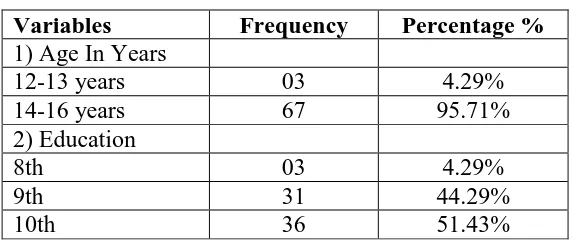
Table 1: Frequency and distribution of age and education.
Variables Frequency Percentage %
1) Age In Years
12-13 years 03 4.29%
14-16 years 67 95.71%
2) Education
8th 03 4.29%
9th 31 44.29%
10th 36 51.43%
Table -1
The finding of above table shows that demographic reproductive health among adolescent
girls in selected school is:
01. Most of the adolescent girls belong to age group of to14-16 yrs of age (95.71%), (4.29.
%) of Adolescent girls belongs to 12-13 yrs of the average age.
02. There were 3 adolescent girls from standard 8th, 31girls from STD 9th&36girls from STD
10th.
Table -2 (A)
Analysis of data related to knowledge scores of adolescent girls before & after administration
of planned teaching programme regarding reproductive health in selected school is computed
by comparison for pre & post score as per category of scored marks.
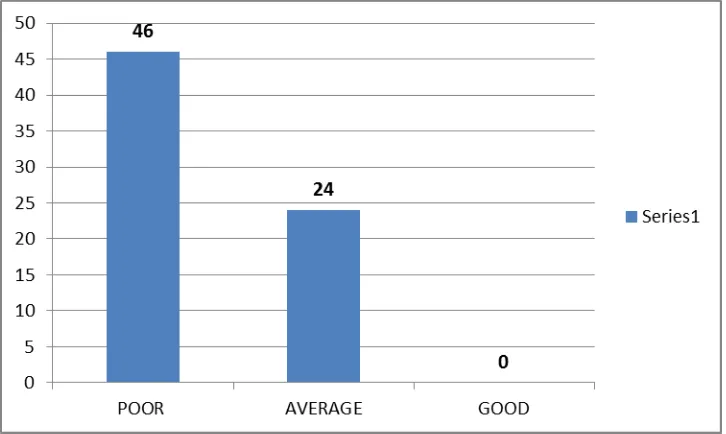
[image:3.595.155.441.212.335.2]Pre Test
Table 2: Persentation of Knowledge Score (n=70).
Score category Pretest Frequency Percentage
Poor (0-8) 46 65%
Average (9-16) 24 35%
www.wjpr.net Vol 7, Issue 9, 2018. 388
[image:4.595.117.480.72.289.2]Post Test
Table 2 A: Persentation of Knowledge Score (n=70).
Score Category Post Test Frequency Percentage
Poor (0-8) 00 00%
Average (9-16) 21 30%
Good (17-25) 49 70%
Graph 1: Pretest scores shows 65% is poor, 35 % is average & 00% is good knowledge
score whereas after conducting planned teaching program on knowledge regarding
reproductive health among adolescent girls in selected school, is increased into poor-00
www.wjpr.net Vol 7, Issue 9, 2018. 389 The study findings revealed that the Mean post-test knowledge score (19.01) was
significantly higher than the Mean pre-test knowledge score (6.87), with value P < 0.000
showing effectiveness of the structured teaching programme in improving the knowledge
regarding reproductive health among adolescent girls.
Table 3: Data Analysis of Final Study.
Mean s. d. t value P value
Pre -test 6.87 4.364
-15.729 0.000
Post - test 19.01 4.2
The above diagram shows there is significant increase in the mean post score & the
knowledge of the adolescent girls.
ACKNOWLEDGEMENT
We are grateful to Almighty God for the abundant blessings showered upon us throughout
the study.
We express our gratitude and appreciation to Dr. Nilima Bhore, Dean& Principal, Bharati
Vidyapeeth College of Nursing, Sangli for providing an opportunity to undertake the
post-graduation course in this esteemed institute and providing all facilities to conduct this study.
This study has been completed under the inspiring guidance of Miss. Regina satvekar
Assistant Professor of Community health nursing Bharatividyapeeth Deemed University
College of nursing, Sangli. We express our sincere gratitude to her guidance, suggestions and
www.wjpr.net Vol 7, Issue 9, 2018. 390 We express our sincere thanks to Miss Regina Satvekar, Assistant Professor & class
coordinator, Bharati Vidyapeeth Deemed University College of nursing, Sangli for helping
us to undertake this study and also for her guidance and constant encouragement which
helped in shaping our negative and raw thinking.
We express our sincere thanks to, Bharatividyapeeth Deemed University College of nursing,
Sangli, for their untiring support rendered during the course of study.
We would like to express our thanks to Mrs. Alka Gore Assistant Professor (Statistics) for
her expert guidance, suggestions and support for statistical analysis of data.
We extremely sincere thanks to all the authorities of various school who granted the
permission to conduct the study.
REFERENCES
1. Knowledge& attitude about reproductive health among rural adolescent girls.
(www.alliedacdemies.org).
2. A study of knowledge and attitude of adolescent girls toward reproductive health and
related problem (Medind.nic.in).
3. A study of the knowledge of the school girls regarding menstrual and reproductive health
and their perception about family life education program (menstrualhygineday.org).
4. A Nurse-Led and Teacher-Assisted Adolescent Healthy Weight Program to Improve
Health Behaviors in the School Setting.
5. Dupart G, Berry DC, D'Auria J, Sharpe L, McDonough L, Houser M, Flanary S,
Koppelberger S. J Sch Nurs. 2017. Jan 1:1059840517744020.
doi: 10.1177/1059840517744020. [Epub ahead of print].
6. Exploring adolescent reproductive health knowledge perception and behavior among
student of non government secondary school supported by BRAC mentoring progrmmme
in rural Bangladesh (Journal of Asian midwives) Questionnaire Design Reproductive
Health Series Module 4.
https://www.cdc.gov/reproductivehealth/productspubs/.../epi_module_04_tag508.pdf By
E Series - Related articles.
7. The International Journal of Indian Psychology, 4(1).