BSc Thesis Supervisors: Edwin Dertien, Erik Faber
Creative Technology, EEMCS, University of Twente
An assignment for Conrad Electronic
Making
Makers
How STEM kits can help in
taking the first steps
Abstract
STEM kits are teaching their users technological or scientific phenomena, with the goal to allow them to use that knowledge to repair, improve, and make with anything around them. Sadly, that goal is not commonly reached. This research set out to find why by interviewing makers and zeros in order to find out which obstacles the zeros perceive and which aids help the makers in an attempt to find ways to remove those obstacles. One solution was to leave room for experimentation and thought in instructions, this method has been
Acknowledgements
First and foremost, I would like to thank Edwin Dertien for being my supervisor, for he has guided me through the process of performing this Bachelor Graduation Project and writing the thesis you see now. Without his feedback, ideas, and advice, this project would not have been possible. I would also like to thank Erik Faber for being my critical observer. He
Table of Contents
Abstract... i
Acknowledgements ... ii
1 Introduction ... 1
1.1 problem statement ... 1
1.2 Common terms ... 1
1.3 Goal ... 1
1.4 Research Question ... 1
1.5 Research Outline ... 2
2 Analysis ... 3
2.1 Mastering Tinkering ... 3
2.2 State of the art ... 4
2.3. Literature Review ... 6
2.4 Conrad’s vision ... 9
3 Method and Techniques ... 11
3.1 Method ... 11
3.2 Techniques ... 12
4 Ideation ... 15
4.1 Makers ... 15
4.2 Zeros ... 21
4.3 zero to maker ... 26
4.4 Applying to STEM kits... 29
4.5 Next steps ... 31
5 Specification... 33
5.1 MoSCoW organizing ... 33
5.2 next steps ... 33
6 Realization ... 35
6.1 Ideating test method ... 35
6.1.2 Implementation methods ... 35
6.2 Instruction construction ... 36
6.3 Testing the ideas ... 36
6.4 Next steps ... 37
7 Results ... 39
7.1 Dave’s opinions ... 39
7.2 Joyce’s opinions ... 40
7.3 Missed information ... 40
7.4 Next Steps ... 40
8 Evaluation ... 41
8.2 dr. Joyce Karreman ... 41
8.3 comparison ... 41
9 Conclusion ... 45
9.1 Summary ... 45
9.2 conclusion ... 45
10 Discussion, Recommendations, and Future Work ... 47
10.1 Discussion ... 47
10.2 Recommendations ... 47
10.3 Future work ... 47
Appendix A ... 49
Appendix B ... 54
Appendix C – Interview series 1 ... 55
Appendix D – Interview Series 2 ... 57
Appendix E – Extra questions after interview series 2 ... 62
Appendix F – New instructions for Arexx Magic Light Kit ... 66
Appendix G – Structure expert interview new instructions ... 67
Appendix H – Expert Interview with Dave Borghuis ... 68
Appendix I – Expert Interview with Joyce Karreman ... 72
Appendix J – Original images ... 76
1 Introduction
1.1 problem statement
In the past, people would often repair or improve their own possessions and equipment. Nowadays, that sort of activity is left to professionals. (Dougherty, 2012) But people have a certain need to use objects in more ways than just consumption. This need has brought forth the maker movement, in which technology enthousiasts create new things by playing with technology.
Conrad Electronic holds great value to the maker movement, as makers and people who want to become makers are their primary target groups. This is why the company sells STEM kits (Science, Technology, Engineering, Mathematics). These kits teach the user a certain technological or scientific phenomenon by letting them build an object which makes use of that. For instance: the user learns how LED lighting works by building a “magic lamp”. The goal behind teaching people these phenomena is to allow them to use that knowledge in order to build or improve things in their surroundings. Sadly, practice learns that only few users actually do so. The goal of this project is to find out why and give Conrad advice on how STEM kits can be improved in order to urge more people to start making.
1.2 Common terms
Maker
According to Dougherty (2012) everyone is a maker, from the cook who prepares meals to the child who plays with its LEGO. In this project, the term maker will be used specifically for those people who use their skills and knowledge to improve existing objects and create new ones.
Zero
In this project, the term zero describes a person who desires to become a maker but does not yet apply their knowledge and skills to play with the world.
STEM education
Science, Technology, Engineering, and Mathematics (STEM) education is a way of learning that subconsciously teaches a principle in one or more of these four domains by letting the student or user put together a project based on that principle. For instance: they can learn how the lever principle works from a set that lets them build a catapult.
Affordance
Affordance is a term used to describe what an object tells the user to do with it. For instance, a chair affords to be sat on.
1.3 Goal
The 21st century skills for Learning direct at creativity & innovation and critical thinking &
problem solving.1 The aim of this project is to design a STEM kit which affords the users to use its materials to improve these skills by trying out and learning new things, by playing with and improving the space they live in. To do so, a serious effort will be made to research what is necessary to help a zero become a maker and how that can be supplied by STEM kits.
1.4 Research Question
It has been briefly named in the previous paragraph, the research question of this graduation project will be: What is necessary to help a zero become a maker and how can that be supplied by STEM kits? In order to find an answer to this research question, it has been divided into four sub questions:
1. What allows makers to build the things they want to? 2. What stops zeros from building the things they want to? 3. What is necessary to help zeros become makers?
4. How can findings from subquestion three be applied in STEM kits?
1.5 Research Outline
Several steps have to be taken to reach these findings. In the following chapter, an analysis of the current state of relevant knowledge and products is given to understand the
background of this research. In chapter 3, the method by which the research question will be answered will be further explained. In chapter 4, the ideation phase, thought processes of makers and those who aspire to be makers will be compared in order to find the differences and how those can be overcome. First, makers will be interviewed about their making
processes. Second, aspiring makers will be interviewed about what stops them from creating their ideas. Then, the findings of these interviews will produce multiple combinations which can help zeros take the steps to become makers. In the next step, the combinations need to be applied in or together with STEM kits, and should therefore adhere to certain
requirements. After this, the four sub questions have been answered, but it is necessary to test whether the found answers are useful. Therefore, in chapter 5, specification, the requirements will be set for an implementation of found ideas in chapter 4. Then, in chapter 6, realization, the implementation is performed and discussed with two experts in expert interviews. In chapter 7, the results of these interviews are displayed and in chapter 8, evaluation, they will be discussed. In chapter 9, a conclusion will be drawn after a short summary of the research before that and the conclusion will be evaluated to see if it functions as an answer to the research question. And finally, in the 10th chapter, the
2 Analysis
In this chapter, all background information gathered will be set out. It contains the learnings of a University of Twente Masters’ course about tinkering and helping others to tinker, which is closely related to making. After that, there is an indexation on currently existing STEM kits and products or services that help people become makers. Furthermore, since curiosity is a main reason of making, there is a literature review of curiosity and how constructions can be changed to spark it. And finally, there is information about the client, Conrad Electronic, and their vision.
2.1 Mastering Tinkering
From the master’s course Mastering Tinkering2, several empiric and scientific findings about the concept of tinkering have been learnt.
Materials were reviewed on their tinkerability on several criteria gained from a group brainstorm, these were: Interoperability, ease of use, preciousness, necessary level of instruction, iteration time, low threshold - high ceiling, affordance. An overview can be seen in appendix B.
The process of tinkering contains six parts, each important to start the process and keep it going. The steps can be seen in image 1.
Image 1: the process of tinkering, as described in Mastering Tinkering.3
2 Osiris course code: 201800228
1. Playground
An environment where the tinkerer feels safe, everything is allowed, creativity and curiosity are stimulated, and failure is nothing more than an experiment with an interesting outcome. That would be the ideal tinkering playground. In order to help someone tinker, the
environment should be 2. Toolbox
The things that will be used to set goals and put objects together. The toolbox can contain literal tools, such as screwdrivers or a soldering iron; but also materials, physical, and virtual ones: from LEGO blocks and microprocessors to Excel and Photoshop. Finally, the toolbox contains what the tinkerer brings to the table, their skills, knowledge, and passions.
3. Seed
The seed is something that inspires the tinkerer to start tinkering, to grow out the seed into a tree of possibilities. A seed can be an exercise, an open goal; it can also be a new material or a concept.
4. Discovery
The tinkerer decides their goals, in order to discover the possibilities of what they are
working with. What do they aim to achieve? It does not necessarily matter if they do achieve that goal, because the process will be full of discoveries and maybe one of those side
discoveries is much more interesting. By self-defining their goals, the tinkerer really becomes an attached owner of the results and the discoveries.
5. Process
The process starts at the seed and uses the toolbox to discover, after every discovery and a little reflection on what happened, the process starts its loop again until the tinkerer is satisfied. In order to achieve this loop of iterations, the tinkerer should keep working with their hands and iterate as much as possible. Working with their hands keeps the tinkerer from getting into dry materials and keeps the iteration process going. Many iterations allows for trial and error, improving the results over time and learning from every mistake along the way.
6. Facilitation
Facilitators are often experienced tinkerers who design the session and are physically present. They set the mood, provide or help identify a seed. Facilitators set a low threshold and a high ceiling, keep the flow, and stimulate reflection; to let failures not be problems, only chances to learn. They provide scaffolding in order to get the process started and going in the right directions.
A kit can provide or influence three of these things: the toolbox, a seed, and facilitation. The toolbox can be enriched with materials and tools the kit provides. Seeds could be delivered and the kit can provide instructions on how to identify a seed. Facilitation is more difficult, since it might prove difficult to provide a live facilitator with the kit; facilitation can be delivered by manner of instructions. The hypothesis is these instructions need to contain explanation of the necessity of failure and reflection, and a few exercises as scaffolding to get started with new materials. Furthermore, these instructions should be designed with aim towards sparking curiosity and allowing tinkering. Out of these terms, seed and process will frequently return in the thesis.
2.2 State of the art
Based on the reviewed existing products and services in the fields of STEM education and maker movement, there appear to be six different types available:
1. Kits providing materials, such as Creative Technology’s own Protobox. 2. Kits with precise instructions, such as most AREXX kits.
3. Kits providing challenges, such as Sciencebuddies
The list of all reviewed products can be found in Appendix A. In this chapter, each category will be reviewed on its manner and level of instructions, and how well it affords the user to tinker.
2.2.1 Category 1: Kits providing materials
These kits are the component boxes and tool deliveries, they deliver materials and tools. The can usually very well be used together, but it is just as easy to use parts in one project, and other parts in another.
Instructions are either not present or generalistic, since the kit mostly provides materials to be used outside of the kit.
Tinkerability is usually high, since the materials are all ‘spare parts’, none directly have a purpose within the kit.
2.2.2 Category 2: Kits with precise instructions
These kits are the most standard type of kit, providing materials and instructions for one specific project. Kits whose results can be enriched by adding more kits, such as Makeblock mBot, usually fall into this category as well, since each kit has their own set of instructions. Instructions are usually very specific. Describing in detail what should be done. This is usually enriched with drawings or images showing what should be done. Sometimes, the instructions are not in words, but an exact design of what should be placed in which position, as with AREXX school lab: radio wave scanner v2, where the circuit board contains
drawings and symbols indicating which components should be soldered where and in which position. Nothing is left to think about.
The assembly process is usually constructing the object piece by piece and can go fairly swiftly thanks to the instructions. It can make the user feel like they manage to build an interesting project on their own.
Tinkerability usually is low, since exactly the components necessary to build the project are delivered, and the instructions are so precise the user can finish building without thinking at all.
2.2.3 Category 3: Challenges to discover
Sets in this category are similar to kits with precise instructions, but they invite the user to do or discover something on their own. Sciencebuddies’ Archimedes Screw4 and Fire Snake5 videos, for instance, give the user explanation on which materials they need and how they should perform the experiments. Then, it asks questions leading to trial and error-wise discovery.
Instructions are usually very specific, until the point where the user has to do or discover on their own, they leave some space open there for the user to find their own results, instead. Not counting gathering materials, the assembly process is usually quite short, since that is not the focus of the challenge. Instructions help building the object fast.
Tinkerability is usually low, but the gained insight can potentially be used in making processes. The trial, error, reflect mentality these kinds of challenges teach is useful in tinkering as well.
2.2.4 Category 4: Products affording to use other things creatively
These types of products are designed in such a way that they create situations in which other objects can suddenly be used in a new way. As an example: makedo plugs and saws transform scrap cardboard into building materials.
6
Instructions are usually minimal and consist mostly of examples of what can be done with the product, because the product already shows what it can be used for.
These items are highly tinkerable, as they are designed to make other materials more tinkerable.
2.2.5 Category 5: Challenges to creative use
An example of challenges to creative use is the MacGyver Challenge6. Every week, it tells contestants to hack something with a specific product. At the end of the week the most useful hack is chosen. Getting the assignment to do something extraordinary with an
ordinary product forces the contestants to think out of the box and see new possible uses for objects around them.
No instructions are delivered, just the challenge and a few examples of what is possible with the chosen product.
The challenge itself is not tinkerable, but it does put contestants in the mindset to look at the world as a playground and see possible new uses in all objects.
2.2.6: Examples of creative use
By being shown what kinds of things are possible when getting rid of regular conceptions on how objects are supposed to be used, and how that can be done, people can get inspired to first try those things themselves and later find their own creative uses of items. The book Rolfs Maakbare Wereld7 is a prime example of this type of product.
The instructions in these types of products range from very precise, as in 5-minute crafts videos8, to basic explanation of components and function of the result, as in Rolfs Maakbare Wereld.
Similar to challenges to creative use, the examples themselves are not tinkerable, but it can help get people to become makers by showing what results they could produce and how that is possible.
2.2.7 Important information
This information paints a background picture of what types of kits there are and in what ways zeros are invited to become makers. By far most STEM kits fall under category 2, so that will be the one focused on. It is expected that the techniques used in categories 3 and 5 will be most effective to improve the chances of STEM kit users becoming makers.
2.3. Literature Review
9
As part of answering the second subquestion, a literature review towards curiosity and its application in instructions has been conducted. This gave insight in common definitions of curiosity, current knowledge about curiosity, and ways curiosity is used in learning and experimentation at this moment.
2.3.1 Introduction
In this world where nearly anything can be created with electronics, a rising trend is the educational STEM kit (Science, Technology, Engineering, and Mathematics). These kits deliver the user parts and instructions to build a water heater, a backflipping robot, a coffee pourer, and more. But, to science’s great dismay, the kits do not inspire the user to keep on
6 https://lifehacker.com/macgyver-challenge-hack-something-using-zip-ties-733655549 7 http://rolfhut.nl/rolfsmaakbarewereld/
8 https://www.youtube.com/watch?v=jySrwZc4sZo
building after their object has been assembled, or to investigate why the technology does what it does; making the kit miss its point: teaching the user how the technology works. This research is conducted as part of a graduation project for the Bachelor of Science Creative Technology. The graduation project aims to design a STEM kit which affords the user to tinker with its materials. Tinkering is a researching method in which a person has a certain object or goal and finds out how the object can be used or how to reach that goal by trial, error, and reflection. Curiosity is a very effective method to get someone to try new things (Kang et al., 2009). Instructions of STEM kits could potentially be designed in such a way that they spark the readers’ curiosity and get them tinkering. Therefore, the information gathered from literature will be used to gain insight in how curiosity can be applied in
instructions.
In order to do so, curiosity should first be defined. Many definitions exist at this time, making it hard to draw definitive conclusions without picking a side (Kidd and Hayden, 2015). The next step is to find out how curiosity can be sparked. To use curiosity in instructions, it is necessary to know how curiosity comes to be. And lastly, it is important to see if other factors influence a person’s level of curiosity, that knowledge may prove an advantage by knowing what to do and what to avoid.
2.3.2 Defining curiosity
Over time, there have been a multitude of definitions of curiosity. There appear to be two main viewpoints. Starting with the 20th century’s pioneer in the field of curiosity research,
Berlyne (as cited by Kidd & Hayden, 2015), who argues curiosity to be defined exploratory behavior along two dimensions, these being perceptual against epistemic exploration and specific against diversive exploration. Followed up by his colleague, Day (as cited by Arnone, 2003), who explains curiosity as a curvilinear relationship between the level of arousal and efficiency. At the optimal level, a person enters a zone of curiosity where they are excited and interested and will explore. If the arousal is too high in relation with the efficiency, the person becomes anxious; on the other side of the zone, they become bored and unmotivated. Elaborating Berlyne’s description of epistemic curiosity, Subasi (2018) presents the Dynamic Systems Theory which, as the author phrased well: “offers a new language to describe the motivational dynamics of epistemic curiosity in its multi-dimensional complexity and variability” (p. 14). However, Subasi also admits his research shows the complexity and elusiveness of human curiosity makes it impossible to clearly describe or measure epistemic curiosity.
On the other side of the discussion we find Loewenstein (as cited by Chater & Loewenstein, 2016)., with the second definition. He refutes these explanations by defining curiosity as a drive similar to hunger or sexual desire. It is a hunger for information, an unconditionally rewarding stimulus to find that bit of knowledge necessary to tie two pieces of information together. Loewenstein calls this phenomenon an information gap. He continues this definition by listing four terms in which curiosity should be addressed:
1. Intensity
2. Transcience and dependence on immediate stimulus 3. Association with impulsivity
4. Tendency to disappoint when satisfied
Each has substantive relations with personality, emotion, and well-being measures. Based on these factors, they identified four distinct types of curious people: The Fascinated, Problem Solvers, Empathizers, and Avoiders.
Due to the different definitions of curiosity, it becomes difficult to build a clear view on what is currently understood as curiosity. Multiple terms exist for the same things, while multiple things are named by the same term in different circumstances (Kidd & Hayden, 2015). This makes it difficult to get a full view of what is currently understood as curiosity and as such, an overall agreed upon definition does not yet exist. However, Kidd also argues the absence of a single definition of curiosity does not necessarily have to be a bad thing. In her words: “We consider this diversity of definitions to be both characteristic of a nascent field and healthy.” (p. 449) For the graduation project, one view of curiosity should be chosen to follow; as multiple will give too many viewpoints to work from. For that reason, during the rest of this research, curiosity will be regarded from Loewenstein’s information gap theory instead of Berlyne’s exploratory behavior theory, since a drive can be awakened and
induced while a behavior needs to be changed and trained. To be clear, the information gap theory explains curiosity as a hunger-like drive for information necessary to close the gap between two pieces of information already known.
2.3.3 Sparking curiosity
Now that a definition of curiosity has been selected, it is time to set out the facts others have found on how curiosity can be sparked and sustained. According to the literature, there are two prominent methods to spark curiosity. The first method is to provide an information gap. Following from Loewenstein’s information-gap theory (as cited by Jirout & Klahr, 2012; Chater & Loewenstein, 2015) curiosity can be sparked by receiving information that does not yet quite make sense (Chater & Loewenstein, 2015). For instance, a video with the title “These ten ways to use a sidewalk tile in your daily life will blow your mind!” will make the recipient confused about the use of a sidewalk tile and how that will blow their mind; and therefore curious to what the video will tell them to make sense of the title they just read. On the other hand, Kidd and Hayden (2015) explain the method to spark curiosity is to place a person in a situation with uncertainty. If a person has no knowledge of a subject at all, they are certain their expectations of a situation are wrong or will not have expectations at all; if a person has a very high amount of knowledge on that subject, they are certain their
expectation of a situation are correct. Neither of these people will be interested in the outcome of that situation; while someone who thinks they might have a correct expectation but is not sure will want to find out whether they were right and why.
Research following other definitions of curiosity also prove curiosity is triggered by uncertain situations. In his research towards the importance of curiosity in learning, Kang et al. (2009) mention the type of curiosity Berlyne called specific epistemic curiosity is triggered by trivia questions, especially if the test subject is about 50% certain of their answer. For the
graduation project these ways of sparking curiosity should be explored and tested, together with potential ways to sustain that curiosity.
2.3.4 Other factors influencing curiosity
someone’s self-curiosity. Although self-curiosity is focused inward, while the curiosity this paper looks for focuses outward, it can be expected they are influenced in the same way. As previously mentioned, the second factor influencing curiosity is the way information is received. Earlier in this literature review, uncertainty of a situation was discussed to induce curiosity. The level of uncertainty influences the amount of curiosity a subject experiences (Kidd & Hayden, 2015). Kang et al. (2009) support this by explaining the same in different terms. They say the level of confidence a person has in their knowledge of a subject influences their curiosity towards situations and questions pertaining that subject. Malone (1981) preceded them with the suggestion that the challenge of an assignment can influence the level of curiosity the subject experiences and how long they will stay curious. Perceived challenge can also be viewed as a person’s confidence in their ability to handle the
assignment. During experiments for the graduation project these other factors cannot be influenced, a persons personality cannot be changed for an experiment. However, it is important to keep these factors in mind when reviewing gathered data, they could be clear explanations of otherwise strange data.
2.3.5 Conclusion
What sparks curiosity and how can that be applied in instructions? To summarize the research above: there are multiple definitions of curiosity, which is healthy and logical for a rising field of research, but for this graduation project curiosity will be viewed as a means to fill information gaps in order to reduce uncertainty. Curiosity can be sparked in two ways: by providing information which does not immediately make sense (or which might make sense of previous information) or by providing a situation with uncertainty. Curiosity is further affected by the personality of the recipient of the information and the way they perceive the information they received: high uncertainty will not make them curious and neither will low uncertainty, the level of uncertainty should lie in a medium range.
Based on the literature it seems the best way to apply curiosity in instructions of, for instance, STEM kits is to provide the user with projects to make with the instructions that have an outcome which might be guessed but is not certain, applying to the correlation between uncertainty and curiosity. In order to do so, crucial information has to be provided but possibly details that tie them together can be left out, making use of the information gap theory.
There are few articles about curiosity and most discuss it as a tool instead of a phenomenon which can be investigated itself. Not all papers cited in this review had curiosity as their primary research goal. This makes some statements little underlaid. The discussion of the definition does return to older articles by Berlyne and Loewenstein. The other factors influencing curiosity have not been a primary research target at all, these conclusions were drawn from parts of cited articles. Chances are conclusions to subquestions could have been different or more elaborate if there were more sources to use, this means experiments and research will have to be conducted during the graduation project in order to find out whether conclusions drawn from literature were correct and sufficient.
In the future, it is necessary to conduct research toward the circumstances under which people are most and least curious, this data could be invaluable to designs of interventions, tinkering sessions, and even classrooms. For a highly evolved information gathering method, we know far too little about how this survival method can be induced.
2.4 Conrad’s vision
This project is closely related to Conrad and should therefore aim in the direction of their vision. Conrad’s vision about what STEM kits should achieve comes close to the vision of ‘lekker samen klooien’10. Lekker samen klooien concisely explains its vision and where it came from in the manifest on their about page. The group believes the world is an amazing place we make together, everybody in their own way, and that it is important to understand
3 Method and Techniques
In this chapter, the method by which the research question will be answered is set out, as well as the techniques that will be used in that method. The method begins with finding out the differences between makers and zeros by interviewing them about the factors that aid and obstruct them in the process of making. Those factors and differences will be used to ideate ways to overcome obstructions zeros experience by using aids makers experience. The next step is to define specifications for those ways to be applied by STEM kits, and to specify those into clear requirements any final solutions to the problem should adhere to. In order to test the solutions, an application of those requirements is implemented and discussed with experts in the field of making and the psychology of instructions. And finally, the opinions and expectations of the experts will be used to form a conclusion and give an advice to Conrad.
3.1 Method
Most users of STEM kits do not use their gained knowledge and skills to play with or improve the world around them, or objects in it. In order to truly find out how to help these zeros become makers, it is necessary to ask people from two groups. The groups that will be interviewed are those who are makers, and zeros, those who want to become makers; with the goal to gather information about why the first group is able to make what they want and why the second group is not, what obstacles they encounter. Combining this information will provide methods to help aspiring makers to take the necessary steps.
3.1.1 Ideation
The first interview’s structure will be designed as such, that most information is gained from the makers. Examples of information interesting for this research could be: their reason to make, which special circumstances allow them to make, and what previously gained
knowledge and skills they apply. This information can then be distilled into common patterns in order to find possible answers to subquestion 1: What allows makers to build the things they want to?
The answers found in the previous question will be used to improve the interview format in order to find out which drives zeros have and what stops those drives. The found patterns are used as a checklist to see if they are present and possibly obstructed, and to see if there are more causes for zeros to let themselves be stopped. This new information can possibly prove or disprove answers to subquestion 1 and provide answers to subquestion 2: What stops zeros from building the things they want to? Since the interview subjects might have built one or two projects, they can potentially deliver information for the first interview as well. After information has been gathered on what drives, aids, and obstructs the type of people who will be the main users and the type of people who the main users should become, the logical next step is to see where there is overlap, which positives can cancel out which negatives. The murder board technique will be used to find the most possible connections. These connections will be taken as basis for possible methods of exploiting them in order to increase the size of the maker community. Those methods are answers to subquestion 3: What is necessary to help zeros become makers?
The methods found during this ideation phase need to be applied to STEM kits. They are still broad ideas and, in order to apply them in specific ways, they need to be sorted and
tweaked. To find ways in which to apply the found methods in STEM kits, another brainstorm is in order. The results of this brainstorm can answer subquestion 4: How can findings from subquestion three be applied in STEM kits?
3.1.2 Specification
12
requirements for improvement of STEM kits found in the ideation phase will be set out into clear requirements for the implementation and sorted in level of importance using the MoSCoW method described later in this chapter.
3.1.3 Realization
One of the ideas will be implemented and discussed with experts to gather their opinions and thoughts about the solutions. Their opinions, arguments, and expectations will be thoroughly explored and compared with each other in order to find out if the ideas created in the ideation phase are satisfying answers to the research question.
3.1.4 Conclusion
After answering all subquestions and testing the ideas by discussing them with experts, the gathered information will be reviewed to see if an answer has been found to the research question: What is necessary to help a zero become a maker and how can that be supplied by STEM kits? Regardless of whether an answer has been found, an advice on STEM kit design will be given to Conrad based on the thoughts of the experts, as well as
recommendations on how to continue refining the requirements and design in the future.
3.2 Techniques
3.2.1 Questioning Techniques11
In order to receive the necessary information from interviews, it is crucial to ask the right questions. The interviews have been designed as open as possible, so the person
interviewed is invited to give elaborate answers from which the interviewer can use parts to ask more specific questions to why and how they created or did not create what they talked about. In order to go into these points deeply, the interviewer needs to ask probing
questions, and potentially use the 5 why’s technique.12 Instructions on what type of probing questions can be asked are included in the interview structure.
3.2.2 Semi-structured interview
In a semi-structured interview, there are two participants. One is the interviewer who has prepared a structure or a list of questions for the interview, the other is the respondent who will attempt to answer the questions posed by the interviewer to their best ability. The goal of an interview is for the interviewer to gather useful information or insight from the respondent. What makes a semi-structured interview special is that they take the form of a conversation which is only started and sometimes lead by the prepared questions and structure, allowing both participants the chance to go deeper into subjects they find important.
3.2.3 Murder board technique
This technique has roots in the blue hat of De Bono’s Thinking Hats (1992) In essention, this technique is similar to the brainstorming technique bisociation; however, instead of
generating ideas, it is used to find out how several parts of knowledge work together. In order to make connections between multiple points and pieces of information one would not always put together, expositioning them on a board and drawing lines between them is a useful technique. This technique allows for drawing parallels, seeing repetition and
connections, noticing patterns, and pointing out differences. In order not to lose overview, it is advised to use more ways to show connections than lines; only using lines can create a web which in which it is hard to see which points are connected. This technique will be used to find patterns for subquestion 1 and 2, and connections for subquestion 3.
3.2.4 MoSCoW method13
The MoSCoW method is used to make explicit which requirements are essential, which are optional, and which are optimistic dreams of the future. This is done by separating them in four categories: Must have, Should have, Could have, and Won’t have.
11 https://www.mindtools.com/pages/article/newTMC_88.htm
12 https://www.mindtools.com/pages/article/newTMC_5W.htm
Must have requirements are the bare necessities of a system. The minimal requirements that are determined in advance for the end result to meet.
Should have requirements are additional and highly desired. They have a high priority, but are not essential in order for the end result to be usable.
Could have requirements are those that can be considered if there is time left, they will make the end result better but will not have a negative impact if they are vacant.
4 Ideation
Now that the work method has been set out, the first part will be executed. The ideation begins with two sets of interviews – one with makers and one with zeros. The next section explains combining outcomes of those interviews into methods to make it easier for zeros to become makers. The fourth section sets out the requirements for these methods to be applied in STEM kits. The interviews with makers showed that resource availability, possessed knowledge, personality, a helpful network, seeds, and causes to make for are helpful factors in the process of making. The interviews with zeros showed that costs exceeding benefits, distractions, outside constraints, a lack of (self-)belief, and missing knowledge are obstructing factors, which stop zeros from becoming makers. Solutions found from making combinations pertain providing inspiration to give seeds, helping to build a network in order to ask for help when necessary, and changing the design of kits, mainly their instructions in order to let the user experience making while they work with the kit. These solutions, together with physical specifications and Conrad’s vision provide requirements which will be taken into the next chapter.
4.1 Makers
In order to find out why makers can build their projects and which factors help them do that, a number of interviews will be conducted with makers. The goal of these interviews is to find out for each participant how their making process works, what skills and knowledge they use during that process, and which other factors help them to make. For their making process to be placed in context and to help the subject remember their process as clear as possible, the conversation will be focused around projects the makers undertook. Because of that, the conversation will be different with every participant, forcing the interview to have only limited structure, based on open questions and a small conversation tree.
For ethical reasons (and common courtesy), all participants will be asked if they have objections to notes being taken of the conversation and their input being used in scientific research. Furthermore, no one of an age below 18 will be interviewed, and all respondents will remain anonymous.
4.1.1 Interview design
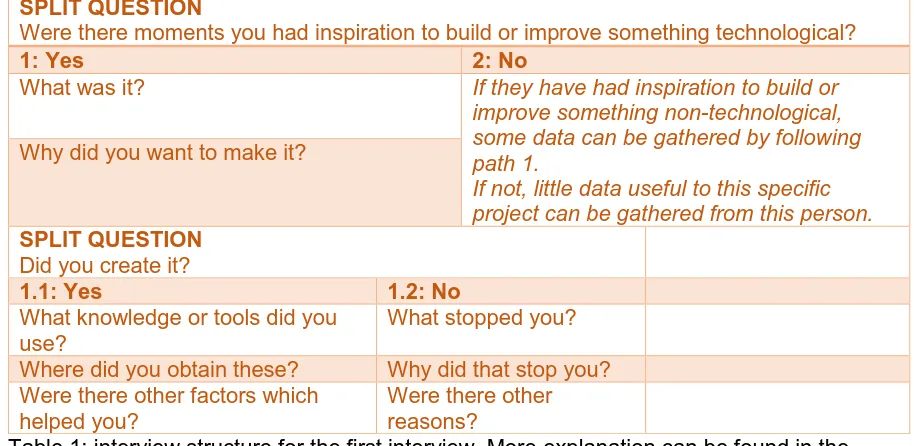
The interview structure in table 1 has been designed to help get a conversation started about the process of making. After greetings and small talk to ease the subject, the conversation starts with the question at the top, the split questions receive an answer that can be
indicated as yes or no, which decides in which direction the rest of the interview will go. The interviewer needs to practice interviewing beforehand, specifically in the field of asking probing questions, and the subjects’ names will not be displayed because of privacy.
The Maker Festival Twente is a wonderful opportunity to talk to makers, as many of them will be gathered in a relatively small area.
SPLIT QUESTION
Were there moments you had inspiration to build or improve something technological?
1: Yes 2: No
What was it? If they have had inspiration to build or improve something non-technological, some data can be gathered by following path 1.
If not, little data useful to this specific project can be gathered from this person. Why did you want to make it?
SPLIT QUESTION Did you create it?
1.1: Yes 1.2: No
What knowledge or tools did you use?
What stopped you?
Where did you obtain these? Why did that stop you? Were there other factors which
helped you?
[image:21.595.68.525.88.311.2]Were there other reasons?
Table 1: interview structure for the first interview. More explanation can be found in the paragraph above.
4.1.2 Execution
On Saturday May 25th, a total of nine interviews have taken place at the Maker Festival in
Enschede. The environment was full of interesting projects, and most people are eager to impress. The interviewer walked around the festival area in order to speak with both visitors and makers who are showing what they made. The visitors and participants are
predominantly male. The participants age between 21 and around 60. All interviews have been conducted in Dutch. The translation of the notes taken during the interviews can be found in Appendix C.
The findings from these interviews have been written out in lists on a whiteboard, after which the Murder Board Technique has been used to look for common factors, connections, and to identify categories of factors by using those connections. For overview, the six categories found were set out on a different whiteboard as word webs with the category in the middle and all factors belonging to the category attached to them.
4.1.3 Results
Image 3: the six categories found from the connections drawn in image 2 and what they contain.
Resource availability
54% of the interviewed explained their ability to make was increased because they had access to the right knowledge, materials, machinery, software, and tools. 31% would not be able to make without access to these resources. Ways in which resources become more available are:
• Pricing
• Access because of job/education • Knowing owners of resources
Possessed Knowledge
Obtaining knowledge
• Raised with technical toys • Education
• Job
Benefit of knowledge • Self-certainty • Insight
• Working methods
Personality
Even though there will be little chance of changing a person’s personality, enough of the interviewed people (46%) talked about one or more of their personality traits as being helpful for making. Therefore, the important personality traits are listed here:
• Creativity • Mentality • Stubbornness • Associative thinking • Can-do attitude
Help
If there are parts of a project the maker does not understand, have access to, or simply is unable to do, others might be able to help out. 38% of the interviewed mentioned having a network of people they can ask for help with projects. Ways in which other people can be helpful are the following:
• Applying their skills • Providing supplies
• Sharing or supplying their knowledge and insights • Expanding the network
Seed
In order to start making, inspiration is necessary. A seed can come from anywhere but must be seen as such. Seeds can come from the following:
• Drive to make • Suboptimal solutions • Associative thinking • Problems
• Curiosity
• Possessed materials
Reason
Every maker has a reason to start making. Without a reason, a person would not put effort in a project. The following categorized lists provide reasons given by interviewed, in order of how often they appear, they are accompanied by the percentage of the total amount of interviewed people who stated the reason or one very similar:
Out of interest 62%
• Interest in the subject 38% • For fun 31%
• Curiosity 23% Circumstance 54%
• Desiring the result 15%
• Wanting to work with hands 15% • Available resources 15%
• Tailored to the maker 8% For the world 38%
• Improving existing ideas/solutions 15% • Decreasing waste 8%
• Improving value of object 8% Improving self 38%
• Testing skills 15%
• Improving value of self 15% • Independency 8%
For others 23%
• Helping others 15% • Impressing others 8% • Making others happy 8%
6.1.4 Theories
After having identified the factors that aid makers in their process based on the categories and most common reasons for making, the following five theories can be crafted out of those categories of factors:
• Makers can make because they feel confident in their ability to make what they want. • Makers feel they have the necessary prior knowledge to build their project.
• Makers can make because they have access to resources or a helpful network. • Makers make out of interest, fun, or curiosity.
• Makers have personality traits that help them make.
The hypothesis is that zeros are kept from making because, for them, one or more of these reasons is obstructed. The next section will test that hypothesis by comparing them with the results of interviews with zeros about their making process and what obstacles they
4.2 Zeros
In the previous section, factors which aid makers in the process of making have been gathered and categorized. In order to find ways to help zeros become makers, it is necessary to find out which factors obstruct them in the making process. Possibly, those factors can be counteracted by the aids found previously. In order to see if that is possible, the theories crafted about why makers can make will be inverted into hypotheses why zeros cannot make and compared with findings from another set of interviews; this time with people who want to become makers or already are makers to some extent but leave many projects uncompleted. The goal of these interviews is to gather information from each respondent about what factors stop them from making or finishing their projects. If these factors are the same as the five reasons hypothesized by inverting the theories in the previous section, the hypothesis that makers’ aids can help zeros overcome their obstacles has been verified; otherwise, new reasons can be added to the list, one or more reasons can possibly be removed, and then those can be used as targets to solve. To help the subjects get into the mindset they have when playing with an idea for a project, the conversation will revolve around one or two projects they have had in mind or started but never finished. Because of that, the conversation will be different with every participant, forcing the interview to have only limited structure, based on open questions and a small conversation tree.
4.2.1 Inverted theories
By turning the reasons from 6.1.4 around, these five hypothetical reasons for why zeros are stopped from making are created:
• Zeros feel less confident in their ability to make what they want to.
• Zeros (think they do) not have the necessary prior knowledge to build their project. • Zeros do not have access to resources or a helpful network.
• Zeros have yet to find the subjects they in which they have enough interest to make. • Zeros have personality traits that stop them from making.
The obstacles found in the following interviews will be compared with these reasons, if they do indeed match, the hypothesis that one or more of the reasons why makers can make are obstructed for zeros has been verified. This would mean that the aids found in the previous section can be used to counteract the obstacles found in this section. If that is not the case, new reasons will be constructed from the obstacles found and other ways to find solutions to those reasons will be ideated.
4.2.2 Interview design
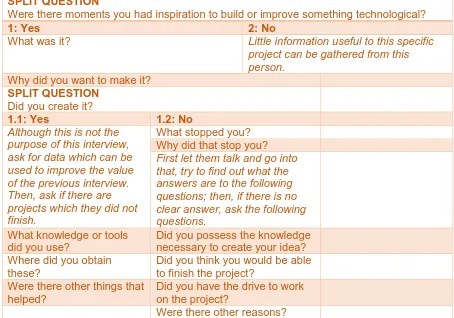
The interview structure is similar to that of the previous interview, but enriched with a reason checklist. Furthermore, the interviewer will probably need to use more probing questions than in the previous interview, enforced with the five why’s method in order to get to the root of why people are being stopped from making. This is because people generally prefer to talk about what they did over talking about what they did not do. The structure can be seen in table 2. And again, or ethical reasons (and common courtesy), all participants will be asked if they have objections to notes being taken of the conversation and their input being used in scientific research. Furthermore, no one of an age below 18 will be interviewed, and all respondents will remain anonymous.
SPLIT QUESTION
Were there moments you had inspiration to build or improve something technological?
1: Yes 2: No
What was it? Little information useful to this specific project can be gathered from this person.
Why did you want to make it? SPLIT QUESTION
Did you create it?
1.1: Yes 1.2: No
Although this is not the purpose of this interview, ask for data which can be used to improve the value of the previous interview. Then, ask if there are projects which they did not finish.
What stopped you? Why did that stop you? First let them talk and go into that, try to find out what the answers are to the following questions; then, if there is no clear answer, ask the following questions.
What knowledge or tools did you use?
Did you possess the knowledge necessary to create your idea? Where did you obtain
these?
Did you think you would be able to finish the project?
Were there other things that helped?
Did you have the drive to work on the project?
[image:27.595.70.524.90.408.2]Were there other reasons?
Table 2: interview structure for the second interview. More explanation is available in the paragraph above.
4.2.3 Execution
On Thursday June 14th, a total of seven interviews have taken place on the campus of the
University of Twente. The environment was different in several interviews, they are
described together with the notes in Appendix D. The participants age between 21 and 26 and are all students of the University. Most of the interviews have been conducted in Dutch. The findings from these interviews have been written out in lists on a whiteboard, then the Murder Board Technique was applied to find correlations and inequalities among them; and to identify categories of factors.
The seventh respondent is the person who performed all other interviews and this project. Because of the self-insight direction of the interview, the chance of this negatively affecting the data is small. This risk has been taken because this person knows exactly which kind of information is being sought after and falls in the category of zeros who want to become makers.
When the data was being reviewed, it appeared two important questions had not been asked. They have been asked to all respondents via WhatsApp, the conversations have been documented in Appendix E.
4.2.4 Results
Image 5: the five categories found from the connections drawn in image 4 and what they contain.
Costs over benefits
57% of interviewed let projects go if the perceived costs outweigh the perceived benefits. The interviewed mentioned the following circumstances that can cause an increase in perceived cost or a decrease in perceived benefit:
• An unclear goal
• Resources that need to be gathered • Investment of time and/or money
• Having to search or outsource for necessary knowledge and/or information • Frustration
• Low usefulness of the object which is the goal • Risk of failure during the process
Distraction
71% of interviewed tend to get distracted before or while working on a project. Potential distracting factors the interviewed mentioned are:
• Fears and anxieties
• Forgetting about the project • Perfectionism
• Instant gratification
Outside constraints
43% of interviewed mentioned one or more constraints they could not easily influence were keeping them from their projects. The constraints they talked about are:
• Responsibilities • Laws
• Accessibility of Knowledge • Accessibility of Tools • Accessibility of Machinery • Accessibility of Resources
Lack of (self-)belief
71% of the interviewed gave reasons for letting go of a project that can be attributed to a lack of belief in themselves or the project.
• Feeling the project will be too difficult for them • Uncertainty about their skills
• No drive to work on the project
Missing knowledge
Even though most knowledge is available within a few clicks, it is a constraint 71% of the interviewed explained for not starting on a project. Below, there is a list of problems that are being caused by a lack of knowledge:
• No clear plan on how to take on the project
• No overview over the project and its process/progress • Difficulty translating theory to practice
• Needing to invest extra time in finding missing knowledge
6.2.4 Theories
At the beginning of this section, the hypothesis has been stated that zeros are kept from making for the following reasons (one or more reasons per person):
• Zeros feel less confident in them their ability to make what they want to.
• Zeros (think they do) not have the necessary prior knowledge to build their project. • Zeros do not have access to resources or a helpful network.
• Zeros have yet to find the subjects in which they have enough interest to make. • Zeros have personality traits that stop from making.
Of these reasons, factors falling under lack of knowledge and little confidence in abilities have been named multiple times and remained dominant categories of obstacles. Access to resources has been named as well, but a lack of network was not; it is possible the
respondents were not aware of the possibility the problem might lie in their network, or lack thereof. In either case, accessibility remained an important factor in the category of outside constraints. Multiple respondents talked about fears and anxieties, sometimes implicitly; one person specifically stated a personality trait (perfectionism) to be hindering him, others talked about desires for instant gratification. This reason is therefore also part of the problem and is accounted for in the category of Distractions. Low interest has been mentioned by only one respondent; possibly meaning this reason is not a main concern. It has therefore been incorporated in the category Lack of (self-)belief as a single factor. And finally, the category of costs over benefits has not been foreseen in the previous set of reasons, but based on these interviews, it should be added to the list. Four of the five reasons have been
4.3 zero to maker
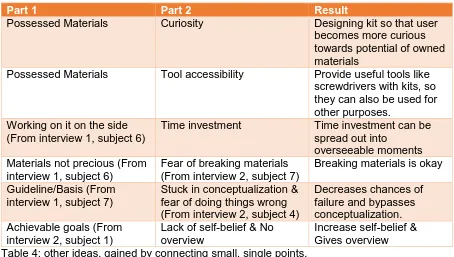
After gathering the information in the previous sections, the next step is to find solutions to the problems zeros explained in the second interview. The reasons why zeros are being stopped from making that were constructed from negatives of reasons why makers can make correlate with the reasons for being stopped found in the second interview. Therefore, the beneficial factors makers explained in the first interview are expected to be able to provide solutions. In order to find these solutions, the categories of factors found in the interviews will be set out on a whiteboard and connected using the Murder Board Technique again, see image 6. The results are shown below, in tables 3 and 4.
6.3.1 results
Idea Removed obstacle Used aid
Lists of examples and problems
Distractions Seed & Reason to build
Project consultants Fears & Anxieties Help
Knowledge sharing platform
Missing Knowledge & No Plan & Lack of Self-belief
Network & Sharing
Knowledge (& others’ work methods/insight)
Fab Labs Gathering resources & Inaccessibility
Network
Reduce prices Money investment constraints
Pricing
Gradually invite to try new things or improve skills by designing the instructions for that purpose
Uncertainty about skills & lack of (self-)belief
Improving Self & uncertain outcome
Turn “Not sure if I can” into “Try if I can” by motivation and making failure okay
Risks & Fears & Uncertainty about skills & Difficulty translating theory to practice
[image:31.595.71.525.476.733.2]Testing skills & information gap
Table 3: results of the Murder Board Technique
Part 1 Part 2 Result
Possessed Materials Curiosity Designing kit so that user
becomes more curious towards potential of owned materials
Possessed Materials Tool accessibility Provide useful tools like screwdrivers with kits, so they can also be used for other purposes.
Working on it on the side (From interview 1, subject 6)
Time investment Time investment can be spread out into
overseeable moments Materials not precious (From
interview 1, subject 6)
Fear of breaking materials (From interview 2, subject 7)
Breaking materials is okay Guideline/Basis (From
interview 1, subject 7)
Stuck in conceptualization & fear of doing things wrong (From interview 2, subject 4)
Decreases chances of failure and bypasses conceptualization. Achievable goals (From
interview 2, subject 1)
Lack of self-belief & No overview
4.4 Applying to STEM kits
The ideas gathered in the previous section can all be used to help people who want to make to actually start making. However, not all of them can be applied in, or combined with STEM kits. In order to answer the last sub question: How can the findings from sub question 3 be applied in Conrad’s STEM kits, both the requirements for applicability in STEM kits and Conrad’s requirements and wishes need to be heard. After that, the ideas will be checked if they fulfil those requirements, or if they could after applying small changes.
4.4.1 Requirements
The rough requirements have been set out in chapter 2, the analysis. These are the ones set out there:
Features commonly returning in STEM kits:
• Total contents small and light enough to be carried by hand. • Teaching scientific or technological phenomena.
• Interesting results after completing the kit. Wishes from Conrad:
• Allowing anyone to become a maker. • Open ended results from the kit. • Low costs.
• If possible, improve sales.
Factors gathered from ‘lekker samen klooien’:
• Teach the user to use new techniques or tools.
• Let the user gain experience with techniques and tools.
• Help the user see the tools and ideas in what they already have. • Help the user understand what the kit teaches them by trying it out. • Get the user to work with their hands.
• Remove fears and practical constraints. • Make users curious.
• Help users to be brave.
4.4.2 Results
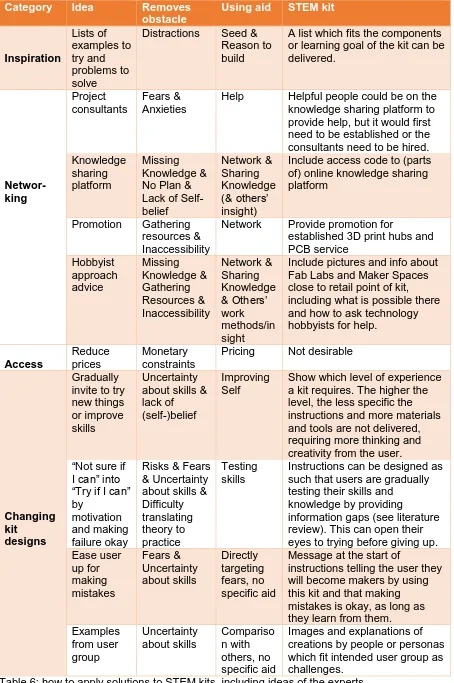
Taking another look at tables 3 and 4 while comparing the contents with findings in this chapter can provide a list of what is and is not possible with STEM kits. This list is shown in table 5. From this list, more requirements can be gathered based on the obstacles and aids picked.
From generated ideas list:
• Remove fears & anxieties • Give users a reason to build • Help users see seeds
• Provide knowledge or experience users feel they lack • Make resources and tools available
• Help users believe in their own capabilities • Help users see that mistakes are allowed • Let users improve their skills
Category Idea Removes Obstacle
Using Aid STEM kit
Inspiration Lists of examples to try and problems to solve
Distractions Seed & Reason to build
A list which fits the components or learning goal of the kit can be delivered. Networ-king Project consultants Fears & Anxieties
Help Helpful people could be on the knowledge sharing platform to provide help, but it would first need to be established or the consultants need to be hired. Knowledge sharing platform Missing Knowledge & No Plan & Lack of Self-belief Network & Sharing Knowledge (& others’ work methods/insight)
Include access code to (parts of) online
knowledge sharing platform
Fab Labs Gathering resources & Inaccessibility
Network Provide promotion for established 3D print hubs and PCB service
Access Reduce prices
Money investment constraints
Pricing Not desirable
Changing kit
designs
Gradually invite to try new things or improve skills
Uncertainty about skills & lack of (self-)belief
Improving Self & uncertain
outcome (from literature review)
Show which level of experience a kit
requires. The higher the level, the less specific the instructions and more materials and tools are not delivered, requiring more thinking and creativity from the user.
“Not sure if I can” into “Try if I can” by motivation and making failure okay
Risks & Fears & Uncertainty about skills & Difficulty translating theory to practice
Testing skills & information gap (from literature review)
4.5 Next steps
5 Specification
In order to move from an idea to a concept, it is important to specify which requirements are vital, which are optional, and which are optimistic future plans. The MoSCoW method will be used to do so. Furthermore, the ideas will be separated into functional and non-functional requirements. The deciding factor is simple: if a requirement can be measured, it is
functional; if it is necessary to do user tests in order to see if a requirement has been met, it is non-functional.
5.1 MoSCoW organizing
Must Have
Functional Non-functional
Help the user understand what the kit teaches them by trying it out.
Teaching scientific or technological phenomena.
Teach the user to use new techniques or tools.
Get the user to work with their hands. Remove fears and practical constraints. Help users believe in their own capabilities Help users see that mistakes are allowed
Should have
Functional Non-functional
Open ended results from the kit. Interesting results after completing the kit. Total contents small and light enough to be
carried by hand.
Let the user gain experience with techniques and tools.
Low costs. Make users curious.
Help users to be brave.
Provide knowledge or experience users feel they lack.
Could Have
Functional Non-functional
Allowing anyone to become a maker Give the users a reason to build.
Help the users see the tools and ideas in what they already have.
Let users improve their skills
Would Have
Functional Non-functional
Improve sales Make resources and tools available
5.2 next steps
6 Realization
After organizing the requirements in their level of importance to the essence of the end result, all is ready to start testing. In this chapter, multiple methods of implementation and testing will be discussed. The instructions of a STEM kit have been altered to leave room for the user to experiment, reflect, and learn by implementing uncertain situations and an information gap; this in line with the ideas in Changing Kit Designs of table 5. And to close off, the structure for a semi-structured expert interview is set out to find out if the expert thinks the presented instructions invite the user to change their behaviour towards instructions, and whether the expert believes the ideas in table 5 will work.
6.1 Ideating test method
Mind map of testing and implementation6.1.1 Testing methods
Expert interviews: requires a very small amount of people, respondents can give insight on how to improve the discussed materials from an experienced point of view, and results can be further explored with the respondents because there is a conversation.
Focus group: requires a large amount of time and a product nearly ready for use.
User tests: requires permission of the ethical committee, a large amount of willing users, and a thoroughly designed set of instructions. On top of that, the product should be nearly ready for use, while these designs are still in early stages. Performing the user tests takes a large amount of time as well.
Survey: takes time to reach enough people and gather enough responses and processing it requires a high amount of time and effort. That while the results gained cannot be further explored with the respondents since there is no conversation, which means the value of each response is low. Furthermore, the types of designs that can be tested via surveys is limited; physical products will be difficult to test.
To conclude, since it fits best in the time left and the stage of development, the design will be tested via expert interviews. In expert interviews, more than applied solutions can be
discussed; the experts could also give their opinions about theoretical solutions.
6.1.2 Implementation methods
Lobbying: Testing this will be difficult. It will hardly be possible to see which people have been reached and what the effects on them were. Furthermore, this has little to do with STEM kits.
Seeing seeds: Testing this can be rather easy via user tests or expert interviews. However, this requires more research into what can be seeds and how to present them, since little of that knowledge has not gathered in this research.
Set up a platform: Setting up a platform can potentially reach a large amount of test users, which will make sending out a survey to enough people relatively easy. The users can then find the platform via invitations included in STEM kits. Doing so will require a high amount of effort, and might provide harmful experiences during testing to potential users of an actual platform Conrad might set up in the future. It will also require time for the platform to take off.
follow customers in order to see what they do with the products they could more easily afford, which is highly intrusive.
Hire project consultant: To test this, a consultant needs to be hired for multiple people who each work on their projects. This requires large amounts of money and time, which are both unavailable at this point. Also, people helping users out can help them reach the desired results, but has little to do with STEM kits.
Go to Fab Labs and talk with people: A cheaper and more network-oriented version of hiring a project consultant. Similar to the consultant, this requires multiple people who each work on their projects, whose progress will be followed in order to see the results of the help of Fab Lab communities. Tracking the processes requires a large amount of time, which is not available. And, in this case as well, the implementation has little to do with STEM kits.
Design ultimate flexible kit: This is more of a dream scenario than an actual option. Knowledge of how to do this is missing at this stage, more needs to be tested in order to know what an ultimate flexible kit should have and should not have.
Make a part: Requires time and understanding of the kits. Required time is little and understanding of a part like instructions is there. Providing problems to work with can be done but knowledge on how to design problems which really motivate is missing.
The implementation which consumes least time and money, and still stays close to STEM kits is to implement changes to instructions of STEM kits. The instructions can be changed according to the Changing Kits’ Designs category of table 5, and problems to work with or examples of what can be done with the contents of the kit by adding own parts and
knowledge can be included in the form of challenges at the end of the instructions, after the user has learnt to understand the scientific phenomenon the kit teaches.
6.1.3 How to test
Concluding both these sections: the ideas in table 5 will be tested by implementing
suggested changes to instructions of a STEM kit, and discussing those with experts in expert interviews. The experts can also take a look at the whole list of ideas in table 5 – which are not all implemented – to give their opinion on the other ideas as well.
6.2 Instruction construction
As such, the Must Have requirements have been implemented by redesigning instructions of a STEM kit. To be precise, they were the instructions of the Arexx School Lab magic Light Kit, redesigned according to the implementation ideas of the ‘changing kits design’ category in table 5, the result of which can be found in Appendix F. In the new instructions, the order of the steps has not been changed, but the new instructions contain only the most vital information of each step in the original instructions, leaving out most tips and warnings. Information on which materials should be used to put two parts together has been deliberately left out, so users get the chance to either use screws delivered or grab their duct-tape, tie-rips, or any other material they can find. These two design choices will likely cause the users to make mistakes in the assembly process, which they will have to solve using their own insight. Doing so will improve their self-belief. Furthermore, the information about how LED lighting works is placed at the beginning, so users for whom the LEDs do not immediately work are confronted with an information gap they can fill by remembering what they learned at the beginning of the assembly process, possibly looking back in the
instructions, or maybe even searching online. Solving that problem on their own will increase self-belief even further.