RESEARCH ARTICLE
Nathusius
’
bats optimize long-distance migration by flying
at maximum range speed
Sara A. Troxell1,2,3, Marc W. Holderied4, Gunārs Pētersons5and Christian C. Voigt1,2,*
ABSTRACT
Aerial migration is the fastest, yet most energetically demanding way of seasonal movement between habitats. However, for many taxa, and bats in particular, we lack a clear understanding of the energy requirements for migration. Here, we examined the energetic cost and flight speed of the long-distance migratory Nathusius’bat (Pipistrellus nathusii). We measured flight metabolism in relation to airspeed in a wind tunnel, inferred the optimal traveling speed over long distances, i.e. maximum range speed, and compared this value with flight speed measured in wild conspecifics. Body mass and wing morphologies were similar in captive and wild bats, indicating that the body condition of captive bats was similar to that of migratory bats. Nine out of the 12 captive bats exhibited a U-shaped relationship between flight metabolic power and airspeed when flying in the wind tunnel. The flight metabolic rate across all airspeeds averaged 0.98±0.28 W, which corresponds well to established allometric relationships between flight metabolic rate and body mass for bats. During summer migration, P. nathusii traveled at an average speed of 6.9±0.7 m s−1, which was significantly higher than the minimum
power speed (5.8±1.0 m s−1), yet within the range of expected
maximum range speed inferred from wind tunnel experiments. This suggests thatP. nathusii may migrate at an energetically optimal speed and that aerial refueling does not substantially lower migratory speed inP. nathusii.
KEY WORDS: Energy consumption, Flight metabolism, Flight speed, Migration physiology,Pipistrellus nathusii, Power curve
INTRODUCTION
Animals in temperate zones face strong seasonal fluctuations in both climatic conditions and resource abundance. Overcoming these challenges requires a number of physiological and behavioral adaptations that coincide with or even precede seasonal environmental changes. Migration is a central adaptive strategy utilized by many animal taxa in response to a seasonal world (Baker, 1978; Dingle, 2014), yet moving over long distances imposes high nutritional demands on migratory animals (Alerstam and Lindström, 1990; Klaassen, 1996; McWilliams et al., 2004) and animals must adjust their time and energy budgets accordingly.
Migration between summer and wintering habitats has been recorded in several bat species (Fleming and Eby, 2003; Steffens et al., 2004; Hutterer et al., 2005; Popa-Lisseanu and Voigt, 2009; Voigt et al., 2014; Lehnert et al., 2018). However, compared with the large amount of information available on migration in other taxa, bat migration has received little attention.
Bats exhibit high metabolic rates during sustained flight (Speakman and Thomas, 2003) and must therefore efficiently acquire fuel reserves while still maintaining body conditions conducive to energy efficient flight. To power migration, bats use a mixed fuel strategy metabolizing both endogenous ( probably glycogen from muscular tissue and triacylglycerols from adipocytes) and exogenous fuels (nutrients from captured insects) (Voigt et al., 2012; Krüger et al., 2014), yet it is unknown how much energy bats expend during migration and whether or not they fly at optimal speed. Here, we quantified the relationship between flight metabolic rate and airspeed in a small temperate zone migratory bat from Europe,Pipistrellus nathusii. Based on this relationship, we estimated the optimal flight speed of foraging and migrating bats and compared derived optimal flight speeds with the speed at which
P. nathusiiis foraging and migrating during late summer.
Aerodynamic theory states that the relationship between metabolic power and flight speed can be described as aU-shaped curve: metabolic power is high at slow and fast speeds and lowest at intermediate speeds (Pennycuick, 1975; Rayner, 1999). Hedenström (2009) suggested that bats should migrate at maximum range speed, the speed at which energy expended in relation to distance traveled per unit time is minimal, under optimal conditions. Maximum range speed,vmris higher than minimum power speed (vmp), which is the speed at which bats would stay airborne at the lowest cost (Hedenström and Alerstam, 1995). Because prey encounter rate increases with flight speed, the highest net energetic intake might be achieved by foraging at speeds above
vmp. So, if a migratory bat were to forage opportunistically during migration (aerial refueling), the resulting flight speed might lie somewhere between vmrand vmp. However, while encounter rate increases with speed, capture success rate still depends on the ability to perform tight turns and incur associated locomotion costs. This maneuverability constraint favors slower speeds and might even lead to flight belowvmp. Although recent flight speed measurements have confirmed some of these assumptions for non-migratory bat species (Grodzinski et al., 2009; Holderied and Jones, 2009; Voigt and Holderied, 2012), compared with the vast literature available on birds, little is known about the exact relationship between flight metabolism and speed for any bat, let alone migratory versus non-migratory species.
Early studies focused on large tropical bats flying with head masks for respirometric measurements (e.g. Thomas, 1975). The first measurements on smaller bat species were done using a combination of doubly labeled water (DLW) and respirometric methods (Speakman and Racey, 1991), by energy budget methods Received 19 December 2017; Accepted 25 January 2019
1Department of Evolutionary Ecology, Leibniz Institute for Zoo and Wildlife Research, Alfred-Kowalke-Strasse 17, 10315 Berlin, Germany.2Freie Universität, Takustrasse 6, 14195 Berlin, Germany.3Max Planck Institute for Ornithology, Eberhard-Gwinner-Strasse 11, 82319 Seewiesen, Germany.4School of Biological Sciences, University of Bristol, 24 Tyndale Avenue, Bristol BS8 1TQ, UK.5Faculty of Veterinary Medicine, Latvia University of Agriculture, Helamaņa 8, Jelgava 3004, Latvia.
*Author for correspondence ([email protected])
S.A.T., 0000-0002-0321-8641; C.C.V., 0000-0002-0706-3974
Journal
of
Experimental
(Winter and von Helversen, 1998) or by respirometry using artificial feeders (Voigt and Winter, 1999). A more recent wind tunnel experiment demonstrated that Seba’s short-tailed fruit bats,Carollia perspicillata, exhibit a U-shaped power curve over a range of velocities (von Busse et al., 2013). However, von Busse and colleagues (2013) also highlighted that individual variation in flight metabolism may be substantial. To assess whether this finding holds true for other species and to determine the extent of individual variation in the shape of power curves, it is necessary to employ these same experimental techniques over a wide range of flight speeds with multiple individuals. Further, it is essential to test the U-shaped curve in a migratory bat species that evolved physiological and morphological adaptations in response to long-distance migration in order to make predictions regarding optimal flight speeds for migration.
In this study, we measured the relationship between flight metabolism and speed in the migratoryP. nathusii. This seasonal long-distance migrant covers up to 2000 km one way between its northeastern breeding range in Germany, Poland, Belarus, Fennoscandia, the Baltic States and Russia and their winter hibernation sites in southwestern Europe (Pētersons, 2004; Steffens et al., 2004; Hutterer et al., 2005). By measuring the relationship between flight metabolism and speed with actual flight speeds encountered during migration in the field, we then tested whether free-ranging migratory bats fly at maximum range speed, or whether foraging during flight (aerial refueling) reduces the realized flight speed.
MATERIALS AND METHODS Wind tunnel experiment
Study animals and experimental protocol
Measurements of flight metabolism were conducted at the wind tunnel of the Max Planck Institute for Ornithology (MPIO) in Seewiesen, Germany. For more information on the technical specifications of the wind tunnel, please refer to Pennycuick et al. (1997). We obtained 12 adult malePipistrellus nathusii(Keyserling and Blasius 1839) from roost boxes in the Berlin area under license I E229-OA-AS/G/1051 from the Senatsverwaltung für Stadtentwicklung und Umwelt in Berlin. Two animals were captured and tested in March 2015 and 10 animals were captured and tested in September 2015. After standard veterinary health checks and quarantine, animals were transferred to the MPIO where they were kept in a tent made out of fine polyester mesh withad libitumaccess to water. Each animal was hand fed with about 1.5– 2 g of live mealworms per night. The temperature in the room was kept at approximately 18°C, reflecting ambient conditions in natural roosts, and bats were exposed to a natural photoperiod cycle. Experiments with bats followed the animal care and ethics permit under license 55.2-1-54-2532-12-2014 granted by the federal district of Oberbayern, Germany. Bats were trained with mealworm rewards to fly for 1 min bouts at airspeeds between 2 and 11 m s−1at 1 m s−1increments. In parallel to flight training, bats were habituated to the respirometry chamber. Throughout training, rewards were given less and less frequently and after 4 nights of training, bats were fed only after completion of an experiment. For each bat, we photographed the outstretched wings and used ImageJ (1.50b, NIH, USA) to measure wingspan and wing area as defined by Norberg and Rayner (1987). Body mass was measured to the nearest milligram with a precision balance (Ohaus, Parsipanny, NJ, USA) at the onset of each metabolic measurement.
We used the13C-labeled Na-bicarbonate (Na13HCO
3) method as outlined in Hambly et al. (2002, 2004) and modified by Voigt and
Lewanzik (2011) for instantaneous measurement of 13C-enriched breath from which the rate of CO2production can be determined (Hambly and Voigt, 2011). At the start of an experiment, a bat was released into the wind tunnel for a warm-up flight of approximately 10 min at the airspeed to be tested. We then administered 60 mg of isotonic13C-labeled Na-bicarbonate solution (0.29 mol l−1; Euriso-Top GmbH, Saarbrücken, Germany) via intraperitoneal injection and immediately placed the bat in the 850 ml respirometry chamber, where temperature was kept constant at 20°C. Flow of CO2-free air into the chamber was set to 1200 ml min−1 using a mass-flow controller (MFS-2, Sable Systems, Las Vegas, NV, USA). We monitored 13CO
2 and 12CO2 enrichment in the outlet air of the chamber using a cavity ring-down spectrometer (G1101 CO2 Isotopic Analyzer, Picarro, Sunnyvale, CA, USA). The bat remained in the chamber until the 13C enrichment reached a plateau and then declined exponentially. This took 8–10 min, after which we released the bat into the wind tunnel flight section for 1 min of flight. The bat was then transferred back to the chamber for 20 min and fed immediately afterward.
Analysis of respirometry data
For analysis of the rate of CO2production, we focused on a 15 min period starting about 5 min after peak 13C enrichment, because previous studies indicated a constant exponential washout rate of the label within this period (Voigt and Lewanzik, 2011). For each sampling event, we calculatedV̇CO2(ml min
−1) by multiplying the
combined concentrations of13CO
2and12CO2( parts per million by volume, ppmv) with the flow-through rate in the chamber using eqn 10.5 from Lighton (2008) and assuming that bats exclusively oxidized glycogen during short bouts of flight (respiratory exchange ratio=1.0). We converted values in the delta notation to Atom% (atom per cent, AP) according to Slater et al. (2001) and plotted the natural logarithm of excess13C enrichment (lnAP13CE) in relation to time elapsed since the i.p. injection of13C-labeled Na-bicarbonate. For the pre-flight period, we calculated the fractional isotopic turnover (kc; min−1) according to:
kc¼ ½lnAP13CEðt1Þ lnAP13CEðt2Þ=t1t2; ð1Þ with13C enrichment above background (AP13CE) at timet
1(min) and at time t2 (min). We then used the maximal post-injection enrichment of13C in exhaled breath expressed as AP13CE (%) to obtain the total body bicarbonate pool,Nc(mol) using the following equation:
Nc¼20eð7:24211:5458ln peak AP
13CEÞ
: ð2Þ
This equation was obtained from a dilution experiment described in Voigt et al. (2010a). We then multiplied the elimination rate of carbon isotopes,kc(min−1), by the bicarbonate pool of the animal,Nc(mol CO2), and converted this into carbon dioxide production rate (V̇CO2,
ml min−1) using the equation for ideal gases, with the actual measured barometric pressure and assuming a temperature of 30°C. To check the accuracy of the13C-labeled Na-bicarbonate method, we plotted
V̇CO2based on the
13C-labeled Na-bicarbonate method in relation to
V̇CO2based on respirometry for the pre-flight period and calculated a
two-way ANOVA using air speed and individual as variables.
Estimation ofV̇CO2in flying bats
For estimatingkc(min−1) of a bat when flying in the wind tunnel, we predicted ln(AP13CE) at the onset and end of the flight interval using two least-squares linear regression equations, one for the relationship between ln(AP13CE) and time during the pre-flight
Journal
of
Experimental
period and one for the relationship between ln(AP13CE) and time during the post-flight period. We then calculatedkcfor flying bats based on Eqn 1, and converted flightkcto flightV̇CO2using the
relationship betweenkcandV̇CO2of the pre-flight period.V̇CO2was
then converted to metabolic power by assuming that bats oxidized mostly glycogen during the short flight bouts of our experiment.
Inference ofvmpandvmrbased on flight metabolic power
We plotted flight metabolic rate against airspeed for each individual and tested whether a degree 2 polynomial (curved regression) fitted each dataset better than a degree 1 polynomial (linear regression). We used a degree 2 polynomial equation because this is the most parsimonious equation (least complex) for a non-linear function of the expected U-shape with the given sample size of 5–7 data points. For each curved relationship, we estimatedvmpas the absolute minimum point of the curve andvmras the point of tangency between the curve and tangent line passing through the origin.
Field studies at the migration site
Measurement of flight speed in foraging and migrating bats
We measured the flight speeds ofP. nathusiiduring migration along the shoreline of the Baltic Sea. Echolocation calls of free-flying migratory and foraging P. nathusiiwere recorded on 27 and 29 August 2013, respectively, between 19:30 h and 23:00 h, at two distinct sites: migratory bats were recorded at sea facing the edge of a forest and foraging bats were recorded at a clearing in the coastal dune forest within 100 m of the Pape Biological Station (56°09′N 21°03′E, Rucava Municipality, Latvia). The two recording sites were less than 100 m apart. Wind speed measurements were obtained from Rucava meteorological station at about 8 km distance from our study site (https://www.meteo.lv; accessed on 20 January 2019). When recording migratory bats on 27 August 2013, the station documented a median wind speed of 0 m s−1 during the measurement period. When recording foraging bats on 29 August 2013, the station documented a median wind speed of about 1 m s−1. However, as the recording site was located in a forest clearing, the local foraging took place in the absence of any wind as the site was protected by trees. Based on this, we refer to measured ground speed as flight speed, assuming no wind interference in our measurements.
The Acoustic Flight Path Tracking (AFPT) recording system consisted of two microphone arrays each with four Knowles BT1759 microphones (Maplewood Drive, Itasca, IL, USA), arranged in a symmetrical star. The two arrays were positioned on either side of the flight route, with a distance between the arrays of between 5.81 and 6.13 m. Microphones faced in the direction of the approaching bats. All eight microphone channels were recorded sample-synchronously using a hard disk logger (GL1100-16 with 4× GL10-VAMP, Graphtec Corporation, Yokohama, Japan) at 16-bit resolution and 500 kHz sampling rate.
The AFPT system utilizes the arrival time differences between the different microphones to triangulate the position of the bat at the moment of sound emission. Sound propagation speed was calculated (Bazley, 1976) for the current air temperature (with 1°C accuracy) and relative humidity (1% accuracy) as measured at the height of the recording microphones with a weather station (GEOS N°11, Skywatch, JDC Electronic SA, Yverdon, Switzerland). Each call emitted by a bat within localization range creates a location, and consecutive localizations will trace the bat’s flight trajectory. Because location accuracy of the AFPT system decreases with wind conditions, data were recorded under near-windless conditions
(≤1 m s−1). For further information, see Holderied and von Helversen (2003) and Aubauer (1994).
Individual flight trajectories were reconstructed from these single call locations using custom-written MatLab scripts (v.6.5, MathWorks, Natick, MA, USA). Trajectories consist of segments, i.e. curved 3D connections between two consecutive locations, which were grouped into trajectories based on their spatial and temporal order, and respective segment flight speeds. Individual localizations leading to sudden jumps in the trajectory and/or the segment flight speeds were manually excluded from analysis as erroneous measurements. Trajectories with fewer than four segments, i.e. five localizations, were considered too short and excluded from further analysis. Three mean measurements were calculated for each trajectory using MatLab scripts: (i) trajectory height above ground (by averaging location height); (ii) trajectory speed (by averaging all segment speeds, which were calculated by fitting a 3D circle to three consecutive locations and deriving the velocity on that circular segment); and (iii) tortuosity value (traveled distance divided by net displacement). Trajectories originating from P. nathusii were identified using the characteristic call end frequency of around 40 kHz. To determine whether the individuals tested in the wind tunnel were of similar body size to individuals at the migration corridor, given it was not possible to capture the individuals we recorded flight speeds from, we collected morphological data from conspecifics. To this end, we measured body mass and digitally photographed the outstretched wings of 20 adult males and 20 adult females captured in a Heligoland funnel trap at the field site.
Statistical analysis
To test for differences in metabolic rate across individuals, we used a one-way ANCOVA with individual as a random effect and body mass as a covariate (SYSTAT, Systat Software Inc., Richmond, VA, USA). For testing the effect of wind speed on flight duration, we used a one-way ANCOVA with individual as random effect and wind speed as covariate. We compared morphological measures (wing area, body mass, wing span and aspect ratio) between males and females using a Mann–WhitneyU-test. We also used a Mann– Whitney U-test to compare morphological measures between captive and wildP. nathusii. Further, we used Student’st-test for comparing flight speeds of foraging and migratingP. nathusiiwith corresponding values derived from wind tunnel measurements. For all statistical tests, we assumed alpha=0.05. Data are presented as means±1 s.d. if not mentioned otherwise.
RESULTS
Wind tunnel experiment
At around 2–3 min post-injection of the isotonic Na13HCO 3 solution,13C enrichment in exhaled breath reached peak values, at which point the incorporation rate of the label into the animal’s bicarbonate pool equaled the washout rate via exhaled CO2. Subsequently, the label decreased exponentially, resulting in a linear decline in the ln-converted scale which was equivalent to the fractional turnover rate,kc, of the resting bat. A comparison of pre-flight metabolic rates using the13C-labeled Na-bicarbonate method and conventional respirometry revealed r2=0.86 (see Fig. S1). Individual as a factor caused some of the variation in metabolic rate (one-way ANCOVA: F11,61=2.35,P=0.017). Pre-flight metabolic rate estimated by the13C-labeled Na-bicarbonate method was on average 5.2±2.1 times higher than that corresponding values obtained by respirometry, yet the two parameters were highly correlated (F1,62=103.4,P<0.001; Fig. S1). The difference between
Journal
of
Experimental
metabolic rates estimated by the 13C-labeled Na-bicarbonate method and respirometry for the pre-flight period was taken into account when using the pre-flight relationship of metabolic rate to estimate flight metabolic rate based on the total bicarbonate pool of the animal (Nc) and the fractional turnover (kc) during flight.
The range of flight speeds achievable by individuals varied between a minimum of 2–6 m s−1and a maximum of 8–11 m s−1 (Table S1). Individuals did not differ on average in flight duration (one-way ANCOVA: F11,62=1.51, P=0.15), yet flight duration increased slightly with increasing airspeed (F1,62=5.37,P=0.024). However, this increase was only moderate (r2=0.242) with flight duration ranging from 68±4 s (N=8) at 3 m s−1to 74±9 s (N=8) at 9 m s−1, i.e. a 6 s increase in flight duration over a 6 m s−1increase in airspeed.
The flight metabolic rate across all airspeeds averaged 0.98±0.28 W (Table S1), which is 2.2±0.9 times higher than the pre-flight metabolic rate of the same animals. Nine of the 12 bats tested in the wind tunnel exhibited a U-shaped relationship between flight metabolic power and airspeed; data from two individuals was best fitted by an invertedU-shape, and data from one individual did not fit well to any regression (r2<0.1) (see Fig. S2). We excluded the datasets of these three individuals, as we observed frequent landings in these animals during the 1 min flight period, which might explain the lack of aU-shaped relationship between flight metabolic rate and speed. For the remaining animals, the average flight metabolic rate at each airspeed followed aU-shaped curve (Fig. 1A). Average vmp based on U-shaped curves from the wind tunnel experiment was 5.8±1.0 m s−1and averagev
mrwas 7.5±1.1 m s−1 (Fig. 1B; Table S1).
Field studies at the migration site
We observed distinct migratory behavior of bats only during the first recording night on 27 August 2013, when several hundred
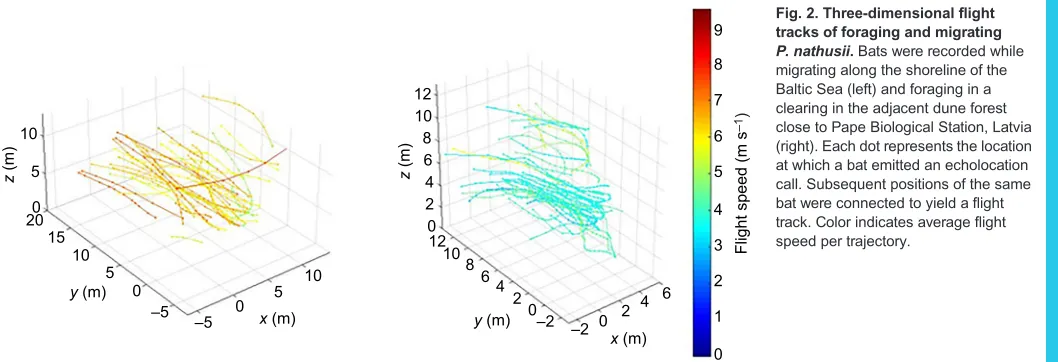
individuals were migrating south in straight lines over a depression between the frontal sand dunes and the seaward edge of the mature dune forest (Fig. 2). Between 19:30 h and 23:00 h, we recorded 37 flight trajectories based on 395 localizations. Because no flight during this period was observed in the opposite direction, we consider these to represent 37 separate individuals. A single trajectory comprised on average 10.7±4.6 localizations and covered a distance of 16.0±4.8 m in 2.3±0.70 s. The mean flight height above ground per trajectory was 7.8±2.1 m and mean flight speed per trajectory was 6.9±0.7 m s−1.
On 29 August, we recorded foraging bats flying up and down a local linear gap in the dune forest. Between 19:30 h and 23:00 h, we recorded 40 foraging flight trajectories comprising 672 individual localizations. On average, a single trajectory comprised 16.8±9.1 localizations and covered a distance of 11.6±5.3 m in 2.7±1.4 s. The mean flight height above ground per trajectory was 6.5±2.4 m and the mean flight speed per trajectory was 4.6±0.7 m s−1.
Morphology of bats in the field and the wind tunnel
The wing area of females was significantly larger than that of males measured in the field (Mann–Whitney U-test: W=296, P=0.01). However, we observed no significant differences in body mass (W=237, P=0.32), wing span (W=269, P=0.06) or aspect ratio (W=198, P=0.97) between the sexes. Morphological measures of bats tested in the wind tunnel can be found in Table S2. We found no differences in wing area (W=120,P=1), wing span (W=134,P=0.60) or aspect ratio (W=128, P=0.77) between bats used in the wind tunnel and males caught in the field. We observed a trend for higher body mass in wild compared with captive bats (W=69,P=0.05).
Comparison of flight speeds
We found that migration flight speed was significantly higher than wind tunnel inferred vmp (d.f.=44, t=4.2, P<0.001), but not
A
B
1.4 1.6
1.2
1.6
0.8
0.6
0.4 0
Vmp measured
Vmp predicted
Pape foraging
Vmr measured
Pape migrating Foraging H&J '09
2 4 6 8 10 12
0 2 4 6
Flight speed (m s–1)
Wind speed (m s–1)
8 10 12
[image:4.612.119.500.445.675.2]Flight metabolic rate (W)
Fig. 1. Comparison of measured and predicted flight speed.(A) Metabolic flight power in relation to airspeed in ninePipistrellus nathusii. Boxes represent 25 and 75 percentiles, bars indicate medians, dots indicate means and whiskers extend to ±1 s.d. A degree 2 polynomial regression equation was
calculated based on means for given airspeeds (solid curved line; note that we neglected the single data point at an airspeed of 2 m s−1). (B) Foraging (top)
and migrating (bottom) flight speeds.vmp(minimum power speed) andvmr(maximum range speed) were inferred from metabolic measurements (open gray
boxes) and measured flight speeds in the field (striped gray boxes);‘Pape’refers to recordings near the Pape Biological Station.‘Foraging H&J‘09’represents
data from Holderied and Jones (2009). Bars indicate medians, boxes show 25 and 75 percentiles, whiskers show 1 s.d.
Journal
of
Experimental
significantly different to wind tunnel inferredvmr(d.f.=44, t=1.8,
P<0.081). Compared with foraging flight speed (4.5±0.7 m s−1), both wind tunnel inferred vmr (d.f.=47, t=10.3, P<0.001) and migration flight speed (d.f.=47,t=4.52,P<0.001) were significantly higher. P-values remained below an alpha value of 5% after Bonferroni correction because of multiple testing.
DISCUSSION
We measured the relationship between flight metabolic rate of Nathusius’ bats (P. nathusii) and airspeed in a wind tunnel. Averaged flight metabolic rate was in the range of expected values based on allometric scaling (1.1 W for flight metabolic rate of a 7 g bat in Winter and von Helversen, 1998). Additionally, we found that migration flight speed of wild P. nathusii was higher than minimum power flight speed estimated from data from the wind tunnel experiment. Indeed, our data suggest thatP. nathusiiwere traveling atvmralong the shoreline of the Baltic Sea towards their hibernacula in southwestern Europe. Therefore, our study confirms that the observed flight speeds are consistent with the expectation that migratory bats practice optimal flight speeds for covering the largest distance with the least amount of energy. Additionally, our data suggest that aerial refueling (Voigt et al., 2012) does not interfere with migration speed by substantially reducing flight speed in migratory bats. Further, foraging flight speeds observed in the field (4.6±0.7 m s−1) were significantly lower than v
mp determined in wind tunnel experiments. One possible explanation for this difference is that foraging in a linear gap in the dune forest required sharp turns in the flight trajectories. These tight turns require slower flight speeds, and hence the overall average speed might be reduced in expectation of such turns. A comparison with field flight speeds of P. nathusii in less confined habitats (Holderied and Jones, 2009), without tight turns, revealed average foraging speeds (5.5±1.1 m s−1) much closer tovmp(5.8±1.0 m s−1).
Data of migratory flight speed and flight energy expenditure allow us to estimate energetic requirements of trans-continental migration in small-sized bats. However, it is important to note here that our insights into the migratory behavior of bats are still in their infancy. For example, we do not know how long bats migrate or what distances they cover per night, let alone how long it takes to migrate a distance of 2000 km. Assuming that a migratory bat is traveling atvmrfor 4–8 h per night, it will require 14.7–29.5 kJ. The distance traveled would equal almost 110 km for a 4 h flight or 220 km for an 8 h flight. On a few occasions, bandedP. nathusii
have been recaptured after a single night of migration at a distance of 50 km from their point of release. Although it is likely that bats do not fly in a straight line during migration, we can infer from this value that these bats may have flown for at least 2 h with a minimum of 7.34 kJ expended for flight alone. Covering the 2000 km between the summer areas in Northeastern Europe and the hibernacula sites in Western or Southern France would require 80 h of continuous flight, or–given that Nathusius’bats fly a maximum of 7 h per night (Šuba et al., 2012)–a minimum of 12 days. The total amount of energy a bat likeP. nathusii has to expend for that flight would amount to almost 300 kJ. Assuming that 50% of this energy originates from the oxidation of triacylglycerols in adipocytes when bats use a mixed-fuel strategy (Voigt et al., 2012), the required amount of fat equals 4.8 g (assuming a 31 kJ g−1caloric content of fat tissue). At our migration site in Latvia, Nathusius’bats weighed about 5–8 g. Thus, it seems plausible thatP. nathusiido not fatten up greatly before migration flight, but instead may frequently route fat nutrients from consumed insects to their fat depots (Voigt et al., 2012). The insect biomass consumed along the route would amount to 35 g to fuel the flight, assuming 8.6 kJ g−1 metabolizable energy for insects (Finke, 2002). Bats may benefit from torpor when resting (McGuire et al., 2012); thus, it is likely that most energy consumed during migratory journeys will be expended for aerial locomotion.
Our comparison of flight speeds is based on several assumptions that we evaluate below. First, the recorded flight speed of foraging and migrating wild bats was not impaired by local winds. During the time of measurement, we experienced low or no wind speed when conducting ultrasonic recordings and therefore we assume that measured ground speed matched flight speed. If bats experienced stronger winds at their actual position during the recording, our comparison might be flawed by not taking the wind speed at the position of the bat into account. However, based on the wind measurements of a local meteorological station and the observed conditions at our study site, we are confident that wind did not interfere with our estimate of flight speed in both migratory and foragingP. nathusii. Second, we assume that bats recorded in flight at the migratory corridor in Latvia were similar in terms of morphology compared with conspecifics captured nearby. This assumption is hard to test, as we could not access those individuals for which we obtained flight trajectories. However, we doubt that these bats were systematically different in body morphology from those captured in the funnel trap, which was only about 50 m distance from the microphone arrays. Therefore, we do not expect
10
12
9
8
7
6
5
4
3
2
1
0 10
8 6 4 2 0 12
10 8
6 4
2 0
–2 –2 0 2 4 6 5
0 20
15 10
5 0
–5 –5
0
x (m)
x (m)
Flight speed (m s
–1
)
y (m)
y (m)
z
(m)
z
(m)
[image:5.612.48.577.55.236.2]5 10
Fig. 2. Three-dimensional flight tracks of foraging and migrating
P. nathusii.Bats were recorded while
migrating along the shoreline of the Baltic Sea (left) and foraging in a clearing in the adjacent dune forest close to Pape Biological Station, Latvia (right). Each dot represents the location at which a bat emitted an echolocation call. Subsequent positions of the same bat were connected to yield a flight track. Color indicates average flight speed per trajectory.
Journal
of
Experimental
that this assumption has been violated. Third, the bats recorded in flight at the migratory corridor were comparable to those used in the wind tunnel experiments. As we measured only males in the wind tunnel and potentially recorded flight tracks of both males and females in the field, we investigated sex-specific differences in the population of captured conspecifics. Female bats recorded in the field were slightly larger in terms of wing area than males; however, they still did not differ from males in body mass, wingspan, aspect ratio or wing loading. Furthermore, neither females nor males measured in the field had a significantly different wing area from that of individuals that flew in the wind tunnel. The bats captured in the field weighed on average 0.5±0.1 g more than conspecifics in the wind tunnel experiment. This 6.6% difference in body mass also results in higher wing loading in wild bats compared with those used in the wind tunnel experiment. Therefore, optimal flight speeds of captive bats might have been slightly lower than those of wild bats. Fourth, we assumed that bats migrate without foraging. Indeed, feeding behavior could reduce the overall flight speed of bats during migration because maneuverability is lower at higher flight speed. Overall, we did not observe hunting behavior ofP. nathusiiwhen the 37 migration flight trajectories were recorded. However, the same species foraged at considerably lower speeds at a nearby forest, suggesting that during migration, distinct phases of migrating and foraging might occur at adjacent locations. It could be argued that the slight but non-significant difference betweenvmrobtained from wind tunnel experiments and flight speed measured in the field is due to the possibility that bats searched for insects en route. On the one hand, this is supported by the fact that insectivorous bats, in contrast to migratory birds, use a mixed fuel to power flight (Voigt et al., 2010b, 2012). On the other hand, recent studies quantifying echolocation call behavior of migratoryP. nathusiiat our study site showed that feeding buzzes, stereotypic repetitions of echolocation calls indicating a successful hunt, were rare (Voigt et al., 2017, 2018). Possibly, migratory bats hunt after sunset for a short time and afterwards engage in extended periods of migration without any extensive aerial hunts. Lastly, we observed aU-shaped power curve in only 9 out of 12 animals in the wind tunnel experiment. We rejected the data of three individuals based on the observation that these individuals engaged in a number of flight maneuvers that may have added additional metabolic costs and thus noise to the dataset. We conclude thatP. nathusiimigrating in late summer along the Latvian shoreline of the Baltic Sea travel atvmr, enabling these bats to cover the longest distances with the least amount of energy. A comparison of bat morphologies revealed no large differences between captive and wild bats and further suggests that wild bats do not carry large fat reserves when migrating. Fueling the high-energy requirements of long-distance flights may force P. nathusii to regularly consume insects as an exogenous fuel. The absence of hunting events in migratory bats suggests thatP. nathusiihunt first before engaging in endurance migratory flights at maximum range speed.
Acknowledgements
We thank Tobias Teige for help in capturing bats in the Berlin area and Ilze Brila, Viesturs Vintulis and Oliver Lindecke for help in capturing bats at Pape Biological Station. Oliver Lindecke additionally helped in taking digital pictures of wild bats for morphometric measurements. We thank Niels Rattenborg, Ninon Ballerstädt, Holger Goerlitz and the Max Planck Institute for Ornithology for facilitating and supporting our experiments there. We thank Renate Heckel-Merz, Klemen Koselj, Silvio Bürge and Leonie Baier for help in keeping and feeding the bats in Seewiesen.
Competing interests
The authors declare no competing or financial interests.
Author contributions
Conceptualization: S.A.T., M.W.H., G.P., C.C.V.; Methodology: S.A.T., M.W.H., G.P., C.C.V.; Validation: S.A.T., M.W.H., C.C.V.; Formal analysis: S.A.T., M.W.H.; Investigation: S.A.T., M.W.H., C.C.V.; Resources: S.A.T., M.W.H., G.P., C.C.V.; Data curation: S.A.T., M.W.H., C.C.V.; Writing original draft: S.A.T., M.W.H.; Writing -review & editing: S.A.T., M.W.H., G.P., C.C.V.; Visualization: S.A.T., C.C.V.; Supervision: C.C.V.; Project administration: G.P., C.C.V.; Funding acquisition: M.W.H., G.P., C.C.V.
Funding
This project was financially supported by the German National Research Council (Deutsche Forschungsgemeinschaft, Vo890/22).
Data availability
Data are available from the Dryad Digital Repository (Troxell et al., 2019; doi:10. 5061/dryad.1476d70).
Supplementary information
Supplementary information available online at
http://jeb.biologists.org/lookup/doi/10.1242/jeb.176396.supplemental
References
Alerstam, T. and Lindström, Å. (1990). Optimal bird migration: the relative
importance of time, energy, and safety. InBird Migration (ed. E. Gwinner), pp. 331-351. Berlin, Heidelberg: Springer.
Aubauer, R. (1994).Dreidimensionale Flugbahnverfolgung von Fledermäusen
Fortschritte der Akustik–DAGA 94.Bad Honnef, Germany: DPG-Verlag.
Baker, R.(1978).Evolutionary Ecology of Animal Migration. Holmes & Meier
Publishers.
Bazley, E. N.(1976).Sound Absorption in Air at Frequencies up to 100 kHz
(No. NPL-AC-74). England: National Physical Lab Teddington.
Dingle, H.(2014). Migration: The Biology of Life on the Move. USA: Oxford
University Press.
Finke, M. D. (2002). Complete nutrient composition of commercially raised
invertebrates used as food for insectivores.Zoo Biol.21, 269-285.
Fleming, T. H. and Eby, P.(2003). Ecology of bat migration. InBat Ecology(ed. T. H.
Kunz and M. B. Fenton), pp. 156-208. Chicago and London: Chicago University Press.
Grodzinski, U., Spiegel, O., Korine, C. and Holderied, M. W.(2009).
Context-dependent flight speed: evidence for energetically optimal flight speed in the bat Pipistrellus kuhlii?J. Anim. Ecol.78, 540-548.
Hambly, C. and Voigt, C. C.(2011). Measuring energy expenditure in birds using
bolus injections of 13C-labelled Na-bicarbonate.Comp. Biochem. Physiol. A158, 323-328.
Hambly, C., Harper, E. and Speakman, J.(2002). Cost of flight in the zebra finch
(Taenopygia guttata): a novel approach based on elimination of 13 C labelled
bicarbonate.J. Comp. Physiol. B172, 529-539.
Hambly, C., Harper, E. and Speakman, J.(2004). The energy cost of loaded flight
is substantially lower than expected due to alterations in flight kinematics.J. Exp.
Biol.207, 3969-3976.
Hedenström, A.(2009). Optimal migration strategies in bats. J. Mammal. 90,
1298-1309.
Hedenström, A. and Alerstam, T.(1995). Optimal flight speed of birds.Philos.
Trans. R. Soc. Lond. B348, 471-487.
Holderied, M. W. and Jones, G. (2009). Flight dynamics. InEcological and
Behavioral Methods for the Study of Bats(ed. T. H. Kunz and S. Parsons),
pp. 459-475. Baltimore: Johns Hopkins University Press.
Holderied, M. W. and Von Helversen, O. (2003). Echolocation range and
wingbeat period match in aerial-hawking bats. Proc. R. Soc. Lond. B 270, 2293-2299.
Hutterer, R., Ivanova, T., Meyer-Cords, C. and Rodrigues, L. (2005). Bat
Migrations in Europe: A Review of Banding Data and Literature. Naturschutz und
Biologische Vielfalt, Vol. 28. Bonn, Germany: Federal Agency for Nature
Conservation.
Klaassen, M.(1996). Metabolic constraints on long-distance migration in birds.
J. Exp. Biol.199, 57-64.
Krüger, F., Clare, E. L., Symondson, W. O. C., Keišs, O. and Pētersons, G.
(2014). Diet of the insectivorous batPipistrellus nathusiiduring autumn migration and summer residence.Mol. Ecol.23, 3672-3683.
Lehnert, L. S., Kramer-Schadt, S., Teige, T., Hoffmeister, U., Popa-Lisseanu, A., Bontadina, F., Ciechanowski, M., Dechmann, D. K. N., Kravchenko, K.,
Presetnik, P. et al.(2018). Variability and repeatability of noctule bat migration in
Central Europe: evidence for partial and differential migration.Proc. R. Soc. B285, 20182174.
Lighton, J. R.(2008).Measuring Metabolic Rates: A Manual for Scientists. Oxford
University Press.
Journal
of
Experimental
McGuire, L. P., Guglielmo, C. G., Mackenzie, S. A. and Taylor, P. D.(2012). Migratory stopover in the long-distance migrant silver-haired bat,Lasionycteris
noctivagans.J. Anim. Ecol.81, 377-385.
McWilliams, S. R., Guglielmo, C., Pierce, B. and Klaassen, M.(2004). Flying,
fasting, and feeding in birds during migration: a nutritional and physiological ecology perspective.J. Avian Biol.35, 377-393.
Norberg, U. M. and Rayner, J. M. V.(1987). Ecological morphology and flight in
bats (Mammalia; Chiroptera): wing adaptations, flight performance, foraging strategy and echolocation.Phil. Trans. R. Soc. Lond. B Biol. Sci.316, 335-427.
Pennycuick, C. J.(1975). Mechanics of flight.Avian Biol.5, 1-75.
Pennycuick, C. J., Alerstam, T. and Hedenström, A.(1997). A new low-turbulence
wind tunnel for bird flight experiments at Lund University, Sweden.J. Exp. Biol. 200, 1441-1449.
Pētersons, G. (2004). Seasonal migrations of north-eastern populations of
Nathusius’batPipistrellus nathusii(Chiroptera).Myotis41, 29-56.
Popa-Lisseanu, A. G. and Voigt, C. C.(2009). Bats on the move.J. Mammal.90,
1283-1289.
Rayner, J. M.(1999). Estimating power curves of flying vertebrates.J. Exp. Biol.
202, 3449-3461.
Slater, C., Preston, T. and Weaver, L. T. (2001). Stable isotopes and the
international system of units.Rapid Comm. Mass Spectr.15, 1270-1273.
Speakman, J. R. and Racey, P. A.(1991). No cost of echolocation for bats in flight.
Nature350, 421.
Speakman, J. R. and Thomas, D. W.(2003). Physiological ecology and energetics
of bats. InBat Ecology(ed. T. H. Kunz and M. B. Fenton), pp. 430-490. Chicago: Chicago University Press.
Steffens, R., Zöphel, U. and Brockmann, D. (2004). 40 Jahre
Fledermausmarkierungszentrale Dresden: methodische Hinweise und
Ergebnisübersicht. Sächsisches Landesamt für Umwelt und Geologie.
Šuba, J., Petersons, G. and Rydell, J.(2012). Fly-and-forage strategy in the bat
Pipistrellus nathusiiduring autumn migration.Acta Chiropterol.14, 379-385.
Thomas, S. P.(1975). Metabolism during flight in two species of bats,Phyllostomus
hastatusandPteropus gouldii.J. Exp. Biol.63, 273-293.
Troxell, S., Holderied, M., Petersons, G. and Voigt, C. (2019). Data from:
Nathusius’bats optimize long-distance migration by flying at maximum range speed.Dryad Digital Repositorydoi:10.5061/dryad.1476d70.
Voigt, C. C. and Holderied, M. W.(2012). High maneuvering costs force
narrow-winged molossid bats to forage in open space.J. Comp. Physiol. B182, 415-424.
Voigt, C. C. and Lewanzik, D.(2011). Trapped in the darkness of the night: thermal
and energetic constraints of daylight flight in bats.Proc. R. Soc. Lond. B278, 2311-2317. rspb20102290.
Voigt, C. C. and Winter, Y.(1999). Energetic cost of hovering flight in nectar-feeding
bats (Phyllostomidae: Glossophaginae) and its scaling in moths, birds and bats.
J. Comp. Physiol. B169, 38-48.
Voigt, C. C., Schuller, B.-M., Greif, S. and Siemers, B. M.(2010a). Perch-hunting
in insectivorous Rhinolophus bats is related to the high energy costs of manoeuvring in flight.J. Comp. Physiol. B180, 1079-1088.
Voigt, C. C., Sörgel, K. and Dechmann, D. K. N.(2010b). Refueling while flying:
foraging bats combust food rapidly and directly to power flight.Ecology 91, 2908-2917.
Voigt, C. C., Sörgel, K., Šuba, J., Keišs, O. and Pētersons, G.(2012). The
insectivorous batPipistrellus nathusiiuses a mixed-fuel strategy to power autumn migration.Proc. R. Soc. Lond. B279, 3772-3778. rspb20120902.
Voigt, C. C., Lehnert, L. S., Popa-Lisseanu, A. G., Ciechanowski, M., Estók, P.,
Gloza-Rausch, F., Görföl, T., Göttsche, M., Harrje, C., Hötzel, M. et al.(2014).
The trans-boundary importance of artificial bat hibernacula in managed European forests.Biodiv. Conserv.23, 617-631.
Voigt, C. C., Roeleke, M., Marggraf, L., Pētersons, G. and Voigt-Heucke, S. L.
(2017). Migratory bats respond to artificial green light with positive phototaxis.
PLoS ONE12, e0177748.
Voigt, C. C., Rehnig, K., Lindecke, O. and Pētersons, G.(2018). Migratory bats
are attracted by red light but not by warm-white light: implications for the protection of nocturnal migrants.Ecol. Evol.8, 9353-9361.
von Busse, R., Swartz, S. M. and Voigt, C. C.(2013). Flight metabolism in relation
to speed in Chiroptera: testing the U-shape paradigm in the short-tailed fruit bat
Carollia perspicillata.J. Exp. Biol.216, 2073-2080.
Winter, Y. and Von Helversen, O.(1998). The energy cost of flight: do small bats fly
more cheaply than birds?J. Comp. Physiol. B168, 105-111.