http://wrap.warwick.ac.uk/
Original citation:Harrison, Mark, 1949- (2013) Accounting for secrets. Working Paper. Coventry, UK: University of Warwick, Department of Economics. (Warwick economics research papers series (TWERPS)).
Permanent WRAP url:
http://wrap.warwick.ac.uk/56598
Copyright and reuse:
The Warwick Research Archive Portal (WRAP) makes this work of researchers of the University of Warwick available open access under the following conditions. Copyright © and all moral rights to the version of the paper presented here belong to the individual author(s) and/or other copyright owners. To the extent reasonable and practicable the material made available in WRAP has been checked for eligibility before being made available.
Copies of full items can be used for personal research or study, educational, or not-for-profit purposes without prior permission or charge. Provided that the authors, title and full bibliographic details are credited, a hyperlink and/or URL is given for the original metadata page and the content is not changed in any way.
A note on versions:
The version presented here is a working paper or pre-print that may be later published elsewhere. If a published version is known of, the above WRAP url will contain details on finding it.
Accounting for Secrets
Mark Harrison
No 1015
WARWICK ECONOMIC RESEARCH PAPERS
First draft: 26 September 2011. This version: 7 April 2013. Mark Harrison**
Department of Economics and CAGE, University of Warwick Centre for Russian and East European Studies, University of Birmingham
Hoover Institution on War, Revolution, and Peace, Stanford University
Abstract
The Soviet dictatorship used secrecy to shield its processes from external scrutiny. A system of accounting for classified documentation assured the protection of secrets. The associated procedures resemble a turnover tax applied to government transactions. There is evidence of both compliance and evasion. The burden of secrecy was multiplied because the system was also secret and so had to account for itself. Unique documentation of a small regional
bureaucracy, the Lithuania KGB, is exploited to yield an estimate of the burden. Measured against available benchmarks, the burden looks surprisingly heavy.
Keywords: Accounting; Bureaucracy; Dictatorship; Lithuania; Secrecy; Soviet Union; Transaction Costs.
JEL Codes: K42, L14, M48, N44, P26.
* I thank participants in the 2011 National Convention of the Association for Slavic, East European, and Eurasian Studies, Washington, DC, the 2011 Vilnius Symposium on Late Soviet and Post-Soviet Issues, the 2012 World Economic History Conference, Stellenbosch, seminars at the Universities of Warwick and Uppsala and the Graduate Institute, Geneva, and especially Steven Aftergood, Golfo Alexopoulos, Richard Aldrich, Gareth Austin, Johann Custodis, R. W. Davies, Marc Flandreau, Saulius Grybkauskas, Alex Hazanov, James Heinzen, Emily Johnson, Andrei Markevich, David Alan Rich, Leonora Soroka, Amir
Weiner, Inga Zaksauskienė, and Amy Zegart for advice; the University of Warwick for
research leave and the Centre on Competitive Advantage in the Global Economy for research support; the Hoover Institution and its Workshop on Totalitarian Regimes for generous hospitality; and the staff of the Hoover Archive for excellent assistance.
First draft: 26 September 2011. This version: 7 April 2013.
Accounting is a core function of the state. Since ancient times, governments have counted people. In modern times, governments have used national accounting to measure income and wealth. The Soviet Union accounted for people and resources in the considerable detail that matched its totalitarian objectives. This is not to say that it did so well: the defects of Soviet records of population, production, and consumption are well known (Treml and Hardt 1972; Davies and Wheatcroft 1994). Despite their imperfections, these were important instruments of Soviet government. In addition to people and resources, there was a system of accounting for secrets. Soviet officials counted all classified documents and many that were not
classified. Each classified document had its own life course each moment of which was recorded from creation through distribution and storage to destruction or assignment to the archive. The traces of this system are everywhere in the former Soviet archives.
In the Soviet Union accounting for secrets was costly because secrets were numerous and keeping track of them consumed effort that was then unavailable for other uses. The costs of accounting for secrets deserve investigation, because a willingness to incur non-trivial costs is prima facie evidence of non-trivial motivation. The costs of Soviet secrecy set a lower bound on the value of secrecy to the Soviet rulers. In turn, the rulers valued secrecy because it helped to prevent change in the political order and preserved the flow of benefits to the regime. The Soviet system of accounting for secrets is also evident from its failures. From creation to destruction, some particular person was responsible for every classified document at every moment. They lost or mislaid them in a variety of circumstances, or failed to record them as required. These failures are of interest because they reveal the system. In addition they provide evidence of misaligned incentives and of attempts to realign them.
This subject is of both historical and present-day importance. In history people have come together in organizations to share beliefs, accumulate experience, reputation, and precedent, and reduce transaction costs. How they do so depends on what different people know (North 1995; Williamson 1996). From an organizational perspective, however, when transaction costs fall beyond a point, resources or information may leak out and so undermine the organization’s existence. In this case we look at an organization that existed to monopolize power and how it manipulated internal transaction costs to preserve its security.
This topic also throws light on current issues. As Washington and Brussels have woken up to looming fiscal disasters, Chinese political and business leaders have lectured European and American politicians on the paralysis of the democracies (e.g. Li 2013). Autocracy is sometimes thought to have the advantage over democracy in enabling decisive actions that eliminate consultation and procedural delay. In contrast democracies must negotiate decisions among competing factions and wavering voters. The political scientist Ronald Wintrobe (2000, pp. 247-279) has identified democracy’s DNZ (“do nothing zone”) where bargaining fails because the costs and risks of concluding negotiations are too high.
unhindered by process. This impression may be mistaken, however. In the case of the Soviet Union I will show that the procedures for managing secret business had an effect on
transaction costs similar to a turnover tax levied on all stages of transactions in the
government sphere (which in the Soviet Union was all-encompassing, given repression of the private sector).
In the first part of this paper I discuss the historical framework of Soviet secrecy. Next, I describe the life course of the secret document and the data that it generated at each stage. I also illustrate mishaps and evasions. Using a unique data source, I go on to measure the burden of the Soviet system of accounting for secrets on the management of a small regional bureaucracy, specifically a republican KGB, and I suggest that in a comparative perspective the burden was heavy. Finally, I consider the scope for generalizing this finding.
DOING BUSINESS IN THE “CONSPIRATIVE” STATE
Until it collapsed, secrecy was the single most important constraint on social science research on the Soviet Union. For most observers secrecy was so obvious that it became an “elephant in the room.” While scholars felt their way around particular secret matters, they gave relatively little attention to Soviet secrecy in general.1Here I describe a few basic principles and I place them in a comparative perspective.
A defining feature of Soviet single-party rule waskonspiratsiia, translated here as “conspirativeness” (not as “conspiracy” or “plot” for which the Russian would bezagovor). These norms originated in the underground practices of the Bolshevik Party before the Revolution of 1917. They were formalized by the party in power in a series of politburo resolutions, especially the “Rules on handling the conspirative documents of the central committee” agreed on 19 August 1924(Istochnik 1993) and a resolution on “On
conspirativeness” adopted on 16 May 1927 (Khlevniuk et al. 1995, pp. 74-77).
Conspirative rules, in the words of the 1927 resolution, were “based on the old, well-tested principle that secret matters should be disclosed only to those for whom it is absolutely necessary to be informed.” The party’s central control commission was responsible for enforcing party rules, including these. “All letters, all the correspondence we maintain, are secret work … All our work is secret,” its chairman declared in March 1950.2
The regime of secrecy was not limited to the party or to Moscow; it applied everywhere. From the 1920s, every Soviet agency and enterprise throughout the country maintained a first (secret) department for classified communications and records (Rosenfeldt 2009, pp. 98-99). The first department was staffed by party members and was supervised directly by the KGB or its predecessors responsible for state security.
1
There are some exceptions. From the Cold-War era see Bergson (1953), Maggs (1964), and Rosenfeldt (1978, 1989). The first benefits of the archival revolution are illustrated by Fitzpatrick (1990), Khlevniuk et al. (1995), Bone (1999), Harrison (2005, 2008), and Rosenfeldt (2009).
2
Information was power. From start to finish the stability of the one-party state rested on its ability to monopolize and channel information. When secrecy ended, so did communist rule. In March 1991 party officials lamented that they could no longer prevent the leakage of secret information to the press. Until the situation was stabilized, they ordered, leading committee members would have come to Moscow and familiarize themselves with “documents of a secret character” within the four walls of the central committee building. Only in “extreme necessity” would secret documents be sent out by courier, marked “person to person” and subject to immediate return.3They thought this was a short-lived emergency, but the Soviet collapse came soon afterwards.
The evidence of the system of accounting for secrecy that I will describe comes from World War II and the postwar period. It is a reasonable question whether this system was significantly different from that of earlier or later years. The scope of Soviet censorship changed markedly over time (Goriaeva 2002; Harrison 2008). Less information reached the public from the late 1930s to the mid-1950s than in any period before or since. From the point of view of keeping classified information from the public, however, the censors were only the last of many filters. Thus, although censorship is important in its own right,
variations in the scope of what was censored do not imply change in the underlying system of secret file management. This seems to have remained largely unaltered from 1927 to 1991.
Degrees of secrecy
The Soviet state recognized various levels of security classification. State secrets, loss of which could damage the interests of the state as a whole, were classified “top secret,” sometimes with a super-secret tag, “special file” or “of special importance.” Matters that were state secrets were listed in periodic decrees of the USSR Council of Ministers (dated 9 June 1947, 28 April 1956, and 15 September 1966, for example). These lists were themselves state secrets. Subject to agreement of the KGB, particular ministries could also declare aspects of their activity to be state secrets. The intentional disclosure or negligent loss of a state secret was always a criminal offence (Nikitchenko et al. 1972, pp. 75, 323-324).
Documents classified “secret” fell into the lower category of administrative secrets, loss of which might damage the interests of an agency or facility but did not threaten the state. Each ministry could determine the scope of administrative secrecy for itself. The disclosure of an administrative secret could be a criminal offense or an administrative violation, depending on circumstances.
How important were the differences between classes of secrecy? To an outsider it is often unclear why one document was classified secret and another top secret. No doubt Soviet bureaucracy was vulnerable to the same tendency to overclassify as American officialdom.
Responsibility for correctly classifying the individual document lay with its author. The archives provide limited evidence of care in classification. In December 1956, for example,
3
the KGB requested a list of USSR Supreme Court secret rulings on anti-state and other crimes. The Supreme Court supplied a list of rulings, each classified to one level or another, and also the corresponding list of top secrets (some “of special importance”) and ordinary secrets agreed with the KGB. The KGB responded by deleting a few items and downgrading others. They also added a new item: “‘All correspondence on questions of secret file
management’ – ‘secret’.” A revised list was duly prepared and circulated.4
The difference between grades of classification mattered practically in two ways. First was personnel selection and promotion. Corresponding to levels of secrecy were levels of clearance. The KGB cleared every government employee for some level of access (or none). Clearance depended on factors ranging from professional qualification to personal and family background, including political loyalty. Denial of clearance was a block to personal
advancement. This made clearance a potent instrument of social control (Grybkauskas 2007a,b).
Second, a document’s level of classification determined punishment of the violator. A story from Vilnius in 1973 shows how this worked. While drinking in a bar, a police lieutenant lost an informer’s paperwork documenting their code name, real name, address, life story, associates, criminal activities, and police contacts. Taken together, were these a state secret, leading to prosecution, or just an administrative secret? Local officials wanted the more serious charge, but Moscow overruled them. The officer lost his job, but criminal charges were dropped for lack of a crime.5
Regardless of the level of classification, all classified documents went into the same accounting system. It was common for auditors and stock-takers to refer to “secret and top secret” documents in the same breath. Documents that were only “secret” were counted just as obsessively as those of higher classifications.
4
Hoover/GARF, R-9474/16/552, 47-72 (memo to USSR Supreme Court chairman Volin A. A., signed by KGB Moscow city administration deputy chief Belokonev, 7 December 1956; memo to Belokonev, signed by USSR Supreme Court deputy chairman Zeidin E., 11 January 1957; “List of guiding decrees of the USSR Supreme Court Plenum,” signed by USSR Supreme Court first department chief Pastushenko A., no date; memo to USSR KGB first deputy chairman Ivashutin P. I., signed by Zeidin, 7 December 1956; “List of
information constituting state secrets and other information subject to classification by the USSR Supreme Court,” signed by Pastushenko (here USSR Supreme Court chief of the secret and encryption department) and others, 6 December 1956; memo to Zeidin, signed by Ivashutin, 19 January 1957; memo to USSR KGB fifth administration fourth department chief Lipatov A. I., signed by Pastushenko, 21 March 1957; memo to the USSR Council of Ministers administration secret unit, signed by Pastushenko, 25 March 1957; revised “List of information constituting state secrets and other information subject to classification by the USSR Supreme Court,” signed by Pastushenko and others, 14 March 1957.
5
Hoover/LYA K-1/10/405, 24-26 and 27-28 (memos to USSR KGB investigation
Secrecy as a transaction tax
Soviet procedures for handling classified paper resemble a turnover tax applied to administrative transactions with two properties. First, the tax was entirely consumed in collecting it; second, the recursive property of Soviet secrecy applied a multiplier on the initial tax.
The secrecy tax was paid in the white-collar work done at society’s expense to track classified documents through the life course we will describe. The turnover aspect of the tax arose from the fact that it was paid every time a classified document changed hands in considering any issue and distributing any information or decision. A personal instruction might change hands only once or twice, but a single decree that was distributed from Moscow to every establishment of a ministry or every province or district could change hands
hundreds of times, with the tax being paid each time. The purpose of the tax was to prevent welfare-increasing exchanges, so there was a further loss to society and to the revenue base of the regime. The regime was willing to incur these losses because secrecy served other
objectives, for example regime stability, that outweighed its costs (Harrison 2013). The secrecy tax multiplier arose from the recursive property of Soviet secrecy. In the Soviet Union secrecy covered not only each original tangible or intangible object that was secret, but also the existence of secrets, including the regulations that protected them. When classified information was distributed, not only its content but also the fact that it existed was classified. This affected the system of accounting for secrets because the paperwork created by logging and auditing original secret documents was also classified secret, and so had to be accounted for in subsequent inventories and inspections, the documentation of which had to be kept secret and accounted for in turn and so on ad infinitum. As a result, one more secret document increased the total cost of secrecy by more than its own cost. Much of what we find in the former Soviet archives, such as inventories of documents including page after page that lists ledgers, inventories, and certificates of transfer and destruction of documents, is
explained by this multiplier.
Soviet and American secrecy compared
Since 1940, U.S. classification practices have been governed by a sequence of presidential executive orders (Quist 2002, pp. 70-73; Elsea 2013). Several underlying principles
distinguish the American system from that adopted under Soviet rule. The first is that of an “informed citizenry” (the term used in Executive Order 11652 of 8 March 1972). As well as need-to-know, there is right-to-know, which did not exist in the USSR. Since World War II the American system has correspondingly emphasized the avoidance of excessive
classification and over-classification of documents, a subject considered rarely (and only in secret) in the Soviet documentation.
Another contrast is found in whether or not the existence of a classified document containing a secret was itself a secret, as in the Soviet system. From Eisenhower to Carter, successive executive orders provided that “References to classified material which do not reveal classified security information shall not be classified.” At this time, therefore, American secrecy was not recursive. From President Ronald Reagan’s Executive Order 12356 (1982), this wording disappeared. The practical effects are not clear.
General presumptions against excessive classification or in favor of ultimate disclosure did not prevent the build-up of classified material in the United States as long as mechanisms were lacking to enforce them. Several attempts were made to change this dynamic; examples have included the Freedom of Information Act (1966); President Jimmy Carter’s Executive Order 12065 (1978), which established an Information Security Oversight Office that has monitored the classification process and reported annually to the president since that time; and President Barack Obama’s Executive Order 13526 (2010), which imposed mandatory declassification targets on federal agencies. The scope of secrecy in American government has always been contested, however, and will surely remain so (Moynihan Commission 1997; Quist 2002).6
It is easier to compare the principles of American and Soviet security than practices. Some measures of practical activities can be found but they are not contemporaneous. It would be desirable to measure the Soviet Union against America in the Cold War, but what is known today about the Soviet Union in the Cold War remains incomplete and can be set against the standards of America only in the relatively recent past.7
6
See also “Secrecy News,” published several times a week by Steven Aftergood for the Federation of American Scientists athttp://www.fas.org/blog/secrecy/(accessed 7 January 2013).
7
In both countries, access to classified information required clearance and there are a few numbers relating to both clearances and clearance refusals. The American data are relatively recent and nationwide; the Soviet data relate to the small border province of Lithuania in the late Cold War. Taken at face value, they suggest that more Americans were cleared in proportion to the population, and fewer were refused clearance.Clearances: In 2011, 4.8 million U.S. personnel were cleared for access to information classified at all levels (U.S. ODNI 2012, p. 3), or 1.5% of the total U.S. population. In 1979 in Soviet Lithuania, according to Grybkauskas (2007a, p. 80), 14,000 personnel were cleared for “top secret” (including “special file”) documentation. In an earlier year, 1973, 2,027 clearances were issued at the “secret” level compared with 2,230 at the higher levels (Grybkauskas 2007a, p. 84). Applying that proportion to the total cleared in 1979 at the higher levels would suggest approximately 27,000 cleared personnel in total for Soviet Lithuania in 1979, or 0.8 per cent of the population at the time – half the American proportion.Refusals: In 2011 refusals ran from zero to 1.2% of applications to the Defense Intelligence Agency, FBI, National Geo-Spatial Intelligence Agency, National Reconnaissance Office, and State Department. For the CIA refusals ran at more than 5%, and they reached 8% at the National Security Agency (ODNI 2012, p. 7). No average is given, but the CIA and State are relatively small
employers, suggesting an average refusal rate well below 5 percent. The refusal rate in Soviet Lithuania across all employments in 1973, and again in 1981, was around 7 percent
Secrecy loomed large in the life of the KGB officer. A veteran of the KGB mission in Dresden, East Germany (where Vladimir Putin was also stationed) reports, recalled that the officer’s “sharpest weapon” was not a knife or a gun, but the hole punch that pierced a stack of papers to allow them to be sewn into the files (Usol’tsev 2004, p. 105). When the Berlin wall came down, the last duty of Soviet officials in Eastern Europe was to destroy secret paperwork in colossal quantities (Putin 2000, p. 76, describes this at first hand). Funder (2003, p. 67) refers to one hundred burnt-out shredders found in just one building of the Stasi headquarters complex.
Secrecy does not seem to have burdened the U.S. intelligence community in the same way. Among many reviews of recent years, the 9/11 Commission (2004, pp. 408-410, 416-417) criticized U.S. intelligence structures as “too complex and secret,” and for preferring “need to know” over “need to share” with other agencies and with the public. The nub of such criticisms was not that the 15 agencies involved in U.S. intelligence and counter-intelligence were overburdened by the costs of secret information management but that they had skimped on the procedures that would allow for information to be managed effectively. For the FBI, America’s closest analogue to the KGB in domestic counter-intelligence, it was a case of “real men don’t type” (Zegart 2007, p. 4).
THE SECRET DOCUMENT’S LIFE COURSE
In this section, I show that the life course of the secret document had rites of passage, enacted at certain fixed points: production, distribution, inventorization, storage, transfer of
ownership, and destruction or archiving. I describe what appears to be generally true and I give examples. Examples do not prove a rule, and I first discuss how the evidence has been selected.
The evidence of secret document handling is drawn from three microfilm collections in the archive of the Hoover Institution. In recent years the Hoover Archive has acquired major microfilm holdings of the records of core agencies of the Soviet state and party. Those used here are from the KPK (commission of party control), the Gulag (chief administration of labour camps of the Soviet interior ministry), and the KGB (committee of state security) of the Lithuanian Soviet Socialist Republic.8
The selection of historical documents for research depends on how much is kept. Not all Soviet official records were archived; we will see that large quantities were routinely
incinerated. In general terms we know that documents were destroyed when they were judged to have neither operational nor historical value. In fact the former Soviet archives that have been openedarefull of records of historical value, including “secret plans, reports, minutes, decisions, appeals, and the official and private correspondence of citizens from the highest authorities in the Kremlin to the humblest provincial petitioner”(Gregory and Harrison 2005,
8
Gulag records are found at the Hoover Archive in the Archives of the Soviet Communist Party and Soviet State Microfilm collection, State Archives of the Russian Federation
(GARF, Gosudarstvennyi arkhiv Rossiiskoi Federatsii), 1903-1990, and KPK records are in the same collection, but from the Russian State Archive of Contemporary History (RGANI, Rossiiskii gosudarstvennyi arkhiv noveishei istorii) 1903-1990. Lithuania KGB records are in
p. 721). How much does this represent compared with what was discarded? As a benchmark, estimates of the proportions of documentation of federal agencies destined for the U.S. National Archives range from “1-3%” (an overall average) to 20 percent in the case of the FBI, the internal security functions of which would appear to match most closely those of the KGB.9But in the Soviet case we may never know how much was lost. This is certainly a problem, and one to which we will return.
Rites of passage
Production.The original secret document was usually typewritten with a fixed number of
carbon copies. On 7 February 1965, for example, deputy chief Juozas Petkevičius of the
Lithuania KGB signed a six-page report to Moscow on popular responses to Khrushchev’s dismissal in 1964. The front page shows we have copy no. 2 of a document classified “top secret.” A standard block of information on the back of the last page, reproduced in Figure 1, panel (A), confirms that two copies were made. Copy 1 went to Moscow and copy 2 to “file no. 236.” The person responsible for the document is identified as Baltinas, and the typist as Kuzina. The date of typing is 6 February, one day before the signature. This information was standard although not absolutely uniform. The next document in the file shows minor
variations (panel B). Copy 1 went to Moscow, but the file destination of the second copy is not completed; we see this quite often. The last line adds that the original draft was destroyed.
[Figure 1 near here.]
Distribution.Every office maintained ledgers of outgoing and incoming secret and non-secret documentation, including letters, instructions, and telegrams. Some ledgers listed correspondence such as reports and memoranda; others itemized the instructions that
cascaded down from above. By logging every item twice, once when it was sent and a second time when it was received, these ledgers assuredsecure distribution.
The ledgers amounted to substantial documentation in their own right. Ledgers were typically bound volumes of 100 double-sided sheets (200 pages) with handwritten entries that recorded every item sent or received, any copies made, to whom they were distributed, by whom acknowledged, when returned, and whether destroyed, with dates of each event.10
9
The website of the U.S. National Archives and Records administration observes that: “Of all documents and materials created in the course of business conducted by the United States Federal government, only 1%-3% are so important for legal or historical reasons that they are kept by us forever.” Seehttp://www.archives.gov/about/(accessed 31 July 2012). Haines and Langbart (1993, p. xvi) report: “In 1984 the National Archive proposed and the FBI accepted recommendations for the FBI Records Retention Schedule, which would preserve approximately 20 percent of all Bureau records as permanently valuable and allow for the destruction of the rest.”
10
To illustrate, ledger no. 221 of the Lithuania KGB listed decrees, directives and
(181-Every office quickly accumulated many ledgers. When the USSR MVD Gulag secretariat changed hands on 7 January 1953, it was recorded that in the two years from 1951 this office had acquired 343 ledgers (nearly 70,000 pages) listing incoming correspondence, more than half of them secret items. Another 15 ledgers itemized more than 11,000 incoming coded telegrams and more than 2,000 outgoing in 1952 alone.11
With such a system, what could go wrong? Either sender or recipient could be guilty of a lack of care. When that happened, the minutes normally required to enter an item in the correspondence ledger turned into hours of painful investigation. To illustrate: a secret packet arrives. You sign for it, so now you are responsible. When you open it, you find a missing page or an incorrect serial number. Who can say it’s not your fault? You convene your colleagues. Together you write and swear a witness statement to confirm the discrepancy.12
That example was the sender’s fault. Alternatively, the sender could be a victim of the recipient’s lack of care. Here is a tale with which every student can empathize. You returned a secret item to the KGB training librarian. But there’s no record of it, so it seems you lost it and you will be charged with a violation. You’re saved only when the book turns up on the library shelf.13
200). Hoover/LYA K-1/10/403, 1-110 (Zhurnal registratsii. Sekretno. Zhurnal no. 221 ucheta prikazov, ukazaniia i instruktsii KGB pri SM SSSR 1/1-31/12/1972).
11
Hoover/GARF R9414/1a/193, 4-40 (deed of transfer signed by former chief of USSR MVD GULAG Chirkov and deputy chief Kovalev, 7 January 1953).
12
Hoover/GARF R9414/1/2575, 107 (deed signed by military unit 7557 chief of secret unit Kozyrevskii, manager of archival file office Iakushev, and secret unit despatcher Ludtsev, 10 November 1951) – a document with the wrong serial number; ibid., 28 (deed signed by MVD security administration chief of secretariat Polovnev and filing officer Laskina, 13 June 1951) – a document with the wrong number of sheets appended; ibid., 31 (deed signed by MVD Sakhalin ITL administration, chief of secret unit Sil’vanovskii, senior inspector Karpukhina, and senior inspector Kovbasa, 31 July 1951) – a document lacking “secret” classification; ibid., 33 (deed signed by Riazan oblast UMVD, chief of secretariat Aleshin, filing officer Gracheva, and typist Kochetygova, 13 August 1951) – a document intended for another recipient; ibid., 35 (deed signed by MVD Gulag senior operational commissioner of secretariat Shaposhnikov, assistant Petrova, and assistant inspector of secretariat Baranova, 17 August 1951) – documents wrongly numbered and wrongly
addressed. From another archive, Hoover/LYA K-1/10/308, 56 (deed signed by 301 training parachute regiment captain Sliadnev, junior sergeant Shlezinger, and servicewoman Os’kina, addressed to USSR KGB special department chief, copied to Lithuania KGB second
administration, 22 March 1963) – a document wrongly classified and wrongly addressed.
13
Hoover/LYA K-1/10/406, 1-2 (memo to Lithuania KGB deputy chairman Aleksandrov, signed by seventh department chief Bukauskas and seventh department second section chief Abramov, 14 March 1972); ibid., 16 (memo to Lithuania KGB acting deputy chairman for personnel Armonavichus, signed by USSR KGB training department chief Ivanov, 21 March
1972); ibid., 17 (memo signed by Lithuania KGB chairman Petkevičius, 29 March 1972);
ibid., 18-19 (finding of investigation, signed by Lithuania KGB investigation department
senior investigator Urbonas and chief Kismanis, 3 March 1972; confirmed by Petkevičius, 4
Intermediaries could blur responsibility. In 1944, Stalin’s war cabinet telegraphed a secret instruction to a factory manager. In his absence, the town party secretary held it for safe keeping. Five years later, someone asked: Who now held the telegram? The party secretary said he handed the telegram to the manager, but without obtaining a receipt. The manager, now a junior minister, swore he had never received it. This story has several notable features. It took five years to follow up the missing telegram, and two more years to investigate it. The case was considered important enough to be reported to Stalin’s chief of staff. And the outcome? After investigation, no guilt could be assigned.14
Secret documents were only supposed to be distributed through one of two channels, the agency’s own courier service (if it had one) or the “special service” of the ministry of
communications. These channels were cumbersome. Mishaps arose when officials resorted to workarounds; they carried documents themselves or sent them by personal courier. Lapses of attention on the part of the bearer, sometimes linked with alcohol, led to many cases of documents being lost or stolen in transit.15
The sheer volume of secret correspondence was sometimes of concern. Throughout the Soviet system there was a perennial cascade of instructions, many of them secret, and many of them implementing, modifying, or cancelling previous instructions. So many decrees heightened the risk that a non-secret decree could disclose the content of secret ones or their existence by referring to them (a problem that illustrates the recursive quality of Soviet secrecy).16
Storage.In important offices such as those of the Gulag, an inventory of secret
paperwork was carried out on the first of each month. This was one of a series of measures that together assuredsecure storage. Many archived files contain lengthy sequences of affidavits enumerating hundreds of secret and top secret items incoming and outgoing from various offices.17Despite the scope for deficient storage and mistakes in handling, nearly all
14
Hoover/RGANI, 6/6/1575, 33-34 (report to Poskrebyshev, signed by KPK chairman Shkiriatov, 16 April 1951).
15
Hoover/GARF, R9414/1a/145 (Gulag chief Nasedkin to chiefs of camps of republics, regions, and provinces, 1 July 1946); Hoover/GARF, R9414/1a/84, 6 (acting Gulag chief Dobrynin, decree no. 4, 13 January 1947); Hoover/GARF, R9414/1a/91, 1 (Gulag chief Dolgikh to minister Kruglov, 22 May 1951).
16
Hoover/GARF, R9414/1/85, 170 (Gulag chief Dobrynin, “top secret” decree no. 139, 17 October 1947).
17
such accounts certified everything as all present and correct. In all cases, the inventories had to be certified by at least two officials who had to agree that the records were in order, or share the consequences if not. It was not possible, therefore, for one person to cover personal deficiencies without securing the collusion of others.
Comprehensive inventories were also required when one official was appointed to replace another in charge of an office. A joint affidavit acknowledged the transfer of responsibility for classified papers. Such documents could range in length from one to many dozens of pages. The following case is not untypical. In June 1965 the first (secret) department of the Lithuania KGB second administration changed hands. Two senior lieutenants signed a deed of transfer (typed the same day in one copy.18Over six pages the document enumerated files,
15 (deed signed by MVD GULAG security administration secretary of department of combat readiness Demushkina and senior assistant of the chief of department Taran, 8 May 1951) counting secret and top secret documents for April, incoming from no. 736 to no. 907, outgoing from no. 3/46 to no. 3/74; ibid., 16 (deed signed by MVD GULAG security administration filing officer of secretariat Laskina and cryptographer of secretariat
Chernenko, 10 May 1951) counting secret and top secret documents for April, not numbered but all present and correct; ibid., 18 (deed signed by MVD GULAG security administration senior veterinary officer Kuz’kin and secretary of operations department Kalmykova, 25 May 1951), counting secret and top secret documents for April, incoming 805, outgoing 167; ibid., 19 (deed signed by MVD GULAG security administration senior instructor of political unit Kuriachii and secretary of political unit Karmanenkova, 5 June 1951) counting secret and top secret documents for May, incoming 185, outgoing 30; ibid., 20 (deed signed by MVD GULAG security administration filing officer of secretariat Laskina and cryptographer of secretariat Chernenko, 8 June 1951), counting secret and top secret documents for April; ibid., 21 (deed signed by MVD GULAG security administration senior instructor of political unit Bartkevich and secretary of political unit Karmanenkova, 15 May 1951), counting secret and top secret documents for 1 to 10 June, incoming 69, outgoing 27; ibid., 22 (deed signed by MVD GULAG security administration senior assistant to chief of quartermaster’s division Ziuzin and assistant to chief of quartermaster’s division Ovechkin, 12 June 1951), counting secret and top secret documents for May, incoming 106, outgoing 89; ibid., 23 (deed signed by MVD GULAG security administration senior assistants to chief of orgstroi department Sorokin and Kurzikova, department secretary Safronova, 16 June 1951), counting secret and top secret documents for May, incoming 748, outgoing 311; ibid., 24 (deed signed by MVD GULAG operations department officers Kuz’kin, Pvlov, Usatov, Rudnev, and Salo, 14 June 1951) counting secret and top secret documents for May to 10 June, incoming 1,137,
outgoing 259, and from the first of the year, incoming 4,028, outgoing 868.
18
Hoover/LYA, K-1/3/636, 155-161 (deed of transfer, signed by LSSR KGB second administration first department, outgoing operational commissioner Marma and incoming Kirichenko, 11 June 1965:). From earlier years see also Hoover/LYA K-1/10/34, 348-351 (deed of transfer of LSSR MGB decrees held by Department “B”, signed by outgoing
ordinary, letter-coded, and special; decrees and instructions; personal files and personnel records; “most wanted” “no longer wanted” notices and lists; information about German intelligence; lists of traitors, foreign agents, participants in anti-Soviet organizations, war criminals, and state criminals; forms to request undercover documentation and wire taps; records of undercover documentation issued to officers; card indexes of agents, “safe house” keepers, and active cases; and ledgers for registration of incoming and outgoing
correspondence.
In this list the largest single item was the correspondence ledgers, amounting to 13 volumes and so 2,600 pages altogether, compared with a mere 1,400 pages of documents in files. This illustrates the recursive aspect of secrecy: the deed itemized not only original documents but also the ledgers that itemized them as they came in and went out. Classified “secret,” the deed of transfer would enter future inventories in its own right.
Changeovers occasionally exposed the loss of documents. When an office changed hands, the new boss had a strong incentive not to cover for items that had gone missing under the old one. In February 1948, for example, a classified document was reported by the incoming chief of the Gulag secretariat. At that time the entire Soviet bureaucracy was in a state of high anxiety over a recent law that criminalized the accidental or negligent disclosure of state secrets (Harrison 2013). The last person to hold it, a former chief of Gulag, could no longer trace it. The loss was reported to the interior minister, who personally demanded another search.19
However strong the precautionary motivation for the newcomer to check the integrity of the secret files left by his predecessor, it could be overridden by other factors. Corners were sometimes cut in the Gulag in wartime when newly appointed camp bosses took over “on the go,” dispensing with inventories and deeds of transfer in the rush. Later, they ran in trouble because they had become responsible for documents that turned out to be missing.20
Further measures ensured secure storage facilities and day-to-day handling. In every establishment, classified documents were the property of the first (secret) department. The documents’ file headings were periodically reviewed and approved. Each file was listed as either secret or top secret, with its term of conservation (three years, for example) and the
period, Hoover/GARF R9414/1/2575, 1 (deed of transfer signed by MVD GULAG security administration secretary of quartermaster’s division Ragina and deputy chief of
quartermaster’s division Ovechkin, 16 May 1951); Hoover/GARF R9414/1a/193, 4-40 (deed of transfer signed by former chief of USSR MVD GULAG Chirkov and deputy chief
Kovalev, 7 July 1953); ibid., 64-99 (deed of transfer signed by Gulag secretariat first division outgoing deputy chief Savina and incoming Konovalov, 7 July 1953).
19
Hoover/GARF R9414/1a/193, 60 (Gulag chief Dobrynin to Interior minister Kruglov, 2 February 1948). The memo bears Dobrynin’s handwritten note: “The minister has been informed. He has decreed to search again for the aforementioned decree. Dobrynin. 2.2.48.”
20
name of the responsible official.21The secret department required secure rooms where staff could work unobserved and safes could be locked away. Outside working hours, all
documents had to be returned to the safes and the doors and safes of the secret department were supposed to be locked and sealed.
Office by office and from time to time, the security of file storage and compliance with procedures for handling secret documentation were audited by inspectors of the MVD or KGB. Their reports show how inadequate facilities and understaffing could interact.22The existence of files did not ensure that documents were placed in them in a timely way; backlogs of unfiled documents might accumulate.23Safes might be left unsealed overnight. Lacking secure accommodation, classified work might be done and documents left lying around in areas accessible to civilians or, in the Gulag, even to prisoners.24
21
To illustrate: for 1953 the MVD GULAG security administration had a list of 492 file titles (with 8 titles in reserve, taking the total up to 500), classified “top secret,” covering 27 typewritten pages, including directives, plans, and correspondence with each of the Gulag’s units and subunits. Hoover/GARF R9414/1dop/194, 2-28 (nomenklatura of secret files of the MVD GULAG security administration for 1953, signed by security administration chief of secretariat Teterevenkov and acting chief of security administration Egnarov, 22 December 1952). For similar documents see Hoover/GARF R9414/1dop/194, 80-82 (nomenklatura of 32 secret files of the MVD GULAG secretariat for 1953, signed by deputy chief of secretariat Kovalev, no date but December 1952, classified “secret”) and ibid., 83-84 (excerpt from nomenklatura of 16 secret files of the MVD GULAG secretariat, cryptography division, for 1953 (second half), signed by chief of cryptography division Malakhov, 29 August 1953, classified “secret”).
22
Hoover/GARF R9414/1/2575, 132-4 (deed of inspection of secret file keeping and the storage of state secrets at MVD Gulag, 69th militarized security detachment, signed by Karaganda province MVD administration, operational commissioner Tret’ian, 26 November 1951).
23
An inventory of incoming and outgoing secret correspondence of the MVD security administration in November 1952 found documents not yet filed, going back to January, with delays in filing in all departments. Hoover/GARF R9414/1/2588, 90 (deed of inventorization, signed by GULAG MVD security administration senior lieutenant of the internal service Babinskii and four others, dated 6 November 1952). A Lithuania KGB report on security in
ministries and state organizations in April 1969 noted that the Kėdainiai raiispolkom
secretary was failing to keep files in good order. Hoover/LYA K-1/3/670, 67-73 (report “On the status of provision of preservation of state secrets in ministries and institutions of the republic,” signed by LSSR SM chief of administration Petrila, April 1969) on pages 67-68.
24
In August 1944, the chief of Gulag complained of secrecy violations in camps and colonies. He cited reports from camps in the Khabarovsk region that listed files with top secret papers, ledgers of secret correspondence, and stamps and seals openly accessible on office desks, and top secret papers and topographical maps in cupboards open to prisoners. Hoover/GARF, R9414/1/324, 84 (Gulag chief Nasedkin to chiefs of local camp
From time to time, external audits gave rise to scandals. Best known is the Gosplan affair of 1949. Nikolai Voznesenskii, the chief of planning, was a young favorite of Stalin but in the spring of that year he lost the dictator’s confidence. An investigation revealed that many secret and top secret papers were missing from Gosplan. The report noted, sinisterly, that no one had yet been prosecuted “as the law demands” (Khlevniuk et al. 2002, pp. 293-300).25
Other audits that can be found in the archives cover a range of years and types of organization.26They often exposed violations similar to those found in Gosplan, including failures to use and store classified paperwork securely, and a steady trickle of lost
instructions, reports, internal publications, photographs, maps, and security passes. These could give rise to sharp criticism, but the lethal consequences of the Gosplan affair were exceptional.
Destruction.The secret document’s life course ended with selection for destruction or the archive. Numerous records of this stage populate the archives. They take the by-now familiar form of an affidavit signed by two or more officers, listing files identified as having lost operational significance and not retaining any historical value, and destroyed by burning. Some are brief (e.g. “today we destroyed so many files”) while others itemize every record destroyed over many pages.27
enclosed office space for those executing secret paperwork. Hoover/LYA K-1/3/670, 67-73 (report “On the status of provision of preservation of state secrets in ministries and
institutions of the republic,” signed by LSSR SM chief of administration Petrila, April 1969).
25
Voznesenskii was afterwards arraigned and executed for treason and undermining the economy (Gorlizki and Khlevniuk 2004, pp. 83-89).
26
See, in addition to those already cited, a Stalin-era MGB inspection of Gosprodsnab, the state committee for supply of consumer and industrial goods, reported at second hand in Hoover/RGANI, 6/6/1650, 21-23 (report to KPK chairman Shkiriatov, signed by responsible controller Byshov, June 1953); and on similar lines a Brezhnev era report on local
government and party organizations in Soviet Lithuania in Hoover/LYA K-1/3/670, 55-61
(report to the Lithuanian party central committee, signed by KGB chair Petkevičius, 31
March 1969); ibid., 88-91 (to Lithuanian council of ministers chairman Maniushis I. A.,
signed by LSSR KGB chair Petkevičius, 1 April 1969).
27
Hoover/GARF R9414/1/2575, 17 (deed of file destruction signed by MVD GULAG security administration cryptographer of secretariat Chernenko and filing officer of secretariat Ivanova, 17 May 1951); Hoover/GARF R9414/1/2588, 13-37 (deed of file destruction signed by MVD GULAG security administration operation department chief of third division
Shipkov, senior operational commission Kharchevnikov, and secretary of operations department Kalmykova, 1 April 1952); ibid, 63-69 (deed of destruction, signed by MVD GULAG security administration operations department, senior operational commissioner Kharchevnikov, senior veterinary officer Kuz’kin, and secretary Kalmykova, 26 July 1952); ibid., 78-79 (deed of destruction, signed by MVD GULAG security administration,
Given the quantities of paperwork destroyed each year, it is not surprising that mistakes were made. Deviations from the record were a nightmare for honest officials and an
opportunity for dishonest ones. It was difficult to tell the difference after the fact. When documents went missing everyone would blame each other, while those closest to the event would maintain that the missing documents had actually been destroyed without a record being kept. Thus, they were willing to admit to procedural violations, which was not as bad as losing state secrets. Conversely, one might ask whether the process of destruction gave scope to cover up the loss or misappropriation of documents by recording them as
incinerated. This could be detected only if a document listed as destroyed, but in reality missing, subsequently turned up intact. Exactly this happened in the Gosplan affair, when 33 documents listed as destroyed turned up in the home of an official of the secret department (Khlevniuk et al. 2002, p. 296).
Compliance, avoidance, and evasion
Because secrecy procedures worked in the same way as an oppressive and distorting tax, one would expect to find evidence of compliance, avoidance, and evasion. The archives present plenty of evidence of compliance and evasion, but none of avoidance.
What might avoidance measures look like? Steps might have been taken to economize on the recording or transmission of classified information or to prevent over-classification. No serious measures have come to light. Did officials even think about avoidance, let alone suppose that avoidance would be a good idea? In April 1974 Lithuania KGB officials warned that secret paperwork was a growing burden: Excluding its first (secret) department, 1.3 million secret and top secret items had gone in and out of the KGB offices during 1973. This was an increase over 1972 of more than 4 percent.28The same figure implied that each employee handled about 1,000 classified items per year.29The authors called on “unit leaders to take forceful measures to restrict administrative correspondence and get rid of instances of the creation and duplication of documents not required by urgent administrative necessity.” That’s all. There is no sign that this (or any other unreported concern) ever led to specific measures that could have reduced or diverted classified information flows.
On compliance and evasion the evidence is mixed. The mass of internal inventories suggests near universal compliance. In many offices, it seems, years went by without a single sheet going missing. It was worthy of note when someone was willing to admit that one
28
Hoover/LYA K-1/3/786, 28-38 (report “On the condition of and measures to improve work with documents in the LSSR KGB,” signed by chief of inspection Rupshis, chief of information and analysis division Andriatis, and chief of secretariat Grakauskas, 8 April 1974) on page 33. This report also gave figures for the Lithuania KGB second (counter-intelligence) administration alone (30,965 items of secret and top secret correspondence in 1971, 31,236 in 1972, and 33,000 in 1973) and for the Kaunas city department of the KGB (4,658 items in 1973 up to 10 April, and 5,456 in the same period of 1974, an increase of 12 percent).
29
document in a thousand or ten thousand had gone astray. Apparently isolated violations were reported to Moscow and pursued vigorously. When a police officer lost an agent’s files, and failed to report it, the loss was uncovered in less than a month. When a manager was
implicated in the loss of a classified item, he was pursued for it for years. These documents give the strong impression of an orderly system of record keeping and tracking where mistakes were exceptional. In contrast, the records of inspections that have been archived sometimes suggest a culture of carelessness and negligence. In some cases entire
organizations degenerated into slipshod practices, giving rise to multiple, repeated violations over considerable periods of time.
How can we reconcile the conflicting impressions of compliance and evasion? A natural supposition is that career concerns were usually enough to ensure that government stuck to the rule book. At the same time, standards could slip. Caught between an exacting rule book and the need to get things done, one person took a shortcut. The next person copied it to save effort and maintain goodwill. In this way, rule-breaking could propagate itself locally for a while, until it was exposed and checked. This appears to be the case in most kinds of offending (e.g. Glaeser, Sacerdote, and Scheinkmann 1996). So it was probably the case in the Soviet bureaucracy as well.
MEASURING TRANSACTION COSTS
In this section I evaluate the burden of the secrecy tax on the administrative turnover of a small regional Soviet bureaucracy. I use a unique source, the catalogue of the Lithuania KGB collection at the Hoover Institution, to work out the proportion of its archived documentation that arose from accounting for secrets. The source is unique in combining two features: it is digitized and it goes down to the level of the individual file.30It enables us to distinguish the records of the secrecy accounting system and its stages from other management records. Other archival catalogues are unpublished paper records that cannot be reproduced, and/or they do not provide file-level information.
Soviet Lithuania and Soviet secrecy
While KGB archives in Russia remain closed for historical research, evidence from Lithuania and other newly independent states can provide a keyhole through which to peer into the Soviet past. Although fascinating in its own right, a keyhole is not unrestricted access. How far can we generalize from what is seen through the keyhole? Soviet Lithuania was a borderland and in some respects a colony. Does the keyhole show us Soviet rule, colonial rule, or the tyranny of distance?
The subjugation of Lithuania to Soviet rule took place in two phases. In the first phase, from 1940 to 1953, Lithuania fell under alternating Soviet and German military occupations. Lithuanian society was divided. Armies and militarized security forces battled each other and
30
armed insurgents (described by Reklaitis (2007), Statiev (2010); Weiner and Rahi-Tamm (2012). This was different from Russia’s revolution and civil war, but not that different: communist rule in Russia also required a civil war, which was fought in two stages, from 1918 to 1920 for control of the towns and borders, and from 1929 to 1934 for control of the countryside.
From 1954 Lithuania entered a long phase of civil peace. The Lithuania KGB maintained a clear sense of its specific environment, based on Lithuania’s location and history
(Burinskaitė 2011, pp. 25-26). Bordering the Baltic Sea and Poland, Lithuania was a strategic
front line of the Cold War. Other security risks included the Lithuanians’ living memory of national independence, the presence of former “state criminals” (the leaders of pre-Soviet Lithuania and the Lithuanian insurgency) who had survived and returned from imprisonment or deportation, and the activities of the Roman Catholic Church. Yet, despite local issues, the methods of Soviet rule in Lithuania were no different from those that were applied
everywhere.
Soviet Ukraine provides a parallel. Sent to Kiev in 1970 to take over the Ukrainian KGB, Vitalii Fedorchuk contemptuously dismissed the idea of doing things the local way: “We work for the entire Union. There is no such thing as Ukraine in our work” (quoted by Weiner and Rahi-Tamm 2012, p. 7). What worked in Moscow and Magadan worked the same in Kiev or in Vilnius: the registration of the population; the control of employment, promotion, travel and association; the capture or suppression of all organizations and means of
communication; mass surveillance and continual monitoring of all the environments where people gathered to live, work, learn, and play; and minimal tolerance of political and social deviations.
In this perspective Lithuania, like Ukraine, was not a colony, and was no distance at all from Moscow. It was an integral part of the Soviet Union, incorporated forever. The social order that was established in Lithuania followed the same template that was built in every Union Republic, starting with Russia. If many Lithuanians felt themselves to be a subject population, Moscow aimed for equal treatment and equal opportunity. Equal distrust was its starting point for everyone; no person’s loyalty was taken for granted, as Alex Inkeles and Raymond Bauer (1959, pp. 282-283, 290-291) concluded from the first western empirical study of the Soviet citizen. If Lithuanians were somewhat resistant to communism and many could be expected to be disloyal in a tight spot, it was not because they were a colonial population: the Russians were treated no differently.
The denial of local particularity, which could look like a weakness from the perspective of an era obsessed with “soft power,” reduced the tasks of organizing totalitarian rule in each locality to a simplified template; one that could be and was applied everywhere. This is why the archives of the former Soviet borderlands are such a precious resource.
Measurement
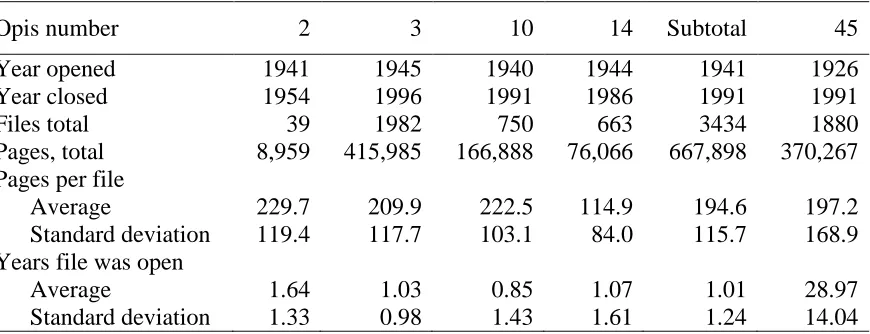
NKVD-NKGB-MVD-KGB up to 1954), 3 (counter-intelligence departments from 1945), 10 (the NKVD-NKGB-MVD-KGB secretariat), 14 (the KGB city administrations); and 45 (operational case files).
[Table 1 near here.]
As can be seen, these files are not all of one type. The typical file in opisi 2, 3, 10, and 14 contained management information (instructions, plans, reports, and so forth). It was open for around a year and was closed at around 200 pages. The typical operational case file was of similar length (but length was more variable). It contained many personal records not of KGB origin. A few were opened long before Soviet rule reached Lithuania, and many remained open for decades (at the extreme, one file ran from 1926 to 1985). In order to focus on the routine management of the Lithuania KGB and place some limits on heterogeneity in the data, opis 45 is excluded from the analysis, leaving opisi 2, 3, 10, and 14 (henceforth the management files).
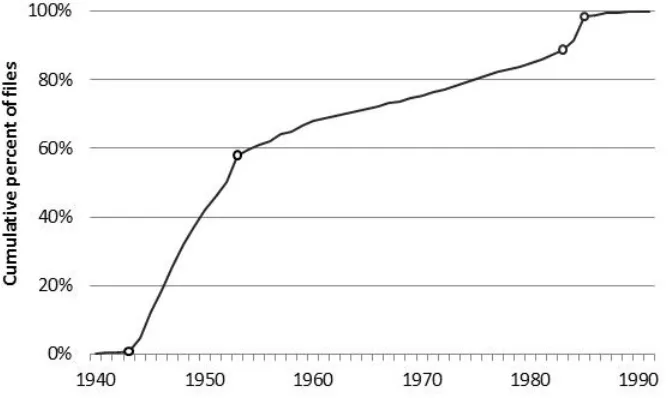
It would be hard to make sense of this material without paying close attention to time variation. Figure 2 shows the cumulative frequency distribution of the management files, which is highly skewed. Almost three fifths of all files were opened in just one decade, from 1944 to 1953. Sharp increases in the rate of file creation can be seen in 1943 and 1983, and sharp declines in 1953 and 1985.
[Figure 2 near here.]
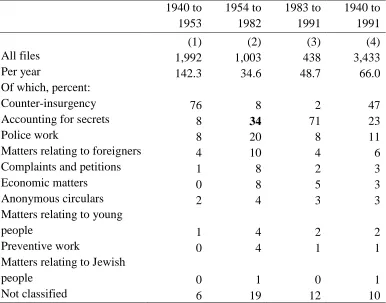
In order to understand the contribution of secret file management to the Lithuania KGB archive in different historical periods, it has been necessary to conduct a wider examination of the content of the files. The spirit of the exercise is to assess their composition, file by file, based on an analysis of keywords and keyword clusters in the file descriptions reported by the Hoover Archive’s electronic catalogue. Results are shown in Table 2 (for source and methods see the Data Appendix).
[Table 2 near here.]
Soviet Lithuania was created by acts of war in 1940 and 1944, and Table 2 gives first priority to identifying files associated with the suppression of armed resistance to Soviet rule ( “counter-insurgency”). After that, I look for files associated with secret file management. Remaining files are assigned to identifiable focuses of the KGB’s mission defined as police work (the identification and pursuit of state criminals), matters relating to foreigners, the study of complaints and petitions, economic matters (surveillance of the economy and the causes of economic disruption), the suppression of anonymous circulars, matters relating to young people, preventive work (calledprofilaktika), and matters relating to Jewish people.
[Figure 3 near here.]
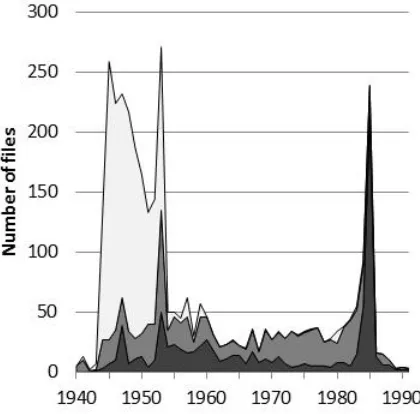
First (Table 2, col. 1), the main factor in the high rate of file creation up to 1953 was the armed struggle to Sovietize Lithuania. The bulge of 1944 to 1953 (Figure 3) is explained entirely by the postwar counter-insurgency, which accounts for three quarters of the files created in this period. A sharp spike in 1953 coincides with Stalin’s death, when opposition to Soviet rule flared up in Lithuania, so that KGB activity increased in all dimensions. After that, counter-insurgency concerns dropped away and “normal” life set in.
In the long years of Soviet postwar normality (Table 2, col. 2) the Soviet Union was economically and politically stable. Counter-insurgency ceased to contribute significantly to new KGB files, and the annual rate of file creation fell by three quarters. The KGB went over to “normal” secret police work such as monitoring and suppressing economic disruption and open opposition, watching the usual suspects, and ensuring cultural and ideological
conformity. But none of these activities was as important for file creation as secret file management, which accounts for one third (34 percent) of all files left in the archives from this time. And this is also the single most important fact to emerge from the data.
In the Soviet Union’s final years, beginning in 1983 (Table 2, col. 4), the proportion of new files associated with secret file management rises to a remarkable 70 percent. As discussed below, this may be connected with last-minute destruction of some records and a failure to discard others.
Finally, Figure 4 isolates the secret file management records and shows their composition over time. It would be useful to measure recursion directly by separating first-order
paperwork (assuring the security of original documents) from that of higher orders (assuring the security of first-order accounting). But the organization of the material does not allow this. A different cut makes a poor but still useful approximation. This separates the
paperwork that assuredsecure distribution(of original documents) from that assuringsecure storage(of all documents, original and derivative).
The distribution/storage distinction maps onto first/higher orders as follows. “Distribution files” are the (first-order) ledgers that recorded incoming and outgoing classified instructions and correspondence. “Storage files” are all other evidence of accounting for secrets,
comprising inventories, audit reports, deeds of destruction, and derivative correspondence. The storage files include inventories of original documents (first order), inventories of
documents including ledgers (first and second orders), and inventories of inventories (second, third, and higher orders).
[Figure 4 near here.]
disturbing: if ledgers were more likely to be incinerated than other documents, then they would be underrepresented in the archive as a whole.
There is circumstantial evidence of this. The ledgers that have survived (from 1985, for example) were given a fixed term of conservation such as 10 years. When the Gulag
secretariat changed hands in 1953, the largest single item in quantity of pages would probably have been the 358 ledgers (more than 700,000 pages) of incoming and outgoing
correspondence, telegrams, and decrees. But these never made it into the archive; at some point, presumably, they were all incinerated. The changeover at the first (secret) department of the Lithuania KGB second administration in June 1965 was a much smaller affair, but the same applies to its 13 volumes (2,600 pages) of ledgers of incoming and outgoing
correspondence. Where are the ledgers now? It seems that those from 1984 and 1985 are the only ones that have survived in significant numbers. As for the years after 1985, relatively few KGB records of any kind have survived from that period.
For present purposes the period of greatest interest is that of post-Stalin normality. We see that the tracking of secret paperwork accounted for 34 percent of management files left by the Lithuania KGB from that time. Within that, most surviving records are of storage, not distribution. If distribution files suffered disproportionate attrition, then 34 percent is a lower bound.
Lithuania’s KGB was a relatively small agency, with fewer than 1,200 regular employees in a country of 3 million as of 1971 (Anušauskas 2008, p. 43). No matter how large as a proportion of its own costs, the direct burden of KGB secrecy on the state was trivial. Secrecy costs loom larger, however, if we think of the addition burdens that KGB regulation imposed on the production and distribution system (described by Grybkauskas 2009). This is a subject for future research. Here, I consider the assumptions required to generalize the figure of one third to the rest of the Sovietstate. Did every Soviet agency spend a third or more of its management resources on complying with secrecy regulations? To support this conclusion we would need to rely on several identifying assumptions. These turn out to have varying plausibility. I discuss each in turn.
Assumption 1. The KGB was not markedly more secretive than any other Soviet organization.This is a strong assumption. That every Soviet organization had a first
department, and that the KGB’s mission was to set standards of secrecy for them all argues in its favor. The KGB’s system for managing secrecy was the same as everyone else’s; the KGB had a first department too. Against this, the proportion of secret to non-secret activity was surely not the same everywhere. Even core agencies had some unclassified correspondence. Agencies outside the core probably had more in relative terms.
Assumption 2. Paperwork intensity was uniform across activities – including the activity of accounting for secret paperwork.There’s no reason why not. But this assumption while heuristically useful is empirically empty. It might be near the truth. The truth is we have no idea.
Assumption 3. Files selected for the archive were representative across activities.
This assumption does not seem to be particularly demanding and could be conservative. As discussed, it seems likely that the ledgers that assured distribution security are
To summarize, we take the proportions of paperwork of different kinds in the Soviet archives to suggest the burdens of handling of secret paperwork. On that basis, the files of the Lithuania KGB at Hoover give a figure of one third for core agencies of Soviet government in normal times. A higher figure is not ruled out; lower figures might be found in a wider sample. Some identifying assumptions are required to generalize further, and some of these look flimsy, so we do not go all the way.
Benchmarks
When the government allocates resources to the security of its own paperwork, is one third a lot? In this section I discuss possible benchmarks obtained from other contexts. One criterion could be how much it takes to excite the public. At the end of 2006 it was revealed that over the previous year London’s Metropolitan police had spent around 5 percent of its £3.2 billion budget on “non-incident linked paperwork” (£122.2 million) and “checking paperwork” (£26.5 million). This figure was enough to create newspaper headlines in the UK.31The Lithuania KGB figure of one third is larger than that of the Met by an order of magnitude, suggesting that the British public would see it as very large.
The principal metric employed in annual reports of the U.S. Information Security Oversight Office (e.g. U.S. ISOO 2012a) is the number of instances of “original” and “derivative” classification and declassification. Although informative in general terms, this does not lead to any statistic against which Soviet practices can be benchmarked. Since 2003, however, the ISOO has published an annual supplementary estimate of the costs of
classification and declassification. The costs of information security and classification management to American government, suitably normalized, could provide a benchmark.
In 2010, $5.7 billion (or 95 percent) of the U.S. federal government’s total outlays on the protection of classified information can be attributed to three departments: Defense, State, and Justice.32What is the right denominator for this sum? In the case of the Lithuania KGB we compared the quantity of paperwork devoted to secret file management with all other
31
These figures emerged from the Home Office’s annual “activity-based costing” review of police budgets: “Police paperwork costs hit £625m,” by Ben Leapman,The Telegraph, 3 December 2006. The figure of £625 million extrapolated the Met’s figures across the country. In 2009 a Home Office report (Normington 2009) made recommendations to reduce
paperwork burdens on the police – including to abolish activity based costing. So, transparency also creates burdens.
32
paperwork not in individual case files. What is the U.S. government activity that corresponds with the latter? Since paperwork is labor-intensive we use labor costs of the three
departments largely responsible for original classification, excluding outlays such as on operation and maintenance, procurement, RDTE, construction, and housing. In 2010 U.S. federal outlays on national defense personnel, “conduct of foreign affairs,” and “litigative and judicial activities” came to $184.6 billion.33With that on the bottom line and $5.7 billion on top, outlays on the protection of American secrets in 2010 ran at 3.1 percent of the direct costs of the general activities concerned. Again we have a fraction that falls below the Lithuania KGB’s secrecy burden by an order of magnitude.
Neither the 5 percent of the Metropolitan Police nor the 3 percent of the U.S. federal government can be considered a completely satisfactory benchmark. However, only a detailed historical micro-study of the composition of office documentation of western government agencies engaged in confidential business in the Cold War seems likely to do better.
Until then there is reason to conclude that one third is a large fraction. It exceeds the benchmarks identified so far in British and American practices by an order of magnitude.
CONCLUSIONS
The Soviet system of accounting for secrets throws light on the transaction costs of doing business under a secretive dictatorship. Conspirative rule imposed something akin to a secrecy tax on the turnover of government business. The burden was increased by Soviet secrecy’s recursive aspect, which means that the system of accounting for secrets was itself secret and so had to account for itself.
Taxation is met by compliance, avoidance, or evasion. The evidence is consistent with the idea that most Soviet officials complied most of the time. There is no evidence of avoidance measures, but localized reports of evasion in the form of neglectful document handling are plentiful. If they went unchecked, bad examples could take hold and locally until they were uncovered and suppressed. Only continual enforcement secured general compliance.
The records of a small regional bureaucracy, the Lithuania KGB, let us measure the burden of secret paperwork. There is much time variation, not all of it easily explained. Under Soviet postwar normality from 1954 to 1982, secret file management contributed around one third of the total documentation now available. This figure is surprisingly large, may be understated, and is the main empirical contribution of the present paper.
Further identifying assumptions, some of them fragile, would be required to generalize the figure of one third across the Soviet bureaucracy. If we take it to signal only KGB objectives, then it seems that priority number one was to prevent the armed overthrow of the Soviet state; number two was to shield its own paperwork from the eyes of others.
33
SUPPLEMENTARY DATA
TABLES
Table 1. The Lithuania KGB collection at Hoover, April 2011: files, pages, and years opened and closed
Opis number 2 3 10 14 Subtotal 45 Year opened 1941 1945 1940 1944 1941 1926 Year closed 1954 1996 1991 1986 1991 1991 Files total 39 1982 750 663 3434 1880 Pages, total 8,959 415,985 166,888 76,066 667,898 370,267 Pages per file
Average 229.7 209.9 222.5 114.9 194.6 197.2 Standard deviation 119.4 117.7 103.1 84.0 115.7 168.9 Years file was open
Average 1.64 1.03 0.85 1.07 1.01 28.97 Standard deviation 1.33 0.98 1.43 1.61 1.24 14.04
Source: Lietuvos SSR Valstybės Saugumo Komitetas selected records, 1940–91, fondK-1, held at the Hoover Archive and described at