Servitization within the manufacturing and
logistics sector: Analysis of a
step-by-step-approach
Author: Oliver Schwob
University of Twente P.O. Box 217, 7500AE EnschedeThe Netherlands
ABSTRACT,
Purpose:
The purpose of this paper is to identify what medium-sized companies within the manufacturing and logistics sector do, to successfully implement servitization within their company and what literature about servitization can learn from that.Design/methodology/approach:
The general theoretical framework of this paper consists out of a diversity of published literature. The four chosen companies do all compete within the chosen sector and provide detailed insights about their servitization readiness and steps towards servitization. The main data collection method is based on interviews with managers/project leaders within the companies. The theoretical framework is covered within the interviews to identify possible improvements.Findings:
Regarding the purpose of this paper about what medium-sized companies within the manufacturing and logistics sector do to implement servitization, it can be said that there are varieties of different steps, challenges and solutions that companies face in order to reach servitization that have not been mentioned by literature, but could be used to improve it. Those steps could be recognized and mentioned in future literature to improve the applicability of models and theories.Research limitations/implications:
The research of this paper can be limited by the aspect of general applicability and the not representative sample of chosen theories. The results and analysis are only applicable in the researched sector and can be hampered by the fact that the chosen models have been generalized and might not represent all published theories about how to reach servitization. Not all literature about servitization might be applicable to lean from this paper.Graduation Committee members:
Raymond Loohuis
H.G. Hanna
Keywords
Servitization, manufacturing, logistics, theories, challenges, step-by-step, new implications
This is an open access article under the terms of the Creative Commons Attribution License, which permits use, distribution and reproduction in any medium, provided
INTRODUCTION
1.1
Servitization
Over the last decades the process of Servitization and the implementation of Servitization within companies gained growing attention (Vandermerwe & Rada, 1988). This paper joins the conversation of how medium-sized enterprises enter the process of Servitization and which steps they take in order to successfully orient towards a more service-oriented company strategy (Servitization). How do medium-sized companies within the production and logistics sector, without the financial stability and back-up of a large enterprise, start a company`s strategy changing process? Within this paper we will rely on the definition of Servitization by Kowalkowski et al.: “The transformational processes whereby a company shifts from a product-centric to a service-centric model and logic” (Kowalkowski, Gebauer, Kamp, & Parry, 2017).
One of the most important results of research over the last decades is that companies are motivated towards Servitization by three drivers. The first driver is of a financial origin. Due to a higher profit margin and a continuous stability of income provided by a service-oriented strategy companies heavily consider to move towards Servitization (Gebauer & Friedli, 2005).
The second major driver has a strategic basis. A service-oriented company strategy ensures competitive advantage (Mathieu, 2001) towards the sectors competitors because services are harder to duplicate than products (Gebauer & Friedli, 2005). The third major driver refers to the marketing possibilities of a service-oriented strategy and the ability of selling more products (Gebauer, Friedli, & Fleisch, 2006) as the service option is directly influencing the purchase decision of customers (Mathieu, 2001). Another major research result of Servitization is that it enables companies to develop customer dialogues and possible long-term relationships that enable companies to generate a high customer loyalty (Vandermerwe & Rada, 1988).
1.2
Research Objectives
The purpose of this paper is to identify what medium-sized manufacturing/logistics-companies do, to successfully implement services to their products.
RQ: What do medium-sized manufacturing and logistics companies do, to successfully implement services to their products?
Other sub-goals of this paper include the development of the basics needed to come up with a scientific step-approach towards servitization, the evaluation of servitization readiness of the evaluated companies, and the identification of which theory applies best to which stage of readiness.
To identify how companies` approach Servitization it is important to find multiple, in this case four, representative companies within the targeted sectors of manufacturing and logistics. The information gathering process firmly starts with the Servitization readiness tool(Coreynen, Matthyssens, & Gebauer, 2018). This tool gives a general indication whether the company is ready to enter a strategy changing process into the direction of Servitization.
Following this entry, the objective is to (1) evaluate the readiness of a company/business unit, (2) ask more questions about the approach a company uses to enter servitization, (those questions are heavily related to the theories and models that are described in the following theoretical part), (3) identify important stages/aspects within their used process.
Based on the resulting data, primarily the research question can be answered, but secondly real-life data can be compared with already published theoretical knowledge. This enables the possibility of identifying similarities and differences between what theories suggests to do, and what companies actually do. With the help of this comparison it can be easier identified what companies do to reach servitization. Those differences and similarities, in addition to the evaluated stage of readiness, enable the possibility of comparing what strategy, theory or model is the best fit to which stage of readiness in servitization. Furthermore, dependent of similarities or differences, as well as in results but also between results and used theories, this could further help in the development of a new and basic usable step approach for medium-sized companies towards servitization.
Critical implications
Critical can be seen the fact that the application of the Servitization readiness tool, in this case, might be of a subjective nature. That implicates that the answers might be biased because companies might try to present themselves in the best way possible. Due to time issues it is not possible to observe a company over a longer period of time to fully analyze and objectively grade the company`s departments regarding the used tool. In this case, it is necessary to rely on certain managers within the company to, as objectively as possible, evaluate the company`s possibilities and boarders. Additionally, only a set of chosen theories will be used to compare the results to.
1.3
Sub- Question
To further dive into the research about the main research question, in this paper, a sub-question has been developed. This sub-question does enhance the research field more into the direction of comparing theories to actually used methods in servitization; identifying differences and similarities between real-time used methods and published theory. To effectively be able to identify the basic needed steps and an eventual development of new steps, a comparison must be drawn. Sub- question: What are similarities and differences between what companies do to reach servitization, and what literature proposes?
Via this research question, another aspect of the main research question is researched about. The main possibility opened up by this sub-question is the possible development of new steps or an approach that results out of differences between theory and practice.
1.4
Theoretical and practical relevance
Practical implications of this paper are the fact that it conducts research about medium-sized companies in very specific sectors. The goal of gaining a general overview and collection of steps towards Servitization and eventually coming up with a model that supports general usage within such sectors is of huge help. The research focusses on a niche in the current state of research. Theoretically seen, the major contribution of this qualitative study is that it obtains practical as well as theoretical input of servitization of medium-sized companies within a national/local scale. It devotes to the research about servitization and theory usage in an evolving sector and contributes to the general discussion about servitization and its different facets.This study does not only explore how, under which circumstances and with what kind of changes, steps of the Servitization process are used and undertaken by companies, but also which used published theories fit best to what exact stage within the readiness of an mid-sized company.
usage for mid-sized companies, might get an update or even new theories or models get developed. Those, then, might be more applicable to the manufacturing and logistics sector.
THEORY SECTION
In this section the main theories used to answer the research question are going to be explained and put into the context of this paper. That means that the major theories involved in this paper are going to be articulated and connected models displayed. Furthermore, the use of these theories will be conceptualized to show the purpose, task and fit within this paper.
2.1
Main Theories
This section will conceptualize the used models in order to explain the usage and task of the theories.
Servitization readiness tool
The first major tool that is going to be used within the interviews with companies is the `Servitization readiness tool`(Coreynen et al., 2018). In general, this tool discovers if companies are ready to start the process of servitization of not. That is done by a system where the companies can score between zero and seven in different topics related to Servitization. Main questions are asked about the `service development capabilities` and the `service deployment capabilities`. Those two main sectors include more separate units named: (1) sensing service opportunities and threats, (2) seizing service opportunities, (3) reconfiguring assets and processes, (4) Digitization, (5) Mass service customization, (6) Network Management, (7) Service orientation of Management values, (8) service orientation of management behavior, (9) service orientation of employee values, (10) service orientation of employee behavior. Based on the attained average score after answering every question, the readiness can be evaluated. As already mentioned, the tool will be implemented during the course of the interviews with certain companies. The detailed layout can be found in Appendix 1.
Process theory
[image:3.595.287.586.520.733.2]The first main theory used in this paper is the `process theory` (Oliva & Kallenberg, 2003). This paper`s main purpose is to show “how organizations […] incorporated service offerings into their offering” (p.164) with the help special developed model by the authors (see Figure 1)
Figure 1. Process model for developing IB service capabilities (Oliva & Kallenberg, 2003).
This model was developed based on a reoccurring pattern identified during research with multiple companies. This
reoccurring pattern shows that companies might use similar strategies and/or patterns to develop service orientation. If this model is applicable for medium-sized companies in the manufacturing/logistics sector research is unclear so far, but it provides a tremendous base to compare the results of the planned interviews with, in order to test applicability and actual usage. The reason this model was chosen for this paper is that it provides a perfect model for comparison. Information gathered during interviews with sector specific companies can be compared with the steps and stages of transition of the `process model` to identify differences and similarities. Furthermore, if results drastically differ after numerous comparisons it could be stated that either companies do not use this model, or it presents a lack of applicability in this sector.
Steps and capabilities for servitization in
process industry companies
The second major theory about steps towards servitization used in this paper is a roadmap that includes defined steps towards servitization and capabilities needed to reach servitization (Kanninen, Penttinen, & Markku, 2017). The aim of this roadmap is to display the steps and capabilities industry companies need to achieve servitization. The map in general is a detailed step-by-step approach (1 pre-step, 5 steps) that is build up along a time/investment/service performance – span (see Figure 2)
This model fits the research aim of this paper because it covers not only the production and manufacturing sectors, but the sector of industry companies (logistics included) in general. The roadmap further adds more abilities to compare the interview results to because of similarities to the `process theory` by Olivia and Kallenberg (2013). Still the steps within both models are different. Not only does the roadmap of Kanninen et al. provide general steps towards servitization, but also capabilities that are necessary for a company to reach a certain stage of servitization. Furthermore, the roadmap provides suggestions of what to do in each step.
[image:3.595.65.257.536.718.2]A similarity between both models is that both describe step-by-step approaches and therefore are very detailed with focus on the activities to perform.
Platform approach in servitization
Another example approach to compare the results of the interviews with, is the `platform approach in Servitization`(Cenamor, Rönnberg Sjödin, & Parida, 2017). This approach represents a rather complex model with numerous specifications and implications (Appendix 3). This approach is, in terms of steps and actions to take towards servitization, different to the `process model`. The major differences are that the `process model` rather focusses on clear steps towards servitization with defined triggers and actions. Furthermore the model starts at zero (“consolidating product-related services” (Oliva & Kallenberg, 2003)), whereas the `platform approach` is mostly about overcoming the a `service paradox` defined as a “substantial investment in extending the service business lead to increased service offerings and higher costs, but does not generate the expected correspondingly higher returns”(p.14) (Gebauer, Fleisch, & Friedli, 2005). Additionally, the `platform approach does explicitly include front-end and back-end configuration within the transformation process.
Based on these differences the `platform approach` provides a good alternative model to compare the results of the interviews with.
Framework for Manufacturing Servitization
[image:4.595.65.267.445.537.2]A completely different approach is the `Framework for Manufacturing Servitization`(Chen & Cusmeroli, 2015). This model does not focus on the lone Servitization of one organization but takes collaborations within a network of servitizing companies into account. The main aspects used for comparison within this paper are the `extended product dimension` (see Figure 3) and the `service innovation dimension` (see Figure 4). Both dimensions can be differentiated into different stages of servitization and are extremely comparable to stages other companies find themselves in.
Figure 3. Extended Product Dimension (Chen & Cusmeroli, 2015).
Figure 4. Service innovation from single company to ecosystem(Chen & Cusmeroli, 2015)
Combined with the `servitization dimension` this model builds a three-axe 3D system where companies can be placed in, dependent on their stage within each of the three dimensions. This model, and exclusively the two displayed dimensions, provide a fitting model that can be used to compare the interview results with. This enables new possibilities for this paper. The first new aspect is, that this model brings in the new alternative of not one company that is servitizing and innovating on its own, but the fact that it includes a network of companies within the servitization model. That covers another sector of servitization. The first two models focused on single organizations, but with the addition of this model to the total equation, also the option of an innovating ecosystem is taken into account. The results of the following interviews can therefore be compared to two different scenarios (single servitization and ecosystem servitization) that cover servitization.
For the next model, the research gets a little shifted. Away from the question what theory says which steps companies should follow in order to achieve servitization, but towards the company’s reaction on challenges that servitization provides. After now introducing mainly models that prescribe different stages of attaining servitization, the next model describes a roadmap of how to react to challenges of servitization. This approach to answer the main research question was chosen because it answers the question from a different point of view. Reacting to challenges and solving major issues is also a way of successfully implementing servitization within mid-sized companies.
Strategy service and challenge roadmap
The roadmap that helps to answer the main research question from another point of view is called `Strategy service and challenge roadmap`(Raddats, Burton, Zolkiewski, & Story, 2018).
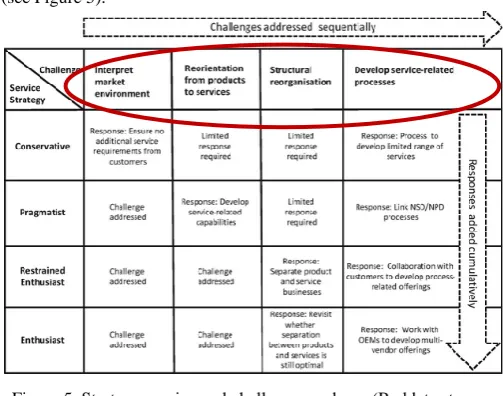
[image:4.595.309.561.505.703.2]The roadmap describes the actions of four different types of service strategies (conservative, pragmatist, restrained enthusiast, enthusiast) towards four major servitization challenges (interpret market environment, reorientation from products to services, structural reorganization, develop service-related processes) developed by the authors (Raddats et al., 2018) (see Figure 5).
Figure 5. Strategy service and challenge roadmap (Raddats et al., 2018)
[image:4.595.57.283.592.728.2]companies towards those challenges, and if they experienced these challenges need to be asked. But more about that in the methodology part.
The inclusion of such a type of model, that differs from the previous types of models used, is explained by the reasons that it brings another point of view to the table. Now, analysis about what companies do to reach successful servitization not only relies on comparison to guided step-by-step approaches but also on reactions towards challenges that might appear during such a guided step-by-step approach.
A major limitation of including an approach like this is that an analysis based on such data might not directly result in a suitable model for the targeted sector, but could still add special facets to a model, generated by the previous described models.
Together, a broader and more complete model could be formed at the end if large differences arise. The research question of what medium-sized companies do to reach successful servitization can still be answered with the involvement of both types of models.
METHODOLOGY
This section is directed towards the methods, and analysis procedures used within this study to get a deep understanding of the results gathered during the data collection. Therefore, the sub-sections of research setting, data collection methods, operationalization of research question and data analysis procedures will follow.
3.1
Research setting
The research setting of this paper is based within the production and logistics sector. The main units of observation will be a set of chosen medium-sized enterprises located in Germany and the Netherlands. The sector was chosen because the manufacturing and logistics industry provides a bright field of servitization opportunities to analyze with multiple sub-sectors (development, transportation etc..) to further dive into for a more detailed insight. The company size `medium` is a unit that also provides high variety and rather unexplored research fields due to the still growing popularity of servitization. In the following paragraphs the chosen companies will be described in detail with the additional information about how those companies fit into the sector, how far they already are in the servitization stage and why those companies are a fit for this study.
Description of company A
Company A is a subsidiary of company C and active within the development and logistics sector of Glass transportation. Not only is Company A specialized in the transportation of Glass, but also in developing and producing smart solutions for challenges and problems this sector presents. The primary product of this company is the transportation and logistics of products between places. Within this company, servitization is a major part of the offerings.
The interview was conducted with the General Manager of the company.
Description of company B
Company B is a sub-division of company C. The interviewee is part of a service-development-center which focusses on adding additional services to the main offer of the company; logistics and transportation. The interviewee itself does not only have knowledge based on the current company, but also presents general knowledge about the processes and necessities within servitization because of employments at other servitizing companies.
The sub-division and especially this interviewee fit the research of the paper because general insights into the servitization processes of companies within the chosen sector can be given. Company B is quite similar to company C in its actions, steps and processes because it is a sub-division. Still, it is possible to evaluate both companies on their own because they represent two different departments of the total company.
Not only does the contact person can relate to the research via one experience but can provide knowledge over a wider range of processes within companies.
Description of company C
Company C is the parent company of companies A and B. The company has sub-divisions that purely focus on the transportation and logistics sector, as well as the manufacturing sector of transport vehicles.
The interview partner is the Sales manager of that company and additionally responsible for new Sales strategies.
Company C fits the research of this paper because it covers both sectors targeted in the paper, manufacturing and logistics/transporting. Furthermore, the position of the Sales manager enables information gathering apart from the supply chain, but rather oriented towards the final step of implementation of services, the challenges of successfully implementing and selling the services. Additionally, more information about the acceptance of services in the market and the strategy how to develop services in a alter stage can be gathered.
Description of company D
Company D is generally active in the logistics sector and slightly bigger than the other three companies. Due to confidentiality reasons only information regarding the usage of theories could be gathered. Neither the servitization readiness tool, nor questions focusing on steps to achieve servitization could be fully filled out or answered. The results of the Servitization readiness tool are incomplete and can therefore not be used for analysis. The interview was conducted with a project manager of the company.
3.2
Data collection
Within this qualitative empirical research design, the major data collection method is the form of an interview (Appendix 2). A prepared set of topic related questions will be sent to the chosen set of several companies to prepare the interviewees for possible questions.
The interview is planned to be undertaken with the CEO`s, sector managers or product managers of several companies because they share a direct connection to the planning process and implementation process of servitization. Those position describe the nearest connection to the actual implementation and morale changing process from a product-centric strategy towards a service-oriented strategy. Therefore, these interviewees provide the highest knowledge about the actual processes within a real-time servitization change.
the above mentioned and published theories might have played a role in during the implementation.
3.3
Operationalization
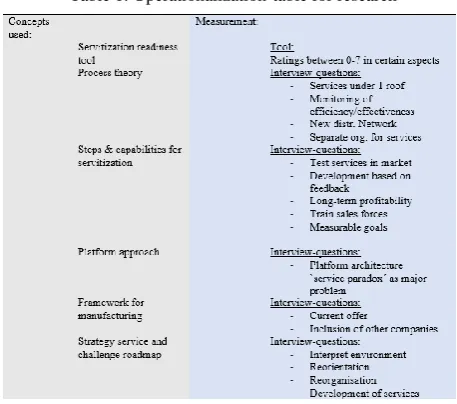
[image:6.595.53.282.168.370.2]For a better analysis and evaluation after the interviews, the operationalization part is used to further dive into the meanings of the research.
Table 1. Operationalization-table for research
The operationalization table (table 1) clarifies the application of the theoretical framework within the interview with the companies and the general transition of the framework towards the related information gathering process. For each concept (except the servitization readiness tool) that was used, a set of questions were developed that cover significant and major steps of each model. Based on those representative questions the overall usage and application of the models could be analyzed by the answers. The focus could be specialized towards either developing new important steps and improving current literature (low similarities, high differences between companies and literature) or evaluating the usage of current theories in relation to which stage of readiness (high similarity between companies and literature).
The servitization readiness tool was purposely excluded within the interview due to the fact that it already is an established and recommended (recommendation by tutors/lecturers) tool. The evaluation of the servitization readiness of the companies was purely based on the ratings provided by the interviewees about their company. The aspects mentioned within the tool provide a detailed evaluation of the strengths and weaknesses of the companies and propose a stage of readiness to servitize which will be applied within the analysis for comparison and the development of new steps.
3.4
Data analysis procedure
The data generated through the interviews will be analyzed through different steps and approaches. The first approach implies that each interview will be read in detail to get a general clue about all the information received during the interview. By reading each interview several times a general analysis of the answers can be executed through getting familiar with the responses. After being familiar with the answers given, and the information received in general, a more detailed analysis can be undertaken. The more detailed analysis consists mainly out of identifying similar steps the companies took towards servitization and grouping them together. Using that method, certain steps towards servitization could be easier identified and
put into context about what companies in general do to reach servitization. Following that, all findings can be summarized for better identification of steps towards servitization.
3.5
Reliability and Validity
Proving the reliability and validity of a data collection method is a major part of every research. According to the definition by Baumbusch, “a semi-structured interview involves a set of open-ended questions that allow for spontaneous and in-depth responses” (p. 255) (Baumbusch, 2010) the data collection method used within this paper is a semi structured interview. The reliability of a study is “demonstrating that the operations of a study – such as the data collection procedures can be repeated, with the same results” (p. 33) (Yin, 1994). To secure the reliability of the data collection method of this paper, interviews, special guidelines and procedures for every interview were established and generalized. Each respondent was asked the same questions. The only difference between the interviews were the follow-up questions after certain answers of the interviewee. When following the procedures and guidelines, as they were established in this study, within a similar study same results should be ensured and therefore prove the reliability of the used data collection method.
The validity of a study is “an important key to effective research. If a piece of research is invalid, then it is worthless.” (p. 179) (Cohen et al., 2013). To increase the validity of my study, not only one interview has been conducted, but four interviews within the same sector. That represents a “use of multiple sources of evidence” (p.35) (Yin, 1994). Those multiple resources prove an increased validity because different views onto the situation have been included and therefore a wider range of aspects and opinions towards the topic can be covered.
FINDINGS
The `Findings-section` of this paper focusses on the results of the Servitization Readiness Tool for each participating company, and the similarities and differences between what has been found out during the interviews, and the theories mentioned in the theory section. The last part of this section focusses on identifying new implications/challenges/steps that have no direct connection to any mentioned theory.
4.1
Servitization Readiness of Companies
Within this section the results of the Servitization Readiness Tool will be displayed and further described. Noticeable highs or lows will be mentioned. Furthermore, the total average score and the total percentage will be shown (see Table 1) [image:6.595.308.540.614.726.2]Company A
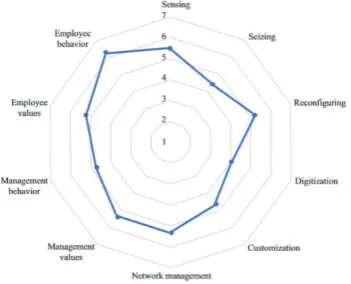
The results of company A of the Servitization readiness tool can be seen in Figure 6 and Table 2. Within the Service Development section of the tool, the ratings differ between 4.5 and 5.5, where the ability to sense service opportunities and threats is the highest rated aspect (5.5). Room for improvement is seen in the aspect of seizing service opportunities (4.5). The capacity to satisfy customer needs (4) and the ability to commercialize new services and to further communicate those to the customers (4) are seen as major obstacles and represent the major aspects for improvement.
In the next section, Service Deployment, the scores of company A are recognizably lower. The lowest rating is within the aspect of Digitization is a 4, whereas the rating of Network Management is the highest at a 5.2. Within the Service Orientation section of the tool, company A scores averagely higher than in the previous two sections (5.36). The highest score comes from the employee behavior (6.25). A reasoning for that can also be found in the interview. Company A solves major servitization problems by talking to employees over and over again while focusing on conveying the importance and processes of servitization: “by talking, talking, talking and explaining to people, and talking to people again and explain them again what the goals are, why we want to do it, how we want to do it” (General Manager, Company A). This enables employees not only to understand the service-oriented strategy, but also to help and solve problems of customers to their satisfaction.
[image:7.595.315.501.232.384.2]The total average score of company A within the Servitization readiness tool is a 5.05 out of 7. The total achieved percentage therefore lies at 61.85%.
Figure 6. Results from Company A from the Servitization Readiness tool (Coreynen et al., 2018)
Company B
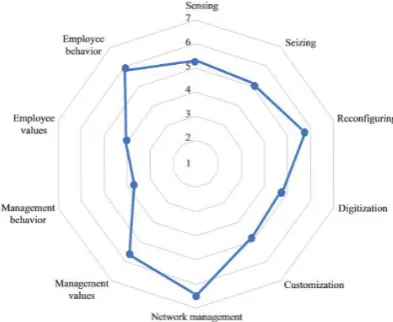
Compared to company A, company B scores generally lower (4.33). The results can be seen in Figure 7 and Table 2. Sub-sections where company B generally scores high in are Management values (5.5), and Employee behavior (5.5). Both are in the section of service orientation. Both can also be recognized as highly valued aspects within the interviews; “you always have to take into account what the customer wants” (Project Manager, Company B). Company B has a hard focus on the interaction with employees about the general Management values towards servitization. Talking, explaining and further developing the understanding employees have, towards a service-oriented strategy is a major aspect in the development of company B. Moreover, that enables employees, similar to company A, to work as reliable and trusted assistants for the customers. Both aspects are rated with a 5.5. Still, lack of
[image:7.595.84.260.408.550.2]performance and room for improvement can be also seen; “The question is if they all understood everything. So I think there is an opportunity there to improve” (Project Manager, Company B- towards the training of employees to understand value of services). The sub-sections of Reconfiguring (3.75) and Digitization (3.25) prove that. Both aspects do not raise above the rating of a 4, and therefore hamper the general performance of the company within the tool. As in company A, Digitization presents a major lack and is rated with the lowest rating in both companies. Average values for company B can be found within the Customization (4.5) and Network Management (4.6). Totally seen, the average score of company B is at 4.33 out of 7. The total percentage is 61.85%.
Figure 7. Results of Company B from the Servitization Readiness tool (Coreynen et al., 2018)
Company C
When comparing company C to company A and B, Company C has a wider range of ratings. The lowest rating is a 0 (setting rewards for service-oriented employee-behavior) whereas the highest rating a 7 is (six times in total). Still, in the total average and percentage company C scores the highest ratings with 5,14 out of 7 (73,42%) (see figure 8 and Table 2).
Figure 8. Results of Company C from the Servitization Readiness tool (Coreynen et al., 2018)
Company D
The results of the Servitization readiness tool for company D are incomplete and can therefore not be used for analysis. Still the available data within the tool enable an estimated readiness percentage of 86,99% with 6,09 out of 7 points.1 (table with
estimated values) (Appendix 4).
4.2
Reflection on findings & comparison
with literature
The chapter `Reflection on findings & comparison with literature` focusses on what companies did similar to what theories suggest and what they did different. Differences do not include aspects companies completely left out or steps companies took that were not mentioned in any model. Those aspects will be discussed in section 4.3 (New implications).
Similarities
In this section the major similarities between the major steps of the used theories and the actual application of the companies will be described. The evaluation will go through each theory step-by-step and mention main aspects that are present in the theory and are resembled in the actual approaches of the companies. The first theory that will be discussed is the `process theory` by Olivia and Kallenberg (2003).
The major actions that were identified within this theory are (1) move all services under one roof (2) monitor efficiency and effectiveness, (3) creation of separate organization to market/deliver services, (4) create new distribution network. Three of the interviewed companies replied positively to the question if their servitization procedure included to move all services under one roof. One company, company C, is targeting this state but currently every sub-division is also having a separate service-department for their products.
Another action that is commonly used among the companies is the action of monitoring and measuring the effectiveness and efficiency of the implemented services. A special aspect mentioned by company C is that the not only monitor the data of their service-shipments but also share them with the customer. With regards to a new distribution network, company D is the only company that knowingly developed one in the process of servitization. Company B mainly used the old network but is currently in conversation with a new customer that might be
1 The total average score and the percentage were estimated
using the average of the available scores as scores for the missing sections
applicable to the development of a new, customized distribution network.
The second theory of analysis, by Kanninen et al. (2017) is a model that includes steps and capabilities of servitization in process industry companies. The major steps of analysis in this model were (1) testing services in the market and to develop them based on feedback, (2) setting long-term goals for services, (3) commercialization of services, (4) training of sales force to understand value of services, (5) setting of measurable goals for services, (6) measurement of long-term profitability of services. Within this theory, in general, more similarities could be identified and validated.
Starting with the step of testing services in the market, only one company did actual testing in the open market (company D). Companies A and B mainly tested services in the environment of customers that directly fit these services. No general publication but offering new services to meet the changing customer needs. Furthermore, developing the offered services was done in a similar manner. Where company D logically received feedback from the entire open market, and could develop the services based on a wider range of feedback, the other two companies (A,B) focused on the feedback given by the customers where the services were first implemented and tested. A special approach was described by company A. The interviewee confirmed that an approach similar to `Trial-and-Error` is fitting. Various services were suggested to various clients and based on their usage and needs services were either dropped of the chart of further developed.
Regarding long-term goals for services the approach of the companies differed. Where company A applies goals within the range of 1 to 5 years, company B is rather working with term goals within an agile work approach. Based on those short-term goals and the agile working approach, the interviewee mentioned that it is easier to evaluate if a service idea is working or not and if the development team should quit or further work on it. The third aspect, commercialization, found approval in three of four companies. Ranging from investments into planned advertising and general commercialization of services. Within all four companies, the special training of sales forces was not mentioned as a step towards servitization. Rather all four companies relied on communication and general meetings with employees to communicate the importance of services. The steps of setting of measurable goals and the measurement of long-term profitability received split answers of the companies. Whereas all companies measure the long-term profitability of their services, only two companies could confirm that they use extra developed measurable goals for their services within the implementation process.
The next theory considered is the `Framework for Manufacturing Servitization`. Because of the fact that this model is rather something where no clear steps are provided towards servitization, but rather a framework is built to evaluate the stage of servitization, the model will be discussed in detail in section 5.1 (Regarding mentioned theories).
The last theory discussed in this section, is the `strategy service and challenge roadmap`(Raddats et al., 2018). In this theory, the major focus was to identify similarities and differences between the challenges mentioned in this model, and the challenges companies felt as major challenges. Furthermore, the theory was used to identify how companies approached the challenges they faced (mentioned in theory or not mentioned in theory). Basically said, three out of the four interviewed companies saw three of the four mentioned challenges as a major problem. Company A, B and C, all experienced the challenges of (1) Interpretation of market environment, (2) reorientation from products to services, (3) Structural reorganization as major challenges during Servitization. The challenge not mentioned (develop service-related processes) was widely not seen as a major problem or could be solved without tremendous effort.
How the companies addressed and overcame those challenges will generally be discussed in section 4.3.1.1 (How to overcome those challenges)
The results of the interview with company D showed that this company did not see any of the mentioned challenges as a major problem. Why or which challenges were experienced and how the company overcame those could, because of confidentiality reasons, not be discussed.
Differences
Results of the interviews showed that the companies do not generally follow a given set of steps by models but use some of them and change other steps, so they fit their general procedure. In this section, those changes in steps will be discussed as differences to theory.
After analyzing the answers of the interviewees of the companies, three major changes/differences between the steps suggested by theory and real actions could be defined.
The first major difference is that the triggers mentioned in the `process theory` by Olivia and Kallenberg were not identified as major triggers by companies and therefore are not generally applicable. The theory names `customer request`, `customers complaints` and `management change` as triggers in different stages. Still, through the interviews it can be identified that the two major trigger for servitization are (1) the change of global strategy towards long-term profitability, and (2) competition. So in this study, those two triggers were referred to more than any other triggers mentioned in the theory.
The second major difference is towards the model by Kanninen et al. (2017). In this model, a suggested step towards servitization is a special training of sales forces so they understand the underlying value of a service-oriented strategy.
After conducting several interviews and directly asking the companies if they executed special trainings for employees, all denied that. The overall answer was that no special training is needed. Still all companies got into direct contact with their employees and had conversations and discussions where they deeply informed them about the necessity of this approach. The third and last major difference is that opposite to what Kanninen et al. (2017) stated in their model, three out of four companies (A, B, C) do not test their services in the open market. They rather test the new services with chosen clients that perfectly fit the purpose of the service and either quit or develop
the services based on focused and tested feedback. Those companies develop services based on customer needs, rather than floating the open market with new service ideas.
4.3
New Implications
After focusing on similarities and differences in the section before, this section will handle the newly found steps, actions, challenges and reactions of approaching servitization.
This section can generally be divided into four parts. The first part is about the challenges that were newly introduced based on the results of the interviews. This part is then followed by the suggested reactions of the companies towards those challenges. The third part then summarizes suggestions by the companies how to improve the process of servitization based on their failures, deficits and miscarriages. The last part then focusses on general new implications and focus-shifts resulting of the interviews.
Challenges
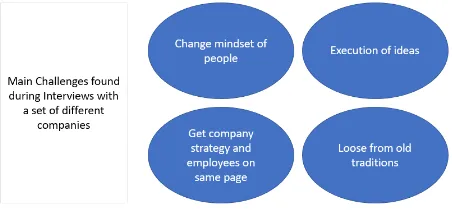
During the interviews four major challenges crystalized out of the answers given (see Figure 9). The first challenge is to change the mindset of the people and employees working for you. One Interviewee formulated it like the following: “to get all the noses in one way, from all the employees.” (General Manager, Company A). Employees that have been working in a company with a product-oriented strategy for a longer period of time might consider it hard to change their thinking and behavior towards servitization and the importance of services. This directly leads to the second challenge; get loose from old traditions. All interviewed companies that had to go through the change from a product- to service-oriented company structure mentioned this challenge as one of the first they have experienced. The third challenge is also closely related to the change of mindset within the company that needs to happen. Meant is the challenge of
[image:9.595.310.536.461.566.2]getting the company`s strategy and its employees on the same page.
Figure 9: Main challenges found during study-related company interviews
All of these three challenges were already at least partly mentioned within the `strategy service and challenge roadmap` of Raddats et al. (2018) but not as clearly expressed as in this paragraph.
4.3.1.1
How to overcome those challenges
After discussing the major challenges resulted by the interviews, this sub-section will focus on the reactions and how to overcome those challenges. The three challenges referring to the general problem of communicating the new strategy to the entire enterprise and all its facets received the most attention. Repeated talking and explaining of methods/words/necessities and advantages within discussion groups, teams or departments in general is the solution that was commonly mentioned; “explain the new words and define the new methods” (Sales Manager, Company C). A solution following the same attention as the first one is the aspect of creating teams within the organization to implement the change step by step in different parts of the organization.
The last reaction mentioned during the interviews to overcome the challenges is an extended communication and partnering with customers and clients. As mentioned by a project manager of Company B an importance is: “having discussions with people and also externally with other institutions like universities, like other competitors” (Project Manager, Company B). This enables a close cooperation between the party providing the service and the party using the service. Both can generally help each other to optimize services and overcome problems within executing ideas or loosing from old traditions (show need of customer to convince employees).
Improvements
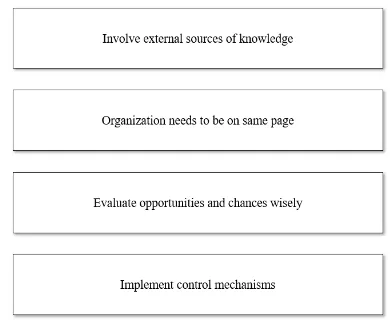
Within the interviews, companies were asked what they would improve in their servitization process after they went through parts of the process already. These are the main results. An improvement that was mentioned by nearly every participant was to involve external sources of knowledge. If that is in terms of hiring external experts, working together with other institutions like universities or cooperating with competitors, all answers targeted one aspect; learn from others.
“What I would say is to involve as much as possible experts in the project and to listen and to learn from other people (…)”
(General Manager, Company A).
The second suggested improvement is to put heavy attention onto the fact that the entire organization needs to be on the same page
to successfully work in a change of environment. This improvement results also related to the challenges mentioned by the companies.
“Understanding in the organization is important. They have to carry the new approach to the customer” (Sales Manager,
Company C).
Evaluating the opportunities and chances within a market before blindly developing every idea of a service that comes to a company’s mind is another major improvement the companies mentioned. Focusing on legitimate service ideas and chose the opportunities for your company wisely to canalize resources is the improvement.
“focus on only a couple of them (…), there are opportunities everywhere but not every opportunity is as good as the other
one” (Project Manager, Company B).
The last improvement moves into a rather technical and strategical sector. Implementing control mechanisms on a regular basis to check success of services. Companies that implemented such control mechanisms and where services do not meet set expectations should not be hampered to drop and quit those services and to move on.
[image:10.595.323.518.87.247.2]“put control mechanisms in the processes that you can measure everything step-by-step (…)” (General Manager, Company A).
Figure 10. Improvements for future Servitization processes
General new implications
Generally said, during the conduction of the interviews, a huge
shift towards the customer needs could be recognized. Companies mentioned customers and clients as the major focal point of their servitization; “We work closely with customers” (Project Manager, Company B). The development of services, the implementation of services and the improvement of services have mainly been based on customer interaction.
Therefore, also the three new implications, supporting future theories within servitization, of this study focus heavily on that shift. Whereas the first one is a general implication that
customers are a huge focal point in the servitization of medium-sized companies, the second implication suggests that service development should happen based on customer needs rather than in the open market. The third new implication is to not only cooperate with the customer but to fully understand their business and include the client`s organizations within the servitization procedure. “You always have to take into account what the customer wants” (Project Manager, Company B). How those new implications and improvements can be implemented within servitization models will be discussed in section 5.3 (Future theories). An overview about the major results of the interviews with the four companies can be found in Appendix 5.
THEORETICAL & PRACTICAL
IMPLICATIONS
The fifth section, `theoretical implications` focusses on the analysis of the previous mentioned findings. In this chapter, an analytical bond will be drawn towards the mentioned theories and how they contribute to the processes of servitization in real companies. The analysis of how much companies rely on those theories will take place in this chapter, but also the evaluation of what stage of readiness fits best to which, if any, model. Furthermore, newly mentioned aspects within the interviews will be analyzed put into context of a possible new model.
5.1
Regarding mentioned literature
Section 5.1 mainly analyzes the information received through the interviews and puts them into context about how the theories and models mentioned in the theory part are actually used by companies representative for the researched sector.
applied in the real transformation process. Some major steps have been used by the companies but neither did they knowingly search or used the model and its steps. Based on the interviews, especially the interview with company D, one can assume that the model rather fits to companies with a higher servitization status/stage and a wider global distribution.
Opposite to the `process theory`, the model developed by Kanninen et al. (2017) (steps and capabilities for servitization n process industry companies) proves a higher accordance in steps completed by companies and mentioned within the model. Still not every step of the theory was conducted by the companies and similar to the `process theory`, no company knowingly search for or used the model. Still, even though not all steps were applied in the company’s transformation processes, the model by Kanninen et al. has the most congruence with what the companies did (or did similar). A step within the model that could be changed towards the results of the interviews would be the action of `Train sales forces to understand value of the services (…) `. Changing this step to `Repeat discussions and conversations about importance of services to employees` a higher applicability to what companies actually did comes forward. Following that one can assume that the model, compared to the representative theories used, fits best to the servitization processes of a company within the servitization process and medium global spatiality.
The platform approach (Cenamor et al., 2017) is the only approach where only one company (company D) did at least go into the direction of the approach. Company D adopted and implemented a platform architecture whereas the other three companies did not. A possible explanation of this phenomenon is that company D is slightly bigger and a globally wider spread company. Additionally, company D is the only company that tests it services in the open market and is not developing services directly related to their customers as the other companies. Therefore, they might have adopted the platform architecture to overcome the problem of the `service paradox`. This assumption remains, due to confidentiality reasons´ unanswered.
Regarding the `Framework for Manufacturing Servitization`, there has been no direct orientation of companies based on that model. Companies neither knew the model, nor did they try to reach the end-state in any of the three axes to reach a high stage of servitization. Still, this model can very positively and easy be used to rate the current situation of companies regarding servitization. Based on the three axes the model provides, companies can evaluate themselves in the included categories and therefore see where in the 3D model they find themselves. The model is not being used to lead the process of servitization, but rather a way of orientation where a company could go to reach servitization and what a final situation may look like. The theoretical implication for this model is that there is no obvious usage of the model, nor do companies use it as a process leading way. The strength of this model is not leading the way to for servitizing companies but to identify and evaluate stages within servitization.
The last model discussed is the roadmap by Rabbats et al. (2018). Generally said, the challenges included in this model do fit to the results of the interviews. The companies faced the challenges and reacted in a similar way to what was described in the model. Still, the roadmap could be expanded based on the results of the interviews. Adding the major challenges of `change mindset of people`, `loose from old traditions` and `get strategy and employees on same page` would further develop the model and enhance its applicability to companies that were represented in this study (mid-sized companies within the manufacturing/logistics sector). Still, even without the additions
of the new challenges, the model is applicable (regarding the challenges) within servitizing companies.
A limitation for improvement of this model is that the strategy and exact reactions of the companies could not been and were not tested.
Summed up it is possible to say that the representative models of this study miss out on the focus towards customers and their needs. Clear steps to take towards servitization while including own customers within that process and developing services based on their needs are completely excluded. Flooding the market with ideas might lead to the major problem discussed in the `platform approach`; the `service paradox`. Because of the fact that the majority of the companies develop their services with their customers, this `service paradox has entirely not been focused and recognized by any company. Additionally, to that, no company used any kind of theories mentioned for the process of transformation, neither oriented themselves based on those. Generally said, companies somehow do what is overall mentioned in the theories to reach servitization, but without purposely using those models as help or the knowledge about the study/model.
5.2
Which strategy in which readiness stage
After evaluating the usage and applicability of theories and models used within this paper, this section quickly summarizes the main findings about if companies within given stages of servitization readiness tend to use a set of models more than companies in a different stage of servitization readiness. Generally, after analyzing the results of the interviews, it can be assumed that companies within the range of 55-75% servitization readiness tend more toward similar steps as mentioned in the model by Kanninen et al. (2017). That does not mean that companies above that percentage do not use these or similar steps, but based on the results of the interview with company D and the estimated value for the ´Servitization readiness tool` it can be assumed that companies with a servitization readiness percentage above 75% also include more complex steps within their servitization, like the ´platform approach´ and the `process theory´.Possible explanations for those results may be the complexity and difficulty of the two models. According to the authors of the `platform approach´ the first step of such a model is the development and investment of working and connecting IT services (Cenamor et al., 2017). The fact that the companies below 75% readiness percentage do have a lack within the digitization section of the Servitization readiness tool might be an indicator why a platform architecture has not been implemented.
Due to the size of company D their ability to implement complex constructs and structures such as the platform architecture or the development of more IB service capabilities (´process theory´ (Oliva & Kallenberg, 2003)) their implementation process of servitization therefore might also turn to more complex theories and models.
5.3
Future theories
also within their service development. An addition that could further innovate theories within this sector.
Furthermore, when considering future theories for servitizing companies within the medium-sized sector, an important aspect that should be included is the aspect of developing services not in general for the open market and wait for customers, but to develop services in collaboration with their clients to exactly identify and meet their needs. Companies with that size do also have the additional challenge of extending their customer base (result of interview company B) so working closely with already present customers is even more important.
Another major upgrade for theories within this sector is the suggestion of clearly and knowingly including externals (experts, institutions, competitors, manufacturers) within the transformation. Using the knowledge of others and learning based on other´s failures is cheaper (in terms of time and money) than starting from the bottom every time.
Furthermore, implementing control mechanism steps/feedback sessions after the major steps of a model could also enhance the model’s usage and applicability within the real market. To summarize these suggestions: future theories should include further steps within their models, that range from (1) focus on customer needs and their businesses, over (2) include customers (needs) in service development, and (3) include externals in transformation process, to (4) implement control mechanisms after major steps. Those steps will further enhance, not only the model’s usage but also the model’s applicability to a wider range of companies.
The next step to take care of, for the development of future theories, is the inclusion of a wider set of challenges. As analyzed during the evaluation of the interview results in the previous part, a major challenge for companies is to get the company’s strategy and the employee’s mindsets onto the same page. This includes changing the mindset of employees and overcoming the difficulty of managing the change from old and used traditions towards new opportunities. Summed up, challenges that should be included in future theories should move from (1) getting company´s strategy and employees mindset on the same page, over to (2) change mindset of employees, to (3) change from old traditions to new opportunities.
CONCLUSION
The research within this paper focused on the research question: What do medium-sized manufacturing/logistics companies do to successfully implement additional services to their products? Manufacturing and logistics companies follow different steps towards servitization. These steps are generally implemented within published models or developed by the company themselves. Examples for those steps are the act of moving all services of the company under one roof and monitoring the efficiency and effectiveness of these services. Furthermore, those steps include the testing of the services either in the open market or with chosen clients that fit to those services. This decision is based on the servitization readiness of the company. Other possible steps towards the aimed stage of servitization is the developing of more services based on the feedback received after testing them in the market/with the customer. To truly conduct the transformation from a product-oriented company strategy towards the state of a service-oriented company strategy and to consolidate this change n the mindset of the employees, another step to take is the repeated conversation and explanation to sales forces and employees in general.
During the process of changing towards servitization, naturally also challenges arise. Examples for those challenges are the interpretation of the market environment but also the structural reorganization of a company. Other challenges that occurred during the analysis include the change of mindset of people, and the process of loosening from old traditions and approaching new opportunities.
To reach servitization those challenges need to be overcome and solved. Companies within the chosen sector mainly do this by approaches, represented by the following three verdicts. The repeated explanation and discussion of the new methods, words, necessities and advantages that come with servitization in a major aspect within the transformation to keep the strategy and company´s employees on the same page. Furthermore, extended communication and the in-depth partnering with customers helps for the same challenge and the challenge of structural reorganization and service development. To create the basis for a smooth transition of all departments and divisions of a company, the creation of teams within a company to implement a step-by-step transition might be lethal.
The above mentioned processes and steps are a summary of what has been analyzed and implicated in this paper and represents a summary of what medium-sized companies within the manufacturing and logistics sector do to successfully implement additional services to their products (servitization).
LIMITATIONS
A word of caution is applicable here.
The study and the newly mentioned steps and challenges within this paper are only applicable within the logistics and manufacturing sector. Generalizing those models into other sectors is only partly possible and should be done with space for change and improvement. For a totally complete applicability, also in the logistics and manufacturing sector, a wider range of companies, with a wider range of numbers of employees should be analyzed and taken into account.
The theories mentioned in the theory section are not covering all developed and mentioned models of servitization (in industry). The chosen models have been generalized and serve as representative models. Exceptions are possible.
All the above-mentioned models are not included or excluded from general usability and servitization fit. Just in the case of the chosen companies and their techniques, some models do fit better or worse.
7.1
Future Research
What to improve for future studies?Suggestions for future research can be made based on the limitations above. To improve studies that will be conducted in the future in the same sector, a researcher should include a wider range of companies within the research. Furthermore, an advice could be to focus on one specific sector and focus on companies within that sector. Included models should then as well be developed and implemented for exactly that sector to be able to generalize the results for all of that sector.
ACKNOWLEDGMENTS
Whom do I want to thank?I want to thank all three of my supervisors, H.G. Hanna MSc, Dr. Ariane von Raesfeld and Dr. Raymond Loohuis MBA, that guided me through the time of my Bachelor thesis and helped me to develop a framework for my research question.
Furthermore, I want to thank all my friends that were with me during the time of writing the thesis and motivated me. Especially I want to thank my family for being there for me when some things did not work out as I planned them to do, or my personal time schedule when writing the paper changed due to unforeseen situations.
Extra thanks go out to all companies and interviewees that participated in my study or brought me into contact with other interviewees
REFERENCES
Baumbusch, J. (2010). Semi-Structured
Interviewing in Practice-Close Research.
Journal for Specialists in Pediatric Nursing, 15(3), 255-258.
doi:10.1111/j.1744-6155.2010.00243.x Cenamor, J., Rönnberg Sjödin, D., & Parida, V.
(2017). Adopting a platform approach in servitization: Leveraging the value of digitalization. International Journal of Production Economics, 192, 54-65. doi:10.1016/j.ijpe.2016.12.033 Chen, D., & Cusmeroli, S. (2015). Framework for
Manufacturing Servitization in Virtual Enterprise Environment and Ecosystem. Cohen, L., Bell, R., Manion, L., Martin, S.,
McCulloch, G., Morrison, K., & O'Sullivan, C. (2013). Research Methods in Education: Routledge Ltd - M.U.A. Coreynen, W., Matthyssens, P., & Gebauer, H.
(2018). Are you ready for servitization? A tool to measure servitization capacity.
Practices and Tools for Servitization, (pp. 25-39).
Gebauer, H., Fleisch, E., & Friedli, T. (2005). Overcoming the Service Paradox in Manufacturing Companies. European Management Journal, 23(1), 14-26. doi:10.1016/j.emj.2004.12.006 Gebauer, H., & Friedli, T. (2005). Behavioural
implications of the transition process from products to services. Journal of Business & Industrial Marketing, 20.
Gebauer, H., Friedli, T., & Fleisch, E. (2006). Success factors for achieving high service revenues in manufacturing companies.
Benchmarking: An International Journal, 13.
Kanninen, T., Penttinen, E., & Markku, T. (2017). Exploring the dynamic capabilities required for servitization: The case process industry. Business Process Management Journal, 23, 226-247. Kowalkowski, C., Gebauer, H., Kamp, B., & Parry,
G. (2017). Servitization and
deservitization: Overview, concepts, and definitions. Industrial Marketing Management, 60, 4-10.
doi:10.1016/j.indmarman.2016.12.007 Mathieu, V. (2001). Product services: from a service
supporting the product to a service supporting the client. Journal of Business & Industrial Marketing, 16(1), 39-61. doi:10.1108/08858620110364873 Oliva, R., & Kallenberg, R. (2003). Managing the
transition from products to services.
International Journal of Service Industry Management, 14(2), 160-172.
doi:10.1108/09564230310474138 Raddats, C., Burton, J., Zolkiewski, J., & Story, V.
(2018). Overcoming the Challenges of Servitisation: Aligning Responses to Service Strategy. In Practices and Tools for Servitization (pp. 171-184): Springer. Vandermerwe, S., & Rada, J. (1988). Servitization
of Business: Adding Value by Adding Services. European Management Journal, 6.
APPENDIX
10.1
Appendix 1: Servitization Readiness Tool (Coreynen et al., 2018)
1/3
3/3
10.2
Appendix 2: Interview Guideline
1) Are you familiar with the term `servitization`?
2) Did you hear about servitization via any kind of literature or published theory?
If yes, do you know any of the following models?
a) Process theory by Olivia and Kallenberg
b) Platform approach in servitization by Cenamor, Rönnberg et al. c) Framework for manufacturing Servitization by Chen and Cusmeroli d) Strategy service and challenge roadmap by Kohtamäki, Baines et al.
3) Do you within your company:
a. Move all services under one roof (created a separate business unit for services)?
b. Monitor efficiency and effectiveness of service delivery? If yes, how?
c. Developed a new distribution network?
d. Adopted a platform architecture?
e. Specifically addressed the `service paradox` as a major problem?
“substantial investment in extending the service business lead to increased service offerings and higher costs, but does not generate the expected correspondingly higher returns”
f. Did you test services in the market and further developed based on feedback or do you use other methods? If you use other methods, please describe which.
g. Do you set long-term goals for services that have been added?
h. Do you commercialize newly implemented services?
i. How do you train sales forces to understand the value of services?
j. Do you set measurable goals for your services?
k. Do you measure long term profitability?
If yes, how? Mention KPI`s or other measurements
4) If none or only some of the above-mentioned aspects fit, what did your company do to reach the current state of servitization (describe major steps)?