Cyber Security (CSE)
Cyber Security and Robustness (CSR)
Thesis
Quantum-safe TOR
Post-Quantum CryptographyTUJNER Zsolt
Promo 2020 – Master EIT Digital Cyber Security
Academic Supervisor: Melek ¨Onen PhD, EURECOM Industrial Supervisors: Maran van Heesch MSc, TNO
Thomas Rooijakkers MSc, TNO
DECLARATION POUR LE RAPPORT DE STAGE
DECLARATION FOR THE MASTER’S THESIS
Je garantis que le rapport est mon travail original et que je n’ai pas re¸cu d’aide ext´erieure.
Seules les sources cit´ees ont ´et´e utilis´ees dans ce projet. Les parties qui sont des citations directes ou des paraphrases sont identifi´ees comme telles.
I warrant, that the thesis is my original work and that I have not received out-side assistance.
Only the sources cited have been used in this report. Parts that are direct quotes or paraphrases are identified as such.
`
A Biot, in Biot
Date : August 30, 2019
Nom Pr´enom : TUJNER Zsolt
Name First Name
Acknowledgments
I would like to express my gratitude to EIT Digital for the opportunity that allowed me to have this unique Master study experience.
Furthermore, I would like to express my sincere gratitude toTNOand my indus-trial supervisors Maran van Heesch and Thomas Rooijakkers for their expertise, ideas, mentoring and patience. I would also like to thank my academic super-visor Melek ¨Onen for her expertise, ideas and supervision of my thesis.
Contents
1 Introduction 2
1.1 Research goal . . . 3
1.2 Outline . . . 3
1.3 Related work . . . 4
2 Preliminaries 6 2.1 Cryptographic schemes . . . 6
2.1.1 Symmetric key cryptography . . . 6
2.1.2 Asymmetric key cryptography . . . 7
2.1.3 Key Encapsulation and Key Derivation functions . . . 7
2.1.4 Signature schemes . . . 9
2.2 Security . . . 11
2.2.1 Defining security . . . 11
2.2.2 n-bit security . . . 12
2.2.3 Attacker models . . . 13
2.3 Post-quantum cryptography . . . 14
2.3.1 NIST submissions . . . 15
2.3.2 Transitioning to Post-quantum cryptography . . . 16
3 TOR network 17 3.1 Introduction to TOR . . . 18
3.1.1 Nodes in TOR . . . 18
3.1.2 Circuit creation . . . 21
3.2 Building blocks and keys . . . 23
3.2.1 Cryptographic building blocks . . . 23
3.2.2 Keys in TOR . . . 24
3.3 Issues and attack surfaces . . . 25
4 Post-quantum TOR 27 4.1 Challenges . . . 27
4.2 Attack scenarios . . . 28
4.3 Papers on quantum-safe TOR . . . 31
4.4 First recommendations for quantum-safe TOR . . . 32
5 Experimental results 35 5.1 Implementation . . . 35
5.1.1 Onion routing . . . 35
5.1.2 Open Quantum Safe library and challenges . . . 36
5.1.3 Expected drawbacks . . . 37
5.2 Experimental setup . . . 37
5.2.1 System setup . . . 37
5.2.2 Experiment setup . . . 37
5.2.3 Classical scheme . . . 38
5.2.5 Hybrid schemes . . . 39
5.3 Benchmark results of quantum-safe cryptography performance . 41 5.4 Experimental results of quantum-safe circuit builds . . . 45
5.4.1 First quantum-safe results . . . 45
5.4.2 Hybrid implementation results . . . 48
5.5 Conclusions . . . 49
6 Conclusion 51 6.1 Own contribution . . . 51
Abstract
Nowadays there is vast information publicly available on the internet and it is ever-expanding. This knowledge should be available to anyone, but some governments or organizations consider the knowledge gained by information unwanted. They can abuse their power by blocking access to the websites on the internet thus, depriving people of their free will. These oppressive regimes also monitor internet traffic and people who are out of line may be severely punished. The Onion Router (TOR) network aims to grant people in such abusive areas anonymity on the internet, but with the emerge of quantum computers this anonymity is threatened. In this work, we give insight into a quantum-safe TOR network that grants anonymity in the quantum world. To do so, we examined which parts of TOR would become vulnerable in a quantum world. We identified that the symmetric key, and the long-term, medium-term keys generated by asym-metric cryptography are the most concerning cryptographic challenges TOR faces in order to preserve forward secrecy. We suggest changes to these parts and predict drawbacks regarding the changes. To prove our predictions, in our experiments we used an existing implementation that simulates the behaviour of TOR. For benchmarking, an implementation calledSweetOnionswas used, later this implementation was updated by adding quantum-safe schemes. Purely quantum-safe and hybrid imple-mentations were both tested. The experiments performed measured CPU cycles required for key generation, message encapsulation and decapsula-tion, and circuit creation. Message sizes were also measured to see how quantum-safe cryptography impacts network traffic. Message sizes pose the biggest challenge for TOR, because sending too many packets can cripple the whole network. Finally, based on our results, we show that quantum-safe TOR is possible and suggest two versions - one that can be used in a purely quantum-safe setting, and one that can be used in a hybrid setting.
avons utilis´e dans nos exp´eriences une impl´ementation existante qui simule le comportement de TOR. Pour l’analyse comparative, l’impl´ementation appel´ee SweetOnionsa ´et´e utilis´ee. Cette impl´ementation a ensuite ´et´e mise `a jour en ajoutant des sch´emas ) quantique-s´ecuriser. Des implemen-tations purement quantiques et hybrides ont ´et´e test´ees. Les exp´eriences effectu´ees ont mesur´e les cycles de processeur n´ecessaires `a la g´en´eration de cl´e, `a l’encapsulation et `a la d´ecapsulation de messages et `a la cr´eation de circuits. La taille des messages a ´egalement ´et´e mesur´ee pour d´eterminer l’impact de la cryptographie quantique sur le trafic r´eseau. La taille des messages constitue le plus gros d´efi pour TOR, car l’envoi d’un trop grand nombre de paquets peut paralyser tout le r´eseau. Enfin, sur la base de nos r´esultats, nous montrons qu’il est possible que TOR devienne quantique-securis´e et proposons deux versions: une pouvant ˆetre utilis´ee dans un environnement purement quantique-s´ecuriser et une autre, dans un envi-ronnement hybride.
1
Introduction
Nowadays information available online is expanding in an unforeseen way, a vast amount of data is uploaded and shared through social media, IoT, etc. [23]. However, this data also attracts unwanted attention and might paint a bad im-age of some stakeholders. Consider the case of Edward Snowden who put the National Security Agency (NSA) in the spotlight by shedding light on how the American population was wiretapped [22]. When blowing the whistle on such a large scale one would aim to remain anonymous as this act can negatively af-fect the career and freedom of the individual. In oppressive regimes, where the freedom of speech is abused this is even more serious, as any type of negative speech, whistleblowing or expressing freedom of information may be recognized as an act of treason and punishments are severe.
The Onion Router (TOR) aims to grant its users anonymity when accessing the internet. In principle, when usingTORthe messages or website connection requests are sent through a network of relays and after multiple ‘hops’ reach their destination. So, if Alice wants to send Bob a message, but does not want an eavesdropper to know that she initiated the contact, Alice can useTOR. The cryptographic schemes used today and inTORare based on hard mathematical assumptions e.g. Discrete Logarithm Problem and integer factorization. These schemes are assumed to be secure against classical adversaries as solving them with the currently known algorithms cost exponential time, but with a quantum computer solving these problems become feasible.
asym-metric key cryptographic schemes [34]. The algorithm of Grover finds pairs in databases faster than a classical computer, it can be considered as a search al-gorithm and it weakens symmetric key cryptography [13]. With all the efforts put into building quantum computers the emerge of quantum computers seems inevitable. This means that the currently widely used cryptographic schemes will become obsolete and TOR will no longer provide anonymity. Therefore, there will be a need to switch to so called quantum-safe cryptographic schemes. The transition from current - classical - cryptography needs to be started as fast as possible, but it is expected to have significant effects on IT infrastruc-ture. This is due to the heavier operations quantum-safe cryptography requires reported by [33] for setting up connections. Furthermore, network load is also expected to increase as message sizes are bound to get larger due to the in-creased encryption sizes. TORis run by volunteers across the globe and it uses the most common cryptographic schemes of today, so making it quantum-safe is a must do task and the effects of changing the cryptography are going to be felt. Not only by the volunteers running relays but also the average user who connects to the network is going to experience these drawbacks.
In this thesis we design a quantum-safeTOR. To do this, we investigate what parts ofTORneed to be changed and how urgent the change is, the effects on user experience and provide recommendations on what the quantum-safeTOR anonymity network should look like.
1.1
Research goal
The goal of this research is to see howTORcan work in the quantum world. To help answering this question, we consider four sub-questions to aid our research. Answering these sub-questions makes it possible in the end to answer the goal of the research:
1. Which are the most pivotal parts inTORthat need to be made quantum-safe first?
2. Where and when should quantum-safe cryptography be added toTOR? 3. What performance drawbacks are users likely to face in a quantum-safe
TORand are these drawbacks confirmed by the experimental results? 4. What are the strengths and weaknesses of a quantum-safeTOR?
1.2
Outline
is also introduced in this section. In Section 3 theTORnetwork is introduced, including connection setup, the cryptographic building blocks and known is-sues. Attack surfaces on TOR with security guarantees are also discussed in this section. Section 4 explains what changes are needed to be made toTOR to become quantum-safe. Furthermore, the challenges faced during the tran-sition to quantum-safe TOR are explained. In Section 5 we explain how the experiments were executed. The experimental results for key generation and circuit build times for quantum-safeTORare discussed, and recommendations are given about what a quantum-safe TOR should look like. In the final sec-tion - Secsec-tion 6 - the work is concluded with possible open problems and future research on the topic.
1.3
Related work
Before talking aboutTOR, first we need to investigate how a user can achieve anonymity online. Nowadays a user can choose from a variety of solutions to become anonymous on the internet [21]. When it comes to anonymity there are two techniques that are considered: high-latency and low-latency anonymity systems [14].
High-latency systems are also called mix-networks, or mixnets for short. Mixnets usually add a batching and mixing process to the messages entering the network adding latency, hence the name high-latency. This makes the linking of mes-sages at the exit of the network hard. Two mixnet examples are Mixminion [24] and Mixmaster [17].
Low-latency systems do not modify the packet delay to achieve end-to-end latency as high-latency systems do. Rather, they pass the messages through multiple relays to achieve anonymity. One example for low-latency system is the Invisible Internet Project(I2P) [16, 2] that uses multiple relays to provide anonymity while users can chat with each other. Another example is the Java Anon Proxy(JAP)with which users can browse the internet anonymously. TORis a low-latency system, that provides both anonymous browsing and com-munication between users in a secure manner on the internet. The original paper onTORby Roger Dingledinde [11] introduces the design, considerations and security goals of the TOR anonymity network. Furthermore, active and passive attack scenarios are discussed in the paper. From [11] it is clear that TOR faces issues in the quantum world as it uses the most common current cryptographic schemes. In a quantum world these cryptographic schemes are broken by a quantum computer and thus,TORcan no longer provide anonymity. When it comes to quantum-safeTOR, there are two papers that are interesting:
hybrid solutions - meaning they use a combination of current cryptography and quantum-safe cryptography. In [12] the Ring-Learning With Errors problem is used in their own cryptographic protocol design to achieve security against quan-tum adversaries. Whereas, in [33] a variant of a quanquan-tum-safe scheme (NTRU) is used with the current design of TOR. These papers are further analysed in Section 4.
Selecting the best fit candidate to replace current cryptography in a quantum world is not only hard forTOR. A lot of research in quantum-safe cryptogra-phy is done already, although the focus of the following papers is not directly quantum-safe TOR. The paper from ETSI [7] gives a lean introduction and overview of quantum-safe cryptography. In [37], D. Stebila et al. propose a key exchange method based on the Learning With Errors problem. J. W. Bos et al. [5] propose a key exchange to make the Transport Layer Security (TLS) pro-tocol quantum-safe. A lot of work is done to design and analyse post-quantum cryptography, e.g. a project from the European Union’s Horizon 2020 called FutureTPM is analysing quantum resistant primitives [15]. This project aims to identify suitable quantum-safe algorithms for future adoption.
2
Preliminaries
In this section the preliminaries required to read this thesis are introduced. The basic cryptographic primitives are explained, followed by notions of security, quantum computing and post-quantum cryptography.
Symmetric key and asymmetric key cryptography, key exchange and key deriva-tion funcderiva-tions, and signature schemes are introduced in Secderiva-tion 2.1. In Sec-tion 2.2 the definiSec-tions of security, noSec-tions of security followed by describing attacker types are explained. Finally, in Section 2.3 post-quantum computing is introduced.
2.1
Cryptographic schemes
In cryptography, the two fundamental operations are encryption and decryption. For encryption a plaintext message, an encryption function and an encryption key are needed. By applying an encryption function to the message using the encryption key, the function outputs a ciphertext. Decryption is the reverse op-eration of encryption. Using the ciphertext and applying the decryption function with the decryption key, the original message should be learned as an output. When encrypting data, the aim of the encrypting party is to disallow anyone from reading the data who does not have the correct decryption key. Further-more, the goal is to have the sent data received in the intended - original - form, and not altered by any third party. These two aims are called confidentiality and integrity, which are two pillars of theCIAtriad -CIAin this setting stands for confidentiality, integrity and availability.
2.1.1 Symmetric key cryptography
When using symmetric key cryptography, the communicating parties agree on a symmetric secret key to use for both encryption and decryption. This key agreement can be done in person as doing this online is not always considered secure.
Enck(m) =c,
Deck(c) =m. (1)
2.1.2 Asymmetric key cryptography
Asymmetric key cryptography works differently than symmetric key cryptog-raphy. For this scheme the parties each have two keys: a public key, that is known to every participant and a private key, that is only known to the person generating it. Encryption is done using the public key of the recipient, while for decryption the individual private key of the recipient is used. Using the public and private keys ensures that only the person who has the correct private key can decrypt the ciphertext.
As an example, two parties - Alice and Bob - would like to communicate with each other. Alice knows her own public key (pkA), her private key (skA) and the public key of Bob (pkB). She encrypts her message with the public key of Bob that guarantees her, that only Bob will be able to decrypt the ciphertext correctly, which can be represented as
EncpkB(m) =c,
DecskB(c) =m. (2)
In Equation 2 the encryption of the messagem is done with the public key of Bob pkB to obtain the ciphertextc. To decrypt the ciphertext, Bob uses his private key skB and obtains the message m. The most common scheme used for asymmetric key cryptography is the Rivest–Shamir–Adleman cryptosystem (RSA).
Because of the computational demand of RSA it is less commonly used to di-rectly encrypt user data. Instead,RSA is used to encrypt shared keys used for symmetric key cryptography which has higher performance speed. Another ap-proach to asymmetric key cryptography is Elliptic-curve cryptography (ECC). ECC uses the properties of elliptic curves over finite fields mostly for key ex-change and digital signatures. The main benefit of ECC is that a smaller key size on an elliptic curve group could provide the same security level asRSAwith large keys.
Asymmetric key cryptography is a good option when parties communicate through an untrusted network and do not have previously agreed symmetric keys. The downside of asymmetric key cryptography is that it is costly com-pared to symmetric key cryptography.
2.1.3 Key Encapsulation and Key Derivation functions
In the hybrid solution asymmetric key cryptography is used for a Key Encapsu-lation Mechanism (KEM) and symmetric key cryptography for a Data Encap-sulation Mechanism (DEM). If Alice would like to communicate with Bob, she encapsulates a symmetric keykwith Bob’s public key and sends the ciphertext to Bob. Using his private key, Bob can successfully decrypt the message and obtain the symmetric key that will be used for encrypting the messages.
KeyGen(K)→(pkB, skB), EncappkB →(c, k),
DecapskB(c)→k.
(3)
The construction of an encapsulation method can be seen formally in Equation 3 and is as follows
1. Bob generates a public, private key pair from the domain K using a key generation function,
2. If Alice wants to communicate with Bob, she generates a symmetric keyk
and encapsulates it with the public key of Bob (pkB) to obtain a ciphertext
c,
3. Alice sends the ciphertext c to Bob, who can decapsulate it using his private key (skB),
4. Now Bob and Alice share a symmetric keyk, that they can use for sym-metric encryption and decryption as in Equation 1.
Another way to create and use symmetric keys is by using key exchange proto-cols. These key exchange protocols - orKEXs- generate a shared secret between two parties that wish to communicate. Using the shared secret, the parties can use a Key Derivation Function to obtain a symmetric key that can be used for encryption and decryption. The construction of such a secret between two parties - Alice and Bob - is the following
1. Alice, using her private key (skA) and Bob’s public key (pkB) calculates the shared secret SA,
SA =f(skA,pkB).
2. Bob does the same, using his private key (skB) and Alice’s public key (pkA) to calculate the secret SB
The function f is chosen at the start of the key exchange scheme and known to both parties. After following the protocol, the secrets match (SA= SB) and
can be used as the symmetric key for encryption and decryption.
Currently, the most widely used key exchange protocols are the Diffie-Hellman (DH) and the Elliptic Curve Diffie-Hellman (ECDH). In the pastTORalso used the Diffie-Hellman key exchange protocol, but due to performance considera-tions it was replaced by Curve25519 - a type of Elliptic Curve cryptography. Key Derivation Functions
Parties having the shared secrets may want to use the secret directly as a sym-metric key. This can be problematic as symsym-metric key schemes assume a uniform key distribution. The problem arises if the function to calculate the shared se-cret is deterministic. In this case the scheme is not secure, and adversaries can always guess the symmetric key by having the encapsulation. Another possible issue with using the shared secret as the symmetric key relates to the size of the secret. It can be either too long or too short for it to become the symmetric key. As the current standard for symmetric cryptographyAESuses key sizes of 128, 192 or 256 bits, the symmetric keys need to meet these criteria.
To overcome the issue for having the correct key format a Key Derivation Func-tion (KDF) can be used. A KDF can be regarded as a Pseudo-Random Func-tion, but for this specific use the input and output of the function is of arbitrary length. Cryptographic hash functions are the most commonKDF functions as they are considered being one-way and meet certain properties:
1. Preimage Resistance: Given a cryptographic hash functionH and an out-puty it should be infeasible to findxsuch thatH(x) =y,
2. Second Preimage Resistance: Given x, it should be hard to find x0 6= x
such thatH(x0) =H(x),
3. Collision Resistance: Finding two distinct valuesxand x0 (x6=x0) such
thatH(x) =H(x0) should be infeasible.
Hash functions are widely used in cryptography as they are efficient to compute when generated, but hard when attempted to be reversed. A common use of hash functions is to ensure data integrity, that is explained in subsection 2.1.4. 2.1.4 Signature schemes
The aim now is to achieve message integrity, which is the second pillar of the CIAtriad.
We discuss two ways to achieve this:
• Message Authentication Codes (MACs), and • Digital Signatures
In order to use a MAC, the two communicating parties need to share a secret key. Using this key, they can ensure that the data has not been tampered with by producing a tag with aMACalgorithm;
MACk(m) = tag.
where MAC is the function that produces the tag, k is the shared secret key, andmis the message they wish to keep intact.
Next to the MAC function it is essential that the receiver can verify if the message sent is still intact. A Verify function takes a tag and a message as an input and using the secret key, it outputs valid/invalid based on the tag and message matching;
Verifyk(tag, m) = valid/invalid.
SinceMACsrequire a shared secret key with each party, it is not the best option for checking data integrity as having a shared secret key prior to the message exchange is not always possible. Rather asymmetric key cryptographic methods are used called Digital Signatures, as these rely on public-private key pairs. If Alice wants to send a message to Bob, she can sign it with her private key to obtain the signature. Then she sends her message and her signature to Bob. Now Bob can use Alice’s public key, the message he received from Alice and the signature that Alice provided to validate if it was really Alice who signed the message.
Similar toMACs, digital signature schemes also work with two algorithms: • An algorithm to sign the message with the sender’s private key (sk) • An algorithm to verify the message with the sender’s public key (pk) Upon sending the message, Alice computes
SignskA(m) = sig,
and sends (m, sig) to Bob. When receiving this from Alice, Bob can verify the message integrity using Alice’s public key by computing
2.2
Security
In this subsection topics related to security are introduced, specifically, defini-tions of security, n-bit security and attacker models. The security definitions define the security model and the assumed capabilities of an adversary. Then -bits of security explain how the security of cryptographic schemes is measured, while attacker models depend on the goals and capabilities of attackers. 2.2.1 Defining security
In [19, 35] security is defined by defining the security of encryption schemes. According to [35], an encryption scheme is information-theoretic secure if an adversary with infinite computing power cannot break the scheme, this is the definition of perfect security. It can be called a one-way function, where the ad-versary is given a publicly available function and is asked to invert the function on an element of the challenger’s choosing - hash functions are a good choice for this as they are considered information-theoretic secure. On the other hand, an encryption scheme is considered computationally secure if a polynomially bounded adversary cannot break the scheme, this is also called semantic secu-rity. On top of perfect security and semantic security, there is another security definition for polynomial security calledINDsecurity, whereINDstands for in-distinguishability. To prove that a scheme hasIND security, we have to show that no adversary can win the following “find and guess” game with greater probability than 1
2;
1. Find: an adversary creates two messages of equal length denoted bym0
andm1.
2. Guess: the adversary is given an encryption of one of the messages denoted byc. The adversary has to correctly guess with a probability greater than half, if the encrypted message wasm0or m1.
If an encryption scheme achievesINDsecurity, it is also considered semantically secure.
When attacking these schemes an adversary requires some attacker capabili-ties. For this reason, in the minimum security game the adversary has access to an encryption oracle. This encryption oracle serves as a ‘black box’ that the adversary can use to perform encryption on plaintexts of her choosing. This attack is called a chosen plaintext attack (CPA). Another type of chosen plain-text attack available is the adaptive chosen plainplain-text attack (CPA2). In this setting the adversary can decide from the list of inputs what to encrypt based on previous plaintexts and their corresponding ciphertexts [4].
ciphertext attack (CCA).
CCA attacks have a weaker definition for an attack compared to the original, called lunchtime attacks (CCA1). In this setting, the adversary has only limited access to the decryption oracle (during lunchtime). At a later time, the adver-sary is given a ciphertext and she has to decrypt it or try to learn about the plaintext without using the decryption oracle.
In the event that a cryptographic scheme is compromised, we would like to be sure that this does not have any effect on the secure communications we had in the past. This security notion is called forward secrecy and is defined by [35] as“A system is said to have forward secrecy if compromising of a long-term key at some point, in the future does not compromise the security of communications made using that key in the past.”
By adding forward secrecy to the security requirements of a cryptographic scheme we can ensure that only the sessions that are using the current keys are compromised. When learning about the compromise, changing the keys mean that the adversary has to compromise the system again. Furthermore, our past connections also remain secure, as the compromised keys do not help adversaries to learn about past communications and data.
2.2.2 n-bit security
The most common way to measure the strength of a cryptographic primitive is in the number of bits of security. It is denoted byn-bit security, wheren stands for 2n operations that an attacker needs to perform to break the security of a cryptographic primitive.
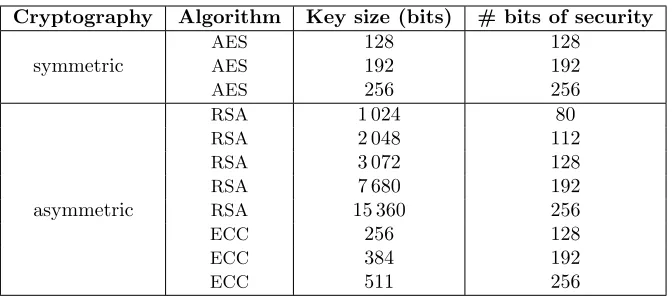
As mentioned in Section 2.1, the most commonly used cryptographic schemes areAESfor symmetric key cryptography, andRSA, ECC and DHfor asymmetric key cryptography. AES uses the same key for both encryption and decryption. This key can be size 128, 192, or 256 bits.
Cryptography Algorithm Key size (bits) # bits of security
symmetric
AES 128 128
AES 192 192
AES 256 256
asymmetric
RSA 1 024 80
RSA 2 048 112
RSA 3 072 128
RSA 7 680 192
RSA 15 360 256
ECC 256 128
ECC 384 192
[image:18.612.139.475.122.270.2]ECC 511 256
Table 1: Symmetric (AES) and asymmetric (RSA, ECC) cryptographic schemes with key sizes and security bits.
2.2.3 Attacker models
When discussing attacker models, we distinguish between two types of attack-ers: active and passive. When it comes to active attacks an adversary is allowed to interfere with the communication between the communicating parties - Alice and Bob; a passive attacker cannot.
Imagine a third party - Eve - who is eavesdropping in the communication and sends modified messages. Eve can join the communication as a relay between Alice and Bob. Eve may establish keys with both Alice and Bob, so when Alice communicates with Bob, in reality Alice is communicating with Eve who is in-tercepting messages that she can read and modify. This kind of attack is called a ‘man-in-the-middle’-attack. Eve is also capable of blocking traffic between participants, this kind of attack is called Denial of Service (DoS) attack. In a passive attack the attacker is not allowed to interfere with the commu-nication, she is only allowed to listen to the communication channel. This limits attack surfaces, but storing the communication captured is a possibility. Once it is stored, the adversary can decrypt the data in the future when the needed computational power will be affordable. This is a worry as we are getting closer to quantum computing. A quantum adversary may be able to decrypt the stored data. This is called the ‘store now, decrypt later’ paradigm.
2.3
Post-quantum cryptography
Post-quantum cryptography or quantum-safe cryptography - as suggested by its name - focuses on the cryptography after quantum computers are available. The goal is to have cryptography that is capable to withstand adversaries with quantum computing power even on classical computers. The most widely used asymmetric key cryptographic schemes (RSA, ECC) are going to become inse-cure against quantum adversaries. Symmetric cryptographic schemes also need to be considered for change. If transition to quantum-safe solutions is not done, current cryptographic schemes become vulnerable to quantum adversaries. This is why quantum-safe schemes are being designed, implemented and tested, so currently used cryptographic schemes can withstand a quantum adversary’s at-tack. These quantum-safe schemes are based on mathematical problems that are hard to compute even for quantum computers.
In 1994 Peter Shor formulated a quantum algorithm [34] (that can run on a quantum computer) for solving the integer factorization problem. On a quan-tum computer this algorithm runs in polynomial time, which is an exponential speed up compared to classical computers, that can solve factorization problems in exponential time. This is a concern for asymmetric cryptography as it based on the integer factorization problem. With a quantum computer running Shor’s quantum algorithm breaking the encryption becomes feasible.
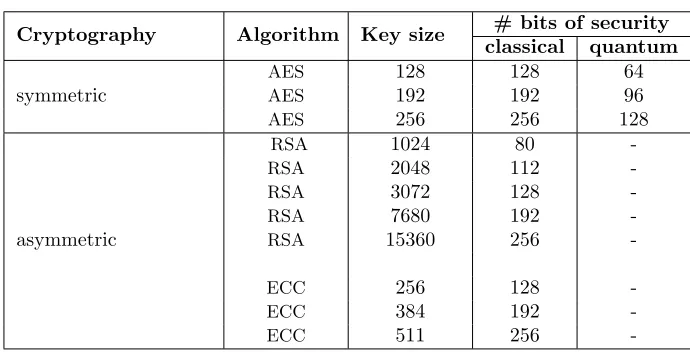
Another notable advancement in quantum computing was done by Lov Grover, who proposed an algorithm that can be considered as a black-box search algo-rithm [13]. It can find a specific value in an unordered database. Unlike Shor’s algorithm the speed up is “only” quadratic, but this means that brute-forcing symmetric key encryptions can be done faster. Brute-forcing a 128-bit AES encryption would take about 264 iterations with Grover’s algorithm instead of 2128. In the extended Table 2 an overview of security bits of currently used schemes can be found against classical and quantum adversaries.
Based on Table 2, it is clear that asymmetric key cryptography will be heavily affected in the quantum world, but keep in mind that symmetric key crypto-graphic schemes also need to be adjusted. Symmetric key cryptography can remain secure but requires using larger key sizes to achieve the current security guarantees.
The five most common types of post-quantum cryptographic schemes are • Code-based,
• Multivariate.
Cryptography Algorithm Key size # bits of security classical quantum
symmetric
AES 128 128 64
AES 192 192 96
AES 256 256 128
asymmetric
RSA 1024 80
-RSA 2048 112
-RSA 3072 128
-RSA 7680 192
-RSA 15360 256
-ECC 256 128
-ECC 384 192
-ECC 511 256
-Table 2: Symmetric and asymmetric cryptographic scheme security in a quan-tum world. Schemes marked with ‘-’ are broken in polynomial time using a quantum computer.
2.3.1 NIST submissions
As already mentioned in Section 1, the National Institute for Standards and Technology (NIST) has called to arms experts working in cryptography to ad-dress the challenge to find candidates for quantum-safe cryptography [28]. Cur-rently, the second round of submissions is being evaluated to find suitable schemes from the 17 candidates to replace asymmetric cryptography - RSA, Diffie-Hellman, Elliptic-Curve Cryptography [8].
The security level of the quantum-safe schemes can be measured in bits - just as with the case of classical computing. TheNIST defined a metric that cat-egorizes quantum-safe submissions into different categories depending on how secure they are. The submissions for the second round focus on three levels of security:
• Level 1 security is achieved when a scheme is considered 128-bit secure against a quantum adversary,
• Level 3 security is achieved when a scheme is considered 192-bit secure against a quantum adversary,
[image:20.612.132.477.149.325.2]All three levels of security are assumed to be secure, but they cannot be fully tested in practice. Instead, because quantum computing capabilities are not known yet, cryptoanalysis is done on these schemes.
Achieving level 3 and level 5 security is a challenging task. The size of public keys, private keys, and ciphertexts usually get larger with increasing the security level. The increasing size of keys result in heavier calculations required for key generation, encapsulation, and decapsulation (an example for such a scheme is
Frodo [1]). In [33] the technique used is the NTRUEncrypt scheme to achieve 128-bit (level 1) security for theTLSconnection against a quantum adversary. In this thesis we aim to reach level 1 security against quantum adversaries. If this statement holds, then we can confirm thatTOR is quantum-safe and can be used in the quantum world.
2.3.2 Transitioning to Post-quantum cryptography
The transition to quantum-safe cryptographic schemes is expected to be a lengthy process. This is due to the fact that cryptographic schemes are never fully tested, rather over time they become trusted. When schemes become well-researched and remain safe against attacks over time they are considered secure. If change from current cryptography to quantum-safe cryptography would be done quickly, without sufficient research and testing, there would be no scheme to fall back to when flaws were discovered in quantum-safe schemes. Instead, hybrid schemes are used - this is different from theKEM/DEMhybrid discussed in Section 2. In a hybrid scheme, currently used secure cryptographic schemes are combined with quantum-safe schemes to form a hybrid. This guarantees se-curity against classical adversaries in case the quantum-safe part of the scheme is broken.
3
TOR network
The Onion Router orTORfor short is an anonymity network operated by vol-unteers all around the globe. The roots of TOR go back to the 90s, when the concept of onion routing was introduced by United States Naval Labora-tories [38]. The goal was to protect foreign U.S. intelligence communications from being intercepted and linked to source and destination. Later it was fur-ther developed by the Defense Advanced Research Projects Agency (DARPA). In 2004, Roger Dingledine, Nick Mathewson and Paul Syverson have published the first paper on theTORnetwork titledTor: The Second-Generation Onion Router [11]. The network they propose claims to grant anonymity for the users between their client and the content they are accessing on the internet. They achieve this anonymity by using a set of intermediate nodes between the source (user) and the destination (website).
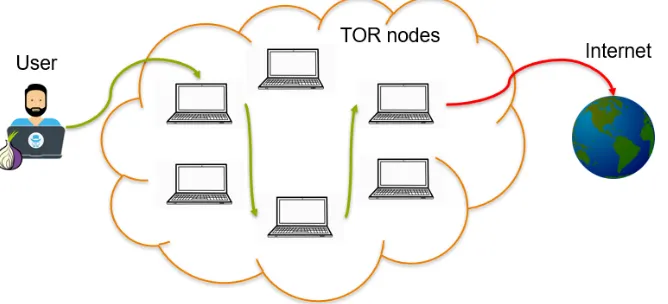
Figure 1: A standard connection on the internet.
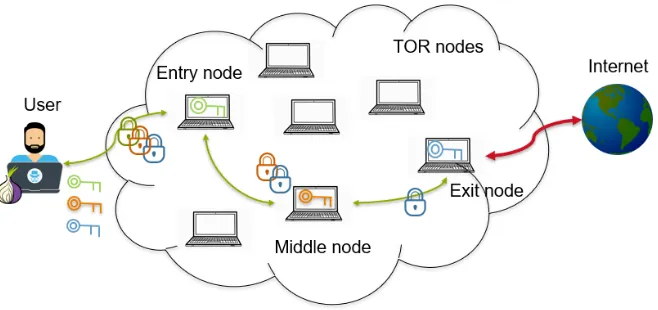
Figure 2: A defaultTORconnection.
3.1
Introduction to TOR
In TOR, when a message is sent through the network it is passed through a number of nodes before finally reaching its destination. This form of trans-porting a message makes it hard for adversaries to link source and destination together. The default number of nodesTOR uses for message transmission is three. Currently there are around 7 000 nodes inTORand the way the network is governed is introduced in the next section.
3.1.1 Nodes in TOR
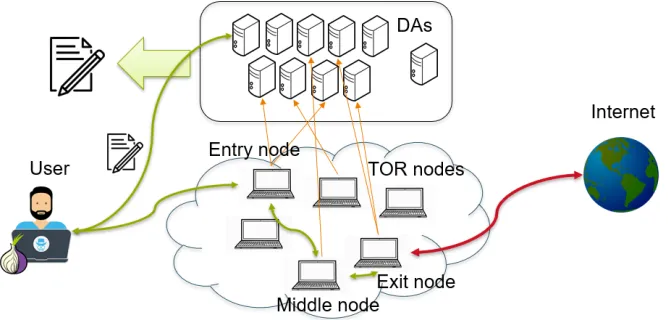
[image:23.612.144.478.321.473.2]are spread around the world - four of them are in The United States, and five in Europe. TheDAs know about all of the available nodes in the network and their main function is to store, check, and verify the state of the network. The nodes controlled by theDAs are called directory nodes. A list of currentTORnodes is publicly available online [9]. Each node has to publish a descriptor to theDAs, containing information about the node likeIP address, bandwidth, country of origin, public key, etc. The nodes need to sign this document and send it to theDAs proving that it is their own information. When theDAs received this document, they have a vote on the state of the network. This is the reason why there is an odd number ofDAs, there cannot be a tie. Once they agree on one state a document called consensus is published and all of theDAs have this same document.
Figure 3: An overview ofTORcontaining the nine DAs, the Bridge Authority, and theTORrelays.
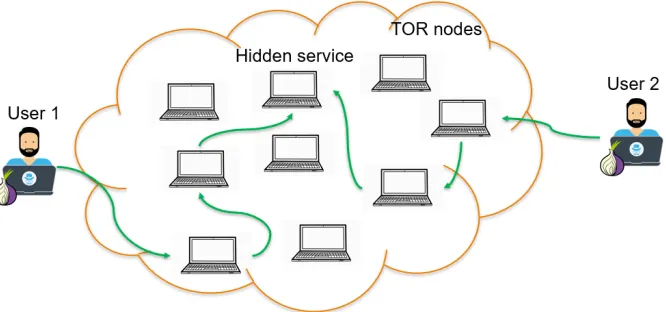
TOR offers more than ‘just’ anonymous browsing of the internet, there are so called hidden services available inTOR. These are services that one of the nodes inTORis hosting e.g. chat service, web-store, etc. A hidden service can only be accessed if the specific URL-like address of the service is known (onion address). In the case of hidden services, the default length of a circuit is five, as both users ‘meet’ at the third hop as shown in 4.
Figure 4: An overview of two users connecting and using a hidden service.
In some parts of the world anonymity may be considered as a problem and organizations or governments are trying to prevent internet users from achiev-ing it. Due to the publicly available list of nodes, these oppressive regimes can block the IP addresses of the entry nodes thus, the user does not have a way to accessTOR. In TORthere is a solution for this. Next to the nine Directory Authorities, there is one Bridge Authority that has a list of entry nodes that are not publicly available online. This makes it possible for people in oppres-sive regimes to access TOR as these entry nodes are not publicly known and cannot be blocked. TheTORsoftware has a setting that enables the use of the Bridge Authority. In the unlikely event that the client cannot connect to the Bridge Authority due to a successful attack or a connection issue, the user can still connect to a bridge node. A list of bridge nodes is hard coded into the TORclient so users from more regulated and strict locations can still access the network. The node controlled by the Bridge Authority is called the bridge node. A short summary of the nodes and functionalities ofTOR:
• The entry node knows the source of the message and the first ‘hop’ on the TORnetwork but does not know the destination of the message.
• The middle node knows the entry node and the exit node but knows neither the source nor the destination of the message.
• The exit node knows the middle node and the destination but does not know about the source of the message.
• Hidden services are provided by users of TOR, they can be any service provided on the internet (e.g. chat, streaming media). They have a unique URL-like address called onion address and can only be accessed using them.
• The bridge node is controlled by the Bridge Authority. Bridge nodes serve as entry nodes to theTORnetwork and are not publicly available to avoid them being blocked.
3.1.2 Circuit creation
So far, we understand that the Directory Authorities have a view of the network, the next step is the creation of a secure circuit. The TOR client connects to one of the DAs to fetch the latest state of the network. From the consensus document the client constructs a path in a backwards fashion:
1. First the exit node is chosen, in order to have a way out of the network. 2. The middle node is chosen in the second step, this step can be repeated
multiple times if more than three nodes are going to be used. 3. Finally, the entry node is selected by the client.
When a circuit is created inTOR, the network sends two kinds of messages to the nodes: CREATEandEXTEND. TheCREATEmessage adds the node to the cir-cuit and creates a shared symmetric key between the node and the client using RSA. If the addition of the node to the path is successful aCREATEDmessage is sent to the client.
Figure 5: An overview of the messages used for circuit creation.
After this procedure the client knows the nodes it will use for the connection, so it creates a secure channel between the nodes and the client. Using asym-metric cryptography, theTORclient performs key exchange with the nodes to obtain a different symmetric key with each node. The client knows the symmet-ric key for each node on the circuit and encrypts the message with these keys in a layered way - hence the name onion routing. The destination and message are encrypted first using the symmetric key of the exit node, followed by the middle node and entry node:
EncOR1(EncOR2(EncOR3(m, dest))) (4) In Equation 4 Enc denotes one layer of encryption. The symmetric keys of Onion Routers 1, 2, and 3 are denoted byOR1, OR2, and OR3. The message
Figure 6: An overview ofTORwith the symmetric keys.
3.2
Building blocks and keys
In this section the cryptographic building blocks behindTORand keys used in TORare explained. Both symmetric and asymmetric cryptography is used in TOR. Asymmetric cryptography is used for circuit creation, while symmetric cryptography is used for encrypting the message that has been sent through the network. The documentation for the latest cryptographic versions used inTOR is available online [10].
3.2.1 Cryptographic building blocks
The asymmetric cryptography used is:
• RSA with 1024-bit keys, with a fixed exponent 65537 and OAEP-MGF1 padding,
• Elliptic Curve cryptography is currently used in the form of Curve25519
andEd25519.
The symmetric cryptography used is:
• AES-128, in counter mode with an initialization vector of 0s
Algorithm Key size # bits of security
RSA 1 024 80
ECC 256 128
[image:29.612.207.404.124.174.2]AES 128 128
Table 3: Cryptographic schemes used inTORwith key sizes and security bits.
3.2.2 Keys in TOR
Each node has to maintain a set of keys. These are called long-term, medium-term, and short-term keys. RSA and Ed25519 are used for all three type of keys, butCurve25519is only used for medium-term keys. Table 5 contains an overview of the keys used inTORwith their functionalities.
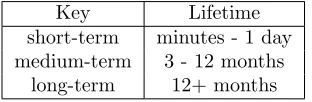
The lifetime of these keys is not too strict, but there is a boundary for each category. Table 4 indicates the lifetime of the keys used by nodes.
Key Lifetime short-term minutes - 1 day medium-term 3 - 12 months
long-term 12+ months
Table 4: Keys and their lifetime used by TOR.
Nodes are uniquely identified using their identity key (RSA) and their master identity key (Ed25519). These two keys together form a unique authentication key pair. After a node has used this unique key pair to authenticate itself, none of the keys may be different in the future.
[image:29.612.229.385.337.388.2]Type Key lifetime Key name Function
RSA
long-term identity key Establish relay identity, sign documents and certifi-cates. Since the introduction of Ed25519, RSA is only used to establish relay identity.
medium-term onion key Decrypt cells at circuit creation. Used in ntor and TAPfor handshakes.
short-term connection key EstablishTLSchannels between nodes.
Curve25519 medium-term - Handle handshakes in thentor protocol.
Ed25519
long-term master identity key Sign medium-term Ed25519 key. This key never changes.
medium-term signing key Replaces RSA identity key to sign documents and certificates.
[image:30.612.57.552.123.296.2]short-term link authentication key Authenticate handshakes after aTORcircuit negoti-ation.
Table 5: Function ofRSA, Curve25519andEd25519keys inTOR. A second challenge that TOR faces also relates to usability: circuit build times [25]. In a standard connection there are three hops in the created circuit. The first hop takes the most time - more than 1.5 seconds in the worst case. The consecutive second and third hop take up to half a second or more. In the end circuit build times can take over 2.5 seconds. Introducing quantum-safe schemes is expected to have a higher load on computation - key generation, encryption and decryption - and on network communication.
The challenge is to keep user experience at an acceptable level but guarantee se-curity against quantum adversaries. Furthermore, current nodes should be able to deal with computational and communicational tasks related to quantum-safe schemes.
3.3
Issues and attack surfaces
early 2019 by Enrico Cambiaso et al. gives a clear overview on past and current attacks onTOR[6]. Cambiaso et al. distinguish between three kinds of attacks on anonymity:
• Attacks on the client, • Attacks on the servers, • Attacks on the network.
Client attacks focus on software related vulnerabilities of the TOR client or third-party applications. They also assume that the attacker has control over some entry and exit nodes and manages to force the user to use these nodes. Server attacks focus on compromisingTORhidden services. The attacker tries to manipulate/modify the packets/TORcells sent through the network. In gen-eral, the goal is to lead the user to a malicious node controlled by the adversary. If this is successful, the user loses anonymity.
4
Post-quantum TOR
In Section 1.3, two papers are mentioned that discuss a Post-quantum TOR network [33, 12], and Section 3.3 explained the possible attacks on TOR. In this section [33, 12] papers are further elaborated, and possible attack surfaces of a quantum adversary are discussed. Finally, we answer the first and second questions of our research.
4.1
Challenges
With quantum computing emerging, the cryptography ofTORneeds to be ad-justed. The quantum vulnerability of asymmetric and symmetric key cryptog-raphy will open a new attack surface for adversaries. Introducing quantum-safe cryptography toTORis the task that needs to be done in order to keep cryp-tographic vulnerabilities off the list of attack surfaces. This is why it is pivotal to introduce quantum-safe cryptography to the keys of the nodes.
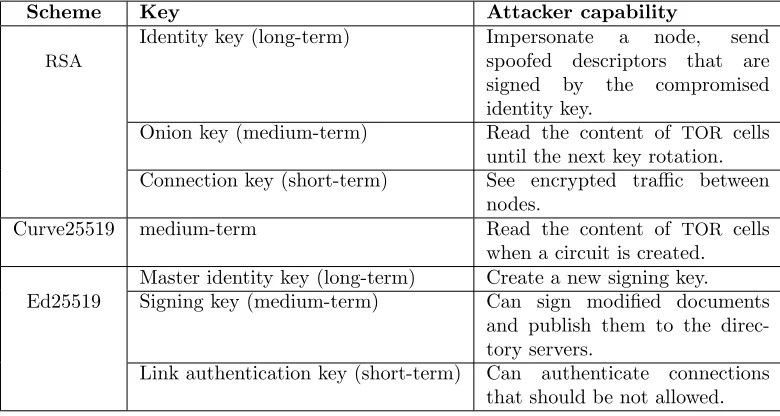
Scheme Key Attacker capability
RSA
Identity key (long-term) Impersonate a node, send spoofed descriptors that are signed by the compromised identity key.
Onion key (medium-term) Read the content of TOR cells until the next key rotation. Connection key (short-term) See encrypted traffic between
nodes.
Curve25519 medium-term Read the content of TOR cells when a circuit is created. Ed25519
Master identity key (long-term) Create a new signing key. Signing key (medium-term) Can sign modified documents
and publish them to the direc-tory servers.
[image:32.612.110.500.334.542.2]Link authentication key (short-term) Can authenticate connections that should be not allowed. Table 6: Attacker capabilities with compromised asymmetric schemes.
Table 6 explains the attacker capabilities in case the RSA, Curve25519 or
4.2
Attack scenarios
As most current attacks onTORare based on other vulnerabilities than cryp-tography, in this section we consider attack scenarios on the keys of the nodes that a quantum adversary possesses. Furthermore, the addition of quantum-safe cryptography is also be considered in this section.
As discussed in Section 3, there are four types of keys inTORand all of these can be compromised by an attacker:
• symmetric key, • short-term key, • medium-term key, • long-term key.
Compromising the symmetric keys enables the adversary to decrypt layers of encryption and learn the destination of the message. In the case that the at-tacker only knows the symmetric keys and nothing else, the encrypted message must be intercepted before entering the network. Otherwise, theTLS connec-tion will add an extra layer of security. If an adversary does not know all the symmetric keys, she cannot fully decrypt the message and thus, the circuit is not fully known, so source and destination remain anonymous.
Compromising the short-term key at an entry node would make the adversary capable to follow the full length of the circuit from sender to recipient. This would lead to deanonymization of the user. This attack is possible during the lifetime of theTLSconnection.
In case the adversary knows the short-term key and the medium-term key of a node, the attacker can impersonate this node. This is doable as the medium-term key enables the attacker to decrypt CREATE messages and establish new circuits. Such a node can decrypt one layer of symmetric encryption when the messages are passed through it. Thus, the previous and next ‘hop’ in the cir-cuit is known for the attacker. The attack is possible until the rotation of the medium-term keys.
The long-term key may also be compromised by the adversary. This would enable the adversary to impersonate the node and send forged descriptors to the directory nodes. Moreover, the attacker can see previous and consecutive ‘hops’ in the circuit with the encrypted cells.
Colluding adversaries at the entry and at the exit node who have the medium-term keys will both know the middle relay in a circuit. Sharing this knowledge enables them to attempt to deanonymize users, as the users using the common middle node has the biggest possibility to be communicating with each other. The colluding attack can also be done when the adversaries at the entry and exit nodes have compromised the long-term keys. Such an adversary is able to alter the packets sent through the network. The adversary at the exit node can inspect the packet received and if the altered packet is received, they can deanonymize users successfully. Table 7 gives a short summary of the attacker capabilities when compromising the short/medium/long-term keys.
In the attacks described, the adversary needs to compromise keys generated by asymmetric schemes. These are currently considered a hard problem, but for a quantum adversary it becomes more feasible to compromise them. As described in Section 3.3 current attacks onTOR do not target the cryptogra-phy, but rather focus on vulnerabilities inTORrelated software, hidden services, bridge node discovery, disabling the network, and on generic attacks like timing. Common technique of adversaries is to introduce new nodes to the TOR net-work, but this is a lengthy process due to the policy of the network. New nodes are even more closely monitored than nodes already in the network for malicious patterns and if such is recognized, they are excluded from the network. A quantum adversary can compromise the short/medium/long-term keys of certain nodes and gain control over it. This poses two issues:
• Deanonymizing users can be done easier if access to nodes is gained, • Causing a Denial of Service attack becomes a concern if many nodes are
taken offline because ofTORpolicy.
Attack surface Attacker capability Impact of successful attack
Compromise symmetric keys Decrypt the message entering the network. Message content learned, and anonymity lost. Compromise short-term key at entry
node (connection key)
Follow the circuit during the lifetime of the connection. Anonymity lost.
Compromise short-term and medium-term keys of middle node (connection key, onion key)
Impersonate the node until the rotation of the medium-term key. Decrypt CREATE ells, see encrypted traffic passing through the node. Compromise long-term key of a node
(identity key)
Replace the node by sending forged descriptors to directory au-thorities, see previous and consecutive hops/encrypted cells.
Direct uses to malicious nodes.
Colluding adversaries with compro-mised medium-term key at entry and exit node (onion key)
The middle nodes will be known by both parties, the colluding parties can match source to destination if the middle node is the same.
Anonymity lost.
Colluding adversaries with compro-mised long-term key at entry and exit node (identity key)
Colluding parties impersonate nodes and can modify packets sent through the network. Receiving such altered packet, the parties together deanonymize the user.
[image:35.612.30.586.123.315.2]Anonymity lost.
Table 7: Attacker capabilities with exploited keys of nodes.
Attack surface Security gain after quantum-safe cryptography
Compromise symmetric keys Larger key size will make it harder or infeasible for the adversary to decrypt messages.
Compromise short-term key at entry node (connection key)
TLSbecomes quantum-safe, adversary can no longer ”look into” the traffic between nodes.
Compromise short-term and medium-term keys of middle node (connection key, onion key)
Impersonating the node will no longer be possible, as the medium-term key will be quantum-safe.
Compromise long-term key of a node (identity key)
Attacker cannot impersonate the node for indefinite time and send forged descriptors to the directory authorities.
Colluding adversaries with compro-mised medium-term key at entry and exit node (onion key)
Cryptographic vulnerability is solved, as the medium-term key remains secure, adversaries will not know about the middle hop. Adversaries monitoring entry and exit nodes can still link sender and destination using timing attacks for example.
Colluding adversaries with compro-mised long-term key at entry and exit node (identity key)
Cryptographic vulnerability is solved, as the long-term key re-mains secure, adversaries can no longer impersonate nodes and alter packets. Adversaries monitoring entry and exit nodes can still link sender and destination using timing attacks for example. Table 8: Security gain with quantum-safe schemes.
[image:35.612.69.546.358.579.2]4.3
Papers on quantum-safe TOR
In Section 1 two papers on quantum-safeTORwere introduced and in this sec-tion, they are further elaborated. These two papers arePost-Quantum Forward-Secure Onion Routing (Future Anonymity in Today’s Budget)by S. Ghosh and A. Kate [12], andCircuit-extension handshakes for Tor achieving forwards se-crecy in a quantum world by J. M. Schanck, W. Whyte, and Z. Zhang [33]. Published in 2015, in [12] the focus is on keeping forward secrecy and to do so the short-term keys are the focus. The proposed solution is a custom key exchange protocol design and it focuses on keeping the short-term keys TOR uses to negotiate session keys forTLSconnections quantum-safe. For long-term keys, they use current classical cryptography. The protocol is calledHybridOR
and is based on lattice problems. In [12] the protocol is reported to be com-putationally more efficient compared to currently used ntor, but this can be due to performing less Diffie-Hellman operations. Drawbacks reported in the paper are related to network communication. Due to the quantum-safe scheme the amount of data communicated increases. HybridORis assumed to be secure under the ring-Learning With Error (r-LWE) assumption. Although, if the r-LWEassumption becomes insecure against a classical adversary, it will no longer provide forward secrecy even against classical adversaries.
One year later another paper on quantum-safe TOR was published [33]. The paper, like [12] also focuses on making the short-term keys quantum-safe. In [33] the currently usedntorprotocol is modified and is calledhybrid. Hybriduses the combination of long-term keys generated by Diffie-Hellman key exchange, and short-term keys generated by a quantum-safe scheme NTRUEncrypt. This implementation is beneficial, as if the quantum-safe part of the key becomes compromised, the protocol can fall back to the currentntorsecurity guarantees thus, provide forward secrecy against classical adversaries. Thehybridscheme is 128-bitIND-CCAsecure against quantum adversaries.
ntor hybrid HybridOR** Packets (1 = max 512 bytes) 1 2 3
[image:37.612.151.459.124.221.2]client→server (bytes) 84 693 1 312 server→client (bytes) 64 673 1 376 client init 84µs 661µs 150µs server response 263µs 306µs 150µs client finish 180µs 218µs 150µs total 527µs 1185µs 450µs
Table 9: A comparison of the currently usedntor protocol, hybrid [33], and
HybridOR[12] protocols. ** [12] assume 100µs for Diffie-Hellman group opera-tions and 50µs for multiplication and addition inr-LWE. The other costs, such as sampling of the r-LWEsecrets are ignored.
Based on Table 9 and [12, 33] we conclude that that adding quantum-safe schemes toTORincreases the message sizes and the time the client and server need to communicate. In the case of [12] we can only draw conclusions about the message sizes and they are even larger than forhybrid. This means even though the assumed computation costs are more favourable, the increased packet size has an impact on network load. Furthermore, these works focus on making short-term keys quantum-safe, that are used whenTLS connections are set up and long/medium-term keys are not considered.
4.4
First recommendations for quantum-safe TOR
At this point, we understandTOR, the vulnerabilities, and have a feeling what adding quantum-safe cryptography means forTOR. The first and second ques-tions can be answered of our research.
Recall the first two questions:
• Which are the most pivotal parts inTORthat need to be made quantum-safe first?
• Where and when should quantum-safe cryptography be added toTOR? TORmakes use of the public-private keys of the nodes thus, the most pivotal parts to be updated are the long-term/medium-term/short-term keys of the nodes and the symmetric keys. Note, in order to make the symmetric keys secure there is no need to add any quantum-safe scheme. The priority list of the focused components is:
1. AESsymmetric key,
TheAESsymmetric key does not require a quantum-safe scheme to be updated, but this has to be changed as soon as possible. Increasing the key size from the currently used 128-bit keys to 256-bit keys would already solve the prob-lem. This is a burning issue as adversaries storing current traffic will be able to decrypt the messages in the future when the needed computational power is available. Updating the symmetric keys makes ‘store-now-decrypt-later’-attacks infeasible.
The most important asymmetric part that needs to be secured are the medium-term and long-medium-term keys. These pose a threat as they do not have frequent rotations. Thus, the attacker has more time to compromise these keys and if succeeded, as the keys do not change for a long period of time, the adversary can impersonate the node until the next key rotation. A compromised node can redirect traffic to other nodes that have been compromised, this can lead to deanonymization. A compromised node can also start to behave suspiciously, and if so it can be excluded from the network. In case of too many nodes being excluded,TORcould become unstable. Key rotation time is not the sole factor for the need to update long-term keys. In order to keep the protocol forward secure, the long-term and medium-term keys need to be updated. This ensures that a compromised long-term key in the future does not aid the adversary to learn about past communications with the same key.
Finally, the shortterm keys need to be updated. These keys rotate frequently -every 10 minutes if the connection has no issues - and because of this, the time for an adversary is limited to compromise the connection. If an adversary man-ages to compromise the short-term key used for the connection at the entry node, it can follow the circuit from start to end making it possible to deanonymize communicating parties. It must be mentioned, thatTORdoes not create new circuits for streaming protocol (IRC) to limit the possibilities for an attacker to link parties. This will also pose as a threat in the quantum world as the circuit will not be recreated after 10 minutes and an adversary will have more time to compromise the circuit. Furthermore,TOR currently uses short-term keys for TLSsession negotiations and quantum-safeTLSis being researched [5].
It is clear that short/medium/long-term keys are the areas that need to be investigated as they are generated using asymmetric key cryptography. More technically, the nodes need to stop usingRSAkeys and switch to quantum-safe schemes for key generation.
5
Experimental results
In this section we describe and discuss the experimental results on quantum-safe TOR implementations. Specifically, Section 5.1 explains the implementation used and the challenges faced. Section 5.2 gives an overview of the system specification used and the steps of the experiment. Section 5.4 contains the results for the experiments and recommendations on what quantum-safeTOR should look like. Finally, in Section 5.5 the third and fourth questions for the research are answered. The final recommendations based on our findings on quantum-safeTOR are discussed and the main question of the research is answered.
5.1
Implementation
5.1.1 Onion routing
In order to further understand the impact of quantum-safe cryptography on TORwe need to perform experimental testing. The original source code for the TORproject can be downloaded [39] but cannot be altered and experimented with easily. A TOR-like simulation called SweetOnions, where a small-scale version of onion routing is emulated using Python 2 was used [20]. The project is well documented and the instructions on how it works are clear. The cryp-tographic implementations differ from the onesTOR uses - 2048-bit RSA and 192-bitAESciphers are used instead of 1024-bitRSAand 128-bitAESthatTOR uses.
To emulate a TOR network with SweetOnions a minimum number of 6 ma-chines is required:
• one server - the destination to where the messages are sent,
• one directory - the IP addresses and public keys of the nodes are stored here,
• one client - source of the message,
• three nodes - theIP addresses and public keys are shared with the direc-tory, when receiving an encrypted message one layer is removed and sent to the next node.
5.1.2 Open Quantum Safe library and challenges
The Open Quantum Safe library [30] has multiple implementations of post-quantum secure schemes. The master branch contains both key encapsulation and signature schemes. In the scope of this thesis the key encapsulation schemes are considered.
The original implementation of these schemes is inC, but there is a wrapper available that can be used for Python [31]. In the Python implementation there are schemes forNIST security levels 1 to 5, but only the schemes that achieve level 1 NIST security are tested. The reason behind this decision is if level 1 security is achieved, we consider TOR to be quantum-safe. When changing to new cryptographic schemes it is important to try to keep the fundamental parts as unmodified as possible. This is because the currently used protocols are well-tested, researched and trusted in their current form and changing the fundamentals can result in some unforeseen challenges. IfTORcan be used with the current packet size, network load and can also be quantum-safe, that would be extremely beneficial as the core ofTORwould not require any change. The tested schemes to provide level 1 NIST security are
• Frodo-640-AES, • Frodo-640-SHAKE, • Kyber512,
• NewHope-512-CCA, • NTRU-HPS-2048-509, • Sike-503.
As mentioned in 5.1 the original codebase forSweetOnionsis Python 2, but in order to use the Open Quantum Safe library Python 3 is required. The main challenges to solve when converting to Python 3 from Python 2 are:
• Formatting, • Networking,
• Encryption and decryption.
written, and modifications were made to the network communication as well. As a result, theSweetOnionsimplementation can now be run using Python 3 and can be combined with the Open Quantum Safe library.
5.1.3 Expected drawbacks
Before running the experiments, some expectations about the negative effects that will be observed when introducing quantum-safe schemes are listed:
1. CPUcomputation times will increase for key generation and for encapsu-lation/decapsulation compared toRSA. This expectation is based on [33], where client initiation and server response times are reported to take more time than for the currentntorprotocol.
2. Public and private key sizes will increase which will result in heavier net-work traffic for Directory Authorities. Based on [12, 33] message sizes increased, which can be caused by larger encryption keys.
3. Message sizes will increase due to quantum-safe encryption of messages. As a result, the 512-byte long packets will not be sufficiently large and fitting one connection into one packet as done forntor will be not possi-ble [33]. This means one of the fundamentals of TORcould need modifi-cation.
5.2
Experimental setup
In this section we give an overview of the system used for our experiments and how these experiments were carried out. Furthermore, we introduce the design of our classical, our purely quantum-safe and our hybrid schemes.
5.2.1 System setup
For the experiment local and virtual environments are both used. The technical specification of the notebook used for the local experiments is Dell Latitude E7240TNOManaged Kepler Computer, with Intel Core i5-4310UCPU@ 2.00 - 2.60GHz processor, 8GB RAM, Samsung SSD SM841N mSATA 128GB for storage and Windows 10 Enterprise 64-bit operating system. Furthermore, an Ubuntu 18.04 LTS subsystem was installed.
In order to emulate the TOR network, 6 virtual machines were used with In-tel Core Processor (Broadwell) @ 2.4 GHz processors, 60GBstorage, a virtual network adapter, and Linux version 4.15.0 operating system.
5.2.2 Experiment setup
First, the theorical parts of classical, quantum-safe and the hybrid schemes were considered. These included planning about what encryption and decryp-tion of messages should look like and also the format of the messages.
Secondly, the public key, private key and ciphertext sizes are measured con-sidering the Open Quantum Safe codebase. CPUcycles for key generation is measured for the classical and quantum-safe schemes.
Thirdly, the encapsulation and decapsulationCPUcycles are measured forRSA and each quantum-safe scheme.
The SweetOnions TOR network was used for measuring circuit build times and message sizes for three scenarios: classical implementation, quantum-safe implementation, hybrid implementation. As this is not the original TOR net-work the classical implementation serves as a benchmark measure and based on the numbers, predictions can be given for the actualTORnetwork.
In order to have comparable results, theCPUcycles were measured. This allows a better comparison method for the experiment as the network has minimal la-tency because the virtual machines are in the same virtual network. Measuring the circuit build times for the original, quantum-safe, and the hybrid implemen-tations demonstrate the CPU cycles required for circuit creation without the network latency having any effect.
5.2.3 Classical scheme
In the original SweetOnions implementation the client sends a message con-tainingRSA and AES encryption through the network. The client creates the correct message format as follows
1. The client generates anAES key and encrypts the message,
2. The client uses theRSApublic key of a node to encrypt theAESkey used to encrypt the message,
3. The client combines the two encryptions as one message and sends it to the node.
The format of the sent message is(RSA(AES key),AES[message]), where() de-notes asymmetric key encryption and [] denotes symmetric key encryption. This notation is the same for the other two methods. The client repeats these steps three times to have the correct wrapping of the message.
After receiving a message in this format, the node can remove the encryption layer from the message:
2. The node uses hisRSAprivate key to decrypt the asymmetric encryption and learns theAES key,
3. After learning the AES key the node decrypts the AES encryption and learns the message.
5.2.4 Quantum-safe schemes
In order to keep measurements most accurate, we aim not to modify the original format of sending/receiving messages too much. The quantum-safe schemes do not use RSA encryption to encrypt the symmetric key, which means that the RSApart of the message sent in the original implementation should be replaced. The implementation used for quantum-safe schemes work the following way:
1. The client uses a quantum-safe scheme to generate a shared secret - that is used and referred to as the (AESkey) - and a ciphertext of this shared secret using the quantum-safe public key of the node (PQC(AES key)), 2. The client uses theAES key to encrypt the message,
3. The client combines the ciphertext of the AES key and the encrypted message as one and sends it to the node.
The message format the client sends is(PQC(AES key), AES[message]).
When a node receives this message, he can remove the encryption layer from the message:
1. The node splits the message into the post-quantum and symmetric part, 2. The node uses his quantum-safe private key to decapsulate the ciphertext
and learns theAES key,
3. After learning theAES key the node decrypts the symmetric encryption and learns the message.
5.2.5 Hybrid schemes
For security considerations a combination of classical and quantum-safe schemes is tested. In an unforeseen security issue of the quantum-safe schemes, a clas-sical adversary should not be able to break the encryption. If this were the case and adversaries managed to decapsulate theAES keys from the ciphertext when purely quantum-safe schemes are used, the content of the message can be learned. To overcome this issue, instead of using purely an encapsulated AES key, the preferred method is to combineRSA and quantum-safe cryptography. This ensures that an adversary would still need to break the security ofRSAin order to compromise the weakness of the quantum-safe scheme.