University of Warwick institutional repository: http://go.warwick.ac.uk/wrap
A Thesis Submitted for the Degree of PhD at the University of Warwick
http://go.warwick.ac.uk/wrap/46815
This thesis is made available online and is protected by original copyright.
Please scroll down to view the document itself.
Intelligent Support for Group Work in
Collaborative Learning Environments
by
Shuangyan Liu
A thesis submitted in partial fulfillment of
the requirements for the degree of
Doctor of Philosophy in Computer Science
Department of Computer Science
i
Contents
List of Tables ... vi
List of Figures ... viii
Acknowledgments ... x
Declaration ... xi
Abstract ... xii
Abbreviations ... xiv
Chapter 1 Introduction ... 1
1.1 Problem Statement and Motivation ... 1
1.2 Research Aim and Objectives ... 5
1.3 Thesis Outline ... 7
Chapter 2 Background and Related Work ... 10
2.1 Collaborative Learning Environments ... 10
2.2 Group Formation for Collaborative Group Work ... 14
2.2.1 Methods & Tools for Group Formation ... 14
2.2.2 Learning Style Theories ... 18
2.2.3 Impact of Learning Styles on Group Collaboration ... 19
2.3 Review of Group Collaboration Problems ... 24
2.3.1 Technical Problems ... 24
2.3.2 Student-induced Problems ... 25
2.4 Group Collaboration Problem Diagnosis ... 28
2.4.1 Interaction Analysis ... 28
2.4.2 Predictive Modelling ... 31
2.5 Summary ... 33
ii
3.1 Overview ... 36
3.2 Learning Styles Modelling ... 40
3.3 Grouping Parameter Identification... 44
3.4 The iGLS Grouping Algorithm ... 46
3.5 iGLS add-on for LAMS ... 52
3.5.1 Introduction... 52
3.5.2 Learning Activity Management System (LAMS)... 52
3.5.3 Architecture of the iGLS Add-on for LAMS ... 54
3.5.4 Component Implementation ... 57
3.6 Demonstrating the iGLS Approach — A Real World Scenario ... 61
3.7 Summary ... 67
Chapter 4 Evaluating the Effectiveness of the iGLS Grouping Algorithm ... 68
4.1 Introduction ... 69
4.2 Evaluation Methodology ... 70
4.2.1 Experiment Design ... 70
4.2.2 Population and Sampling ... 72
4.2.3 Data Collection Procedure ... 73
4.2.4 Data Analysis Methods ... 74
4.3 Results ... 77
4.3.1 Grouping Results ... 77
4.3.2 Group Achievements ... 79
4.3.3 Individual Student Achievements ... 81
4.3.4 Qualitative Findings from Group Processes ... 83
4.3.5 Student Feedback ... 87
4.4 Discussion ... 91
4.5 Summary ... 95
Chapter 5 A Student Perspective on Group Collaboration Problems and Causes ... 96
5.1 Introduction ... 96
5.2 Methodology ... 100
iii
5.2.2 Participants ... 101
5.2.3 Data Collection ... 101
5.2.4 Data Analysis Methods ... 102
5.3 Survey Results ... 103
5.3.1 Participants‘ Demographic Information ... 103
5.3.2 Perceptions on the Problem Scenarios and the Factors Causing the Problems ... 104
5.3.3 Associations between Student Background and Their Perceptions on the Factors ... 108
5.3.4 The Popularity of Various Asynchronous Collaboration Tools ... 110
5.4 Major Group Collaboration Problems and Their Causes ... 112
5.5 Representing the Collaboration Problem-Cause Linkages ... 113
5.5.1 An XML-based Representation of the Linkages ... 114
5.5.2 Discussing the Potential Applications of the XML-based Representation ... 118
5.6 Summary ... 119
Chapter 6 An Approach for Diagnosing Group Collaboration Problems ... 120
6.1 Overview ... 121
6.2 The Diagnostic Mechanism ... 126
6.2.1 Introduction... 126
6.2.2 Constructing the Forum Data Set ... 129
6.2.3 The GCPD Predictive Models ... 136
6.2.4 The GCPD Algorithms ... 147
6.2.5 The Grammar and Spelling Checker ... 155
6.3 Data Collection and Processing ... 158
6.4 Presentation of Diagnostic Products ... 163
6.5 The GCPD Implementation ... 165
6.5.1 Introduction... 165
6.5.2 Implementation Scope ... 166
6.5.3 The GroupDoctor Tool ... 168
iv
Chapter 7 Evaluating the Validity of the GCPD Predictive Models and the
Diagnostic Accuracy of the GCPD Algorithms ... 174
7.1 Introduction ... 175
7.2 Evaluation Methods ... 177
7.2.1 Experiment Design ... 177
7.2.2 The Testing Dataset ... 179
7.2.3 Experiment Procedure ... 183
7.2.4 Data Analysis ... 184
7.3 Experiment Results ... 186
7.3.1 Apparent Validation for the Predictive Models I, II and III ... 186
7.3.2 Split-sample Validation for the Predictive Models I, II and III ... 189
7.3.3 Diagnostic Accuracy of the GCPD Algorithms ... 194
7.4 Discussion ... 197
7.5 Summary ... 202
Chapter 8 Exploring A Multi-Agent Architecture for Online Collaborative Learning ... 204
8.1 Introduction ... 204
8.2 Scope of the Pedagogical Process Supported ... 207
8.3 Development Methodology ... 210
8.4 Analyzing and Designing the Architecture Using Gaia Methodology 214 8.4.1 The Role Model ... 215
8.4.2 The Interaction Model ... 219
8.4.3 The Agent Model ... 221
8.4.4 The Service Model ... 223
8.4.5 The Acquaintance Model ... 227
8.5 Overview of the Multi-Agent Architecture ... 228
8.6 Summary ... 232
Chapter 9 Conclusions and Future Work ... 233
v 9.2 Research Contributions ... 239 9.3 Future Work ... 242
vi
List of Tables
Table 3.1 Features of open source collaborative learning environments ... 53 Table 4.1 The grouping results for the first group task ... 78 Table 4.2 The grouping results for the second group task ... 78 Table 4.3 Similar groups—units of interactions categorised under
categories 1–12 of the Bales IPA Framework [18] ... 83 Table 4.4 Diverse groups—units of interactions categorised under
categories 1–12 of the Bales IPA Framework [18] ... 84 Table 4.5 Results of the t-tests to compare the number of units of
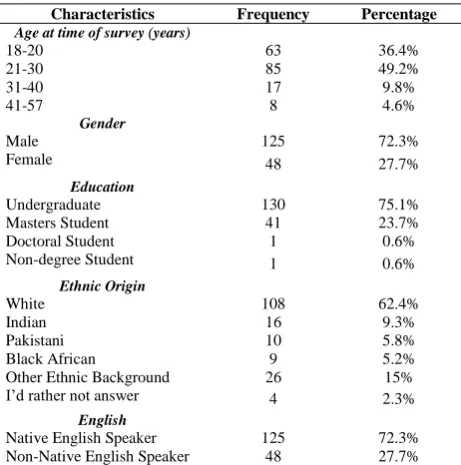
interactions ... 85 Table 4.6 A summary of the factors that might affect the group work ... 87 Table 5.1 Demographic characteristics of participants (N=173) ... 104 Table 5.2 Associations between students‘ characteristics and their
perceptions on the factors ... 109 Table 5.3 Names and symbols of the major group collaboration problems ... 113 Table 5.4 Schema for determining the influence level ... 116 Table 6.1 Indicators for each collaboration problem identified in Chapter 5 . 131 Table 6.2 Data segments from the table Forum-1 in the Forum data set ... 135 Table 6.3 Summary of multinomial logistic regression analysis for
variables predicting the collaboration problem ‗not contributing much in online discussions‘ (CP-1) (N=87)... 139 Table 6.4 Summary of multinomial logistic regression analysis for
variables predicting the collaboration problem ‗not actively
meeting the deadlines‘ (CP-2) (N=87) ... 143 Table 6.5 Summary of multinomial logistic regression analysis for
variables predicting the collaboration problem ‗not actively
vii Table 6.6 The types of data derived from the diagnostic mechanism for
diagnosing the collaboration problems that are examined ... 158
Table 7.1 Classification table for the predictive model I (N=87) ... 186
Table 7.2 Classification table for the predictive model II (N=87) ... 187
Table 7.3 Classification table for the predictive model III (N=87) ... 188
Table 7.4 Classification table for the estimation model ′ that was applied on the validation sample VS-1 (N=43) ... 190
Table 7.5 Classification table for the estimation model ′ that was applied on the validation sample VS-2 (N=43) ... 192
Table 7.6 Classification table for the estimation model ′ that was applied on the validation sample VS-3 (N=43) ... 193
Table 7.7 Comparison applied for the CP-5 diagnosis algorithm on the testing sample (N=18) ... 195
Table 7.8 Comparison applied for the CP-6 diagnosis algorithm on the testing sample (N=18) ... 196
viii
List of Figures
Figure 3.1. The overall process of iGLS ... 37
Figure 3.2. iGLS and collaborative learning environment ... 38
Figure 3.3. The active/reflective dimension of the FSLSM model ... 42
Figure 3.4. The architecture of the iGLS add-on for LAMS ... 55
Figure 3.5. Implementation of learning styles modelling ... 59
Figure 3.6. Implementation of the iGLS grouping algorithm ... 60
Figure 3.7. Screenshot of ―design the learning process for the lesson ‗Cold Siberia‘‖ ... 63
Figure 3.8. Screenshot of ―student profile‖ ... 64
Figure 3.9. Screenshot of ―take learning style questionnaire‖ ... 65
Figure 3.10. Screenshot of ―grouping result for the lesson of ‗Cold Siberia‘‖ ... 66
Figure 4.1. The group scores by SLS groups (Group Task 1) and DLS groups (Group Task 2) ... 80
Figure 4.2. Percentage of meaningful interactions by SLS groups and DLS groups ... 81
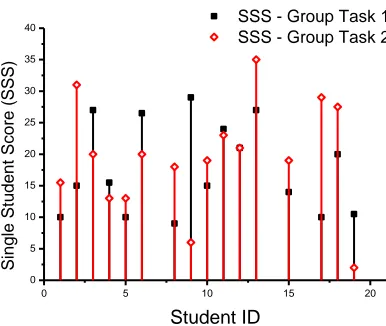
Figure 4.3. The single student scores of each participant in the SLS and DLS groups ... 82
Figure 4.4. Student preferences for the collaborative groups (a. preferred the SLS group; b. preferred the DLS group; c. preferred equally for the SLS and DLS groups; d. expressed no preferences) ... 90
ix Figure 5.2. Types of asynchronous collaboration tools and the number of
students who have previously used them when working on
online group work ... 111
Figure 5.3. A hierarchical structure of the elements ... 115
Figure 6.1. An overall view of the GCPD components and the diagnostic process ... 123
Figure 6.2. The steps of the CP-5 diagnosis algorithm ... 149
Figure 6.3. The steps of the CP-6 diagnosis algorithm ... 153
Figure 6.4. The process for diagnosing the collaboration problem CP-4 ... 155
Figure 6.5. The architecture of grammar and spelling checking ... 157
Figure 6.6. The process of gathering data from a CLE data centre ... 159
Figure 6.7. GroupDoctor Diagnosis Setting screenshot ... 170
Figure 6.8. GroupDoctor Diagnosis Results screenshot ... 172
Figure 8.1. Agent-oriented software development methodologies (adapted from [34]) ... 213
Figure 8.2. Schema for role Grouping ... 218
Figure 8.3. Definition of protocols associated with the Grouping role: (a) GetLearningStyles, (b) GetGroupingParameter, and (c) GetGroups. ... 220
Figure 8.4. The agent model ... 222
Figure 8.5. The acquaintance model ... 227
x
Acknowledgments
I would like to express the deepest appreciation to my supervisor, Dr. Mike Joy, who led me to the interesting field of educational technology. He provided great guidance, support and encouragement to my study, and has always been patient to offer advice on my research. I would also like to thank my co-supervisor, Dr. Nathan Griffiths, for his valuable suggestions and feedback made to this thesis.
My thanks must also go to Dr. Sarabjot Singh Anand for his time and constructive feedback at the annual meetings during years of my study.
I am also very appreciative of Dr. Steve Russ, Dr. Jane Sinclair, Dr. Alexandra Cristea, Dr. Christine Leigh, Roger Packwood, and other staff members in the Computer Science Department, for their kind support during this PhD project. I also give sincere gratitude to the past and present colleagues in the Intelligent and Adaptive Systems Group. It was a great pleasure to work with them and they were very supportive and enthusiastic during my study.
In addition I would like to thank the students who participated in the experiments and the survey study for this PhD project, for their contributions and time, and the tutors in my department in coordinating the student groups, the university representatives in delivering the survey.
Thanks to my parents and sister for their unlimited support and encouragement. Without their love, care, and faith this thesis would have remained a dream.
xi
Declaration
This thesis is presented in accordance with the regulations for the degree of Doctor of Philosophy. It has been written by myself and has not been submitted in any previous application for any degree. The work presented in this thesis has been undertaken by myself except where otherwise stated. Parts of this thesis have been published or submitted for publication as below.
xii
Abstract
The delivery of intelligent support for group work is a complex issue in collaborative learning environments. This particularly pertains to the construction of effective groups and assessment of collaboration problems. This is because the composition of groups can be affected by several variables, and various methods are desirable for ascertaining the existence of different collaboration problems. Literature has shown that current collaborative learning environments provide limited or no support for teachers to cope with these tasks. Considering this and the increasing use of online collaboration, this research aims to explore solutions for improving the delivery of support for group work in collaborative learning environments, and thus to simplify how teachers manage collaborative group work. In this thesis, three aspects were investigated to achieve this goal. The first aspect emphasises on proposing a novel approach for group formation based on students‘ learning styles. The novelty and importance of this approach is the provision of an automatic grouping method that can tailor to individual students‘ characteristics and fit well into the existing collaborative learning environments. The evaluation activities comprise the development of an add-on tool and an undergraduate student experiment, which indicate the feasibility and strength of the proposed approach — being capable of forming diverse groups that tend to perform more effectively and efficiently than similar groups for conducting group discussion tasks.
The second focus of this research relates to the identification of major group collaboration problems and their causes. A nationwide survey was conducted that reveals a student perspective on the issue, which current literature fails to adequately address. Based on the findings from the survey, an XML-based representation was created that provides a unique perspective on the linkages between the problems and causes identified.
xiii ascertaining the existence of different collaboration problems identified, based on student interaction data that result from the group work examined. The evaluation procedure focused on the development of a supporting tool and several experiments with a test dataset. The results of the evaluation show that the feasibility and effectiveness are sustained, to a great extent, for the diagnostic methods addressed.
xiv
Abbreviations
API Application Programming Interface BDI Belief-Desire-Intention
CLE Collaborative Learning Environment CSV Comma-separated Values
DLS Diverse Learning Style
FSLSM Felder-Silverman Learning Style Model GCPD Group Collaboration Problems Diagnosis HTML Hypertext Markup Language
IDE Integrated Development Environment ILS Index of Learning Styles Questionnaire iGLS Intelligent Grouping based on Learning Styles JSP JavaServer Pages
OOAD Object-Oriented Analysis and Design LAMS Learning Activity Management System LMS Learning Management System
LSQ Learning Style Questionnaire MLR Multinomial Logistic Regression
Moodle Modular Object-Oriented Dynamic Learning Environment SLS Similar Learning Style
SPSS Statistical Package for the Social Sciences SQL Structured Query Language
1
Chapter 1
Introduction
This research pursues answers for the following main research questions. What approach can be applied for group formation that tailors to individual students‘ characteristics and fits well into the existing collaborative learning environments? What problems exist widely in group collaboration and what are the factors that may lead to these problems? What approach can be adopted for automatically diagnosing these identified group collaboration problems in a collaborative learning environment?
1.1
Problem Statement and Motivation
2 individual students‘ needs and assessing their problems in the collaborative process. As a result of this, the teachers must adopt a direct-manipulation method of interaction to cope with these tasks [141]. However, this direct-manipulation method is very time-consuming and labour-intensive for information gathering, retrieving and filtering. Along with the increasing use of online collaboration, there is a growing need to improve the delivery methods and to simplify how teachers manage collaborative group work.
The composition of groups is one of the factors that determine the effectiveness of collaborative group work, and is affected by several variables, including the demographics of the group members such as age, gender and race, the size of the group, and other differences between participants [54], and the allocation of students to such groups should take those factors into consideration. Furthermore, for a group to function effectively in a given learning environment, teachers should identify specific student characteristics and the group type (homogeneous or heterogeneous) which they understand to be appropriate for the learning activity [168]. However, the approaches adopted by teachers for group formation are usually forming ad-hoc groups in which these two aspects are ignored. Take self-created groups and computational randomly assigned groups as an example, it could be argued that these approaches provide no particular educational benefits. Self-created groups in particular friendship groups usually tend to avoid heterogeneity [148]. Randomly assigned groups do not ensure that students satisfy their individual needs.
3 [7,139,165]. However, current research does not suggest an approach that can automatically and efficiently form learning style groups. It motivates this research to propose an approach for group formation based on students‘ learning styles.
Some recent empirical studies including [8,71,81,93,118,142,143] have revealed that there is still a variety of problems existing in group collaboration, which eventually affects the effectiveness of collaborative group work. Some problems are caused by factors not directly related to the students such as challenges inherent in virtual communication relying solely on written language, insufficient and ambiguous instructions, and problems presented by working in different time zones. These studies also indicate that student-induced problems are the most serious. However, current literature does not systematically address the major student-induced group collaboration problems and the factors that may cause such problems. This issue motivates the research carried out in this thesis to identify student perceptions of the major group collaboration problems and their causes.
4 the collaborative process and thus assessing the problems encountered by individual students and groups.
A number of research studies in interaction analysis for collaborative activities including [9,30,31,33,91,164,166] have indicated that quantitative data relating to student interactions with a collaborative learning system can account for the behaviours of individual students and collaborative groups. For example, Talavera and Gaudioso suggested that the number of threads started by an individual student can indicate the degree of involvement to produce a contribution [164]. Therefore, this research also seeks to propose an approach that can automatically diagnose the identified types of group collaboration problems based on student interactions with a collaborative learning environment.
Besides the above main research questions, this research also explores an architecture which can intelligently manage online collaborative learning. This is because the proposed approaches for group formation and collaboration problem diagnosis derive a set of components providing solutions to the detailed issues faced, and an architecture is needed to unify all the components into a single system. This architecture serves as an overarching framework that provides context for other parts of this research.
5 research to explore a multi-agent architecture for supporting online collaborative learning.
1.2
Research Aim and Objectives
The aim of this research is to explore solutions for improving the delivery of support for group work in collaborative learning environments, which can provide an enhanced and efficient way for teachers to cope with tasks of constructing collaborative groups and diagnosing group collaboration problems.
To achieve this aim, the following objectives are to be addressed.
Investigate the state of the art in the fields of collaborative learning environments and group collaboration, and assess the existing approaches for group formation and collaboration problem diagnosis.
Propose an approach that can automatically and efficiently form groups based on students‘ learning styles and is generally applicable for contemporary collaborative learning environments.
Develop an add-on tool for group formation in a representative collaborative learning environment that implements the proposed approach for group formation.
Evaluate the effectiveness of the grouping algorithm for group formation which is the core component of the proposed approach by conducting a collaborative process-oriented experiment.
6
Propose an approach that can automatically diagnose the identified types of group collaboration problems based on student interactions with a collaborative learning environment.
Develop a tool for diagnosing group collaboration problems that implements the core components established for the diagnosis approach proposed.
Carry out an evaluation of the diagnostic mechanism developed using a mixture of methods to determine its validity and effectiveness in ascertaining the existence of the collaboration problems identified on a test dataset.
Unify the components derived from the proposed approaches in a multi-agent architecture for managing online collaborative learning.
Reflect on the findings from the evaluations and make conclusions about whether the approaches proposed could enhance the ways teachers manage online group work.
The contributions of this thesis are presented as follows.
This research proposes a novel approach for group formation which can automatically and efficiently form heterogeneous learning style groups in web-based collaborative learning environments, which current research fails to address.
Based on the results from a survey-based study, this research identifies major student-induced group collaboration problems and their causes from the perspectives of students, and establishes a machine-readable representation of the linkages between the major problems and their causes. This is the first study that systematically addresses this issue, and the representation provides a unique perspective on the linkages between the problems and causes identified.
7 with a collaborative learning environment. This is, to our knowledge, the first approach that addresses various methods for ascertaining the existence of different group collaboration problems.
A multi-agent architecture is defined which unifies all the derived components of the proposed approaches into a single system. Although this is not a main contribution of this thesis, it suggests an overarching framework providing context for other parts of this thesis, and it can also support the development of intelligent collaborative learning environments.
1.3
Thesis Outline
The structure of the remaining chapters is as below.
Chapter 2 presents a literature review of collaborative learning environments, group formation, group collaboration problems and diagnosis of collaboration problems. This review analyses the relevant theories and practice and identifies the gaps in existing literature which motivates this research.
Chapter 3 starts with an overview of the proposed approach for group formation and then discusses the components of the approach in detail. It also describes the add-on tool developed for the Learning Activity Management System (LAMS) and demonstrates how it supports the process of group formation in a real world scenario.
8 and qualitative methods were applied for analysing the experiment data and a comprehensive discussion on the findings is presented.
Chapter 5 reports the methodology and results of a nationwide survey in the UK, which reveals student perceptions of group collaboration problems with online group work and the factors that can cause these problems. An XML-based representation of the linkages between the identified major problems and their causes is described followed by a discussion of its potential use.
Chapter 6 moves on to present one of the main contributions of this thesis. It begins with an overview of the approach proposed for diagnosing group collaboration problems, and continues with a description of its components. This chapter finally describes a supporting tool that was implemented and acts as a proof-of-concept of the core mechanism constructed.
Chapter 7 focuses on presenting the methods and results of several experiments carried out for evaluating the performance of the diagnostic mechanism proposed, using a test dataset that was collected from a web-based computer science group project. It also provides an exhaustive discussion of the evaluation findings.
10
Chapter 2
Background and Related Work
Having addressed the aims and objectives of this thesis in Chapter 1, this chapter presents a review of relevant literature which provides a theoretical foundation of the thesis. The emphasis of this literature review has been laid on current delivery of support for group work in collaborative learning environments with regard to the formation and diagnosis for groups, and theories and practice relating to the topics of interest. This literature review has identified the gaps in research that motivate this thesis.
2.1
Collaborative Learning Environments
11 to the allocation of members to groups [47], assigning group members to roles such as ‗producer‘ and ‗reviewer‘, and regulating who can interact with whom over time [10]. Forms through which collaboration can be managed include collecting interaction data, constructing models of interaction, comparing with desired state, moderating [149], etc. The supporting functionalities constitute the basic platform for online collaborative learning as for other e-learning forms, which include administration, content management, the learning workplace and tools for interaction (e.g. chats, forums, bulletin-boards) [126]. This definition of a CLE is also used by prior research in web-based collaborative learning environments including [97,107,153].
Current collaborative learning environments, which are better known as Learning Management Systems (LMSs), are used to distribute courses over the Internet with features for online collaboration. Some common LMSs are Moodle [128], LAMS [49] and Blackboard Learn [26]. The main feature of the existing collaborative learning environments is that they consist of courses that contain activities and resources. Students can take an online course by participating in the activities arranged for the course. Here an activity means the work to be completed by students for the purpose of learning or assessment. There are mainly three common types of activities that are supported by these collaborative learning environments: informative activities (e.g. noticeboards, announcements, and sharing resources), collaborative activities (e.g. chats, forums, and wikis), and assessment activities (e.g. choices, questions and answers, and submitting files).
12 supports various functionalities: content management allows various activities to be defined and arranged for a particular course; tools for supporting activities provide different ways to present the activities; a collaborative workplace allows online students to carry out learning activities together and interact with each other remotely in synchronous or asynchronous ways; administration allows technicians to maintain the collaborative learning system and course managers to manage online courses.
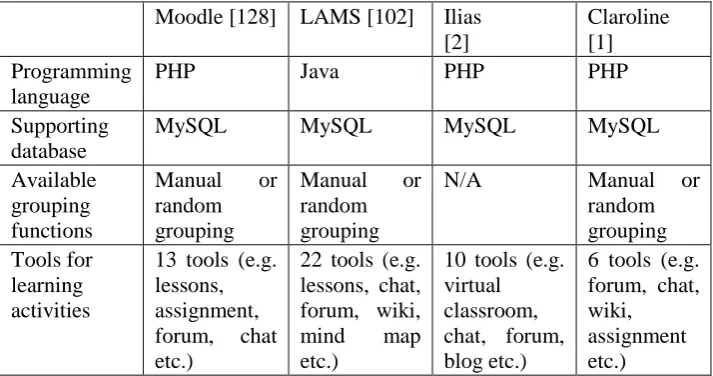
Moodle is a typical activity-based collaborative learning environment, which is suitable both for individual learning and collaborative learning. Moodle offers 13 different types of activities that a student can complete via interacting with other students and/or the teacher. Among these activities, there are five types of activities that are used to support group work: chats, forums, wikis, blogs and glossaries (i.e. lists of definitions that can be created and maintained collaboratively). Moodle also supports a range of resource types such as files, pages (in HTML format) and links (URLs) that a teacher can add to a course to support student learning. It possesses all the supporting functionalities that are needed for a CLE. Regarding the collaborative learning specific functionalities, Moodle provides a basic level of support for structuring and managing collaboration. These include manually created or randomly created groups, logs of student participations (―view‖, ―add‖, ―update‖ and ―delete‖) in any group activities and reports on the number of the hits on the group activities.
13 single activity or simply content. This is because LAMS has been developed in accordance with the Learning Design approach [36], which emphasises the capturing of the ―process‖ of education instead of simply content. It is different from the well developed approach for e-learning which is dedicated to the authoring of content-based, self-paced learning objects for individual learning. LAMS provides 22 various types of activities of which six are for the group activities: chats, web conferencing, forums, Google maps (to add students‘ own place markers and view others‘ markers), mind maps and wikis. LAMS also allows a teacher to add a number of resource types such as files, URL links and zipped websites into a sequence of learning activities. Similar to Moodle, LAMS incorporates all the required supporting functionalities for a CLE and some simple collaborative learning specific functionalities such as teacher or student selected groups and random-created groups, and logs of user access to the group activities (for example, viewing a forum or a thread).
14 the association of created groups with any group activities as Moodle and LAMS provide. Blackboard Learn can only create groups for certain activities which include discussion boards, email lists, file exchanges and online chats.
As can be seen from the above discussions, the existing collaborative learning environments provide a variety of supporting functionalities for online collaborative learning. Although they provide support for teachers to create collaborative groups, the methods adopted for constructing groups do not tailor to individual students‘ characteristics because students are usually assigned to groups manually by teachers or randomly by the systems. Moreover, most contemporary CLEs are capable of tracking the accesses and actions performed by users, which enable student interactions stemming from the collaborative activities examined to be captured. However, they do not provide support for teachers to check the progress of student collaboration and thus to assess the collaboration problems. To investigate these issues, the following sections present a discussion of the methods, tools, theories and practice for group formation, prior research which revealed the problems impeding group collaboration, and the methodologies for establishing the diagnostic methods.
2.2
Group Formation for Collaborative Group
Work
2.2.1
Methods & Tools for Group Formation
15 as addressed by Wessner and Pfister, is the process of identifying students who belong to one specific group [170]. In practice, the formation of learning groups is an educational instrument used by teachers to carry out their instructional design. Groups can be formed for different purposes. Student project groups for computer science courses are an example of task groups, which are formed to solve a specific problem. Student reading groups for language learning courses are an example of learning groups, which are formed mainly to enable learners to practice for a particular course assignment with no specific problem to solve (e.g. improving the speaking ability in English in front of other learners).
Group work in face-to-face setting and online setting each have their different features. Face-to-face group work has the advantage of verbal and non-verbal cues that can enrich the collaboration process while online group work is time independent and enables ‗many-to-many‘ interactive communication which can boost the quantity and quality of interaction between students. These different features allow groups to collaborate differently in the two settings. As revealed from Smith et al.‘s study [158], the most significant difference between
face-to-face groups and online groups was that online groups felt less able to resolve their logistical issues including scheduling, time allocation and other related issues compared to face-to-face groups. Another significant difference lied in the communication methods and tools. In online setting, text communication is mainly used whereas in face-to-face setting students can easily conduct visual communication (e.g. draw rough sketches or point to hardcopy images) besides verbal communication. However, in an exploratory study conducted by Warkentin
16 proportion of unique information items exchanged between the online and face-to-face groups. Smith et al. [158] further suggested that there were no significant difference in satisfaction with a participant‘s group between students worked in face-to-face groups and online groups. From the study conducted by Stein and Wanstreet [161], it was revealed that there were no significant difference in satisfaction with the overall course and course structure between collaborative groups in the two settings.
Groups can either be homogeneous or heterogeneous. Many advocates of collaborative learning strive for heterogeneous groups. One of the main reasons is that heterogeneity naturally produces controversy more frequently [59]. This is consistent with literature on constructive controversy [58] which believed it can bring in multiple perspectives and impact on the collective acquisition of knowledge and skill within teams. Another reason is that heterogeneous groups can demonstrate more creative behaviours than homogeneous groups [154].
17 other students with different strengths and backgrounds. Manually assigned groups can increase the likelihood of heterogeneous groupings, but this does not ensure that the groups work effectively together. Moreover, constraints such as large class size and time limitation may prohibit teachers from forming groups efficiently.
Compared with chosen grouping methods, computational random grouping methods increase the efficiency of the group formation process and the likelihood of heterogeneous groupings, but do not guarantee that students satisfy their individual needs. Chapman et al. suggest that self selected student groups tend to work better than those groups selected by random assignment [154]. Their study indicated that students in randomly assigned groups generally had more concerns about working in their groups, and had slightly less positive group attitudes and lower group outcome measures. These findings agree with the results of Mahenthiran and Rouse‘s study [123] which showed that random groups obtained lower group performance and satisfaction, and demonstrated smaller individual accountability than self selected groups. As discussed in the previous section, most contemporary collaborative learning environments such as LAMS [49] and Moodle [128] can provide a random grouping function for teachers to cope with group formation tasks.
18 on different student characteristics. A number of research studies indicated that learning styles could have a positive impact on the process of group formation for collaborative learning [7,74,139,155,165]. An extensive review of relevant literature in the impact of learning styles on group collaboration and tools that support group formation based on students‘ learning styles is provided in Section 2.2.3.
Next, a brief explanation of the learning style theories is presented.
2.2.2
Learning Style Theories
Different people prefer different ways of perceiving, taking in, processing and understanding information. These preferred ways of learning are known as
19 Although the definitions are rather complex, learning styles can be categorized as either constitutionally-based or contextually determined [46]. The constitutionally-based learning styles such as [66,150] are deep-seated, possibly biological. They are relatively fixed and not amenable to educational change [3]. The contextually determined learning styles such as [85] are learning preferences that may change from context to context [46]. There are other theorists who believe learning styles can operate across all activities and subject areas, for example, science, engineering or art [3]. Furthermore, it can be inferred from the various definitions of learning styles that the perceptions of learning styles overlap with some other concepts such as personality and cognitive styles. Nevertheless, they are not equivalent.
2.2.3
Impact of Learning Styles on Group Collaboration
An increasing number of studies have explored the relationships between psychological attributes of students and group collaboration development [165,168] [4,40,84], and many of these studies reveal that such attributes (including learning styles) affect how students engage with group collaboration. This could because, as Steiner suggested, psychological features of group members form one of the determinants of a group‘s potential productivity, which is ―the maximum level of productivity that can occur when an individual or group employs its resources to meet the task demands of a work situation‖ [162].
20 conducted a study which involved 73 undergraduate students in performing three online asynchronous discussion tasks for an educational psychology course, and this study indicated that personality influences group discussion tasks both quantitatively and qualitatively [40]. Ahn also identified strong associations between personality types and group collaboration experiences [4].
Learning styles form one of the important psychology features of students that affect the learning process. Several existing case studies have shown that taking account of learning styles positively influences the effective formation of groups [7,74,135,139,165], and indicated that collaborative groups with appropriate combinations of learning styles could perform better than other types of groups on the assigned group tasks.
21 An empirical study by Papanikolaou et al. investigated the impact of learning styles on group formation for collaborative concept mapping activities [74,139]. This study collected data from 21 undergraduate students who had constructed concept maps on the topic ―computer storage units‖. The students were assigned into seven groups (three students per group) that possessed various combinations of learning style type. The learning style types of the students were determined through their responses to the Honey and Mumford Learning Styles Questionnaire [85] and the Index of Learning Styles (ILS) questionnaire [62]. The group work was measured quantitatively according to two approaches for evaluating learning effectiveness of concept mapping tasks [92,163]. The findings suggested that the ideal group seemed to consist of students with a mixture of learning styles but without extreme difference (rather than students with a wide range of styles or students whose styles are similar).
22 level. This was viewed as one of the most important individual benefits by the students who took part in the focus group interviews for the study.
Furthermore, an empirical study by Taylor investigated the effects of learning styles on creating effective groups in project-based learning activities [165]. This study involved 75 students who participated in different types of groups: self-selected groups, similar learning style groups and diverse learning style groups. The learning styles of students were measured by the VARK learning style inventory [65]. The project outputs by different groups were graded by the teacher. The findings from the study indicate that diverse groups performed more effectively than the similar groups and the self-selected groups on the project output.
From the existing case studies, it is believed that learning styles are one of the important factors that affect group work. The tendency seems to be that mixed learning style groups without extreme differences work better than other types of groups. As can be inferred from Alfonseca et al.‘s study [7], the active/reflective
dimension is the most influential of the dimensions that impacts on group collaboration in the context of science and engineering education.
23 TOGETHER is a tool that can suggest a set of candidate grouping solutions for heterogeneous learning style groups in a visualized way, and allow a teacher to look for the best one through a trial-and-error process [140]. This tool applies an algorithm using heuristics to find an optimal solution for heterogeneous groups, and it requires the teacher to determine the appropriate solution based on his or her criteria. The teacher should try different criteria until he or she finds the best solution. It may be argued that TOGETHER does not provide an efficient way for building heterogeneous groups because the overall processes are rather complex and can be time-consuming for teachers to find a good enough solution. PEGASUS and TOGETHER are independent tools for supporting group formation. They do not suggest an approach from contemporary research that can automatically and efficiently form diverse learning style groups in web-based collaborative learning environments.
24
2.3
Review of Group Collaboration Problems
2.3.1
Technical Problems
Numerous studies including [42,44] have shown that collaborative group working is an important way to enhance the learning experience of students. This is because students can develop valuable skills in critical thinking and self-reflection and also develop strong team working abilities. Although empirical studies demonstrate the benefits that collaboration can bring for student learning (e.g. better learning outcomes), there are still many problems existing in group collaboration, which eventually affects the effectiveness of collaborative learning. These problems have been addressed by several studies including [6,8,80-82,93,100,118,127,142,143,151].
25 participating in online collaboration do not possess or have enough computer literacy [87].
Insufficient and ambiguous instructions were also identified as one of the problems that impede online group collaboration [8]. An et al. pointed out that poor instructions could cause students to misunderstand the assignment and to feel they had lost the direction needed to complete it [8]. The reason for poor instruction in online environments mainly lies in the fact that most instructors have little formal training in how to successfully create and manage interaction in online courses [35]. Students who participate in online group collaboration could also face the challenge presented by working in different time zones [8]. This is because it is often difficult to find a dedicated time for all the students in a group to have online meetings.
However, these non-student-induced problems are not the main factors affecting group collaboration. The existing studies reveal that the most serious problems that students and instructors face are induced by the students themselves, and suggest that the problems induced by students must be addressed in order for effective group collaboration [6,8,80,151]. The next subsection presents a review of the student-induced group collaboration problems in detail.
2.3.2
Student-induced Problems
26
Poor Motivation
In 2002 a national survey of educators in the US [20] ranked eighteen different factors by their level of impact on first-year students‘ academic performance, identifying ―lack of (student) motivation‖ as the number one factor.
Hiltz and Turoff suggest group learning activities that are well-suited for online learning environments include online seminars (individual groups lead a discussion on a topic), collaborative exams (students construct exam questions and answer each other‘s questions), group projects (for example, collaborative composition of essays), case study discussions and debates [83]. Online discussion is a common and important component of the group learning activities. Al-Shalchi reported that students can behave problematically in such discussions, indicating that they possess poor motivation for the learning activities [6]. Al-Shalchi noted that some students may not participate in a discussion at all and others may take part but give short and superficial responses rather than deep reflective ones. Hassanien also pointed out that poor communication and poor attendance at group meetings are the main challenges that students face [80].
27
Lack of Individual Accountability
An, Kim and Kim conducted an empirical study [8] on a sample size of 24 students enrolled in an instructional technology course. The participants formed small groups and were required to complete a four-week online group project. They were asked to comment on the problems they had faced completing the group project, and the most common problem was ―lack of individual accountability‖. Several subcategories of this problem were addressed by the participants, including not meeting the deadlines, not completing assigned work, and lack of participation (e.g. not engaging with the online discussions).
Herrick et al., based on their teaching experience of an asynchronous online class, noted that students tended to wait until the group work deadline to make postings on the group forums [81]. In the study of Gilbert et al. [71], students worked in pairs to conduct online discussion activities for supporting the topic of the week‘s readings. This study addressed the same impediment as what Herrick et al. noted, ―Students would often only contribute to the discussion on the last day rather than consistently engaging in discourse over the entire discussion period.‖
Negative Interdependence
28 consequently decrease the group‘s ability to reach its full potential. Prior research including [93,118,143] also addressed the same impediment.
This negative interdependence among group members typically results in oppositional interaction (individuals obstructing each other‘s efforts to achieve), whereas positive interdependence can encourage members‘ efforts to help the group reach its goals [89]. Khandaker and Soh pointed out that the free-riding phenomenon could discourage student collaboration and student learning [93]. Johnson and Johnson further suggest that there are several ways that group members can promote each other‘s success, including giving and receiving feedback, challenging each other‘s reasoning, and exchanging resources and information [89].
As can be seen from this point, there are several problem scenarios existing which can reveal the same category of group collaboration problem. The analysis of the problem scenarios corresponding to each major category of group collaboration problems is described in detail in Chapter 5. Current literature indicates that student induced group collaboration problems are the most serious; however, it does not systematically address the main problems and provide insightful views on the factors that may lead to such problems.
2.4
Group Collaboration Problem Diagnosis
2.4.1
Interaction Analysis
29 analysis of these problems. To address the required methods, research in the interaction analysis field [55,105,145] suggested the types of data that indicate the existence of various collaboration problems and the methods to obtain these data from the learning systems or environments. This field has made great strides in research that focuses on the extent of student participation in the learning process examined [21,52]. The aspects of analysis in the field of interaction analysis include the quantity and quality of student interactions with the system for performing the collaborative activities [77]. The former aspect derives activity information about student interactions with the system [32], for example, the number of accesses to the group workspace in the system by individual students. The latter aspect relates to the identification of the categories of contributions by individual students and groups in conversation-based collaboration. For example, Barros and Felisa Verdejo defined six types of contributions — proposal, contra-proposal, comment, clarification, question and agree — for analysing student contributions in a conversation-based collaborative task [21].
30 in interaction analysis for collaborative activities. A detailed description of the indicators is provided in Section 6.2.2 (―indicators of collaboration problem existence‖).
The collaborative learning systems which support interaction analysis usually allow records of user accesses and actions performed when they are tackling the group tasks. Examples of these systems include the TrAVis system [125], the DIAS system [33] and the DEGREE system [21]. The information automatically recorded by such systems is generally comprised of the following types: the user identification, the session information, and the activity information (for example, the time and date, and who has viewed the group forum). All the information is usually stored in a relational database, and can be retrieved for producing the indicators that represent student interactions with the system through different queries combining a variety of selection criteria. Typical collaborative learning environments such as Moodle [128] adopt similar methods to capture and extract student interaction data.
31 for conversation-based collaboration and thus to measure contributions by individual students and groups. In this thesis, diagnosing one of the major collaboration problems that were identified requires identifying the messages types for the posts created by students in group discussion forums. Thus, a content analysis technique is required, which should be capable of classifying the messages automatically. A possible technique that can be applied for identifying message types by the proposed diagnosing approach is presented in detail in Section 6.3.
In summary, the types of data that indicate the existence of the collaboration problems identified and the general methods to obtain the data from learning systems are addressed by contemporary research in the interaction analysis field. However, no research has addressed the issue of how to determine the existence of various collaboration problems identified based on the student interaction data. Therefore, one of the objectives of this doctoral study is to address various methods for diagnosing the problems for a piece of group work. Chapter 6 will present details of the proposed diagnostic approach, and determine some of the collaboration problems needed to quantitatively define the relationships between the existence of the collaboration problems and various types of student interaction data that indicate the problems. Predictive modelling offers such a methodology that can deal with this issue. Next, a brief description of the predictive modelling methodology and related work is provided.
2.4.2
Predictive Modelling
32 occurrences of such an event (i.e. the predictors or independent variables). The produced predictive models can then be used to compute values of a response variable for a given set of predictors. The procedure of predictive modelling involves building a data set, which collects empirical data about the response variable and the potential predictors. Then statistical analysis techniques can be applied for estimating and validating the predictive models using the constructed data set.
The methodology of predictive modelling has been widely applied in different fields. In higher education, predictive modelling has been used in a number of areas including but not limited to enrolment management, retention and graduation analysis, and donation prediction [27,103]. In these areas, the majority of time spent on a modelling project is establishing the dataset to be used, and it usually requires at least one year of historical data for building such a dataset.
33 was used to investigate the relationship between the discussions categorised as ―social talk‖ and ―group-task-related dialogue‖ and the group learning outcome.
A wide variety of statistical analysis techniques are available for the predictive modelling including regression analysis [43], time series models [76] and survival analysis [95]. Regression analysis focuses on the relationship between a response variable (also known as the dependent variable) and one or more predictors (i.e. the independent variables) [43]. It was used for the predictive modelling process conducted in this thesis (Section 6.2.3) for the following reasons. First, regression analysis is applicable for the required predictive modelling task while some other statistical analysis techniques are not. The data needed for the predictive modelling task was collected at one time rather than taken over a period of time so that techniques such as time series models and survival analysis are not suitable for the modelling task. Second, regression analysis is conceptually simple but effective for the predictive modelling process while other sophisticated modelling techniques such as neural networks are surplus to requirements. Finally, there is a range of regression models available for fitting the collected data, which allows alternative ways to be adopted if a particular regression analysis technique does not work.
2.5
Summary
34 learning styles can have a positive impact on the process of group formation for collaborative group work, but it does not suggest an automated approach that can efficiently construct diverse learning style groups in web-based collaborative learning environments; (ii) there are a variety of group collaboration problems and existing studies indicate that the most serious problems are caused by students themselves, however, a systematical description of the major group collaboration problems and their causes from the perspectives of students is lacking; and (iii) diagnosing the group collaboration problems requires different methods for ascertaining the existence of these problems, however, no research has addressed an automated approach that can diagnose these identified types of group collaboration problems in a collaborative learning environment.
35
Chapter 3
An Approach for Group Formation
based on Learning Styles
36
3.1
Overview
From the review of existing case studies (as discussed in Section 2.2.3, i.e. ―impact of learning styles on group collaboration‖), mixed learning style groups tend to obtain better learning outcomes than other types of groups. Hence, the aim of this chapter is to propose a solution for group formation in a CLE which is able to formulate diverse learning style groups.
For achieving the aim of this chapter, the proposed grouping approach should address the following research questions. First, the approach should address the question of how to model students‘ learning styles. By the notion of ‗model‘, the process of acquiring learning style scores from individual students is referred to. Second, it needs to identify other elements besides learning styles that should be considered for the problem of group formation together with a method to define them. Furthermore, the approach should include a method to create diverse groups of students based on their learning style scores and the identified elements that affect the group formation.
Considering these research questions, the proposed iGLS approach is composed of the following components:
a learning styles modelling component;
a grouping parameter identification component; and
a grouping algorithm.
37
identification component attempts to determine the method for defining the values of parameters to be used in the process of group formation. The grouping algorithm is the method for assigning students into heterogeneous learning style groups (i.e. students with different levels of learning style).
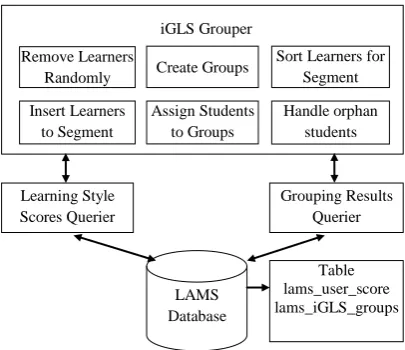
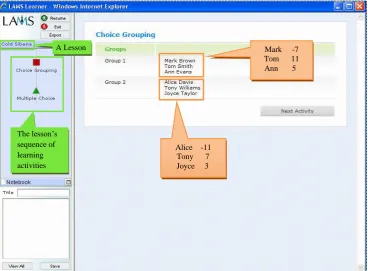
The overall process of applying iGLS for completing a group formation task is illustrated in Figure 3.1. This process includes extracting students‘ learning style scores through the learning styles modelling component, defining the values of the parameters via the grouping parameter identification component and subsequently assigning students into diverse learning style groups by the grouping algorithm. The grouping algorithm can take the students‘ learning style scores and the grouping parameters as input and generate the desired grouping results.
Figure 3.1. The overall process of iGLS
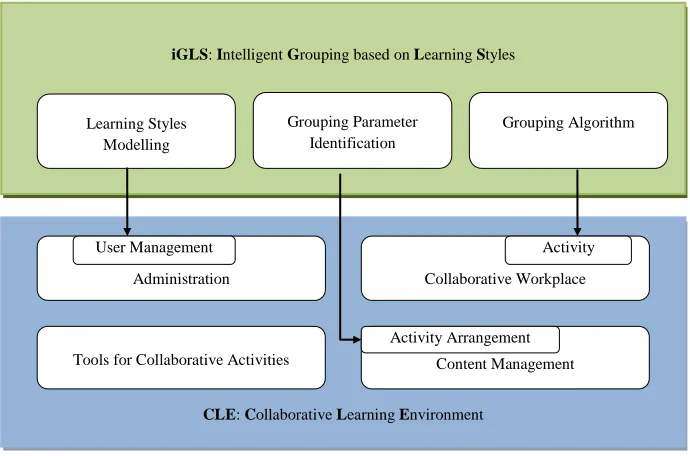
As the group collaboration process is assumed to be carried out with a CLE, the components of the iGLS approach are desired to fit into current CLEs. Before describing how the components of iGLS fit a CLE, the modules that constitute current CLEs for supporting teaching and learning activities are discussed below.
Learning Styles Modelling Grouping Parameter Identification
Grouping Algorithm
Grouping Results (Collaborative groups) Learning style
scores
38 As mentioned in Section 2.1, the functionalities that a CLE provide are diverse, and can vary from educational administration to content management. The CLE block as shown in Figure 3.2 illustrates the functionalities that current CLEs (e.g. Moodle [128], LAMS [102] and Blackboard [26]) provide. These include administration, collaborative workplace, tools for collaborative activities and content management.
Figure 3.2. iGLS and collaborative learning environment
Each of the mentioned functionalities is supported by several modules of a CLE, which are described as follows:
Administration:
- user management
- course management
- system settings
Administration
Tools for Collaborative Activities
Collaborative Workplace
Content Management Learning Styles
Modelling
Grouping Parameter Identification
Grouping Algorithm
CLE: Collaborative Learning Environment
iGLS: Intelligent Grouping based on Learning Styles
Activity Arrangement
39
Collaborative workplace:
- activity performing
Tools for collaborative activities:
- tools for learning activities such as chats, forums, and bulletinboards
- tools for assessment activities such as questions, submit files, and multiple choices
Content management:
- learning resources management
- collaborative activity arrangement
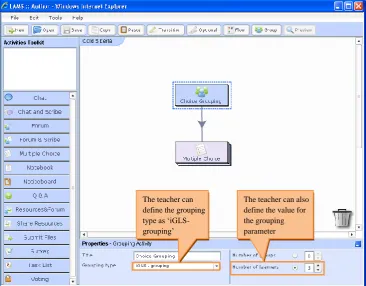
Figure 3.2 also illustrates how the three components of iGLS (the iGLS block) fit into a CLE for the process of group formation. The learning styles modelling component can be built on top of the user management module which supports the administration functionality of the underlying collaborative learning environment. The grouping parameter identification component can be integrated in the activity arrangement module which underpins the content management
functionality of the CLE. Moreover, the grouping algorithm component can be incorporated into the activity module that supports the functionality of
collaborative workplace. Details of the interactions between the iGLS components and a CLE are discussed later in Section 3.5.3.
40 how it is applied in the learning styles modelling component. Section 3.3 identifies other elements that should be considered for the process of group formation and how the parameters representing these elements can be determined in the component for grouping parameter identification. Following that, the details of the proposed grouping algorithm are presented in Section 3.4. Furthermore, Section 3.5 discusses how the iGLS add-on for LAMS was created including a brief description of the LAMS system, the architecture of the iGLS add-on, the essential implementation issues that were decided and a concise description of the components of the developed add-on. Subsequently, a real world scenario in which the developed iGLS add-on is used for supporting the process of group formation in a LAMS system is described in Section 3.6. Finally, Section 3.7 presents a summary of this chapter.
3.2
Learning Styles Modelling
41
Felder-Silverman Learning Style Model (FSLSM)
FSLSM was initially proposed by Felder and Silverman in 1988 based on their expertise in educational psychology and experience in engineering education. The original model contained five dimensions of learning styles. Recently, this model has been modified. The current FSLSM include four dimensions of learning styles: sensing/intuitive, visual/verbal, active/reflective, and sequential/global. The review of the impact of learning styles on group collaboration (in Section 2.2.3) revealed that the active and reflective are the most influential learning styles that impact on group work [7,60,61]. Therefore, the proposed learning styles modelling component attempts to incorporate the active/reflective dimension of the FSLSM model for describing students‘ learning styles.
The ‗active/reflective‘ dimension of FSLSM describes the way people convert perceived information into knowledge. Active learners prefer to learn by doing something with the information — discussing, or explaining it to others. Reflective learners prefer to review the information introspectively. More information about this dimension can be referred to [61].
42 Figure 3.3. The active/reflective dimension of the FSLSM model
Using a scale between -11 and 11, strong and weak preferences of learning styles on a single dimension of FSLSM can be measured. If the score is valued between -3 and 3, a well balanced preference on the two styles of a dimension is indicated. If the score is valued in {-7, -5, 5, 7}, a moderate preference on the two styles of this dimension is revealed. Moreover, if the score is valued in {-11, -9, 9, 11}, a strong preference on the two styles of this dimension is shown.
There are several reasons for adopting the FSLSM model. First, FSLSM includes a dimension for identifying the active/reflective learning styles while most other learning style models do not. Second, compared with other models that contain active/reflective learning styles, FSLSM provides a sliding scale supporting a richer classification of students‘ styles which is more flexible than bipolar models for the balancing of learning styles in the iGLS approach. Third, FSLSM adopts the Index of Learning Styles (ILS) questionnaire [62] for measuring the described learning styles and the ILS questionnaire is shorter than the instruments used by most other models that contain the active/reflective styles such as [85] and [96]. The ILS questionnaire contains only 44 questions for measuring four pairs of learning styles while the instruments for most other models require more than 20 questions for identifying one pair of learning styles. Since students are more likely to respond to a shorter questionnaire, the ILS questionnaire is more acceptable by most students. Finally, FSLSM has become popular in technology-enhanced
-11 -9 -7 -5 -3 -1 1 3 5 7 9 11
43 learning. Some researchers even argue that FSLSM is the most suitable learning styles model in technology-enhanced learning [41,98].
A Questionnaire-based Approach for Learning Styles Modelling
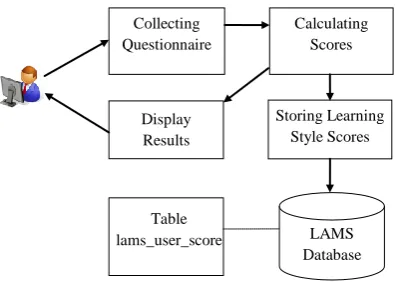
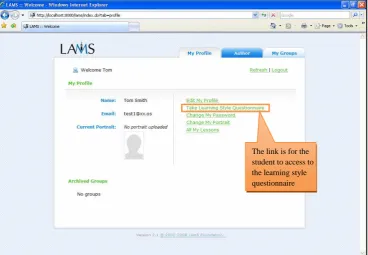
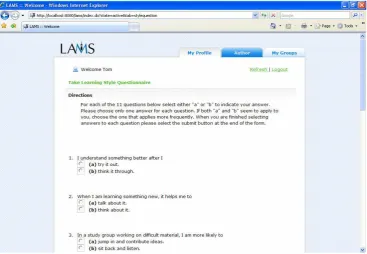
As mentioned above, a questionnaire, namely ILS, is proposed by [62] to measure the learning styles categorized in the FSLSM model. The ILS questionnaire is adopted by the learning styles modelling component to acquire learning style scores from individual students. This is because a questionnaire-based approach for modelling students‘ learning styles is efficient and flexible and most current learning styles models adopt a questionnaire-based approach to measure students‘ learning styles. Moreover, the ILS questionnaire has been examined to be reliable and valid for assessing the learning styles categorized in the FSLSM model [63,108].