Biochemistry 3G03 Test 3 October 28, 2013
Note: Please check your examination booklet to ensure all pages are there. There are 27 questions and 7 pages. Please mark your answers clearly on the examination answer sheet. You can keep the examination booklet. There are several different versions of this test, therefore it's important that you mark your version on the CLASSROOM ANSWER SHEET (scantron) according to question 1 & 2.
Please also mark your seat number on the scantron in the space for RECORD (SEAT) NUMBER according to the following table.
Failure to indicate your version number or seat number may result in 5% penalty.
Table for conversion of ROW number:
A 01 F 06 K 11 P 16 U 21 Z 26 B 02 G 07 L 12 Q 17 V 22
C 03 H 08 M 13 R 18 W 23 D 04 I 09 N 14 S 19 X 24 E 05 J 10 O 15 T 20 Y 25
First two numbers in RECORD (SEAT) NUMBER are used for letter (row) and the following three numbers are for the seat number. For example: w020 is 23020.
________________________________________________________________________________________________________________
1. Please mark question 1 c 2. Please mark question 2 a
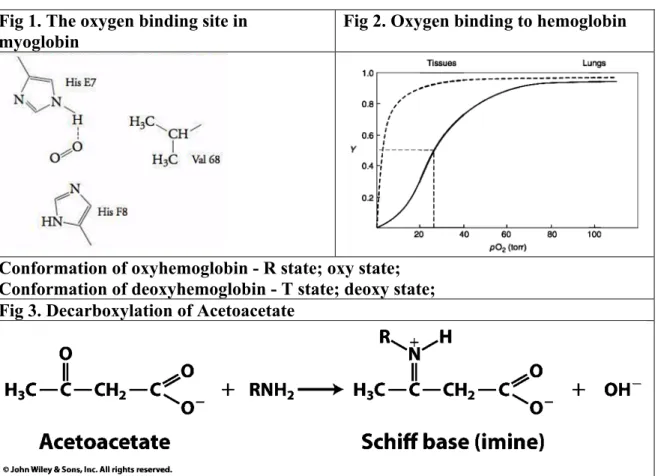
3. When oxygen is bound to the heme group of myoglobin, it is coordinated between _____ and _____.
a) E7 His; Fe2+ of heme b) E7 His; Fe3+ of heme c) none of the rest d) F8 His; Fe2+ of heme e) F8 His; Fe3+ of heme
4. During the initial synthesis of collagen molecules, _____ and _____ are most often incorporated into the growing protein.
a) Ser; Pro b) Ala; Gly c) Pro; Ala d) Ser; Gly e) Gly; Pro
5. Which of the following fibers is correctly paired with the protein that forms the fiber?
a) microfilaments: actin
b) extracellular support fibers: collagen c) intermediate filaments: keratin d) microtubule: tubulin
e) all of the rest
6. What amino acid performs the nucleophilic attack during the chymotrypsin mechanism?
a) Lys b) Ser c) His d) Asp e) Thr
7. How does a catalyst affect the overall delta-G of an endergonic reaction?
a) the reaction becomes exergonic b) it has no effect
c) none of the rest
d) the reaction becomes more endergonic e) the reaction has a delta-G of zero
8. Which allosteric effector has the greatest ability to stabilize the deoxy state of hemoglobin?
a) H+
b) BPG c) O2 d) CO2
e) all of the rest have equal ability
9. The idea that binding of one molecule of oxygen to hemoglobin enhances further binding of oxygen to hemoglobin is called _____.
a) allosterism b) none of the rest c) cooperativity d) fractional saturation e) homologous binding
10. The isoelectric point of the peptide RTRADAE is?
a) 3.00 b) 6.53 c) 3.98 d) 10.74 e) 10.21
11. With respect to oxygen saturation, hemoglobin is _____ saturated at the pO2 of the lungs and _____
saturated at the pO2 of the tissue a) 20%; 20%
b) 50%; 20%
c) >90%; between 30 and 70%
d) 50%; between 30 and 70%
e) 25%; 20%
12. What three amino acids are found in the catalytic triad of chymotrypsin?
a) Cys, Lys, Glu b) Glu, His, Thr c) Asp, His, Ser d) Asn, His, Thr e) Ser, Arg, Cys
13. How does CO2 affect hemoglobin-oxygen binding?
a) CO2 binds directly to the oxygen binding site, displacing oxygen and thus promoting the deoxy state b) CO2 displaces BPG, thus promoting the oxy state
c) none of the rest
d) CO2 is converted to bicarbonate and H+ which promotes the oxy state e) CO2 is converted to bicarbonate and H+ which promotes the deoxy state
14. Which of the following occurs in hemoglobin upon oxygen binding?
a) hemoglobin changes from the R state to the T state
b) the heme Fe2+ is pulled out of the plane of the heme group
c) the His coordinated to the heme Fe2+ is pushed away from the heme group d) the central cavity between the four subunits is decreased in size
e) all of the rest occur
15. A plot of the binding of oxygen to myoglobin as a function of pO2 gives a _____ shape; a similar plot for hemoglobin gives a _____ shape.
a) sigmoidal; hyperbolic b) hyperbolic; hyperbolic c) hyperbolic; exponential d) sigmoidal; sigmoidal e) hyperbolic; sigmoidal
16. Why is the decreased affinity of fetal hemoglobin for BPG advantageous to the fetus?
a) More free BPG is available to bind to adult hemoglobin, resulting in a shift of adult hemoglobin to the R state
b) It reduces fetal hemoglobin's P50
c) With fewer BPG molecules bound there are more heme residues available for O2 binding d) Decreased BPG binding biases the fetal hemoglobin toward the T state
e) BPG is available to bind to fetal myoglobin, helping to release O2 in fetal muscle tissue
17. In the chymotrypsin mechanism, what is used to stabilize the negative charge on the carbonyl oxygen of the transition state?
a) electrostatic interaction of the positively charged His and carbonyl oxygen b) all of the rest
c) electrostatic interaction of the active site Zn2+ and carbonyl oxygen d) electrostatic interaction of the negatively charged Asp and carbonyl oxygen e) hydrogen bonding between the enzyme and the anion from the carbonyl oxygen
18. In the enzyme catalyzed decarboxylation of acetoacetate, a Schiff base is formed between the ketone of acetoacetate and a _____ residue in the active site of the enzyme.
a) Arg b) Asn c) Ser d) Lys e) Glu
19. Which of the following statements does not apply to collagen?
a) One single polypeptide forms a left-handed helix.
b) It contains hydroxylated amino acids.
c) Glycine at every third position is essential for the stability of the triple helical structure.
e) The triple helical structure twists in the right-handed direction.
20. Hemoglobin is 50% saturated with oxygen when pO2 = 26 torr. If hemoglobin exhibited hyperbolic binding (as myoglobin does) with 50% saturation at 26 torr. Which of the following statements is correct?
(pO2 =100 in the lungs and pO2 = 30 in the tissues; fractional saturation YO2 = pO2 / {K + pO2} and K=p50=pO2 when YO2=0.5)
a) The fractional saturation when pO2 = 100 torr is 0.59 b) None of the rest
c) The fractional saturation when pO2 = 30 torr is 0.24 d) Hemoglobin is fully oxidized in the tissues
e) Hemoglobin can only use approximately 1/4 of its capacity to deliver O2 to the tissues
21. EcoRI recognizes the sequence 5'-G|AATTC-3' ("|" indicates the point of cleavage). Treatment of the following oligonucleotide with EcoRI would produce two oligonucleotides with sizes of _____ double- stranded nucleotides containing _____ ends.
5'-GAAGTCGATACAGAATTCGTACCTAGC-3' a) 13 and 10; sticky
b) 11 and 8; sticky c) 12 and 13; blunt d) 12 and 9; sticky e) 12 and 8; blunt
22. Of all the species that enzymes bind, they are thought to bind most tightly to _____.
a) substrates b) products c) transition states
d) all are bound very tightly e) intermediates
23. Which of the following is an example of a conservative amino acid substitution?
a) Asp -> Gln b) Ile -> Leu c) Arg -> Cys d) Phe -> Tyr e) Ser -> Glu
24. Which of the following explains the conversion of hemoglobin subunits from deoxy to oxy state?
a) each subunit switches only upon oxygen binding to the particular subunit b) both beta subunits simultaneously switch first followed by both alpha subunits c) all four subunits switch simultaneously
d) both alpha subunits simultaneously switch first followed by both beta subunits e) none of the rest
25. In an enzyme mechanism that generates a negative charge in the transition state, which of the following would be most effective to have in the active site of the enzyme?
a) transition metal anion b) transition metal cation c) none of the rest d) Asp residue e) Gln residue
26. Which protein in the blood is responsible for converting fibrinogen to fibrin?
a) factor VIIa b) factor X c) thrombin d) factor VII e) prothrombin
27. Zymogens are not enzymatically active because _____.
a) the pH of their environment is not optimal for activity
b) their active sites are distorted and incapable of enzymatic activity c) none of the rest
d) they do not contain the cofactors required for catalysis e) they are the product of mutated genes
THE END of QUESTIONS