warwick.ac.uk/lib-publications
A Thesis Submitted for the Degree of PhD at the University of Warwick
Permanent WRAP URL:
http://wrap.warwick.ac.uk/95171
Copyright and reuse:
This thesis is made available online and is protected by original copyright.
Please scroll down to view the document itself.
Please refer to the repository record for this item for information to help you to cite it.
Our policy information is available from the repository home page.
M A
E
G
NS I
T A T MOLEM
U N
IV
ER
SITAS WARWICEN
SIS
Maximal subgroups of classical groups in
dimensions 16 and 17
by
Daniel Rogers
Thesis
Submitted to the University of Warwick
for the degree of
Doctor of Philosophy
Department of Mathematics
Contents
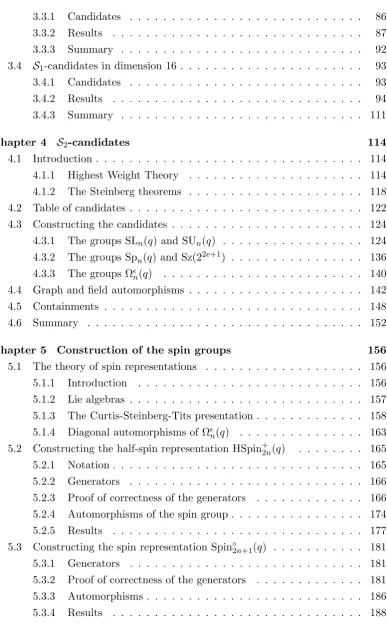
List of Tables v
Acknowledgments vi
Declarations viii
Abstract ix
Chapter 1 Background 1
1.1 Introduction . . . 1
1.2 Notation . . . 3
1.3 First definitions and motivation . . . 3
1.4 Simple groups . . . 4
1.4.1 Quasisimple groups and the Schur multiplier . . . 6
1.4.2 Almost simple groups . . . 7
1.4.3 Isoclinism . . . 7
1.5 Finite fields . . . 8
1.6 Classical groups . . . 10
1.6.1 Direct and anti-direct products . . . 10
1.6.2 Forms . . . 11
1.6.3 Extensions of classical groups . . . 13
1.6.4 Linear groups . . . 14
1.6.5 Unitary groups . . . 15
1.6.6 Symplectic groups . . . 16
1.6.7 Orthogonal groups . . . 18
1.7 Representation theory . . . 25
1.7.1 Representations . . . 25
1.7.2 Representations preserving forms . . . 27
1.7.4 Other results . . . 30
1.8 Tensor products . . . 30
1.8.1 Definitions . . . 30
1.8.2 Symmetric powers . . . 31
1.9 Number Theory . . . 32
1.9.1 Legendre symbols . . . 32
1.9.2 Algebraic irrationalities . . . 33
1.9.3 The M¨obius function . . . 36
1.10 Aschbacher’s Theorem . . . 37
1.10.1 ClassC1 . . . 38
1.10.2 ClassC2 . . . 39
1.10.3 ClassC3 . . . 39
1.10.4 ClassC4 . . . 40
1.10.5 ClassC5 . . . 41
1.10.6 ClassC6 . . . 41
1.10.7 ClassC7 . . . 42
1.10.8 ClassC8 . . . 43
1.10.9 ClassS . . . 43
1.11 Maximal subgroups of almost simple groups and novelties . . . 45
Chapter 2 Determinants and spinor norms of permutation matrices 47 2.1 Introduction . . . 47
2.2 Determinants of permutation matrices . . . 48
2.3 Spinor norms of permutation matrices in odd characteristic . . . 50
2.3.1 General theory and preliminary results . . . 51
2.3.2 Spinor norms when dis odd . . . 56
2.3.3 Spinor norms when dis even . . . 56
2.4 Quasideterminants of permutation matrices in even characteristic . . 68
2.5 Applications . . . 70
Chapter 3 S1-candidates 72 3.1 Introduction . . . 72
3.2 The theory ofS1-candidates . . . 72
3.2.1 Candidates . . . 72
3.2.2 Forms and fields . . . 74
3.2.3 Actions of automorphisms of the classical group . . . 75
3.2.4 Containments . . . 85
3.3.1 Candidates . . . 86
3.3.2 Results . . . 87
3.3.3 Summary . . . 92
3.4 S1-candidates in dimension 16 . . . 93
3.4.1 Candidates . . . 93
3.4.2 Results . . . 94
3.4.3 Summary . . . 111
Chapter 4 S2-candidates 114 4.1 Introduction . . . 114
4.1.1 Highest Weight Theory . . . 114
4.1.2 The Steinberg theorems . . . 118
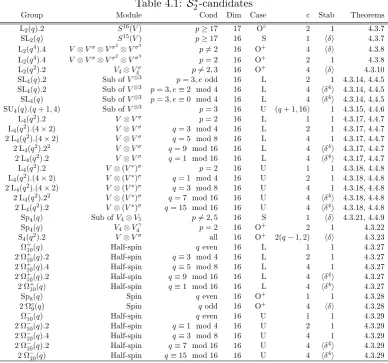
4.2 Table of candidates . . . 122
4.3 Constructing the candidates . . . 124
4.3.1 The groups SLn(q) and SUn(q) . . . 124
4.3.2 The groups Spn(q) and Sz(22e+1) . . . 136
4.3.3 The groups Ωn(q) . . . 140
4.4 Graph and field automorphisms . . . 142
4.5 Containments . . . 148
4.6 Summary . . . 152
Chapter 5 Construction of the spin groups 156 5.1 The theory of spin representations . . . 156
5.1.1 Introduction . . . 156
5.1.2 Lie algebras . . . 157
5.1.3 The Curtis-Steinberg-Tits presentation . . . 158
5.1.4 Diagonal automorphisms of Ω n(q) . . . 163
5.2 Constructing the half-spin representation HSpin+2n(q) . . . 165
5.2.1 Notation . . . 165
5.2.2 Generators . . . 166
5.2.3 Proof of correctness of the generators . . . 166
5.2.4 Automorphisms of the spin group . . . 174
5.2.5 Results . . . 177
5.3 Constructing the spin representation Spin◦2n+1(q) . . . 181
5.3.1 Generators . . . 181
5.3.2 Proof of correctness of the generators . . . 181
5.3.3 Automorphisms . . . 186
[image:5.595.131.519.99.731.2]5.4 Constructing the half-spin representation HSpin−2n(q) . . . 189
5.4.1 Generators . . . 189
5.4.2 Proof of correctness of the generators . . . 190
5.4.3 Automorphisms . . . 194
5.4.4 Results . . . 199
5.5 2−generating sets . . . 203
5.5.1 HSpin+2n(q) . . . 204
5.5.2 Spin◦2n+1(q) . . . 205
5.5.3 HSpin−2n(q) . . . 208
5.6 Computations . . . 208
Chapter 6 Containments 212 6.1 Introductory notes . . . 212
6.2 Containments in ClassS . . . 213
6.2.1 SL16(q) . . . 213
6.2.2 SU16(q) . . . 213
6.2.3 Sp16(q) . . . 215
6.2.4 Ω+16(q) . . . 216
6.2.5 Ω◦17(q) . . . 218
6.3 Containments between S∗ and geometric type subgroups . . . 219
6.3.1 Preliminary results . . . 219
6.3.2 SL16(q) . . . 223
6.3.3 SU16(q) . . . 225
6.3.4 Sp16(q) . . . 226
6.3.5 Ω+16(q) . . . 227
6.3.6 Ω−16(q) . . . 230
6.3.7 Ω◦17(q) . . . 230
Chapter 7 Results 233 7.1 SL16(q) . . . 234
7.2 SU16(q) . . . 236
7.3 Sp16(q) . . . 238
7.4 Ω+16(q) . . . 240
7.5 Ω−16(q) . . . 242
7.6 SL17(q) . . . 244
7.7 SU17(q) . . . 245
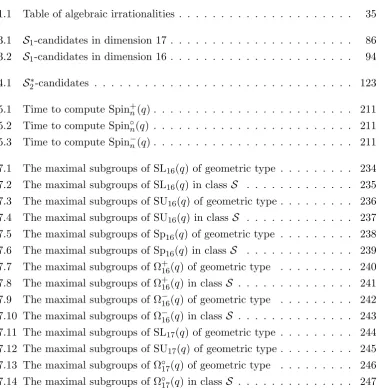
List of Tables
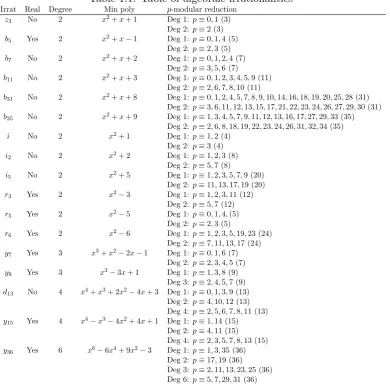
1.1 Table of algebraic irrationalities . . . 35
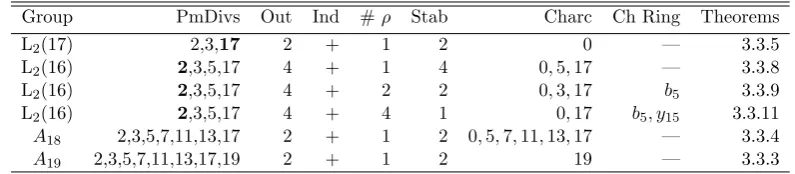
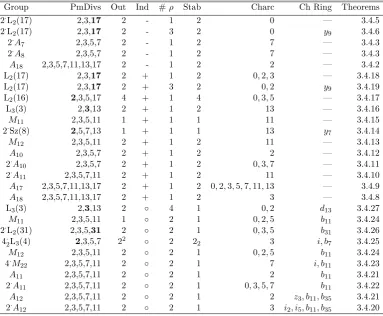
3.1 S1-candidates in dimension 17 . . . 86
3.2 S1-candidates in dimension 16 . . . 94
4.1 S∗ 2-candidates . . . 123
5.1 Time to compute Spin+n(q) . . . 211
5.2 Time to compute Spin◦n(q) . . . 211
5.3 Time to compute Spin−n(q) . . . 211
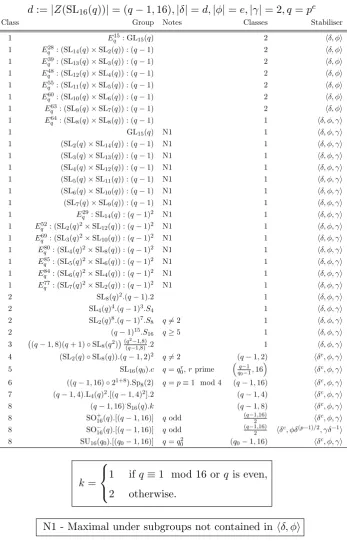
7.1 The maximal subgroups of SL16(q) of geometric type . . . 234
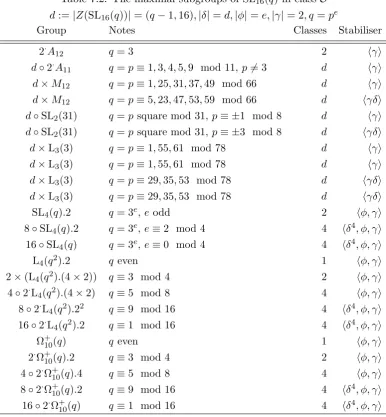
7.2 The maximal subgroups of SL16(q) in class S . . . 235
7.3 The maximal subgroups of SU16(q) of geometric type . . . 236
7.4 The maximal subgroups of SU16(q) in class S . . . 237
7.5 The maximal subgroups of Sp16(q) of geometric type . . . 238
7.6 The maximal subgroups of Sp16(q) in class S . . . 239
7.7 The maximal subgroups of Ω+16(q) of geometric type . . . 240
7.8 The maximal subgroups of Ω+16(q) in classS . . . 241
7.9 The maximal subgroups of Ω−16(q) of geometric type . . . 242
7.10 The maximal subgroups of Ω−16(q) in classS . . . 243
7.11 The maximal subgroups of SL17(q) of geometric type . . . 244
7.12 The maximal subgroups of SU17(q) of geometric type . . . 245
7.13 The maximal subgroups of Ω◦17(q) of geometric type . . . 246
[image:7.595.141.521.254.644.2]Acknowledgments
First and foremost, I would like to thank my supervisor Professor Derek Holt
for his guidance and support throughout my studies. This thesis would not have
been possible without his expert guidance, diligent proofreading and generosity of
time throughout, as well as his patience and persistence in helping me to grow as
a mathematician. I am also immensely grateful to Professor Don Taylor for his
invaluable suggestions whch formed the basis of my approach in Chapter 5. I am
also grateful to the many people with whom I have discussed the ideas and problems
within this thesis; particular thanks to Gareth Tracey for many useful conversations
and comments on my work. My thanks also to EPSRC for funding my studies.
I have been very fortunate during my time at Warwick to work in a friendly
and supportive environment. I am grateful for all those I have interacted with,
be they students, academic or non-academic staff. My particular thanks go to
Alex Bartel, Mark Bell, Chris Birkbeck, Florian Bouyer, Mark Cummings,
Rhian-non Dougall, Carole Fisher, George Kenison, Ronja Kuhne, Nicolas Mascot, Dave
McCormick, Vandita Patel, Ben Pooley, Matthew Spencer, Alex Torzewski, Katie
Vokes and Alex Wendland; my thanks and apologies also go to those who should
also be on that list whom I have inadvertently forgotten.
My thanks also go to my friends Emma, Steve, Chaoyi, Sarah, Dave, Andrew,
Lynn, Owen, Geraint and Barney. I value and appreciate the friendship I have with
each of you, the support I have received from each of you throughout my PhD,
and the numerous evenings and weekends spent talking, relaxing and playing board
games.
a pleasure and a joy to be welcomed into such a friendly and loving community.
Particular thanks go to my small group, with whom I shared my highs, my lows and
my favourite motorway service stations.
Last but by no means least, my thanks to my family for their love and
support, and especially to my parents for the innumerable ways they have supported
Declarations
This thesis is submitted to the University of Warwick in support of my
ap-plication for the degree of Doctor of Philosophy. It has been composed by myself
and has not been submitted in any previous application for any degree.
The work presented was carried out by the author, unless otherwise
Abstract
Aschbacher’s Theorem [1] subdivides maximal subgroups of the classical
groups and their almost simple extensions into nine classes, denotedC1, . . . ,C9. The
first eight of these classes contain the so-called ‘geometric-type’ subgroups.
Mem-bers of these classes have been classified fully for classical groups in dimensions 13
and higher in [33], and in the low-dimensional case in [8]. ClassC9, orS, consists of
groups which are almost simple modulo their centre. There is currently no
descrip-tion of all members of this class in all dimensions. In [8], the authors describe all
members of class S in dimensions up to 12, and in [48] the author describes these
in dimensions 13−15. In this thesis, we will extend these results to determine the
members of class S in dimensions 16 and 17 (and thus all maximal subgroups of
classical groups in these dimensions) except in the case of the orthogonal groups
where some results are conjectured.
Chapter 1 provides background information, including the subdivision of
classS into subclassesS1 andS2. Chapters 3 and 4 describe the members ofS1 and
S2respectively for 16- and 17-dimensional classical groups, and Chapter 6 describes
containments between these classes. The list of maximal subgroups is summarised
in Chapter 7.
We also provide some general results which can be applied to members of
class S in classical groups of other dimensions. Chapter 2 discusses results which
can be applied to a class of S2-candidate subgroups whose field automorphism is
induced by a permutation matrix. In Chapter 5 we provide a construction of the
Chapter 1
Background
1.1
Introduction
The purpose of this thesis is to prove the following theorem.
Theorem 1.1.1. Letqbe a prime power, let n∈ {16,17}and letΩbe a quasisimple group equal to one of SLn(q),SUn(q),Spn(q) or Ωn(q). Let G be an almost simple
extension of Ω = Ω/Z(Ω). Further, if Ω = Ωn(q) with (n, ) ∈ {(16,+),(17,◦)}, assume additionally that Conjecture 2.3.3 holds and that G <CGOn(q). Then rep-resentatives of the conjugacy classes of maximal subgroups ofGthat do not contain
Ωare as specified in the appropriate table in Chapter 7.
In the case where Ω = Ωn(q), we can also describe precisely the situations where the structure of maximal subgroups is conjectured.
• For Ω = Ω◦17(p2) whenp≡ ±2 mod 5, the class stabiliser of theS1-candidate
subgroup L2(16)2 in the full automorphism group of Ω is conjectured to be hφiwhen p≡ ±1 mod 8 andhφδi when p≡ ±3 mod 8.
• For Ω = Ω+16(q), we have:
– The field automorphism of order 4 of the S2-candidate subgroup G =
L2(q4).4 is realisable over Ω if Conjecture 2.3.3 is true; otherwise, it is
also possible that the field automorphism of order 4 is induced byδ0 and the S2-candidate subgroup is L2(q4).2. It is also conjectured that the
field automorphismφΩ of Ω induces the field automorphism φG of G.
– Similarly, the field automorphism of order 2 of theS2-candidate subgroup
S4(q2).2 is realisable over Ω if Conjecture 2.3.3 is true; otherwise, it is
theS2-candidate subgroup is S4(q2). It is also conjectured that the field
automorphismφΩ of Ω induces the field automorphismφG of G.
To prove Theorem 1.1.1, we will follow closely the approach of the authors in [8]. The main focus of this thesis will be to classify the groups in ClassC9, otherwise
known as S, in Aschbacher’s theorem, since groups in the remaining Aschbacher
classes (the geometric-type subgroups) have been determined in [33].
In the remainder of this chapter, we will introduce aspects of the theory
that we will require for the computations in later chapters, including defining the
terms used in Theorem 1.1.1. We will provide an introduction to classical groups, as well as Aschbacher’s theorem. We will also introduce the results we need regarding
simple groups, finite fields, representation theory and number theory.
In Chapter 2, we introduce a family of members of ClassS2 known as rewrit-ten rewrit-tensor field groups. Such groups have a field automorphism which is induced
by a conjugate of a permutation matrix, and in this chapter we compute the
deter-minant and (assuming an additional conjecture) spinor norm/quasideterdeter-minant of such permutation matrices with respect to a particular form in full generality.
In Chapter 3, we classify the S1-candidates, one of the sub-classes of the
Aschbacher class S. We first describe the general approach and theory as given in [8, Chapter 4], before describing in detail the candidate S1-maximal subgroups
in dimensions 16 and 17 (for expository purposes we provide the computations in
dimension 17 first, since these are generally more straightforward).
In Chapter 4, we perform similar computations for the S2-candidates. We
again provide an introduction to the theory required following [8, Chapter 5],
in-cluding a brief introduction to highest weight theory, before again giving a detailed construction of all the candidateS2-maximal subgroups.
In Chapter 5, we provide an explicit construction of the spin and half-spin
representations and their extensions by automorphisms, by building these represen-tations from the corresponding spin and half-spin represenrepresen-tations of smaller groups,
and verifying correctness using the Curtis-Steinberg-Tits presentation. We consider these groups asS2-candidate subgroups of certain classical groups and perform the
computations as in Chapter 4 in a more general setting. We also provide aMagma
implementation of this construction.
In Chapter 6, we check containments between the geometric-type subgroups
and the groups in classesS1andS2. Finally, in Chapter 7 we summarise the maximal
1.2
Notation
The notation we use will be consistent with [8], and we refer the reader to
[8, Section 1.2] for a full description of the standard notation required. We will introduce any non-standard notation as it is required.
For a group G and group elements g, h ∈ G, we write gh = h−1gh and [g, h] =g−1h−1gh.
Throughout, all vectors will be row vectors and matrices will typically act
on vector spaces via a right action.
For integers aand b, we denotea mod bby a(b).
ByH < G, we mean thatH is a subgroup ofG, allowing the possibility that
H=G. If we explicitly wish to rule out the latter possibility we will use HG.
Our notation for groups, especially simple groups and group extensions,
fol-low theAtlas notation as given in [12]. In particular, An and Sn will refer to the
alternating and symmetric group respectively. Sometimes we will consider An and
Snas acting on a particular setX; when this is important, we will use the alternative
notation Alt(X) and Sym(X). In the special case whereX ={1, . . . , n}, the natural
An- or Sn-set, we will denote these groups by Alt(n) and Sym(n) respectively, to
emphasise that we are considering the natural permutation action of these groups.
There may be some possibility of confusion between notation for the
alter-nating group on n points and the Dynkin diagram for SLn+1(q); to avoid this, we will denote simple Lie algebras in gothic font, for instanceAn.
1.3
First definitions and motivation
Definition 1.3.1. A subgroup M of a group G is maximal if M 6= G and there exists no other subgroupN < Gsuch that M N G.
Understanding maximal subgroups is useful for a number of reasons. We will briefly illustrate two.
Firstly, there is the following obvious consequence of the definition, which
nonetheless is useful to state.
Lemma 1.3.2. Let S < G be any subgroup, with S 6=G. Then S < M for some maximal subgroup M of G.
Thus, understanding all subgroups of G is equivalent to understanding all subgroups of maximal subgroups ofG.
The second application is to understanding permutation representations of
Definition 1.3.3. LetGact on a setX, with the action ofg∈Gonx∈Xdenoted
byxg.
• The action is transitive if, for every x, y ∈X, there exists an element g ∈ G
such thatxg =y.
• Ablock for the action is a nonempty subset B ⊂X such that for anyg∈G, eitherBg =B orBg∩B=∅.
• The action isprimitive if it is transitive and the only blocks B of the action satisfy eitherB =X or|B|= 1.
Lemma 1.3.4. [46, Theorem 9.15] LetGact transitively on a set X. Then the ac-tion ofGonX is primitive if and only if for everyx∈X, the stabiliserStabG(x) =
{g∈G|xg =x} is a maximal subgroup of G.
An immediate consequence of the above lemma is that, for a given group
G, there are only finitely many sets X that Gacts upon primitively (up to
equiva-lence). Indeed, there is a one-to-one correspondence between primitive permutation representations and conjugacy classes of maximal subgroups, since if we are given a
maximal subgroup M < G,Gacts primitively on the set of cosets {M g :g∈G}, a
set of size|G:M|. Hence, we can understand all primitive permutation representa-tions ofG by understanding its maximal subgroups.
1.4
Simple groups
Finding all maximal subgroups of classical groups relies heavily on under-standing simple groups. In this section we provide a very brief introduction to some
of the theory we will require. For a more detailed introduction to the simple groups,
see [59].
Definition 1.4.1. A groupGis simple if it has precisely two normal subgroups; 1 andG.
Simple groups are of interest since every group can be said to be “built” from
simple groups.
Definition 1.4.2. Amaximal normal subgroupHof a groupGis a normal subgroup of Gsuch that H 6=G and there are no other normal subgroupsN of Gsuch that
Acomposition series forG is a series of subgroups
G=G0> G1> . . . > Gr = 1
where eachGi+1 is a maximal normal subgroup ofGi.
Thecomposition factors of a group Gare the simple groups
G0/G1, . . . , Gr−1/Gr.
A priori the composition factors of a group may appear to depend on the
choice of composition series; however the next theorem shows that this is not the case.
Theorem 1.4.3 (Jordan-H¨older Theorem). [46, Theorem 5.12] Let G be a group, and suppose that we have two composition series for G, namely G = G0 > G1 >
. . . > Gr = 1andG=H0 > H1> . . . > Hs= 1. Thenr=sand there is a bijection
between the multisets of simple groups{Gi/Gi+1} and {Hi/Hi+1}.
Hence to each group Gwe can associate a list of simple groups, namely its composition factors. The converse is not true; the composition factors of a group do
not generally determineG. The question of determining all groups with a certain set
of composition factors is known as the extension problem and is an open problem. A very important result, and one that plays a crucial part in many areas
of finite group theory, is the classification of finite simple groups (CFSG). The classification was a collaborative effort by hundreds of mathematicians over several
decades and thousands of journal pages.
Theorem 1.4.4 (CFSG). Let G be a finite simple group. ThenG is isomorphic to one of the following groups:
• Cp, a cyclic group of prime order;
• An, the alternating group on n≥5 points;
• a group of Lie type; or
• one of 26 sporadic simple groups.
The unique nonabelian simple composition factor of the classical groups are
examples of simple groups of Lie type, and will be the main area of focus for us. See
information on the exceptional groups of Lie type, and [59, Chapter 5], [19, Chapter
5.3] or [21] for more information on the sporadic groups.
We will also provide two further definitions closely related to simplicity in
the following sections.
1.4.1 Quasisimple groups and the Schur multiplier
Definition 1.4.5. A group G is perfect if it has no nontrivial abelian quotients (equivalently,Gis equal to its commutator subgroup [G, G]).
A groupGisquasisimple if it is perfect, andG/Z(G) is a nonabelian simple group. In other words,Gis a perfect central extension of a nonabelian simple group.
We will follow the notational standard of the Atlas [12] and denote the
quasisimple groupGbyZ·S, whereZ=Z(G) andG/Z =S, whereSis a nonabelian simple group.
Closely related to the notion of a quasisimple group is the Schur multiplier.
Definition 1.4.6. LetGandK be groups, with K abelian. Then astem extension of G by K is a group C with a normal subgroup K such that C/K ∼= G and
K < Z(C)∩[C, C].
The following theorems are well-known.
Theorem 1.4.7(Schur, 1904). [46, Theorem 7.66] For any groupG, there exists a largest groupM(G) such that a stem extension of Gby M(G) exists.
Theorem 1.4.8. [46, Theorem 11.11, Corollary 11.12] If G is perfect, then the stem extension ofG by M(G) is uniquely defined up to isomorphism, and any stem extension of G by any other group K is a quotient of this extension by a subgroup of M(G). Further, the stem extension of Gby M(G) is also perfect.
Definition 1.4.9. The groupM(G) as given in Theorem 1.4.7 is the Schur multi-plier ofG.
Remark 1.4.10. The Schur multiplier is defined formally using homological alge-bra; see for instance the definition in [46, Chapter 7, p.201], although we will not
require this definition in this thesis.
IfS is a nonabelian simple group, then applying Theorem 1.4.8 gives us that there exists a largest quasisimple group whose nonabelian composition factor isS.
The Schur multipliers of the finite simple groups are known; see [19, Theorem
mulitipliers of the groups of Lie type (including the classical groups) and [19, Section
5.3] or [12] for Schur multipliers of the sporadic simple groups.
For general finite groupsG, stem extensions ofGby M(G) are only defined
up to isoclinism, as defined in Section 1.4.3.
1.4.2 Almost simple groups
Note that if S is a nonabelian simple group, then we have an isomorphism
S ∼= Inn(S), the group of inner automorphisms of S induced by conjugation by
elements of S. Hence we can consider S as a subgroup of its full automorphism
group Aut(S).
Definition 1.4.11. A groupGisalmost simple if there exists a nonabelian simple groupS such that S≤G≤Aut(S).
We again follow the notational convention of the Atlas. If S is a simple
group and H < Out(S), then we denote an extension of H by S (i.e. a group G
with a normal subgroup S such that G/S ∼=H) by S.H, and will refer to G as an
almost simple extension ofS. IfH is generated by a single automorphismα we will often denote this group byS.α.
Often we will be considering groups G such that G/Z(G) is almost simple;
alternatively, we can think ofGas having a normal subgroupHwhich is quasisimple.
Since H is not simple it would not be correct to refer to G as an almost simple extension ofH; instead we will refer toGas an extension of H by automorphisms.
1.4.3 Isoclinism
Here, we follow the definitions as given in [12, Section 6.7].
Definition 1.4.12. Two groups G and H are isoclinic if there are isomorphisms betweenG/Z(G) andH/Z(H), and between [G, G] and [H, H], which commute with
the commutator map.
Remark 1.4.13. Equivalently, Gand H are isoclinic if there exists a larger group
Ksuch that G < K,H < Kand K is generated byZ(K) andG, and also byZ(K) and H. In other words, we can enlarge the centres of G and H to get isomorphic
groups.
Example 1.4.14. 1. All abelian groups are isoclinic; indeed, if G and H are abelian thenG/Z(G),H/Z(H), [G, G] and [H, H] are all trivial. For the
alter-nate characterisation as given in Remark 1.4.13,Gand H are both subgroups
2. D8 and Q8 are isoclinic. Indeed, take ito be an element of a field such that
i2 =−1, and let g1 = diag(i,−i) and g2 be the permutation matrix given by the permutation (1,2). Then hg1, g2i ∼= D8 and hg1, ig2i ∼=Q8, and both are
subgroups of the group of order 16 generated byhg1, g2, iIi.
3. SupposeG is a nonabelian simple group with Schur multiplier of even order
and an outer automorphism of order 2, and suppose we have a faithful repre-sentation of the corresponding group H+ = 2·G.2. Suppose as before that i
is an element of the field such that i2 = −1. Then H+ is generated by 2·G
and a matrixh∈H+\2·G. There is another extension generated by 2·Gand
ih. This group, which we denoteH−, is isoclinic toH+ as both embed inside
the group generated by 2·G, handiI, althoughH+ andH− are not generally
isomorphic. For groups such as these, the character tables in [12] record only one of these groups. For instance, the characterχ9of 2·A5.2 as given in [12, p.
2] gives rise to a representation of 2− ·A5.2 by multiplying the character values
on 2·A5.2\2·A5 by i2, giving a character which takes values r2 on elements in the conjugacy class 4A. Thus, when considering representations of such
groups we will need to consider the possibility of isoclinic variants.
1.5
Finite fields
We provide a brief introduction to the aspects of finite field theory we will
need for this thesis. We will use these results without further reference throughout. The classification of all finite fields is well-known; see for instance [11,
The-orem 7.8.2] for a proof of the following theThe-orem.
Theorem 1.5.1 (Moore, 1893). For each prime p and each e≥1 there is exactly one field ofq=peelements (up to isomorphism), and these are the only finite fields.
For example, the finite field Fp of order p is Z/pZ. More generally, one can
obtain a finite field of orderpe via the quotient of the polynomial ringFp[x] by the
ideal generated by an irreducible polynomial of degreee. We will denote the finite
field of order q by Fq.
Definition 1.5.2. For a fieldF, F∗ =F\ {0} denotes the set of units of F, and is
an abelian group under multiplication.
Theorem 1.5.3. [11, Theorem 7.7.3] Let q=pe for p prime. Then every element
Definition 1.5.4. Let ν denote a generator of the cyclic group F∗q. Thenν is said
to be a primitive element of F∗q.
We will also refer toν as a primitive element of Fq.
Lemma 1.5.5. Lete, f be positive integers such thatf|e, and letν denote a primi-tive element ofFpe. Then there is an embedding ofFpf intoFpe, with Fpf generated
by ν
pe−1
pf−1, which is a primitive element of F
pf.
Proof. It is straightforward to check that the element ν
pe−1
pf−1 has order pf −1 and generates a field of orderpf, which by uniqueness of finite fields must be Fpf.
At various stages we will need to consider whether an elementx ∈Fq is an
n-th power of an element of Fq.
Definition 1.5.6. Let n and q be integers. Write n = qαt with q - t. Then α is
said to be theq-part of n, and is denotedνq(n).
Lemma 1.5.7. Let ν be a primitive element of Fq. Then νk has odd order if and
only ifν2(q−1)≤ν2(k).
Proof. (νk)(qq−−11,k) =νlcm(q−1,k)= 1, and by definition of the lowest common multiple this is the smallest such power; henceνk has order (qq−−11,k). The result follows.
Lemma 1.5.8. Letν be a primitive element ofFq. Thenνk is a2n-th power if and
only ifmin{n, ν2(q−1)} ≤ν2(k).
Proof. Clearly if 2n|k thenνk is expressible as a 2n-th power. Otherwise, ifνk has odd order then it generates a multiplicative subgroup of F∗q of odd order, and the
squaring map is an automorphism on such a group. Hence if νk has odd order, it is a 2r-th power for any r ≥ 1. By Lemma 1.5.7 νk has odd order if and only if
ν2(q −1) ≤ ν2(k). Hence νk is a 2n-th power if n ≤ ν2(k) or ν2(q−1) ≤ ν2(k). Conversely, if neither of the previous conditions hold then νk/ν2(k) has even order and is raised to an odd power; hence it cannot be a square and so νk cannot be a 2n-th power.
The automorphism group ofFpe is also easy to determine.
Definition 1.5.9. The map Fpe → Fpe mapping a 7→ ap is called the Frobenius
mapping.
Lemma 1.5.10. [11, Theorem 7.8.3] The automorphism group of Fpe is cyclic of
1.6
Classical groups
In this section, we will introduce the various types of classical group, and
their outer automorphism groups.
We first introduce some notation. IfAis ana×bmatrix, with (i, j)-th entry
given by ai,j, we will write A= (ai,j)a×b. If aand b are clear from the context we
will just writeA= (ai,j).
By Ei,j(n), we mean the n×n matrix with a 1 in the (i, j)-th entry and 0 everywhere else. Ifn is clear from the context we will writeEi,j.
Throughout this section, letq =pe be a prime power.
1.6.1 Direct and anti-direct products
The following notation will be used frequently, especially when considering
forms.
Definition 1.6.1. A diagonal matrix, denoted diag(a1, . . . , an), has the form
a1
a2
0
. ..
0
an−1an .
Ananti-diagonal matrix, denoted antidiag(a1, . . . , an), has the form
an
0
an−1. ..
a2
0
a1 .
Definition 1.6.2. Let A = (ai,j) be a matrix. The transpose of A, denoted AT,
is its reflection through the diagonal; i.e. AT = (aj,i). If A is an n×n matrix,
Definition 1.6.3. LetA and B be n×nmatrices over the same fieldF. Then:
• Thedirect sum ofA and B, denoted A⊕B, is the matrix
"
A 0 0 B
#
.
• Theanti-direct sum ofA and B, denoted A⊕b B, is the matrix
" 0 B
A 0 #
.
Remark 1.6.4. Clearly, the direct sum of two diagonal matrices is diagonal, and
the anti-direct sum of two anti-diagonal matrices is anti-diagonal.
The following lemma is immediate from the definitions:
Lemma 1.6.5. Suppose A, B, C, Dare square matrices of the same dimension over the same field. Then:
(A⊕B)(C ⊕b D) =BC ⊕b AD.
(A ⊕b B)(C⊕D) =AC ⊕b BD.
(A ⊕b B)(C ⊕b D) =BC⊕AD.
1.6.2 Forms
In order to define classical groups, we will first introduce the concept of a
form.
Definition 1.6.6. Letf = (fi,j)∈Mn(F). Then:
• f issymmetric iffT =f.
• f isanti-symmetric iffT =−f.
• f is alternating or symplectic if f is anti-symmetric and all of its diagonal entries are 0.
• f isσ-hermitian for someσ∈Aut(F) if fT =fσ, where fσ = (fi,jσ ).
If f ∈ GLn(F) (i.e. f is invertible) then f is said to be non-degenerate;
otherwise,f is degenerate.
Definition 1.6.7. Let F be a field, f be a form on Fn, and g ∈ GLn(F). We say
thatg preserves the formf up to scalars if there existsλ∈F∗ such that:
• Iff is symmetric or anti-symmetric, then gf gT =λf;
• Iff is σ-hermitian, then gf gσT =λf.
Ifλ= 1, we say thatg preserves the form f.
IfH <GLn(F), thenH preservesf up to scalars(respectivelyHpreservesf)
provided everyh∈H preserves f up to scalars (respectively everyh∈H preserves
f).
Ifg∈GLn(F) preservesf up to scalars then we say that g is asimilarity of f. If gpreserves f then we say thatg is anisometry of f.
Proposition 1.6.8. Let G < GLn(F) preserve a symmetric (respectively
anti-symmetric) formf, andc∈GLn(F). ThenGcpreserves the symmetric (respectively
anti-symmetric) formc−1f c−T.
Proof. Letg∈G. Then:
(c−1gc)(c−1f c−T)(c−1gc)T = (c−1gc)(c−1f c−T)(cTgTc−T) =c−1gf gTc−T
=c−1f c−T
so thatc−1gcpreservesc−1f c−T. Also, iffT =±f, then (c−1f c−T)T =c−1fTc−T = ±c−1f c−T, so that c−1f c−T and f are bilinear forms of the same type.
Proposition 1.6.9. Let G < GLn(F) preserve a σ-hermitian form f, and c ∈
GLn(F). Then Gc preserves the σ-hermitian formc−1f c−σT.
Proof. Similar to Proposition 1.6.8.
Definition 1.6.10. Let f and f0 be forms over the same field F, with σ a field
automorphism ofF iff is σ-hermitian andσ the trivial field automorphism
1.6.3 Extensions of classical groups
Remark 1.6.11. Typically, a finite classical groupGwill be the group of matrices
in GLn(q) that preserve a given form f. Together withG, we can associate a chain
of groups Ω< S < G < C <Γ< A, as described below:
• G is the general group, the group of matrices preserving a form f; in other words the group of isometries off.
• S is the special group consisting of matrices preserving the form with deter-minant 1.
• Ω is equal toSexcept in the orthogonal case, and is usually quasisimple except
in a few small cases. We will make both of these statements precise later.
• C is the conformal group consisting of matrices preserving the form up to scalars; in other words, the group of similarities of the form. In the natural representation this is the largest group in the chain that occurs as a subgroup
of GLn(q).
• Γ is the conformal semilinear group, which is usually the extension of C by field automorphisms of Ω.
• A= Γ except in the linear case.
These groups will be defined precisely in the sections corresponding to the
relevant classical groups. Often we will suppress mention of the formf, and in the following subsections we will describe thestandard formpreserved by each family of classical groups; whenever a classical group is introduced hereafter, we will assume
that it preserves the standard form unless stated otherwise.
Throughout, adding the prefixP to a group name will denote the projective version of that group; that is, P X will denote the quotient of the group X by its
centreZ(X). This may also be denoted byX.
Remark 1.6.12. We will not give a formal definition of what is meant by a classical
group in this thesis, but will use the term in line with the usage in [8, p. x]. Thus, we will describe H as a classical group if we have Ω < H < A with Ω and A as
in Remark 1.6.11 for any of the families of groups described in Sections 1.6.4-1.6.7.
One automorphism that we will refer to frequently is the Frobenius
automor-phism.
Definition 1.6.13. Let G= GLn(pe). The Frobenius automorphism φ ∈Aut(G)
is the automorphism mapping (gi,j) to (gi,jp ). Likewise, for r < e we define the
pr-power Frobenius automorphism to be φr.
Note that the Frobenius automorphism is obtained by applying the Frobenius
mapping as defined in Definition 1.5.9 to each entry ofg∈G.
In the following sections we will also construct the outer automorphism groups of each of the classical groups; the computations and notation throughout
are due to [8, Section 1.7] unless cited otherwise. For each family of classical groups,
we will also detail our notation for each of the groups Ω,S,G,C, Γ andA as given in Remark 1.6.11.
1.6.4 Linear groups
Construction
The general linear groupG= GLn(q) is the most straightforward example of
a classical group. It is sometimes convenient to think ofGas the group of invertible matrices preserving the degenerate bilinear form f = 0; viewed in this way, it is
clear that the conformal linear groupC is equal to the general linear groupG.
GcontainsS = SLn(q) as a subgroup.
Theorem 1.6.14. [59, Section 3.3.2] The group PSLn(q) = SLn(q)/Z(SLn(q)) is
simple unless (n, q) = (2,2)or (2,3).
We denote the group PSLn(q) by Ln(q).
Automorphisms
We now discuss the outer automorphism group of Ln(q). We give explicit
generators for each generator of Out(Ln(q)), viewed as an element of Aut(Ln(q)).
We will often abuse notation and use the same symbol for the element of Out(Ln(q))
and Aut(Ln(q)).
• δ is adiagonal automorphism, induced by diag(ν,1, . . . ,1) whereν is a primi-tive element ofF∗q. Projectively this extends Ln(q) to PGLn(q).
• γ is a graph automorphism, sending g to g−T. Projectively this extends PΓLn(q) to the full automorphism group Aut(Ln(q)). This is only outer for
n≥3.
We also give a presentation of the outer automorphism group of Ln(q).
Out(L2(q)) =hδ, φ |δ(q−1,2) =φe= [δ, φ] = 1i.
Out(Ln(q)) =hδ, γ, φ|δ(q−1,n)=γ2 =φe= [γ, φ] = 1, δγ =δ−1, δφ=δpi forn≥3.
1.6.5 Unitary groups
Construction
Let σ be the field automorphism of Fp2e of order 2 (the q-power Frobenius automorphism), and letf be a non-degenerateσ-hermitian form overFq2. Then the general unitary groupG= GUn(q, f)<GLn(q2) is the group of matrices preserving
f. Since σ is clear from the context, we will suppress mention of σ and instead
typically refer tof as a unitary form.
Proposition 1.6.15. [8, Proposition 1.5.28] Let f and f0 be two non-degenerate unitary forms defined over Fq2. Then there exists a matrix c ∈GLn(q2) such that GUn(q, f)c= GUn(q, f0).
Thus, any two non-degenerate unitary forms overFq2 are isometric, and so often we will use the notation GUn(q) in place of GUn(q, f). If no form is explicitly
specified, we will assume that the standard form preserved by GUn(q) isIn.
The special unitary group S = SUn(q) is defined as in Remark 1.6.11, as
matrices in GUn(q) with determinant 1.
Theorem 1.6.16. [59, Section 3.6.1] Suppose n ≥ 3. If (n, q) 6= (3,2), then the group PSUn(q) = SUn(q)/Z(SUn(q)) is simple.
We denote the group PSUn(q) by Un(q). Whenn= 2, we have that U2(q)∼= L2(q).
The conformal unitary groupC = CGUn(q) and conformal semilinear unitary
group Γ = ΓUn(q) are also defined as in Remark 1.6.11.
Note that due to a result in [7, Section 3], some extensions of SUn(q) and
Un(q) are not well-defined - specifically, their extensions by field automorphisms are
not well-defined for evennand oddq, as there are two possible isomorphism classes
depending on the formf. Thus we will describe the automorphisms of Un(q) and
Remark 1.6.17. In many of the computations in the following sections, it is
con-venient to consider the linear and unitary groups together. For this reason, we will occasionally denote Un(q) by L−n(q) (and the same for related groups), and use the
notation L±n(q) to refer to a group which is either linear or unitary.
Automorphisms
We now discuss the outer automorphism group of Un(q) preserving the form
f =In. The group Out(Un(q)) has the following generators:
• δ is a diagonal automorphism induced by diag(νq−1,1, . . . ,1), where ν is a primitive element ofF∗q2. Projectively this extends Un(q) to PGUn(q).
• φ is the Frobenius automorphism as given in Definition 1.6.13. Projectively
this extends PGUn(q) to PΓUn(q).
• γ is a graph automorphism sending g to g−T. Projectively this extends PΓUn(q) to Aut(Un(q)).
We also give a presentation of the outer automorphism group.
Out(Un(q)) =hδ, φ, γ |δ(q+1,n)=γ2= 1, φe=γ, δγ =δ−1, δφ=δpi forn≥3.
1.6.6 Symplectic groups
Construction
Let f ∈ GLn(q) be a non-degenerate symplectic form. Then the general
symplectic group G= Spn(q, f)<GLn(q) is the group preserving f.
Proposition 1.6.18. [8, Proposition 1.5.26] Let f, f0 ∈GLn(q) be two
nondegen-erate symplectic forms. Thenn is even, and there exists a matrix c∈GLn(q) such
thatSpn(q, f)c= Spn(q, f0).
Thus any two non-degenerate symplectic forms over Fq are isometric. We
will often use the notation Spn(q) in place of Spn(q, f). The standard symplectic form will be the matrix antidiag(−1, . . . ,−1,1, . . . ,1) with n2 1’s and n2 (−1)’s.
It follows from [53, Corollary 8.6] that the determinant of every element of
Spn(q) is 1, and hence the special symplectic group is equal to the general symplectic group. We will refer to Spn(q) as thesymplectic group.
Note that whenn= 2, conjugation by the matrixf = antidiag(−1,1) has the
this means that the graph automorphism of SL2(q) is not outer). This means that
Sp2(q) = SL2(q), and hence when we consider the symplectic group, we usually take
n≥4.
Theorem 1.6.19. [59, Section 3.5.2] Supposen≥4is even. If (n, q)6= (4,2), then the group PSpn(q) = Spn(q)/Z(Spn(q)) is simple.
We denote the group PSpn(q) by Sn(q).
The conformal symplectic group C = CSpn(q) and conformal semilinear symplectic group Γ = ΓSpn(q) are defined as in Remark 1.6.11. Unlike for the unitary groups, there is no ambiguity regarding the isomorphism type of ΓSpn(q); see [7, Theorem 4].
PΓSpn(q) is the full automorphism group of Sn(q), except whenn= 4 andq
is even where we have an exceptional graph automorphism.
Automorphisms
We now discuss the outer automorphism group of Sn(q) preserving the form
f = antidiag(−1, . . . ,−1,1, . . . ,1). The group Out(Sn(q)) has the following
genera-tors:
• δis a diagonal automorphism, which is nontrivial precisely whenqis odd. It is
induced by diag(ν, . . . , ν,1, . . . ,1) with n2 ν’s and n2 1’s, whereν is a primitive element ofFq. Projectively, δ extends Sn(q) to PCSpn(q).
• φ is the Frobenius automorphism as given in Definition 1.6.13. Projectively
this extends PCSpn(q) to PΓSpn(q).
• γ is a graph automorphism such that γ2 = φ, which only exists when n= 4
and q = 22r+1 for some integer r. This corresponds to the symmetry of the Dynkin diagramB2 when both roots have the same length. We will not need an explicit definition ofγ for this thesis; see for example [59, Section 4.2.1] for
details.
We also give a presentation of the outer automorphism group.
1.6.7 Orthogonal groups
Quadratic forms
Definition 1.6.20. Theupper triangulation of ann×nmatrixg= (gi,j), denoted
gU T, is the matrix (hi,j), where hi,i = gi,i for 1 ≤ i ≤ n, hi,j = gi,j +gj,i for
1≤i < j≤nand hi,j = 0 for 1≤j < i≤n.
A matrix Q is a quadratic form if it is upper triangular; i.e. if Q = (qi,j)
withqi,j = 0 whenever i > j.
Letgbe an n×nmatrix, and Qann×nquadratic form. Theng preserves
Qif (gQgT)U T =Q.
The orthogonal group GOn(q, Q) is the group of matrices preserving the
quadratic form Q, defined over Fq.
Remark 1.6.21.
(1) Associated with the matrix Q, we can obtain a symmetric bilinear form f :=
Q+QT. This f is called thepolar form of Q.
(2) In fields of characteristic not equal to 2, we can recoverQ from its polar form
f by setting Q= 12fU T; thus in odd characteristic we have a one-to-one corre-spondence between symmetric bilinear forms and quadratic forms.
Proposition 1.6.22. Let G < GLn(F) preserve a quadratic form Q, and c ∈
GLn(F). Then Gc preserves the quadratic form (c−1Qc−T)U T.
Proof. Similar to Proposition 1.6.8.
Definition 1.6.23. LetG= GOn(q, Q) with associated polar formf, and letV be
the underlying n-dimensional vector space. Supposev ∈V is such thatvQvT 6= 0. Then we define thereflection rv :V →V by
(x)rv =x−
vf xT
vQvTv =x−
vQxT +xQvT vQvT v.
Remark 1.6.24. We have that detrv =−1 for any vector v such thatvQvT 6= 0.
Proposition 1.6.25. [53, Corollary 11.42] Let G= GOn(q, Q) with(n, q)6= (4,2).
ThenG is generated by the set of reflectionsrv.
Remark 1.6.26. For some choices ofQ, the groupG= GO4(2, Q) is also generated by the set of reflections. In the notation we will introduce later, ifQ is a quadratic
form of minus type then the set of reflections generatesG; ifQis a quadratic form
Definition 1.6.27. Suppose that G= GOn(q, Q) withG generated by reflections,
andg∈G. Writeg=
k
Q
i=1
rvi, wherevi are vectors.
• If q is odd, then the spinor norm of g is +1 if
k
Q
i=1
vif vTi is a square in F∗q.
Otherwise, the spinor norm is−1.
• Ifq is even, then the quasideterminant of g is +1 if k is even, and−1 if k is odd.
Proposition 1.6.28. [59, Section 3.8.1 and Section 3.9.2] The spinor norm and the quasideterminant are well-defined homomorphismsGOn(q, Q)→ {±1}.
Remark 1.6.29.
(1) Observe that our definition of the spinor norm homomorphism has image±1, in
comparison with the determinant homomorphism. However elsewhere, including
Magma, the convention is to use 0 and 1 in place of 1 and−1 respectively, which
may cause some confusion in some of the Magma computations later in this
thesis.
(2) When q is odd, the kernels K1 of the determinant homomorphism and K2 of
the spinor norm homomorphism are distinct subgroups of GOn(q, Q) of index
two. There are alternative methods of defining the spinor norm homomorphism,
which all agree on elements ofK1∩K2 (matrices with determinant and spinor
norm 1); however some definitions may take the kernel of the spinor norm to be K1K2 instead of K2. Hence, there is not a universally well-defined notion
of a matrix with determinant 1 and spinor norm −1 with respect to a formf,
and in particular there may be computational variations when considering the spinor norms of elements with determinant−1.
The following lemma provides a method of computing the spinor norm.
Lemma 1.6.30. [8, Proposition 1.6.11] Let g ∈ GOn(q, Q) with associated polar
formf. Let a:=In−g and suppose that a has rank k. If q is odd, then let b be a
k×n matrix over Fq whose rows form a basis of a complement of the nullspace of
a. Then:
(i) If q is even and GOn(q, Q) is generated by reflections, then the
(ii) Ifq is odd, then the spinor norm of gis 1 if det(baf bT) is a square inF∗q, and
−1 otherwise.
We will now consider separately the cases when the field has odd character-istic and even charactercharacter-istic.
Orthogonal groups in odd characteristic
In odd characteristic, the following proposition shows that it suffices to
con-sider symmetric bilinear forms rather than quadratic forms.
Proposition 1.6.31. [8, Proposition 1.5.15] Let F be a field with char(F) 6= 2.
Let Q be a quadratic form over F, with associated polar form f. Then a matrix g
preservesf if and only if it preserves Q.
Thus, we write GOn(q, f) instead of GOn(q, Q), where f is the polar form
of Q. It follows immediately from the fact thatgf gT =f that detg =±1 for any
g∈GOn(q, f).
Proposition 1.6.32. [53, p. 138-139] Let f and f0 be n×n symmetric bilinear forms overFq, where q is odd.
(i) If n is even, then there exists a matrix c ∈ GLn(q) such that GOn(q, f)c =
GOn(q, f0) if and only if det(f f0) is a square.
(ii) If n is odd, then there exists a matrix c ∈ GLn(q) such that GOn(q, f)c =
GOn(q, f0).
Remark 1.6.33. It follows immediately from Proposition 1.6.32(ii) that when nis
odd, the isomorphism type of the group GOn(q, f) does not depend on f. We will
denote this group by GO◦n(q, f), and often we will simply refer to it as GO◦n(q). We will take the standard form to beIn in this case.
By Proposition 1.6.32(i), when n is even we have two isomorphism classes of groups preserving a symmetric bilinear form. We denote these two groups by
GO+n(q) and GO−n(q). The standard forms preserved by GO±n(q) are as follows:
• The standard form for GO+n(q) is antidiag(1, . . . ,1).
• Letft= diag(t,1, . . . ,1) for some choice oft, and letν denote a primitive
ele-ment ofFq. Note that by Proposition 1.6.32(i), the groups of matrices
preserv-ingf1andfν are not isometric; hence one will be isometric to antidiag(1, . . . ,1)
n≡2 mod 4 andq ≡3 mod 4,Inis not isometric to antidiag(1, . . . ,1); hence
in this case the standard form preserved by GO−n(q) is In. Otherwise In and
antidiag(1, . . . ,1) are isometric, and the standard form preserved by GO−n(q) is diag(ν,1, . . . ,1).
We will thus refer to a generic orthogonal group as GOn(q), where=◦ifn
is odd, and∈ {+,−} ifn is even. We will refer to these groups as theorthogonal group,orthogonal plus-type group andorthogonal minus-type group respectively.
We define S = SOn(q) to be the subgroup of GOn(q) of matrices with de-terminant 1. Unlike the other classical groups, SOn(q) is not quasisimple; indeed it contains a (unique) index-2 subgroup denoted Ω = Ωn(q), the kernel of the restric-tion of the spinor norm homomorphism as defined in Definirestric-tion 1.6.27.
Theorem 1.6.34. [59, Section 3.7.3] Suppose n≥5 andq is odd. Then the group
PΩn(q) = Ωn(q)/Z(Ωn(q))is simple.
We denote the group PΩn(q) by On(q).
Remark 1.6.35.
(1) It follows from [53, Theorem 11.4] that GO+2(q) and GO−2(q) are dihedral groups. The corresponding subgroups Ω±2(q) are cyclic.
(2) It is shown in [53, Theorem 11.6] that Ω◦3(q)∼= L2(q).
(3) We also have the following isomorphisms, with sketch proofs in [33, Proposition
2.9.1]:
(i) Ω+4(q)∼= (2, q−1)·(L2(q)×L2(q)).
(ii) Ω−4(q)∼= L2(q2).
(iii) Ω◦5(q)∼= S4(q).
(iv) O+6(q)∼= L4(q).
(v) O−6(q)∼= U4(q).
Following Remark 1.6.35 we will only consider the orthogonal groups in
di-mensionn≥7.
When n is even and q is a square, it follows from [7, Proposition 12] that
there are two isomorphism classes of field extensions of Ωn(q). In particular, the automorphism groups we describe below will be with respect to the standard forms
as given in Remark 1.6.33.
Automorphisms in odd characteristic
We now discuss the outer automorphism group of On(q) forq odd and forms as in Remark 1.6.33. Forneven, the group Out(O+
n(q)) has the following generators:
• δ0 is a diagonal automorphism which is nontrivial unless n ≡ 2 mod 4 and
q≡3 mod 4. It is induced by an element of SO+n(q)\Ω+n(q). Projectively, δ0
extends O+n(q) to PSO+n(q).
• γ is a graph automorphism. It is induced by an element of GO+n(q)\SO+n(q). Projectively,γ extends PSO+n(q) to PGO+n(q).
• δ is a diagonal automorphism. It is induced by conjugation by the matrix
diag(ν, . . . , ν,1, . . . ,1) in CGO+n(q)\GO+n(q). This matrix scales the form by
ν and has determinantνn2. Projectively it extends PGO+
n(q) to PCGO+n(q).
• φ is the Frobenius automorphism as given in Definition 1.6.13. Projectively
this extends PCGO+n(q) to PCΓO+n(q).
• τ is a graph automorphism of order 3, which is only defined whenn= 4. This
corresponds to the fact that the Dynkin diagramD4 has additional symmetry. We will not provide an explicit definition ofτ here; see for example [59, Section
4.7] for details.
We also give a presentation of the outer automorphism group.
Conditions Out(O+
n(q))
n≥12,4|n hδ0, γ, δ, φ|δ02=γ2=δ2= 1,(δγ)2=δ0, φe= [δ, φ] = [γ, φ] = 1i
n≥6, n≡2 mod 4, q≡1 mod 4 hδ0, γ, δ, φ|δ02=γ2= 1, δ2=δ0, δγ=δ−1, φe= [γ, φ] = 1, δφ=δpi
n≥6, n≡2 mod 4, q≡3 mod 4 hγ, δ, φ|γ2=δ2= [δ, γ] =φe= [γ, φ] = [δ, φ] = 1i
n= 8 hδ0, τ, γ, δ, φ|δ02=τ3=γ2= (γτ)2=δ2= 1, δτ =δ0,
Forneven, the group Out(O−n(q)) has the following generators:
• δ0 is a diagonal automorphism which is only defined when n≡2 mod 4 and
q≡3 mod 4. It is induced by an element of SO−n(q)\Ω−n(q). Projectively, δ0
extends O−n(q) to PSO−n(q).
• γ is a graph automorphism. It is induced by an element of GO−n(q)\SO−n(q). Projectively,γ extends PSO−n(q) to PGO−n(q).
• δ is a diagonal automorphism, induced by an element of CGO−n(q)\GO−n(q), which is defined as follows. Choose a, b ∈ F∗q such that a2 +b2 = ν, for ν
a primitive element of F∗q. Define X =
a b
−b a
!
and Y = 0 ν
−1 0 !
.
Then δ = diag(X, . . . , X) when n ≡ 2 mod 4 and q ≡ 3 mod 4, and δ =
diag(Y, X, . . . , X) otherwise. In both cases, this matrix scales the form by ν
and has determinantνn2. Projectively this extends PGO−n(q) to PCGO−n(q).
• φ is the Frobenius automorphism as given in Definition 1.6.13, and is only
defined when n ≡ 2 mod 4 and q ≡ 3 mod 4. Projectively this extends
PCGO−n(q) to PCΓO−n(q), which is the full automorphism group.
• ϕis the field automorphism when 4|n orq ≡ 1 mod 4, and is given by φcg,
where φ is the Frobenius automorphism as given in Definition 1.6.13 and cg
is conjugation by the matrix g = diag(ν(p−1)/2,1,1, . . . ,1). Projectively this extends PCGO−n(q) to PCΓO−n(q), which is the full automorphism group.
We also give a presentation of the outer automorphism group.
Conditions Out(O−n(q))
n≥4,4|norq≡1 mod 4 hγ, δ, ϕ|γ2=δ2= [δ, γ] = [δ, ϕ] = 1, ϕe=γi
n≥4, n≡2 mod 4 andq≡3 mod 4 hδ0, γ, δ, φ|δ02=γ2= 1, δ2=δ0, δγ=δ−1, φe= [γ, φ] = [δ, φ] = 1i
Fornodd, the group Out(O◦n(q)) has the following generators:
• δ is a diagonal automorphism, induced by an element of SO◦n(q)\Ω◦n(q). Pro-jectively, this extends O◦n(q) to PSO◦n(q).
We also give a presentation of the outer automorphism group.
Out(O◦n(q)) =hδ, φ|δ2=φe = [δ, φ] = 1i.
Orthogonal groups in even characteristic
Throughout this section let q be even. We first describe the situation when
nis odd.
Lemma 1.6.36. [53, Theorem 11.9] Let q be even and nbe odd. Then the natural module ofO◦n(q) is reducible, and O◦n(q)∼= Sn−1(q).
Let us now consider the case whenn is even.
Remark 1.6.37. When n is even, there are two isomorphism classes of groups
GOn(q, Q), depending on the Witt index of Q. We will not define the Witt index
here; see for instance [53, p. 59]. It will suffice for our purposes to describe our
standard quadratic forms.
As in the case when q is odd, we will denote the two isomorphism classes GO+n(q) and GO−n(q). The standard quadratic form for GO+n(q) is
antidiag(0, . . . ,0,1, . . . ,1).
The standard quadratic form for GO−n(q) is
antidiag(0, . . . ,0,1, . . . ,1) +En
2,
n
2 +µE
n
2+1,
n
2+1,
whereµ∈Fq is such that the polynomial x2+x+µ is irreducible overFq.
Note that in even characteristic, all matrices preserving a quadratic form
have determinant 1, so that S = SO±n(q) = GOn±(q). We define Ω = Ω±n(q) as the kernel of the quasideterminant homomorphism.
Theorem 1.6.38. [59, Section 3.8.2] Suppose n≥6 is even, and q is even. Then the group PΩ±n(q) = Ω±n(q)/Z(Ω±n(q)) is simple.
We denote the group PΩ±n(q) by O±n(q).
The conformal orthogonal group C = CGO±n(q) is equal to the general or-thogonal group GO±n(q), and we define the conformal semilinear orthogonal group CΓO±n(q) in the usual way.
As in the case whereq is odd, to avoid ambiguity with respect to extensions
Automorphisms in even characteristic
We now discuss the outer automorphism group of On(q) for q even, n even and forms as in Remark 1.6.37. The group Out(O±n(q)) has the following generators: • γ is a graph automorphism induced by an element of SO±n(q)\Ω±n(q).
Projec-tively this extends O±n(q) to PGO±n(q).
• φis the Frobenius automorphism as given in Definition 1.6.13, when the group
is Ω+n(q). Projectively this extends PGO+n(q) to PCΓO+n(q), which is the full automorphism group except whenn= 4.
• ϕ is the field automorphism when the group is Ω−n(q), and is given by φcg,
where φ is the Frobenius automorphism as given in Definition 1.6.13 and cg
is conjugation by a matrixg which we will not define explicitly here; see [33, Section 2.8] for details. Projectively this extends PGO−n(q) to PCΓO−n(q), which is the full automorphism group.
• τ is a graph automorphism of order 3 whenn= 4, as in the odd characteristic
case.
We also give a presentation of the outer automorphism groups.
Conditions Out(O±n(q))
n= 8, = + hτ, γ, φ|τ3 =γ2 = (γτ)2 =φe= [τ, φ] = [γ, φ] = 1i
n6= 8, = + hγ, φ|γ2=φe = [γ, φ] = 1i
=− hγ, ϕ|γ2 = 1, ϕe=γi
1.7
Representation theory
In this section we provide a brief introduction to the aspects of represen-tation theory that we will need for this thesis. For a more detailed treatment of
representation and character theory, see [30].
1.7.1 Representations
degree of the representation, and if we want to specify F precisely we will say that ρ is a representation of G over F. The image Gρ is said to be the action group of
the representationρ.
Aprojective representation of Gis a homomorphism ρ:G→PGLn(F).
For our purposes, F will usually be either a finite field, a number field (see
Section 1.9.2) orC.
It is a straightforward result in representation theory (see for instance [30,
Chapter 1]) that there is an equivalence between representationsρ of degree nand
G-modules V = Fn, where G acts onV by v·g =v(gρ). Thus we will often refer
to theG-module V as also being the representation of G, and will interchange the
two notions without further comment.
Definition 1.7.2. Letρ:G→GLn(F) be a representation.
(i) The representationρ isfaithful ifGρ∼=G; i.e. ρ is injective.
(ii) The representationρisirreducibleifGρstabilises no proper non-zero subspace of Fn; otherwise ρ is reducible.
(iii) The representation ρ is absolutely irreducible if, for any field E >F, we have
that ρ is irreducible, whereGρ is viewed as a subgroup of GLn(E).
Lemma 1.7.3. [30, Theorem 9.2] A representation ρ :G→ GLn(F) is absolutely
irreducible if and only if the only matrices inGLn(F)which centralise Gρare scalar
matrices.
Remark 1.7.4. Note that if we have a representation ρ : G → GLn(F), and a
subgroup H < G, then the restriction of ρ to H gives us a representation of H, which we denote ρ|H. If ρ is reducible then ρ|H will also be reducible, but it is possible for ρ to be irreducible (respectively absolutely irreducible) and ρ|H to be
reducible (respectively not absolutely irreducible).
We now introduce some notation. Let ρ : G → Ω be a representation, for
some classical group Ω. Let α ∈ Aut(G) and β ∈ Aut(Ω). We denote by αρ
the representation given by g(αρ) = (gα)ρ, and by ρβ the representation given by
g(ρβ) = (gρ)β.
Definition 1.7.5. Letρ and ρ0 be representations G→GLn(F).
(i) The representations ρ and ρ0 are equivalent if there exists β ∈ Inn(GLn(F))
(ii) The representations ρ and ρ0 are quasi-equivalent if there exists α ∈ Aut(G) such that αρis equivalent to ρ.
(iii) The automorphismα∈Aut(G)stabilises ρ ifαρ is equivalent toρ.
(iv) The automorphismβ ∈Aut(GLn(F))stabilises ρ ifρβ is equivalent toρ.
1.7.2 Representations preserving forms
We first make the following definition of the dual representation, following
[8, Proposition 1.8.3].
Definition 1.7.6. Let ρ : G → GLn(F) be a representation. Then we define the
dual representation ofρ, denoted ρ∗, by gρ∗= (gρ)−T.
The representationρ is self-dual ifρ is equivalent toρ∗.
Next, we show some connections between duality of absolutely irreducible representationsρ and the type of form preserved by Gρ.
Lemma 1.7.7. Let ρ : G → GLn(F) be an absolutely irreducible self-dual
repre-sentation of G. Then Gρ preserves a nondegenerate symmetric or anti-symmetric bilinear form.
Proof. LetV denote the module corresponding to ρ. Sinceρ is self-dual, it follows thatρ and ρ∗ are equivalent, so there exists a matrixx∈GLn(F) such that for all g∈G,x−1(gρ)x=gρ∗ = (gρ)−T. Rearranging, we get that x= (gρ)x(gρ)T; hence if x is symmetric or anti-symmetric then Gρ preserves the corresponding bilinear form. Transposing this relation, we also get that xT = (gρ)xT(gρ)T, and thus also thatx−T(gρ)xT = (gρ)−T. Hence for allg∈Gwe have
xx−T(gρ)xTx−1 =x(gρ)−Tx−1 =gρ.
Hence xTx−1 centralises Gρ, and since Gρ is absolutely irreducible it follows from Lemma 1.7.3 that there exists λ∈F∗ such that x =λxT. Transposing, we obtain thatxT =λxso that x=λ2x and λ=±1. Thus eitherx=xT orx=−xT; i.e. x
is either a symmetric or anti-symmetric matrix.
Lemma 1.7.8. Let ρ : G → GLn(F) be an absolutely irreducible representation,.
Let σ be a field automorphism of F of order 2, and suppose that (ρ∗)σ is equivalent
toρ. Then Gρ preserves a σ-sesquilinear form.
Remark 1.7.9. Conversely, if Gρ preserves a nondegenerate symmetric or
anti-symmetric bilinear form, then ρ is self-dual (although not necessarily absolutely irreducible). Similarly, ifGρ preserves aσ-sesquilinear form, thenρ is equivalent to
(ρ∗)σ.
Lemma 1.7.10. [8, Lemma 1.8.8] Letρ:G→GLn(F) be an absolutely irreducible
representation ofG.
(i) Up to multiplication of the form by a scalar, Gρpreserves at most one bilinear form, at most one σ-hermitian form for a given automorphism σ of F, and
(assuming char(F)6= 2 or F is finite) at most one quadratic form.
(ii) IfFis finite andGρsimultaneously preserves aσ-hermitian form and a bilinear
form, then Gρ is conjugate to a subgroup of GLn(E) for some proper subfield Eof F.
We next collect some results on matrices inducing automorphisms on
quasi-equivalent representations.
Lemma 1.7.11. [8, Lemma 1.8.9] Letρ:G→GLn(F) be an absolutely irreducible
representation, and suppose thatGρlies inside the general group of a classical group preserving a formf. If the form preserved is a quadratic form and Fhas
character-istic 2, assume additionally that F is finite. Let C denote the group of similarities
of the form f. Then NGLn(F)(Gρ)≤C.
Lemma 1.7.12. [8, Lemma 1.8.6] Let ρ, ρ0 : G → GLn(F) be faithful, and let α∈Aut(G). Then:
(i) Representations ρ and ρ0 are quasi-equivalent if and only if Gρ and Gρ0 are conjugate in GLn(F).
(ii) The automorphism α stabilises ρ if and only if there exists x∈GLn(F) which
normalises Gρ and induces α on Gρ.
Lemma 1.7.13. [8, Lemma 1.8.10] Let ρ, ρ0 : G → GLn(q) be quasi-equivalent
absolutely irreducible representations of a group G. Then:
(i) IfGρ andGρ0 are both subgroups ofGUn(
√
q), thenGρ andGρ0 are conjugate in GUn(
√
q).
(ii) IfGρ andGρ0 are both subgroups of Spn(q), thenGρ andGρ0 are conjugate in
CSpn(q).
1.7.3 Character theory
An object closely related to a representation of a groupG is a character of
the group.
Definition 1.7.14. Thecharacter of a representationρof a groupGis the function
χ:G→Fgven by gχ= Trace(gρ) for all g∈G. The character ring of a character
is the smallest subring ofCcontaining the imageGχ. Similarly, thecharacter field
is the smallest subfield ofCcontaining the character values.
There is an important connection between characters and representations.
Lemma 1.7.15. [30, Corollary 2.9] Let ρ, ρ0:G→GLn(C) be representations of a
group G, with corresponding characters χ and χ0 respectively. Then χ =χ0 if and only ifρ and ρ0 are equivalent.
Since many of the representations we will be considering in this thesis will be obtained from representations overC, this connection between representations and
characters will be used frequently. In particular, we will refer to a character being
irreducible, absolutely irreducible, self-dual etc. if the corresponding representation is.
When considering containments later, we will also need the notion of an
induced character.
Definition 1.7.16. Let G be a group, H < G and χ a character of H. Then the
induced character on Gis given by:
gχG= 1 |H|
X
x∈G
(x−1gx)χ◦
wherehχ◦=
hχ ifh∈H,
0 ifh /∈H.
Lemma 1.7.17. [30, Corollary 5.3] The induced characterχG is a character of G.
Representation and character theory can vary significantly if we change the field of definition of the representation, depending on whether the characteristic of
the field divides the order of the group G. Characters over fields of characteristic
dividing the order of G are called Brauer characters. We will not require much of the theory of Brauer characters in this thesis - see for instance [30, Chapter 15] for