Improving the motivation
of students using an
educational escaperoom.
B A C H E L O R T H E S I S
BACHELOR THESIS
Author
Name Linde van den Elzen
Programme BSc Creative Technology
Institute University of Twente
Enschede, The Netherlands
Student number s1703072
E-mail [email protected]
Graduation Committee
First Supervisor Edwin Dertien (University of Twente) Second Supervisor Karin Slotman (University of Twente)
ABSTRACT
ACKNOWLEDGEMENTS
I would like to thank my supervisor Edwin Dertien for his help, guidance and new insights about creative thinking during this project. I would also like to thank Karin Slotman for being my critical observer.
Furthermore, I would like to thank The Palthehuis Museum and AssortiMens for providing the topic of this graduation project. In special, I would like to thank Daniella van der Stelt, the project leader of this project, for her enthusiasm and leadership.
CONTENTS
Abstract ... 3
Acknowledgements ... 4
Contents ... 5
1. INTRODUCTION ... 7
1.1 Situation ... 7
1.2 Challenges ... 7
1.3 Research Questions ... 7
1.4 Report Outline ... 8
2 CONTEXT ANALYSIS ... 9
2.1 Literature Review ... 9
2.2 State of the Art Review ... 14
2.3 Conclusion ... 15
3 METHOD ... 16
4 IDEATION ... 17
4.1 Moodboards ... 17
4.2 Brainstorm ... 18
4.3 Stakeholder analysis ... 20
4.4 Scenario ... 22
4.5 Concepts ... 23
5 SPECIFICATION... 25
6 REALISATION... 27
6.1 The puzzles explained ... 27
6.2 LoFi Prototypes ... 27
6.3 HiFi Prototypes ... 29
7 EVALUATION ... 33
7.1 LoFi testing ... 33
7.2 Results of the LoFi testing phase ... 36
7.3 HiFi testing ... 36
7.4 Results of HiFi testing ... 38
8 CONCLUSIONS AND RECOMMENDATIONS ... 40
8.1 Conclusions ... 40
8.2 Recommendations... 41
Appendix A – Brainstorm: puzzles ... 42
Appendix C – Final Scenario by Researchers ... 46
Appendix D – Results LoFi Testing ... 50
Appendix E – Results HiFi testing ... 52
Appendix F – Consent Approval ... 53
Appendix G – Consent Form ... 54
1.
INTRODUCTION
1.1
S
ITUATIONEducational escaperooms are live-action team-based games in which players work together to solve puzzles using hints, clues and a strategy to escape from a locked room. During this experience, the players learn something about the assigned topic of the room.
Over the last decade, education is being reshaped through innovative teaching methods, use of technology and individualized learning. An educational escaperoom can complement that movement. Designing an educational escaperoom brings a lot of responsibilities in terms of motivation, education, and safety. But, when accomplished with these responsibilities in mind, it can contribute to a gain of motivation by the players.
The current mission and vision of The Palthehuis Museum is to create an educational escaperoom for students around the age of 14. The theme for the escaperoom is The Cold War and the location of will be in an attic at The Palthehuis Museum.
1.2
C
HALLENGESThe goal of this graduation project is to develop an educational escaperoom that contributes to the gain of motivation of the players. The escaperoom overcomes the problems of lack of motivation by students and will keep them motivated to learn new things about the Cold War or other things in general. The escaperoom is developed in a high-fi prototype state.
1.3
R
ESEARCHQ
UESTIONSContinuing on the previous presented situation and challenges, the following research question is defined:
How to create an educational escaperoom that contributes to a gain of motivation with young teens?
In order to answer and support the central research question, the following sub-questions were formulated.
- How to build an escaperoom? o What is a puzzle?
o Why do people solve puzzles?
o How to design a puzzle?
o How to design a puzzle for an escaperoom?
o How to design a good escaperoom?
- How to motivate young teenager students? o What is motivation?
o Why is motivation important in order to learn something?
1.4
R
EPORTO
UTLINEThe report is organized as follows. In chapter 2 a literature review and state-of-the-art review are performed which results in a context analysis. In this chapter literature on the topics puzzles and motivation is examined and a state of the art of educational escaperooms are stated. The conclusions are that motivation is important in order to learn something and gamification in the form of an educational escaperoom can help with that. Also, gamified learning experiences such as the diabetes escaperoom, is an example of teaching materials that are ‘made fun’. Students showed that it was helpful and motivating to attain the escaperoom.
Chapter 3 describes the method used for this thesis and how this project is approached. In order to find fitting solutions for this particular assignment, chapter 4 examines possible, fitting puzzle ideas. Preliminary requirements are formulated based on the brainstorm session, a stakeholder analysis and research. Based on these findings, puzzle ideas in more detail are chosen and described in chapter 5 based on the prioritized requirements based on the MoSCoW method. The puzzles that will be discussed in this thesis are, the Red Reveal puzzle, the Bookcase puzzle and the Telephone puzzle.
Chapter 6 describes the realization of the puzzles. The LoFi prototypes and, based on tests with the LoFi prototypes, the HiFi prototypes are stated. Chapter 7 describes the two test phases: tests with the LoFi prototypes and tests with the HiFi prototypes. The HiFi tests are conducted with implementations of the findings from the first LoFi tests. Also the results are presented. These tests showed positive results in terms of fun and motivation. All ‘must’ requirements are met and a lot the ‘should’ requirements are met.
2
CONTEXT ANALYSIS
This chapter covers a literature research which describes what motivation is and how important it is in order to learn something. It also covers a literature research about how to design an actual escaperoom and what the best choices are in terms of puzzles and the whole.
Different kinds of motivation are described as well as requirements for a good escaperoom. Also, the role of teachers in motivation is described. Applying these findings to each other lists a full list of possible requirements that can be used in the design phase of the puzzles.
Furthermore, this chapter will cover a state of the art review describing which educational escaperooms already exist and how relevant they are. The final part of this chapter is an overall conclusion on the context analysis. This conclusion tends to combine the findings in the literature on the topic of educational escaperoom.
2.1
L
ITERATURER
EVIEWThis literature review covers a study on puzzles. How to design them and how to implement them into an escaperoom. This review also covers a study on motivation, different kinds of motivation and how to increase motivation of young teenagers by using an escaperoom. This literature review tries to answer the questions: How to build an escaperoom? And, How to motivate young teenager students?
2.1.1 The definition of motivation
A motive is an impulse, a need that requires satisfaction, that causes a person to do something. Motivation is an internal process that makes a person move toward a goal. There are two types of motivation, intrinsic and extrinsic motivation. Intrinsic, which means “from within” is the kind of motivation that works with the area of passion from a person. The motivational stimuli comes from within. The individual has the desire to perform a task because it satisfies them. Quite the opposite, others will respond better to extrinsic motivation which, provides that difficult tasks can be dealt with provided there is a reward upon completion of that task. For example an employee of the month award.
Ryan and Deci (2000) found that when people are intrinsically motivated, the quality of their action is leading to better performance. They have more passion for their actions and a stronger sense of commitment. They are more persistent when facing difficulties. Whenever possible, striving for intrinsic motivation works better in terms of results.
2.1.2 Motivation among adolescents in education
Motivation in education can have a few effects on the manner that students learn and how they behave towards subject matter (Prince & Angulo, 2014). It can, for example, lead to enhancement of the cognitive processing, it can lead to improved performances and it can lead to increased effort and energy for a certain task the student is motivated for. Therefore it is of interest of many teachers to increase the motivation of students as much as possible. Students are not always motivated by themselves in terms of education. Therefore teachers find new ways that create situated motivation. This is a form of extrinsic motivation because it is created from the outside. This can help with the motivation of students but it is not an insurance it will.
tendency to explore high-intensity, exciting experiences. The second example is ‘stronger natural interest in contact with potential romantic partners’. The researchers found that these motivational focus changes are very important in growing up but can affect motivation in education. Goodenow (1993) stated that ‘relatedness’ is one of the core foundations of motivation. Relatedness is described as the presence of secure and satisfying connections with others in one’s social milieu. Relatedness may have influence in the sense of belonging and of being supported in a particular context. Middle school for example. When a high relatedness is present, the student is more likely to enhance motivation and engagement in that particular context. Goodenow (1993) also stated that the quality of students’ relationships with their teachers to be significantly associated with the students’ sense of autonomy personal control, and active engagement in school. Change in school organization can affect the relationship with student and teacher. When students move from a typically small elementary school to a larger middle school. this often results in less personal bonding with teachers. The relationship is less personalized in many cases.
Wentzel (1997) found that ‘teachers who care’ have a positive influence to students. He defines that caring teachers are the teachers who, for example, makes a special effort, teaches in a special way or makes classes interesting. Teachers who are not caring are described by the following characteristics: don’t care about grades, teach a boring class, teaches while students aren’t paying attention.
2.1.3 Gamification
One way to make classes more interesting is the use of gamification. This is the approach that uses game design elements and game mechanics in non-game contexts in order to support gameful experiences and further positive behavioral outcomes (Domínguez et al. 2013; Hamari et al. 2014; Landers 2014). In 2014, De Sousa Borges, Durelli, Reis, and Isotani stated that, gamification has been continued to be a popular approach in educational purposes. Supporting user engagement and enhancing positive patterns when using this educational approach. For example, maximize enjoyment through capturing the interest of students and inspiring them to continue learning after having a gamified experience. De Sousa et al. (2014) found that using this method results in positive experiences that can motivate students afterwards. This makes gamification of learning an appreciated approach in education.
Sailer, Hense, Mayr, and Mandl (2017) stated that the majority of studies indicate more positive than negative effects of gamification. The criterion to measure these effects are often measured by the gain of motivation after conducting a gamified experience. The evidence base on the effectiveness of gamification is still lacking due to limitations of researching the effects of gamification in escaperooms.
Without motivation, a player (or student) will not be interested in continue a certain task. The structure of implementing game elements into education is central in the gamification trend and could contribute in designing an escaperoom.
2.1.4 Definition of a puzzle
A puzzle is a game, problem or toy that tests a person’s ingenuity or knowledge. In a puzzle, the solver is expected to put pieces together in a logical way, in order to find the solution of the puzzle. There exist different kind of puzzles, such as crossword puzzles, number puzzles, riddles or lock-puzzles. Puzzles are often created for entertainment but they can also be used in more serious situations. For example in mathematical research or education.1
2.1.5 Advantages of solving puzzles
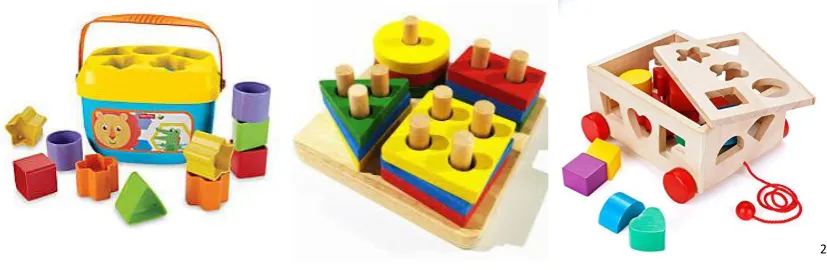
People have solved puzzles for millennia. This age-old activity is popular amongst all ages. These days puzzling starts early in life with different toys that are basically puzzles. See Figure 1 for recognizable toys that are simple puzzles.
[image:11.595.73.487.149.284.2]2
Figure 1: Common puzzle games for kids
Growing up, many people start to solve other kind of puzzles like crossword or sudoku puzzles. These are known for relieving stress and training the brain. And above all, it just feels good to solve any kind of puzzle. According to NIPO, more than 65% of the Dutch population solves puzzles. That means that in almost 5 million households somebody solves a puzzle once in a while. See Figure 2 for examples of common puzzle games that people solve these days.
3
Figure 2: Common puzzle games
There are some striking statements on the internet that claim that puzzles can reduce the change of diseases like Alzheimer and dementia but there is no hard evidence for that. David Corcoran, a journalist that has done a few articles about puzzles wrote: "What puzzles can do -- and it almost goes without saying -- is they're fun. They're a form of recreation. They're satisfying to do. And in that way, they can help you keep tabs on yourself. You know if you can solve a puzzle, you know you're still pretty much intact."
2 Images from www.dhgate.com/product/geometric-intelligence-board-column-shapes/408248689.html, visited at 15-05-2019
[image:11.595.73.506.394.525.2]2.1.6 How to design a good puzzle
According to Kendall, Parkes and Spoerer, a good puzzle should have a solution which is aesthetically pleasing and gives the user satisfaction in reaching the solution. The appearance of a puzzle really makes a difference in wanting to solve the puzzle. A puzzle has to have ‘medium’ difficulty. Medium difficulty differs per person. The puzzle can’t be too easy because then there is no challenge and satisfaction in solving it. The puzzle can’t be too hard either because the user may feel disappointed at not being able to solve it. Defining what medium difficulty means is another challenge itself. But a good puzzle should fit the user(s).
Denksport, a large Dutch puzzle company that designs all kinds of puzzles, divides the levels of puzzles into different categories using stars. One star indicates the easiest puzzles and five stars indicates the most difficult ones. This way, every person can choose for himself what level fits him the best which will make sure the most satisfaction can be obtained by the user.
Scott, K. (2006), stated that a good puzzle has two characteristics. It has to be fun and it has a right answer. He also stated that there are several things that help in making a puzzle ‘fun’. A puzzle should be novel: puzzles give us permission to do things that are not practical at first sight. Designing puzzles are therefore a good way of inviting a designer and player to be playful. Also, as stated before, a puzzle should be not too easy and not too hard. Puzzles that are too easy are disappointing; puzzles that are too hard are discouraging. Lastly, a puzzle should be tricky. Shen a perceptual shift is needed in solving a puzzle, the satisfaction of solving one will be greater. But, of course fun is not the same for everyone. Scott, K. (2006) stated that “What may be fun for one person may be torture for another.”
2.1.7 The general benefits of escaperooms
In a recent study (Pan, Lo, & Neustaedter, 2017) stated that escaperooms are beneficial for several skills that can be used in everyday life. An escaperoom can contribute to communication skills, teamwork and problem solving skills.
In escaperooms it is often required to have more than one person to complete a given puzzle, such as needing to push five buttons on opposite side of the room at the same time or someone reading instructions to another player in a different room. The need to work together to solve the puzzles is beneficial for teamwork skills. Of course it can result in negative communication and so a negative experience. Then it will also be a good lesson for the participants. To work together, people need to communicate very well so this is also trained by participating in escaperooms. Without communication people most likely will not escape. Good escaperooms are filled with unique puzzles that require out of the box thinking. The puzzles are not easy and obvious, that would be boring. Participating in escaperooms can help people train this skill, the skill of problem solving.
2.1.8 How to design a puzzle for an escaperoom
An escaperoom is an experience. Designing good puzzles is important but if the puzzle does not fit the room it is worthless in terms of obtaining the most joy out of it. The escaperoom community has accepted the following basic rules in order to design good escaperoom puzzles.
- No Red Herrings (puzzles that are made for distraction, the answer will not be used) - No outside knowledge needed
- No spelling or grammar mistakes
There are a lot of escaperoom enthusiasts these days. One of the most influential in the escape room community is thecodex.ca. One of the co-writers is Errol and he devoted an article to the ’13 Rules for Escape Room Puzzle Design’. This article summarizes the rules that can be followed in order to get that awesome experience an escaperoom stands for. These rules are approved by escaperoom enthusiasts from all over the world. It is not a scientific article but reading the comments from people who followed Errol for a long time indicates that he knows what he is talking about. He is trusted in the escaperoom community. A few of his rules are listed in table 1.
Requirement Explanation
Puzzles must be fair As a puzzle designer, the goal is to let people solve the puzzle and have some sort of satisfaction out of it. Puzzle designers do not take satisfaction when a person can’t solve the puzzle. A good puzzle can be solved and follows the guidelines all puzzles follow. Fair means the player is in control of their win state. The puzzles are meant to be solved. They are designed for players that want a challenge and want to have fun.
Everything needs clues
Nothing is obvious. Even something as simple as a date can be misleading. This is because a lot of countries have different rules in writing down a date. Do not assume people have a certain amount of foreknowledge. A good escaperoom puzzle can be solved with the information that is provided in the room. No knowledge on beforehand is needed. This does not take away that a puzzle can be really difficult to solve.
A puzzle should have one answer
It can be very frustrating when people think they found the answer to a puzzle but it is incorrect. When they followed the clues and think of the answer in a logical way it should be the correct answer.
A puzzle should have a self-validating answer
When the players solve a puzzle, they should be confident they have the correct answer without entering it into a device to validate the answer.
Clues and puzzles should be clearly linked
Puzzles can be linked by some common aspect like shape, color or context.
Correlations should make sense
When a correlation makes sense it will create that ‘aha’ moment which is very satisfying.
A puzzle should not take more than 5 minutes to complete
Puzzles that require a lot of process is fine, working up to the correct answer is exciting. But, when the player already knows how to solve the puzzle and it still takes longer than five minutes it is too long. The fun level drops dramatically.
Tedious work should not be ambiguous on instruction
When players should do something what will take a long time to process, make sure they are doing it the right way. If they spend ten minutes on something, only to learn they did it wrong from the beginning because of ambiguous instruction or they missed something with searching, then they’ll probably spend the rest of their time resetting all your locks to different combinations.
Puzzles should have no destroyable states
In an escape room, you don’t want to design a puzzle where elements crucial to solving the puzzle can disappear.
If a clue or an object must be in a particular place in order to solve the puzzle, then don’t allow it to be moved. Either that or provide a way to reset it back to its initial state.
Puzzles must have feedback
Puzzles should be consistent
Patterns that are set should be followed.
Table 1: Requirements for implementing puzzles into an escaperoom, derived from www.thecodex.ca/13-rules-for-escape-room-puzzle-design/
2.2
S
TATE OF THEA
RTR
EVIEW 2.2.1 The Escape ClassroomWith this educational escaperoom, students have to compete against other teams in order to escape the classroom before the clock ticks down to zero. They are ‘locked’ by ‘Super Villains’ into the classroom. There are clues and puzzles in order to help them escape. The escapes are designed around specific curriculum. To get access to this form of education, teachers can order a try out version. When they like it, and want more they need to take out a subscription in order to be able to use it for a longer period of time. Looking at the reviews and feedback on the Facebook community they are really popular all over the world. The Escape Classroom has more than 65 000 likes on Facebook. They promote their product among teachers all over the world and promise a gain in creativity, innovation, critical thinking, problem solving, communication skills and collaboration. This product is very versatile because everybody can order it online. The downside is that the learning objectives are very basic because it has to fit students all over the world. It can’t be personalized to local learning objectives.
2.2.2 Diabetes-themed Escape room
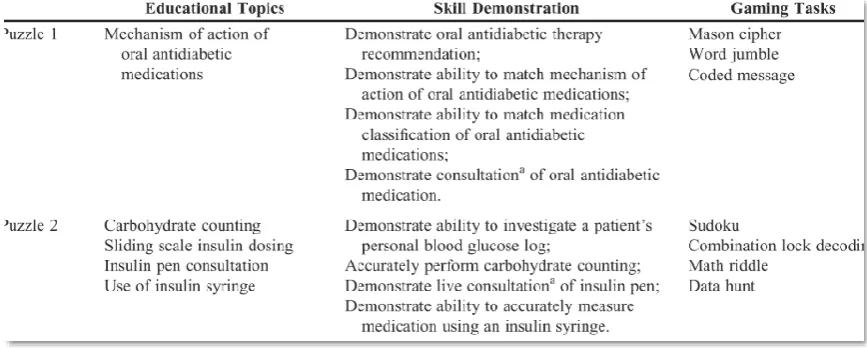
[image:14.595.78.512.541.715.2]Pharmaceutical students are looking for new ways to train their self-confidence and competence to provide diabetes care. (Wongwiwatthananukit et al., 2013). The 2013-2014 American Association of Colleges of Pharmacy (AACP) encouraged the development of serious games in pharmacy education. The AACP wanted to prepare pharmaceutical students for their future jobs. The goal was to enhance pharmacy and interprofessional education. Therefore, the diabetes escaperoom was developed. The particular goal of the escaperoom is to increase the knowledge of diabetes disease management and to fully engage students in learning by doing. The puzzles are divided in educational topics, skill demonstration and gaming tasks. For example: a sudoku puzzle in combination with ‘accurately perform carbohydrate counting’. The outcome of this pilot was positive. Through this game, students improved their knowledge in diabetes management and reported a positive perceived value of this learning activity. (Heidi N. et al., (2017))
2.2.3 Well rated escaperooms from The Netherlands
According to Escaperooms Nederland4 the best rated escaperoom from The Netherlands are the two rooms from ‘Locked Amsterdam’. The unique aspect at these two room is that it is not just locks and combinations in the correct order. The story is logical and the technical and electronical aspects are very well-developed. This makes the escaperoom a real experience. The rating is 9.4 out of 10 from 120 reviews.
Following up, the rooms from ‘Dark Park Zoetermeer’ have a high rating as well. Developers used special effects, a unique 3D sound design and a specially produces movie images that deliver a unique experience.
2.3
C
ONCLUSIONThis conclusion consists of two parts. The first part is the overall conclusion about the literature review, the second part is the overall conclusion about the state of the art. Together they conclude chapter 2, the context analysis.
To summarize the literature review, motivation is important in order to learn something. It can lead to improved performances. It is in the interest of teachers to increase the motivation of their students. Situated motivation is very common these days and a way to do that is to use gamification. Using an educational escaperoom can be an example of that. In order to make the gain of motivation as big as possible, the escaperoom should be convincing. Therefore, the puzzles have to be good puzzles. Next to that, the puzzles should fit into the escaperoom well. Not just every puzzle can be in every escaperoom. Table 1 sums up the needed requirements in order to do so. Also, escaperooms can contribute to skills like communication, teamwork and problem solving. Teachers who care have a positive influence to students. Caring teachers who make a special effort, can motivate students in order to engage more with school. Going to an escaperoom, which provides benefits like teamwork, could be a great way for a teacher to be more ‘caring’.
To summarize the state of the art, the three projects that are viewed are very different from each other. The first one is a portable escaperoom that teachers can order. They have to print it out themselves. There is a lot of positive feedback from the users which implies that there is a demand for gamified learning experiences. The second one, the diabetes escaperoom is an example of an escaperoom that is particularly made for students in order to motivate them. The escaperoom is an example of teaching materials that are ‘made fun’, game elements are applied. The students showed that it was helpful and motivating to attain the escaperoom.
3
METHOD
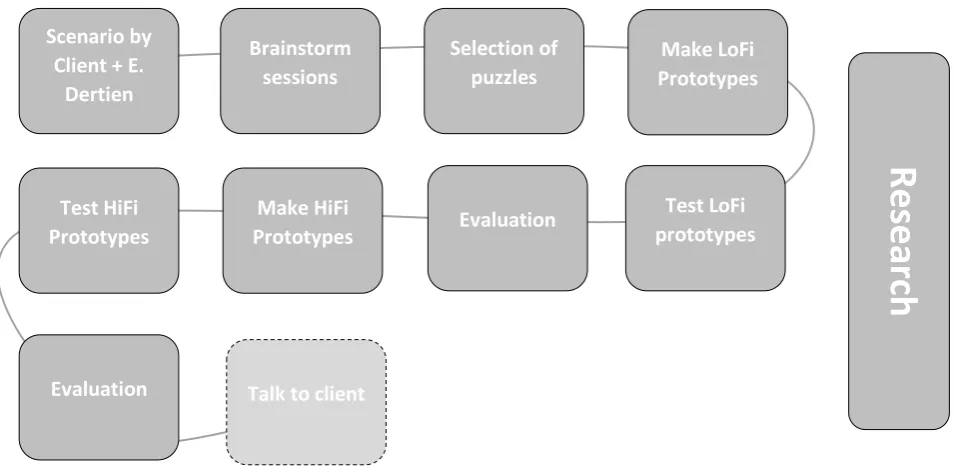
In order to provide clarity about how this project worked, the method has been described. This chapter describes how everything was put together from the beginning on until the last steps. A schematic overview of this can be seen in Figure 4.
The starting point for this project was the given scenario written by the client and Edwin Dertien. This scenario can be found in Appendix B – Scenario by Daniella and Edwin From this point on the researchers started brainstorming in order to generate new puzzle ideas. These sessions can be found in Appendix A – Brainstorm: puzzles. Based on those brainstorm sessions, decisions were made. this resulted in a selection of puzzles. Then the making of the LoFi prototypes started. These are described in section LoFi Prototypes6.2. These prototypes have been tested. Which is, together with the results, described in section 7.1 and 7.2.. Then the making of the HiFi prototypes started. These are described in section 6.3. These prototypes also have been tested. This is described, together with the results, in section 7.3 and 7.4. The last evaluation in the form of recommendations and conclusions is described in chapter 8. The next step is to talk again with the client. This is planned, but did not happen at the time of writing.
Brainstorm sessions
Selection of puzzles
Make LoFi Prototypes
Test LoFi prototypes Evaluation
Make HiFi Prototypes Test HiFi
Prototypes
Evaluation Talk to client
Research
Scenario by Client + E.
[image:16.595.60.538.364.597.2]Dertien
4
IDEATION
To maximize the amount of fun in the escaperoom by making the puzzles as good as possible, an extensive ideation phase is conducted. The ideation phase is the mode of the design process in which idea generation is concentrated on. This phase can go on forever, new findings are found during every phase. These findings can be used for the final design choices.
Different puzzles were divided among the different researchers. This report focuses on the puzzles that matter to the research of the researcher herself. The moodboards focus on all puzzles to prevent the researchers from designing individual puzzles that do not correspond to each other. It is important to stay likewise with each other.
4.1
M
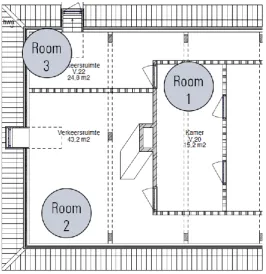
OODBOARDSIn order to stay like-minded about the escaperoom ideation, three moodboards were created. These moodboards create an image about how the feel and look of the escaperoom should be. One per room in the escaperoom. The flour plan of the actual place for the escaperoom can be found in Figure 5. The moodboards for every room can be found in Figure 6. This section describes what can be seen in the moodboards and how the researchers interpreted these.
[image:17.595.166.433.438.713.2]The first room is inspired by the BVD office. Very crime-like aspects such as a wall with most wanted spies, file cases and some 50s-styled attributes. The second room is inspired by an 50s living room. It should as similar to that as possible to enhance the feel of the room. An old phone and television are part of the puzzles as well as part of the living room. An old bookcase will also be used in the room. The third room is inspired by a bomb or launch room. A lot of buttons, lights and sound will give the impression of that.
4.2
B
RAINSTORMThis section describes the most important puzzle ideas that came forward during different brainstorms. There were more ideas but the puzzles described here did have the most influence in the design choices that were made afterwards. These puzzles influenced the puzzles the researcher had to develop further. In the brainstorm the learning objectives were not taken into account. The full list of puzzle ideas can be found in Appendix A.
Puzzle idea 1 | Red Reveal
Use a red reveal glasses to see a certain code or hint. A red reveal glasses is a glasses with red glasses. When people look through this glasses everything that is red disappears. The rest of the colors, mostly blue, can be seen vividly. This is used in a lot of escaperooms and toys.
[image:18.595.37.563.65.291.2]5
Figure 7: Example of a red reveal glasses
Puzzle idea 2 | Book Safe
A secret book safe in a book which the title is given by another puzzle. The book safe contains the hint to the next puzzle.
[image:18.595.222.372.526.637.2]
5Image from www.kristenanncarter.com/design.html, visited at 28-05-2019
Figure 6: A moodboard for every room.
6
Figure 8: Example of a book safe
Puzzle idea 3 | Thermochromic rub
Use thermochromic rub to reveal a hint on a chair. Thermochromic rub is a material that is black, but when it touches something heated, like rubbing of hands it changes to a transparent material. The idea is to place this on a chair so when the players will sit on the chair, the material changes transparent from the heat of the body. A hint will show in order to solve the next puzzle.
[image:19.595.213.380.316.429.2]7
Figure 9: Example of thermochromic rub
Puzzle idea 4 | Telephone
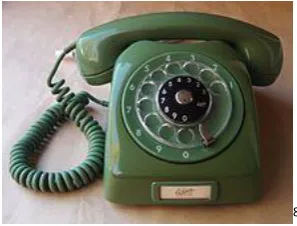
The telephone puzzle idea was present from the beginning of the project. The supervisor of this project thought of this idea. The idea is that an old rotary telephone will be converted with a little computer inside. This will make it possible to call certain numbers in order to hear a voice message from the telephone.
8
Figure 10: Example of a rotary phone
6 Image from www.secretsafebooks.com/products/harry-potter-sorcerers-stone-rowling-1, visited at 28-05-2019
[image:19.595.222.371.551.664.2]Puzzle idea 5 | Google Cardboard
[image:20.595.217.381.160.316.2]Using Google Cardboard, a present world will be shown with Trump in it. A modern living room with a huge tv. On that tv a short film will play. Players will see a speech of Trump where Trump talks about the INF agreement. The players need to watch that. The end of the video will be a hint or code that is a transition to the next puzzle. The room is has the same interior as the escape room but modern.
Figure 11: The VR world with Trump's speech on tv
Puzzle idea 6 | Bookcase
The Bookcase puzzle idea was present from the beginning of the project. The supervisor of this project thought of this idea. The idea is to use a book shelf as a secret door. The door can open when a certain combination of books is touched or pushed. The right combination can be found in other puzzles in the room.
9
Figure 12: example of a secret bookshelf door
4.3
S
TAKEHOLDER ANALYSISBy doing a stakeholder analysis, all the stakeholders with their characteristics related to the project are described. It can help to identify the interest of all stakeholders. Stakeholder analysis’s can also be used to generate knowledge about the relevant actors about their behavior, intentions, interrelations, agendas, interests and the influence or resources they have brought (Brugha, 2000). A stakeholder is a party that has an interest in the project. A stakeholder can either affect or be affected by the business.
[image:20.595.218.374.436.559.2]
The stakeholder analysis is conducted due to the many parties involved in this project. The stakeholder analysis is based on findings of the researcher and is in no means based on facts but it is supported by research to do so (Brugha, 2000). It is based on estimations and made for understanding of the stakeholders with their power and interest.
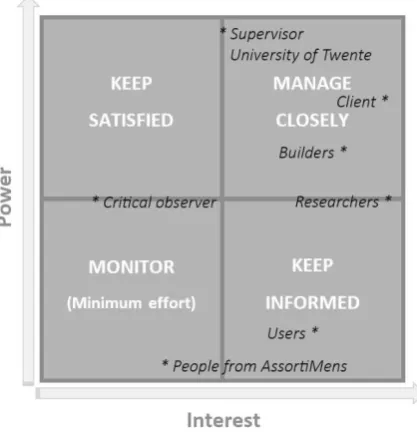
Mapping the stakeholders into a matrix, the level of power and interest can be determined. Figure 7 holds this matrix. This matrix is conducted from the stakeholder analysis below. The x and y axis both are discussed with every stakeholder. After that the stakeholders are places in this matrix for an overview, a summary of the stakeholder analysis.
4.3.1 Users
The users are the people that will interact with the system, will use the system. For this project, the main users are young teenagers that will go into the escaperoom. These teenagers are students that go to middle school and follow the havo or vwo program in The Netherlands. They are around the age of fourteen. The users have a high interest but their power is on the lower side because they will have little influence in this research. Tests are mainly done with students around the age of 22, not the real target group. The final escaperoom will not be released during this project so the real users do not have high power. The interest is higher assuming that students always are in for a fun experience like an escaperoom.
4.3.2 Developers
Developers are the people that are involved in the developing of the project. In this project the researcher herself is one of the developers. However, the researcher has to work together with other developers in order to succeed this project. To get a straight overview of all the developers involved, Table 2 is made. Because there are a lot of developers working at this project, communication with each other is key. Some decision makers are also the developers and interests can clash.
Developer Function Role
Edwin Dertien First observer &
Founder of AssortiMens
Helps with some projects within the project. People who come to
AssortiMens for daytime activities (Autistic people)
Specialists on specific skills (f.e.: programming, 3D printing, laser cut)
Can carry out certain tasks
Daniella van der Stelt Project leader from The Palthehuis Museum, the client
Supervises the overall project.
Mark and Jet Building Make the overall feel of
the room. Make furniture, walls and the floor.
[image:21.595.94.504.450.696.2]Famke and Chantal Fellow researchers Every individual has her own research question and therefore develops different puzzles and conducts different research.
4.3.3 Decision-makers
Decision-makers are the ones who have high power in the development of the system. These people are responsible for the project. They want, and have to be involved in the overall decisions and important steps that are made.
The client for this project is The Palthehuis Museum from Oldenzaal with Daniella van der Stelt as the project leader. The client has high interest and high power. The client manages the money for the builders and has contact with the township in order to realize this project. They museum is interested in developing an educational escaperoom. The goal of The Palthehuis Museum is to have to room up and running in October 2019. This means that the researchers will deliver a concept of the actual escaperoom along with the research, test results and other findings.
Another decision-maker is Edwin Dertien, supervisor from the University of Twente. The supervisor has medium interest and high power. Medium interest because Edwin Dertien has a lot of projects like these. A critical observer is also present: Karin Slotman. She has low interest and medium power.
4.3.4 Visualization of the stakeholder analysis
[image:22.595.194.403.412.629.2]In order to get an overall view of all the stakeholders involved, the visualization in Figure 13 is made. This visualization is made using the ‘power/ interest matrix’ from Gardner et al. (1986). These authors indicate that defining the stakeholders in not just about establishing the interest of each stakeholder group, but also about making an inventory of how much power stakeholders can influence over the policy of the project or organization. Gardner et al. (1986) indicate in outline how an project/ organization should deal with the different interests of the various stakeholder groups.
Figure 13: Visualization of the stakeholder analysis
4.4
S
CENARIOThe first thing that had to make sense was the scenario of the escaperoom. This would be the basis of the project. The first concept of the scenario idea, made by Edwin and Daniella, has been adapted along the way. This first scenario concept can be found in appendix B.
After all the research that has been done, and some input from people from AssortiMens, something did not make sense. The idea of a bomb chamber was not logical. Nobody had a bomb chamber in the cold war. It was all about nuclear weapons. So, for some spy to have a bomb chamber in the room was not the most logical. Following the requirements in order to design the best escaperoom possible, the room should have purposeful décor and a logical story with logical links. Therefore, the scenario has been changed. The renewed scenario can be found in appendix C right after the first scenario.
4.5
C
ONCEPTSWhen comparing the ideas of the brainstorming section with the requirements found in the research that has been done, several choices can be made. The dropouts and the promising ideas are stated. A small recap of the puzzle ideas:
- Red reveal - Book safe
- Thermochromic rub - Telephone
- Google cardboard room - Secret bookshelf door
4.5.1 Dropouts
Looking at the requirements three different reasons for an idea to fail can be formulated. Namely, confusion, not realizable in the timespan given for this project, lack of skill and inability to provide feedback.
- Book safe
In order to follow the basic escaperoom rules, accepted by the escaperoom community which can be found in section 2.1.7, it is not a good idea to have another book-related puzzle in the room. The secret bookshelf door will be the goal of the second room so tis puzzle will get priority. Therefore, the decision is made to not include a book safe puzzle in the room. This is predicted to be too confusing next to the other puzzles.
- Thermochromic rub
The idea to put thermochromic rub on to a chair is a dropout because it will not work in reality. The idea is very cool but putting this material on a chair is not a clue for rubbing it, or sitting it long enough in order that it will get transparent. Looking at the requirement: ‘Everything needs clues’ that can be found in Table 1: Requirements for implementing puzzles into an escaperoom, it is not a good idea to use thermochromic rub on a chair. The chair would be the ‘hint’ but this hint will not be obvious enough. People who are in an escaperoom usually are very busy running around, they will not sit down and relax on the chair. The reason for this dropout is the inability to provide feedback.
- Google cardboard room
proceeding with this puzzle idea, it would probably not turn out the best way possible. Therefore it is a dropout due to lack of skill.
4.5.2 Promising ideas
- Red reveal
This puzzle can be adapted in many shapes and forms. A glasses can be used to read the hidden message. But to stimulate teamwork, a red window can also be hang. This would make sure not just one person could read the message at a time. It would require teamwork in order to solve the puzzle.
- Telephone
This puzzle is able to meet almost all of the requirements. It has instant feedback because when the right number is called, the participant immediately knows that he called the right one. No outside knowledge is needed except for knowing how to call a number on a rotary phone. Most likely at least 1 person will know that.
- Secret bookshelf door
5
SPECIFICATION
The specification phase is the phase where the found requirements of the ideation phase are specified in to more detail. Taken the context analysis and the ideation into account, requirements can be formulated. A few sketches are made in order to specify into more detail what the envisioned puzzles should look like. Not every part of every puzzle is included. Details will be specified in the next chapter.
Similar to Table 1, Table 4 is created. The difference with the first table is that this tables uses a prioritized list of requirements. These are prioritized based on the MoSCoW method. This method, developed by Dai Clegg, is a method that is often used to prioritize lists of requirements. The abbreviation MoSCoW stands for Must have, Should have, Could have and Won’t have. In Table 3, every part is explained shortly.
Mo Must Have: The most vital things you can’t live without.
S Should have: Things you consider as important, but not viral.
Co Could have: The “nice-to-haves”.
W Won’t have: Things that would be good to implement but are not yet possible in this phase.
Table 3: The abbreviation MoSCoW explained
[image:25.595.193.400.407.579.2]Combining as many requirements as possible, the envisioned red reveal puzzle should look like the sketch below. The red reveal puzzle is for stimulating teamwork. Therefore the choice is made to use a window instead of a pair of glasses. This makes sure that the person who can read the instructions has to communicate with the players inside room 3. Teamwork is needed to complete this puzzle.
Figure 14: Sketch of the Red Reveal puzzle placed in room 3. Only when the players look through the window, the instructions can be read. This means that players have to go back to ‘room 2’ to read the instructions.
The bookcase puzzle will stay in the prototype phase. This puzzle can only be made in collaboration with the builders10. The first builder dropped out of this project due to personal reasons. Therefore, this puzzle will stay in the prototype phase.
Must Puzzles must be fair
Puzzles must have feedback No Red Herrings11
No outside knowledge needed No spelling or grammar mistakes
Puzzles must be solvable without requiring hints Puzzles cannot be used twice
Should Everything needs clues
A puzzle should have one answer
A puzzle should have a self-validating answer Correlations should make sense
A puzzle should not take more than 5 minutes to complete Clues and puzzles should be clearly linked
Could Tedious work could not be ambiguous on instruction Puzzles could have no destroyable states
Puzzles could stimulate teamwork
Puzzles could stimulate skills like creative thinking Puzzles could be consistent
Won’t Puzzles won’t be a finished product
[image:26.595.114.484.142.415.2]The room won’t be fully in theme
Table 4: Requirements of the puzzles, prioritized using the MoSCoW method. These requirements are based on chapter 2 and 3, the research and the ideation phase.
10 See Table 2: all developers and decision makers involved in this project
6
REALISATION
The realization phase leads towards design choices which are made using the requirements stated in the last chapter. This chapter describes how the prototypes are made, which technologies are used and why certain design choices are made. Two test phases are conducted which will be discussed in chapter 6. The HiFi prototypes are designed after the first test phase but are described in this chapter.
6.1
T
HE PUZZLES EXPLAINED [image:27.595.72.526.264.585.2]In order to understand the cohesion between all the puzzles, a scheme is made. There are a lot of aspects to every puzzle which are visualized in the scheme below, Figure 15. This scheme has changed a lot during all the different phases of designing. The figure below is the final one which the researchers used to conduct user tests.
Figure 15: Flowchart of all the puzzles in the envisioned escaperoom. The three different rooms are divided with lines. This flowchart is made by Famke who is one of the researchers.
6.2
L
OF
IP
ROTOTYPESTo test with LoFi Prototypes, paper prototypes are made. A description can be find below.
Telephone puzzle
The phonebook that had to be used to find the right person to call existed out of a lot of post-it notes. This phonebook was inside an envelope with a picture of an address book.
Figure 16: LoFi prototypes of all the parts of the telephone puzzle
Red reveal puzzle
In order to test the red reveal puzzle a glasses with red glass is used. The encrypted message was printed and hang on the whiteboard. A big difference with the final idea is that the glasses can be moved. In the final design, the red reveal glass is fixed. The code that reveals when looking through the red glasses where the letters ‘K I R A J’, which was the code for ‘stopping the bomb’ in the launch room.
Figure 17: LoFi prototype of the red reveal puzzle
Bookcase puzzle
[image:28.595.120.480.398.632.2]Figure 18: LoFi prototype of the bookcase puzzle
6.3
H
IF
IP
ROTOTYPESTo test with HiFi prototypes, the LoFi prototypes are made into real puzzles. The phone isn’t from paper anymore and the red reveal glass feels more like a window. The bookcase is still in the paper prototype phase but more thoughts went into designing it. All the ‘must’ requirements are met and the ‘should’ requirements are almost met.
Telephone puzzle
The telephone puzzle is part of a larger whole that exists out of different small puzzles. In Figure 19 an overview of the table in the ‘living room12’ can be seen. The different aspects are explained in the description. This HiFi presentation of the Telephone puzzle already feels like an escaperoom. Pieces like the suitcase, the phonebook and the telephone itself are ready to use in the real escaperoom.
To complete the Telephone puzzle, different puzzles should be solved in advance. First the poster has to be found which is inside the folder. The code comes out of this poster is: ‘211’, the date and time that is on the poster. When the participant enters this code into the lock on the suitcase the suitcase opens. Inside the suitcase is the next puzzle. An encrypted message. A ‘spionage befehl’. The output of this puzzle is D.SMIT, which is the name that has to be looked up inside the phonebook. The corresponding number to this name is the number that has to be called with the telephone. The output of the telephone is an audiofile which refers to a booktitle.
Figure 19: Overview of the desk in room 2. Different aspects of the telephone puzzle are numbered. (1) The folder with the
poster of the “kruisrakettennee” inside. (2) The suitcase which can be opened with the code from the poster. (3) The phonebook. The name that has to be called can be found in the puzzle inside the suitcase. (4) The telephone
Table 5: small puzzles that are part of the Telephone Puzzle
Inside the folder (1) Inside the suitcase (2) Inside the phonebook (3) Inside the phone (4) 62 individual people with
their name, address and telephone number.
An audio file which is a book reference. It refers to the book title: “Manifest der
kommunistischen partei
[image:30.595.70.567.512.686.2]The Bookcase puzzle
[image:31.595.171.425.234.466.2]The bookcase puzzle is the puzzle that combines all the puzzles. A lot of puzzles in the room have a ‘book reference’. This is also visualized in Figure 15. The idea of this puzzle is that it is an interactive system which reacts to touch. All the books have a sensor in them that light up when the books are touched. To complete this puzzle, al the references have to be found and the corresponding books have to be pressed in the right order. Then the secret door/ bookcase opens to the next room. Because this puzzle has to be developed together with the builders, the puzzle is not further developed than a paper prototype version that can be seen in Figure 20. This was printed on A1 format so it felt like a real bookcase. However, it was not interactive and during the testing phase the wizard-of-oz technique was used to simulate the interactive bookcase.
Red Reveal puzzle
The Red Reveal puzzle is the final puzzle that has to be solved in order to get the right instructions for the last puzzle, the puzzle that unlocks the choice of firing back or do nothing. This puzzle is made by another researcher. The solution of the puzzle is the right order that the buttons have to be pressed. In Figure 21 the setup as well as the puzzle itself can be seen.
The first step that has to be made when participants enter the third room is that they need to realize that they need to walk back to the second room in order to look through the red window. Then the roles are as follows: one person needs to give instructions, one person needs to write them down on, in this case, the whiteboard and another person needs to put every other participant with the right button. When everybody is working together, the puzzle can be solved.
[image:32.595.76.499.238.439.2]
7
EVALUATION
In the evaluation phase, the LoFi and HiFi prototypes are tested with potential users. Three types of tests are conducted: the LoFi test with fellow students as test persons, the HiFi test with fellow students as test persons and the HiFi test with potential users. The LoFi test was to exclude major mistakes in the relation of the puzzles. The HiFi tests are conducted in order to see if all the identified requirements are met.
First an explanation of the different tests is given, second the results are given and third, conclusions are drawn. Combining all the results of the different tests results in conclusions regarding the concept and the HiFi prototypes. Using the conclusions, the puzzles can be placed in the context of the real escaperoom with some further adjustments.
7.1
L
OF
I TESTINGThe LoFi testing phase is important to maximize the number of times to refine the design before committing to the HiFi prototype. It gives quick feedback about the puzzle ideas. It effectively educates researchers in possible design mistakes. The division of roles was as follows. Famke and Linde were observing, making short notes and stepped in where needed. They also explained to the participants how the puzzle is envisioned when the participant did not interpret the LoFi prototype correctly. Chantal was the one who took minute. She wrote an expanded report with observations, times, facts and impressions.
Figure 22: A visualization of the LoFi test room setup
LoFi Test 1
Date May 9, 2019
Amount of participants 1
Who Creative technology student, 21, male
Description 1 person who attempts to escape from the LoFi test escaperoom to see if the puzzles have a logic relationship to each other. He is asked to think out loud.
immediately knows what to do, he takes the glasses and reads the instructions. After 40 minutes he escaped.
LoFi Test 2
Date May 9, 2019
Amount of participants 2
Who Creative technology students, 21 & 27 years old, male & female Description 2 persons who attempt to escape from the LoFi test escaperoom to
see if the puzzles have a logic relationship to each other and to see if the puzzles require teamwork.
Changes as opposed to LoFi test 1: more names in the telephone book which makes it more difficult to guess which name needs to be called. The gambling factor is made smaller doing this.
The participants enter the first room. After 12 minutes they enter the second room. The two participants tend to solve every puzzle together. They do not split up to solve puzzles separately. Again, they guess which number they need to call. They guess the right one. After 28 minutes they enter the third room. Immediately they make the connection between the red reveal instructions and the glasses. After 30 minutes they escaped.
LoFi Test 3
Date May 9, 2019
Amount of participants 2
Who Creative technology students, 18 & 19 years old, female & female Description 2 persons who attempt to escape from the LoFi test escaperoom to
see if the puzzles have a logic relationship to each other and to see if the puzzles require teamwork.
Changes as opposed to LoFi Test 2: more names in the telephone book
The participants enter the first room. After 11 minutes they enter the second room. They instantly make the assumption that they need to call someone from the phonebook. They also recognize the book titles and assume that they need to do something with them. After 30 minutes they enter the launch room. They make the connection with the red reveal glasses and escape in 32 minutes.
LoFi Test 4
Date May 9, 2019
Amount of participants 2
Who Creative technology students, 21 & 23 years old, male & female Description 2 persons who attempt to escape from the LoFi test escaperoom to
see if the puzzles have a logic relationship to each other and to see if the puzzles require teamwork.
No changes as opposed to LoFi Test 3.
7.2
R
ESULTS OF THEL
OF
I TESTING PHASEThe results of the questionnaire can be found in Appendix D. Only the results for the questions about the puzzles of the researcher are shown and evaluated. Questions about the rest of the puzzles are not. The most important findings from the LoFi tests are insights in design mistakes. Mistakes that can be fixed easily and make puzzles better according to the puzzle requirements.
7.3
H
IF
I TESTINGThe HiFi testing phase is important to cover not only the user interface of the puzzles in terms of aesthetics, but also the user experience aspects in terms of interactions an behavior of the participants. Also the HiFi tests are conducted in order to see if the requirements are met. The HiFi prototypes, which can be found in section 6.3, are made in order to come as close to the envisioned puzzles as possible. The division of the roles was as follows. Famke and Linde were observing, making short notes and stepped in where needed. They also explained to the participants if they did not interpreted a HiFi prototype correctly. Chantal was the one who took minute again. She wrote a short minutes.
In order to get insight in how users experience the escaperoom, five user tests are performed. Four of them with students from The University of Twente. One of them with real potential users from Bonhoeffer College from Enschede. These were 6 students that participated in a vwo+ Programme. Attending the escaperoom was a gift of their teacher because they were the students with the highest score. They had the extra time because they were ahead on other students.
All the participants signed a consent form which there are two versions of. One for the parents of the middle school students and one for participants above the age of 18. The consent form that is used for the parents can be found in Appendix G – Consent FormThe one for participants above the age of 18 is not included. It is very similar only the words ‘uw kind’ are changed into ‘jij’. The consent form is approved by the ethics committee. This can be seen in Appendix F – Consent Approval.
For the first four test, a room named ‘play’ in the Design Lab was used to conduct the user tests. For the fifth test, a classroom at the Bonhoeffer college was used. The results are merged together because the researchers found that it did not make much of a difference between the participants from the middle school and the participants from high school. It appeared that puzzle solving is not that much age-related.
HiFi Test 1
Date June 18, 2019
Location Play room, Design Lab
Who A mix of master and bachelor students (5)
Escape time 46 minutes
Description This is the first test. The participants were really enjoying
themselves. They had been in an escaperoom before so they knew how it worked.
HiFi Test 2
Date June 19, 2019
Location Play room, Design Lab
Who Creative Technology students
Escape time 52 minutes
laughed and they were excited about some specific puzzles. They AR puzzle was really amazing to them.
HiFi Test 3
Date June 19, 2019
Location Play room, Design Lab
Who Creative Technology students
Escape time 25 minutes (they skipped puzzles due to errors, the researchers asked the group to re attain the room. After that they escaped in 42 minutes)
Description Due to an error in the bookcase prototype, the participants skipped a lot of puzzles. The bookcase puzzle prototype is too easy to gamble the code. This should be fixed in the next round. They were very fanatic and had a good time. They were proud that they skipped puzzles.
HiFi Test 4
Date June 19, 2019
Location Play room, Design Lab
Who Bachelor students
Escape time 50 minutes
Description Good test round. The guys were very busy. They did laugh while solving puzzles and also because they were making jokes. They were motivated to solve the escaperoom without using hints. The puzzles sometimes were too hard without hints and this resulted in a little bit less motivation at the end. This is noticed because at first they were all very fanatic and in the end they seemed a little bored. They also told the researchers that it felt a little too long. Overall they had fun.
HiFi Test 5
Date June 20, 2019
Location Bonhoeffer college, Enschede Amount of participants 6
Who Students from a middle school who are in a vwo+ Programme
Escape time 58 minutes
7.4
R
ESULTS OFH
IF
I TESTINGTo test if the requirements for ‘good puzzles’ were met, four questions were asked to 21 participants. These four requirements are the ones that are not qualified as ‘met’ yet. The other requirements either were already met or could not be tested by a questionnaire. In this section all the ‘must’ requirements from Table 4: Requirements of the puzzles, prioritized using the MoSCoW method. These requirements are based on chapter 2 and 3, the research and the ideation phase. are discussed.
puzzles must be fair
“As a puzzle designer, the goal is to let people solve the puzzle and have some sort of satisfaction out of it. Puzzle designers do not take satisfaction when a person can’t solve the puzzle. A good puzzle can be solved and follows the guidelines all puzzles follow. Fair means the player is in control of their win state. The puzzles are meant to be solved. They are designed for players that want a challenge and want to have fun.” – from table 4.
All the researchers’ puzzles are solved by every test group which indicates that puzzles are fair. The players were in control of their win state. Some groups needed little hints but that was mostly due to that the puzzle was in a prototype stage instead of fully developed state. For example, every group needed a hint for the bookcase puzzle because that was not an interactive system. Overall, this requirement is met but at the same time, this is a requirement that is always ready for improvement. How this can be done is explained in the next chapter.
Puzzles must have feedback
“Video games have been doing feedback for years. There are countless games telling the player when an attempt was correct, as well as when it was wrong. That too is equally as important, especially if your puzzles tend to be more difficult.”– from table 4.
This requirement is partly met. 15 out of 21 participants agreed or definitely agreed on the statement “I knew immediately when I solved a puzzle correctly”. (See Appendix E – Results HiFi testing for the chart belonging to this question). 3 were neutral and 3 did not agree. The feedback in the puzzles have to be improved. How this can be done is described in the next chapter.
No Red Herrings
This is a requirement that the researchers took into account from the beginning on. Therefore they did not include distraction puzzles into the escaperoom. During the user tests the researchers found that there were no aspects in the room that distracted the participants. The participants fully focused on the puzzles that the researchers designed. This requirement is met.
No outside knowledge needed
This requirement is partly met. This was measured by the statement “I was convinced I could solve the puzzle without in front knowledge”. 5 out of 21 did not agree and 7 out of 21 were neutral, the rest agreed or definitely agreed (See Appendix E – Results HiFi testing for the chart belonging to this question). This requirement needs to be more clear. How this can be done is described in the next chapter.
No spelling or grammar mistakes
This is a requirement that the researchers took into account from the beginning on. Therefore they paid attention to this. This requirement is met. There are no spelling or grammar mistakes inside the escaperoom.
Puzzles must be solvable without requiring hints
This is a requirement that the researchers took into account from the beginning on. Therefore they paid attention to this. However, this requirement is only met partly. During the HiFi test phase the researchers needed to provide hints. This, as explained before, was due to the state of the prototypes. They were not developed fully. The telephone puzzle was solvable without hints. The Red reveal puzzle as well, except the fact that the window was not a window but just a glass placed in between the two rooms. How this can be improved is described in the next chapter.
Puzzles cannot be used twice
This is a requirement that the researchers took into account from the beginning on. Therefore they paid attention to this. This requirement is met. The researchers made sure that a puzzle is only used once. This is also illustrated in Figure 15, there can be seen that all the different objects in the room function for 1 purpose.
Correlations should make sense
“When a correlation makes sense it will create that ‘aha’ moment which is very satisfying.” – from
table 4.’
This requirement is tested with two statements and is partially met. The first statement is “I had a ‘aha-moment’ while solving one or more puzzles”. 20 out of 21 agreed or definitely agreed to this statement. Only 1 participant was neutral. (See Appendix E – Results HiFi testing for the chart belonging to this question). The only doubtful thing about this question is that it is does not cover for all puzzles individually. If the participant only had an ‘aha-moment’ one time they already could agree to this statement. The second statement is “The puzzles had where logically connected to each other”. 16 out of 21 people agreed and agreed definitely. 5 were neutral.
Having fun
8
CONCLUSIONS AND RECOMMENDATIONS
8.1
C
ONCLUSIONSThis bachelor thesis describes the process of designing and creating an educational escaperoom. The concepts of these puzzles ready to implement into the location for the escaperoom at the Palthehuis Museum. The puzzles are tested in a HiFi prototype state but need to be developed further if the puzzles are going to be used in a real escaperoom with real users.
The main research question for this thesis was as following: ‘How to create an educational escaperoom that contributes to a gain of motivation with young teens?’ The topic of this thesis is presented by Edwin Dertien, AssortiMens and The Palthehuis museum.
After conducting a context analysis, using a literature review and a state-of-the-art review, it was concluded that without motivation, a player (or student) will not be interested in continue a certain task. The structure of implementing game elements into education is central in the gamification trend and could contribute in designing an escaperoom. Also, ‘teachers who care’ have a positive influence to students. Teachers who make a special effort are considered as ‘teachers who care’. This can be done by giving their class the opportunity to participate at an escaperoom. Also, in escaperooms it is often required to have more than one person to complete a given puzzle, such as needing to push five buttons on opposite side of the room at the same time or someone reading instructions to another player in a different room. The need to work together to solve the puzzles is beneficial for teamwork skills. Lastly requirements are stated in order to design good puzzles and how to implement those into an escaperoom.
The puzzles first were made using the paper-prototyping method. These LoFi prototypes were tested among students. The findings from these test were taking into account and applied to the HiFi prototypes. These were made with a mix of real items and as little as possible paper-prototyping. The HiFi prototypes are evaluated via user tests among students and real potential target group participants.
The following conclusions can be drawn based on the evaluation. In general, the escaperoom was up and running in the HiFi test phase. All the participants were able to escape and had a good time attending the escaperoom. The escaperoom meets almost every ‘must’ requirement and a lot of ‘should’ requirements. Participants had fun. However, to be able to get this concept in the foreseen location at the Palthehuis Museum, adjustments have to be made. People required hints in order to understand some prototypes and the test room was definitely nothing like the foreseen escaperoom. The feel of the room can be improved with more details, real division between rooms, real locks, real everything. People were aware of being observed. To what extend the appearance of the room is necessary in order to have a trustworthy escaperoom should be investigated.
The client was satisfied with the developed prototypes. The client felt sorry for the fact that the foreseen end result was not reached. The developed concept however, adds value to the project. The builders can now, with these concepts and the recommendations in section 8.2 in mind, complete the escaperoom.