warwick.ac.uk/lib-publications
Manuscript version: Author’s Accepted Manuscript
The version presented in WRAP is the author’s accepted manuscript and may differ from the
published version or Version of Record.
Persistent WRAP URL:
http://wrap.warwick.ac.uk/111532
How to cite:
Please refer to published version for the most recent bibliographic citation information.
If a published version is known of, the repository item page linked to above, will contain
details on accessing it.
Copyright and reuse:
The Warwick Research Archive Portal (WRAP) makes this work by researchers of the
University of Warwick available open access under the following conditions.
© 2018 Elsevier. Licensed under the Creative Commons
Attribution-NonCommercial-NoDerivatives 4.0 International
http://creativecommons.org/licenses/by-nc-nd/4.0/.
Publisher’s statement:
Please refer to the repository item page, publisher’s statement section, for further
information.
with the Dual-Source Model
Henrik Singmann and Karl Christoph Klauer
Albert-Ludwigs-Universität FreiburgSieghard Beller
University of BergenTo appear in:
Cognitive Psychology
The present research examines descriptive models of probabilistic conditional reasoning, that is of reasoning from uncertain conditionals with contents about which reasoners have rich back-ground knowledge. According to our dual-source model, two types of information shape such reasoning: knowledge-based information elicited by the contents of the material and content-independent information derived from the form of inferences. Two experiments implemented manipulations that selectively influenced the model parameters for the knowledge-based in-formation, the relative weight given to form-based versus knowledge-based inin-formation, and the parameters for the form-based information, validating the psychological interpretation of these parameters. We apply the model to classical suppression effects dissecting them into effects on background knowledge and effects on form-based processes (Exp. 3) and we use it to reanalyse previous studies manipulating reasoning instructions. In a model-comparison exercise, based on data of seven studies, the dual-source model outperformed three Bayesian competitor models. Overall, our results support the view that people make use of background knowledge in line with current Bayesian models, but they also suggest that the form of the conditional argument, irrespective of its content, plays a substantive, yet smaller, role.
Keywords:conditional reasoning; probabilistic reasoning; dual-source model; measurement model; meta-analysis
Introduction
It is difficult to overstate the influence Bayesian ap-proaches have had on the development of theories in cog-nitive psychology in the last few decades. Across diverse domains – ranging from low-level phenomena such as per-ception to high-level phenomena such as argumentation – Bayesian models often provide an unprecedented level of ex-planatory power (Chater, Oaksford, Hahn, & Heit, 2010). A core assumption of such models is that subjective degrees of belief can be modeled as probabilities obeying the axioms of
Henrik Singmann and Karl Christoph Klauer, Institut für Psy-chologie, Albert-Ludwigs-Universität Freiburg, Freiburg, Germany. Sieghard Beller, Department of Psychosocial Science, University of Bergen, Bergen, Norway. Henrik Singmann is now at the Depart-ment of Psychology, University of Zürich, Switzerland.
The first two authors contributed equally to this work.
This work was supported by Grant KL 614/33-1 to Karl Christoph Klauer and Sieghard Beller from the Deutsche Forschungsgemein-schaft (DFG) as part of the priority program “New Frameworks of Rationality” (SPP 1516). We thank the members of the SPP 1516 for their ideas and discussions about this work.
Correspondence concerning this article should be addressed to Hen-rik Singmann ([email protected]).
probability theory.
In the field of reasoning, people evaluating an argu-ment have traditionally been asked to assume that the stated premises hold true and to ignore any background knowledge elicited by the contents of the premises. In tune with these instructions, theoretical accounts have often assumed that reasoning is performed on relatively abstract representations of the argument form (e.g., Laird, 1983; Johnson-Laird & Byrne, 1991; Rips, 1994). The advent of Bayesian and related probabilistic approaches has led to what has been called thenew paradigm(Over, 2009). In the new paradigm, the reasoning problems are typically couched in everyday, real-world contents, and reasoners are not instructed to dis-regard what they know about the contents.
wholesale replacement for logic as a computational level theory of what inferences people should draw.” (p. 208). Prominent Bayesian models assume that reasoning amounts to the assessment of probabilities of conclusions based on what the reasoners know about the contents of conclusions and premises; reasoning is thus conceptualized as proba-bilistic and content-driven (e.g., Baratgin & Politzer, 2006; Cruz, Baratgin, Oaksford, & Over, 2015; Oaksford & Chater, 2007; Pfeifer & Kleiter, 2010).
The focus of the current work is on a model that integrates these two seemingly irreconcilable positions within the new paradigm. We will show that there are content-independent effects of different argument forms that are not adequately captured by Bayesian models. Hence, we propose that rea-soning is influenced by two different and independent cog-nitive processes – a probabilistic process in line with ex-tant Bayesian models, which we callknowledge-based, and a content-independent process driven by the form of the ar-gument, which we call form-based. In this view, reason-ers’ evaluations actually reflect a mixture of form-based and knowledge-based information. These assumptions are ex-plicated formally in our dual-source model(DSM; Klauer, Beller, & Hütter, 2010) elaborated on below.
Probabilistic Conditional Reasoning
A conditional rule links two propositions, an antecedent p and a consequentq, in the form “ifp thenq”. Inference tasks in conditional reasoning (for an overview, see Nick-erson, 2015) typically present the conditional rule as major premise and one ofp,q, or their negations as minor premise. Reasoners are asked to assess a proposed conclusion on the basis of this information. According to classical logic, two of the usually studied inferences are valid; the truth of the premises entails the truth of the conclusion:
Modus ponens (MP): Given “if p then q” and “p”, it follows that “q”.
Modus tollens (MT): Given “if p thenq” and “notq”, it follows that “notp”.
The two so-called reasoning fallacies are invalid; the truth of the premises does not entail the truth of the conclusion:
Affirmation of the consequent (AC): Given “ifp thenq” and “q”, it follows that “p”.
Denial of the antecedent (DA): Given “if pthen q” and “notp”, it follows that “notq”.
Studies in the old paradigm typically employed contents for which participants have little prior knowledge (e.g., a major premise might be: “If there is a vowel on the black-board then there is an even number on the blackblack-board”), and participants are asked to evaluate the logical validity of the
above conditional arguments. Naive reasoners almost unani-mously accept MP as valid, whereas acceptance rates for MT are significantly smaller, although typically still above 50%. AC and DA are often erroneously accepted as valid with ac-ceptance rates of AC sometimes reaching those of MT (e.g., Evans, 1993; Schroyens & Schaeken, 2003).
In contrast, studies in the new paradigm usually employ everyday contents (e.g., a premise might be: “If a balloon is pricked with a needle then it will pop”), and participants are to evaluate the probability or plausibility of the conclusions of the different conditional arguments on a graded scale. In what follows, we will use the termendorsementto refer to these graded responses.
Antecedent and consequent of so-calledcausal condition-als are at least weakly related as cause and effect. For causal conditionals, content is usually characterized and sometimes manipulated in terms of two different types of counterexam-ples: disablersthat prevent the consequent in the presence of the antecedent andalternativesthat bring about the con-sequent in the absence of the antecedent. For instance, for the conditional “If a person drinks a lot of coke then the person will gain weight”, heavy exercising is a disabler that prevents weight gain, whereas eating food rich in calories is an alternative cause of gaining weight. A set of seminal experiments by Cummins (1995; Cummins, Lubart, Alks-nis, & Rist, 1991; see also Thompson, 1994) established that the availability or likelihood (Geiger & Oberauer, 2007) of disablers is negatively related to the endorsement of the for-mally valid inferences MP and MT, whereas the availability or likelihood of alternatives is negatively related to the en-dorsement of the reasoning fallacies AC and DA (for reviews see Beller & Kuhnmünch, 2007; Politzer, 2003).
Oaksford, Chater, and Larkin’s (2000) model of
prob-abilistic conditional reasoning. An influential Bayesian
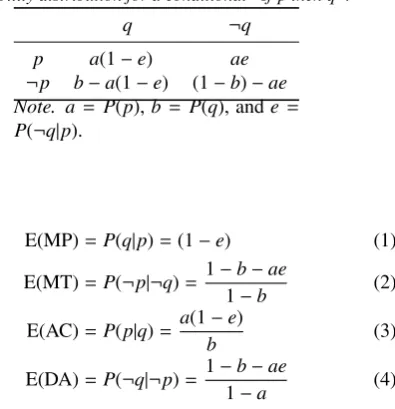
Table 1
Joint probability distribution for a conditional “If p then q”.
q ¬q
p a(1−e) ae
¬p b−a(1−e) (1−b)−ae
Note. a = P(p),b =P(q), ande= P(¬q|p).
E(MP)=P(q|p)=(1−e) (1)
E(MT)=P(¬p|¬q)=1−b−ae
1−b (2)
E(AC)=P(p|q)=a(1−e)
b (3)
E(DA)=P(¬q|¬p)=1−b−ae
1−a (4)
The endorsements of the four inferences provide four in-dependent data points, whereas there are only three free model parameters, a, b, and e. In consequence, Oaksford et al.’s (2000) model can be fitted to data and the differences between observed and predicted values indicate whether or not the reasoners’ responses are consistent with the axioms of probability theory as postulated by the model.1
Fitting the model to empirical data, the Bayesian model outperformed a classical logic-based model for data obtained in the old paradigm (Oaksford & Chater, 2003) and described data from studies in the new paradigm well (Oaksford et al., 2000). Moreover, there was evidence for the intended inter-pretation of the model parametersaandb in terms ofP(p) andP(q), respectively: The parameter estimates ofa(b) were small in value when pretesting showed that antecedent cases p (consequent cases q) were rare compared to when they were frequent.
Disentangling form and content: The dual-source
model. In the old paradigm, a focus on logical form was
encouraged through the use of contents for which little background knowledge is available (such as arbitrary rules obeyed by letters on a blackboard), leading to a neglect of the potential impact of content-related variables, which were usually held constant. In the new paradigm, meaningful contents are used for which background knowledge is avail-able, and content-related variables such as the availability of different kinds of counterexamples are manipulated, but there is now a neglect of the potential impact of logical form. For example, Oaksford et al.’s (2000) model refers only to the joint probability distribution shown in Table 1, but it does not specify a role for the conditional rule as such. In fact, a conditional inference such as MP:
• If a balloon is pricked with a needle, then it will pop. A balloon is pricked with a needle. How likely is it that it will pop?
can be meaningfully evaluated even if the conditional premise is left out and thus in the absence of a definite logical form:
• A balloon is pricked with a needle. How likely is it that it will pop?
Simply mentioning p(“a balloon is pricked with a needle”) and q (“the balloon pops”) is sufficient to elicit the back-ground knowledge summarized in the joint probability dis-tribution of Table 1 which in turn allows one to assess the conditional probability ofqgivenp. This makes it difficult to disentangle whether the logical MP form as such contributes anything over and above the content-driven probabilistic as-sessment.
The present source model (DSM) builds on the dual-source framework (Beller & Spada, 2003; Klauer et al., 2010) according to which both logical form and content shape reasoning with realistic materials. Reasoners’ re-sponses are seen as reflecting a weighted integration of both sources of information, logical form and content.
To disentangle the impacts of logical form and content, the DSM contrasts (a) responses to the conditional infer-ences and (b) responses to reduced inferinfer-ences that leave out the conditional rule. As just exemplified for the MP form, the reduced MP inference presents only the minor premisep and asks for an assessment of the conclusionq. This yields a baseline that reflects only the content-related contribution (Liu, 2003, see also Beller, 2008; Beller & Kuhnmünch, 2007).
A few studies have contrasted reduced and full inferences and found that conclusion endorsement increased when the conditional was present as compared to when the conditional was absent. This increase was relatively content-independent and especially pronounced for MP and MT (Klauer et al., 2010; Liu, 2003; Matarazzo & Baldassarre, 2008).
According to the DSM, responses to the reduced infer-ences are probabilistic assessments based on the joint proba-bility distribution of Table 1 like in Oaksford et al.’s (2000) model. Adding the conditional rule results in a definite log-ical form. According to the DSM, reasoners also assess the logical form where present resulting in a form-based response proposal, and observed responses then reflect a weighted mixture of both knowledge-based and form-based response proposals (Klauer et al., 2010).
Let us refer to the content domain addressed in the four inferences with a given conditional byC (e.g., the domain of the behaviors of balloons pricked or not pricked with a needle) and to the four inferences by x, x ∈{MP, MT, AC,
Table 2
Parameters of the dual-source model.
Par. Interpretation
τ Degree to which an inference is seen as logically warranted
ξ Knowledge-based response proposal (based on the parameters given in Table 1)
λ Relative weight given to form-based versus knowledge-based evidence
DA}. We continue to refer to the reduced inferences as MP, MT, AC, or DA according to the logical form that results if the rule is added.
Endorsement of the reduced problem x (e.g., MP) with contentC, Er(C,x), reflects the conditional probability of the
conclusion (e.g., q) given the premise (e.g., p) just like in Oaksford et al.’s (2000) model. We refer to the conditional probability by the DSM’s knowledge parameterξ(C,x):
Er(C,x)=ξ(C,x). (5)
Corresponding to the four inferencesx, there are four knowl-edge parameters ξ per content which are expressed as in Oaksford et al.’s (2000) model by three parametersa,b, and eper content (see Equations 1 to 4).
Endorsement of the full inference x, Ef(C,x), is a
weighted average of a form-based component, multiplied by the weight λgiven to the form-based information, and the knowledge-based componentξ(C,x), multiplied by (1−λ), 0≤λ≤1.
The form-based component reflects the subjective degree of belief τ(x) in the validity of the (full) inference x on a probability scale. When uncertain about the validity of the inference, with probability 1−τ(x), reasoners fall back on their background knowledge. Thus, the form-based compo-nent is itself a mixture, with mixture weightsτ(x), given by τ(x)×1+(1−τ(x))×ξ(C,x). Taken together, the DSM predicts that responses to full probabilistic conditional inferences are given by
Ef(C,x)=λ{τ(x)+(1−τ(x))×ξ(C,x)}+(1−λ)ξ(C,x), (6)
where 0≤λ, τ, ξ ≤1. An overview of the DSM parameters is given in Table 2.
The knowledge parameters can be uniquely estimated be-cause they are identified from the observed endorsements of reduced problems (see Eq. 5). The parametersτ(x) andλ cannot be uniquely estimated on the basis of the observed en-dorsements to reduced and full problems; only their products λτ(x) are identified (see the correction to Klauer et al., 2010). To fix the scale for these parameters, we set the largest of the τ(x) equal to one. This yields unique parameter estimates forλandτ(x). Differences in the overall level of the profile of theτ(x) parameters over the four inferences are thereby represented in theλparameter, whereas profile shape is re-flected in theτ(x) parameters. Theτ(x) parameters accord-ingly quantify the relative support for the respective conclu-sions elicited by the full inference forms xrelative to each
other. Theλparameters quantify theoverallweight given to conditional rules and inferences based on them.
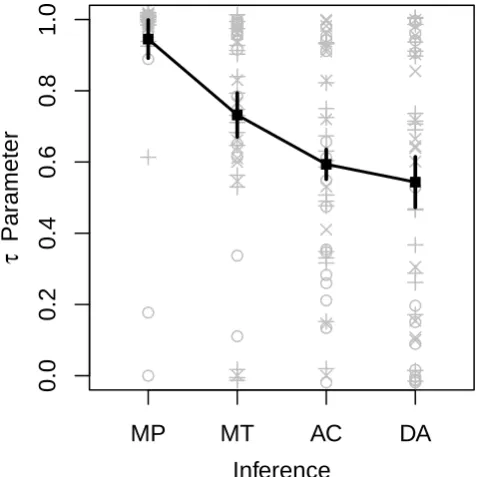
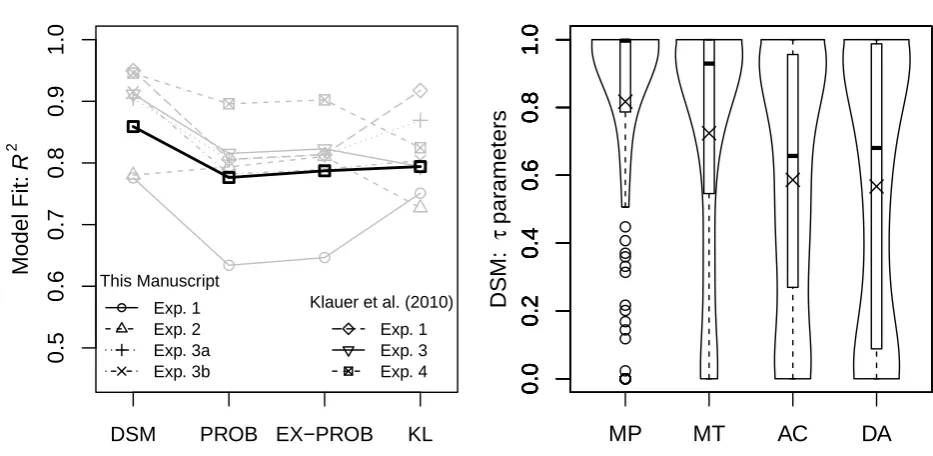
Figure 1 shows the profile ofτparameters estimated from previous experiments. It can be seen that it mirrors the pat-tern of acceptance rates with MP>MT>AC≥DA described above for reasoning based on materials for which little back-ground knowledge is available.
The DSM’s predictions for the basic paradigm. The
model makes predictions for the pattern of observed endorse-ments for reduced and full inferences, Er(C,x) and Ef(C,x).
For the reduced inferences, these are the same as those of the Oaksford et al.’s (2000) model, namely that the endorse-ments are consistent with conditional probabilities from a joint probability distribution. As shown in the online ap-pendix, this is equivalent to the constraint that for each
con-● ● ● ● ● ●
● ● ● ●
● ● ● ● ●
0.0
0.2
0.4
0.6
0.8
1.0
Inference
τ
P
a
ra
m
e
te
r
MP
MT
AC
DA
●
● ● ● ● ●
● ● ● ●
● ● ●
● ●
● ●
● ●
● ●
● ● ● ●
● ● ●
● ●
● ●
● ●
● ● ●
● ● ● ●
● ●
[image:5.595.318.557.398.637.2]● ●
tentC,
(1−Er(C,MP))Er(C,MT)(1−Er(C,DA))Er(C,AC) =Er(C,MP)(1−Er(C,MT))Er(C,DA)(1−Er(C,AC)).
(7)
Turning to the full inferences, an additional prediction is that endorsement should increase, ∆(C,x) = Ef(C,x)−
Er(C,x) ≥0 for allCandx. As discussed above this is the
pattern that is usually observed and we also generally find this in the new data presented here. An additional and unique prediction of the DSM is that for each inferencex,
∆(C,x) 1−Er(C,x)
is not a function ofC. (8)
As shown in the online appendix, observed endorsements are consistent with the DSM if and only if these predictions are met. We tested the non-parametric prediction of Equa-tion 8 on data from 132 participants from six experiments who all used the same four contentsC(see Table 3 below) in a meta-analytic fashion. This analysis (which is described in detail in the online appendix) revealed thatChad no ef-fect on the ratio confirming the prediction of Equation 8.2 Taken together, for the basic paradigm the DSM does not only describe the usually obtained increase from reduced to full inferences, it also generates a new and unique prediction which is confirmed by the data.
Bayesian models of reduced and full inferences.
Re-member that reduced and full inferences differ by the condi-tional rule. How could adding a condicondi-tional rule be modeled in a Bayesian framework? Normatively, adding a premise (the conditional rule) implies updating the joint probability distribution of Table 1 using Bayes’ rule. Updating amounts to computing the conditional probability distribution given the new premise. Unfortunately, Bayesian updating is de-fined only for premises that are events in the sample space of the probability distribution in question, which is not the case for conditional rules (at least as conceptualized in prob-abilistic conditional reasoning Nickerson, 2015, chaps. 9 and 10).
In consequence, there is no normative or agreed-upon solution of how to model updating by a conditional in a Bayesian framework. A few descriptive models have been proposed, however. For example, Oaksford and Chater (2007) state that the only effect of adding a conditional should be to reduce parametere: “It seems that the only ef-fect the assertion of the conditional premise could have is to provide additional evidence thatqand pare related, which increases the assessment ofP2(q|p) [i.e., of 1−e]“ (p. 164).
In this model, endorsement of the reduced and full problems is thus modeled as above (see Equations 1 to 4) in terms of three parametersa,b,andeper contentC, but different pa-rameterseande0are used for the reduced and full problems,
respectively, withe0<e. for each content withe0<e.
This version of Oaksford et al.’s (2000) model can be char-acterized by a different, unique prediction for the quantities
∆(C,x)
1−Er(C,x) that is, however, more complex than that shown
in Equation 8 and correspondingly difficult to test directly. This model and two alternative Bayesian models that imple-ment updating by conditionals are considered in the section “Goodness of fit Meta-Analysis” and compared to the DSM.
Scope of the Present Studies: Validating and Applying the DSM
Following the recommendations laid out by Heathcote, Brown, and Wagenmakers (2015) for good practices in cog-nitive modeling, we assess the DSM by evaluating model fit, by model comparisons, and by selective-influence studies. Because of the difficulties of directly testing complex non-linear models’ predictions for the data, a traditional approach is to fit such models to the data and to assess model fit (for an example in probabilistic reasoning, see Oaksford et al., 2000). A reasonable goodness of fit indicates that the ensem-ble of restrictions defining the model is satisfied to at least a reasonable degree of approximation. Moreover, comparing model fit across different models such as the DSM and the just-sketched descriptive Bayesian models reveals which set of restrictions describes the data better, the one defining the DSM or a set defining an alternative model.
Model parameters are mathematical entities that are as such devoid of psychological meaning. Selective-influence studies test whether the psychological interpretations at-tached to model parameters in the verbal description of the model are tenable. In selective-influence studies, manipu-lations are chosen that are expected – a priori and on the-oretical grounds – to affect certain model parameters (such as theτ parameters) based on their intended psychological interpretation, while leaving other parameters unaffected. If the differences between the manipulated conditions do map on differences in the estimates of the targeted model param-eters and leave the estimates of the other model paramparam-eters unaffected, the intended psychological interpretation of the model parameters in question is supported (Heathcote et al., 2015). As pointed out by Batchelder and Alexander (2013) in their discussion of selective-influence studies, “any
paramet-2Note that testing this prediction was not trivial as it involves a ratio. For 6.8% of the data this ratio was not identified as the en-dorsement for the reduced inferences, Er(C,x), was 1 (we removed
these data points from the analysis). Another problem was of nu-merical nature and jeopardized the statistical analysis. The ratio can take on extreme negative values if∆(C,x) is negative and at the same time Er(C,x) near 1. As noted above,∆(C,x) is predicted to be
Table 3
Contents used in Klauer et al.’s (2010) Experiments 1 and 3.
No. Content Disablers Alternatives
1 If a predator is hungry then it will search for prey. few few 2 If a balloon is pricked with a needle then it will pop. few many 3 If a girl has sexual intercourse then she will be pregnant. many few 4 If a person drinks a lot of coke then the person will gain weight. many many
Note.Content is expressed in the form of a conditional “ifpthenq”.
ric. . .model can be reparameterized in an unlimited number
of ways, each yielding exactly the same model in terms of its ability to fit data. Many of these statistically equivalent models have parameters that have absolutely no psycholog-ical meaning, and, as a consequence,. . .validity [selective-influence] studies are essential. The usefulness of. . . mod-els is that, if properly validated, they return measurements of latent cognitive processes, and this goes well beyond just providing statistically acceptable fits to the data” (p. 1209).
As an example, consider the knowledge parameters, ξ(C,x). Klauer et al. (2010) used four contents, shown in Table 3, that systematically varied in the availability of disablers and alternatives. MP and MT (AC and DA) require that p is sufficient (necessary) for q to occur, and sufficiency (necessity) is questioned by disablers (alternatives). If our “knowledge parameters” ξ model such characteristics of reasoners’ background knowledge then they should respond to variations between contents in the availability of counterexamples, of disablers and alternatives, in specific patterns. Klauer et al. (2010) indeed found that the knowledge parameters for MP and MT (for AC and DA) were smaller for contents with many disablers (alternatives), whereas alternatives (disablers) had little effect on the knowledge parameters for MP and MT (for AC and DA).
In Experiment 1, we contrast conditional rules “if p then q” and biconditional rules “if p then and only then q”. As elaborated on below, we expect this manipulation to affect the τ parameters, but not theλ parameters. Experiment 1 thereby aims to validate that τ captures differences in rea-soning form. For Experiment 2, we predict the converse pat-tern, via a manipulation of the expertise of the speaker of the conditional rule. We expect the manipulation to affect theλparameter, but not theτparameters. Experiment 1 also uses the four contents of Table 3, providing an opportunity to replicate the pattern predicted for the knowledge parameters just discussed.
These studies provide evidence for the validity of the dif-ferent DSM parameters as measures of specific and separa-ble cognitive processes. Based on them, we use the model to dissect a prominent phenomenon from the literature on conditionals, suppression effects (Byrne, 1989), into effects on knowledge-based processes versus form-based processes in Experiment 3, and we apply the model to a reanalysis of
studies by Markovits, Brisson, and de Chantal (2015). Next, we compare the performance of the DSM and a number of Bayesian competitor models, such as Oaksford et al.’s (2000) model, in a goodness-of-fit meta-analysis. Finally, we com-pare the DSM to dual-process theories (Evans & Stanovich, 2013) and show that many criticisms of the latter do not apply to the DSM.
General Method
In all experiments, participants first worked on reduced inferences in what we call the knowledge phase and then on full inferences in what we call the rule phase. The two phases are separated by at least one week to avoid trivial carry-over effects. The reduced inferences consist of a minor premise and a conclusion; the probability of the conclusion has to be assessed. For example:
Observation: A balloon is pricked with a needle. How likely is it that it will pop?
In the rule phase, participants work on full conditional infer-ences with conditional, a minor premise, and a conclusion, for example:
Rule: If a balloon is pricked with a needle then it will pop.
Observation: A balloon is pricked with a needle. How likely is it that it will pop?
In both phases, responses are given on a probability scale from 0% to 100%. Responses are divided by 100 for the analyses.
In each phase, participants provide responses for all four inferences per content. To obtain more reliable estimates, participants were also asked to provide responses for the so-called converse inferences MP’, MT’, AC’, and DA’ (Oaks-ford et al., 2000) in which the conclusion is presented in negated form. Continuing the above example, MP’ for the full inference reads as follows:
Rule: If a balloon is pricked with a needle then it will pop.
For each content, the two responses to an inference and its converse were combined into one estimate.3
Each phase was split into two blocks. In each block, par-ticipants responded to the four inferences for each content in either original or converse form. For each inference and content, one member of each pair of inference and converse was randomly selected (e.g., either MP or MP’) for the first block, whereas the other member was shown in the second block. Within each block, the four inferences per content were blocked and presented in random order. Order of con-tents was also randomly determined anew for each block.
There were two control groups, the knowledge control group and therule control group to assess possible biases due to the fixed sequence of knowledge phase followed by rule phase. The knowledge control group was administered the knowledge phase twice, separated by at least one week. The rule control group was administered the rule phase as first phase, and participants had to appear for a second phase with unrelated tasks or without tasks.
An analysis of the data from these control groups showed that the pattern of results reported for the experimental groups in within-participants comparisons was also obtained when analyzing the data from the control groups in between-participants comparisons based on their first-phase data. Fur-thermore, in the knowledge control group, we found that re-sponding to the knowledge phase items a second time led to a small but reliable increase of .02 to .03 on the response scale divided by 100. This increase was however negligi-ble compared to the increase found in the rule phases of the experimental groups (≥.10). Modeling the former (small) increase explicitly within the DSM led to virtually the same pattern of results as reported here. For these reasons and for reasons of space, we decided to relegate the analysis of the control conditions to the online appendix.
Almost all participants in our studies were University-of-Freiburg students. Individuals with education in formal logic were not permitted to participate.
The raw data as well as complete analysis scripts includ-ing model fittinclud-ing routines are available in the supplemental materials (available at https://osf.io/zcdfq/). The supplemen-tal materials furthermore contains a single manuscript re-ferred to throughout the article as the online appendix.
Experiment 1: Selective Influence on theτParameters
The first experiment contrasted standard conditionals in “if p then q” form with biconditionals in “if p then and only then q” form. From a logical perspective all four inferences are valid with a biconditional, whereas only two of them are valid with a conditional form. We therefore predicted that this manipulation should affect the τ parameters, but there was no reason to expect an effect on the overall weight given to form-based information as quantified by theλparameters. Using the contents of Table 3, we also expected to
repli-cate the effects of disablers and alternatives already described above.
Method
Participants. A total of 105 persons (35 per group) took
part in the first phase of the experiment. Of these, 86 (mean age 22.2 years, SD =2.7) participated in all phases of the experiment; 31, 26, and 29, in order, in the experimental group, the knowledge control group, and the rule control group. After finishing all phases of the experiment, partic-ipants received a monetary gratification of 16€.
Materials. All materials were presented in German,
participants’ mother tongue. The conditionals in “if-then” form are the ones shown in Table 3. For the biconditionals, the form “if pthen and only thenq” was used, for example: “If a predator is hungry then and only then it will search for prey”; see online appendix for the complete list of materials.
Procedure. The procedure followed the “General
Method” described above with the following changes. To manipulate form, two rule phases were established (i.e., there were three sessions in total), in the first rule phase two randomly selected contents were shown in the conditional form and the other two in the biconditional form. This mapping was reversed for the second rule phase. In total, members of the experimental group responded to 32 items in the knowledge phase, generated by crossing 4 contents, 4 inferences (MP, MT, AC, & DA), and 2 conclusion polarities (original vs. converse), and to 32 items per rule type (conditional vs. biconditional) spread across two rule phases. After aggregating across original and converse inference, 3×16=48 data points remained per participant.
Members of the knowledge control group were adminis-tered the knowledge phase in all three sessions. Members of the rule control group started with the rule phases in the first and second session, which were otherwise identical to the two rule phases of the experimental group, but they also had to appear for a third session.
Results
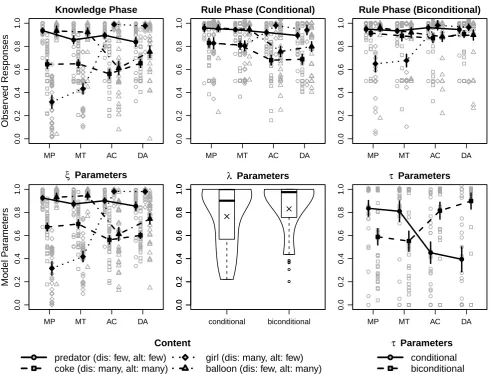
Observed Data. The observed data are displayed in the
upper row of Figure 2 for knowledge phase and the rule phases, separately for conditional and biconditional rules. The data were submitted to a repeated-measures ANOVA with factors type (without conditional, conditional infer-ences, biconditional inferences), inference (MP, MT, AC, DA), and content.
0.0 0.2 0.4 0.6 0.8 1.0 Knowledge Phase Obser v ed Responses ● ● ● ● ● ● ● ● ● ● ● ● ● ● ● ● ● ● ● ● ● ● ● ● ● ● ● ● ● ● ● ● ● ● ● ● ● ● ● ● ● ● ● ● ● ● ● ● ● ● ● ● ● ● ● ● ● ● ● ● ● ● ● ● ● ● ● ● ● ● ● ● ● ● ● ● ● ● ● ● ● ● ● ● ● ● ● ● ● ● ● ● ● ● ● ● ● ● ● ● ● ● ● ● ● ● ● ● ● ● ● ● ● ● ● ● ● ● ● ● ● ● ● ● ● ● ● ●
MP MT AC DA
0.0 0.2 0.4 0.6 0.8 1.0
Rule Phase (Conditional)
● ● ● ● ● ● ● ● ● ● ● ● ● ● ● ● ● ● ● ● ● ● ● ● ● ● ● ● ● ● ● ● ● ● ● ● ● ● ● ● ● ● ● ● ● ● ● ● ● ● ● ● ● ● ● ● ● ● ● ● ● ● ● ● ● ● ● ● ● ● ● ● ● ● ● ● ● ● ● ● ● ● ● ● ● ● ● ● ● ● ● ● ● ●●● ● ● ● ● ● ● ● ● ● ● ● ● ● ● ● ● ● ● ● ● ● ● ● ● ● ● ● ● ● ● ● ●
MP MT AC DA
0.0 0.2 0.4 0.6 0.8 1.0
Rule Phase (Biconditional)
● ● ● ● ● ● ● ● ● ● ● ● ● ● ● ● ● ● ● ● ● ● ● ● ● ● ● ● ● ● ● ● ● ● ● ● ● ● ● ● ● ● ● ● ● ● ● ● ● ● ● ● ● ● ● ● ● ● ● ● ● ● ●●●●●● ● ● ● ● ● ● ● ● ● ● ● ● ● ● ● ● ● ● ● ● ● ● ● ● ● ●● ● ● ● ● ● ● ● ● ● ● ● ● ● ● ● ● ● ● ● ● ● ● ● ● ● ● ● ● ● ● ● ● ●
MP MT AC DA
0.0 0.2 0.4 0.6 0.8 1.0
ξ Parameters
Model P ar ameters ● ● ● ● ● ● ● ● ● ● ● ● ● ● ● ● ● ● ● ● ● ● ● ● ● ● ● ● ● ● ● ● ● ● ● ● ● ● ● ● ● ● ● ● ● ● ● ● ● ● ● ● ● ● ● ● ● ● ● ● ● ● ● ● ● ● ● ● ● ● ● ● ● ● ● ● ● ● ● ● ● ● ● ● ● ● ● ● ● ● ● ● ● ● ● ● ● ● ● ● ● ● ● ● ● ● ● ● ● ● ● ● ● ● ● ● ● ● ● ● ● ● ● ● ● ● ● ●
MP MT AC DA
0.0 0.2 0.4 0.6 0.8 1.0 conditional biconditional 0.0 0.2 0.4 0.6 0.8 1.0 ● ● ● ● ● 0.0 0.2 0.4 0.6 0.8 1.0
λ Parameters
0.0 0.2 0.4 0.6 0.8 1.0
τ Parameters
● ● ● ● ● ● ● ● ● ● ● ● ● ● ● ● ● ● ● ● ● ● ● ● ● ● ● ● ● ● ● ●● ● ● ● ● ● ● ● ● ● ● ● ● ● ● ● ● ● ● ● ● ● ● ● ● ● ● ● ● ● ● ● ● ● ● ● ● ● ● ● ● ● ● ● ● ● ● ● ● ● ● ● ● ● ● ● ● ● ● ● ● ● ● ● ● ● ● ● ● ● ● ● ● ● ● ● ● ● ● ● ● ● ● ● ● ● ● ● ● ● ● ● ● ● ● ●
MP MT AC DA
●
Content
predator (dis: few, alt: few) coke (dis: many, alt: many)
girl (dis: many, alt: few) balloon (dis: few, alt: many)
●
τ Parameters
[image:9.595.57.548.79.453.2]conditional biconditional
Figure 2. Observed responses (upper row) and model parameters (lower row) from Experiment 1. Mean values are displayed in black, error bars show per-plot difference-adjusted 95%-Cousineau-Morey-Baguley intervals (Baguley, 2012). Individual participants’ values are displayed as in Figure 1. Theλparameters (lower row, middle panel) are displayed in a violin plot (Hintze & Nelson, 1998) in which the outlines show the density, the boxplots the first, second (i.e., median), and third quartiles, and the×the mean. dis=disablers; alt= alternatives.
There was a significant main effect of type, F(1.68,50.28) = 61.74, η2
G = .12, p < .0001,
4
and a significant interaction of type and inference, F(3.70,111.04) = 12.08, η2
G = .03, p < .0001: Mean
endorsement was larger by .13 for inferences with con-ditional rule than for reduced inferences, t(60) = 10.80,
pH < .0001, and this increase, ∆, was more pronounced
for MP and MT than for AC and DA,∆MP and MT = .16,
∆AC and DA = .09, t(180) = 4.53, pH < .0001. Both
increases were individually significant (both pH < .0001).
Switching from conditional to biconditional rules led to a further increase in overall endorsement by an amount of .04, t(60)=2.61,pH=.01.
As can be seen in Figure 2, the expected effects of dis-ablers and alternatives were also present across all inference
4Throughout the manuscript degrees of freedom (df) are Greenhouse-Geisser corrected in ANOVAs for repeated-measures factors with more than two levels. Furthermore, we reportη2
G as
effect size measure for ANOVAs following Bakeman’s (2005) rec-ommendations. Contrasts are obtained using the methods imple-mented inlsmeans(Lenth, 2015). For ANOVAs, contrasts use un-corrected Satterthwaite approximateddf. To control for multiple testing, p-values of follow-up contrasts are corrected using either the Bonferroni-Holm correction (Holm, 1979), denoted pH, or, in
case all follow-up tests share the samedf and do not involve one-tailed tests, a generalization of the Bonferroni-Holm method which takes the correlation among parameters into account (methodfree in packagemultcomp, Bretz, Hothorn, & Westfall, 2011), denoted
pF. Tests are one-tailed throughout the manuscript for the
types and most pronounced in the knowledge phase. Con-tents with many disablers (i.e., the coke and girl content) were associated with depressed endorsement for MP and MT, whereas contents with many alternatives (i.e., the coke and balloon content) were asssociated with depressed endorse-ment for AC and DA, leading to a substantial interaction of inference and content, F(4.11,123.23) = 62.22,η2
G = .26,
p< .0001.
In addition to the effects reported above, all other effects of the ANOVA were significant, including the three-way in-teraction of type, inference, and content,F(8.50,255.02) = 15.53,η2
G =.08,p < .0001. The just-reported effects were
thus further modified by a higher-order interaction. Note, however, that the reported patterns hold quite consistently across conditions.
Dual-Source Model. We fitted the DSM to the 48 data
points of each individual participant using 20 parameters: 4 ×3 parameters underlyingξplus 2×4λτparameters from which we obtained two sets of oneλand fourτparameters each, one set for the conditional rule and one set for the bi-conditional rule. Overall model fit was good, meanR2 =.90
(SD = .06), mean and individual parameter estimates are shown in the lower row of Figure 2.
Results confirmed the prediction of selective influence. The effect of rule type (conditional vs. biconditional) on the mixture weight parametersλwas small and not signif-icant in a repeated-measures ANOVA with factor rule type, F(1,30)=3.15,η2
G =.02, p=.09. In contrast, a
repeated-measures ANOVA of theτparameters with factors rule type and inference revealed a small main effect of rule type, F(1,30) = 4.92,η2G = .02, p = .03, moderated by a sub-stantial interaction with inference, F(2.10,63.10) = 27.54, η2
G=.20,p< .0001. There was no main effect of inference,
F <1. Taken together, rule type did not affect the weighting of the two types of information; instead, it affected the form-based information.
Follow-up contrasts revealed that theτparameters were lower for the biconditionals than for the conditionals by a mean amount of−.25,t(83.78)=−4.51,pH< .0001, for MP
and MT, whereas they were larger for AC and DA by a mean amount of.43,t(83.78)=7.76,pH < .0001. Theτ
parame-ters for the conditional inferences showed the pattern usually obtained for abstract conditionals (see lower right panel of Figure 2).
The knowledge parameters ξ mimicked the pattern of endorsements observed in the knowledge phase: A repeated-measures ANOVA of theξparameters with factors inference and content revealed a significant interaction, F(4.41,132.30) = 119.61, η2
G = .56, p < .0001. ξ
parameters of MP and MT were smaller for contents with many disablers than for contents with few disablers by a mean amount of −.39, t(161) = −19.76, pF < .0001,
whereas there was no such difference for AC and DA, the
mean difference being .00, t(161) = 0.19, pF = .85. The
ξparameters of AC and DA were smaller for contents with many alternatives than for contents with few alternatives by a mean amount of−.30,t(161) = −15.08, pF < .0001,
and theξparameters of MP and MT were larger by a mean amount of.18,t(161)=9.06,pF < .0001.
Discussion
We found the predicted selective influence of the inference form manipulation on the parameters of the DSM. Contrast-ing conditional and biconditional inferences affected only the form-parametersτ, but not the mixture weightsλ. These re-sults are consistent with the DSM assumption that the role of a (bi)conditional rule in probabilistic (bi)conditional in-ferences is to provide content-independent form-based infor-mation that reasoners integrate with their background knowl-edge about the content of the inference.
That τparameters of MP and MT were found lower for the biconditional than for the conditional was somewhat un-expected. This pattern does not conform to the usual inter-pretation of biconditionals according to which the bicondi-tional rule licenses all four inferences alike. However, in-stead of the “canonical” form of biconditionals (“if and only ifpthenq”), we used a form that sounded more natural in a probabilistic setting (“ifpthen and only thenq”). This form may have specifically emphasized the necessity of p for q on which AC and DA are based, while being more neutral towards the sufficiency of pforqon which MP and MT are based.
Experiment 2: Selective Influence on theλParameters
The second experiment sought evidence for the assump-tion that theλparameter reflects the relative weight given to the form-based versus knowledge-based information. To this end, we employed a paradigm introduced by Stevenson and Over (2001) in which we manipulated – within-participants – the expertise with which a conditional was uttered: Some conditionals were uttered by an expert on the rule’s con-tent, others by a non-expert. For example, the conditional “If Anne eats a lot of parsley then the level of iron in her blood will increase” could have been stated by either a nutri-tion scientist or a drugstore clerk. As this manipulanutri-tion does not change the form of the inferences, it should not affect τ. Rather, if a conditional is uttered by a non-expert (e.g., a drugstore clerk), reasoners should discount the rule and rely more strongly on their background knowledge of the subject matter than for rules stemming from an expert source. In terms of the DSM, this should lead to an effect on theλ
rameter for the relative weight given to form-based versus knowledge-based information.
A secondary goal was to see whether the applicability of the DSM would generalize to contents without strong causal links between antecedent and consequent.5Note that we
nev-ertheless did not use abstract materials, but everyday contents for which participants prior knowledge was assumed to be rather vague. This ensured that the manipulation of speaker expertise could overshadow participants’ prior knowledge. To develop appropriate materials we first performed a large online pilot study (N=435) in which we tested 20 different conditionals constructed after Stevenson and Over (2001) for which participants were expected to have little prior causal knowledge. Results replicated the effect of speaker expertise reported by Stevenson and Over (2001) on MP such that en-dorsement was lower for conditionals uttered by non-experts compared to experts. However, we could not replicate such an effect on MT. Extending Stevenson and Over’s work, we also tested AC and DA and found a similar effect on DA, but not on AC. For the current experiment, we selected the seven conditionals with particularly strong effects of speaker expertise. A full description of the pilot study can be found in the online appendix.
Method
Participants. Because the effects of speaker expertise
observed in the pilot study were comparatively small, we collected more participants per group than in our other ex-periments. A total of 153 participants (51 per group) were sampled. Of these, 138 (mean age 21.9 years,SD=3.4) par-ticipated in both phases of the experiment; 47, 46, and 45, in order, in the experimental group, the knowledge control group, and the rule control group. Participants received 12€ as monetary gratification.
Materials and Procedure. The procedure followed the
“General Method” with a few changes. Six contents (out of the pool of seven) were randomly selected for each partic-ipant. In the knowledge phase, participants only saw the minor premise and were asked to rate the probability of a conclusion. The minor premise was labeled “situation”; for example,
Situation: Anne eats a lot of parsley.
How likely do you think it is that the level of iron in her blood will increase?
Participants provided 48 responses, obtained by crossing 6 contents, 4 inferences (MP, MT, AC, DA), and 2 conclusion polarities (original vs. converse).
In the rule phase, the same six contents were again used. For three randomly selected contents, the conditional rules were uttered by an expert (e.g., “A nutrition scientist says: If Anne eats a lot of parsley then the level of iron in her blood will increase.”), and by a non-expert for the remaining
three rules (e.g., “A drugstore clerk says: If Anne . . . ”). The manipulation of speaker expertise was performed within-participants; the expertise assigned to each rule was random-ized across participants. Note that speaker expertise was ma-nipulated only in the rule phase and not in the knowledge phase. After aggregating across original and converse infer-ence, participants provided 2 ×24=48 data points across knowledge and rule phase.
Participants in the knowledge control group responded to reduced problems in both sessions. Participants in the rule control group started with the rule phase in the first session which was identical to the rule phase of the experimental group, but they also had to appear for a second session.
Results
Observed Data. We submitted the observed data to a
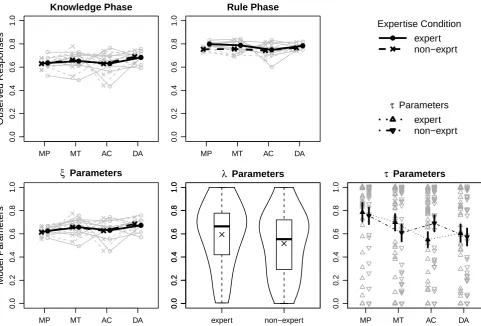
linear mixed model (LMM) with fixed effects for inference, phase (knowledge vs. rule), expertise (expert vs. non-expert), and their interactions. Note that for this analysis, contents that were assigned to experts or non-experts in the rule phase were assigned the same expertise status in the knowledge phase although we did not manipulate expertise in the knowledge phase (i.e., an effect of expertise in the knowledge phase was a priori impossible). Furthermore, we estimated crossed random effects for participant and content with maximal random slopes (i.e., random slopes for infer-ence, expertise, phase, and their interactions for both random effects; Barr, Levy, Scheepers, & Tily, 2013; see online ap-pendix for more details). Each participant provided three re-sponses per cell of the design. The estimated marginal means of the LMM are displayed in Figure 3, upper row.
The only significant effect to emerge was a main effect of phase, χ2(1) = 13.35, p = .0002, all other p > .19. Re-sponses were larger by a mean amount of.12 for full infer-ences in the rule phase compared to reduced inferinfer-ences in the knowledge phase.
We fitted a separate LMM to the rule-phase data in which expertise had been manipulated. This provided some evi-dence for an effect of expertise, χ2(1) = 3.66, p = .06;
p > .49 for all other effects and interactions. Follow-up
contrasts showed that only for MP was there evidence for an effect of speaker expertise (difference=.05), z = 2.41, pH=.03, but not for the other three inferences, allpH> .23.
Dual-Source Model. The DSM for the 48 data points
per participant uses 26 parameters: 6×3 parameters under-lyingξ plus 2×4 λτparameters from which we obtained
0.0
0.2
0.4
0.6
0.8
1.0
Knowledge Phase
Obser
v
ed Responses
● ●
● ●
● ●
● ●
● ●
● ● ●
● ●
●
● ●
● ●
● ● ● ●
● ●
● ●
● ● ●
●
MP MT AC DA
0.0
0.2
0.4
0.6
0.8
1.0
Rule Phase
● ●
● ●
● ●
● ● ●
● ●
●
● ● ● ●
● ●
● ●
● ●
● ●
● ●
● ●
● ●
● ●
MP MT AC DA
●
Expertise Condition expert non−exprt
τ Parameters expert non−exprt
0.0
0.2
0.4
0.6
0.8
1.0
ξ Parameters
Model P
ar
ameters
● ●
● ● ●
●
● ●
● ●
● ● ●
● ●
●
● ●
● ● ●
● ●
●
● ●
● ●
● ● ●
●
MP MT AC DA
0.0
0.2
0.4
0.6
0.8
1.0
expert non−expert
0.0
0.2
0.4
0.6
0.8
1.0
0.0
0.2
0.4
0.6
0.8
1.0
λ Parameters
0.0
0.2
0.4
0.6
0.8
1.0
τ Parameters
[image:12.595.62.544.81.407.2]MP MT AC DA
Figure 3. Observed responses (upper row) and DSM parameters (lower row) for Experiment 2. Estimated marginal means from LMMs are displayed in black, grey lines show LMM estimates for the random effect of content. Theλandτparameters are displayed as in Figure 2.
two sets of oneλ and four τ parameters, one set for each expertise condition. Overall model fit was acceptable, mean R2 = .82 (SD =.13), mean and individual parameter
esti-mates are shown in Figure 3, lower row.
A repeated-measures ANOVA of the λparameters with factor expertise showed that meanλwas significantly larger for experts than for non-experts,F(1,46)=6.88,η2G =.02, p =.01. In contrast, a repeated-measures ANOVA of theτ parameters with factors expertise and inference revealed only a main effect of inference,F(2.55,117.45)=5.08,η2
G=.03,
p = .004, but no main effect of expertise, F < 1, nor an interaction of both factorsF(2.76,127.10)=1.93,η2
G=.01,
p=.13. Considering the main effect of inference, the pattern of theτparameters descriptively followed the pattern usually obtained for abstract contents (see lower right panel of Fig-ure 3). Taken together, the manipulation of speaker expertise affected only the weighting of the two types of information (λ), but not the form-based information (τ).
Discussion
We found the predicted selective influence of speaker ex-pertise on the parameters of the DSM. The exex-pertise with
which the conditional was uttered affected only the weight parameterλ, but not the form parametersτ. Experiment 2 also replicated Stevenson and Over’s (2001) classical exper-tise effect for MP. To our knowledge, this is the first repli-cation of the effect. Going beyond replication, the present results suggest that the effect is driven by the mixture weight: Some participants discount a low-expertise conditional, rely-ing on their background knowledge more strongly for such conditionals than for high-expertise conditionals.
content-independent information based on the form of an in-ference.
The DSM in its current form does not permit an influ-ence of the conditional rule on the participants’ background knowledge. It is possible that a Bayesian model of the effects of speaker expertise could be developed in which updating by a conditional rule changes the knowledge base via an updat-ing process that leads to different changes in one’s knowledge base as a function of whether the conditional is uttered by an expert or by a non-expert. As discussed in the introduction, there is, however, currently no agreed-upon or normative way of Bayesian updating by a conditional premise (see below for three descriptive approaches).
Together with Klauer et al.’s results (2010), the results presented so far provide evidence for the theoretical assump-tions underlying the DSM and for the intended psycholog-ical interpretations of the model parameters. At least two dissociable and quantifiable cognitive processes contribute to probabilistic conditional reasoning, plus an independent and dissociable weighting process determining how the two types of information are integrated. In the next experiment, we move from validation to applying the DSM as a mea-surement model to dissect the classical suppression effects first described by Byrne (1989) into possible effects on the knowledge-based component, the form-based component, or their mixture.
Experiment 3: Dissecting Suppression Effects
Human reasoning is defeasibleor non-monotonic: New premises can render a previously acceptable inference un-acceptable. A classical demonstration of non-monotonicity goes back to Byrne (1989) who compared acceptance rates of conditional inferences with and without an additional premise. For example, given Premises 1 and 3 below, most reasoners accept the Conclusion 4 in an MP inference. Upon adding Premise 2, the acceptance of the conclusion usually drops dramatically.
1. If a balloon is pricked with a needle then it will quickly lose air.
2. If a balloon is inflated to begin with then it will quickly lose air.
3. A balloon is pricked with a needle.
4. The balloon quickly loses air.
MP and MT require that p is sufficient to bring about q, and sufficiency is questioned by disablers. AC and DA require that p is necessary for q to occur, and necessity is questioned by alternatives. Premises such as Premise 2 sug-gesting a disabling condition (the balloon is not inflated in
the first place) reduce acceptance of the MP and MT infer-ences with little effect on AC and DA. Conversely, adding a premise suggesting an alternative cause (e.g., Premise 2’: If a balloon is inflated too much and bursts then it will quickly lose air) decreases acceptance of AC and DA with little effect on MP and MT (Byrne, Espino, & Santamaria, 1999; Chan & Chua, 1994; Neth & Beller, 1999).
Several explanations have been offered. One possibility retains monotonicity of human reasoning and claims that the two rules are combined into one such as “If the balloon is pricked with a needle and it is inflated to begin with then it will quickly lose air” (e.g., Byrne, 1989; Stenning & van Lambalgen, 2010) or similarly that they are combined in one mental model (Johnson-Laird & Byrne, 2002), changing the formal or semantic structure of the argument. Another pos-sibility, based on the pragmatics of natural language, is that the second premise undermines the belief in the truth of the conditional rule (Bonnefon & Politzer, 2010), undermining all inferences that might be drawn from it formally. A third possibility exemplified by Oaksford and Chater (2007, chap. 5) is that the second premise alters the knowledge base on which the assessment of the probability of the conclusion rests.
In terms of the DSM, the first possibility should lead to a change in the profile ofτparameters across inferences, the second to a decrease in the weightλgiven to the form-based information, the third to an effect on the knowledge param-eters ξ. Note that the three possibilities by no means ex-clude each other. Experiment 3 aims at assessing the extent to which suppression effects reflect effects on the form-based information (τ), on the weight given to such information (λ), and/or on the knowledge parametersξin probabilistic rea-soning.
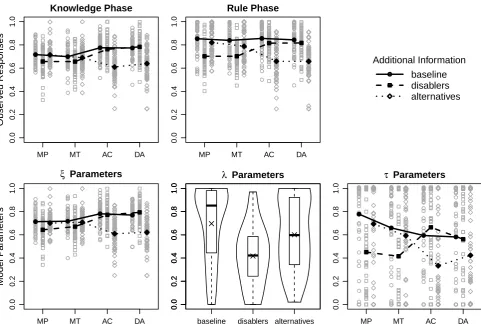
A baseline group followed the procedures described in the section “General Method” above; members of two addi-tional groups, the disablers group and the alternatives group, worked on the same problems with additional information presented for each problem. In the disablers group, the ad-ditional information specified disablers; in the alternatives group, alternative causes. The additional information was always presented in both knowledge and rule phase to enable us to assess the influence of the additional information on the full set of DSM parameters.
ex-periments was virtually indistinguishable, we pooled the data sets and only report the pooled analysis here, retaining exper-iment as a factor in the analyses (see the online appendix for the separate analyses).
Method
Participants. In Experiment 3a, a total of 80 persons
participated in the first phase of the experiment; 26, 27, and 27, in order, in the baseline group, disablers group, and alter-natives group. Of these, 77 (mean age 23.5 years,SD=4.5) participated in both phases of the experiment (3 participants in the alternatives group did not appear for the second ses-sion).
In Experiment 3b, a total of 281 persons participated in the first phase; in the experimental groups, in order, 31, 31, and 31 in the baseline group, disabler group, and alternatives group; in the knowledge control groups, 32, 31, and 31; in the rule control groups, 31, 32, and 31. Of those, 273 (mean age 21.5 years,SD=3.2) participated in both phases of the experiment (29, 31, and 31 in the experimental groups; 31, 31, and 30 in the knowledge control groups; 29, 32, and 29 in the rule control groups). In both experiments participants received 12€for their participation.
Materials and Procedure. We used the four contents
displayed in Table 3 (we slightly adapted contents 2 and 3 such that we were able to present both disablers and alterna-tives). Pilot work pretested different ways of presenting the additional information. Presenting the additional informa-tion as addiinforma-tional condiinforma-tionals as done by Byrne (1989) did not lead to suppression effects of similar size as the ones re-ported by Byrne; the obtained effects were small or absent.6 Therefore, we decided to present three additional counterex-amples in a form clearly signaling their causal influence on the conditional, using “only . . . if” for disablers and “also . . . if” for alternative causes. For example, MP for the coke content in the disablers group was presented in the following way in Experiment 3b:
Rule: If a person drinks a lot of coke then the person will gain weight.
Observation:A person drinks a lot of coke. How likely is it that the person will gain weight? Please note:
A persononlygains weight if
• the metabolism of the person permits it,
• the person does not exercise as a compen-sation,
• the person does not only drink diet coke.
In the alternatives group, this content was presented in the following way:
Rule: If a person drinks a lot of coke then the person will gain weight.
Observation:A person drinks a lot of coke. How likely is it that the person will gain weight? Please note:
A personalsogains weight if
• the person eats a lot,
• the person has metabolic problems,
• the person hardly exercises.
Prior to Experiment 3b we assessed the validity of the pre-sented additional information in a pretest. The full list of the items used in Experiments 3a and 3b (including the ad-ditional information and a description of the pretest) can be found in the online appendix.
The procedure otherwise followed the “General Method” with the only difference that the disablers and alternatives were presented alongside the inferences in the disablers and alternatives groups, respectively, as exemplified above in both knowledge and rule phases.
Participants responded to 32 items in each phase obtained by crossing 4 contents, 4 inferences, and 2 conclusion polari-ties. After aggregating original and converse inference, there were 2×16=32 data points per participant.
Results
Observed data. The upper rows of Figure 4 present
mean endorsements as a function of group and inference (see online appendix for plots further split up by contents). A mixed-effects ANOVA with within-participants factors phase (knowledge vs. rule), inference (MP, MT, AC, and DA), and content (see Table 3), and between-participants factors group (baseline, disablers, and alternatives), and experiment (Experiment 3a vs. 3b), was run to see whether suppression effects were observed in the rule phase and perhaps already in the knowledge phase. Note that for this ANOVA and all further ANOVAs reported for Experiment 3, the effect of ex-periment did not reach significance, allF<1.3, allp> .08. The signature of suppression effects is that disablers sup-press MP and MT, but not AC and DA, and vice versa for alternatives. Consistent with this signature, we found an in-teraction of inference and group, F(3.69,298.65) = 40.51,
η2
G = .07, p < .0001, qualified by a significant three-way
interaction with phase, F(4.91,397.72) = 2.99,η2G = .002, p = .01. This latter interaction indicated that suppression effects differ across phases.
0.0 0.2 0.4 0.6 0.8 1.0 Knowledge Phase Obser v ed Responses ● ● ● ● ● ● ● ● ● ● ● ● ● ● ● ● ● ● ● ● ● ● ● ● ● ● ● ● ● ● ● ● ● ● ● ● ● ● ● ● ● ● ● ● ● ● ● ● ● ● ● ● ● ● ● ● ● ● ● ● ● ● ● ● ● ● ● ● ● ● ● ● ● ● ● ● ● ● ● ● ● ● ● ● ● ● ● ● ● ● ● ● ● ● ● ● ● ● ● ● ● ● ● ● ● ● ● ● ● ● ● ● ● ● ● ● ● ● ● ● ● ● ● ● ● ● ● ● ● ● ● ● ● ● ● ● ● ● ● ● ● ● ● ● ● ● ● ● ● ● ● ● ● ● ● ● ● ● ● ● ● ● ● ● ● ● ● ● ● ● ● ● ● ● ● ● ● ● ● ● ● ● ● ● ● ● ● ● ● ● ● ● ● ● ● ● ● ● ● ● ● ● ● ● ● ● ● ● ● ● ● ● ● ● ● ● ● ● ● ● ● ● ● ●
MP MT AC DA
0.0 0.2 0.4 0.6 0.8 1.0 Rule Phase ● ● ● ● ● ● ● ● ● ● ● ● ● ● ● ● ● ● ● ● ● ● ● ● ● ● ● ● ● ● ● ● ● ● ● ● ● ● ● ● ● ● ● ● ● ● ● ● ● ● ● ● ● ● ● ● ● ● ● ● ● ● ● ● ● ● ● ● ● ● ● ● ● ● ● ● ● ● ● ● ● ● ● ● ● ● ● ● ● ● ● ● ● ● ● ● ● ● ● ● ● ● ● ● ● ● ● ● ● ● ● ● ● ● ● ● ● ● ● ● ● ● ● ● ● ● ● ● ● ● ● ● ● ● ● ● ● ● ● ● ● ● ● ● ● ● ● ● ● ● ● ● ● ● ● ● ● ● ● ● ● ● ● ● ● ● ● ● ● ● ● ● ● ● ● ● ● ● ● ● ● ● ● ● ● ● ● ● ● ● ● ● ● ● ● ● ● ● ● ● ● ● ● ● ● ● ● ● ● ● ● ● ● ● ● ● ● ● ● ● ● ● ● ●
MP MT AC DA
● Additional Information baseline disablers alternatives 0.0 0.2 0.4 0.6 0.8 1.0
ξ Parameters
Model P ar ameters ● ● ● ● ● ● ● ● ● ● ● ● ● ● ● ● ● ● ● ● ● ● ● ● ● ● ● ● ● ● ● ● ● ● ● ● ● ● ● ● ● ● ● ● ● ● ● ● ● ● ● ● ● ● ● ● ● ● ● ● ● ● ● ● ● ● ● ● ● ● ● ● ● ● ● ● ● ● ● ● ● ● ● ● ● ● ● ● ● ● ● ● ● ● ● ● ● ● ● ● ● ● ● ● ● ● ● ● ● ● ● ● ● ● ● ● ● ● ● ● ● ● ● ● ● ● ● ● ● ● ● ● ● ● ● ● ● ● ● ● ● ● ● ● ● ● ● ● ● ● ● ● ● ● ● ● ● ● ● ● ● ● ● ● ● ● ● ● ● ● ● ● ● ● ● ● ● ● ● ● ● ● ● ● ● ● ● ● ● ● ● ● ● ● ● ● ● ● ● ● ● ● ● ● ● ● ● ● ● ● ● ● ● ● ● ● ● ● ● ● ● ● ● ●
MP MT AC DA
0.0 0.2 0.4 0.6 0.8 1.0
baseline disablers alternatives
0.0 0.2 0.4 0.6 0.8 1.0 0.0 0.2 0.4 0.6 0.8 1.0 0.0 0.2 0.4 0.6 0.8 1.0
λ Parameters
0.0 0.2 0.4 0.6 0.8 1.0
τ Parameters
● ● ● ● ● ● ● ● ● ● ● ● ● ● ● ● ● ● ● ● ● ● ● ● ● ● ● ● ● ● ● ● ● ● ● ● ● ● ● ● ● ● ● ● ● ● ● ● ● ● ● ● ● ● ● ● ● ● ● ● ● ● ● ● ● ● ● ● ● ● ● ● ● ● ● ● ● ● ● ● ● ● ● ● ● ● ● ● ● ● ● ● ● ● ● ● ● ● ● ● ● ● ● ● ● ● ● ● ● ● ● ● ● ● ● ● ● ● ● ● ● ● ● ● ● ● ● ● ● ● ● ● ● ● ● ● ● ● ● ● ● ● ● ● ● ● ● ● ● ● ● ● ● ● ● ● ● ● ● ● ● ● ● ● ● ● ● ● ● ● ● ● ● ● ● ● ● ● ● ● ● ● ● ● ● ● ● ● ● ● ● ● ● ● ● ● ● ● ● ● ● ● ● ● ● ● ● ● ● ● ● ● ● ● ● ● ● ● ● ● ● ● ● ●
[image:15.595.62.544.80.406.2]MP MT AC DA
Figure 4. Observed responses (upper row) and model parameters (lower row) from Experiments 3a and 3b combined. Mean and individual participants’ data points are shown as in Figure 2.
As can be seen in Figure 4 (upper row), endorsement of MP and MT was indeed decreased in the disablers group rel-ative to the baseline group, although this suppression effect was smaller in the knowledge phase,M =−.05,t(412.69)= −2.87, pH = .03, than in the rule phase, M = −.14,
t(412.69)=−8.14,pH < .0001 (pHof difference=.0001).
Analogously, endorsement of AC and DA was decreased in the alternatives group relative to the baseline group, and this suppression effect was of similar size in knowledge phase, M =−.15, and rule phase, M =−.19, botht < −8.1, both
pH < .0001 (pHof difference=.07). In contrast, in neither
phase did disablers suppress AC and DA or alternatives MP and MT, all|t| <2.26, allpH > .09. Taken together, there
were clear suppression effects showing the classical signa-ture.
Dual-source model. We fitted a DSM to each
partici-pant’s 32 data point using 16 parameters: 4×3 parameters underlyingξ, and 4λτparameters from which we obtained oneλand fourτparameters. The overall model fit was good, meanR2 =.89 (SD=.10). Parameter estimates are displayed
in the lower row of Figure 4 as a function of inference and group.
As can be seen in the figure, disablers and alternatives sup-press theτparameters of the “attacked” inferences, that is of MP and MT for disablers, and of AC and DA for alternatives. Disablers also undermine the overall weightλfor the rule and all inferences based on it, whereas alternatives also suppress the knowledge parametersξfor AC and DA.
Knowledge-parameters ξ. A mixed-effects ANOVA
with between-participants factors group and experiment, and within-participants factors content and inference found a significant interaction of group and inference, F(3.61,292.75) = 32.96,η2
G = .08, p < .0001. According
to follow-up contrasts, alternatives reducedξparameters for AC and DA by M = −.16 relative to the baseline group,
t(277.78) = −9.99, pH < .0001, but they left MP and
MT unaffected, M = −.01,t(277.78) = −0.59, pH > .99.
Disablers exerted a small suppression effect on MP and MT, M = −.06, t(277.28) = −3.72, pH = .0007 that was
significantly smaller than the just-reported suppression effect of alternatives on AC and DA, t(489.14) = 5.21,
pH< .0001. Disablers left AC and DA unaffected,M=.01,