Original citation:
Ramis Ferrer, Borja, Ahmad, Bilal, Vera, Daniel, Lobov, Andrei, Harrison, Robert and Martínez
Lastra, José Luis. (2016) Product, process and resource model coupling for knowledge-driven
assembly automation. Automatisierungstechnik, 64 (3). pp. 231-243.
Permanent WRAP URL:
http://wrap.warwick.ac.uk/78817
Copyright and reuse:
The Warwick Research Archive Portal (WRAP) makes this work by researchers of the
University of Warwick available open access under the following conditions. Copyright ©
and all moral rights to the version of the paper presented here belong to the individual
author(s) and/or other copyright owners. To the extent reasonable and practicable the
material made available in WRAP has been checked for eligibility before being made
available.
Copies of full items can be used for personal research or study, educational, or not-for-profit
purposes without prior permission or charge. Provided that the authors, title and full
bibliographic details are credited, a hyperlink and/or URL is given for the original metadata
page and the content is not changed in any way.
Publisher’s statement:
© De Gruyter 2016
http://dx.doi.org/10.1515/auto-2015-0073
A note on versions:
The version presented in WRAP is the published version or, version of record, and may be
cited as it appears here.
Anwendungen
Borja Ramis Ferrer*, Bilal Ahmad, Daniel Vera, Andrei Lobov, Robert Harrison, and
José Luis Martínez Lastra
Product, process and resource model coupling for
knowledge-driven assembly automation
Kopplung von Produkt-, Prozess- und Ressourcenmodell für die wissensgetriebene
Montageautomation
DOI 10.1515/auto-2015-0073
Received October 15, 2015; accepted December 30, 2015
Abstract: Accommodating frequent product changes in a short period of time is a challenging task due to limita-tions of the contemporary engineering approach to design, build and reconfigure automation systems. In particular, the growing quantity and diversity of manufacturing in-formation, and the increasing need to exchange and reuse this information in an efficient way has become a bottle-neck. To improve the engineering process, digital manu-facturing and Product, Process and Resource (PPR) mod-elling are considered very promising to compress devel-opment time and engineering cost by enabling efficient design and reconfiguration of manufacturing resources. However, due to ineffective coupling of PPR data, design and reconfiguration of assembly systems are still challeng-ing tasks due to the dependency on the knowledge and experience of engineers. This paper presents an approach for data models integration that can be employed for cou-pling the PPR domain models for matching the require-ments of products for assembly automation. The approach presented in this paper can be used effectively to link data models from various engineering domains and engineer-ing tools. For proof of concept, an example implementa-tion of the approach for modelling and integraimplementa-tion of PPR for a Festo test rig is presented as a case study.
Keywords: Knowledge driven systems, model coupling, ontology matching, assembly automation.
*Corresponding author: Borja Ramis Ferrer, Tampere University
of Technology – FAST-Lab. P.O. 600, FI-33101, Tampere, Finland, e-mail: [email protected]
Andrei Lobov, José Luis Martínez Lastra: Tampere University of
Technology – FAST-Lab. P.O. 600, FI-33101, Tampere, Finland
Bilal Ahmad, Daniel Vera, Robert Harrison: WMG, University of
Warwick, Coventry, CV4 7AL, United Kingdom
Zusammenfassung: Die Berücksichtigung häufiger Pro-duktänderungen innerhalb kurzer Zeiträume ist eine Her-ausforderung für Ingenieure aufgrund der Limitierungen aktueller Ansätze zum Entwurf, Aufbau und Rekonfigu-ration von Automatisierungssystemen. Insbesondere die steigende Menge und Vielfalt an Informationen aus der Produktion, die auf effiziente Art und Weise ausgetauscht und wiederverwendet werden sollen, führt zu einem Eng-pass. Zwei vielversprechende Ansätze um Entwicklungs-kosten und Entwicklungszeit zu reduzieren und gleichzei-tig eine effiziente Entwicklung sowie die Rekonfiguration des Montagesystems zu ermöglichen, sind die digitale Fa-brik und kombinierte Produkt-, Prozess- und Ressourcen-modelle (PPR). Aufgrund der bisher ineffizienten Verknüp-fung der PPR-Daten ist die Entwicklung und die Rekonfi-guration von Montageanlagen noch immer eine sehr an-spruchsvolle Aufgabe aufgrund der starken Abhängigkeit vom Fachwissen und der Erfahrung der Ingenieure. Dieser Artikel präsentiert einen Ansatz zur Integration von Da-tenmodellen, der zur Kopplung der PPR-Domänenmodelle eingesetzt werden kann, um die Anforderungen der Pro-dukte an die Montageautomatisierung zu erfüllen. Die hier vorgestellte Methode dient dazu, Datenmodelle und ih-re Werkzeuge aus verschiedenen Ingenieursdisziplinen zu koppeln. Zur Evaluation wird eine beispielhafte Imple-mentierung des Modell und Integrationsansatzes die Fall-studie eines FESTO-Prüfstandes präsentiert.
Schlüsselwörter: wissensbasierte Systeme, Koppel-modell, ontologische Übereinstimmung, Montageauto-matisierung, Produktionsautomatisierung.
1 Introduction
production volume constantly. For example, the automo-tive industry is expected to accommodate changes fre-quently due to increased environmental concerns, tech-nological advancements, changes in the market require-ments etc. As a result, product assembly is becom-ing a challengbecom-ing task. Industries have to frequently change manufacturing process plans and subsequently reconfigure/build assembly lines to manufacture new products [1].
Assembly systems within the automotive manufactur-ing sector are typically based on commonality approaches. Around80% of existing off-the-shelf manufacturing re-sources remain unchanged or slightly modified to accom-modate a new version of a product. However, due to the use of ad hoc engineering methods the knowledge utilised from previous similar projects is only a small percentage of the available knowledge [2]. It is reported in [3] that compa-nies are often unaware of the extent of in-house knowledge and therefore spend significant time searching for relevant information from previous similar projects.
To accommodate product changes, the required man-ufacturing process and associated resource constraints are typically checked manually due to the lack of tools that can support analysis of how the product changes will affect manufacturing operations. As a result, feasibility studies associated with the manufacturing of new products on ex-isting assembly lines, design of new process plans and re-quired reconfiguration of manufacturing resources remain subjective. Such ad hoc approaches rely heavily on the knowledge and experience of engineers that result in pro-longed lead-times and increased engineering costs [4].
To assist in the design, planning and reconfiguration of assembly systems, a number of digital modelling and simulation tools have been developed. These tools pro-vide a number of benefits such as visualisation, verifica-tion and optimisaverifica-tion of the manufacturing systems before the physical build [5,6]. However, manufacturing process and resource modelling is still a challenging and complex task. This is mainly due to the gaps that exist in the engi-neering process due to the reliance on ad hoc mechanisms for knowledge sharing, integration and reusability. Typi-cally, product, process, and resource information and data sets exist within a given organisation, but they are not ef-fectively coupled [7], which represents a big challenge in this field.
One promising approach to address this issue is the effective linking of the digital descriptions of the product attributes and requirements, to the characteristics of the manufacturing resources. The resulting knowledge-base derived from such integrated digital description can po-tentially increase the efficiency of the engineering
pro-cess. The focus of this paper is to improve PPR mod-elling of assembly automation systems by integrating vir-tual engineering tools with an ontology-based knowledge modelling system. To realise such modelling approach, a generic concept is presented that couples data mod-els of PPR. The matching of different ontology domain models in a knowledge-driven system can potentially pro-vide reusable knowledge-based PPR description to inter-connect product attributes with related manufacturing re-sources.
In this article, the authors present a method for cou-pling PPR data models that can be achieved within the implementation of the rule-based approaches described in [4,8] for mapping data of different concepts. In other words, this research work presents an application of pre-vious work for multiple domain ontologies matching. It should be noted that previous work focused directly on mapping data in a unique and artificial model. In fact in a real scenario, these models can be generated from the domain specific engineering tools by corresponding do-main experts. For this, the use of standard terminology and taxonomies is a promising approach, where standard-isation can be driven by relevant communities holding the expert knowledge on a particular domain. Based on query rules, the presented methodology allows mapping between product, process and resource ontology models that will become modules of the PPR model. The ontology-based representation of engineering knowledge permits the dynamic modelling and mapping of products to re-quired assembly processes and resources. Moreover, the use of standard languages for designing ontological mod-els means that data can be accessed by third party appli-cations, allowing retrieval and updating of the data model and thus makes the proposed approach extensible and scalable.
The remainder of this paper is organised as follows. Section2presents the background of the research work. Section3describes the approach for PPR model coupling within semantic descriptions. Section 4presents an im-plementation of the approach with a case study based on a Festo test rig. Finally, Section5concludes the research work and discusses further tasks.
2 Background
integrated with MPM (Manufacturing Processes Manage-ment) tools in order to achieve better integration between product design and manufacturing system design pro-cesses [9]. Paradigms such as design for assembly, fabri-cation, manufacture, etc. focus on integrating critical sign parameters and constraints, early in the product de-sign phase, in order to achieve higher level of concurrency and avoid deviations between product and production sys-tem design processes [10].
Within PLM systems, the concept of PPR extends the above mentioned concepts by integrating the notion of standardised manufacturing processes and resources, and the relation that exists between processes and re-sources [11]. In the domain of manufacturing, resources typically represent standardised modular machine units defined at various level of granularity (e.g. component, station, cell, zone, etc.). Each resource supports a spe-cific process and may consist of processes and sub-resources (e.g. a station-level transport system consisting of sub process and resources such as pre-stop, machine-stop and clamping operations).
A typical PPR-based engineering workflow consists of initiating the product design while the manufacturing process and resources required to manufacture this prod-uct are concurrently derived from the PPR information mapping. Existing PPR-based systems (e.g. Dassault En-ovia, Siemens TeamCenter) typically implement PPR ca-pabilities through the storage and integration (i.e. cross-referencing) of PPR data models. The increasing availabil-ity and usage of 3D based virtual modelling and simula-tion tools within PPR tool chain have significantly con-tributed to i) extending the data set integrated into PPR systems (mechanical/3D data, station/line layout, PLC control data in the form of re-usable Function Blocks, etc.) and ii) improving design support and validation functions through the use of dynamic 3D-based simulation environ-ment that provide an intuitive view of the complete data set and therefore of the final systems design.
PPR systems rely heavily on the use of relational database systems to store information and to define rela-tions between PPR data sets; relarela-tionships between data sets are based on physical or logical constraints and re-lations (e.g. processing time, product size/resource ca-pacity, etc.), or on specific relations derived from experi-ence collected during past projects (e.g. specific product variant/resource mapping). However, today’s deployment of advanced ICT systems and the exponentially increasing quantity of digital data generated, represents a real chal-lenge in not only managing the data (i.e. storage, categori-sation, storage), but also in defining and maintaining the
relation between various engineering data sets and mod-els.
The emergence of cyber-physical systems (CPS) in-tegration and the expected industry evolution (Industry 4.0), Knowledge Representation (KR) is a promising solu-tion to manage the referencing and integrasolu-tion of large and expending data sets. This permits the reduction of data processing overload and, at the same time, the support of advanced reasoning and design capabilities provided by knowledge-based systems.
KR is the field of study concerned with describing facts in a human and machine-readable format, which makes machines capable of automating processes with the usage of semantic descriptions. Aside from formally defining KR, [12] presents several formalisms that can be used for im-plementing KR. During the last decade, the industrial au-tomation research community has tended to implement ontologies for formal description of manufacturing sys-tems [13]. However, it should be noted that Linked Data [14] is considered as a simple method for managing interre-lated data in knowledge-based systems but with several challenges for reasoning [15]. On the other hand, other KR formalisms such as semantic rules or frames can be used for representing knowledge.
Ontologies contain formal descriptions, which can be queried and even reasoned. An ontological model is em-ployed as a data storage that contains the actual status of systems, which are semantically described through ax-ioms and relationships between instances of real world ob-jects. In addition, the design of models based on standards permits different designers to convey and describe knowl-edge with same terminologies and taxonomies. Although there are numerous semantic languages that can be used for modelling manufacturing systems, Resource Definition Framework (RDF)¹based languages are the dominant ones for model implementation in factory automation [16]. RDF is an XML-based language that belongs to the W3C stan-dard recommendations.
RDF-based models, or RDF graphs, are sets of RDF triples that permit the semantic description of any domain. Syntactically, triples are structured within a relation of three terms: subject, predicate and object. Furthermore, the Ontology Web Language (OWL) [17] is an RDF-based language that extends RDF within the declaration of class descriptions (e.g. enumeration, property restriction, cardi-nality constraints) and axioms allowing the enrichment of model descriptions. Hence, ontologies not only link data but also add semantics (or meaning) to model resources.
The information can be retrieved from models and modified with the use of standard query languages. This feature allows the data of graph accessible by other ap-plications. In fact, any RDF-based graph datasets can be queried within SPARQL [18] and updated via its extension SPARQL Update (SPARUL). SPARQL permits the extraction of model data in the form of result sets or RDF graphs. SPARUL is an extension of SPARQL that includes a set of operations for updating, creating and removing data from RDF-based models.
The utilisation of semantic descriptions in factory au-tomation domain permits the development of knowledge-driven solutions that are capable of managing and even orchestrating the execution of operations in contempo-rary production lines. For instance, [19] present useful ap-plications of KR in the factory automation domain that allows scalability and reconfigurability of intelligent in-dustrial automation systems. Implicit data of ontologies can be inferred by semantic reasoning engines to evalu-ate model descriptions and define new facts, which are not beforehand explicitly described [12]. This is a powerful characteristic of ontologies since the evaluation of mod-els, inclusion at runtime, can result in new classifications or assertions of data. Furthermore, reasoning allows re-structuring of models with statements which are not visi-ble or deducivisi-ble in the design phase. In addition, descrip-tion of semantic rules using Semantic Web Rules Language (SWRL) [20] can be employed for mapping data from differ-ent domains [4,8] to achieve model coupling.
Due to the number of domains involved in the engi-neering of manufacturing systems, the data generated dur-ing the design phase is heterogeneous and is defined in dif-ferent domain models. Therefore, effective model coupling and ontology matching becomes an important research fo-cus. [21] describes a conceptual methodology for merging heterogeneous data from upper levels. On the other hand, an example for lower level data coupling is shown in [22], which shows an implementation of algorithms for gener-ating unique models as aggregation of sub-models. The evaluation of mentioned studies and previous work done in [4,8] motivated and inspired the presented approach in this article.
3 Approach
The extensive use of virtual engineering tools in assem-bly automation for manufacturing process planning, opti-misation and validation is promising. Virtual engineering tools have shifted work activity from serial to parallel and advanced information and communication infrastructure
has replaced paper-based processes. Despite this, launch-ing a new product variant in the automotive industry re-mains a challenge. The selection of required manufactur-ing resources heavily rely on knowledge and experience of engineers. Although the PPR information exist separately, the lack of mappings between those data sets makes it dif-ficult to identify whether the manufacturing process could be executed using available resources. To address this, an approach for automating the mappings of products, pro-cesses and resources using semantic descriptions for as-sembly automation systems is presented in this section.
The use of modular ontologies (each module belongs to a different domain) and standard terminology and tax-onomies is a promising approach to achieving such PPR ontology coupling for assembly systems. Integration of modules in a unique representation creates a common source from which system information can be accessed. However, the main problem with using modular ontology is to define a manner of mapping data to be carried out by designers or with automatic approaches. In fact, the use of common terminology and taxonomies already presented in standards that are being implemented in the industry might avoid data naming convention issues. This requires employment of several standards for covering data man-aged in all levels of automation systems. For instance, the ISA 88 (used for defining the control batch processes) and the ISA 95 (used for describing the interface between en-terprise) can be integrated [23] and used for describing re-lated taxonomy in the PPR domain ontologies.
On the other hand, one of the problems that exits nowadays is the lack of a large infrastructure for sharing ontologies that could be reused for describing different in-dustry domains. In fact, the common practice is to develop in-house models that are frequently described in other for-mats than ontologies e.g. XML, UML models, MS Office documents etc. Nevertheless, models can be transformed to ontologies automatically using existing approaches [24,
25] besides creating them manually and from the scratch. Moreover, APIs as e.g. Apache POI²permits the manipula-tion of MS documents with Java so they can be transformed e.g. to XML objects.
The focus of this paper is working with different do-main ontologies and demonstrate how they can be cou-pled by mapping ontology elements, achieved by import-ing ontologies and combinimport-ing them through a rule-based approach. The implementation of this approach allows merging modular ontologies and therefore create a link
Product domain ontology Process domain ontology Resource domain ontology PPR domain ontology
[image:6.595.53.454.75.264.2]Rule1, Rule2, Rule3, Rule4, Rule5, Rule6
Figure 1: Representation of the resulting PPR domain ontology through different domain model coupling.
tween concepts and data covered by different domains that are frequently described with non-connected standards.
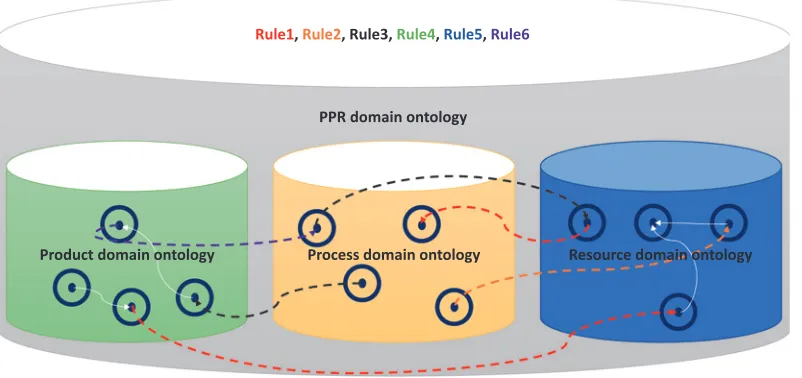
As this approach is intended for the case of having data in different ontologies, the mapping of data is in fact an interconnection between different domain mod-els to address the model coupling of Product, Process and Resource domain ontologies. Figure1 depicts that how instances belonging to different domain ontologies are matched with rules.
Taking into account the design of modular ontolo-gies [26], different models can be merged to form a unique higher level ontology. This is achieved by using existing ontology editors (e.g. Protégé³editor) that form a graph dataset containing all graphs of imported ontologies.
Nevertheless, merging ontologies does not result in automatic creation of link between data belonging to dif-ferent domains because tools (or an import action) only create a model containing all instances of imported mod-els. Thus, data coupling requires an extra process step. As shown in Figure1, the model coupling is achieved through the definition of rules that link different data domains. A semantic reasoner that evaluates the model and stated rules infers the interrelation between different data mod-els. It should be noted that creating the PPR ontology and data mapping semantic rules does not remove existing links of the individual domain ontologies, provided they do not create conflict with new rules. The important char-acteristic of achieving model coupling with the use of rules
3 http://protege.stanford.edu/
and a reasoning engine is that the reasoner automatically validates the consistency of the model.
The approach for domain model coupling of PPR data used in this research consist of following four main steps: 1. Importing domain models in a unique ontology 2. Define a set of object properties that relate different
domain concepts
3. Define a set of rules that can be understood by reason-ing engines to infer model couplreason-ing
4. Automatically infer links between instances and vali-date model consistency
In the first step, a first graph data set, known as the PPR on-tology, is created as an aggregation of all imported models. This new model contains all the elements of each ontol-ogy, and have its own Internationalised Resource Identifier (IRI). In the second step, additional object properties that interrelate different domain concepts are defined. These new properties are added in the PPR ontology IRI. Once object properties are added, a set of rules are defined in the next step. Finally, the semantic reasoning engines in-fer implicit data based on the rules defined in the previous step. The implementation of each step is further described in the case study.
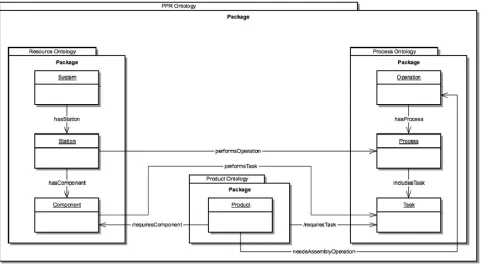
im-Figure 2: Processing Station ontology model.
plementation of the four step approach are shown in Fig-ure2with a UML class diagram. The diagram depicts the hierarchical distribution of packages (ontologies) and in-cluded classes, which permit the description of processes and resources of assembly lines for manufacturing prod-ucts.
Figure2depicts the resultant model. This diagram is used as a reference for required descriptions of the re-search work implementation. Although domain models are usually larger than the ones presented, the described classes are sufficient for demonstrating how the approach can be implemented. It should be noted that the model is reused from the research work presented in [4]. However, different concepts are now separated in different ontolo-gies which are treated as modules (or higher classes) of the PPR ontology model.
4 Case study
This section describes the implementation details of the approach presented in previous section with the help of a case study. The case study is based on a station of a Festo Modular Production System, which presents a small-scale realistic industrial test bench widely used for teaching and research purpose. Figure3shows the Festo test rig, com-posed of four stations: Distributing, Buffering, Processing
and Handling stations. The Processing Station is selected for this use case.
4.1 Creating the PPR ontology model
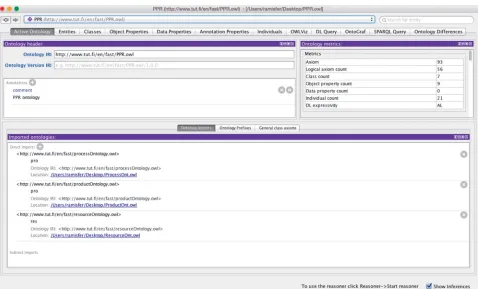
The first step of the approach is accomplished by import-ing all the ontology models in a unique model. This is car-ried out using an ontology editor that permits importing models and saving the resulting ontology in a file. Protégé is an ontology editor that is used to implement the pre-sented approach. Figure4shows the Active Ontology tab from the Protégé interface, in which the imported ontolo-gies information is shown.
As it can be seen in Figure4, imported ontologies re-tain the IRI which allow the differentiation between ele-ments that belong to different domain models (even if the name of the instances is same). Therefore, the difference in IRI forms a basis for querying and defining rules in the model.
[image:7.595.64.546.68.335.2]Figure 3: Festo test rig.
Figure 4: Imported ontologies in the PPR ontology.
A process is defined as a set of tasks performed in a cer-tain sequence.
With the import of product ontology, Product class is imported and included in the PPR ontology which is used for collecting types of products that are manufactured in the assembly line. All required relations for PPR mappings
are shown in the class diagram of Figure2, which is de-scribed in section4.2. These relations are implemented as ontology object properties because they are used as a rela-tionship between class instances.
[image:8.595.54.532.325.614.2]Table 1: Instances Property Assertions included in the PPR ontology model. Instance (type) Object property Instance (type)
product_1 (Product) needsAssemblyOperation op_01 (Operation)
product_2 (Product) op_02 (Operation)
festoSystem (System) hasStation processingStation (Station)
processingStation (Station) hasComponent rotaryInTableModule (Component) drillingModule (Component) testingModule (Component) clampingModule (Component) sortingGateModule (Component)
rotaryInTableModule (Component) performsTask advance_position (Task)
drillingModule (Component) drill (Task)
testingModule (Component) move_up (Task) move_down (Task)
clampingModule (Component) push_clamp (Task) release_clamp (Task)
sortingGateModule (Component) push_sort (Task) release_sort (Task)
op_01 (Operation) hasProcess process_1 (Process)
op_02 (Operation) process_2 (Process)
process_1 (Process) includesTask advance_position (Task) drill (Task)
push_clamp (Task) move_down (Task) move_up (Task) release_clamp (Task) push_sort (Task) release_sort (Task)
process_2 (Process) advance_position (Task) push_sort (Task) release_sort (Task)
physical concept description of the assembly line: System, Station and Component. System class is used for assembly line instances, representing an entire production line. Sta-tion contains different staSta-tions of a system which represent an assembly operation (such as piston stuffing). Compo-nent includes elements that are used for performing sta-tion operasta-tions (such as clamping).
4.2 Adding required object properties in the
ontology model
As described previously, some object properties are al-ready asserted when models are imported. This is because relationships described in models are not modified during the import process, which is just an aggregation of graphs
into the generated graph dataset. Hence, graphs that are linking instances with properties are not affected.
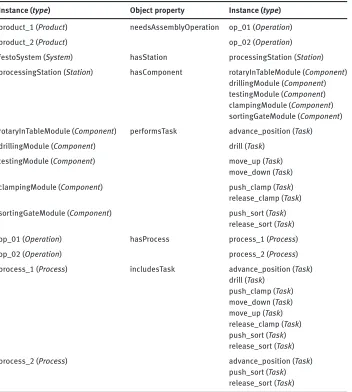
However, the new links that relate elements of differ-ent domain models are inserted once the unique ontol-ogy is being created. In this case study, the properties per-formsOperation and performsTask are added and linked between corresponding PPR ontology instances. The IRI of these properties is same as of the PPR ontology. These added properties in the second step of the approach are represented as UML direct association. Table1presents the relationships between instances of the model after the definition of the PPR ontology object properties. The names of instances are based on the information available in [27].
man-Figure 5: Class hierarchy and object property
hierarchy (a) before and (b) after enriching the PPR ontology.
ufacturing processes. Thus, they are related to op_01 and op_02 that, in turn, are related to process_1 and process_2. In this use case scenario, product_1 is executed using pro-cess_1. The main steps constitute: advancing through the station, position testing, drilling and sorting. On the other hand, product_2 does not require the manufacturing oper-ations of processing station and is transported to the next station through the positions of the station, which are the steps of the process_2.
It should be noted that in addition to the shown object properties in Table1, there are two more object properties represented in the UML ontology model: requiresCompo-nent and requiresTask. These properties are used for deter-mining which components and tasks are required to man-ufacture a product. However, they are represented within an UML derived association notation because such prop-erties are derived from information included in the model. Basically, requiresComponent and requiresTask are not ex-plicitly described because this approach implements such relation within semantic rules, as described in following sub-sections. Figure5shows the hierarchy of classes and object properties (a) before and (b) after the enrichment of object properties in the PPR ontology.
As it can be seen in Protégé views, the class hierarchy remains same in (a) and (b); the object property hierarchy changes because (b) contains the object properties shown in Figure2that are used for interrelating different domain models.
Figure6 depicts that processingStation resource do-main instance is linked to two dodo-main instances. First, it
is still linked with hasComponent object property to other resource domain instances (from the imported resource ontology model) and, afterwards, it is linked with differ-ent process domain instances (op_01 and op_02) with per-formsOperation object property.
4.3 Adding required SWRL rules and
coupling data in the ontology model
In addition to presented classes and object properties that are imported from different domain models and object properties that are defined in the PPR ontology, the auto-matic coupling of data is achieved with SWRL rules. This section presents two rules that allow the mapping between product, component and tasks of assembly lines. As the rules are expressed though SWRL they are suitable for any RDF-based ontology model. Table2shows the two SWRL rules that are defined for this use case.
[image:10.595.52.330.69.325.2]Figure 6: Object property assertions of
[image:11.595.62.505.378.454.2]processingStation in the PPR ontology.
Table 2: SWRL rules for automatic data coupling.
Rule 1: Linking products with required components Rule 2: Linking products with required tasks
Component(?c)∧Task(?t)∧Operation(?o)∧Station(?s)∧ Task(?t)∧Process(?p)∧Operation(?o)∧ Product(?pr)∧performsOperation(?s, ?o)∧ Product(?pr)∧includesTask(?p, ?t)∧
includesTask(?p, ?t)∧hasProcess(?o, ?p)∧ hasProcess(?o, ?p)∧needsAssemblyOperation(?pr, ?o) needsAssemblyOperation(?pr, ?o)∧hasComponent(?s, ?c)∧ →requiresTask(?pr, ?t)
performsTask(?c, ?t)→requiresComponent(?pr, ?c)
4.4 Automatic data mapping within
semantic reasoning engines
Using the presented SWRL rules, products can be inter-related with tasks and components. Thus, through SWRL rules and reasoning engines, the relation between prod-ucts, tasks and components are inferred. It should be noted that these rules could be merged in one rule, which would give the same mappings. However, the implemen-tation of two independent rules allows identifying which classes and properties are required for each type of map-ping. It should be noted that for this approach implemen-tation, Pellet reasoner [28] has been used as the reason-ing engine for obtainreason-ing the mappreason-ings. Thus, before SWRL rules are executed, Pellet must be started.
Once the reasoning engine runs the final graph, dataset is generated because it includes the inferred data. Figure7shows the inferred data mappings of product_1 (visible in property assertions tab) created with the help of SWRL rules and the evaluation done by the semantic
reasoner. The mappings demonstrate that the data of all models is successfully coupled because product_1 (prod-uct domain) is linked to op_01 and to a set of tasks (process domain) and, at the same time, to a set of components (re-source domain).
Figure 7: Inferred mappings in the PPR ontology.
5 Conclusion
This paper presents the application of a knowledge-based PPR mapping approach that can support dynamic config-uration of assembly systems because the model interrela-tions may change when populating the ontology with new instances. Such approach relies on capturing and formal-ising in house engineering knowledge that link Product, Process and Resource in order to reduce system develop-ment and reconfiguration time. To illustrate the concept, generic models of products, processes and manufactur-ing resource components are created for a Festo test rig with two product variants scenario. The authors believe that such approach can be extended to allow reconfigura-tion of existing manufacturing systems in order to include more complex products (e.g. product structure and com-plexity, product variants) querying the available facilities to manufacture a new product variant. From the results of the case study, it can be concluded that ontological map-ping of product, process and resource data and their rep-resentation within virtual modelling and simulation envi-ronment can, to a certain extent, allow the automation of the process that consists in instantiating a specific system from a library of PPR components and therefore to accel-erate the configuration of manufacturing system for a spe-cific production requirement.
The approach is implemented for a table-size test rig with a small number of components. Preliminary results are the automatic generation of a list of resource compo-nents based on Process and Product requirement input. Such results suggest that further development of ontology based system can potentially be used to achieve automatic configuration of manufacturing resources and contribute to the self-configuration paradigm introduced by Industry 4.0. An important aspect of the presented approach is the mapping between models based on query rules. The use of best practices to create these rules and serve as a ref-erence to develop and advance the expertise is an impor-tant research area which needs to be addressed to enable wide application of such approach. A wider application of the proposed approach is required in order to assess the robustness, practicality and efficiency in terms of timesav-ing of this approach. Further research will focus on ustimesav-ing semantics to characterise data collect from IoT devices de-ployed on the real system (e.g. PLC, energy monitors, sen-sors, production data) in order to further extend the data set based on which ontology and case based reasoning can be conducted.
project under the Flexible and Reconfigurable Manu-facturing Initiative and the graduate school funding of Tampere University of Technology in carrying out this work.
References
1. Kong, X., B. Ahmad, R. Harrison, Y. Park, and L.J. Lee. Direct
de-ployment of component-based automation systems. In Emerg-ing Technologies & Factory Automation (ETFA), 2012 IEEE 17th Conference on. 2012.
2. Raza, M.B., A knowledge based appraoch to integration of
products, processes and reconfigurable automation resources.
2012, Loughborough University.
3. Murray, S., Knowledge management in manufacturing, in The
Economist. 2007.
4. Ferrer, B.R., B. Ahmad, A. Lobov, D.A. Vera, J.L.M. Lastra, and R. Harrison. An approach for knowledge-driven product,
pro-cess and resource mappings for assembly automation. In Automation Science and Engineering (CASE), 2015 IEEE Inter-national Conference on. 2015. IEEE.
5. Kong, X., An approach to open virtual commissioning for
component-based automation, Doctoral Thesis, in Wolfson School of Mechanical and Manufacturing Engineering. 2013,
Loughborough University: Loughborough, Leicestershire. 6. Falkman, P., F. Westman, and C. Modig. Verification of
oper-ation sequences in process simulate by connecting a formal verification tool. In Control and Automation, 2009. ICCA 2009. IEEE International Conference on. 2009.
7. Raza, M., B. and R. Harrison, Design, development &
imple-mentation of ontological knowledge based system for auto-motive assembly lines. International Journal of Data Mining &
Knowledge Management Process, 2011.1(5): p. 21–40.
8. Ferrer, B.R., B. Ahmad, A. Lobov, D. Vera, J.L.M. Lastra, and R. Harrison. A knowledge-based solution for automatic
map-ping in component based automation systems. In Industrial Informatics (INDIN), 2015 IEEE 13th International Conference on.
2015. IEEE.
9. Haq, I., T. Masood, B. Ahmad, R. Harrison, B. Raza, and R. Mon-fared. Product to process lifecycle management in assembly
automation systems. In 7th CIRP international conference on digital enterprise technology. 2011. Athens, Greece.
10. Urrutia, U.A., P. Webb, and M. Summers. Analysis of Design for
X Methodologies for Complex Assembly Processes: A Literature Review. In ASME 2014 International Design Engineering Techni-cal Conferences and Computers and Information in Engineering Conference. 2014. American Society of Mechanical Engineers.
11. Choi, S.S., T.H. Yoon, and S.D. Noh, XML-based neutral file
and PLM integrator for PPR information exchange between heterogeneous PLM systems. International Journal of Computer
Integrated Manufacturing, 2010.23(3): p. 216–228.
12. Brachman, R. and H. Levesque, Knowledge representation and
reasoning. 2004: Elsevier.
13. Lastra, J.L.M., I.M. Delamer, and F. Ubis, Domain ontologies for
reasoning machines in factory automation. 2010: ISA.
14. Bizer, C., T. Heath, and T. Berners-Lee, Linked data-the story so
far. Semantic Services, Interoperability and Web Applications:
Emerging Concepts, 2009: p. 205–227.
15. Polleres, A., A. Hogan, R. Delbru, and J. Umbrich, RDFS and
OWL reasoning for linked data, in Reasoning Web. Semantic Technologies for Intelligent Data Access. 2013, Springer. p. 91–
149.
16. Kalibatiene, D. and O. Vasilecas, Survey on ontology
lan-guages, in Perspectives in Business Informatics Research.
2011, Springer. p. 124–141.
17. OWL Web Ontology Language Semantics and Abstract Syntax. 2015 [cited 2015 01 March]; Available from:http://www.w3.
org/TR/owl-semantics.
18. SPARQL Query Language for RDF. 2015 [cited 2015 01 March]; Available from:http://www.w3.org/TR/rdf-sparql-query. 19. Ramis, B., L. Gonzalez, S. Iarovyi, A. Lobov, J.L. Martinez
Las-tra, V. Vyatkin, and W. Dai. Knowledge-based web service
in-tegration for industrial automation. In Industrial Informatics (INDIN), 2014 12th IEEE International Conference on. 2014. IEEE.
20. SWRL: A Semantic Web Rule Language Combining OWL and
RuleML. [cited 2015 12 January]; Available from:http://www.
w3.org/Submission/SWRL/.
21. Yap, C.E. and M.H. Kim. Instance-based ontology matching with
rough set features selection. In IT Convergence and Security (ICITCS), 2013 International Conference on. 2013. IEEE.
22. Nath, R.P.D., H. Seddiqui, and M. Aono. Resolving
scalabil-ity issue to ontology instance matching in semantic web. In Computer and Information Technology (ICCIT), 2012 15th Inter-national Conference on. 2012. IEEE.
23. Vegetti, M. and G. Henning, ISA-88 Formalization. A Step
To-wards its Integration with the ISA-95 Standard. FOMI’2014
Formal Ontologies meet Industry: p. 17.
24. Bosch, T. and B. Mathiak. XSLT transformation generating OWL
ontologies automatically based on XML Schemas. In Internet Technology and Secured Transactions (ICITST), 2011 Interna-tional Conference for. 2011. IEEE.
25. Belghiat, A. and M. Bourahla. Transformation of UML models
towards OWL ontologies. In Sciences of Electronics, Technolo-gies of Information and Telecommunications (SETIT), 2012 6th International Conference on. 2012. IEEE.
26. Ensan, F. and W. Du, A knowledge encapsulation approach to
ontology modularization. Knowledge and information systems,
2011.26(2): p. 249–283.
27. Festo Didactic. Processing station: Purely
electricalProcess-ing station: Purely electrical. 2015 [cited 2015 12 May];
Avail-able from: http://www.festo-didactic.com/int-en/learning-systems/mps-the-modular-production-system/stations/
processing-station-purely-electrical.htm.
28. Sirin, E., B. Parsia, B.C. Grau, A. Kalyanpur, and Y. Katz, Pellet:
A practical owl-dl reasoner. Web Semantics: science, services
Bionotes
M. Sc. Borja Ramis Ferrer
Tampere University of Technology – FAST-Lab. P.O. 600, FI-33101, Tampere, Finland
Borja Ramis Ferrer received the Ingeniero Técnico Industrial degree in electrical engineering from the Universidad de las Islas Baleares, Islas Baleares, Spain, in 2011 and the M.Sc. degree (with Distinc-tion) in Factory Automation from Tampere University of Technology, Tampere, Finland, in 2013. He is currently working towards his Dr. Tech degree at Tampere University of Technology and is President’s Doctoral School fellow. His research interests include the deploy-ment of knowledge-based and cyber-physical systems in factory automation.
Dr. Bilal Ahmad
WMG, University of Warwick, Coventry, CV4 7AL, United Kingdom
Bilal Ahmad is a Research Fellow at WMG, University of Warwick. He received his MSc in Mechatronics and PhD in Automation Sys-tems from Loughborough University. He specialises in the area of industrial automation. He has worked on a number of UK and EU engineering research projects in collaboration with automotive manufacturers, machine builders and control vendors to develop tools and methods to support lifecycle of automation systems.
Dr. Daniel Vera
WMG, University of Warwick, Coventry, CV4 7AL, United Kingdom
Daniel Vera has been working in the domain of manufacturing en-gineering for over ten years. His research interests are focused on various aspects of manufacturing from the modelling, analysis and optimisation of engineering processes to the design and devel-opment of 3D-based virtual engineering tools for supporting the manufacturing system lifecycle, which formed the focus of his PhD thesis. Dr Vera has been involved in numerous UK and European projects as a Research Associate at Loughborough University and now a Research Fellow at the University of Warwick. He is currently taking a leading role in the commercialisation of new automation systems and methods.
Dr. Andrei Lobov
Tampere University of Technology – FAST-Lab. P.O. 600, FI-33101, Tampere, Finland
Andrei Lobov is lecturing at the Tampere University of Technology. He received his PhD in Formal Methods of Factory Automation, in 2008. He holds BSc in Computer and System Engineering from the Tallinn University of Technology (2001). Then, he continued his ed-ucation at the Tampere University of Technology and received MSc in Automation Engineering (2004). His research interests include development of architectures, methodologies and technologies for manufacturing systems. He is a technical coordinator of the eScop project.
Prof. Dr. Robert Harrison
WMG, University of Warwick, Coventry, CV4 7AL, United Kingdom
Robert Harrison is Professor of Automation Systems at WMG, Uni-versity of Warwick and has been principal investigator on more than 35 EU, UK government, and commercial R&D projects related to manufacturing automation with current projects focusing on lifecy-cle engineering and virtual commissioning, control deployment and augmented reality. He led the UK research related to Ford’s Tech-nology Cycle Plan for powertrain manufacturing automation and was recipient of a RAEng Global Research Award to study “Lifecycle Engineering of Modular Reconfigurable Manufacturing Automation”.
Prof. Dr. José L. Martínez Lastra
Tampere University of Technology – FAST-Lab. P.O. 600, FI-33101, Tampere, Finland