warwick.ac.uk/lib-publications
Original citation:
Janssen, Jonathan Laflamme, Beaudin, Jason, Hine, Nicholas, Haynes, Peter D. and Cote,
Michel. (2013) Bromophenyl functionalization of carbon nanotubes : an ab initio study.
Nanotechnology, 24 (37). 375702.
Permanent WRAP URL:
http://wrap.warwick.ac.uk/78170
Copyright and reuse:
The Warwick Research Archive Portal (WRAP) makes this work by researchers of the
University of Warwick available open access under the following conditions. Copyright ©
and all moral rights to the version of the paper presented here belong to the individual
author(s) and/or other copyright owners. To the extent reasonable and practicable the
material made available in WRAP has been checked for eligibility before being made
available.
Copies of full items can be used for personal research or study, educational, or not-for-profit
purposes without prior permission or charge. Provided that the authors, title and full
bibliographic details are credited, a hyperlink and/or URL is given for the original metadata
page and the content is not changed in any way.
Publisher’s statement:
"This is an author-created, un-copyedited version of an article accepted for
publication/published in Nanotechnology. IOP Publishing Ltd is not responsible for any
errors or omissions in this version of the manuscript or any version derived from it. The
Version of Record is available online at
http://dx.doi.org/10.1088/0957-4484/24/37/375702
."
A note on versions:
The version presented here may differ from the published version or, version of record, if
you wish to cite this item you are advised to consult the publisher’s version. Please see the
‘permanent WRAP URL’ above for details on accessing the published version and note that
access may require a subscription.
Jason Beaudin,1 Jonathan Laflamme Janssen,1 Nicholas D. M. Hine,2 Peter D. Haynes,2 and Michel Cˆot´e1,∗
1
D´epartement de physique et Regroupement Qu´eb´ecois sur les Mat´eriaux de Pointe (RQMP), Universit´e de Montr´eal, C. P. 6128 Succursale Centre-ville, Montr´eal (Qu´ebec) H3C 3J7, Canada
2
Departments of Materials and Physics, Imperial College London, Exhibition Road, London SW7 2AZ, United Kingdom
(Dated: 2 October 2012)
We study the thermodynamics of bromophenyl functionalization of carbon nanotubes with respect to diameter and metallic/insulating character using density-functional theory (DFT). On one hand, we show that the activation energy for the grafting of a bromophenyl molecule onto a semiconducting zigzag nanotube ranges from 0.73 eV to 0.76 eV without any clear trend with respect to diameter within numerical accuracy. On the other hand, the binding energy of a single bromophenyl molecule shows a clear diameter dependence and ranges from 1.51 eV for a (8,0) zigzag nanotube to 0.83 eV for a (20,0) zigzag nanotube. This is in part explained by the transition fromsp2 tosp3 bonding occurring to a carbon atom of a nanotube when a phenyl is grafted to it and the fact that smaller nanotubes are closer to a sp3 hybridization than larger ones due to increased curvature. Since a second bromophenyl unit can attach without energy barrier next to an isolated grafted unit, they are assumed to exist in pairs. Theparaconfiguration is found to be favored for the pairs and their binding energy decreases with increasing diameter, ranging from 4.34 eV for a (7,0) nanotube to 2.27 eV for a (29,0) nanotube. An analytic form for this radius dependence is derived using a tight binding hamiltonian and first order perturbation theory. The 1/R2dependance obtained (whereR is the nanotube radius) is verified by our DFT results within numerical accuracy. Finally, metallic nanotubes are found to be more reactive than semiconducting nanotubes, a feature that can be explained by a non-zero density of states at the Fermi level for metallic nanotubes.
I. INTRODUCTION
Since their discovery1,2, a lot of efforts have been
de-voted to harnessing the exceptional characteristics of single-walled carbon nanotubes into useful electronic de-vices. Despite numerous realizations of such devices,3–6
schemes for their production at the commercial scale are scarce. The main problem lies in the selection and ma-nipulation of a single nanotubes, mainly because the van der Waals force causes them to agglomerate in bundles.7,8
Moreover, the high molecular weight and hydrophobic character of carbon nanotubes makes them particularly difficult to solubilize and to handle on a substrate or in solution.9,10
A proposed solution is to functionalize covalently the nanotube walls to modify their interaction with their environment.11 A high yield method developed by J.M.
Tour et al. uses the grafting of a phenyl unit.12 These are commonly added to different molecules to ease their manipulation13 and increase their solubility.11 It is
fur-thermore reversible,14 allowing the original electronic
features of the nanotubes to be retrieved by thermal annealing.15 Although the mechanism governing this re-action has been previously described in the literature,16 the dependence of its thermodynamics on the nanotube diameter and metallicity is not fully known and is there-fore investigated in this work.
To be more specific, we report ab initio results on the thermodynamics of the functionalization of carbon nanotubes with bromophenyl molecules. We study bro-mophenyl since it has more practical interest that phenyl, that is, because the bromine atom can be used in a
successive Suzuki reaction17,18 to attach a vast number
of other organic molecules to the grafted phenyl. This scheme is commonly used, for instance, in nanotube het-erojunction design.19
This article is organized as follows : the next section describes the computational procedure used, followed by results on the thermodynamics of the functionalization of a carbon nanotube by a single bromophenyl unit. Next, we assess the thermodynamics of pair formation by grafted bromophenyls. Finally, we derive an analyti-cal form for the diameter dependance of the binding en-ergy from a tight binding hamiltonian and first order perturbation theory, then verify its agreement with our computed results.
II. COMPUTATIONAL DETAILS
All the results in this work were produced using density-functional theory (DFT)20,21 as implemented in
the ONETEP22 code. The reduced computational
ef-fort for this implementation of DFT (linear scaling when applied to semiconductors) enables us to investigate the bromophenyl functionalization for a wider range of sys-tem sizes. Also, the use of Nonorthogonal Generalized Wannier Functions (NGWFs)23ensures that the amount
2
nanotubes is chosen to be zigzag since it keeps the primi-tive cell size minimal and allows us to simulate both semi-conducting and metallic nanotubes. Periodic boundary conditions are applied to this system, so that the effec-tive length of the simulated nanotube is infinite. Putting one single bromophenyl or bromophenyl pair per 5 zigzag nanotube primitive cells ensures that periodic images of the bromophenyl functionalization will not interact with each other. Therefore, this system size provides fully converged binding and activation energies, even for the metallic nanotubes. Due to the reduced computational effort required, we were able to investigate nanotubes of chirality up to (29,0). Also, the nanotubes are kept 2 nm apart from their periodic images in the direction perpen-dicular to the nanotube axis, to prevent any spurious nanotube-nanotube interaction. Since the nanotubes are uncharged and have no large dipole moment, truncation of the Coulomb interaction24is not required in this case,
but could be used for other ligand species.
The electronic structure is represented by 1, 4 and 7 NGWFs with a cutoff radius of 8.0, 7.0 and 8.0 bohr for the hydrogen, carbon and bromine atoms respec-tively. An effective cutoff energy, analogous to the one in plane wave pseudopotential codes, is set to 35 Ha, which is quite sufficient for our systems (c.f. E.R. Margine and al16). The PBE25 approximation for the
exchange-correlation energy is used throughout this work. Spin-polarized calculations are used whenever the system con-tains an odd number of electrons. A level of convergence was achieved such that the calculated activation and binding energies have a numerical accuracy of 50 meV per primitive cell (consisting of 5 zigzag nanotube prim-itive cells). Geometric relaxations of each structure were then carried out with a tighter convergence criteria of 10 meV per primitive cell. The optimization of the NGWFs within ONETEP results in a smooth poten-tial energy surface from which accurate ionic forces can be calculated26 and eliminates the basis set
superposi-tion error27 present in traditional DFT implementations
based on localized basis sets. This feature allows conver-gence criteria as tight as the one above to be reached.
III. ACTIVATION ENERGY
A. Procedure
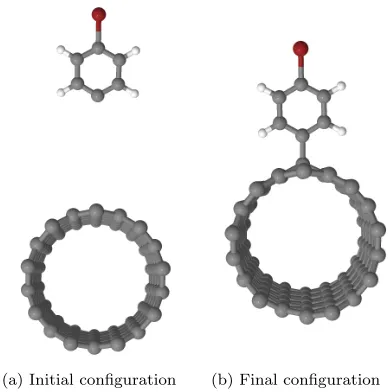
In this section, we report our calculated activation and binding energies for the functionalization of a nanotube with one bromophenyl unit. In both cases, the first step is to relax a system where the pristine nanotube and the bromophenyl unit are 7 ˚A apart (see Fig. 1(a)) to find the ground state energy of the isolated reactants. Then, a functionalized nanotube (see Fig. 1(b)) is relaxed to obtain the ground state energy of the product. The binding energy is then obtained by taking the difference between the two results.
To find the activation energy, we linearly interpolate
[image:3.612.338.534.54.250.2](a) Initial configuration (b) Final configuration
FIG. 1. Initial and final configurations used to simulate the bromophenyl functionalization of a (9,0) carbon nanotube. The distance between the nanotube and the bromophenyl unit is set to 7 ˚A in the initial configuration to prevent any inter-action between the two systems. In the final configuration, the relaxed bromophenyl-nanotube bond length is 1.54 ˚A.
the atomic positions of 12 intermediate systems between the isolated reactants and the final product. The ground state energy of each interpolated system is then calcu-lated without any geometric relaxation. The top of the energy barrier is taken to be the highest energy value obtained among the 12 interpolated calculations. The activation energy is obtained by taking the difference between the top of the energy barrier and the ground state energy of the isolated reactants. As an example, a graph of the total energy with respect to bromophenyl-nanotube distance is given for a (13,0) bromophenyl-nanotube in Fig. 2. We obtain an activation energy of 0.76 eV and a binding energy of 1.06 eV which are of the right order of magni-tude according to previous studies.16
It should be noted that the activation energies ob-tained here are in fact upper bounds to the exact DFT ones. Rigorously, a complete relaxation for each geomet-ric distance between the nanotube and the bromophenyl unit should have been performed. This would have low-ered slightly our estimation of the activation energy and greatly increased the computational cost. Still, this should not prevent diameter or metallicity dependence from being observed in our calculations. However, our ac-tivation energy calculations might overestimate by more than 50 meV the exact DFT prediction, despite the tight numerical precision of our calculations.
FIG. 2. Reaction barrier for the functionalization of the (13,0) nanotube by a bromophenyl unit. The dashed line is a guide for the eye and is set to the ground state energy of the reac-tants. Each point between the initial and final ones is a linear interpolation between the two geometries shown in Fig. 1.
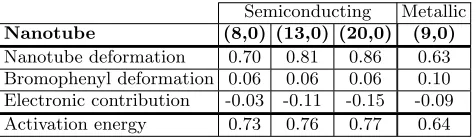
TABLE I. Contributions to activation energies (in eV) for a bromophenyl unit functionalization.
Semiconducting Metallic
Nanotube (8,0) (13,0) (20,0) (9,0)
Nanotube deformation 0.70 0.81 0.86 0.63 Bromophenyl deformation 0.06 0.06 0.06 0.10 Electronic contribution -0.03 -0.11 -0.15 -0.09 Activation energy 0.73 0.76 0.77 0.64
electronic contribution. For the binding energy, the nan-otube deformation contribution is obtained from the dif-ference between the total energy of a system having the same geometry as the functionalized nanotube, but from which the bromophenyl has been removed, and the total energy of the pristine nanotube. The same scheme was applied for the activation energy, except that the func-tionalized nanotube is replaced with the system configu-ration at the top of the energy barrier. The bromophenyl deformation contribution is obtained with a scheme anal-ogous to the nanotube deformation contribution.
B. Results
[image:4.612.316.578.84.151.2]Results for the activation energy are presented in Ta-ble I. For the semiconducting nanotubes, the deforma-tion contribudeforma-tion increases with their diameter. How-ever, the electronic contribution has the opposite trend, so that the two effects cancel out up to numerical preci-sion. Thus, the activation energy is found to be between 0.73 and 0.76 eV, without any significant diameter depen-dence. However, the metallic nanotube (9,0), with an ac-tivation energy of 0.64 eV, shows a reactivity significantly higher than the semiconducting nanotubes. This trend
TABLE II. Contributions to binding energies (in eV) for a bromophenyl unit functionalization.
Semiconducting Metallic
Nanotube (8,0) (13,0) (20,0) (9,0)
Nanotube deformation 1.12 1.30 1.38 1.17 Bromophenyl deformation 0.11 0.12 0.11 0.12 Electronic contribution -2.74 -2.47 -2.33 -3.14 Binding energy (absolute value) 1.51 1.05 0.84 1.85
agrees with other DFT studies on NO228 and carbene29
nanotube functionalization and is associated with a non-zero electronic density of states (DOS) at the Fermi level of metallic nanotubes.28 As we shall see later, all metal-lic nanotubes in the present study are more reactive than semiconducting tubes of similar diameter.
Results for the binding energy are presented in Ta-ble II. For the semiconducting nanotubes, the deforma-tion energy cost increases with diameter. This is easy to understand intuitively. The bromophenyl functional-ization involves changing the hybridfunctional-ization of a carbon atom of the sidewall of the nanotube from sp2-like to sp3-like.30For larger diameters, the geometry of the wall
is close to planarity and to ideal geometry ofsp2
bond-ing. Thus, when the nanotube’s diameter increases, it becomes more energetically unfavorable to undergo geo-metrical deformation tosp3bonding. That explains why the deformation contribution to the binding energy fa-vors functionalization of small nanotubes over large ones. This analysis applies both to binding and activation ener-gies, thus explaining why deformation energy favors small tube functionalization in both cases.
The electronic contribution to the binding energy also favors small nanotubes. Since the bromophenyl deforma-tion energy shows no trend with respect to diameter and both other contributions favor small nanotubes, the total binding energy is stronger when the nanotube is smaller. The binding energy trend with respect to metallicity shows, for the same reason given in the activation en-ergy discussion, that the electronic contribution is higher for the metallic nanotubes than for the semiconducting ones. Since both deformation contributions to the bind-ing energy remain similar for nanotubes of similar size, whether they are semiconducting or metallic, the over-all result is that metover-allic nanotubes bond more strongly with bromophenyl than semiconducting ones.
In summary, our results show that the activation en-ergy of bromophenyl functionalization of semiconducting nanotubes has almost no diameter dependence, although the binding energy is significantly higher for small tubes, making their functionalization more stable. This is in part explained by the fact that nanotubes with higher curvature are closer to asp3 hybridization. Also, thanks
[image:4.612.59.297.345.414.2]4
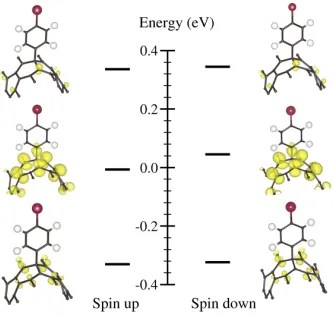
FIG. 3. Energy levels and their corresponding electronic den-sities for orbitals near the Fermi level of functionalized (13,0) nanotube. Only the functionalized site and the surrounding atoms are shown.
metallic ones.
IV. FUNCTIONALIZATION IN PAIRS
A. Procedure
The study presented in the previous section explores how a bromophenyl unit reacts with a pristine nanotube. However, it has been shown in the literature that, at room temperature, a single bromophenyl grafted onto a nanotube can desorb or migrate on its surface.16
There-fore, a stable bromophenyl unit on a nanotube cannot be isolated as pictured in Fig. 1. It is believed that it must instead be adjacent to another bromophenyl unit.16 The motivation for this hypothesis can be explained qualita-tively and was introduced by the groups of C. Dyke31and
G. Schmidt.32Just before grafting onto the nanotube, the
bromophenyl radical gets an unpaired electron from the separation of phenyldiazonium (RC6H4N+2) and is
there-fore highly reactive.
When the first bromophenyl unit covalently bonds, its half-filled orbital mixes with the orbitals of the tube. This adds two new electronic states in the gap of the pristine nanotube according to our calculations. One is associated with the filled state of the half-filled or-bital of the bromophenyl unit and constitutes the high-est occupied molecular orbital (HOMO) of the function-alized nanotube. The other electronic state is associ-ated with the empty state of the half-filled orbital of the bromophenyl unit and constitutes the lowest unoc-cupied molecular orbital (LUMO) of the functionalized tube. Fig. 3 shows the electronic density of the orbitals near the Fermi level of the functionalized (13,0) nan-otube. Only a section of the sidewall of the tube close
to the functionalized site is shown to ease visualization. We notice that the LUMO has exactly the same shape as the HOMO state and is 50 meV above the Fermi level. Both the HOMO and LUMO states are well localized near the functionalized site, whereas the other orbitals are spread over the nanotube. The other nearest states are further apart in energy from the Fermi level, about 350 meV from it. Since the new LUMO only exists a few angstroms around the first bromophenyl unit on the nan-otube’s sidewall, the functionalization of the second bro-mophenyl, eased by the higher electronic affinity around the first one, takes place close to it. Thus, at room tem-perature, bromophenyls should be found in pairs on the surface of a functionalized nanotube.
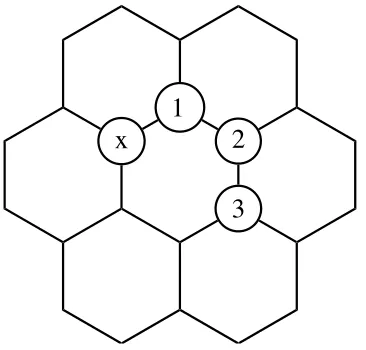
Since we are interested in the thermodynamics of the functionalization, it is relevant to investigate the stability of the final product obtained, that is, the binding energy of pairs of bromophenyls on carbon nanotubes. Yet, a calculation of the binding energy of the pairs requires a precise knowledge of the configuration of these pairs. Since the LUMO is strongly localized around the first bromophenyl unit, we expect the second bromophenyl to bind more strongly closer to the first one. We then have three likely configurations, pictured in Fig. 4 and named
ortho(first adjacent atom), meta(second adjacent atom) andpara(third adjacent atom). To evaluate the likeliness of the different reaction sites, let’s first neglect the effect of the sidewall curvature of the nanotube.
It has been shown in the literature, using ab initio
calculations, that themeta configuration of aryl groups on a graphene sheet is unstable33in accordance with the
aryl addition rule. Moreover, the LUMO state illustrated in Fig. 3 is localized on theorthoandparasites, but not themeta sites. The functionalization of the former ones is therefore favored over the latter.
However, steric constraints will lower the binding en-ergy of the second phenyl if it binds on atoms adjacent to the first reaction site, thus disfavoring theortho site.
In addition, the binding energies of phenyls on graphene for these configurations were found by Margine
et al. to be 1.25 eV for theortho site and 1.51 eV for the
parasite.16The higher binding energy of thepara config-uration over theorthoconfiguration shows that although theorthoconfiguration has larger LUMO electronic den-sity than the para configuration, the steric constraints disfavor the closest site.
In our study, a hydrogen of the phenyl is replaced by a bromine atom, which should further increase the steric constraints. Indeed, our results also show thatpara con-figuration is favored over theortho configuration in our systems. Therefore, we limit our study to the former case.
x
1
2
[image:6.612.85.268.51.226.2]3
[image:6.612.324.548.62.255.2]FIG. 4. Three possible configurations for a bromophenyl pair. The ”x” shows the first functionalized site. The location of the second unit gives the ortho (1), meta (2) and para (3) configurations.
TABLE III. Binding energies (in eV) for bromophenyl pairs (paraconfiguration, 0◦relative to the axis, see Fig. 5) and for two isolated units.
Semiconducting Metallic
Nanotube (8,0) (13,0) (20,0) (9,0)
Bromophenyl pair 3.63 2.76 2.38 3.77 Single bromophenyl unit×2 3.02 2.12 1.66 3.72
If we now take into account the curvature of the side-wall, we find that there are two possible variants for the
paraconfiguration on a zigzag nanotube. The imaginary line linking the two grafted sites can either be parallel to the axis of the tube or make an angle of 60◦with it. Both cases should show different binding energies since the cur-vature of the nanotube affects their geometry. Therefore, for pairs of bromophenyls in the para configuration, we investigate the magnitude of this difference in addition to the diameter and metallicity dependence of their binding energy.
B. Results
The results are shown in Fig. 5. The difference of bind-ing energy between the two variants of para configura-tions (0◦ and 60◦) does not show any clear trend with respect to diameter or metallicity and its magnitude re-mains small in all cases. Therefore, we cannot conclude whether there is a variant favored in the functionalization process.
However, the binding energy trend with respect to diameter is clear : bromophenyl pairs are more stable on small nanotubes. This conclusion agrees with previ-ousab initio studies of nanotube functionalization with phenyls16and NO2.28The fit in Fig. 5 is explained in the
next section.
FIG. 5. Binding energy of bromophenyl pairs on zigzag nanotubes for two para variants (0◦ and 60◦ relative to the tube axis). The continuous line shows the best fit of Eq. 6 on the semiconducting nanotubes data. We obtain Ebinding = 15.00 eV ˚A
2
/R2 + 2.11 eV. The standard devi-ation σ = 86 meV is similar to our numerical accuracy of 50 meV, which supports the validity of our model (Eq. 6).
Table III compares the binding energy of para paired bromophenyls units and isolated units. The results con-firm the pair configuration to be more stable than the isolated configuration for all semiconducting cases stud-ied. However, they cast doubt in the case of metallic nanotubes since the pairs are only 50 meV more stable than isolated units and could therefore separate easily at room temperature (kBT = 25 meV). This observation is
in agreement with the explanation given earlier for the pairing of bromophenyls. Indeed, since the pairing occurs because the LUMO of a nanotube functionalized with a single bromophenyl is well inside the electronic gap of the pristine nanotube, the proposed mechanism cannot account for an eventual pairing of the bromophenyls on metallic nanotubes since they have no gap.
V. THEORETICAL BACKGROUND
It is interesting to derive an approximate expression for the diameter dependance of the binding energy of a bromophenyl pair on a nanotube. At first order in perturbation theory, it is given by the expectation value of the Hamiltonian of the bromophenyl pair,H0, in the
eigenstate of the pristine nanotube (most) involved in the bond formation,| πni. Since the other eigenstates have
a smaller overlap with the orbitals of the phenyl graft, we do not expect them to contribute significantly to the bromophenyl-nanotube bond.
6
be written as:
|πni= tanθ r
3 cos 2θ−1 3 cos 2θ |si +√tanθ
3 cos 2θ |pyi+
√
cos 2θ cosθ |pzi,
(1)
whereθ is a measure of the curvature and is defined as:
sinθ=
√
3a
4R , (2)
wherea= 1.42 ˚A is the length of a covalent bond in the nanotube and R is the radius. To first order in static non-degenerate perturbation theory, we have:
hs|H0|pyi=hs|H0|pzi=hpy|H0|pzi= 0. (3)
Therefore,
hπn|H0|πni= tan2θ
3 cos 2θ−1
3 cos 2θ
hs|H0|si
+ tan
2θ
3 cos 2θhpy|H
0|p
yi
+cos 2θ cos2θhpz|H
0|p
zi.
(4)
With a Taylor expansion and some algebra, we find that for small values of 1/R (Ra), at leading order :
hπn|H0|πni=hpz|H0|pzi+ 2
3hs|H
0|si
+1 3hpy|H
0|p
yi − hpz|H0|pzi 3a2
16R2.
(5)
Therefore, the trend with respect to diameter of the binding energy for a bromophenyl pair functionalization can be written as:
Ebinding=α
1
R2 +c, (6)
where c is the binding energy for graphene. This argu-ment also applies to the binding energy of a single bro-mophenyl. However, in the latter case, we do not have enough results to assess the accuracy of Eq. 6.
[image:7.612.89.299.71.127.2]A fit of Eq. 6 on binding energies for pairs of bro-mophenyl on semiconducting nanotubes is shown in Fig. 5. The agreement is excellent. We find:
Ebinding= 15.00 eV
˚ A2
R2 + 2.11 eV, (7)
with a standard deviation of σ= 86 meV. However, for metallic nanotubes, the amount of available data was in-sufficient for a fit of Eq. 6 to be meaningful.
The discrepancy between the fit on semiconducting nanotube data (Eq. 7) and our results is similar to our numerical accuracy (σfit = 86 meV ∼ σconvergence ≈
50 meV). Also, our fitted value of c is 2.11 eV, in very close agreement to the calculated binding energy of 2.10 eV, which is not part of the fitted data. There-fore, Eq. 6 accurately describes the diameter dependance of semiconducting nanotubes functionalized with mophenyl pairs. Since no properties exclusive to bro-mophenyl has been assumed in the derivation, it should accurately describe any covalent functionalization of nan-otubes where first order perturbation theory remains valid, i.e. where the binding energy is of the same order of magnitude as the cases studied here.
The binding energy also shows a clear trend with metallicity : it is significantly higher for metallic nan-otubes than for semiconducting nannan-otubes of similar di-ameter. This is expected since the explanation given for the activation energy trend with metallicity remains valid for the binding energy of pairs. Together with the acti-vation energies, these results confirm that bromophenyl functionalization thermodynamically favors nanotubes of smaller diameter and metallic nanotubes over semicon-ducting ones.
VI. CONCLUSION
Our activation and binding energy calculations show that bromophenyl functionalization is selective with re-spect to nanotube size and metallicity : functionalization of smaller and/or metallic nanotubes is thermodynami-cally favored. However, this selectivity is stronger for smaller nanotubes while the experimental tubes are rela-tively large. Therefore, it may be challenging to observe this selectivity in experimental samples, due to others factors becoming of equal importance as compared to the diameter, such as the family of the nanotube.
VII. ACKNOWLEDGMENTS
∗
Corresponding author. E-mail address: [email protected]
1 D. S. Bethune, C. H. Klang, M. S. de Vries, G. Gorman,
R. Savoy, J. Vazquez, and R. Beyers, Nature 363, 605 (1993).
2 S. Iijima and T. Ichihashi, Nature363, 603 (1993). 3
K. Bradley, J.-C. P. Gabriel, and G. Grner, Nano Letters
3, 1353 (2003).
4 Y.-C. Tseng, P. Xuan, A. Javey, R. Malloy, Q. Wang,
J. Bokor, and H. Dai, Nano Letters4, 123 (2004). 5
A. Javey, J. Guo, D. B. Farmer, Q. Wang, E. Yenilmez, R. G. Gordon, M. Lundstrom, and H. Dai, Nano Letters
4, 1319 (2004). 6
A. Javey, J. Guo, Q. Wang, M. Lundstrom, and H. Dai, Letters to Nature424, 654 (2003).
7 J. Tersoff and R. S. Ruoff, Phys. Rev. Lett.73, 676 (1994). 8
L. A. Girifalco, M. Hodak, and R. S. Lee, Phys. Rev. B
62, 13104 (2000).
9 S. Giordani, S. D. Bergin, V. Nicolosi, S. Lebedkin, M. M.
Kappes, W. J. Blau, and J. N. Coleman, The Journal of Physical Chemistry B110, 15708 (2006).
10 S. D. Bergin, Z. Sun, D. Rickard, P. V. Streich, J. P.
Hamil-ton, and J. N. Coleman, ACS Nano3, 2340 (2009). 11
D. A. Britz and A. N. Khlobystov, Chem. Soc. Rev.35, 637 (2006).
12
J. L. Bahr and J. M. Tour, Chemistry of Materials 13, 3823 (2001).
13 J. Cabana, M. Paillet, and R. Martel, Langmuir26, 607
(2010). 14
D. A. Britz and A. N. Khlobystov, Chem. Soc. Rev.35, 637 (2006).
15 J. Cabana and R. Martel, Journal of the American
Chem-ical Society129, 2244 (2007). 16
E. R. Margine, M.-L. Bocquet, and X. Blase, Nano Letters
8, 3315 (2008). 17
N. Miyaura, K. Yamada, and A. Suzuki, Tetrahedron Let-ters20, 3437 (1979).
18 N. Miyaura and A. Suzuki, J. Chem. Soc., Chem.
Com-mun. , 866 (1979).
19
S. Mahouche Chergui, A. Ledebt, F. Mammeri, F. Herbst, B. Carbonnier, H. Ben Romdhane, M. Delamar, and M. M. Chehimi, Langmuir26, 16115 (2010).
20
P. Hohenberg and W. Kohn, Phys. Rev.136, B864 (1964). 21
W. Kohn and L. J. Sham, Phys. Rev.140, A1133 (1965). 22 C.-K. Skylaris, P. D. Haynes, A. A. Mostofi, and M. C.
Payne, The Journal of Chemical Physics 122, 084119 (2005).
23 C.-K. Skylaris, A. A. Mostofi, P. D. Haynes, O. Dieguez,
and M. C. Payne, Phys. Rev. B66, 035119 (2002). 24
N. D. M. Hine, J. Dziedzic, P. D. Haynes, and C.-K. Sky-laris, The Journal of Chemical Physics135, 204103 (2011). 25
J. P. Perdew, K. Burke, and M. Ernzerhof, Phys. Rev. Lett.77, 3865 (1996).
26 N. D. M. Hine, M. Robinson, P. D. Haynes, C.-K. Skylaris,
M. C. Payne, and A. A. Mostofi, Phys. Rev. B83, 195102 (2011).
27 P. Haynes, C.-K. Skylaris, A. Mostofi, and M. Payne,
Chemical Physics Letters422, 345 (2006). 28
K. Seo, K. A. Park, C. Kim, S. Han, B. Kim, and Y. H. Lee, Journal of the American Chemical Society127, 15724 (2005).
29
H. F. Bettinger, Chemistry A European Journal12, 4372 (2006).
30 Y.-S. Lee, M. B. Nardelli, and N. Marzari, Phys. Rev.
Lett.95, 076804 (2005). 31
C. A. Dyke, M. P. Stewart, F. Maya, and J. M. Tour, Synlett1, 155 (2004).
32
G. Schmidt, S. Gallon, S. Esnouf, J.-P. Bourgoin, and P. Chenevier, Chemistry A European Journal 15, 2101 (2009).
33 D. Jiang, B. G. Sumpter, and S. Dai, The Journal of
Physical Chemistry B110, 23628 (2006). 34