- 2 - 20-5-2009
Increase the contribution of Maars China to
Maars Holding by improving the overall
performance of Maars China.
Developing a new organization structure and an accounting
system to improve the performance of Maars China
Ertan Ates Jack Huang
Thesis for Master of Science degrees in Business Administration Track International Management
University of Twente, Enschede
Graduation committee: Prof. dr. ir. J.J. Krabbendam
Contact information Information principal
Maarsgroup BV Maars China
Newtonweg 1 Maars Dutch Design Center Shanghai
3846 BJ Harderwijk Suite. 1505, HuaWen Plaza, no. 999
Netherlands Zhongshan Road
T: +31(0)341 465211 Shanghai 200051
F: +31(0)341 414024 P.R. China
E: [email protected] T: +86 (0)21 3251 5505
F: +86 (0)21 3251 5506
Maars Kunshan Factory
No. 9 Airport Road, Dianshanhu Town Kunshan
P.R. China
Contact person Contact person
Kasper Tappel Frank Smit
Chief Financial Officer Production Manager
Newtonweg 1 No. 9 Airport Road, Dianshanhu Town
3846 BJ Harderwijk Kunshan
Netherlands P.R. China
T: +31(0)341 465211 T: +86 (0)21 3251 5505
F: +31(0)341 414024 F: +86 (0)21 3251 5506
E: [email protected] E: [email protected] Information trainee
Ertan Ates Jack Huang
Dr. Sloetstraat 2 Dorpsstraat 65
7572 XX Oldenzaal 7447 CP Helendoorn
Netherlands Netherlands
T: 06 30554301 T: 06 10339797
E: [email protected] E: [email protected]
Graduation committee
Prof. dr. ir. J.J. Krabbendam Capitool building, room E-209 Captiool 15
7521 Enschede Netherlands
T: +31 (0)53 4893494/4893480 E: [email protected] Ir. S. J. Maathuis
Capitool building, room E-304 Captiool 15
7521 Enschede Netherlands
- 4 - 20-5-2009
Executive summary
This thesis is written with the intention to improve the performance of Maars China for delivering a greater overall contribution to Maars Holding. We focused our research on the development of a new organizational structure and the improvement of the accounting system of Maars China. The main objectives of this research are to close the accounting gap between Maars Holding and Maars China, and to develop an organizational structure that fits Maars China. With this in our mind, we started with a preliminary research. The goal of this preliminary research was to identify the problem and analyze the current situation of theorganization.
The research consists of an analysis of the current situation, an overview of the desired situation and a proposal for improvement. The analysis of the current situation describes both the problems of the organizational structure and the accounting system. The data from the current situation is gathered by an in-depth interview (formal and informal), an observation, an internal document review, a desk and a field research. The overview of the desired situation describes the gap between the current situation and how the situation could theoretically be. In the section “proposal for improvement”, we discuss and analyze the gap between the current situation and the desired situation and propose suggestions for improvement. In the chapter “implementation” we present a plan on how to translate the research results into practical improvements.
The results of our research reveal that there is room for organizational improvement. The organizational structure of Maars China does not fit the organization’s complexity, size, culture, environment and goals. As a result, we observe an organization adrift; the organization’s capabilities do not match the performance and the goals. The financial targets, for example, are not achieved, due to a lack of control and planning. The job descriptions (unclear and incomplete) are not adapted to Chinese employees, who have no initiative what so ever. The bottleneck can be traced to the low formalization and standardization, the extremely high centralization of decision making, unclear hierarchy and authority, hardly any collaboration between departments and individuals, indirect and sparse internal communications, not well defined goals and also limited resources and knowledge. The pressure for change can be explained both internally and externally. The internal pressure for change is growth pressure, integration and collaboration pressure, identity pressure and new-broom pressure. For the external change pressure we recognize international pressure, bench marking pressure, market pressure, competition pressure and reputation and credibility pressure.
information is caused by a lack of Dutch GAAP knowledge, a lack of cost price calculation, communication and collaboration and a lack of financial policies and procedures. The differences of financial accounting between Maars Holding and Maars China are caused by the external environment. The country specific accounting system is dictated by the government, by law and economic needs. The International Accounting Standard Board tries to set up an international accounting system which can model as a bench mark for every country specific accounting system. This international accounting system is also adopted by the Chinese government, with adaptations for the Chinese circumstances. The gap in financial accounting between the Maars Holding and Maars China accounting systems will always exist.
Our suggestions for improvement are based on the improvement of the current accounting system. The implementation of the International Accounting System (IAS) as the standard system is not feasible for Maars Holding and Maars China because country specific circumstances are not included in IAS. We focus our suggestions on the financial knowledge transfer between Maars China and Maars Holding. We strive to implement the Dutch GAAP in Maars China as management accounting for Maars Holding, next to the financial accounting for the Chinese government based on the Chinese GAAP. Therefore the financial department of Maars China must be familiar with and be able to report financial information based on the Dutch GAAP. On the other hand, the financial department of Maars Holding has to learn the Chinese financial and tax rules, so that they can make well-considered decisions about Maars China, like decisions on investment, financial aid, and etcetera. To produce reliable input for financial reports the cost price has been calculated; interdepartmental communication has been intensified and financial policies and procedures have been established for the whole organization. Reliable financial information will increase the accountability, control and decision making. Reliable financial information will indirectly improve the performance of Maars China.
- 6 - 20-5-2009
Table of contents
CONTACT INFORMATION ... 3
EXECUTIVE SUMMARY ... 4
PREFACE ... 8
INTRODUCTION ... 9
-1. BACKGROUND MAARS ... 10
-1.1 BACKGROUND OF MAARS HOLDING... -10
-1.2 BACKGROUND OF MAARS CHINA... -10
-2. GENERAL PROBLEM AND RESEARCH PLAN ... 13
-2.1 THE GENERAL PROBLEM... -13
-2.2 RESEARCH OBJECTIVES... -14
-2.3 RESEARCH PROBLEM DEFINITION... -14
-2.4 RESEARCH QUESTIONS... -15
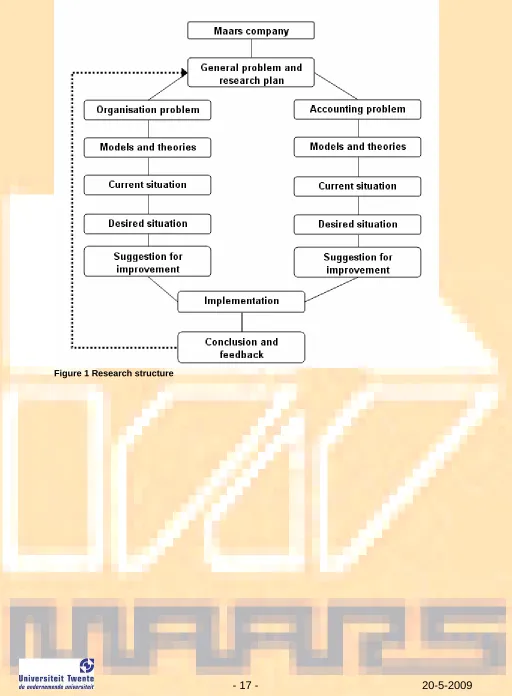
-2.5 RESEARCH APPROACH... -15
-2.6 RESEARCH STRUCTURE... -17
-3. ORGANIZATION STRUCTURE ... 18
-3.1 MODELS AND THEORIES ORGANIZATION STRUCTURE... -18
-3.1.1 GAP analysis model... - 18 -
3.1.2 Organization theory model... - 18 -
3.1.3 Organization pressure theory... - 28 -
3.1.4 Organization structure theory... - 28 -
3.2 CURRENT SITUATION... 33
3.2.1 Structural dimension ... 33
3.2.2 Contextual dimensions... 35
3.2.3 Why should the organization change... 42
3.3 DESIRED SITUATION... 46
3.3.1 Contextual dimensions... 46
3.3.2 Structure dimensions ... 48
3.4 SUGGESTION FOR IMPROVEMENT... 49
3.4.1 Mission, vision and goals ... 49
3.4.2 The gap between current and desired situation... 52
3.4.3 Proposed organizational structure ... 52
3.4.4 The advantage and the disadvantage of the proposed organizational model... 55
4. ACCOUNTING SYSTEM... 56
4.1 MODELS AND THEORIES... 56
4.1.1 Accounting in general ... 56
4.1.2 International accounting... 58
4.1.3 Chinese accounting ... 59
4.1.4 Accounting for Maars China... 61
4.2 CURRENT SITUATION... 63
4.2.1 Maars Holding ... 63
4.2.2 Maars China... 63
4.2.3 Management accounting... 64
4.2.4 Financial accounting ... 65
4.3 DESIRED SITUATION... 68
4.3.1 Maars Holding and Maars China ... 68
4.3.2 Financial accounting ... 68
4.3.3 Management accounting... 68
4.4 SUGGESTIONS FOR IMPROVEMENT... 70
4.4.1 The gap between the current and the desired situation ... 70
5. INTEGRAL IMPLEMENTATION PLAN ... 74
5.1 RESISTANCE TO CHANGE... 74
5.2 IMPLEMENTATION STRATEGY... 74
5.3 TO DO LIST... 75
5.4 IMPLEMENTATION PLANNING... 77
6. CONCLUSION AND FEEDBACK ... 83
6.1 CONCLUSION... 83
6.2 FEEDBACK... 84
7. LITERATURE REFERENCES... 86
8. APPENDIX... 88
8.1 APPENDIX 1:SWOT ANALYSE... 88
8.2 APPENDIX 2: ORGANIZATION STRUCTURE ... 91
8.3 APPENDIX 3:EXTERNAL INFLUENCES ON CHINA’S ACCOUNTING DEVELOPMENT... 94
8.4. APPENDIX 4:ASBE ... 102
8.5 APPENDIX 5: THE STRUCTURE OF IAS AND CHINESE ASBE. ... 107
- 8 - 20-5-2009
Preface
This master thesis has been written to graduate the Business Administration study with Track International Management at the University of Twente. This thesis was carried out for Maars Holding in Harderwijk, The Netherlands and Maars China in Shanghai, China. A big part of our research took place at Maars China. This thesis includes two researches. The first part of the thesis can be characterized as a strategic organizational development with a focus on organizational structure. The second part of the thesis focuses on the development of an accounting system. The biggest drives for us to carry out this challenging research are the international characteristics of the problem, the multicultural aspects of this research and our interest in China. For us, this is a unique chance to test our knowledge and to gain experience.
During the research we had our ups and downs. The culture barriers, communication obstacles, time pressure and extremely changeable situations are some of the problems we faced during our research. Sometimes it was very frustrating for us. But we are very grateful that we can work well together; this encourages us to achieve the maximum result. Nevertheless, during the research period we have learned a lot. It was a great experience in our lives.
We are very grateful for the individual contribution of our mentors which helped us to accomplish our master thesis. The first persons we want to show our appreciation to are our company mentors Frank Smit, Kasper Tappel and Huub Gering.
In addition, we want to express our thanks to our mentor of the University of Twente, Prof J.J. Krabbendam and Ir. S. Maathuis. We appreciate their academic advices, their professional support and their willingness to support us when we encountered problems. We also want to thank the University of Twente, which provided us with the necessary accommodations enabling us to complete our master thesis successfully.
Finally, we want to thank everybody who supported us during our master thesis. Without all of you this result would not be achieved.
Ertan Ates Jack Huang
Introduction
This master thesis includes two research topics: organizational structure and accounting system. Jack Huang is responsible for the organizational structure. Ertan Ates is responsible for the accounting system. Despite our individual topics, we have collaborated intensively during our research because of the interdependence of our research topics. The layout of the thesis has, in accordance with our research strategies, various chapters and subchapters.
Chapter one contains information on the background of the organization.
Chapter two involves the general problems of the organization. Next, the research problems are defined. And finally, the problem formulation, research questions, research approach and research structure are added.
In chapter three the organizational structure is discussed. We started with theories and models on the organizational structure. After analyzing the current situation, we scanned the current organizational structure for theoretical shortcomings. Finally, we suggested improvements for the organizational structure.
In chapter four the accounting problems are discussed. First, we started with the theories and models about accounting. Next the current situation is discussed. After that we scanned the current accounting system for theoretical shortcomings. Finally, we suggested improvements of the current accounting system.
In chapter five an integral implementation plan for both research topics is presented.
Chapter six includes conclusions and feedback of the general problems and suggestions for further research.
- 10 - 20-5-2009
1.
Background Maars
1.1 Background of Maars Holding
Maars Holding is a Dutch Company for partitioning systems headquartered in Harderwijk in The Netherlands. Maars is established in 1946 by Mr. L. Maars Sr. He started the company in a canal house in Amsterdam just after the Second World War. Maars quickly grew out of this house and made a necessary move in 1960 to the building on the Deventerweg in Harderwijk. At that time, Maars’ product package consisted of light, air, walls and ceilings. The current location of Maars was built in 1974. To become a main player in the market of partitioning systems, Maars sold its other activities and became a specialist in partitioning systems.
Activities of Maars Holding
For more than 60 years now, Maars has been producing, selling and assembling Maars flexible partitioning systems for commercial and industrial buildings, offices, schools, hospitals, hotels, showrooms, and etcetera. It supplies virtually the entire ‘inner skin’ of a building, consisting of movable partitions including doors and wall units. Now Maars Holding consists of three divisions: Project, Manufacturing and Trade. The project division is the cash maker of the company. This division takes care of the order portfolio until the project comes through. The Manufacturing division is responsible for the production of a partitioning system; this division does not make any profit. The difference between the project and the trade division is that the trade division sells products to third parties and does not take care of the installation of the partitioning products. The turnover has grown to almost 70 million euro a year. 70% of the turnover is export. Maars Holding is the market leader of partitioning systems in The Netherlands. At the moment, Maars exports to more than 35 countries in the world. Maars Holding has 8 companies (100% owned or joint ventures) in the following countries: Belgium, Germany, France, The Netherlands, Poland, Switzerland, the United Kingdom and the Republic of China. In the other 24 countries, Maars Holding positioned itself through dealerships. According to the forecast of CBS and Maars Holding the Dutch market for construction is shrinking and international activities will therefore become more important.
Internationalization
At the beginning of the nineteen-seventies, a joint venture with the Americans led to various technological developments. In 1974, work started on the construction of a new production facility and the introduction of new machines allowed a sharp increase of production capacity. It now became more attractive to develop more activities abroad, so a start was made on setting up foreign branches with their own assembly teams. This resulted in expansions into Belgium, France, Germany and Switzerland, with a staff increase of at least 600.
1.2 Background of Maars China
beginning it was very important for Maars China to let the “potential” customer become familiar with Maars China products.
Activities Maars China
As a daughter company of Maars Holding, Maars China is influenced by the activities of Maars Holding. The product range and activities of Maars China are almost the same as those of Maars Holding. This means that Maars China will expand its activities to hotels and hospitals in the near future. At this moment, Maars China totals 80 percent market shares of the high end segment for partitioning products in Shanghai. China is more than only Shanghai. In 2008 Maars China expands its geographical representation. For example, it opened a new office in Beijing and also tried to establish dealerships inside and outside of China. The sales target for the next couple of years is very ambitious.
Organizational structure of Maars China
- 12 - 20-5-2009
- 13 - 20-5-2009
2.
General problem and research plan
2.1 The general problem
In 2004 Maars Holding started a partnership with a Chinese company. The result was that the Chinese partner owned 49 % of the stock and Maars Holding 51%. According to the agreement between Maars Holding and the Chinese partner, Maars Holding would provide production capacity and technological knowledge to produce partitioning systems and the Chinese partner would take care of the sales activities because of their knowledge of the Chinese market. This partnership did not last long due to a lack of cooperation and commitment from the side of the Chinese partner. The Chinese partner did not undertake any sales activity. In 2007 changes have taken place within Maars Holding. One of the most obvious changes was the buy-out of the Chinese partner. Maars Holding became 100% owner of Maars China. After the break-up, Maars China relocated its production facility and sales office. For Maars China the break up with the Chinese partner consequently resulted in the loss of knowledge of the Chinese market and culture. Maars Holding wanted full control over their subsidiary and therefore decided not to search for a new partner. For Maars Holding, Maars China is the only subsidiary with a production facility. This makes the company more complex to manage. In the beginning, the support from Maars Holding was minimal. Maars Holding itself was in a transition phase (for example establishing a divisional structure, consolidation of business and activities).
After Maars Holding became 100% owner of Maars China, the performance of Maars China became more important for Maars Holding. The attention for the total performance of Maars China was increasing. A budgeting system, a financial target and goals were determined to measure the performance of Maars China. According to the financial report and top management of Maars China the performance of Maars China was not up to standard and improvement was necessary. Maars China was not sufficiently contributing to Maars Holding. The general problem is: how to improve the contribution of Maars China to Maars Holding?
Our interviews with employees of Maars China and Maars Holding from top to the bottom in combination with our own work experience within Maars Holding for a couple of weeks, provided us with significant information about the general problem.
We discovered that the inadequate performance of Maars China is caused by the following elements: The differences between the accounting systems of Maars Holding and Maars China.
A lack of collaboration between Maars Holding and Maars China (purchasing, marketing, R&D, etc) The SBU organizational structure of Maars Holding is not suitable for Maars China (the organizational structure does not fit the complexity, size and culture of Maars China)
Missing a trade division to contribute to the financial goals.
Limited resources and knowledge (open vacancies, because it is hard to hire and keep well educated employees.)
Cultural differences between The Netherlands and China.
Understaffed departments (like R&D, Marketing, Back office support, purchasing, logistics and planning).
Lacking of product quality control (input and output both)
According to our interviews with the management of Maars China and Maars Holding, the cultural differences between The Netherlands and China play an important role in the general problem. The Chinese culture is more focused on groups than on individuals. Individual accountability is vague when the job description is not clear. This is the case with Maars China. Also the hierarchy is more embedded in the Chinese culture and employees only receive and accept orders from their direct supervisors. The internal communication lacks strength because the different departments are isolated and only communicate internally and not with each other.
- 14 - 20-5-2009 based on the Chinese accounting system. There are still some important vacancies in the Maars China organization. For example, the function of buyer (vacant for a long time) still causes problems for the purchasing department. The educational background of some employees does not fit the job profiles well. Lack of employees with the right education limits the ability to solve the problem and improve the performance.
In our view, the biggest problem for Maars China is the absence of a clear strategy. Without a clear strategy it is difficult to achieve goals. A strategy gives the organization guidance for middle-long term actions.
Due to limited time and resources, Maars China decided to prioritize solving first two the problems. They have chosen for the accounting system and the organizational structure as research topics.
2.2 Research objectives
In this research we try to find a solution for the structural and accounting problems of Maars China. Our main objectives are to (re)develop an organizational structure that fits Maars China and to find a match between the Maars China and Maars Holding accounting systems.
2.3 Research problem definition
The problem formulation, e.g. the specific central question that will be answered in the assignment, is outlined in this section. As a subsidiary of Maars Holding, Maars China has to report on its finances to Maars Holding. One of the problems Maars Holding faces is the difference in accounting systems between China and The Netherlands. The main differences are: Maars Holding has a financial report on management accounting and a report on financial accounting, Maars China has only a report on financial accounting and does not have any knowledge of management accounting. Another difference is the content of the Dutch GAAP which differs from the Chinese GAAP. The difference in accounting systems results in incorrect or unclear financial reports to Maars Holding. Due to this unclear financial reporting, it is hard for Maars Holding to gain the necessary financial information to judge the financial condition of Maars China and to develop a strategy for the future. Investment decisions and expansion are also largely depending on correct financial information.
Maars China is a young foreign organization in China. To execute the strategy and reach the target, a smooth and well structured organization is a precondition. The current structure of Maars China is not clear for everyone and does not fit Maars China. The procedures as we know them from Maars Holding are not (yet) available in Maars China. This causes problems like accountability and responsibility for the different disciplines within the organization. For example: when a problem occurs it is hard to pinpoint it and solve it effectively, because of a lack of proper procedures and because it is unclear which discipline is accountable for a problem and/or solution.
The following aspects are to be taken into account in order to come to a well defined problem formulation.
The objective of the research can be categorized as a combination of a strategic and an operational objective, because it requires analysis of Maars Holding, Maars China and the environment. We will try to implement our results and recommendations into the organization’s strategic and operational level.
Considering the rapidly changing environment and the complicated problems, we can only look for a solution to the current problems. This means we cannot develop a solution for problems that may occur in the future.
One of the main issues in our research is the difference between China and The Netherlands. How to target this difference and how to deal with this difference in relation to our research objective.
Based on the statements above, the problem formulations are defined as follows:
Problem 1: How to reorganize Maars China, a 100% daughter company of Maars Holding Problem 2: How to improve the current accounting system of Maars China to fulfill the requirements of Maars Holding and Maars China?
2.4 Research questions
Both problems will be broken down into research questions. Research questions concerning the organizational structure are:
• What is the current situation? • What is the desired situation?
• What are the differences between the current situation and the desired situation and how to close this gap?
Research questions concerning the accounting system are: • What is the current situation?
• What is the desired situation?
• What are the differences between the current situation and desired situation and how to close this gap?
2.5 Research approach
The research we will perform is defined as Exploratory Research. Exploratory research is used when one is seeking insights into the general nature of a problem, the possible alternative decisions, and relevant variables that need to be considered. The research method is highly flexible, unstructured and qualitative technique-wise (Aaker, Kumar & Day, 1995) though exploration researchers develop concepts more clearly, establish priorities, develop operational definitions, and improve the final research design. (Business research methods, Donald R. Copper/ Pamela S. Schindler, 2006).
- 16 - 20-5-2009 The method of data collection is about the choice between primary and secondary data. According to Aaker, Kumar & Day primary data is data collected to address a specific research objective. Secondary data is data collected for some purpose other than the present research purpose.
In general, there are three sources of secondary data collection: the company information system, data-bases of other organizations and syndicated data resources.
To have a clear picture of Maars China, we will start with a “helicopter view” of the organization. To do this, we will have interviews with different employees within Maars China and Maars Holding. Information from the top management will give us a good picture of the organizational condition of Maars China. They have access to specific company confidential information. We will try to pinpoint the core problem and link it with our research topics.
After that we start with a qualitative collection of primary data to formulate our research problem. Because the problem is quite specific for Maars China, primary data will be an important resource.
Next, we will make an analysis of the current situation of Maars China. Then compare the current situation with the theory of what it should be. This comparison will provide us with aspects of the problem and how to solve them. Both primary and secondary data will be used.
Then we will suggest improvement solutions for both research problems. Furthermore, an integral implementation plan will be presented.
2.6 Research structure
- 18 - 20-5-2009
3.
Organization structure
In this chapter we start to discuss the theories and models which will help us to understand the problem and provide us tools to solve the problem. Then we start to analyse the current situation of Maars China’s organization. After that we put the theory into the practice. What is the desired situation according to the theories and how to get there. In the final step a comparison between the current situation and the theory will take place. The comparison will provide us a clear picture which aspect of organization should changed according to the needs of Maars China and the environment which in the organization execute their strategy and reach the goals. Our analysis will focus on the organization structure of Maars China. 3.1 Models and theories organization structure
3.1.1 GAP analysis model
GAP analysis is a very basic tool for reviewing an organization’s position. It is based on three questions:
1. Where are we now (current situation)
2. Where do we want to get to (desired situation) 3. How can we get there (suggestion for improvement)
Although basic, these questions can be useful on a number of levels. First, there are very general, this means that most managers should be able to give their own opinion and able to answer at least two of the three questions. Second, regardless of whether the responses indicate low or high degree of consensus, this information is useful for our research.
3.1.2 Organization theory model
Richard L. Daft defines the organization as social entities that are goal directed, are designed as deliberately structure and co-ordinated activity systems and are linked to the external environment. An organization exists when people interact with one another to perform essential functions that help attain goals. Internally it is important that the interaction between the departments are smoothly. Boundaries between departments become more flexible and rapid response to the external change is necessary. An organization cannot exists without interacting with customers, suppliers, competitors and other elements of the external environment.
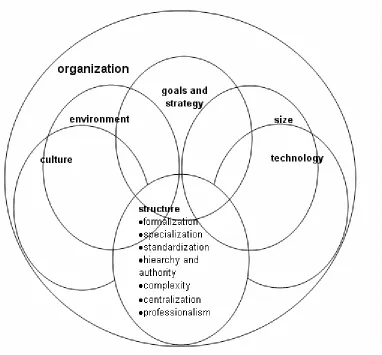
Figure 2 Interacting contextual and structural dimensions of organization design
Contextual dimensions includes: Size, organizational technology, environment, organization goals and strategy and organization’s culture.
Size
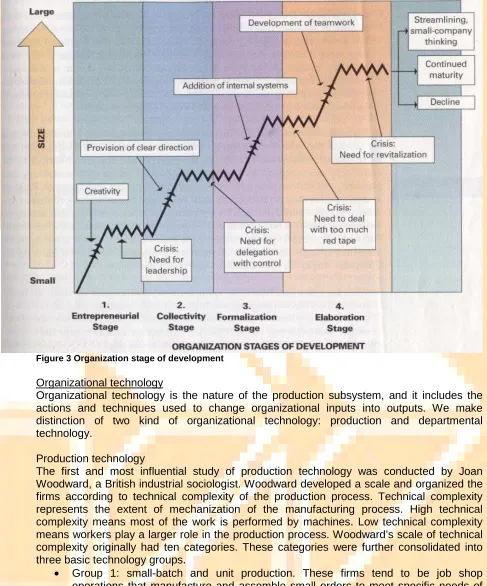
- 20 - 20-5-2009 Figure 3 Organization stage of development
Organizational technology
Organizational technology is the nature of the production subsystem, and it includes the actions and techniques used to change organizational inputs into outputs. We make distinction of two kind of organizational technology: production and departmental technology.
Production technology
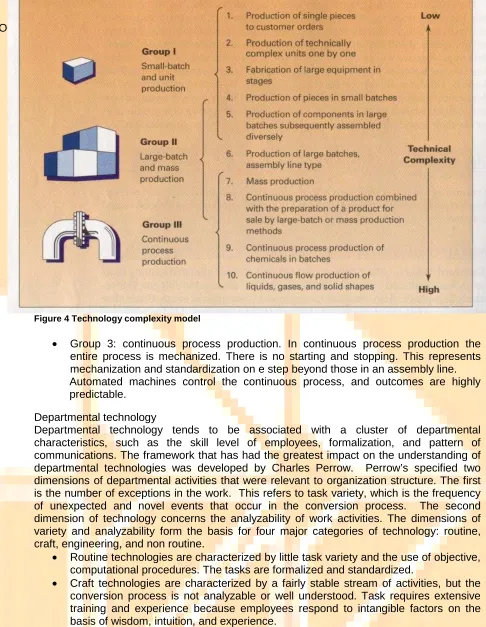
The first and most influential study of production technology was conducted by Joan Woodward, a British industrial sociologist. Woodward developed a scale and organized the firms according to technical complexity of the production process. Technical complexity represents the extent of mechanization of the manufacturing process. High technical complexity means most of the work is performed by machines. Low technical complexity means workers play a larger role in the production process. Woodward’s scale of technical complexity originally had ten categories. These categories were further consolidated into three basic technology groups.
• Group 1: small-batch and unit production. These firms tend to be job shop operations that manufacture and assemble small orders to meet specific needs of customers. It relies heavily on the human operator.
Figure 4 Technology complexity model
• Group 3: continuous process production. In continuous process production the entire process is mechanized. There is no starting and stopping. This represents mechanization and standardization on e step beyond those in an assembly line. Automated machines control the continuous process, and outcomes are highly predictable.
Departmental technology
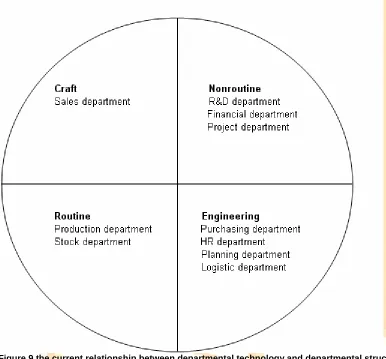
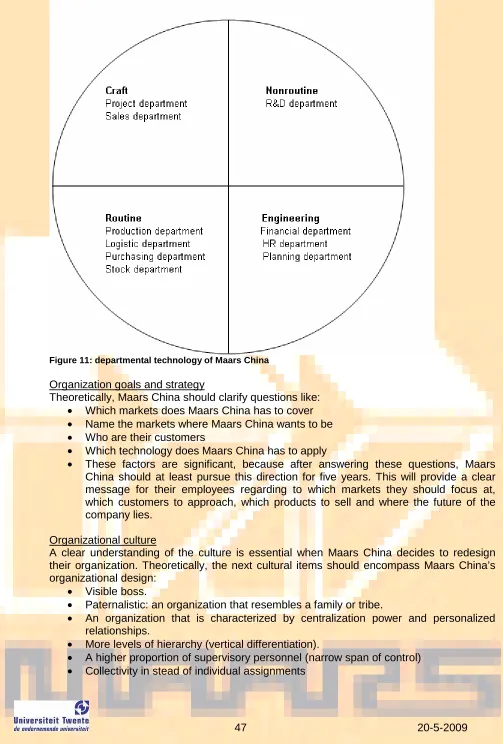
Departmental technology tends to be associated with a cluster of departmental characteristics, such as the skill level of employees, formalization, and pattern of communications. The framework that has had the greatest impact on the understanding of departmental technologies was developed by Charles Perrow. Perrow’s specified two dimensions of departmental activities that were relevant to organization structure. The first is the number of exceptions in the work. This refers to task variety, which is the frequency of unexpected and novel events that occur in the conversion process. The second dimension of technology concerns the analyzability of work activities. The dimensions of variety and analyzability form the basis for four major categories of technology: routine, craft, engineering, and non routine.
• Routine technologies are characterized by little task variety and the use of objective, computational procedures. The tasks are formalized and standardized.
• Craft technologies are characterized by a fairly stable stream of activities, but the conversion process is not analyzable or well understood. Task requires extensive training and experience because employees respond to intangible factors on the basis of wisdom, intuition, and experience.
• Engineering technologies tend to be complex because there is substantial variety in the tasks performed. However, the various activities are usually handled on the basis of established formulas, procedures, and techniques. Employees normally refer to a well-developed boy of knowledge to handle problems.
- 22 - 20-5-2009 Figure 5 The relation between departmental technology and organization characteristics
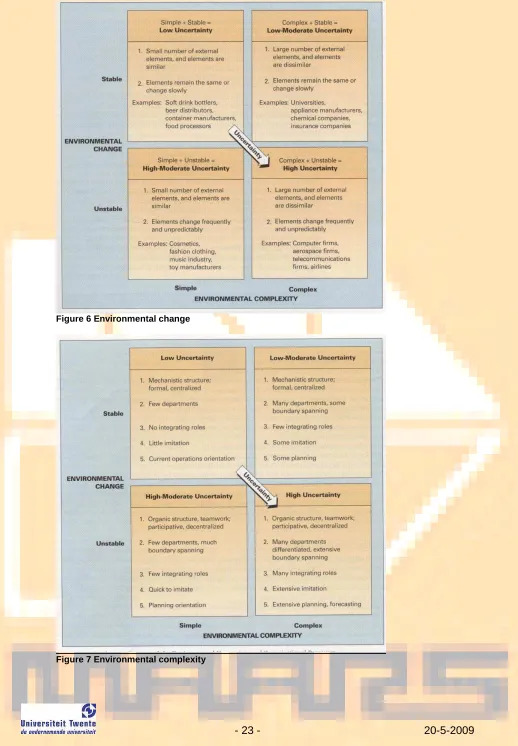
The environment
Figure 6 Environmental change
- 24 - 20-5-2009 The organization’s goals and strategy
The organization’s goals and strategy define the purpose and competitive techniques that set it apart from other organizations. Goals are often written down as an enduring statement of company intent. A strategy is the plan of action that describes resource allocation and activities for dealing with the environment and for reaching the organization’s goals.
Organizational purpose
Organization purpose can be divided into two topics, namely official goals and operative goals. Both are important for organization, but they serve very different proposes.
Official goals
Organizations are created and continued in order to accomplish something. All organization exists for a purpose. The overall goal for an organization is often called the mission, the organization’s reason for existence. The mission describes organization’s vision, its shared values and beliefs, and its reason for being. The mission refers to the formally stated definition of business scope and outcomes what the organization is trying to achieve. One of the primary purposes of mission is to serve as a communication tool. The mission communicates to current and prospective employees, customers, investors, suppliers, and competitors what the organization stand for and what it is trying to achieve. Companies where managers are sincerely guided by mission statements focus on their social purpose, typically attract better employees, have better relationships with external parties, and perform better in the marketplace over the long term.
How to formulate Mission according to theories1
An organization’s mission or purpose is the answer to the question "why?" Different questions will illicit different facets or flavors of mission. For example:
Why are we doing this? Brings out purpose, motives, and intention. A mission is usually meant to define internal motivation - it’s meant to align and engage employee in the organization, rather than helping define an orientation to outside customers.
Begins to identify the values and interests that drive the organization. It is designed to promote the brand's purpose image as part of a reason for doing business, for public relations purposes or to attract employees or investors. That's an external message defined in terms of the target market or the competition.
With what aspects of this work do I most identify? This type of reasoning will not be useful for aligning workplace structures, systems, processes and cultures. It is more like an advertisement, and can be effective when it represents an operational reality, communicates honest values, and helps the audience make meaning.
How to formulate vision according to theories?
Vision and Mission are the inspiring words chosen by leaders to clearly and concisely convey the direction of the organization. By crafting a clear mission and vision, you can powerfully communicate your intentions and motivate your team or organization to realize an attractive and inspiring common vision of the future. So it crystallizes top management’s view of firm’s long-term direction, helps managers avoid visionless or rudderless decision-making, conveys organizational purpose to motivate employees to do their very best and helps keep direction-related actions of lower-level managers on common path.
Essential Keys stones what must be found back in a vision statement are: • Firm’s future makeup
• Forming vision of firm’s future in 5-10 years • Inject sense of purpose into firm’s activities
• Provide long – term direction
• Give firm strong identity for its customers
• Decide “who we are, what we do, & where we are headed”
Vision and mission-making work can thus serve the firm in carrying out their leadership role, unifying their efforts and building alignment and loyalty among employees. When all employees are committed to firm’s long-term direction, optimum choices on business decisions are more likely because individuals & teams know the intent of a firm’s strategic vision and the daily execution of strategy will be improved2.
Operative goals designate the ends sought through the actual operating procedures of the organization and explain what the organization actually is trying to do. Operative goals typically pertain to the primary tasks an organization must perform. These goals concern overall performance, boundary spanning, maintenance, adaptation, and production activities.
After formulating the vision and mission of a firm, the next step is setting objectives. The purpose of setting the objectives is to convert into performance targets, create yardsticks to track performance, establish performance goals and pushing a firm to be inventive, intentional and focused. The criterions for setting the objectives are specific, measurable, challenging but receivable and dated. We can make two kinds of distinction about objectives, namely financial and strategic objectives. Financial objectives are outcomes that relate to improving firm’s financial performance and strategic objectives are outcomes that will result in a greater competitiveness & stronger long–term market position. Another essential part of strategic objective is that it relates to a firm’s competitiveness, market position and competitor focused.
Goals are important because goals can provide employees with a sense of direction, so that they know what they are working toward. This can help motivate employees toward goal accomplishment. Another important purpose of goals is to act as guidelines for employee behavior and decision making. Appropriate goals can act as a set of constraints on individual behavior and actions so that employees behave within boundaries that are acceptable to the organization and larger society. They help to define the appropriate decisions concerning organization structure, innovation, employee welfare, or growth. The level of organizational performance, whether in terms of profits, units produced, degree of employee satisfaction, level of innovation, or number of customer complaints needs a basis for evaluation. Operative goals provide this standard for measurements
Organization’s culture
The management of cultural diversity is becoming a significant issue for companies of all sizes, not just multinationals. The rise of global business, with an increasing number of joint ventures and cross-border partnerships, greater cooperation within the European Union, and the business need to embrace people from a variety of ethnic backgrounds and cultures, have all contributed to the need to develop a cultural sensitivity. The transfer of Western values to the East, for example, can be inappropriate, and corporate culture and management practices may need modifying to suit local conditions. Hofstede's work has provided a framework for understanding cultural differences.
Hofstede has identified four dimensions for defining work-related values associated with national culture: power distance; individualism/collectivism; masculinity/femininity; uncertainty avoidance. He devised the Values Survey Module for use in researching cultural differences, and this has been used by many other researchers in their work.
- 26 - 20-5-2009 Hofstede defines culture as being collective but often intangible. It is, however, what distinguishes one group, organization or nation from another in Hofstede's view, culture is made up of two main elements: the internal values of culture - which are invisible - and external elements of culture - which are more visible- and are known as practices. The latter include rituals (such as greetings), heroes (such as people or television shows) and symbols (such as words and gestures). The cultures of different organizations can be distinguished from one other by their practices, while national cultures can be differentiated by their values.
Hofstede carried out his research using a questionnaire called the Values Survey Module. From the results, he drew up indices which reflect the national cultural characteristics or dimensions of a country. (All the quotations in this section are taken from Hofstede's Cultures and Organizations, 1991.)
Power distance is defined by Hofstede as "the extent to which the less powerful members of institutions and organizations within a country expect and accept that power is distributed unequally".
In low power distance nations inequalities among people will tend to be minimized,
decentralization of activities is more likely, subordinates expect to be consulted by superiors, and privileges and status symbols are less evident. Conversely, in high power distance nations inequalities among people are considered desirable, there is greater reliance by the less powerful on those who hold power, centralization is more normal, and subordinates are likely to be separated from their bosses by wide differentials in salary, privileges and status symbols.
Individualism pertains to societies in which the ties between individuals are loose: everyone is expected to look after himself or herself and his or her immediate family. Collectivism as its opposite pertains to societies in which people from birth onwards are integrated into strong, cohesive in groups, which throughout people's lifetime continue to protect them in exchange for unquestioning loyalty.
With the rise in global business, many people are working with, or managing, individuals and groups from cultures other than their own. Hofstede is keen to emphasize that the dimensions are not a prescription or formula but merely a concept or framework. They equip us with an analytical tool to help us understand intercultural differences. For example, the practical experience of many multinationals in building international teams can be explained in terms of Hofstede's framework.
Knowing about such differences can help to avoid conflict in international management. Hofstede's framework shows that it is not safe to assume that apparently similar countries in the same region, for example The Netherlands and China have similar cultures.
The cultural dimensions also provide us with a convenient shorthand term to illustrate a characteristic of a particular organization or country. For example if someone refers to a country as having a `high feminine index' it suggests that people in that country
Organization culture can be assessed along many dimensions, such as the extent of collaboration versus isolation among people and departments, the importance of control and where control is concentrate. Four categories of culture associates with these differences are adaptability, mission, clan, and bureaucratic.
The Adaptability culture is characterized by strategic focus on the external environmental through flexibility and change to meet customer needs. The culture encourages entrepreneurial values, norms, and beliefs that support the capacity of the organization to detect, interpret, and translate signal from the environment into new behaviour responses. The Mission culture is characterized by emphasis on a clear vision of the organization’s purpose and on the achievement off goals, such as sales growth, profitability, or market share, to help achieve the purpose.
The clan culture has primarily focus on the involvement and participation of the organization’s members and on rapidly changing expectations form the external environment.
The bureaucratic culture has an internal focus and a consistency orientation for stable environment. This organization has a culture that supports a methodical approach to doing business. Symbols, heroes, and ceremonies support cooperation, tradition, and following established policies and practises as ways to achieve goals.
Culture plays an important role in creating an organizational climate that enables learning an innovative response to challenges, competitive threats, or new opportunities. A strong culture hat encourages adaptation and change enhances organization performance by energizing and motivating employees, unifying people around shared goals and a higher mission, and shaping guiding employee behaviour so that everyone’s actions are aligned with strategic priorities.
Structural dimensions
• Formalization pertains to the amount of written documentation in the organization. Documentation includes procedures, job descriptions, regulations and policy manuals. These written documents describe behaviour and activities. Formalization is often measured by simply counting the number of pages of documentation within the organization.
• Specialization is the degree to which organisational tasks are subdivided into separate jobs. If specialization is extensive, each employee performs only a narrow range of tasks. If specialization is low, employees perform a wide range of tasks in their jobs.
• Standardization is the extent to which similar work activities are performed in a uniform manner, in a highly standardized organization like McDonald’s, work content is described in detail, and similar work is performed the same way at all locations. • Hierarchy and authority describe who reports to whom and the span of control for
each manager. The hierarchy is depicted by the vertical lines on an organization chart. The hierarchy is related to span of control.
• Complexity refers to the number of activities or subsystems within the organization. Complexity can be measured along three dimensions: vertical, horizontal, and spatial. Vertical complexity is the number of levels in the hierarchy. Horizontal complexity is the number of job titles or departments existing horizontally across the organization. Spatial complexity is the number of geographical locations.
- 28 - 20-5-2009 • Professionalism is the level of formal education and training of employees.
Professionalism is considered of formal education and training of employees requires long periods of training to hold jobs in the organization.
After collecting and analysing the structural and contextual dimensions of Maars China, we continued our research to find out what are the factors and pressures for organizational change. This analyse will provide us information’s about the drives behind the organizational change.
3.1.3 Organization pressure theory
According to the organization pressure theory, organization and human systems of all sorts are complex and evolving. In this view, the objective of change management is the need to increase an organization’s adaptive capacity, since how an organization might achieve shareholder value, and the knowledge needed for achieving this, is likely to change over time. Therefore, building in the capacity to both respond to and shape, external changes is an alternative rationale for explaining why managers conduct change.
There is variety of pressures to change the organization: environmental pressure and organizational pressure. Environmental pressure is external related and organizational pressure is internal related. We focus on six types of environmental pressures for change that organization faces: pressures to carry out fashionable management changes; pressures that are forced or mandated on the organization form outside agencies; broad changes in geopolitical relationships necessitating changes in organizational operations; pressures associated with declining markets; hypercompetitive business pressures; and the pressure to maintain corporate reputation and credibility with stakeholders.
Organizational pressures involve growth pressures; pressures related to the need for integration and collaboration; pressures around establishing or re-establishing organizational identities in new eras, “new broom” pressures associated with the appointment of new CEOs, and a variety of power and political pressures.
3.1.4 Organization structure theory
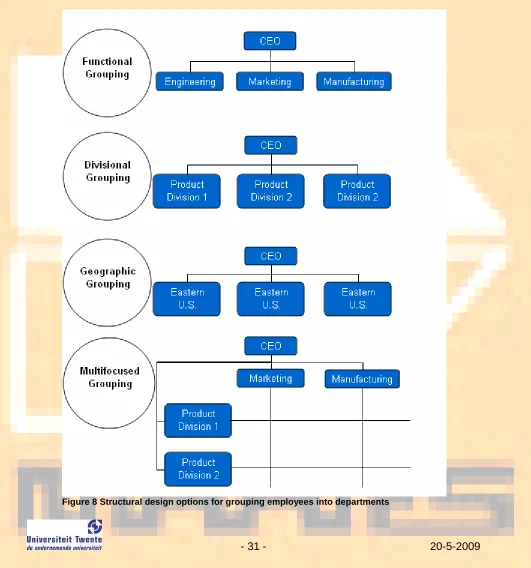
Our solution is focused to improve the organization structure of Maars China. There are many organization models, so we will consider all these models. The overall design of organization structure indicated three things: required work activities, reporting relationships and departmental groupings. There are three key components in the definition of organization structure (Daft, 2007):
• Organization structure designates formal reporting relationships, including the number of levels in the hierarchy and the span of control of managers and supervisors.
• Organization structure identifies the grouping together of individuals into departments and of departments into the total organization
• Organization structure includes the design of systems to ensure effective communication, coordination, and integration of efforts across departments.
Functional structure
In a functional structure, activities are grouped together by common function from the bottom to the top of the organization. For example, all engineers are located in the engineering department, and the manager of engineering is responsible for all engineering activities. The same for financial, sales, etcetera.
Context
Structure: functional
Environment: low uncertainty, stable Technology: routine, low interdependence Size: small to medium
Strategy, goals: internal efficiency, technical quality
Internal systems
Operative goals: functional goals emphasis
Planning and budgeting: cost basis-budget, statistical reports Formal authority: functional managers
Strengths
Allows economies of scale within functional departments Enables in-depth skill development
Enables organization to accomplish functional goals Is best in small to medium-sized organizations Is best with only one or a few products
Weaknesses
Slow response time to environmental changes
May cause decisions to pile on top, hierarchy overload Leads to poor horizontal coordination among departments Results in less innovation
Involves restricted view of organizational goals Divisional structure
The term divisional structure is used here as the generic term for what is sometimes calls a product structure or strategic business units. With this structure, divisions can be organized according to individual products, services, product groups, major projects or programs, divisions, business, or profit centres. The distinctive feature of a divisional structure is that grouping is based on organizational outputs.
Context
Structure: divisional
Environment: moderate to high uncertainty, changing
Technology: nonroutine, high interdependence among departments Size: large
Strategy, goals: external effectiveness, adaptation, client satisfaction.
Internal systems
Operative goals: product line emphasis
Planning and budgeting: profit centre basis-cost and income Formal authority: product managers
Strengths
Suited to fast change in unstable environment
Leads to client satisfaction because product responsibility and contact points are clear Involves high coordination across functions
Allows units to adapt to differences in products, regions, clients Best in large organizations with several products
Decentralizes decision making
Weaknesses
- 30 - 20-5-2009 Eliminated in-depth competence and technical specialization
Makes integration and standardization across product lines difficult Geographical structure
Another basis for structural grouping is the organization’s users or customers. The most common structure in this category is geography. Each region of the country may have distinct tasted and needs. Each geographic unit includes all functions required to produce and market products in that region. For multinational corporations, self-contained units are created for different countries and parts of the world.
The strengths and weakness of a geographic divisional structure are similar to the divisional organization characteristics. The organization can adapt to specific needs of its own region, and employees identify with regional goals rather than with national goals.
Hybrid structure
As a practical matter, many structures in the real world do not exist in the pure form of functional, divisional, or geographic. An organization’s structure may be multifocused in that both product and function, or product and geography, are emphasized at the same time. One type of structure that combines characteristics of both is called the hybrid structure.
Context
Structure: hybrid
Environment: moderate to high uncertainty, changing customer demands
Technology: routine or nonroutine, with some interdependencies between functions. Size: large
Strategy, goals: external effectiveness and adaptation plus efficiency within some functions.
Internal systems
Operative goals: product line emphasis, some functional emphasis
Planning and budgeting: profit centre for divisions, cost basis for central functions
Formal authority: product managers; coordination responsibility resting with functional managers
Strengths
Allows organization to achieve adaptability and coordination in product divisions and efficiency in centralized functional departments
Results in better alignment between corporate and division-level goals Achieves coordination both within and between product lines
Weaknesses
Has potential for excessive administrative overhead
Leads to conflict between division and corporate departments Matrix structure
Another way to achieve focus on multiple outcomes is with the matrix structure. The matrix can be used when one sector of the environment requires technological expertise, for example, and another sector requires rapid change within each product line. The matrix structure often is the answer when organizations find that neither the functional, divisional, geographical, nor hybrid structures combined with horizontal linkages mechanisms will work.
Context
Structure: matrix
Environment: high uncertainty
Technology: nonroutine, many interdependencies Size: moderate, a few product lines
Strategy, goals: dual-product innovation and technical specialization
Internal systems
Operative goals: equal product and functional emphasis
Formal authority: joint between functional and product heads
Strengths
Achieves coordination necessary to meet dual demands from environment Flexible sharing of human resources across products
Suited to complex decisions and frequent changes in unstable environment Provides opportunity for functional and product skill development
Best in medium-sized organizations with multiple products
Weaknesses
Causes participants to experience dual authority, which can be frustrating and confusing Means participants need good interpersonal skills and extensive training
Is time-consuming; involves frequent meetings and conflict resolution sessions
Will not work unless participants understand it and adopt collegial rather than vertical-type relationships.
[image:31.595.30.561.254.822.2]Requires dual pressure from environment to maintain power balance
32 20-5-2009
3.2 Current situation
First we analyze the structural dimension of Maars China. This analysis tries to describe the current organizational structure in detail. Next, we analyze the relation between the current organizational structure and the contextual dimension, size, organizational technology, environment, goals and strategy and organizational culture. After that we put the organizational pressure model into practice. This includes internal and external pressure for organizational change. In the last part we summarize the research results of the current situation.
3.2.1 Structural dimension Formalization
The current level of formalization of Maars China is low compared to that of Maars Holding. The procedures, job descriptions, regulations and policy manuals are either lacking or unclear. We observed that very little is documented. The top management has kept it only in their minds. The formalizations that exist are copied from Maars Holding and then adapted somewhat. This caused problems; for example, the unclear job description has caused little accountability on the part of the employees. Due to the Chinese culture, the employees have no initiative. The employees are often spoken to in detail by their direct supervisor. This means that formalization will be a very extensive process and that all the details will have to be written down. This makes the organization very bureaucratic and hierarchic. The interdepartmental communication is practically non-existent. The departments are very isolated and there is no communication procedure.
Specialization
The lack of documented job descriptions makes it difficult to analyze the level of specialization with Maars China. Interviews with managers and our observations on the work floor provided us with a lot of insight in the level of specialization with Maars China. In general, the specialization with Maars China is low. Employees of small to medium companies have a large number of tasks. The problem is that these tasks are not documented. The production floor is divided in sections (pre-assembly, painting, glass washing, etcetera). When employees of the pre-assembly department finish their work, they are assigned to help other departments. The level of skills and knowledge of what is needed to fulfill the tasks is low. In other words, the workplace and the tasks of the employees on the work floor depend on the situation. The specialization of employees with an office job (white collar) is higher. For example, the employees of the financial department have a narrow range of tasks. They only execute tasks related to financial issues. The specialization level of the top management is also very low. The job description is vague, because it is hard to define their jobs in details. The top management is responsible for the operation of the whole organization.
Standardization
34 20-5-2009 Hierarchy and authority
Despite Maars China being a small to medium company, hierarchy and control is high. For many tasks permission of different people and departments is needed. For example, the payments: the person responsible for payments needs approval of the financial supervisor, a top manager and his coworkers who checked the bills. We can explain this high level of control with communism and the Chinese culture. In the Chinese state, company control is a very important issue. All the systems are focused on building up an extensive control mechanism. The Chinese government needs this extensive control mechanism, because they are not able to control all the state companies by themselves. They also need this control system to evaluate and guide the central planning. The high but unclear hierarchy and authority of Maars China is also related to accountability and the level of independence of its employees. Maars China expects employees on all levels to be independent. In reality, this is not the case. Especially on the work floor employees are very anticipative and need orders in detail from their direct supervisor. Employees are anticipative because they are afraid of punishment or accountability for their own independence. Our informal interview with employees on the work floor showed us that these employees have no initiative because they think that if they do nothing without a direct order, they cannot do anything wrong. The internal reporting and communication structure is very hierarchic and bureaucratic. Before the information reaches the right person, there is a long way to go. The communication between departments goes through the highest manager of each department. Only they have the authority to let things happen. The authority is high, because the departments are isolated and the authority of each manager is limited to their own department. The employees only accept orders from their direct supervisors.
Complexity
Maars China has two divisions: the sales and the manufacturing division. Vertically, the organizational structure can be divided into three main layers: top management (GM and the manufacturing manager), middle management (the department managers), and operational staff (people on the work floor for example). Horizontally, the organization includes the following main departments: Sales, Project, HR, Finance, Production, Engineering, Logistic, Purchasing, and Planning. Compared to Maars Holding, the horizontal complexity is low. The basic departments and positions are taken. All these departments are needed for the daily operation. The spatial complexity is very low; there are two geographical locations, a sales office in Shanghai and a factory near Shanghai (Kunshan). In this sense, the spatial complexity is not difficult to manage.
Centralization
The decision making process is a good indicator for measuring whether Maars China is centralized. As we mentioned above, the organization is hierarchic and only the top and middle management have the authority to make decisions and let things happen. In this light, Maars China is highly centralized. In general, the employees of Maars China are very anticipative. This makes it difficult to delegate the decision making to lower levels. All decisions are made on a top management level. Orders and decisions from the top are always accepted, also if they are wrong. The communication is often top down.
Control
Professionalism
For employees on the work floor the average education level is very low. The skills and knowledge of these employees are company specific because the products of Maars China are unique. A high formal education and training is not necessary to fulfill the job. The educational level of middle management and other white collar positions is high compared to the average educational level in China. In general, the middle managers have bachelor degrees. Their skills and knowledge are generic. This means that their knowledge and skills are not (company) specific. For example the employees of the financial department can use the same knowledge and skills to execute financial tasks in another company. The formal education and training requires long periods of training to fulfill the job. The educational background is more important to hold the position in the organization. But their educational background does not always fit their current position.
The majority of the staff has the Chinese nationality and is familiar with the Chinese culture. As a foreign company it is hard to hire well educated and qualified employees. The Chinese labor market is very fragmented. Due to the movement of the labor market, it is hard to develop a good HRM policy to keep the good employees within the organization.
3.2.2 Contextual dimensions Size
In the field of organizational theories, the size of the organization has been described as an important variable that influences structural design. Should an organization like Maars China become more bureaucratic as it grows larger? In what size organizations are bureaucratic characteristics the most appropriate? One thing is clear to us, large organizations are different from small organizations along with several dimensions of bureaucratic structures, including formalization, centralization, and complexity.
Before we discuss the relation between the size and structural characteristics, we will try to define the size of Maars China. Maars China can be defined as a small to medium organization including basic positions and departments, necessary for the daily operation. The organizational life cycle theory provides us with a clear picture of the stage Maars China is in. Currently, Maars China is in the starting phase of formalization. This stage involves the installation and use of rules, procedures, and control systems. The top management becomes concerned with issues such as strategy and planning, and leaves the responsibility of the every day operation to the middle management. Bureaucratic characteristics emerge. The organization adds staff support groups, formalizes procedures, and establishes a clear hierarchy and division of labor. Innovations may be achieved by establishing a separate research and development department. This picture is partly comparable with the current situation of Maars China. Strategical and operational decisions are both made by the top management of Maars China. Bureaucracy and centralization is high. The organization of Maars China is becoming more and more complex as more employees and departments are added.
Formalization
Compared to Maars Holding which can be defined as a large organization, the formalization of Maars China is low. This evidence supports the conclusion that large organizations are more formalized because they rely more on rules, procedures, and paperwork to achieve standardization and control over their large number of employees and departments.
Decentralization