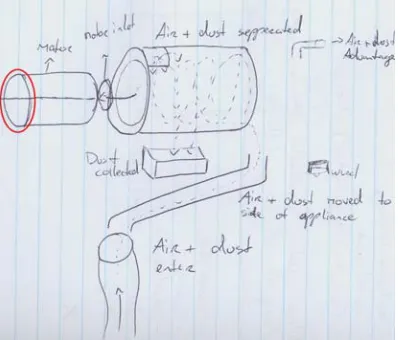
Minimizing the overall size of a vacuum cleaner
Author Leon van Dijk
Graduation supervisors Paul van Wolferen Maarten Bonnema
Date 15-02-2010
Company Royal Philips N.V.
Educational institution University of Twente
Title Page
Full Title Define the options for minimizing (optimizing) the overall size of a vacuum cleaner
Graduation student Leon Martijn van Dijk
Student number s0112658
Study Industrial Design Engineering
Exam date 02-03-2010
Examination Committee prof. dr. ir. Wim Poelman (UT) dr. ir. Maarten Bonnema (UT)
Paul van Wolferen (Philips)
Freddie Moes (Philips) Company information University of Twente
Faculty of Engineering Technology
Industrial Design Engineering
7500 AE Enschede +31 (0)53 489 9111
Royal Philips N.V.
Innovation & Development site Tussendiepen 4
9206 AD Drachten
Preface
This report is the result of a research on the options for minimizing overall vacuum cleaner size for Philips. The research was done as a final assignment in the bachelor curriculum of the study Industrial Design Engineering at the University of Twente. The research was executed at Philips, which gave me the opportunity to learn about the work ethos in a big company, to work in an international setting and to take a look behind the scenes of one of the worlds’ biggest electric consumer product producing companies.
‘As Industrial Designers, you will be taught to lead multidisciplinary project teams that are involved in product development. You will be able to talk about the content with all the involved disciplines and translate and share this information with the people from other involved disciplines’, is a commonly heard statement. In the research, I have tried to include a lot of specialists to make this broad assignment as valuable as possible and to test my abilities as Industrial Designer.
I want to thank Maarten Bonnema, my scientific supervisor, and Paul van Wolferen, my supervisor at Philips, for the time and effort they put into this project. The talks I had with you, Maarten, always gave me new insights on the project and cleared my view on the assignment. Paul, you gave me a really good opportunity to see Philips in a lot of different aspects. You explained how the company works and gave me freedom in my assignment and on the Philips work floor. This made me really enjoy my time in Drachten.
If it were not for Freddie Moes, I would have had a really hard time keeping the research lively and consistent. We shared a lot of lunches and brainstorm sessions together and your creativity and ability to shift focus on a subject inspires me.
Other colleagues that cannot be left unmentioned:
Erik Teeuw for showing me the business sides of the Philips-employer relationship.
Pritesh Patel for the discussions we had and of course the fun activities you took me to in Drachten and Groningen.
And I want to thank Sunil, Kelly, Erica, Olivier and Vidyadhar for giving me the chance to learn about their cultures and taking my mind off the work in the evening. We had a lot of fun guys! Next to the people involved in the process, I would like to thank my family and friends. Special thanks to my parents for giving me the opportunity to study and unconditional support in my activities. Also my aunt Elly should be mentioned for helping me out with the housing problem in the beginning of the assignment and Rick, Melvin, Kajsa, Ivo, Freek, Sander, Irina, Tim and Jan-Jaap for keeping my social life so very interesting and fun.
Last, but not least, I want to thank Joan for helping me correct the English in this report.
I hope you will enjoy reading my report.
Table of content
Preface ... 3
Table of content ... 4
Summary ... 6
Samenvatting ... 7
1. Introduction ... 8
1.1 Company ... 8
1.2 Problem ... 8
1.3 Objective ... 8
1.4 Scope ... 8
1.5 Approach ... 8
2. Requirements development ... 9
2.1 Previous research ... 9
Mind
map
stakeholders
model
...
10
2.2 Acquiring requirements from involved Philips departments ... 11
Gathering
information
from
involved
Philips
departments
...
11
Processing
gathered
information
...
11
2.3 Consumer research ... 13
Preparing
and
performing
the
consumer
research
...
13
Processing
results
from
the
consumer
research
...
15
3. Future opportunities for Philips floorcare ... 16
3.1 Vacuum cleaner key drivers ... 16
3.2 Key components that influence size and shape ... 16
3.3 Used innovation methods ... 17
TRIZ
...
17
SIT
...
18
3.4 Ideas ... 19
3.5 Component roadmap ... 20
4. Miniaturized concepts ... 23
4.1 Conventional concept ... 23
Development
...
23
4.2 Future concept ... 25
Choice
of
ideas
for
concepts
...
25
Development
...
25
Features
and
specifications...
26
4.3 Concepts review ... 26
5. Conclusions and Recommendations ... 27
6. Evaluation ... 29
Summary
Recent Philips consumer research showed that big, bulky canister vacuum cleaners negatively influence consumer satisfaction. Consumers stated that they had a hard time cleaning between two objects, that big canister vacuum cleaners move clumsily and that such a vacuum cleaner is too heavy to lift when cleaning the stairs. Therefore Philips wanted to research the possibilities of developing a small canister vacuum cleaner, without decreasing the performance level that had been reached. The Philips ‘Performer’ vacuum cleaner was chosen as the competitor model.
The research started with an inventory of the available information on size within Philips. Because Philips is a big international organization, the assumption was made that all necessary information to perform this research would be available. A lot of the information indeed was present, however the effect of decreasing overall vacuum cleaner size on consumer satisfaction was missing. Therefore, apart from an internal research into the requirements for the Philips departments, a consumer satisfaction research also had to be done.
To gather all the right information within Philips, specialists involved in the vacuum cleaner development process were interviewed. As a preparation to these interviews, colleagues were informed about the project and its goals through a Value Proposition House and two use scenarios. After the interviews, the acquired requirements were bundled in the requirement management program DOORS. In this program the requirements were elaborated on stakeholder, system and component level. After processing the results, it became clear that there were few detailed requirements for the development of a small vacuum. It was clear, however, that decreasing the size of certain components has a negative influence on the performance. For example the air tubes; there is no minimum width for the tubes, but a change in tube diameter causes performance loss.
While gathering the information at the Philips departments, a consumer research was prepared. The goal of the investigation was to determine the effect of size, weight and the size-weight combination (independent variables) on consumer satisfaction (dependant variable). To test these effects, three vacuum cleaner dummies, with different sizes and changeable weights, were made. Participants were asked to perform three operations with the dummies and give the model a score. The result of the research was that consumer satisfaction is the biggest at approximately 12 dm3. Results on weight, and therefore as also on size-weight combinations, were invalid due to a wide spread in consumer satisfaction scores and a small difference in average scores.
The possibilities of decreasing overall vacuum cleaner size were explored by first determining the key drivers of a vacuum cleaner. These were then used together with system and component information to determine the key components of a vacuum cleaner. Hereafter ideas were generated, using the innovation methods TRIZ, the Theory of Inventive Problem Solving, and SIT, Systematic Inventive Thinking, to decrease overall vacuum cleaner size. Then together with the component specialist, a component roadmap was made for the next five years.
Samenvatting
Recente consumenten onderzoeken van Philips lieten zien dat een grote slede stofzuiger de tevredenheid van consumenten negatief beïnvloed. Consumenten gaven aan beperkt te worden in hun mogelijkheid om tussen twee object schoon te maken, dat grote slede stofzuigers lomp zijn in hun verplaatsing en dat deze stofzuigers erg zwaar zijn voor het schoonmaken van de trap. Om deze redenen wilde Philips de mogelijkheden onderzocht hebben om een kleine slede stofzuiger, met de prestaties van een grote stofzuiger, te ontwikkelen. De Philips ‘Performer’ stofzuiger was gekozen als referentiemodel.
Het onderzoek begon met een inventarisatie naar alle beschikbare informatie over grootte binnen Philips. Omdat Philips een grote internationale organisatie is, was het uitgangspunt voor de opdracht dat alle benodigde informatie voor dit onderzoek beschikbaar was binnen het bedrijf. Voor een groot deel klopte dit, echter informatie over het effect van de verkleining van de stofzuiger grootte op consument tevredenheid miste. Hierdoor is er, naast een onderzoek binnen Philips naar de eisen voor het verkleinen van een stofzuiger, een consumenten onderzoek gedaan. Om binnen Philips de juiste informatie bij elkaar te krijgen en te bundelen, zijn er interviews gehouden met specialisten van elke betrokken afdeling in het stofzuiger ontwikkel proces. Ter voorbereiding op deze interviews zijn collega’s geïnformeerd over het project en haar doelen middels een Value Proposition House en twee gebruik scenario’s. De verkregen eisen zijn hierna overzichtelijk gebundeld in het requirement management programma DOORS. In dit programma zijn de eisen op stakeholder, systeem en component niveau uiteen gezet. Na het verwerken van de eisen bleek dat er weinig harde eisen zijn. Desondanks was het duidelijk dat het verkleinen van sommige componenten een negatief effect had op de prestatie. Bijvoorbeeld bij vernauwing van de luchtwegen; technisch gezien kan dit gerealiseerd worden, maar een verandering van de diameter veroorzaakt prestatieverlies.
Tegelijkertijd met het verzamelen van de informatie binnen de Philips afdelingen is er een consumenten onderzoek voorbereid. Het doel van het onderzoek was om het effect van grootte, gewicht en grootte-gewicht combinaties (onafhankelijke variabelen) op consument tevredenheid (afhankelijk variabele) te bepalen. Om deze effecten te testen zijn er drie dummy stofzuigers gemaakt. Participanten werden gevraagd om een aantal gebruikshandelingen uit te voeren met de dummies en het model een cijfer te geven. De uitkomst van het onderzoek was dat de consument tevredenheid het grootst is bij een volume van ongeveer 12 dm3. Resultaten over het gewicht, en daardoor ook over grootte-gewicht combinaties, waren niet valide bevonden door een grote spreiding van de gegeven cijfers en hele kleine verschillen in de gemiddelde cijfers.
De mogelijkheden tot verkleining waren onderzocht door eerst de key drivers van een stofzuiger te bepalen. Deze werden vervolgens gebruikt om, samen met de systeem en component informatie, de belangrijkste componenten van een stofzuiger te bepalen. Vervolgens zijn er met behulp van de innovatie methoden TRIZ, de theorie van het inventief probleem oplossen, en SIT, systematisch inventief denken, ideeën gegenereerd om een stofzuiger te verkleinen. Hierna is er samen met de component specialisten een component roadmap voor de komende vijf jaar gemaakt.
1.
Introduction
1.1 Company
The foundations of Philips were laid in 1891 when Anton and Gerard Philips established Philips & Co. in Eindhoven, the Netherlands. The company began manufacturing carbon-filament lamps and, by the turn of the century, had become one of the largest producers in Europe. By 1910, with 2,000 employees, Philips was the largest single employer in The Netherlands.
Nowadays Philips is a diversified Health and Well-being company, focused on improving people’s lives through timely innovations. As a world leader in healthcare, lifestyle and lighting, Philips integrates technology and design into people centered solutions, based on fundamental customer insights and the brand promise of “sense and simplicity”. (www.philips.com)
1.2 Problem
Recent market research showed Philips that big / bulky vacuum cleaners are disliked by consumers in Europe. Often consumers pointed out that big vacuum cleaner decrease their flexibility to clean between objects, move clumsily, are often heavy when cleaning the stairs and that storing a big vacuum cleaner is inconvenient. Using this consumer insight, Philips wants to increase consumer satisfaction and meet the consumer demands on size. Therefore Philips wants to know the possibilities of reducing the size of vacuum cleaners for the European market, without decreasing the performance and durability.
1.3 Objective
The goal of this research is to define options for minimizing the overall size of a vacuum cleaner for the European market, without compromising in performance or durability.
1.4 Scope
The focus of the research was “Normal” canister-type vacuum cleaners that use the existing key components like Philips canister-type vacuum cleaners do.
1.5 Approach
The start of the research, gathering the necessary information and requirements for a miniaturized vacuum cleaner, is described in chapter two. This started with an inventory of the available information on size at Philips. After reading the available reports, all involved stakeholders in the development of a vacuum cleaner in the Philips floorcare value stream were identified. Requirements were acquired from the stakeholders through interviews in which the stakeholder got insight in the project from a Value Proposition House and two scenarios. One stakeholder, the end user, needed a different method of approach to get the right requirements. A consumer research into user satisfaction, in which vacuum cleaner operations with dummies had to be performed, was done to obtain the consumer requirements on the minimal size of a vacuum cleaner. All the requirements were processed in DOORS, the requirement management program that Philips uses.
In Chapter three the innovation and roadmap steps are elaborated. First key drivers were derived from the Philips requirements, component information and data from (previous) experiments. Hereafter key components that influence size and shape were determined and road mapped for the next five years. The key drivers were also used as input for the innovation methods. To define future opportunities, TRIZ, a Russian innovation method, and SIT, a simplification of TRIZ, were used. Brainstorm sessions to gather innovation ideas were held and together with Paul van Wolferen, vacuum cleaner specialist, the ideas were rated on their feasibility.
2.
Requirements development
At the start of this project the assumption was made that Philips, a multinational with more than fifty years of experience in the development of vacuum cleaners, would have a lot of information about the technical and consumer aspects of a vacuum cleaner available within the company. Philips indeed had a lot of information on vacuum cleaning available, detailed consumer information was missing. Although Philips has propagated being a consumer centered organization for the past few years, it had been a technology driven company for most of the time that they were involved in vacuum cleaner development. To make this change in the way of working in Philips Consumer Lifestyle, the ergonomics department was transformed into the Application Research Centre (ARC). Where as the ergonomics department was a passive department that was mostly focused on not making a bad appliance, the ARC is a pro-active department that collects data on consumer preferences, satisfaction and the overall use of products. Because this change in the way of working occurred recently, there was a lot of knowledge and information on vacuum cleaner systems and components size, but information on the influence of vacuum cleaner size on customer satisfaction was lacking. Therefore next to gathering requirements for a miniaturized vacuum cleaner in the Philips departments, requirements for a miniaturized vacuum cleaner also had to be acquired from consumers.
2.1 Previous research
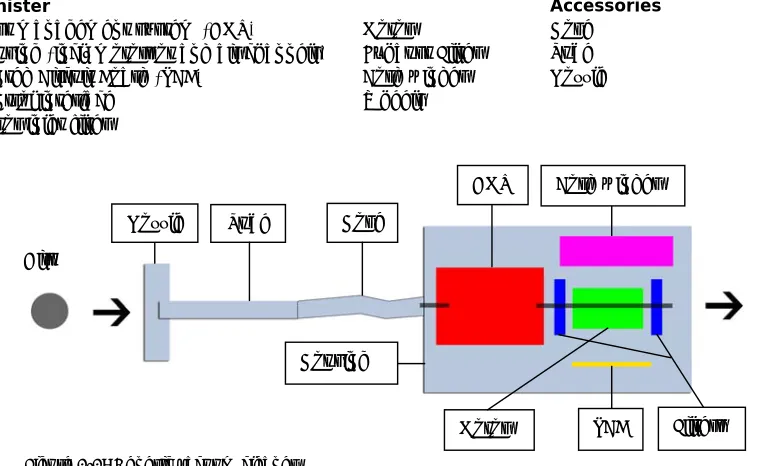
Before the search for the necessary information started, two vacuum cleaners, the Philips ‘Performer’ and ‘Gemini’ (Figure 2.1), were disassembled to gain insight in the components and architecture of current canister vacuum cleaners. The components found are listed below and showed in Figure 2.2. A list with pictures to visualize components can be found in appendix A.
Canister
Dust management system (DMS) Housing (incl. motorpot and air channels) Printed Circuit Board (PCB)
Control interface Motor inlet filter
[image:9.612.92.246.291.392.2]Accessories Hose Tube Nozzle Motor Exhaust Filter Cord winder Wheels Figure 2.1: Gemini and Performer
Dirt
Tube Hose
Motor PCB Filters Housing
Nozzle
DMS Cord winder
[image:9.612.107.488.459.692.2]To get a better understanding of what the assignment ‘miniaturization of a vacuum cleaners’ included, previous Philips researches were read. Most reports were size related, but did not have size as main focus.
[Van Raalte & van der Wijst, 2001] gave a better understanding of the cleaning process. The report describes what dust and dirt is, what it consists of and explains the circle of Sinner.Several reports like [Gibert and Arends, 2001; Dindas,2008] about modules and platforms in vacuum cleaners, gave more insight into necessary vacuum cleaner components and how they affected the overall size. [Van Wolferen, 2006, 2007] showed how competitor vacuum cleaner producers constructed their vacuum cleaners. Small vacuum cleaners, high efficiency vacuum cleaners, all different vacuum cleaner models with different properties. The high efficiency report [Zjiroecha, 2009] elaborated the basic principles of efficiency loss in a vacuum cleaner.
Several concept labs and turbo factories, types of Philips consumer researches, gave insight into the Philips consumer segments and their preferences. All the knowledge that has been collected through these researches is bundled in the floorcare consumer bible [Grol, 2007].This document turned out to be a very helpful document because based on all the consumer information in this document a substantiated choice of consumer segment could be made. Although the consumer bible features a lot of consumer information, much more then this project required, information on the effect of size on consumers preference was not included. Therefore next to collecting requirements from the Philips departments involved, requirements from end users also had to be acquired.
Mind
map
stakeholders
model
[image:10.612.96.509.455.586.2]
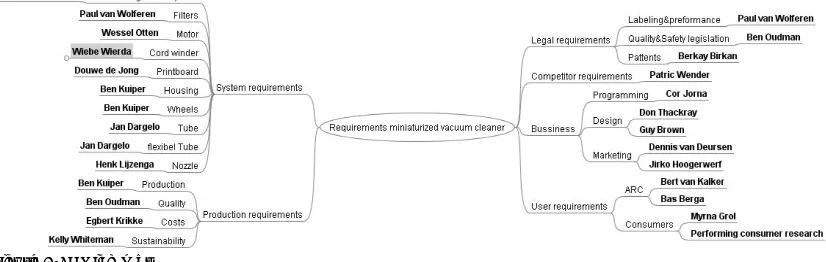
A mind map was made to get a clear view of the stakeholders in vacuum cleaner development. It was composed top down, which means that from the main set of requirements for a miniaturized vacuum cleaner, stakeholders involved in the vacuum cleaner development were determined. Passive stakeholders like distributors or resellers would, most probably, also have had requirements, but these stakeholders were not included in the research (and mind map) to keep the size of the project limited. This choice was made in consultation with Philips. The map includes representatives for each stakeholder to direct the communication for requirements. The representatives were chosen in collaboration with Paul van Wolferen. A full-scale mind map can be found in Appendix B.
2.2 Acquiring requirements from involved Philips departments
Using the stakeholders mind map, the way of collecting the necessary information could be determined. Beside the available information from previous research, information from various Philips departments and from consumer research had to be gathered. Combined, this set of information could be used as a basis for determining current limitations, future opportunities and concept development.
Gathering
information
from
involved
Philips
departments
To give the representatives (colleagues) of the Philips departments a quick, but adequate insight in the miniaturization project, a Value Proposition House (VPH) and two operation scenario’s were made. These documents describe the benefits and context of using a miniaturized vacuum cleaner entirely and compact. Involving colleagues in the project in this way enabled their ability to imagine possible results so that they could justify their requirements more specifically. The VPH and Scenarios can be found in appendix C.
At first it was attempted to collect the requirements through digital communication, but it quickly turned out that this way of working did not produce the right kind of requirements. Therefore it was decided to interview the representative of every department to collect the right requirements. A side effect of making a VPH and the scenario’s was that to write the documents it was necessary to have a very clear view of the target group. As it turned out that this was not the case, the target group was further explored using the information from the floorcare consumer bible and discussions with colleagues from the Application Research Centre.
Processing
gathered
information
When all requirements from Philips departments had been collected, they were arranged in DOORS, a requirement management program that is used within Philips. Using DOORS, requirements can be written in separate documents and those documents can be assigned to a specified group of people. The requirements in the different documents can then be linked together. An evaluation of working with this program can be found in [6. Evaluation].
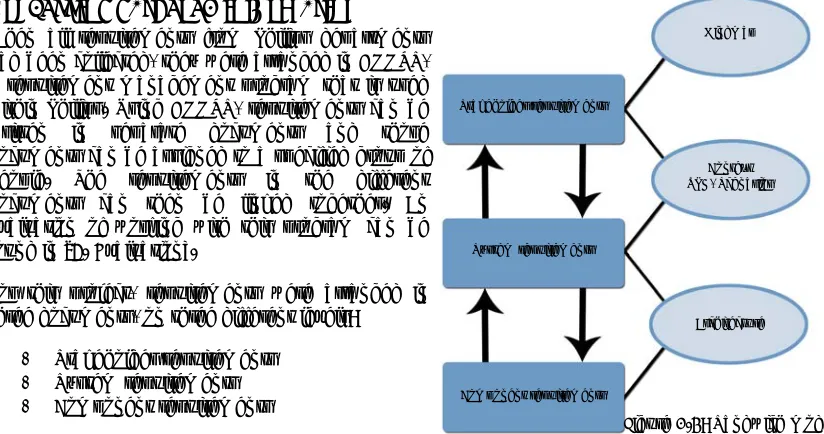
For this project, requirements were arranged in three documents, on three different levels:
- Stakeholder requirements - System requirements - Component requirements
These levels were determined together with Patric Wender, requirement engineer at Philips. He explained the model in Figure 2.4 as the sandwich model and other different levels of requirements were discussed. The result of the discussion was that more general and more detailed requirement levels were outside the scope of this assignment.
Stakeholder requirements were the most general requirements for this project. The end user, the production department and quality department were the only parties that had requirements on the stakeholder level. Requirements from the business departments (Design, Marketing and Programming) would also have fit well in this set of requirements. However, it was chosen to not include the only Marketing requirement ‘reduce size with <70%’ in this project, because consumer research results contradict this requirement. The Marketing requirement could be used as starting point in miniaturization projects until other, more specifically applicable requirements contradicted this requirement. The only requirement from the Design department ‘a miniaturized vacuum
[image:11.612.100.512.345.562.2]Stakeholder requirements System requirements Component requirements Mindmap Context VPH, Scenarios Architecture
cleaners must look as much as a broomstick as possible’ did not fit in the document because the scope was limited to canister vacuum cleaners. Programming did not have direct requirements in this phase of a project.
The stakeholder requirements interact with the system requirements and both interact with the context of use. These requirements are detailed on the system, but describe limited information on component. Except for requirements from the business, labeling and patents departments, all stakeholders from the project have requirements on system level. The lack of business requirements is explained in the paragraph above. Requirements from the labeling department were equal to the competitor requirements and not yet that detailed (because labeling is still in progress), therefore they were left out. Together with the patent department there has been a search for patents that would restrict the development of a miniaturized vacuum cleaner, using the adjusted Philips database. This search had no explicit results.
The system requirements interact with the component requirements and both interact with the system architecture. As the scope of the assignment was ‘normal’ canister vacuum cleaners, the main (component) architecture was already determined. The end user, the quality department and divers component departments were the only parties who had component requirements.
The full requirements documents can be found in appendix D.
The critical factor from the involved Philips departments in developing a miniaturized vacuum cleaner was determined by the necessary components and their size limitations. These size limitations determine together what minimal vacuum cleaner volume was technically feasible. If the components would not fit the minimal accepted volume by consumers, the minimal vacuum cleaner size would be determined by the sum of the minimal components sizes. The component size limitations are discussed in the paragraph ‘component size limitations’ below.
Next to the critical factor, the competitor requirements were found to be very important for the system requirements. Because the Philip ‘Performer’ is the competitor for this project, the miniaturized vacuum cleaner must be able to achieve a very high dust pick up, have a handle to be lifted and the user must be able to control the suction power of the appliance.
Component size limitations
Although all components had requirements that were to be met when decreasing the size of a high performing vacuum cleaner, not all requirements include a minimum size. There were only a small amount of requirements found that limit the size of a component. This did not mean that the size could be decreased without consequence, but the size could be decreased. The consequences are listed in the efficiency principles.
Vacuum cleaner accessories requirements:
The nozzle must have a minimal width of 270 mm.
The nozzle must have a minimal height equal to the tube width.
The tube must be variable in working height from maximal 600 mm to 1080 mm. The tube must have a handle of 32 mm diameter.
The hose must have a minimal length of 1700 mm.
All connection interfaces between nozzle, tube, hose and canister must fit the standards already used.
Vacuum cleaner canister requirements:
The motor has a minimal cylindrical space in the appliance of 120 diameter * 100 dept (1.1 dm3). The dust management system must have a volume of at least 1.5 dm3.
The exhaust filter must keep the same volume (0.45 dm3), but can differ in dimensions.
The cord winder should have a minimal volume of 0.015 dm3 for the cord (9 meter) and a total cylindrical space of 1.5 dm3.
2.3 Consumer research
As Philips claims to be a consumer-centered company, consumers are an active, leading stakeholder in the development of current vacuum cleaners. No previous Philips researches focused on the effect of minimizing vacuum cleaner size on consumer satisfaction. Therefore a consumer research into the effect of minimizing vacuum cleaner size on consumer satisfaction had to be done.
Preparing
and
performing
the
consumer
research
After discussing several research methods to achieve
the goal, “test the effect of minimizing vacuum cleaner size on consumer satisfaction”, with colleagues from the Application Research Centre (ARC) department, it was decided to perform a consumer research with dummies of different sizes. This method was chosen because size perception is best when people are able to see, touch and use a 3D model. The effects of size, the independent variable, on consumer satisfaction, the dependent variable could be tested by performing specifically chosen handlings with the dummies.
Next to the different sizes, it was decided to include the weight of the dummies as an independent variable in the research. The variable weight was included because this was an interesting, unexplored field for the ARC and because there could be a size-weight influence (third independent variable) on the consumer satisfaction.
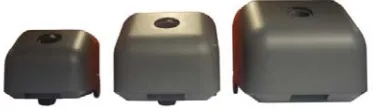
Once the research method was chosen, dummies had to be made. Because there were no guidelines for the dimensions of a (miniaturized) vacuum cleaner, and therefore neither for the dummies, a research was done into the dimensions used for various vacuum cleaner canisters (appendix E). The resulting insight into the used dimensions for vacuum cleaners, was used as a starting point for the development of the dummies. Because of this, the dimensions of the middle model are the same dimensions as the Philips ‘Gemini’, a Philips vacuum cleaner that is currently on the market. Once the dimensions were chosen, only simple adjustments to the shape were made, to make the dummies look like vacuum cleaners. After the models were made they were painted grey to reduce the effect of color on the perception of the sizes as grey is a fairly neutral color. The result is shown in Figure 2.5.
Once all the dummies were finished, consumers were invited through EyeQuestion. EyeQuestion is an application that Philips uses to prepare and process sensory and consumer research. In collaboration with colleagues from the ARC, consumers who fitted the Philips Happy Home segment profile and were between 25 and 55 years old, were filtered from the database and invited to come to the home lab at the Philips site in Drachten. The invitation included two questions about the participants’ current vacuum cleaning situation, about the cleaning surface and the currently used vacuum cleaner, to be able to compare this information with the results of the research.
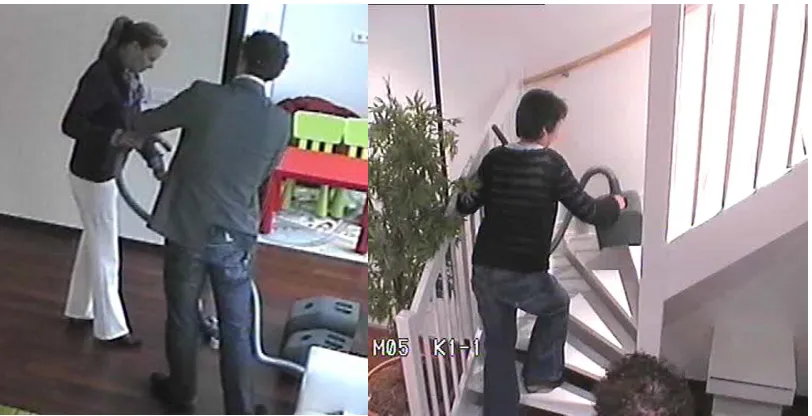
The consumer research was done in the home lab, which is especially equipped for consumer testing, consist of a hall, living room, kitchen and a discussion room and has the possibility to record the research on audio and video. The living room and the hall were used to test three operations on the vacuum cleaner to determine the consumer satisfaction:
- Cleaning a hard floor - Cleaning a carpeted floor - Cleaning the stairs
[image:13.612.335.522.199.254.2]These actions were chosen, because they are the most common and require interaction with the canister. Therefore they have a big influence on consumer satisfaction.
A second, subordinate, goal of the consumer research was to gain more insight on the importance of size versus other vacuum cleaner properties. To achieve this goal, two trade-off questionnaires were held among the participants. In the first questionnaire, respondents had to trade off different properties of a vacuum cleaner against each other. In the second questionnaire different operations had to be traded off against each other.
[image:14.612.103.509.197.405.2]Results of the consumer research are described in the next paragraph. For the whole consumer plan, see the appendix F – consumer research plan. To watch the consumer research contact Jan Kohl, test coordinator at the ARC of Philips Drachten, for the DVD’s.
Processing
results
from
the
consumer
research
To reach the goals, fifteen consumers tested nine vacuum cleaner dummies with different sizes and/or weights. After the doing the test exercises with a dummy, participants were asked to rate dummy, on a scale of one (low) to ten (high), based on their overall satisfaction. The average scores are shown in Figure 2.7.
With the score results the optimal (minimal) volume of a vacuum cleaner was calculated together with Marc Schuld, a senior consultant in quantitative methods from CQM. First the assumption was made that the scores represent points in a linear model and therefore the consumer satisfaction could continuous be calculated by using the linear regression model (ANOVA). The consumer satisfaction can then be described in the formulas:
Yv = Score of the dummy (consumer satisfaction) on weight V = volume
Yv = α0 + α1*V + α2*V2
The outcome is that the optimal, minimal volume of a vacuum cleaner is approximately 12,1 dm3. This volume
has a score of 7,45 and results have a fit of 39%. This fit is not very high, but the specialist indicated that this fit was high enough for valid results.
With the score results the optimal (minimal) weight of a vacuum cleaner could also be calculated. However, the scores from the test had a very wide spread (low fit) and the average scores of the different weights did not differ much, this caused an invalid outcome. The reason that the scores were invalid could have been caused by two factors. The first, most likely, factor is that the difference in weights that were used in the consumer test was too small. Therefore the differences in weight were not noticeable and consumers did not base their score on weight. The second factor could be that weight is not important for consumers, but this contradicts the results from the trade off questionnaire.
Because the weight results were not valid, the effect of a different size-weight combinations was invalid as well. Although it has to be remarked, that there is an effect noticeable.
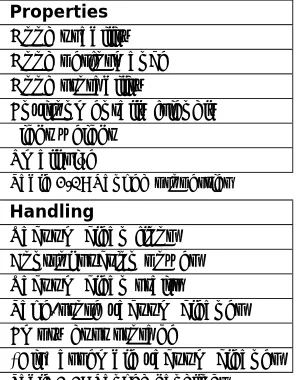
Next to the interaction tests with dummies, participants were asked to fill out two trade-off questionnaires and some open questions to gain insight into the most important properties and actions in vacuum cleaning. The results (Table 2.1) showed that from all included vacuum cleaner properties, a small size was the least important. In the operations trade off, operations where size played an important role, were also not that important (Table 2.1).
The open questions gave more insight on other vacuum cleaning aspects. For example all respondents answered that they find changing the cord to another plug within the same room a dissatisfactory and half of the respondents claimed to be willing to pay 50 euro extra for a miniaturized high performing vacuum cleaner. When asked what the ideal vacuum cleaner would be, only one respondent answered “a robot vacuum cleaner”.
The overall conclusion from the consumer research is that miniaturization is subordinate to other properties of a vacuum cleaner. This is in line with the requirement from the Philips departments to only minimize when performance, operation and usability are not decreased. All the results of the consumer research are shown in appendix F – consumer research results.
[image:15.612.369.519.147.348.2]Properties Good usability Good performance Good storability Environmentally friendly Light weight Small size
Table 2.1: Ranked properties Handling
Vacuum clean floor Control suction power Vacuum clean stairs Take/store vacuum cleaner Empty dust storage
(Dis) assemble vacuum cleaner Table 2.2: Ranked handlings
8 dm3 15,7 dm3 23,8 dm3
[image:15.612.94.247.479.669.2]3.
Future opportunities for Philips floorcare
To determine future opportunities, first the key components that influence size and shape were determined using the acquired component information and the key drivers. Then ideas were generated to improve a vacuum cleaner. Minimizing the overall size was always the main focus of these brainstorms, but other ideas were also listed. The ideas were rated on their feasibility together with Paul van Wolferen. In collaboration with the components specialists, a component roadmap was made. Based on all these steps, the most potential future opportunities were pointed out.
3.1 Vacuum cleaner key drivers
Seven key drivers for vacuum cleaning were derived from the available Philips consumer information. These key drivers were used for determining the key components in the rest of the idea process and concept development.
Key drivers (randomly ranked):
1) Dust pickup (DPU) 5) Convenience of use 2) Dust storage capacity (DSC) 6) Storage Convenience 3) Cleaning range 7) Size
4) Weight
3.2 Key components that influence size and shape
The components that have the biggest influence on the final shape and size were determined from the collected requirements and key drivers of a vacuum cleaner. In a vacuum cleaner, three components have the biggest influence on size and shape and they are listed below. The first listed component has the most influence and the third listed component the least.
1. The motor
There is a wide selection of available vacuum motors and their influence on size and shape differs per motor type. However, the motors that Philips uses in her vacuum cleaners are most important to the size and shape of the vacuum cleaner.
Current vacuum cleaner systems use a motor that is able to produce a high vacuum and a fast airstream. The efficiency of the used vacuum cleaner motors, approximately 46%, results in the need for a high input power. This high input power requires the use of a cord (winder). Furthermore, Philips uses motors that work with carbon brushes. This causes a need for an exhaust filter and an airtight air channel to this filter. The shape of a motor is also predetermined and there has to be enough space in the vacuum cleaner to reduce the noise the motor produces. All this together makes the motor a big component with a big influence on size and shape of a vacuum cleaner.
2. The cord winder
A cord winder is a necessary component in a vacuum cleaner to achieve a certain performance level. Batteries of the same size as the cord winder do not have the required capacity for good cleaning and are much more expensive. Therefore without a cord winder the performance of a vacuum cleaner would decrease significantly.
The cord winder is a very standardized component. The only variables in this component are the overall size due to different cord lengths (small difference) and the width/diameter ratio. Furthermore, a cord winder does not use its volume efficiently, because the winding volume has to be approximately 1.7 times the cord volume due to the lack of a cord guiding system. Additionally current cord winders must to be placed vertically in order to work correctly. These properties make the cord winder a very inflexible, big component that has a big influence on the size and shape of a vacuum cleaner.
3. The dust management system
systems do not compress dust into a small volume, a big dust storage capacity requires a big volume. So the required / determined storage capacity has a big influence on the volume. However, the shape of the dust storage is flexible and designed in house at Philips. This means the influence on the total size and shape of a vacuum cleaner could be reduced by shaping the dust storage custom (smart) for each vacuum cleaner.
Because the dust filtering systems do not filter out all the dust, motor inlet filters are required to guarantee a certain product lifetime. This again causes a lot of extra necessary volume.
3.3 Used innovation methods
To generate ideas for improving vacuum cleaners (in size), tools from two methods were used. The first used method is called TRIZ, the acronym for Teoriya Resheniya Izobretatelskikh Zadatch
meaning “The Theory of Inventive Problem Solving”. TRIZ features a set of tools that can be used in all kinds of innovation processes. TRIZ was founded in 1969 by Gerrit Altshuller and is based on the analysis of innovations in 40 000 patents. Two tools from this method were used. First a S-Jump curve was made to get a clear view of the evolution of the vacuum cleaner. After this the ‘40 principles’ and ‘evolution analysis’ tools were used to generate ideas.
Next to the tools used from the TRIZ methodology, a tool from the SIT methodology was used. Filkovsky, Horowitz and Goldenberg introduced SIT, short for Systematic Inventive Thinking, in the early 1990’s with the goal of simplifying TRIZ. SIT starts its process with the product or service that is offered and elements directly available in the environment. With this closed world principle, new product ideas will be formed based on the current product. From the SIT method the subtraction tool was used.
The use of TRIZ en SIT is elaborated in the next two paragraphs.
TRIZ
To get a clear view of the evolution of the dry cleaning process, a S-Jump curve, that can be found in appendix G, was made. This curve orders all innovations from the broomstick up to the canister vacuum cleaners used nowadays. Hereafter the ‘40 inventive principles matrix’ was used. The tool consists of a matrix that is filled with 40 abstract engineering parameters. Innovative ideas were formed when changing a parameter caused a negative effect on another parameter. In the matrix abstract solutions were proposed from which engineering solutions could be created. An example: Two vacuum cleaner properties, overall size and dust storage capacity, conflicted with one another when decreasing the overall size. These properties were converted to the parameters ‘size of moving object’ and ‘amount of substance’ in the 40 principles matrix and the result suggested: Inventive principle 29. The use of gasses and liquids
Inventive principle 30. The use of thin films and flexible shells Inventive principle 7. Nestling
When all conflicts were determined, brainstorm sessions about innovative solutions took place using these suggestion. These sessions resulted in a list of ideas for improvements and/or new products that can be found in appendix H.
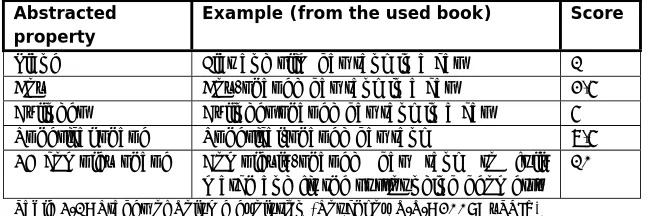
The second tool, the ‘Evolution analysis’ tool, was used to define up to what stage the product parameters were evolved compared to their maximal evolutionary potential. An example:
The volume of a vacuum cleaner was shaped in three dimensions. This property was abstracted to the term 3D complex shape. The shape of an object can evolve in the following stages:
Abstracted property
Example (from the used book) Score
Plane Flat and slim gas tank in a car 1
Box Box-shaped gas tank in a car 2,5
Cylinder Cylinder shaped gas tank in a car 5 Spherical shape Spherical-shaped gas tank 7,5 3D complex shape Complexly-shaped gas tank to fully
[image:17.612.145.479.612.720.2]match and fit the surrounding geometry 10
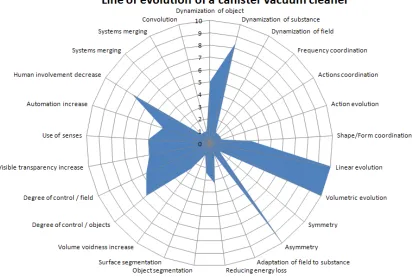
The stage up to which the parameter was evolved was given a score. Scores of all parameters were plotted on a radar plot. In this type of plot chances to improve the product are clearly visualized. Per parameter that was not evolved to its maximal evolutionary potential, a brainstorm was held about how to achieve an higher evolution of the parameter in order to improve the product.The scores of all parameters are plotted in Figure 3.1. An explanation of the score per parameter is to be found in Appendix H.
SIT
[image:18.612.99.513.162.439.2]
From the SIT methodology one of the five thinking tools, that form the base of the methodology, was used: the subtraction tool. With this tool essential components were taken away from the component (one at a time) and benefits for the subtracted version were found. For example: The chosen product was a vacuum cleaner. One of the critical components, the motor, was taken away. Ideas were formed about how the product could work if other components fulfill the function of the motor. This would save a component and therefore reduce size. The ideas are included in the idea list. Pictures of the SIT session, that was held with Freddie Moes, can be found in appendix I.
3.4 Ideas
Although the focus of the brainstorm sessions had always been reducing the overall size of a vacuum cleaner, all ideas to improve a vacuum cleaner were noted. This was done because it would be a waste to throw away ideas that might be of use to Philips but did not fit in the scope of the project. The ideas for decreasing the size of a vacuum cleaner are listed in Table 3.2, with their feasibility.The full list of ideas can be found in appendix J.
Idea
Feasibility
Make the whole vacuum cleaner flexible in size
██
Motor with filtering system in it
██
Motor with dust storage in it
██
Use a rotating brush to stir up / collect dust
██
Put several filters with different porosity behind each other instead of a dust
separation system
██
Use an inflatable dust storage
██
Separate different types of dust to reduce storage volume
██
Introduce a special hair filter
██
Develop an extendable hose
██
Collect dust in a small one-time-use cup that you have to throw away after use every
time
██
Make a plug entrance and sell cords & winders separately
██
Adapt the shape on the most functionally used shape
██
Use a brushless motor to lose the hepa filter for carbon particles
██
Use a motor that only produces an airflow, no vacuum
██
Increase the broadness of the winding space for the cord winder
██
Change the motor type into a motor with a flexible body
██
3.5 Component roadmap
In collaboration with the components specialists from the engineering department (mind map), a component roadmap was made for the next five years. The basis for this roadmap was formed by the interviews where the development of components was discussed. The ideas that were generated in the brainstorm sessions were also discussed in these interviews and based on the discussion included or excluded. The roadmap of the key components can be found in Table 3.3. The full component roadmap is available in appendix K.
Component Alternatives
2010 2012
2015
Motor Currently used (global 2)
Diameter ± 120 mm, Height ± 100 mm, 1800 W input power, 800 – 900 grams, 48% efficiency
Same size and weight, 1200 W input power and 50% efficiency
Same size and weight, 750 W input power and 52% efficiency
Brushless motors
Same as the brush motors, though more expensive
Same as the brush motors, a bit more expensive
Same as the brush motors
Axial flux (flat) motor
Diameter ≤ 100 mm, Height ≤ 30 mm, 50 W input power, Low weight, At least same efficiency
All the same but 750 W input power
Cord winder Currently used (vertical) Diameter ± 160 mm, Width ± 60 mm A bit smaller size available
More flexible sizes to implement Horizontal cord
winder Not yet that far developed Good working prototype
An option for using it in a vacuum cleaner New cord winder
configuration Start development Functional prototype Working system
Dust
management
system Bag
Standard interface, minimal 1,5 L loose dust in a bag
Same as in 2010
Less used (maybe even a phase out) or better, more efficient materials used
Bag less
Different types of bag less filtering, requires a motor inlet filter
More effective filtering
No motor inlet filter required Compressed dust
system Start development
Functional prototype
Working mechanism
Table 3.3 shows that the traditional key components will only increase in efficiency and, except for the motor, will also increase in flexibility. Size does not really decrease when current components are optimized. It requires alternative, yet to be developed components to achieve a real decrease in size. For instance the dust management system could be decreased a little bit in size due to more effective filtering and therefore the option to leave out the motor inlet filter, but a real size decrease can be achieved when the stored dust requires less volume.
3.6 Most potential opportunities
The
future
opportunities
in
Philips
floorcare
were
focused
on
product
improvement
opportunities
for
miniaturizing
vacuum
cleaners.
However,
next
to
the
opportunities
based
on
the
research,
a
document
has
also
been
written
about
the
opportunities
for
the
process
in
the
Philips
floorcare
department,
based
on
the
work
floor
experience.
The
process
proposals
can
be
found
in
appendix
L.
The
product
improvement
opportunities
are
elaborated
in
the
next
paragraphs.
The
most
potential
opportunities
for
Philips
to
minimize
vacuum
cleaners
can
be
found
in
the
extensive
research
into
(alternative)
key
components
and
new
vacuum
cleaner
designs.
The
cleaning
level
of
Philips
vacuum
cleaners
has
improved
over
the
years
and
the
current
cleaning
level
is
very
good.
However,
these
improvements
were
all
based
on
using
the
same
type
of
components
and
small
changes
in
the
design
of
the
same
product
configuration.
A
wider,
more
free
choice
of
the
key
components
changes
the
system
requirements
and
creates
the
opportunity
to
come
up
with
designing
solutions
to
create
a
compact
system
or
even
a
different
product.
The
impact
of
developing
new
and/or
using
different
key
components
will
be
demonstrated
for
each
key
component.
It
is
recommended
to
start
with
a
change
of
the
motor
type.
For
example:
by
using
brushless
motors,
the
exhaust
filter
and
airtight
channels
would
become
superfluous.
This
creates
the
opportunity
to
make
different,
smart
designs
that
decrease
the
overall
vacuum
cleaner
size.
Combining
a
brushless
motor
with
an
active
nozzle
would
have
even
more
impact
as
there
is
less
vacuum
needed
and
the
choice
of
motor
types
increases.
Research
into
alternative
working
mechanisms
to
decrease
the
size
of
the
motor
while
keeping
the
efficiency
constant
would
have
an
extra
impact
because
the
size
of
the
motor
is
quite
big
in
relation
to
the
overall
size.
The
upcoming
axial
flux
motor
for
vacuum
cleaners
is
therefore
a
very
interesting
development
for
minimized
vacuum
cleaners.
The
inflexibility
of
the
traditional
cord
winder
has
to
be
broken
to
expand
the
design
freedom
while
keeping
a
high
performance.
The
vacuum
cleaning
requires
so
much
power
that
a
cord
winder
must
still
be
included
in
the
vacuum
cleaner.
A
translation
to
more
flexible,
compacter
solutions
must
be
made.
For
example,
if
the
cord
can
be
wrapped
around
the
motor
pot,
the
cord
winder
and
the
motor
related
components
can
be
integrated,
which
can
save
a
lot
of
space.
Especially
when
developing
towards
a
whole
new
product
configuration,
flexibility
in
storing
the
cord,
without
decreasing
user
comfort
is
a
necessity.
Making
the
dust
storage
more
compact
would
be
a
good
development,
but
is
not
a
necessity
yet.
First
a
consumer
research
into
the
different
options
for
emptying
dust
storage
must
give
an
outcome
that
can
be
used
as
starting
point
for
developing
a
more
compact
dust
storage.
For
example:
keep
a
big
dust
can,
starting
to
use
a
cup
system,
a
compacted
system,
or
a
combined
system
with
the
garbage
bin.
[image:21.612.313.512.452.622.2]
Figure 3.2: Axial flux motor
An
extensive
research
into
alternative
system
designs
and
product
configurations,
when
size
can
get
<
12
dm
3,
is
a
good
way
to
stay
ahead
of
the
competition
in
other
vacuum
cleaner
properties.
The
more
space
a
design
has
left
over
after
putting
in
the
necessary
components,
the
more
other
vacuum
cleaner
properties
(e.g.
muffling
of
the
motor
for
sound
reduction)
can
improve.
Next
to
this
benefit,
other
product
configurations
to
increase
user
convenience,
like
a
slim
upright
solution,
would
become
easier
to
realize
and
consumers
have
a
big
preference
for
these
configurations
according
to
the
ARC
department.
It
is
important
to
keep
in
mind
that
Philips
is
a
cost
driven
organization.
Products
must
be
produced
as
cheaply
as
possible
and
therefore
costs
are
a
very
important
argument
in
making
component
choices.
However
using
more
expensive
components
does
not
automatically
result
in
a
more
expensive
system.
If,
for
example,
a
brushless
motor
would
be
used,
the
costs
for
the
motor
would
double
from
eight
euro
to
sixteen
euro.
Therefore
this
option
appears
to
be
very
unattractive,
but
because
an
exhaust
filter
(approximately
five
euro)
becomes
superfluous,
less
material
would
be
used,
transportation
costs
would
be
less
and
the
construction
for
the
filter
could
be
left
out,
the
costs
could
end
up
being
(almost)
similar.
[image:22.612.137.441.296.452.2]
4.
Miniaturized concepts
As a closure of the assignment two vacuum cleaner concepts were developed that have as main purpose to visualize the conclusions of the research into the options for minimizing overall vacuum cleaner size. In consultation with Philips it was decided to develop a concept using only conventional components and a future concept for the year 2015.
4.1 Conventional concept
The conventional concept had to consists of already used components in Philips vacuum cleaners, which meant that most of the components were determined before the concept development started, showed in table 4.1. To meet the minimized volume, the components had to be arranged in an architecture that fitted this volume, with a theoretical plausibility that performance could be similar to the performance of the Philips ‘Performer’.
Component Model Comment
Motor Domel 463.3.401 Same as Performer Cord Winder Athos Cord winder Same as Performer Dust Management
System
Custom design Separator from Panther project
Motor inlet filter Hepa custom size
Exhaust filter Hepa regular size Required due to motor
PCB Same components Not included in design due to flexible size Wheels Custom design Same wheel configuration as Performer
Housing Custom design Based on archetype used in the consumer research
Development
The development of the conventional concept started with the creation of a box that had a volume of 12,1 dm3 and the archetype that was used in the consumer research, Figure 4.1. Also raw component shapes were made, based on the known component sizes and/or minimal requirements from the various Philips departments. Before different architectures could be made up it was tried to fit all components in the volume.
Once it was clear that the components fitted different architectures were thought and tried. In a review, with Philips, of these different architectures it was chosen to use the architecture of Figure4.2. The most notable difference of this architecture compared to the other architectures is that the motor was put in the front of the vacuum cleaner. The motor was put there because putting the motor in the back of the appliance would in any case cause a very short exhaust channel, leaving little options for sound reduction as a consequence. After choosing the architecture, sketches were
[image:23.612.196.510.226.734.2]made to roughly design the housing of the vacuum cleaner in Figure 4.3. Due to limited time a definite shape was chosen from the sketches and put into Solid Works. Here again the raw components, arranged in the architecture, were tried to fit in the shape. To fit all the detailed components in the model, additional components like the air channel and motor pot had to be designed.
Table 4.1: Conventional concept component list
Figure 4.1: Sketch box
Figure 4.2: Architecture
[image:23.612.96.523.226.350.2]Once it was clear that all components fitted, the translation to printable files for the prototype was made (Figure 4.4). When the files (components) were translated, it was chosen to make the prototype completely able to be (dis)assembled often, so future students can use the model to learn about the components and architecture more easy.
Features
and
Specifications
Because a lot of the used components are also used in the Philips ‘Performer’ and the basic efficiency principles were taken into account, the theoretical performance of the conventional concept can be similar to the performance of the Philips ‘Performer’.
Features
+ Good dust separation + Optimal minimized size + Big Handle
0 Weight distribution (Figure 4.5) - Take out the dust bin on the side - Effectiveness of the dust storage
- The hose connection must be up before the dust bin can be removed
Specifications
L*B*H: 318 * 255 * 210 mm Volume: 12,8 dm3
[image:24.612.152.436.132.221.2]Mass: 3712 gram (input) Power: 2000 W Loudness: ≤ 76 db Dust capacity: 2,1 dm3 Cost price: 45 euro
Figure 4.4: Prototype translation
[image:24.612.87.523.314.725.2]Figure 4.5: Centre of mass
4.2 Future concept
Developing the future concept created the possibility to use the feasible ideas and component roadmap. In deliberation with Philips it was decided to make an upright vacuum cleaner concept. This was chosen because the Philips ARC and Design department had a strong preference towards such a concept and the most recommended opportunities could be clearly visualized.
Choice
of
ideas
for
concepts
Include a handheld in appliance
When a high performing vacuum cleaner and a handheld can be combined in one concept, it would safe homes a lot of storage space as it requires one appliance less. And it is a handy feature to be able to clean e.g. the table, while cleaning the floor.
Make the vacuum cleaner consist of several subparts
This idea was used to include a handheld and to make it possible to store the appliance more flexible.
Use a rotating brush so the nozzle stirs up dust & Use of an axial flux motor
Combining a brushless flat motor and a rotating brush in the nozzle, results in the possibility to achieve a high DPU within a small appliance size using less energy.
Increase the broadness of the winding space for the cord winder
By changing the whole working mechanism of a cord winder, the size could be made more flexible. The cord winder included in the model is a mechanism that guides the cord in one direction. Use a compressed dust volume system
There are numerous possibilities to reduce the size of stored dust. A future research to this new component has to turn out what possibility would work best.
Development
Component Model Comment
Motor Axial flux motor Research to increasing performance Cord Winder Custom design One of the possibilities
Dust Management System
Custom design Separator from Panther project
The compression system is yet to be researched Motor inlet filter -- Not included. Necessity depends on the DMS Exhaust filter -- Not required due to motor
PCB Same components
Not included in design due to flexible size
Wheels -- Included in the Nozzle
[image:25.612.102.516.396.731.2]Housing Custom design Sketched around the necessary components Table 4.2 Conventional concept component list
The development of the future concept started with making the raw component shapes and composing them in an upright architecture. Because there was limited time there were only a few architectures made and directly one chosen.
Around these components a rough shape was sketched in Figure 4.7 and put as a shell in Solid Works. Because the shape was sketched around the components it was not necessary to try to fit the components in the shell.
After all parts were made in Solid Works the translation to printable parts started immediately. Because the concept had to be developed in a very limited time span, but was still very well thought true, it was chosen to develop one of the innovations, the new cord winder, into a semi working part. This way it could be shown that the ideas were not just a guess, but a very well estimated chance of being able to develop components to producible parts in the next five years. The rest of the model only consists of the shell, because most of the components are not available yet.
Features
and
specifications
Cleaning with an upright (stick) vacuum cleaner is a totally different experience of cleaning the floor. All the interaction between the user, the appliance and the environment is within eyesight. This causes a lot more control over the vacuum cleaner
Features
+ Modular components
+ Transformable to a handheld + Low energy
+ Very easy to use and store
0 Dust storage is at the bottom of the appliance - Still a bit bulky
Specifications Vacuum cleaner mode L*B*H: 120 * 120 * 1093 mm Volume: 6,0 dm3
Mass: ≈4100 g (input) Power: 800 W Loudness: ≤76 dB
Dust capacity: ≥2,1 dm3 compressed Cost price: -- euro
Specifications Handheld mode L*B*H: 120 * 120 * 597 mm Volume: 3,4 dm3
Mass: ≈1800 g
(input) Power: To be determined Loudness: ≤76 dB
[image:26.612.84.517.210.716.2]Dust capacity: ≥2,1 dm3
Figure 4.8: Centre of mass
Figure 4.9: Future concept vacuum cleaner mode
4.3 Concepts review
In Table 4.3 the concepts are reviewed, using the KPI’s that were determined in the project. The results show that improvement in vacuum cleaning can both be achieved by minimizing the current vacuum cleaner architectures and developing towards an upright concept, with each their own impact on the consumer satisfaction.
KPI \ Models Philips Performer
Philips Gemini Conventional concept
Future concept
Dust pick up 1 -1 1 (1)
Dust storage 1 -1 0 (1)
Cleaning range 1 -1 1 (1)
Use
convenience 0 1 1 (1)
Storage