Toward a Model for Incremental Grounding
in Dialogue Systems
omas Visser
University of Twente, EEMCS, HMI
Enschede,
e Netherlands
Prof. dr. D.K.J. Heylen
Dr. ir. H.J.A. op den Akker
Dr. M.
eune
USC Institute for Creative Technologies
Playa del Rey, CA, USA
So
Yes what
Go on actually
Hm-hmm is
Ah incremental
Okay grounding?
Contents
1 Introduction 6
1.1 Incremental processing . . . 8
1.2 Motivation . . . 8
1.3 Problem Statement . . . 9
1.4 Research Goals . . . 9
1.5 Methodology . . . 10
1.6 Contributions . . . 10
1.7 Previous Work . . . 10
1.8 Outline of esis . . . 10
2 On Grounding and Dialogue Systems 12 2.1 Overview . . . 12
2.2 Evidence of Understanding . . . 13
2.3 Levels of Action . . . 14
2.4 A eory of Computational Grounding . . . 15
2.5 Spoken Dialogue Systems . . . 18
2.5.1 Automatic Speech Recognition . . . 19
2.5.2 Natural Language Understanding . . . 19
2.5.3 Dialogue Management . . . 19
2.5.4 Natural Language Generation . . . 20
2.5.5 Text-to-speech Synthesis . . . 21
2.6 Errors in Spoken Dialogue Systems . . . 21
2.6.1 Grounding in Spoken Dialogue Systems . . . 22
3 A Model of Incremental Grounding 25 3.1 Overview . . . 25
3.1.1 Predictive vs. Non-predictive . . . 26
3.1.2 Incremental language generation . . . 27
3.2 Incremental Grounding Behavior in Human Dialogue . . . 27
3.2.2 Evidence of understanding by completion . . . 29
3.2.3 Implicit veri cation of predicted content . . . 31
3.2.4 Conclusions . . . 31
3.3 A Model of Incremental Grounding . . . 32
3.3.1 Two approaches . . . 33
3.3.2 Identi cation of grounding acts . . . 35
3.3.3 Updating the grounding state . . . 36
3.3.4 Examples . . . 38
4 Incremental Grounding in SASO4 40 4.1 Overview . . . 40
4.1.1 Institute for Creative Technologies . . . 40
4.1.2 e Virtual Humans Project . . . 41
4.2 SASO4 . . . 41
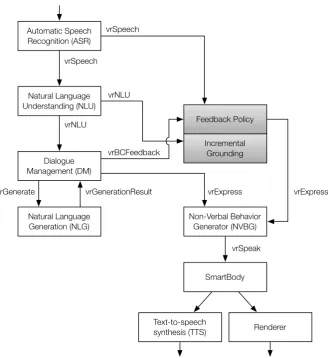
4.2.1 Architecture . . . 43
4.3 Implementation . . . 44
4.3.1 Input . . . 44
4.3.2 Model implementation . . . 48
4.3.3 Feedback policy . . . 51
5 Conclusions and Future Work 58 5.1 Results and Conclusions . . . 58
5.2 Future Work . . . 59
5.2.1 Implementation and evaluation . . . 59
5.2.2 Degrees of grounding . . . 60
5.2.3 Continuous processing . . . 60
A Paraphrase Corpus 62 A.1 Method . . . 62
A.2 Statistics . . . 63
B Origin of Dialogue Excerpts 67
Acknowledgments
e title of this section is not to be confused with the kind of acknowledgments that play a major role in the rest of this thesis. is is not a preamble containing the de nition of that important concept. is is where I say thanks.
First and foremost, I would like to thank my supervisors David, Dirk, Rieks and Mariët for their academic guidance, valuable feedback and moral support. anks to Dirk for introduc-ing me to David and allowintroduc-ing me to pursue a direction of research that I set out for with my bachelor’s thesis. anks to Rieks for introducing me to the topic of grounding back when you supervised my bachelor’s thesis. ank you, Mariët, for supervising my rst research project in natural language processing even before that. anks to David for inviting me to the Institute for Creative Technologies and making me experience life in academics and Los Angeles. I am also very thankful for the great support that David DeVault has offered me, the pleasant conversation and his help with getting the right input for the implementation of my model.
I have a lot of people to thank for my pleasant stay in Los Angeles and at the Institute for Creative Technologies. ank you Stefan, Derya, Jill, Alesia, Elnaz, Giotta, Antionne, Abe, Shannon, Rudy, Coen, Trace and the others.
I am also indebted to my friends and family for taking an interest and supporting my work. ank you Jasper, Jorrit, Johan, Sanne, Marja, Johan, Marthe and Hannah.
If you are still looking for a de nition of the kind of acknowledgments that support grounding in discourse, please read along.
Abstract
Spoken dialogue systems have until recently upheld the simplifying assumption that the conver-sation between the user and the system occurs in a strict turn-by-turn fashion. In order to have more human-like, uent conversations with computers, a new generation of spoken dialogue systems has arisen that is capable of processing the user’s speech in an incremental way. As the user is speaking, the automated speech recognizer
We have studied the AMI Meeting Corpus in order to identify ways of grounding in human-human dialogue that a system would be able to pick up using incremental processing. ese incremental grounding behaviors include overlapping feedback, the completion of un nished utterances that were initiated by the other party and responding to an utterance before it is completed.
Chapter 1
Introduction
On the many layers of human conversation, interlocutors continuously interact to facilitate a uent and effective communication process. ey share information, convey intentions through nonverbal behavior, nish each other’s sentences, request the turn, interrupt the speaker and signal understanding. e latter is of particular interest for this thesis.
Understanding plays a key role in effective communication. Typically, the speaker will con-tinuously introduce new information for the hearer to understand so eventually the conversation’s goal can be met. But understanding on its own is not enough, the hearer also needs to signal understanding by acknowledging the new information. en the speaker knows that the new information is now shared and the next topic can be discussed. is process is calledgrounding
and the shared information is called thecommon ground [1, 2].
Signaling understanding can be done in different ways, ranging from not doing anything at all, i.e. not signaling misunderstanding, to taking the turn and elaborating on the new information[1]. e rst conveys less evidence of understanding than the second, but in some situations that might just be enough [3]. Also, the second, more elaborate, way of showing un-derstanding has an impact on the efficiency of the dialogue as it involves a change in who is the speaker. erefore, listeners will often choose to signal understanding without interrupting the speaker, using backchannels, such as a head nod, “yeah” or “ok”, overlapping the other person’s speech without taking the turn, while still providing sufficient evidence of understanding.
Since the rise of the computer, in the 1940s and 1950s, scientists have been interested in recreating the human language capabilities in arti cial systems [4]. Out of that interest, the eld ofnatural language processingwas born. Natural language processing is an interdisciplinary research area that operates on the intersection of computer science, psychology and linguistics. e goal of this eld is to equip computers with capabilities that will allow them to perform tasks involving natural, human language.1 In our everyday life, we encounter applications that have their roots in natural language processing research. For example, Google Translate [5],
Figure 1.1: e twins talking with a group of children in the Museum of Science, Boston.
Apple’s Siri [6], Wolfram Alpha [7], computerized customer service help desk agents and voice controlled on board computers in cars.
Some of the aforementioned natural language processing applications involve having a con-versation with the system. ese systems are calleddialogue systems. A dialogue system is de-signed to partake in a conversation and act and respond like a human would. ose systems are often represented as anagent, having a name, some sort of personality and, in case of aspoken dialogue system, a voice. ese traits are realized by a complex system that involves speech recog-nition, language understanding, discourse reasoning, response planning, language generation and speech synthesis.
A state of the art spoken dialogue system is capable of having a conversation with the user on a nite-domainof recognized inputs and possible answers. For example, the Higgins dialogue system [8] can help the user nd his way through a virtual village, Gunslinger [9] emerges the user in a movie-like scenario in which he can become the hero of the virtual inhabitants of a Wild West town by getting rid of a vicious outlaw and twins Ada and Grace [10] act as virtual museum guides that can answer visitor’s questions (see Figure 1.1).
What all the mentioned systems and any typical state of the art dialogue system have in common is that they are still far from being sophisticated enough to engage in real human-like conversations. ey are capable of having a conversation when the user obeys to a rigid dialogue structure, speaking clearly and in full sentences, but, until recently, systems would fail at participating in real uent human-like conversations with frequent overlapping behaviors.
1.1
Incremental processing
In a typical non-incremental dialogue system, the system processes the user’s utterances in a single piece. When the user is done talking, the ASR automatic speech recognition component (ASR) will transcribe it and pass it on to the rest of the system’s components. In a dialogue system that is capable of incremental processing, the user’s utterance is being processed while it is still in process. With short time intervals, the ASR will attempt to transcribe the utterance so far and pass that partial transcription on to the rest of the system. e other components can use that partial transcription for their own processing, e.g. the natural language understanding component (NLU) will try to nd the meaning of the utterance so far. ese incremental updates can be used to make decisions while the user is still talking. e system can decide to perform a backchannel, interrupt or help the user if he has trouble nding the right words.
Using incremental processing, a dialogue system can display an affective listening behavior towards the user, building rapport2. e Virtual Rapport [14, 15] monitors the pitch, loudness and uency of the user’s speech and tracks his posture shifts, gaze and head movements. e agent can nod, shift its posture or gaze and can mimic the user’s body language, while the user is speaking to the agent. A user study showed that this increases the perceived naturalness and efficiency of the conversation.
In [17], the authors present a system that can nish the user’s utterances. e system pro-cesses the incremental updates from the NLU to determine when it has reached the point of maximum understanding of an ongoing utterance. When used strategically, this ability can complete utterances in situations when this would positively contribute to the dialogue.
In [13], a system is presented that is capable of even more comprehensive incremental listen-ing behavior. It uses incremental updates from the NLU to show, e.g. by noddlisten-ing or frownlisten-ing, whether the system is understanding what the user is saying.
1.2
Motivation
To date, the incremental dialogue systems, including those mentioned above, have not closely linked the incremental listening behaviors to the grounding model. ose listening behaviors however, convey information on whether the system is understanding and thus in uence the grounding of the content that is being discussed in the conversation. Instead of being directly based off of prosody and NLU results, they should be initiated by a grounding model. A ground-ing model keeps track of the content that is beground-ing presented over the course of the dialogue and knows what behaviors to execute in order to ground pieces of that content. e incremental listening behaviors then become meaningful tools that contribute to efficient conversation. is does require aincremental grounding model, which does not exist yet.
1.3
Problem Statement
Coming up with an incremental grounding model poses two main challenges. e rst challenge originates from the incremental context, the second has its root in the shortcomings that existing non-incremental grounding models may have .
e incremental results that are generated in an incremental dialogue system during the user utterances are less reliable than the results from non-incremental processing. Many small pieces of data are processed instead of a few large chunks. e components of the dialogue system have less information to work with. Also, the separation of the user’s speech into those small chunks is arbitrary, e.g. by using a 200ms window. It will happen that a chunk boundary occurs within a single word. e ASR might transcribe a chunk of speech as ‘four’, until the next chunk comes in and it turned out to be ‘forty’. ese errors propagate to the other components of the dialogue system that rely on the transcription. An incremental grounding model should be robust to those errors.
Existing grounding models have never been tested in incremental dialogue systems. While the theoretical groundwork of those models typically usesprocessing units of unde ned length, the dialogue systems in which they have been implemented have always been non-incremental. erefore, the existing implementations can rely on the traditional simplifying assumption that the conversation between the user and the system occurs in a strict turn by turn fashion. e system will not speak while the user is speaking and it is assumed that this also holds the other way around. In an incremental system, utterances are processed while they are being uttered and responses can overlap. An incremental dialogue system will be able to pick up a range of new overlapping behaviors that humans use for grounding purposes. e incremental grounding model needs to be able to support those behaviors. It is not clear if an existing grounding model would work or how it can be adapted to do so.
1.4
Research Goals
1.5
Methodology
e rst sub-goal, in which we investigate the differences between non-incremental and in-cremental dialogue systems, is achieved through a study of the literature in the eld of natural language processing. is study includes the works that present new incremental approaches to speci c components of the dialogue system or the system as a whole.
e second sub-goal, in which we set out to nd new overlapping behaviors that an incre-mental model for grounding should support, is achieved by a study of the AMI Meeting Corpus [18]. e analysis of several interesting dialogue excerpts is conducted using theoretical frame-works from computational linguistic literature.
e main goal, i.e. creating a model of incremental grounding, calls for the combination of the results of both sub-goals. e theoretical model is developed to bene t from the strengths of incremental processing, while being robust to its negative characteristics. e model is im-plemented in an existing incremental spoken dialogue system to validate the design.
1.6
Contributions
e work presented in this thesis consists of the theoretical treatise of the relevant concepts men-tioned above, a corpus study of overlapping grounding behavior, the development of a theoretical model for incremental grounding and the implementation of the model in an existing dialogue system.
1.7
Previous Work
Parts of this thesis are based on work already published in a paper that was written by the author together with David Traum and Rieks op den Akker, both supervisors of this thesis, and David DeVault.
T. J. Visser, D. R. Traum, D. DeVault, and R. op den Akker, “Toward a model for incremental grounding in spoken dialogue systems,” in12th IVA Workshop on Real-time Conversa-tions with Virtual Agents, Santa Cruz, 2012
1.8
Outline of Thesis
Chapter 2 discusses the two central concepts of this thesis: grounding and dialogue systems. It provides the user with a primer on both topics, discussing existing grounding theories and explaining the typical components of a dialogue system.
reviewed. is is followed by a study of the AMI Meeting Corpus, looking for examples of incremental grounding behavior in human-human dialogue. e remaining part of the chapter presents the new theoretical model for incremental grounding.
Chapter 4 describes the speci c dialogue system that was used for this thesis, called SASO4. A discussion of the implementation of the theoretical model presented in the previous chapter follows. An important part of the implementation is the response policy, which determines when overlapping responses by the system are desired.
Chapter 2
On Grounding and Dialogue Systems
2.1
Overview
All contributions to a dialogue are built oncommon ground [2]. e common ground contains knowledge that can be required to properly process new contributions. When a speaker presents a new contribution and it is accepted by the listener, its content will update the common ground, enabling every next contribution to build upon the previous. e process of updating the com-mon ground is calledgrounding.
Common ground exists between two (or more) people and consists of theircommon knowledge,
mutual knowledgeorbelief, which all are different notions used in literature to describe roughly the same. Something is said to be in the common ground if it is known to both parties and is known to be known. is can be expressed more formally, and perhaps more clearly, for two persons A and B as
pis CG ⇐⇒ bel(A, p)∧bel(B, p)∧bel(A, bel(B, p))∧bel(B, bel(A, p)) (2.1) wherebel(P, q)models the belief of propositionqby personP.
In conversation, new content is added to the common ground, to a speci c part of it which Clark calls thepersonal common ground[2]. is type of common ground is created and updated through personal experiences with each other. e opposite of the personal common ground is thecommunal common ground. e content of the communal common ground is de ned by shared culture, nationality, profession, education, hobbies or religion. As soon as you nd out you have somethingin commonwith the other person, e.g. you both love classical music, the common ground suddenly expands to incorporate topics of the newfound similarity.
commonalities with the conversational partner are discovered.1 e personal common ground on the other hand continuously changes during the conversation, re ecting the latest conversational topics. In an in uential model of grounding by Clark and Schaefer [1], the changes to the common ground are modeled ascontributionsto discourse.
Clark and Schaefer distinguish two phases in the grounding of a contribution: the presenta-tionphase and theacceptancephase [1]. In the presentation phase, the speaker presents a piece of new content for the listener to consider. e speaker assumes that if the listener provides evi-dence of at least a certain strength, he can believe that the listener understands what he meant. In the acceptance phase, the listener accepts the new content by giving evidence of understanding, assuming that this evidence will make the speaker believe that he understands. e acceptance itself is also considered a contribution, which in turn needs to be accepted. Consider the follow-ing example:
(1) A: Maybe even pre-programmed sound modes, like um
B*: Okay
A: the user could determine a series of sound modes.
C*: Mm-hmm
is dialogue excerpt contains four contributions, one for each utterance. e rst contri-bution is presented with “Maybe (…) modes” and accepted by “Okay”. B’s acceptance is also a presentation of a new contribution, which is then accepted by A’s next utterance and so on.
2.2
Evidence of Understanding
e evidence of understanding that a listener can give to show his acceptance of the contribution can, according to Clark and Schaefer, be one of the ve types listed in Table 2.1. e types of evidence are ordered in increasing strength. However, it can be argued that evidence 4 might be stronger than evidence 5, since it shows that the listener has processed the contribution on a deeper level [20]. In dialogue 1 above, B’s “Okay” and C’s “Mm-hmm” are acknowledgments and A’s second utterance initiates the relevant next contribution at the same level as the last one. e type of evidence that a listener gives is based on a trade-off between the effort it takes to provide such evidence and the strength of the evidence, providing at least enough evidence to sufficiently ground the contribution for the current purposes or, in other words, meet the
grounding criterion[21].
e grounding criterion of A’s contributions is higher than that of the acknowledgments by B and C, i.e. A’s contributions require stronger evidence in order to be accepted. Acknowl-edgments are easy to understand and accept and therefore require less evidence. at is why A’s contributions seem to require acknowledgment evidence and B’s contribution is accepted by merely initiating the relevant next contribution.
1. Continued attention. B shows that he is continuing to attend and therefore remains satis ed with A’s presentation.
2. Initiation of the relevant next contribution. B starts in on the next contribution that would be relevant at a level as high as the current one.
3. Acknowledgment. B nods or says “uh huh”, “yeah”, or the like.
4. Demonstration. B demonstrates all or part of what he has understood A to mean.
5. Display. B displays verbatim all or parts of A’s presentation.
Table 2.1: Types of Evidence of Understanding, from Clark and Schaefer [1, p. 267]
2.3
Levels of Action
Up until now, we have been talking about grounding in the sense of understanding what the speaker is saying and providing evidence of that understanding. In this section, we go into more detail about what actions are required before what we have been calling ‘understanding’ can be reached.
Consider the act of asking a question. For most questions, the ultimate communicative goal that the speaker has, is to get an answer. is requires a listener who is aware of the convention that when a question is asked you are supposed to give an answer. is requires that the listener understands the intended meaning of the sentence, i.e. it being a question. In turn, this requires from the listener that he recognizes that the sound coming from the speaker’s mouth form words. And at the most fundamental level, this requires that the listener attends to the sound coming from the speaker. Analog to these actions by the listener, there is a same set of actions that the speaker performs by asking a question: he makes the sound that corresponds to the words he wants to say, he presents the words, he asks a question and he proposes to the listener to answer the question.
Clark introduced the notion ofaction laddersto capture the levels of action in communication [22]. Table 2.2 contains the combined ladder of the actions that are performed by the speaker and the listener, resulting in the four levels ofjoint action. Continuing the example from before, we can now say that at the conversation level the speaker proposes and the listener considers the project of asking and answering a question, at the intention level the speaker is signaling and the listener is recognizing a question, at the signal level the speaker presents and the listener identi es the verbal utterance and at the channel level the speaker executes and the listener attends to the sounds that make up the utterance.
Since each level is built on top of the level below, a communication error at a lower level will make it impossible to succeed at the levels above. For example, if the speaker fails to recognize the utterance as a question, he will certainly not consider answering it. is is what Clark calls
Level SpeakerS ListenerL
4. Conversation Sis proposing activityw Lis considering the proposal ofw
3. Intention Sis signaling thatp Lis recognizing thatp
2. Signal Sis presenting signals Lis identifying signals
[image:16.595.112.483.101.172.2]1. Channel Sis executing behaviort Lis attending to behaviort
Table 2.2: e four action levels, from Clark [22, p. 152]
succeeded, the levels below must also have succeeded. For example, if the listener provides a tting answer to the question posed by the speaker, he must have heard and understood the speaker correctly. is is what Clark callsdownward evidence.
To ensure that errors are detected and recovered from, coordination between the conversa-tional partners is required on four levels. is is achieved by grounding the mutual understanding on all levels. In this light, the commonsensical meaning of ‘understanding’ is just a special case of succesful coordination. What we have been calling ‘understanding’ can now be de ned more formally as understanding on level 3 and up.
Now we know that grounding occurs on all four action levels, we can also talk about how evidence of understanding (see Section 2.2) relates to this. Depending on the type of evidence, it can only be used to infer understanding up to a certain level. For example, the weakest evi-dence type that Clark and Schaefer describe, Continued attention, only requires that the listener attends to the speaker’s behavior, thus only provides evidence of understanding on level 1. In some cases it is sufficient to merely provide evidence of understanding up to a lower level, e.g. when the conversational partners have rapport or if the grounding criterion is low.
2.4
A Theory of Computational Grounding
Because of the fundamental role that grounding plays in human-human conversation, it is also an essential part of human-computer interaction. Clark’s work describes a formal model of language use, including grounding, but his primary audience is the cognitive psychologists and psycholinguists, not computer scientists and computational linguists. Before his theory could be applied in the context of dialogue systems, it needed to be adapted for computational use. is task was taken up by Traum, who came up with a computational theory of grounding [20, 23] which has since become an in uential approach to solving the grounding problem for dialogue systems.
grounding state of the current contribution after each utterance. Often, larger parts of the con-versation are needed before the effect of a single utterance can be seen. is is not of much use for a dialogue agent that, in the middle of a conversation, needs to decide what its next action will be.
Instead of the two phases of presentation and acceptation, Traum de nes sevengrounding acts
that perform a speci c function towards the grounding of a piece of content. Clark and Schaefer called this piece of content, i.e. the unit of grounding, a ‘contribution’, while Traum calls it a ‘discourse unit’ (later renamed toCommon Ground Unit or CGU). ‘Contribution’ and ‘CGU’ are similar concepts, but the CGU is more closely related to surface structure of the dialogue [25], and therefore better suited for analysis from the perspective of a dialogue system, while the dialogue is taking place.
Label Description
initiate Begins a new CGU
continue Adds new content to an open CGU
acknowledge Provides evidence of understanding of the CGU repair Removes, adds or replaces content from the CGU request repair Signals lack of understanding
[image:17.595.145.452.276.381.2]request ack Signals the need for evidence of understanding cancel Ends the work on a CGU, leaving it ungrounded
Table 2.3: e seven grounding acts from Traum’s model, adapted from [24, p. 127]
e seven grounding acts are presented in Table 2.3. Each CGU begins with an initiate
act, in which the speaker presents new content to the conversation. e speaker that initiates a CGU is assigned theInitiator(I) role for that CGU. e initiator cancontinuein the following utterances, which adds more content to the current CGU orrepairto revise the content of the CGU. If the listener, who is also theResponder(R), of the CGU does not understand what the initiator means, he can signal his lack of understanding by performing arequest repair. When the responder understands, he canacknowledgethe CGU. If the responder fails to acknowledge the CGU and the initiator is uncertain about the understanding of his partner, he can solicit evidence of understanding by performing arequest acknowledgment. e grounding of a CGU can be abandoned by acancel act, which leaves the CGU ungrounded and ungroundable.
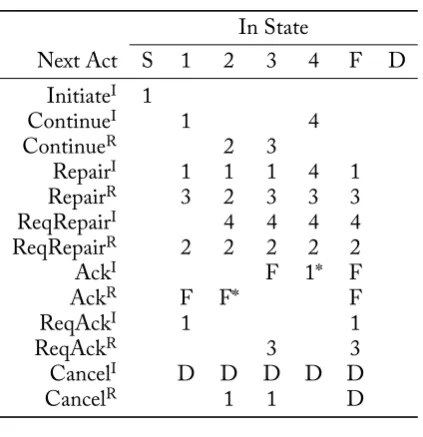
e sequence of actions described in the paragraph above is just one of the many possible courses grounding can take. Table 2.4 contains the transition diagram of the nite automaton that models the grounding of a CGU. For all grounding acts, it describes the effect it has on the grounding state of a CGU, given the previous state of the CGU. Most CGUs will reach the nal state F, meaning that the content has become common ground.
For example, consider dialogue excerpt 22, in which two persons try to manage a rail road freight system. e dialogue is from the TRAINS project [26], the annotations are adapted from
In State
Next Act S 1 2 3 4 F D
InitiateI 1
ContinueI 1 4
ContinueR 2 3
RepairI 1 1 1 4 1
RepairR 3 2 3 3 3
ReqRepairI 4 4 4 4
ReqRepairR 2 2 2 2 2
AckI F 1* F
AckR F F* F
ReqAckI 1 1
ReqAckR 3 3
CancelI D D D D D
CancelR 1 1 D
[image:18.595.193.405.96.315.2]*repair request is ignored
Table 2.4: Traum’s CGU transition diagram. A CGU is said to be in the common ground when it reaches state F [20, p. 41].
(2) A: [so we should move the engine at Avon engine E to]InitiateI1
B*: [engine E1]RepairR1
A: [E1]AcknowledgeI1 B: [okay]AcknowledgeR1
A: [engine E1 to Bath to]InitiateI2 [or]CancelI2 A: [we could actually move it to Dansville]InitiateI3
2.5
Spoken Dialogue Systems
In this section, we describe a typical academic spoken dialogue system in order to provide an introduction to the various parts it is composed of. is will clarify the subsequent discussion on grounding in such a system and the work of this thesis as a whole. A more detailed description of a spoken dialogue system is provided in Chapter 4, where the SASO4 dialogue system is discussed.
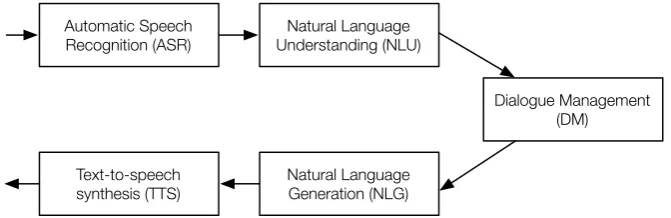
A well-known approach to building a dialogue system is to use a pipeline architecture, in which a chain of components takes a user utterance as input and comes up with a system re-sponse as output [27, 28]. Figure 2.1 gives an overview of such an approach. In a typical dialogue system, the components process a whole user utterance at a time. After the user is done talk-ing, indicated by releasing the push-to-talk button or assumed after a certain amount of speech inactivity, the ASR will take the audio signal and come up with a hypothesis of the complete utterance. e NLU will then work with the ASR hypothesis and determine the meaning of the utterance. e Dialogue Manager performs additional analysis and consults the internal state to decide on the type of response. e Natural Language Generator transforms the Dialogue Man-ager’s result into natural language, which is then converted into speech by the Text-to-speech Synthesizer.
Automatic Speech
Recognition (ASR) Understanding (NLU)Natural Language
Dialogue Management (DM)
Natural Language Generation (NLG) Text-to-speech
[image:19.595.131.467.486.595.2]synthesis (TTS)
2.5.1
Automatic Speech Recognition
e Automatic Speech Recognition (ASR) component turns the audio signal from the user’s microphone into a written transcription of what the user is saying. A typical ASR uses an
acoustic model, which describes the probability of a word sequence given the observed audio, and alanguage model, which describes the probability of certain word n-grams (usually bigrams and/or trigrams). With those two models combined, the ASR can calculate the most probable transcription for the observed audio signal.
2.5.2
Natural Language Understanding
e Natural Language Understanding (NLU) component uses the ASR output to determine the meaning of the user’s utterance. An example representation, often called aframe, can be found in Figure 2.2. is frame represents the meaning of “Utah, do you want to be the sheriff ?”, but also of “Would you agree to becoming the sheriff, Utah?” e NLU will collapse all the ways of saying the same thing into a single frame. e frames are constructed using a vocabulary of concepts that the Dialogue Manager will be able to process.
s.addressee utah
s.mod interrogative
s.sem.speechact.type info-req
s.sem.type question
s.sem.q-slot polarity
s.sem.prop.agent you
s.prop.type event
s.prop.event accept
s.prop.theme sheriff-job
Figure 2.2: An example NLU frame
Approaches to the NLU problem include the use of a Context Free Grammar (e.g. [29]), keyword or keyphrase spotting and data-driven statistical language modeling [30]. e latter has been found to have an increased robustness, i.e. in dealing with unseen utterances and ASR errors, compared to the other two approaches [28].
2.5.3
Dialogue Management
e Dialogue Manager (DM) is responsible for three aspects:
∗ Contextual interpretation: interpret pragmatic meaning
∗ Domain reasoning: reason about world and update internal state
e DM performs the nal processing of the input and initiates processes that will lead to system response. It is the core component of the dialogue system.
e representation provided by the NLU denotes the context-free meaning of the user’s ut-terance. It is the DM’s task to interpret this within the current context to gure out the prag-matic meaning. is includes the resolution of named entities, referring expressions (e.g. “I”, “here” and “that”) and recognizing the dialogue acts that have been performed by the utterance. Among the possible dialogue acts that an utterance can perform are the seven grounding acts from Traum’s theory.
Based on the fully interpreted user utterance, the DM can reason about how it relates to its model of the world, i.e. which states, events and objects are mentioned, and its stance towards the utterance content. e grounding state of the relevant CGUs is updated based on the recognized grounding acts and, if applicable, new content is added to the common ground.
Finally, the DM will select the communicative act that is to be performed by the system. is act should convey the dialogue acts that the DM wants to communicate based on the outcome of the contextual interpretation and domain reasoning. If the DM encountered an ambiguous referring expression that prevented full understanding of the utterance, a clari cation request, i.e. a request repair in terms of grounding, might be the appropriate response in order to reach understanding. If the DM did understand the utterance, it should pick up its role in the proposed project, providing evidence of understanding by doing so.
For example, if the user says “Utah, do you want to be the sheriff ?” and the NLU returns the corresponding frame as shown in Figure 2.2, the system could show its understanding by taking up on the project of answering the question. e answer woulddemonstrate(i.e. one of Clark and Schaefer’s types of evidence of understanding, see Table 2.1) understanding of the question and successfully ground it.
2.5.4
Natural Language Generation
e Natural Language Generation (NLG) component uses the semantic representation of the communicative act from the DM and generates a corresponding textual representation, the sur-face text, that is to be synthesized by the text-to-speech component. e least complex approach to NLG is to have one or more surface texts ready for every possible communicative act and simply select one for the act at hand. More complex approaches exist that aim at increasing the exibility of the output, e.g. by parsing the semantic representation with a grammar of known representation chunks linked with pieces of surface text [31].
Spoken Utah, do you want to be the sheriff?
Recognized
utah do you want the we the sheriff utah do you want the sheriff you town you want we the sheriff
Table 2.5: Example ASR errors
2.5.5
Text-to-speech Synthesis
e simplest approach to generating audio output for a dialogue system is to have all possible ut-terances prerecorded. While the output quality will exceed any of the alternatives, this approach is not applicable to a system beyond the most limited ones. A more exible solution is text-to-speech synthesis (TTS). e task of a TTS is twofold: 1) calculation of the pronunciation of the utterance and 2) generation of an audio signal of the pronunciation.
2.6
Errors in Spoken Dialogue Systems
Listening and speaking does not come as natural to dialogue systems as it does to humans. A system’s speech recognition and language understanding capabilities are not nearly as sophisti-cated as that of humans. erefore, a dialogue system can never be certain of what the user is saying, it can onlyhypothesize. It is not clear if that really differs from our human capabilities, but it seems that we are doing ne nonetheless. However, dialogue systems will have to learn to deal with frequent errors.
In the typical pipeline architecture of dialogue systems, the result of a single component in-uences all downstream components. For example, an incorrect ASR hypothesis might result in the wrong frame being selected by the NLU, which consequently moves the DM to select a communicative act that the user will not understand. Such propagating errors are not unlikely, since even a state-of-the-art ASR will frequently misinterpret the user’s speech and return in-correct words in the transcription. Table 2.5 contains three examples of ASR hypotheses with errors.
e performance of an ASR can be measured with theword error rate(WER). It is de ned as the number of incorrect words in the ASR hypothesis divided by the number of words in the user’s utterance. Existing literature reports relatively high WER values, e.g. 23.6% ([28, p. 138]), 39% ([33]) and 54% ([34]). e performance of an ASR can be improved by training it with the same equipment, e.g. microphone and sound card, that is being used in production, with the same user that will be operating the system and on example utterances that fall in-side the domain of the system. Remaining errors can however be corrected by the components downstream.
utter-ances as one of the NLU frames from a nite set. It does require a large corpus of utterance-frame pairs to train the classi er. But if this corpus consists of real ASR transcriptions, including real ASR errors, the classi er will learn to map possibly erroneous ASR hypotheses of an utterance to the correct frame representing the actual user utterance.
e performance of a classi er can be measured using f-score. [30] reports an f-score of 74.46% with a WER of 35.6%, and [34] reports the same f-score with a WER of 54%, showing that a robust NLU can compensate for errors made by the ASR.
If the NLU sends the incorrect frame to the dialogue manager, it will impede all three tasks that the DM performs. e DM might draw incorrect conclusions when resolving contextual references, corrupt the internal state with incorrect information and select an incorrect conver-sational act to respond with. is can be resolved by having the NLU provide more information about its analysis. It could provide ann-best listof frames instead of a single frame. e DM could then re-rank the frames based on contextual information, i.e. how likely it is that a frame occurs given the current state of the dialogue, and select a frame that is more likely to be correct. e NLU could also providecon dence metricsthat indicate the con dence the NLU has in its prediction [33]. If the con dence is below a certain threshold, the DM can conclude that the NLU did not understand and make the system show its misunderstanding.
2.6.1
Grounding in Spoken Dialogue Systems
Because of the apparent risk of misunderstanding, grounding plays an important role in dialogue systems. By keeping track of grounding, the DM can determine which actions are required to reach understanding.
e DM can assess its degree of understanding based on the con dence of the ASR, NLU and the con dence in its own contextual interpretation. e DM then can decide whether to accept or reject the hypothesis. A good decision strategy minimizes thefalse acceptancesandfalse rejectionsand maximizestrue acceptancesandtrue rejections(see Table 2.6).
System Accepts System Rejects
Correct Hypothesis True Acceptances False Rejections
Incorrect Hypothesis False Acceptances True Rejections
Table 2.6: e four outcomes of accepting/rejecting a hypothesis.
Using one of the stronger two evidence types, i.e. demonstration and display, the system can provide implicit veri cation of the content. Consider the following example from [35]:
(3) U: I want to go to Swalmen
S: When do you want to go to Swalmen?
e system’s (S) response is intended as an acknowledgment grounding act, but by explicitly repeating the content that is to be grounded, the user (U) is also given the opportunity to repair. If the user continues by answering the question, he passes on the opportunity to perform a repair and thereby provides evidence that the initial request to go to Swalmen is now grounded. If the user had requested to go to Almen instead of Swalmen, the system’s response would not be an acknowledgment, as intended. is would become clear to the system as soon as the user performs a repair.
If the system would not be con dent about understanding the user’s utterance, it could per-form a request repair by explicitly verifying the content. e following example is also from [35]:
(4) U: I want to go to Swalmen S: Do you want to go to Swalmen?
e user would have to respond to the request repair, increasing the combined effort it takes to ground the user’s initial utterance. is has a negative impact on the efficiency and uency of the conversation, if the system’s understanding would turn out to be correct to begin with. On the other hand, if the system would have performed an acknowledgment of an incorrect hypothesis (i.e. the case where in Dialogue 3 the user actually said Almen instead of Swalmen), the user would have to put effort into correcting the mistake instead of answering the question about travel time.
In Dialogue 4, the system correctly processed the user’s utterance, but had low con dence in the result. More often, there will be errors on one of the lower action levels that either the ASR or NLU is concerned with that prevent the system from sufficient understanding in order to generate a veri cation. Consider the following example:
(5) U: I want to go to Swalmen
a) S: I couldn't hear what you were saying b) S: I don't understand what you mean
Chapter 3
A Model of Incremental Grounding
3.1
Overview
A dialogue system is said to be capable of incremental processing if it starts processing before the user utterance is complete. In such systems, each component will start processing after receiving a minimal amount of its characteristic input [39]. For the ASR, thisincremental unit (IU) is a short fragment of audio signal, for the NLU, this is any change to the ASR’s hypothesis and for the DM, this is any change to the NLU output.
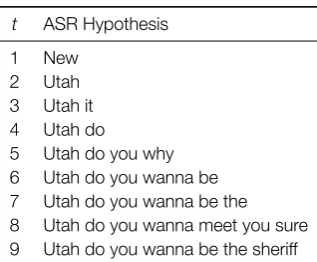
Because the utterance is still in the progress of being uttered at the time of processing, the components generate output based on incomplete information. As new information comes in, and the information becomes more complete, the components might need to revise their hy-pothesis [40]. Consider the sequence of hypotheses in Table 3.1 that the ASR produces as the user utters “Utah, do you wanna be the sheriff ?” Att= 1, the ASR hypothesizes that the word “New” has been spoken. is hypothesis was probably generated right after the user uttered the “U” of “Utah”. Another revision occurs at t = 9as the ASR goes “meet you sure” to “be the sheriff ”. e hypothesis at t = 8was probably generated right after the user said “sher”. e 2-gram “meet you” probably has a high probability in the language model, but with the addition of “sheriff ”, the 3-gram “be the sheriff ” has a stronger preference.
t ASR Hypothesis
1 New
2 Utah 3 Utah it 4 Utah do
[image:27.595.218.377.98.229.2]5 Utah do you why 6 Utah do you wanna be 7 Utah do you wanna be the 8 Utah do you wanna meet you sure 9 Utah do you wanna be the sheriff
Table 3.1: e ASR hypothesis is revised as more information becomes available.
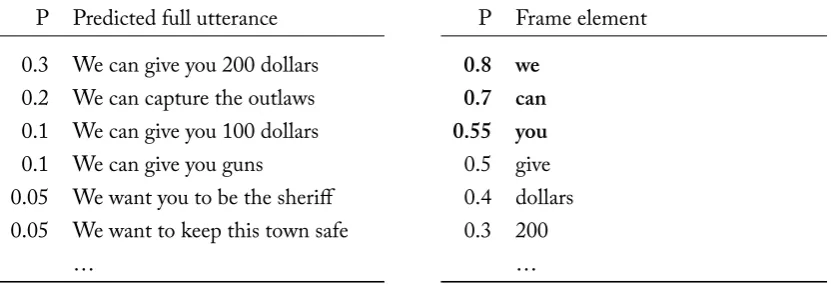
frame elements of the corresponding frame.
t NLU frame
2 s.addressee utah
4 s.mod interrogative
5 s.sem.speechact.type info-req
5 s.sem.type question
5 s.sem.q-slot polarity
5 s.sem.prop.agent you
9 s.prop.type event
9 s.prop.event accept
9 s.prop.theme sheriff-job
Table 3.2: An NLU frame with for each element the time-step (from Table 3.1) when it is added to the NLU output.
3.1.1
Predictive vs. Non-predictive
e approach to incremental processing described above can provide a basis for feedback behav-iors such as head nods, shakes, gaze shifts and backchannels. Based on the growing ASR and NLU hypotheses, the DM can provide early grounding on the lower levels of Clark’s action lad-der. For some other responsive behaviors, the strictly incremental,non-predictive, interpretation is not sufficient and a prediction of the interpretation of the full utterance is required. Behaviors such as timing a reply to have little or no gap, grounding by saying the same thing at the same time or performing collaborative completions require this [17].
[image:27.595.195.400.297.428.2]Both predictive and non-predictive incremental processing are valuable in dialogue systems. e two approaches combined even more, because then a distinction can be made between what has been said so far and what is likely to follow. Such a hybrid approach was presented in [27], which describes the SASO4 dialogue system that is also used for this thesis and will be discussed in more detail in Section 4.
3.1.2
Incremental language generation
So far, we have talked about incremental language understanding. A fully incremental dialogue system will however also have to be able to incrementally generate its output. is will allow the system to plan, realize and monitor its output while simultaneously processing the input from the user [43, 44]. By monitoring its own output, the system knows the explicit content of the utterance at any moment while it is in progress. is allows the system to more accurately inter-pret overlapping feedback from the user by relating it to the content uttered up to the moment of the feedback.
is thesis however - much like most work in grounding in spoken dialogue systems -, is primarily concerned with the state of understanding of the system. We focus on how to deal with system non-understanding and misunderstanding and how to provide feedback to the user of the system’s understanding or the lack thereof. e system’s capabilities are however only one side of the coin, as the user will also convey his understanding with overlapping behaviors.
While the theoretical model that is presented in this chapter does not make assumptions about how the role of Initiator and Responder are divided among the user and the system, the implementation that is presented in Chapter 4 primarily discusses how the system should provide feedback, i.e. thefeedback policy, as it listens to the user.
3.2
Incremental Grounding Behavior in Human Dialogue
We have studied human-human dialogues for examples of incremental grounding behavior. ese examples should provide insight into the grounding mechanics that support efficient com-munication.
e examples that are discussed in this section were taken from the AMI Meeting Corpus [18]. e corpus consists of 100 hours of meetings captured using recording devices of various modalities. In the meetings, a team of four subjects is given the task of designing a new remote control. Each team takes a design from start to prototype in a series of four meetings.
is section continues with the discussion of several excerpts from the meetings. In those discussions, we take the perspective of the third-party impartial bystander. is differs from the perspective that a computational model of grounding operates from. We cannot peek inside the heads of the interlocutors to gure out the intentions behind their actions. e model on the other hand can only go by its intentions and has to observe the other person’s response to gure out thetrueeffect of its actions.
3.2.1
Granularity
Humans process language incrementally. is enables us to continuously provide feedback to the speaker or react on that feedback. is feedback is usually given by means ofbackchannels. Backchannels are verbal or non-verbal behaviors, such as head nods, frowns, “Okay”, “Huh” or “Yeah”, that can be performed in overlap with someone else’s turn. e speaker remains in control of themain channel, while the listener uses theback channelto provide feedback on how well it is going.
e listener’s feedback aids the speaker in his performance. e speaker can decide to elabo-rate on a certain concept if the listener is not understanding [37] or fade out an utterance when it appears the rest is not needed [45].
Frequent overlapping feedback will divide the content of a single turn, or utterance, over multiple smaller CGU’s. An overlapping acknowledgment grounds the current open CGU and new content that the speaker continues to introduce after the acknowledgment becomes part of a new CGU, which lasts until the next acknowledgment. is mechanism can be observed in the following example:
(6) A1: [The LCD panel just displays um functionally what you're doing.]InitiateI1
A2: [If you're using an advanced function right, like um brightness, contrast, whatever]InitiateI2 C1*: [Right]AcknowledgeR1
C2*: [Okay]AcknowledgeR2
With C1, C acknowledges A’s rst utterance. When A continues, he initiates a second CGU, because C’s acknowledgment grounded and closed the rst CGU. If C would not have uttered C1, A2 would have been a continuation of CGU 1 instead. is would have resulted in one bigger open CGU at the end of A2, instead of two smaller CGUs. e frequent feedback reduces the amount of open content by grounding information early and often. Misunderstandings can also be handled more efficiently, since there is only a limited amount of content that is in the process of being grounded.
3.2.2
Evidence of understanding by completion
Consider the following dialogue excerpt from an AMI meeting:
(7) C1: We could just go with um
D1*: Yeah
A1*: Normal coloured buttons
In the middle of C’s sentence, C appears to struggle with how to continue his utterance, uttering a verbal hesitation “um”. A then utters “Normal coloured buttons” as a completion of C’s partial utterance. e dialogue continues without correction by C, so it is reasonable to assume that this was indeed what C intended to communicate (or was close enough). Meanwhile, D gives a simultaneous backchannel acknowledgment of C’s utterance.
In a way, A is not making up the words he is saying. It is not satisfactory to say that A presents some new content, or according to Traum’s theory, initiates a new CGU. His intention is to utter what C was going to say and while C did not say “normal coloured buttons”, A did receive enough evidence leading to this completion. A appears to be able to predict the intended meaning (or perhaps even surface form) of the full utterance based on the partial utterance. We call the content of the partial utterance explicit and the content of the utterance completion
predicted. A provides evidence of understanding by completing the utterance, grounding both the explicit and predicted content. We add completionto Clark and Schaefers list of types of evidence of understanding. A1 is thus a acknowledgment grounding act providing evidence by completion. e relevant utterances from dialogue 7 can be annotated with grounding acts as follows:
(8) C1: [We could just go with um]InitiateI1
A1*: [Normal coloured buttons]AcknowledgeR1
It may seem like the listener is making up new content for the open CGU by proposing a completion. e completion is based on a hypothesis of what the speaker was going to say. is is not fundamentally different from a regular response, which is based on the hypothesis of what the speaker said. It is not clear why these two cases should be handled differently.
Attempted utterance completions do not always match a speaker’s intended content or surface form, as in dialogue excerpt (9).
(9) B1: That would probably not be in keeping with the um the
C1*: *laugh* Technology
B2: fashion statement and such, yeah.
C2*: Yeah.
as a completion of B’s utterance.1 B however continues his utterance by saying “fashion statement and such”, revealing perhaps more precisely what he intended to say. C then issues an overlapping acknowledgment of B’s continuation with “fashion statement”, by saying “Yeah”. When B nally adds “yeah” to his own continuation, he also shows his agreement with C’s continuation, i.e. the fact that the technology is indeed also not kept up with. Based on this analysis, the dialogue excerpt can be annotated with grounding acts as follows:
(10) B1: [That would probably not be in keeping with]InitiateI1the um the
C1*: *laugh* [Technology]AcknowledgeR1, InitiateI2
B2: [fashion statement and such]InitiateI3, [yeah.]AcknowledgeR2 C2*: [Yeah.]AcknowledgeR3
C’s predicted content “Technology” apparently does not exactly match B’s original intention. However, it does provide some evidence of understanding of the explicit content of B’s partial utterance and grounds CGU1 containing that content. It is a tting completion to the un n-ished utterance, because it is a syntactical and conceptual continuation. e strength of evidence of understanding that a completion conveys depends on the relation between the un nished utterance and the continuation, being either syntactical, conceptual or both. Asyntactical con-tinuation provides weak evidence, because it only relates to the surface form. Following Clark’s action levels, we can say that syntactical completions provide evidence up to the Signal level (level 2). Aconceptual continuation operates on the same conceptual level as the un nished utterance it completes. In the example above, both technology and fashion statement are similar concepts, which are both not satis ed in the remote control design. is type of completions operate on the Intention and Conversation (level 3 and 4) of Clark’s action ladder and thus provide stronger evidence compared to completions with a mere syntactical relation to its antecedent.
A special category of incorrect completions that is worth mentioning - but will not be pur-sued further in this thesis - contains a variety of completions that purposefully deviate from the speaker’s intended meaning. ose kinds are used as a joke or as an opportunity to convey your own meaning at the cost of the original speaker. Consider the following hypothetical conversa-tion about dinner between a mother and her child:
(11) Mom1: Tonight we're having
Child1*: pizza, yay!
Mom2: *laugh* You wish, it's green peas for you mister.
e child needs to be aware of what his mother intended to say in order to be able to make a wrong continuation. So by joking “pizza, yay!”, the child acknowledges that dinner is going to be green peas, or something healthy at least. Humor identi cation is a natural language understanding problem (see e.g. [46]) of its own and not yet directly relevant to dialogue systems.
3.2.3
Implicit verification of predicted content
In Section 2.6.1, we distinguished between implicit and explicit veri cation to characterize vari-ous grounding strategies. We can use the same distinction to identify different ways of verifying predicted content. e completions as discussed in the previous section are a way to explicitly verify the grounded content. e following dialogue contains an example of implicit veri cation of predicted content:
(12) B1: [power-wise, have we got]IntiateI1
A1*: [The battery.]AcknowledgeR1, InitiateI2
B2: [battery]AcknowledgeR2[Do we have kinetic as well?]AcknowledgeR2, InitiateI3
A2*: [No.]AcknowledgeR3, InitiateI4
B3*: [No.]AcknowledgeR4
B4: [Okay, just battery]AcknowledgeR4
Before B has nished uttering his question (B1), A goes ahead and answers it. An answer conveys evidence of understanding of the question it answers, if it ts the question, i.e. if it actually answers the question that was posed. A tting answer to an un nished question shows understanding of the complete question, because it requires understanding of the full question in order to recognize what answer would t. In this dialogue, the full question would have been something like, “power-wise, have we got what?” A’s “ e battery” implicitly acknowledges his understanding of the full question, because it answers that question. e dialogue continues without correction by B, so it can be assumed that A was right in his prediction of B’s question. e result is efficient and uent interaction, achieved through good coordination between A and B.
If such coordination, or rapport, is not present between the interlocutors, this type of inter-action is not at their disposal. e following dialogue excerpt displays a failed attempt:
(13) C1: Are these the colours of production, or is this just what we had available?
D1*: Well I'm
D2: We're gonna have again the sort of foggy yellow from last time.
D attempts to answer C’s question, but C refuses to give up the turn and continues uttering the remaining part of the question. It might be that C did not believe that D had already sufficiently understood his question. While implicit veri cation might be efficient for certain cases of grounding, it conveys less evidence of understanding than explicit veri cation. It will only be effective in cases that require a lower amount of evidence, e.g. based on the grounding criterion and rapport.
3.2.4
Conclusions
at which CGUs are grounded increases and the size, i.e. the amount of content, of CGUs decreases compared to situations where incremental grounding is not used. Single utterances are often represented by multiple small CGUs. On this new scale of sub-utterance CGUs, the CGUs, through their content, are more related to each other. Incremental grounding acts not only acknowledge that what was already said, i.e. the explicit content of an utterance in progress, but may also concern what the speaker is about to say, i.e. the content of the remaining part of the utterance as predicted by the listener.
3.3
A Model of Incremental Grounding
Based on the empirical evidence gathered from the AMI Corpus, we have developed a grounding model for the purposes of more ne-grained incremental processing. e model is adapted from Traum’s grounding acts model. It will need to be able to interpret the incremental updates that come in while an utterance is in progress and update the grounding state accordingly. e original model by Traum does not pose any limitations on the size of the processing units, but the typical unit size in existing implementation corresponds to full utterances. is makes sense, because the components of a dialogue system, especially the NLU and DM, would only be able to process full utterances. Now that that is changing, a grounding model with incremental processing capabilities is becoming relevant.
An important requirement of the model is that it should be robust to errors and revisions by upstream components. In Section 3.1, we described several cases in which the ASR or NLU would revise their incremental hypotheses. e ASR could, for example, revoke the last word from the previous hypothesis, or replace it with a different word. In turn, the grounding model has to update its hypothesis, i.e. the grounding state, which could result in a change in CGU content or require reinterpretation of an utterance assuming it conveys a different grounding act all together.
As input to our model, we assume a component with incremental speech understanding capabilities that delivers a nite sequence of incremental hypotheses as an utterance progresses, henceforth referred to aspartials. Each partial contains both the explicit and predicted content of the utterance at that point in time. ( e implementation of this component is discussed in Chapter 4.) We will denote the sequence of partials for an utterance as
O=⟨(E1, P1, C1), ...,(EN, PN, CN)⟩, (3.1)
whereEiis the explicit content andPiis the predicted content for theithpartial. At each point
in time, we assume further that the incremental understanding component is able to assign a con dence levelCithat describes the reliability of its estimatesEiandPi.
(14) D1: So basically the only new thing is the LCD on the remote now.
B1*: Being manipulated by the joystick, yeah.
D2: Oh and the joystick , yeah.
At the moment when B decides to interrupt, let us call this timet, the output by the incre-mental understander could be: Et=“So basically the only new thing is the LCD”,Pt=“being
manipulated by the joystick” andCt= 0.72. For the sake of this example, we have represented
the contents ofE andP by surface texts. For a real system, it would be reasonable to assume that the content is similar to elements from an NLU frame (see e.g. Table 3.2). At this moment however, we will not make any assumptions on this matter other than that the content ofEand
Pis a set of zero or more unique elements representing the pragmatic meaning of the utterance. e task of the grounding model when processing an utterance consists of two steps. e model has toidentifythe grounding acts that are being conveyed by the utterance and the CGUs they relate to, and it has toupdate the affected CGUs accordingly. Updating of the CGU will change its grounding state and may change its contents. e ultimate goal is to have an up-to-date representation of both aspects, so the system knows what is going on and what the effect of overlapping grounding acts at any point during an utterance, e.g. at timetin the example above, would be.
Some grounding acts will only affect the grounding state, such as a request repair, acknowl-edgment, request acknowledgment and cancel, and others will also change its content, e.g. ini-tiate, continue and repair. We will call the latter categoryauthorialgrounding acts, as they make the uttering party co-author of the CGU. By becoming an author, theburden of evidenceshifts to the other interlocutor.
For example, if the responder repairs a CGU, the initiator is required to provide evidence of understanding for that CGU to be grounded. If the initiator however decides, in his turn, to repair the CGU again, he becomes the most recent author and the burden of evidence shifts to the responder. In Traum’s original model, these notions are implicitly contained in the four in-progress grounding states (see Table 2.4). In state 1 and 2, the initiator is themost recent author
and the burden of evidence lies with the responder, an acknowledgment act by the responder from those states will move the CGU to the nal state. In states 3 and 4, the situation is the other way around.
3.3.1
Two approaches
We have investigated two approaches to modelling grounding in an incremental dialogue system: a content rst approach and function rst approach.
In the content rst approach, the difference between the explicit content of the partials is used as the main input for the grounding model. A partial is different from its predecessor if
2WhileC
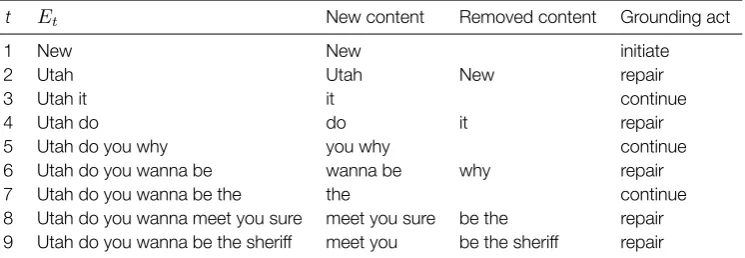
it contains content that its predecessor did not have or if it lacks content that the predecessor had. e effect that the difference has on the content or creation of CGUs then determines what grounding act the partial conveys. Consider the example in Table 3.3. We again use the surface text to represent the partial’s explicit content. e rst partial initiates a new CGU and adds the initial content “New”. e second partial contains new content (“Utah”), but also lacks content from the previous partial (“New”), so it is repairing the CGU that was created with the previous partial. e CGU now contains “Utah”. e third partial has new content in addition to the content from the previous partial. ere is no need for a repair, the CGU content can be extended. us, the third partial is a continue act.
t Et New content Removed content Grounding act
1 New New initiate
2 Utah Utah New repair
3 Utah it it continue
4 Utah do do it repair
5 Utah do you why you why continue
6 Utah do you wanna be wanna be why repair
7 Utah do you wanna be the the continue
[image:35.595.114.487.246.375.2]8 Utah do you wanna meet you sure meet you sure be the repair 9 Utah do you wanna be the sheriff meet you be the sheriff repair
Table 3.3: e rst approach to incremental grounding: using the differences between each partial.
With this approach, the grounding model can not distinguish between what the user said and what the NLU understood. An NLU error or the recovery thereof is a repair, and not treated different than an actual repair, when the user actually xes his previous statement. e lack of a distinction between these cases emphasizes their similarity and relieves the system from having to reliably identify either of the two individually in an utterance.
e second approach favors function over content. It most importantly solves the problem encountered with the rst approach, but also takes care of CGU content updates. As long as consecutive partials are part of the same grounding act, they are grouped. In the example from Table 3.3, the model would select the initiate act based on the rst partial, and reconsider that hypothesis after each partial, to eventually conclude that all nine partials together form one initiate act. is is the approach that we pursued in our work and will now continue to present.
3.3.2
Identification of grounding acts
e rst step in processing an utterance is to identify the grounding acts it conveys. is deter-mines how the content of the utterance is processed. e explicit content and predicted content can be combined into the full utterance meaning: St for time t. Stcan be used to for
prag-matic reasoning, which is typically a responsibility of the DM, to recognize backward looking speech acts, such as answers, con rmations or clari cation requests. ese acts can signify ac-knowledgments or request repairs respectively. We assume a dialogue system that is capable of understanding the grounding acts of Traum’s model. What we add is more comprehensive and incremental identi cation of grounding acts, including a strategy to deal with a change of the hypothesized grounding act.
Following Traum’s model, most utterances will only have a single grounding act. Not all combinations of grounding acts are suitable to be conveyed in a single utterance. e model will only support utterances that simultaneously convey an acknowledgment and initiate act. is combination was found most often during our study of the AMI corpus, see e.g. Dialogues 10 and 12.
Starting withS1, the model will try to assign grounding acts to the utterance. At timet, when
Ctis high enough and the model selected the grounding acts for that utterance, the partial will
be processed according to the selected grounding acts. e subsequent partials will be processed in the same way (more details follow in the next section), until the end of the utterance or if the selected grounding acts are revised. If the selected grounding acts are revised, e.g. caused by an NLU error or if the user said something unexpected, all updates to the grounding state under the former grounding act selection are reversed, and the current and subsequent partials will be processed according to the new information.
Evidence of understanding
In our study of the AMI Corpus (see Section 3.2), we have encountered several ways to convey acknowledgments that are speci c to incremental grounding. Listeners can provide overlapping feedback, continue an un nished sentence or respond to an un nished utterance. Only because of incremental processing, these kinds of behaviors can now be identi ed and used to update the grounding state. We de ne a set of rules that an utterance can be tested against for the occurrence of those behaviors. LetUbe the current utterance,V the previous utterance andEU
the explicit content, predicted content and full content of utteranceUat timetrespectively, then:
U conveys an acknowledgment if:
there is an open CGU of which the speaker is not the most recent author and at least one of the following is true:
1. SU
t conveys a positive backchannel (e.g. “Yeah”, “Uh-huh”, etc.)
2. V is un nished andEtU is a syntactical or conceptual continuation ofEuV, whereuis when
U started (Completion, see Section 3.2.2) 3. SU
t contains parts ofSuV, whereuis whenU started
(Explicit veri cation, see Section 3.2.2)
4. SU
t is the next relevant contribution toSuV, whereuis whenU started
(Implicit veri cation, see Section 3.2.3)
Note that the special caseu=NV, whereuis the time whenU started andNV the number
of partials of the previous utterance, is a regular non-overlapping response. For this special case, 3 is equal to Clark and Schaefer’s ‘Display’ evidence type and 4 is the ‘next relevant contribution’ type. Non-incremental grounding is a special case of incremental grounding.
3.3.3
Updating the grounding state
Based on the grounding acts that were identi ed in the utterance, each incoming partial is pro-cessed in order to update the grounding state. If more than one grounding act is identi ed, i.e. in the case of an acknowledgment-initiate combination, each partial is processed for each grounding act separately.
Initiate
e rst partial of an initiate act triggers the creation of a new CGU. e ungrounded explicit content of that partial becomes the initial content of the new CGU. Consecutive partials will replace the CGU content with their explicit content. If an overlapping backchannel or request for repair is detected, the initiate act ends. Let the overlapping behavior start at partialtof this utteranceU, then content of the CGU will beEU
t−1. In the case of a backchannel, the CGU is grounded, and if the speaker decides to continue utteringU, this will be a new initiate act. e initial content of the new CGU will be the ungrounded content ofEU
t, which is all elements

![Table 2.2: �e four action levels, from Clark [22, p. 152]](https://thumb-us.123doks.com/thumbv2/123dok_us/1201175.643552/16.595.112.483.101.172/table-e-action-levels-clark-p.webp)
![Table 2.3: �e seven grounding acts from Traum’s model, adapted from [24, p. 127]](https://thumb-us.123doks.com/thumbv2/123dok_us/1201175.643552/17.595.145.452.276.381/table-e-seven-grounding-acts-traum-model-adapted.webp)