Olfactory systems have engaged neurophysiologists interested in stimulus coding, oscillatory dynamics and memory formation for more than 60 years (Gerard and Young, 1937). Robust oscillatory field potentials modulated by odor stimuli, first demonstrated in the olfactory bulb of the hedgehog (Adrian, 1942), have now been documented in the olfactory bulb of a wide array of vertebrates and in analogous structures in arthropods and molluscs (Delaney and Hall, 1995; Gray, 1994; Laurent, 1997; Tank et al., 1994). The implications of oscillatory dynamics for the temporal coding of stimulus properties in the mammalian central nervous system (CNS) have been explored in several sensory (Decharms and Merzenich, 1996; Gray and DiPrisco, 1997; Singer and Gray, 1995) and premotor (Donoghue et al., 1998; Murthy and Fetz, 1996) areas and in human brain (Classen et al., 1998; Ribary et al., 1991). The computational role of oscillatory dynamics remains to be clarified.
Oscillatory dynamics may contribute to the demonstrated ability of some olfactory systems to make the fine temporal discriminations needed to differentiate between a single odor source emitting a uniform odor blend and multiple odor sources emitting the blend components independently (Hopfield, 1991, 1995; Heinbockel et al., 1998). The noctuid moth Helicoverpa zea can distinguish the odor of its sex pheromone from the odor of the sex pheromone of a related
moth species under stimulus conditions where at most 1 ms separates the arrival times of the two odors (Baker et al., 1998). The terrestrial slug Limax maximus forms different memory representations for odor mixtures on the basis of whether the components of an odor mixture are emitted by a spatially uniform source or by spatially separate but contiguous odor sources (Hopfield and Gelperin, 1989).
Invertebrate model systems offer the possibility of analyzing the causal link between oscillatory dynamics in olfactory processing networks and odor-guided behavior. In particular, odor-elicited or odor-modulated oscillatory dynamics in the first-order sensory relay for olfactory processing has been documented in two species with highly developed odor-learning abilities, the honeybee Apis mellifera (Stopfer et al., 1997; see also Laurent, 1997; Menzel and Müller, 1996) and the terrestrial slug Limax maximus (Gelperin and Tank, 1990; Gervais et al., 1996; Sahley, 1990). Recent behavioral results in the honeybee obtained after pharmacological manipulation of temporal correlations between the odor-elicited activity of principal cells in the antennal lobe suggest that discrimination between closely related odors is impaired by blockade of oscillatory dynamics (Stopfer et al., 1997). Recent results in Limax maximus using peritentacular nerve discharge as the index of a positive odor response (Peschel et al., 1996) show that block of oscillations in the procerebral lobe during odor JEB1942
Oscillatory dynamics is a universal design feature of olfactory information-processing systems. Recent results in honeybees and terrestrial slugs suggest that oscillations underlie temporal patterns of olfactory interneuron responses critical for odor discrimination. Additional general design features in olfactory information-processing systems include (1) the use of central processing areas receiving direct olfactory input for odor memory storage and (2) modulation of circuit dynamics and olfactory memory function by nitric oxide. Recent results in the procerebral lobe of the terrestrial slug Limax maximus, an
olfactory analyzer with oscillatory dynamics and propagating activity waves, suggest that Lucifer Yellow can be used to reveal a band-shaped group of procerebral neurons involved in the storage of an odor memory. A model has been constructed to relate wave propagation and odor memory bands in the procerebral lobe of L. maximus and to relate these findings to glomerular odor representations in arthropods and vertebrates.
Key words: olfactory dynamics, information processing, olfaction, odour discrimination, memory.
Summary
REVIEW
OSCILLATORY DYNAMICS AND INFORMATION PROCESSING IN OLFACTORY
SYSTEMS
ALAN GELPERIN*
Biological Computation Research Department, Room 1C464, Bell Laboratories, Lucent Technologies, 600 Mountain Avenue, Murray Hill, NJ 07974, USA
*e-mail: [email protected]
Accepted 12 April; published on WWW 22 June 1999
stimulation in vitro also leads to amplified responsiveness to an odor similar to the one used for training (Teyke and Gelperin, 1999). These results are discussed in more detail below.
General design principles for olfaction
Odor-processing networks in Limax maximus and other invertebrate species display a number of design features typical of vertebrate olfactory systems (Ache, 1991; Chase and Tolloczko, 1993; Hildebrand and Shepherd, 1997; Laurent, 1996; Shipley and Ennis, 1995). As in terrestrial vertebrates, ciliated receptor neurons have their receptor processes embedded in a thin mucus layer where they function for 30–60 days before dying and being replaced by newly generated primary receptors (Chase and Rieling, 1986). The newly generated receptors extend axons into the CNS to connect with synaptic targets, including glomeruli located in central or peripheral ganglia (Chase and Tolloczko, 1986) and the procerebral lobe of the cerebral ganglion (Chase, 1985). As in the olfactory bulb of mammals (Lois and Alvarez-Buylla, 1994), new neurons are added to the procerebral lobe for at least several months after birth (Zakharov et al., 1998), suggesting that odor experience during the period of neurogenesis may guide synaptic connectivity as new procerebral neurons make synaptic contacts. Persistent neurogenesis of olfactory projection neurons (Harzsch et al., 1999) and experience-dependent effects on olfactory interneurons (Technau, 1984) are well-documented in arthropods. Olfactory experience-dependent influences on the developing olfactory bulb include effects on neurogenesis and neuronal survival (Brunjes, 1994; Corotto et al., 1994; Najbauer and Leon, 1995).
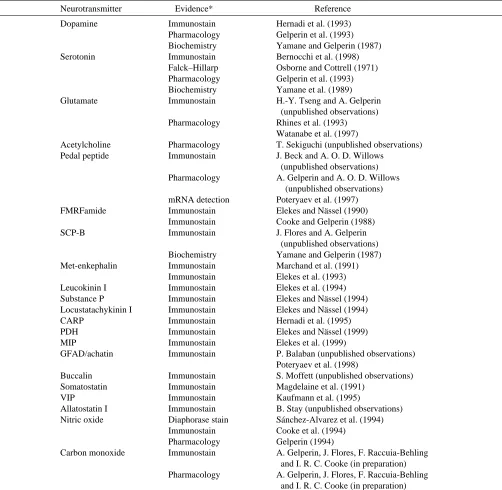
The olfactory bulb and procerebral lobe share several features of their synaptic connectivity. Both are characterized by extensive local feedback synapses modulated by a variety of amine and peptide transmitters. The olfactory bulb implements local feedback using reciprocal synapses between mitral and granule cell dendrites (Isaacson and Strowbridge, 1998; Rall et al., 1966). Dendrodendritic synaptic interactions in the bulb mediate lateral inhibition, which increases the response specificity of mitral cells (Yokoi et al., 1995). Reciprocal synapses are also prominent in the procerebral lobe neuropil (McCarragher and Chase, 1985; Zs.-Nagy and Sakharov, 1970); however, their synaptic function is yet to be determined. Like the olfactory bulb (Shepherd and Greer, 1990), the procerebral lobe circuitry is modulated by a variety of monoamines and peptides (Table 1) providing the synaptic substrate for dynamic reconfiguration of the procerebral lobe odor-processing circuitry, as documented with particular clarity for crustacean stomatogastric ganglion (Marder, 1998) and Aplysia californica neuromuscular circuits (Brezina et al, 1996; Brezina and Weiss, 1997). The procerebral lobe is a likely site for the short-term (1–100 min) memory of odor stimulation, which is converted to a long-term (days) memory if a strong aversive stimulus follows odor stimulation within
an hour (Gelperin, 1975). One or more of the neuromodulators in Table 1 liberated as a concomitant of aversive stimulation, e.g. serotonin, may trigger the biochemical events leading to this transformation of the memory trace from short-term to long-term form (Abel and Kandel, 1998). Also, since the procerebral lobe, like the olfactory bulb, is continually receiving ingrowing axons from newly generated olfactory receptors, growth guidance and connection enhancement are also potential functions of procerebral neuromodulators. The recent demonstration of continued cell division in the procerebral lobe for several months after hatching (Zakharov et al., 1998) suggests additional roles for guidance and growth regulatory peptides, as postulated in the control of olfactory sensory neuron projections from the sensory epithelium into the olfactory bulb (Lin and Ngai, 1999).
Another design principle common to the olfactory bulb and procerebral lobe is the involvement of nitric oxide (NO) in circuit dynamics and synaptic plasticity. The olfactory bulb stains intensely for NADPH diaphorase (Hopkins et al., 1996), a marker for nitric oxide synthase (NOS) (Dawson et al., 1991; Hope et al., 1991; Huang et al., 1997). Inhibition of neuronal NOS in the olfactory bulb blocks olfactory learning by female sheep during the 2 h postparturition period when they learn the odor of their lambs (Kendrick et al., 1997). The procerebral lobe also stains intensely for NADPH diaphorase (Sánchez-Alvarez et al., 1994) and NOS immunoreactivity (Cooke et al., 1994), both in cellular elements and in fiber tracts. Olfactory learning is blocked by injection of the NOS blocker Nω
-nitro-L-arginine methyl ester (L-NAME) in both honeybees (Müller, 1996) and terrestrial snails (Teyke, 1996). As in vertebrate species, NO can activate a soluble guanylate cyclase in Helix pomatia, which then increases cGMP levels more than 20-fold (Huang et al., 1998). NO also has direct actions on ion channels (Broillet and Firestein, 1996, 1997), quantal transmission (Lin and Bennett, 1994) and axonal growth cone guidance (Renteria and Constantine-Paton, 1996).
of B cell–NB cell synaptic connectivity (Kawahara et al., 1997). Procerebral lobe oscillatory activity can also be recorded from fine wire electrodes implanted in the lobe of intact slugs (Limax maximus), although the spectral content of the in vivo signals is more complex than that of signals recorded in vitro (Gelperin et al., 1996).
The gradient of B cell properties along the apical–basal axis of the procerebral lobe and the excitatory coupling between B
cells result in waves of hyperpolarization and depolarization propagating continuously at 1 mm s−1 from the apical end to
[image:3.609.60.562.85.575.2]the basal end of the procerebral lobe in Limax maximus (Fig. 1) (Delaney et al., 1994; Kleinfeld et al., 1994), in two other species of terrestrial slug (Incilaria bilineata and Limax marginatus) (Kawahara et al., 1997) and in Helix lucorum (P. Balaban and E. S. Nikitin, personal communication). The wave can be recorded optically after staining the procerebral lobe Table 1. Neurotransmitters in the procerebral lobe
Neurotransmitter Evidence* Reference
Dopamine Immunostain Hernadi et al. (1993) Pharmacology Gelperin et al. (1993) Biochemistry Yamane and Gelperin (1987) Serotonin Immunostain Bernocchi et al. (1998)
Falck–Hillarp Osborne and Cottrell (1971) Pharmacology Gelperin et al. (1993) Biochemistry Yamane et al. (1989) Glutamate Immunostain H.-Y. Tseng and A. Gelperin
(unpublished observations) Pharmacology Rhines et al. (1993)
Watanabe et al. (1997)
Acetylcholine Pharmacology T. Sekiguchi (unpublished observations) Pedal peptide Immunostain J. Beck and A. O. D. Willows
(unpublished observations) Pharmacology A. Gelperin and A. O. D. Willows
(unpublished observations) mRNA detection Poteryaev et al. (1997) FMRFamide Immunostain Elekes and Nässel (1990)
Immunostain Cooke and Gelperin (1988)
SCP-B Immunostain J. Flores and A. Gelperin
(unpublished observations) Biochemistry Yamane and Gelperin (1987) Met-enkephalin Immunostain Marchand et al. (1991)
Immunostain Elekes et al. (1993) Leucokinin I Immunostain Elekes et al. (1994) Substance P Immunostain Elekes and Nässel (1994) Locustatachykinin I Immunostain Elekes and Nässel (1994)
CARP Immunostain Hernadi et al. (1995)
PDH Immunostain Elekes and Nässel (1999)
MIP Immunostain Elekes et al. (1999)
GFAD/achatin Immunostain P. Balaban (unpublished observations) Poteryaev et al. (1998)
Buccalin Immunostain S. Moffett (unpublished observations) Somatostatin Immunostain Magdelaine et al. (1991)
VIP Immunostain Kaufmann et al. (1995)
Allatostatin I Immunostain B. Stay (unpublished observations) Nitric oxide Diaphorase stain Sánchez-Alvarez et al. (1994)
Immunostain Cooke et al. (1994) Pharmacology Gelperin (1994)
Carbon monoxide Immunostain A. Gelperin, J. Flores, F. Raccuia-Behling and I. R. C. Cooke (in preparation) Pharmacology A. Gelperin, J. Flores, F. Raccuia-Behling
and I. R. C. Cooke (in preparation)
SCP-B, small cardioactive peptide B; CARP, catch-relaxing peptide; PDH, pigment-dispersing hormone; MIP, Mytilus inhibitory peptides; GFAD, Gly-D-Phe-Ala-Asp-COOH; VIP, vasoactive intestinal peptide.
Note that the data were obtained in a variety of terrestrial gastropod species.
with voltage-sensitive dyes (Senseman, 1996; Wu et al., 1998) or electrically with multisite local field potential measurements. Both recording modes show a delay in the basal local field potential peak relative to the apical local field potential peak. Activity waves have also been recorded from an in vitro preparation of the ferret thalamus (Kim et al., 1995) and from turtle visual cortex (Prechtl et al., 1997). In both turtle cortex and Limax maximus procerebral lobe, space/frequency analysis of image sequences taken from a preparation stained with voltage-sensitive dye suggests the presence of two waves propagating in slightly different directions (Mitra and Pesaran, 1999).
Function of olfactory waves
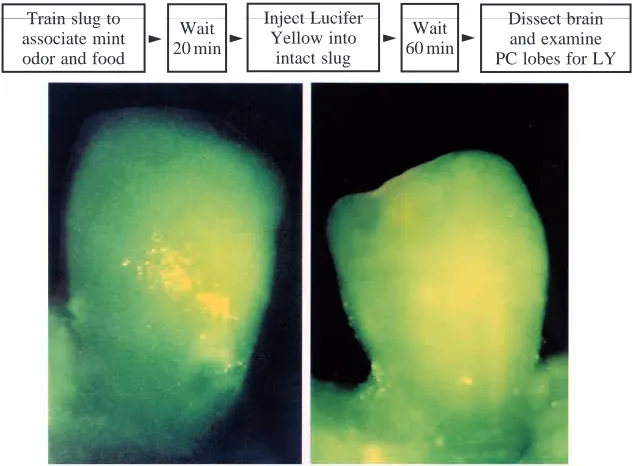
The waves in the procerebral lobe of Limax maximus may serve to parcel out space in the lobe to optimize storage of odor memory representations during odor learning. This suggestion arises from the remarkable observation that associative odor
[image:4.609.127.484.77.184.2]training followed by injection of Lucifer Yellow into the intact slug labels a band of procerebral cells for each odor learned (Kimura et al., 1998). An example of learning-specific Lucifer Yellow labeling of a band of procerebral cells in Limax maximus after appetitive odor conditioning is shown in Fig. 2. The labeling is specific to odor learning because it does not occur after exposure to odor alone or to aversive stimulus alone. The long axis of the labeled band of procerebral cells is transverse to the axis of wave propagation. If two odors are trained, two bands are labeled, both bands located in one procerebral lobe. Unilateral band formation may result from a crossed inhibition between right and left odor-processing streams, demonstrated when the right and left noses are stimulated with different known odors (T. Teyke, J. Wang and A. Gelperin, in preparation). Wave propagation may serve to determine the size and orientation of the band and to limit the overlap between adjacent bands. If closely related odors are represented as bands in close proximity in the procerebral lobe, then suppression of wave propagation might lead to a loss of Fig. 1. A series of CCD images of a procerebral lobe stained with a voltage-sensitive dye (Di-4-ANEPPS) to show spontaneous wave propagation from the apex of the procerebral lobe (upper left of each image) to its base (lower right of each image). One cycle of wave propagation is complete in 16 frames taken at 9 frames s−1, corresponding to a local field potential oscillation frequency of 0.56 Hz. Details of
specimen preparation, data acquisition and calculation of the fractional change in fluorescence (∆F/F) are given by Kleinfeld et al. (1994).
0
1 2 3 4 5 6 7 8
9 10 11 12 13 14 15 16
−0.1%
+0.1% Optical signal, −∆F/F
112 ms per frame 100µm
Right PC Left PC
䉴
Train slug to associate mint odor and food
Dissect brain and examine PC lobes for LY
䉴
Inject Lucifer Yellow into intact slug
䉴
Wait
20 min 䉴
Wait 60 min
[image:4.609.245.564.497.730.2]discrimination between closely related odors. Data consistent with this interpretation have been obtained (Teyke and Gelperin, 1999).
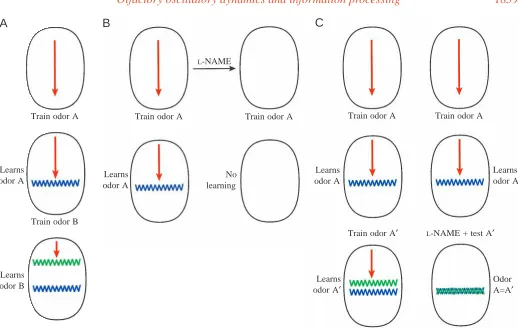
A hypothesis relating oscillations, waves and odor representations in the procerebral lobe can be summarized in the following way. When odor A is experienced, a short-term memory trace of odor A lasting tens of seconds is laid down in a band of neurons in the procerebral lobe. This is based on the observation that toxicosis can follow odor exposure by tens of seconds and still lead to associative conditioning (Gelperin, 1975). When the aversive stimulus is applied, neuromodulators liberated in the procerebral lobe trigger biochemical changes in the band of procerebral cells which lead to the formation of a long-term (days) memory of odor A (Fig. 3A). Some consequence of these biochemical events leads to membrane recycling, which results in internalization of Lucifer Yellow in slugs injected with Lucifer Yellow following odor training. When two different odors, A and B, are learned, two bands form in the same procerebral lobe, with the apical–basal distance between the bands being proportional to the chemical or perceptual similarity of the two odors (Fig. 3A). If two closely related odors, A and A′, are learned, two spatially contiguous bands form in the procerebral lobe with minimal spacing along
the apical–basal axis of the procerebral lobe determined by the dynamics of wave propagation (Fig. 3C) (Ermentrout and Gelperin, 1998). If procerebral oscillation and wave propagation are blocked by injection of L-NAME before odor training, odor learning is blocked and no bands form (Fig. 3B). If a slug previously trained to odor A is subsequently tested with odor A′ while oscillations and wave propagation are suppressed, odor A′is not discriminated from odor A (Fig. 3C). The behavior or reflex response normally elicited by odor A is now generated in response to odor A′, as demonstrated for odor-elicited motor activity in the external peritentacular nerve of Limax maximus (Teyke and Gelperin, 1999).
[image:5.609.49.567.56.384.2]The way in which wave propagation may act to parcel out space in the procerebral lobe for distinct odor representations has recently been modeled as an extension of a two-layered coupled oscillator model of the procerebral lobe which propagates band-like waves from apex to base (Ermentrout et al., 1998). In the new model, when novel odor exposure causes collapse of the phase gradient along the apical–basal axis of the procerebral lobe (Kleinfeld et al., 1994), a competitive synaptic mechanism based on a Kohonen-type algorithm (Kohonen and Hari, 1999) with winner-take-all dynamics is enabled (B. Ermentrout, J. Flores and A. Gelperin, in preparation). The Fig. 3. Diagrammatic representation of a possible relationship between waves, odor memory bands and odor discrimination. (A) Forming odor memories for two dissimilar odors leads to two well-separated odor memory bands. (B) Blocking of oscillations and waves in the procerebral lobe blocks odor learning. (C) Learning two similar odors (A and A′) leads to the formation of two closely spaced odor memory bands. After learning odor A, if oscillations and waves are blocked, odor A′is not discriminated from odor A. Red arrows signify a propagated wave.
L-NAME, Nω-nitro-L-arginine methyl ester.
A
B
C
Learns odor B Learns odor A
Train odor A
Train odor B
Learns odor A
Learns odor A
Learns odor A′ No
learning
Train odor A Train odor A
L-NAME
Train odor A′ L-NAME + test A′ Learns odor A
group of procerebral neurons driven most strongly by the coincidence of odor input and the passage of the wave front becomes the odor memory band, as revealed by Lucifer Yellow labeling. A key point is that one group of cells can only suppress the activity of another group of cells when the two groups are active concurrently. Wave activity at rest allows multiple inputs into the system with little suppression. When learning an odor, the activity in the procerebral lobe is synchronized and then winner-take-all behavior can occur. The synaptic basis for winner-take-all behavior remains to be elucidated.
Elements of this hypothesis dealing with spatial segregation of learned odor representations can be extended to relate odor memory bands in the procerebral lobe of Limax maximus to glomerular sites of odor memory modification in vertebrates. In the rat, odorant receptor gene expression guides the connection of olfactory sensory cells to specific glomeruli such that sensory cells expressing a given receptor gene connect with two of the 1800 glomeruli (Bozza and Kauer, 1998; Wang et al., 1998; see also Buck, 1996; Dynes and Ngai, 1998). A variety of physiological measurements indicate that odorants are represented by spatiotemporal patterns of glomerular activation (Cinelli et al., 1995; Friedrich and Korsching, 1997; Joerges et al., 1997; Vickers et al., 1998). The representation of a given odorant must be distributed because the function of the olfactory bulb in odor detection and discrimination survives lesions of 80 % of the bulb (Lu and Slotnick, 1998). There is ample evidence for learning-related changes in the olfactory bulb, including changes in the odor-elicited spatial patterns of the local field potential (Freeman, 1991; Freeman and Schneider, 1982) and learning-associated changes in focal uptake of 2-deoxy[14C]glucose (Johnson and Leon, 1996), a
technique that has also been applied to Limax maximus chemosensory networks (Reingold et al., 1981; Sejnowski et al., 1980). Structurally similar odors will activate neighboring glomeruli in patterns that depend critically on lateral inhibition via reciprocal synaptic interactions between mitral and granule cells (Yokoi et al., 1995). The odor-elicited oscillation of bulbar circuits (Delaney and Hall, 1995) may play a critical role in timing the discharges of the responding mitral/tufted cells during odor discrimination (Hopfield, 1995).
The waves in the procerebral lobe of Limax maximus may accomplish spatial segregation of learned odor representations, which in arthropods and vertebrates is accomplished by segregating odor representations in glomeruli. This explains why waves are not found in insect antennal lobes (Joerges et al., 1997; Laurent, 1997) or in the vertebrate olfactory bulb (Freeman, 1991). The local field potential oscillations, which are common to the procerebral lobe and the glomerular structures in arthropods and vertebrates, would then have the primary function of correlating activity in odor-responsive interneurons into temporal patterns critical for odor identification (Laurent et al., 1996; MacLeod and Laurent, 1996; Meredith, 1986; Wehr and Laurent, 1996). A test of the idea that temporal features of the spike trains of odor-responsive units in the olfactory bulb/antennal lobe/procerebral lobe are critical for odor identification could be performed if
pharmacological agents could block selectively the mechanism responsible for correlated interneuron firing, i.e. the mechanism giving rise to the local field potential oscillation in the olfactory bulb and its invertebrate analogs. This experiment requires a read-out of odor evaluation during drug action, using either a behavioral reflex in the intact animal or the neural substrate of such a reflex in the isolated nervous system.
Recent results in the honeybee present direct measurements of the behavioral effects of selectively blocking correlations in odor-responsive interneurons. Restrained bees are first trained to give a conditioned proboscis extension to odor A. Picrotoxin is then applied to the antennal lobe to block the γ-aminobutyric acid (GABA)ergic synaptic interactions that underlie oscillatory synchronization, while leaving intact the odor-responsiveness of antennal lobe neurons (Leitch and Laurent, 1996; MacLeod and Laurent, 1996). During suppression of oscillatory synchronization by picrotoxin, bees are tested for their conditioned proboscis extension response to odor A, a chemically similar odor A′and a dissimilar odor B. Oscillation blockage induced conditioned responding to odor A′ in addition to odor A, but not to odor B (Stopfer et al., 1997). The oscillatory synchronization of odor-responsive interneurons enables discrimination between similar temporal patterns of neural activity presumably representing chemically similar odors. Note that oscillatory synchronization is not required for odor identification per se or for recall of previously learned odor memories.
Similar results relating procerebral lobe oscillations and odor discrimination have recently been obtained using the in vitro Limax maximus nose–brain preparation. The odor-elicited discharge in the external peritentacular nerve is used as a monitor of odor recognition, as first shown in Helix pomatia (Peschel et al., 1996). The procerebral lobe is lodged in a suction electrode that can be perfused internally. This allows continuous monitoring of the procerebral oscillation and suppression of the oscillation by perfusion of the procerebral lobe with L-NAME. A slug is appetitively trained with one apple variety (odor A), and a nose–brain preparation is obtained from the trained slug. A brisk discharge in the external peritentacular nerve is obtained in response to odor A but only a weak discharge in response to the odor of a second apple variety (odor A′) to which the slug gave little or no behavioral response. When the procerebral oscillation is suppressed by perfusion with L-NAME, the nerve response to odor A decreases by 10 % while the nerve response to odor A′ increases by 40 % (Gelperin et al., 1998; Teyke and Gelperin, 1999). On the basis of the model presented in Fig. 2, the Lucifer Yellow bands resulting from conditioning to odor A and odor A′should be in close proximity. Also, injection of L -NAME into an intact slug previously conditioned to odor A should result in conditioned responding to both odor A and odor A′. These predictions remain to be tested.
Conclusions
information-processing systems in a diverse set of organisms from molluscs to mammals. This set includes oscillatory dynamics, adult neurogenesis, gaseous (NO) neurotransmission and odor-learning-related changes at early stages of sensory processing. The central odor analyzer of the terrestrial mollusc Limax maximus displays these design features in the procerebral lobe, which has a 0.7 Hz oscillation in local field potential and propagates activity waves. Suppression of the procerebral oscillation and wave propagation reduces discrimination between related odors, as demonstrated previously in the honeybee antennal lobe. Recent demonstrations of learning-dependent Lucifer Yellow labeling of bands of neurons in the procerebral lobe have led to testable predictions as to how oscillatory dynamics and wave propagation may influence the storage of odor memory and odor discrimination.
I thank T. H. Bullock and H. Sompolinsky for critical comments on the manuscript and numerous colleagues who shared unpublished data for inclusion in Table 1.
Note added in proof
Cellular analysis of nitrergic neurons, particularly in gastropod molluscs, has recently been reviewed by Moroz et al. (1999).
References
Abel, T. and Kandel, E. R. (1998). Positive and negative regulatory mechanisms that mediate long term memory storage. Brain Res.
Rev. 26, 360–378.
Ache, B. W. (1991). Phylogeny of smell and taste. In Smell and Taste
in Health and Disease (ed. T. V. Getchell, R. L. Doty, L. M.
Bartoshuk and J. B. Snow), pp. 3–18. New York: Raven Press. Adrian, E. D. (1942). Olfactory reactions in the brain of the
hedgehog. J. Physiol., Lond. 100, 459–473.
Baker, T. C., Fadamiro, H. Y. and Cosse, A. A. (1998). Moth uses fine tuning for odour resolution. Nature 393, 530.
Bernocchi, G., Vignola, C., Scherini, E., Necchi, D. and Pisu, M. B. (1998). Bioactive peptides and serotonin immunocytochemistry in the cerebral ganglia of hibernating Helix aspersa. J. Exp. Zool. 280, 354–367.
Bozza, T. C. and Kauer, J. S. (1998). Odorant response properties of convergent olfactory receptor neurons. J. Neurosci. 18, 4560–4569.
Brezina, V., Orekhova, I. V. and Weiss, K. R. (1996). Functional uncoupling of linked neurotransmitter effects by combinatorial convergence. Science 273, 806–810.
Brezina, V. and Weiss, K. R. (1997). Analyzing the functional consequences of transmitter complexity. Trends Neurosci. 20, 538–543.
Broillet, M. C. and Firestein, S. (1996). Direct activation of the olfactory cyclic nucleotide gated channel through modification of sulfhydryl groups by NO compounds. Neuron 16, 377–385. Broillet, M. C. and Firestein, S. (1997). Beta subunits of the
olfactory cyclic nucleotide gated channel form a nitric oxide activated Ca2+channel. Neuron 18, 951–958.
Brunjes, P. C. (1994). Unilateral naris closure and olfactory system development. Brain Res. Rev. 19, 146–160.
Buck, L. (1996). Information coding in the vertebrate olfactory bulb.
Annu. Rev. Neurosci. 19, 517–544.
Chase, R. (1985). Responses to odors mapped in snail tentacles and brain by 14C-2-deoxyglucose autoradiography. J. Neurosci. 5,
2930–2939.
Chase, R. and Rieling, J. (1986). Autoradiographic evidence for receptor cell renewal in the olfactory epithelium of a snail. Brain
Res. 384, 232–239.
Chase, R. and Tolloczko, B. (1986). Synaptic glomeruli in the olfactory system of a snail. Cell Tissue Res. 246, 567–573. Chase, R. and Tolloczko, B. (1993). Tracing neural pathways in snail
olfaction: From the tip of the tentacles to the brain and beyond.
Microsc. Res. Tech. 24, 214–230.
Cinelli, A. R., Hamilton, K. A. and Kauer, J. S. (1995). Salamander olfactory bulb neuronal activity observed by video rate, voltage-sensitive dye imaging. III. Spatial and temporal properties of responses evoked by odorant stimulation. J. Neurophysiol. 73, 2053–2071.
Classen, J., Gerloff, C., Honda, M. and Hallett, M. (1998). Integrative visuomotor behavior is associated with interregionally coherent oscillations in the human brain. J. Neurophysiol. 79, 1567–1573.
Cooke, I. R. C., Edwards, S. L. and Anderson, C. R. (1994). The distribution of NADPH-diaphorase activity and immunoreactivity to nitric oxide synthase in the nervous system of the pulmonate mollusc Helix aspersa. Cell Tissue Res. 277, 565–572.
Cooke, I. and Gelperin, A. (1988). Distribution of FMRFamide-like immunoreactivity in the nervous system of the slug Limax
maximus. Cell Tissue Res. 253, 69–76.
Corotto, F. S., Henegar, J. R. and Maruniak, J. A. (1994). Odor deprivation leads to reduced neurogenesis and reduced neuronal survival in the olfactory bulb of the adult mouse. Neurosci. 61, 739–744.
Dawson, T. M., Bredt, D. S., Fotuhi, M., Hwang, P. M. and Snyder, S. H. (1991). Nitric oxide synthase and neuronal NADPH diaphorase are identical in brain and peripheral tissues. Proc. Natl.
Acad. Sci. USA 88, 7797–7801.
Decharms, R. C. and Merzenich, M. M. (1996). Primary cortical representation of sounds by the coordination of action potential timing. Nature 381, 610–613.
Delaney, K. R., Gelperin, A., Fee, M. S., Flores, J. A., Gervais, R., Tank, D. W. and Kleinfeld, D. (1994). Waves and stimulus-modulated dynamics in an oscillating olfactory network. Proc.
Natl. Acad. Sci. USA 91, 669–673.
Delaney, K. R. and Hall, J. B. (1995). An in vitro preparation of frog nose and brain for the study of odour-evoked oscillatory activity.
J. Neurosci. Meth. 68, 193–202.
Donoghue, J. P., Sanes, J. N., Hatsopoulos, N. G. and Gaal, G. (1998). Neural discharge and local field potential oscillations in primate motor cortex during voluntary movements. J.
Neurophysiol. 79, 159–173.
Dynes, J. L. and Ngai, J. (1998). Pathfinding of olfactory neuron axons to stereotyped glomerular targets revealed by dynamic imaging in living zebrafish embryos. Neuron 20, 1081–1091.
Elekes, K., Hernadi, L., Muren, J. E. and Nässel, D. R. (1994). Peptidergic neurons in the snail Helix pomatia: Distribution of neurons in the central and peripheral nervous system that react with an antibody raised against an insect neuropeptide, leucokinin I. J.
Comp. Neurol. 341, 257–272.
FMRFamide-like immunoreactive neurons in the central nervous system of the snail Helix pomatia. Cell Tissue Res. 262, 177–190.
Elekes, K. and Nässel, D. R. (1994). Tachykinin-related neuropeptides in the central nervous system of the snail, Helix
pomatia: an immunocytochemical study. Brain Res. 661, 223–236.
Elekes, K. and Nässel, D. R. (1999). Pigment-dispersing hormone-like neurons in the central nervous system of gastropods, Helix and
Lymnaea. Cell Tissue Res. (in press).
Elekes, K., Stefano, G. B. and Carpenter, D. O. (1993). Enkephalin-like immunoreactive neurons in the central nervous system of gastropods (Helix pomatia, Lymnaea stagnalis, Aplysia
californica): a comparative immunocytochemical study. Cell Tissue Res. 272, 329–341.
Ermentrout, B., Flores, J. and Gelperin, A. (1998). Minimal model of oscillations and waves in the Limax olfactory lobe with tests of the model’s predictive power. J. Neurophysiol. 79, 2677–2689. Ermentrout, B. and Gelperin, A. (1998). Model for olfactory
discrimination and learning in the Limax procerebral lobe incorporating oscillatory dynamics and wave propagation. Soc.
Neurosci. Abstr. 24, 652.
Freeman, W. J. (1991). Nonlinear dynamics in olfactory information processing. In Olfaction: A Model System for Computational
Neuroscience (ed. J. L. Davis and H. Eichenbaum), pp. 225–249.
Cambridge, MA: MIT Press.
Freeman, W. J. and Schneider, W. S. (1982). Changes in spatial patterns of rabbit olfactory EEG with conditioning to odors.
Psychophysiol. 19, 44–56.
Friedrich, A. and Teyke, T. (1998). Identification of stimuli and input pathways mediating food-attraction conditioning in the snail,
Helix. J. Comp. Physiol. A 183, 247–254.
Friedrich, R. W. and Korsching, S. I. (1997). Combinatorial and chemotopic odorant coding in the zebrafish olfactory bulb visualized by optical imaging. Neuron 18, 737–752.
Gelperin, A. (1975). Rapid food-aversion learning by a terrestrial mollusk. Science 189, 567–570.
Gelperin, A. (1994). Nitric oxide mediates network oscillations of olfactory interneurons in a terrestrial mollusc. Nature 369, 61–63. Gelperin, A. and Flores, J. (1997). Vital staining from dye-coated microprobes identifies new olfactory interneurons for optical and electrical recording. J. Neurosci. Meth. 72, 97–108.
Gelperin, A., Flores, J. and Teyke, T. (1998). Olfactory oscillations enable odor discrimination by the Limax nose–brain preparation.
Soc. Neurosci. Abstr. 24, 653.
Gelperin, A., Kleinfeld, D., Denk, W. and Cooke, I. R. C. (1996). Oscillations and gaseous oxides in invertebrate olfaction. J.
Neurobiol. 30, 110–122.
Gelperin, A., Rhines, L., Flores, J. and Tank, D. (1993). Coherent network oscillations by olfactory interneurons: Modulation by endogenous amines. J. Neurophysiol. 69, 1930–1939.
Gelperin, A. and Tank, D. W. (1990). Odor-modulated collective network oscillations of olfactory interneurons in a terrestrial mollusc. Nature 345, 437–440.
Gerard, R. W. and Young, J. Z. (1937). Electrical activity of the central nervous system of the frog. Proc. R. Soc. B 122, 343–352.
Gervais, R., Kleinfeld, D., Delaney, K. R. and Gelperin, A. (1996). Central and reflex neuronal responses elicited by odor in a terrestrial mollusc. J. Neurophysiol. 76, 1327–1339.
Gray, C. M. (1994). Synchronous oscillations in neuronal systems: Mechanisms and functions. J. Comput. Neurosci. 1, 11–38. Gray, C. M. and DiPrisco, G. V. (1997). Stimulus-dependent
neuronal oscillations and local synchronization in striate cortex of the alert cat. J. Neurosci. 17, 3239–3253.
Harzsch, S., Miller, J., Benton, J. and Beltz, B. (1999). From embryo to adult: persistent neurogenesis and apoptotic cell death shape the lobster deutocerebrum. J. Neurosci. 19, 3472–3485. Heinbockel, T., Kloppenberg, P. and Hildebrand, J. G. (1998).
Pheromone-evoked potentials and oscillations in the antennal lobes of the sphinx moth Manduca sexta. J. Comp. Physiol. A 182, 703–714. Hernadi, L., Juhos, S. and Elekes, K. (1993). Distribution of dopamine-immunoreactive and tyrosine-hydroxylase immunoreactive neurons in the central nervous system of Helix
pomatia. Cell Tissue Res. 274, 503–513.
Hernadi, L., Teranno, Y., Muneoka, Y. and Kiss, T. (1995). Distribution of catch-relaxing peptide (CARP)-like immunoreative neurons in the central and peripheral nervous system of Helix
pomatia. Cell Tissue Res. 280, 335–348.
Hildebrand, J. G. and Shepherd, G. M. (1997). Mechanisms of olfactory discrimination: Converging evidence for common principles across phyla. Annu. Rev. Neurosci. 20, 595–631. Hope, B. T., Michael, G. J., Knigge, K. M. and Vincent, S. R.
(1991). Neuronal NADPH diaphorase is a nitric oxide synthase.
Proc. Natl. Acad. Sci. USA 88, 2811–2814.
Hopfield, J. F. and Gelperin, A. (1989). Differential conditioning to a compound stimulus and its components in the terrestrial mollusc
Limax maximus. Behav. Neurosci. 103, 274–293.
Hopfield, J. J. (1991). Olfactory computation and object perception.
Proc. Natl. Acad. Sci. USA 88, 6462–6466.
Hopfield, J. J. (1995). Pattern recognition computation using action potential timing for stimulus representation. Nature 376, 33–36. Hopkins, D. A., Steinbusch, H. W. M., Markerink-Van Ittersum,
M. and De Vente, J. (1996). Nitric oxide synthase, cGMP and NO-mediated cGMP production in the olfactory bulb of the rat. J.
Comp. Neurol. 375, 641–658.
Huang, S., Kerschbaum, H. H., Engel, E. and Hermann, A. (1997). Biochemical characterization and histochemical localization of nitric oxide synthase in the nervous system of the snail, Helix
pomatia. J. Neurochem. 69, 2516–2528.
Huang, S., Kerschbaum, H. H. and Hermann, A. (1998). Nitric oxide-mediated cGMP synthesis in Helix neural ganglia. Brain Res. 780, 329–336.
Isaacson, J. S. and Strowbridge, B. W. (1998). Olfactory reciprocal synapses: Dendritic signaling in the CNS. Neuron 20, 749–761. Joerges, J., Küttner, A., Galizia, C. G. and Menzel, R. (1997).
Representations of odours and odour mixtures visualized in the honeybee brain. Nature 387, 285–288.
Johnson, B. A. and Leon, M. (1996). Spatial distribution of [C-14]2-deoxyglucose uptake in the glomerular layer of the rat olfactory bulb following early odor preference learning. J. Comp. Neurol. 376, 557–566.
Kaufmann, W., Kerschbaum, H. H., Hauserkronberger, C., Hacker, G. W. and Hermann, A. (1995). Distribution and seasonal variation of vasoactive intestinal (VIP)-like peptides in the nervous system of Helix pomatia. Brain Res. 695, 125–136. Kawahara, S., Toda, S., Suzuki, Y., Watanabe, S. and Kirino, Y.
(1997). Comparative study on neural oscillation in the procerebrum of the terrestrial slugs Incilaria bilineata and Limax marginatus. J.
Exp. Biol. 200, 1851–1861.
Kim, U., Bal, T. and McCormick, D. A. (1995). Spindle waves are propagating synchronized oscillations in the ferret LGNd in vitro.
J. Neurophysiol. 74, 1301–1323.
Kimura, T., Suzuki, H., Kono, E. and Sekiguchi, T. (1998). Mapping of interneurons that contribute to food aversion conditioning in the slug brain. Learning & Memory 4, 376–388. Kleinfeld, D., Delaney, K. R., Fee, M. S., Flores, J. A., Tank, D.
W. and Gelperin, A. (1994). Dynamics of propagating waves in the olfactory network of a terrestrial mollusc: An electrical and optical study. J. Neurophysiol. 72, 1402–1419.
Kohonen, T. and Hari, R. (1999). Where the abstract feature maps of the brain might come from. Trends Neurosci. 22, 135–139. Laurent, G. (1996). Odor images and tunes. Neuron 16, 473–476. Laurent, G. (1997). Olfactory processing: maps, time and codes.
Curr. Opin. Neurobiol. 7, 547–553.
Laurent, G., Wehr, M. and Davidowitz, H. (1996). Odour encoding by temporal sequences of firing in oscillating neural assemblies. J.
Neurosci. 16, 3837–3847.
Leitch, B. and Laurent, G. (1996). GABAergic synapses in the antennal lobe and mushroom body of the locust olfactory system.
J. Comp. Neurol. 372, 487–514.
Lin, D. M. and Ngai, J. (1999). Development of the vertebrate main olfactory system. Curr. Opin. Neurobiol. 9, 74–78.
Lin, Y. Q. and Bennett, M. R. (1994). Nitric-oxide modulation of quantal secretion in chick ciliary ganglia. J. Physiol., Lond. 481, 385–394.
Lois, C. and Alvarez-Buylla, A. (1994). Long-distance neuronal migration in the adult mammalian brain. Science 264, 1145–1148. Lu, X. C. M. and Slotnick, B. M. (1998). Olfaction in rats with extensive lesions of the olfactory bulbs: Implications for odor coding. Neurosci. 84, 849–866.
MacLeod, K. and Laurent, G. (1996). Distinct mechanisms for synchronization and temporal patterning of odor-coding assemblies. Science 274, 976–979.
Magdelaine, S., Mansuit, P., Marchand, C. R. and Richardson, J. (1991). Growth and SRIF-like substances in the snail Helix aspersa
maxima fed with an arginin-enriched food at different times of a
short daily photoperiod. Comp. Biochem. Physiol. 99A, 429–435. Marchand, C. R., Griffond, B. and MouColard, C. (1991).
Distribution of methionine-enkephalin-like and FMRFamide-like immunoreactivities in the central nervous system (including dorsal bodies) of the snail Helix aspersa Müller. Zool. Sci. 8, 905–913. Marder, E. (1998). From biophysics to models of network function.
Annu. Rev. Neurosci. 21, 25–45.
McCarragher, G. and Chase, R. (1985). Quantification of ultrastructural symmetry at molluscan chemical synapses. J.
Neurobiol. 16, 69–74.
Menzel, R. and Müller, U. (1996). Learning and memory in honeybees: From behavior to neural substrate. Annu. Rev. Neurosci. 19, 379–404.
Meredith, M. (1986). Patterned response to odor in mammalian olfactory bulb: the influence of intensity. J. Neurophysiol. 56, 572–597.
Mitra, P. P. and Pesaran, B. (1999). Analysis of dynamic brain imaging data. Biophys. J. 76, 691–708.
Moroz, L. L., Gillette, R. and Sweedler, J. V. (1999). Single-cell analysis of nitrergic neurons in simple nervous systems. J. Exp.
Biol. 202, 333–341.
Müller, U. (1996). Inhibition of nitric oxide synthase impairs a distinct form of long-term memory in the honeybee, Apis mellifera.
Neuron 16, 541–549.
Murthy, V. N. and Fetz, E. E. (1996). Oscillatory activity in sensorimotor cortex of awake monkeys: synchronization of local field potentials and relation to behavior. J. Neurophysiol. 76, 3949–3967.
Najbauer, J. and Leon, M. (1995). Olfactory experience modulates apoptosis in the developing olfactory bulb. Brain Res. 674, 245–251.
Osborne, N. N. and Cottrell, G. A. (1971). Distribution of biogenic amines in the slug Limax maximus. Z. Zellforsch. 112, 15–30. Peschel, M., Straub, V. and Teyke, T. (1996). Consequences of
food-attraction conditioning in Helix: A behavioral and electrophysiological study. J. Comp. Physiol. 178, 317–327. Poteryaev, D. A., Zakharov, I. S., Balaban, P. M. and Belyavsky,
A. V. (1998). A novel neuropeptide precursor gene is expressed in the terrestrial snail central nervous system by a group of neurons that control mating behavior. J. Neurobiol. 35, 183–197.
Poteryaev, D. A., Zakharov, I. S., Balaban, P. M., Uvarov, P. N. and Belyavsky, A. V. (1997). Characterization of a cDNA clone encoding pedal peptide in the terrestrial snail. NeuroReport 8, 3631–3635.
Prechtl, J., Cohen, L. B., Pesaran, B., Mitra, P. P. and Kleinfeld, D. (1997). Visual stimuli induce waves of electrical activity in turtle cortex. Proc. Natl. Acad. Sci. USA 94, 7621–7626.
Rall, W., Shepherd, G. M., Reese, T. S. and Brightman, M. W. (1966). Dendrodendritic synaptic pathway for inhibition in the olfactory bulb. Exp. Neurol. 14, 44–56.
Reingold, S. C., Sejnowski, T. J., Gelperin, A. and Kelley, D. B. (1981). [3H]-2-deoxyglucose autoradiography in a molluscan
nervous system. Brain Res. 208, 416–420.
Renteria, R. C. and Constantine-Paton, M. (1996). Exogenous nitric oxide causes collapse of retinal ganglion cell axonal growth cones in vitro. J. Neurobiol. 29, 415–428.
Rhines, L., Sokolove, P., Flores, J., Tank, D. W. and Gelperin, A. (1993). Cultured olfactory interneurons from Limax maximus: Optical and electrophysiological studies of transmitter-evoked responses. J. Neurophysiol. 69, 1940–1947.
Ribary, U., Joannides, A. A., Singh, K. D., Hasson, R., Bolton, J. P. R., Lado, F., Mogilner, A. and Llinas, R. (1991). Magnetic field tomography of coherent thalamocortical 40 Hz oscillations in humans. Proc. Natl. Acad. Sci. USA 88, 11037–11041.
Sahley, C. L. (1990). The behavioral analysis of associative learning in the terrestrial mollusc Limax maximus: The importance of interevent relationships. In Connectionist Modeling and Brain
Function: The Developing Interface (ed. S. Hanson and C. Olson),
pp. 36–73. Cambridge, MA: MIT Press.
Sánchez-Alvarez, M., León-Olea, M., Talavera, E., Pellicer, F., Sánchez-Islas, E. and Martínez-Lorenzana, G. (1994). Distribution of NADPH-diaphorase in the perioesophageal ganglia of the snail, Helix aspersa. Neurosci. Lett. 169, 51–55.
Sejnowski, T. J., Reingold, S. C., Kelley, D. B. and Gelperin, A. (1980). Localization of [3H]-2-deoxyglucose in single molluscan
neurones. Nature 287, 449–451.
Senseman, D. M. (1996). High-speed optical imaging of afferent flow through rat olfactory bulb slices: Voltage-sensitive dye signals reveal periglomerular cell activity. J. Neurosci. 16, 313–324. Shepherd, G. M. and Greer, C. A. (1990). Olfactory bulb. In The
Synaptic Organization of the Brain (ed. G. M. Shepherd), pp.
133–169. New York: Oxford University Press.
Shipley, M. T. and Ennis, M. (1995). Functional organization of olfactory system. J. Neurobiol. 30, 123–176.
the temporal correlation hypothesis. Annu. Rev. Neurosci. 18, 555–586.
Stopfer, M., Bhagavan, S., Smith, B. H. and Laurent, G. (1997). Impaired odour discrimination on desynchronization of odour-encoding neural assemblies. Nature 390, 70–74.
Tank, D. W., Gelperin, A. and Kleinfeld, D. (1994). Odors, oscillations and waves: Does it all compute? Science 265, 1819–1820.
Technau, G. M. (1984). Fiber number in the mushroom bodies of adult Drosophila melanogaster depends on age, sex and experience. J. Neurogenet. 1, 113–126.
Teyke, T. (1996). Nitric oxide, but not serotonin, is involved in acquisition of food-attraction conditioning in the snail Helix
pomatia. Neurosci. Lett. 206, 29–32.
Teyke, T. and Gelperin, A. (1999). Olfactory oscillations augment odor discrimination not odor identification by Limax CNS.
NeuroReport 10, 1061–1068.
Vickers, N. J., Christensen, T. A. and Hildebrand, J. G. (1998). Combinatorial odor discrimination in the brain: Attractive and antagonistic odor blends are represented in distinct combinations of uniquely identifiable glomeruli. J. Comp. Neurol. 400, 35–56. Wang, F., Nemes, A., Mendelsohn, M. and Axel, R. (1998).
Odorant receptors govern the formation of a precise topographic map. Cell 93, 47–60.
Watanabe, S., Kawahara, S. and Kirino, Y. (1997). Glutamate responses of procerebral neurons of the terrestrial slug Limax
marginatus. Soc. Neurosci. Abstr. 23, 1824.
Watanabe, S., Kawahara, S. and Kirino, Y. (1998). Morphological characterization of the bursting and nonbursting neurones in the olfactory centre of the terrestrial slug Limax marginatus. J. Exp.
Biol. 201, 925–930.
Wehr, M. and Laurent, G. (1996). Odor encoding by temporal sequences of firing in oscillating neural assemblies. Nature 384, 162–166.
Wu, J. Y., Lam, Y. W., Falk, C. X., Cohen, L. B., Fang, J., Loew, L., Prechtl, J. C., Kleinfeld, D. and Tsau, Y. (1998). Voltage-sensitive dyes for monitoring multineuronal activity in the intact central nervous system. Histochem. J. 30, 169–187.
Yamane, T. and Gelperin, A. (1987). Aminergic and peptidergic amplification of intracellular cyclic AMP levels in a molluscan neural network. Cell. Mol. Neurobiol. 7, 291–301.
Yamane, T., Oestericher, A. B. and Gelperin, A. (1989). Serotonin-stimulated biochemical events in the procerebrum of Limax. Cell.
Mol. Neurobiol. 9, 447–459.
Yokoi, M., Mori, K. and Nakanishi, S. (1995). Refinement of odor molecule tuning by dendrodendritic synaptic inhibition in the olfactory bulb. Proc. Natl. Acad. Sci. USA 92, 3371–3375. Zakharov, I. S., Hayes, N. L., Ierusalimsky, V. N., Nowakowski,
R. S. and Balaban, P. M. (1998). Postembryonic neuronogenesis in the procerebrum of the terrestrial snail, Helix lucorum. J.
Neurobiol. 35, 271–276.
Zs.-Nagy, I. and Sakharov, D. A. (1970). The fine structure of the procerebrum of pulmonate molluscs, Helix and Limax. Tissue &