ISSN Online: 2165-3925 ISSN Print: 2165-3917
Base Doping Effects on the Efficiency of Vertical
Parallel Junction Solar Cells
Almoustapha Samoura, Oumar Sakho, Omar Faye, Aboubaker Chedikh Beye
Solid State Physics and Material Science Laboratory, Sciences and Technique Faculty, Cheikh Anta Diop University, Dakar, Senegal
Abstract
In this work, we present a theoretical study of a vertical parallel junction sili-con solar cell under monochromatic illumination. The internal quantum effi-ciency (IQE) and the photovoltaic conversion effieffi-ciency are calculated, taking into account the base doping density and illumination wave-length. The main purpose of this work is to show how conversion efficiency depends on inter-nal quantum efficiency and the dependence of the later on the base doping density.
Keywords
Vertical Junction, Doping, Internal Quantum Efficiency (IQE)
1. Introduction
Solar cells are semiconductor devices that are able of direct conversion of light into electricity. Since their invention in the 1950s [1] there was a very rapid growth of the production and use of solar cells. Many technologies were devel-oped like crystalline silicon solar cells, thin films, organic solar cells, nanowire solar cells and so on with families and subfamilies.
Vertical junction solar cells also called edge-illumination solar cells [2][3][4]
are solar cells that are illuminated parallel to the junction contrary to conven-tional solar cells illuminated perpendicularly to their junctions.
Vertical multijunction solar cells (VMJ) can be classified into two main fami-lies: parallel-connected junctions and series-connected junctions; in this work, we are using parallel-connected vertical junction solar cells.
Since their introduction, these devices continue to be improved to minimize both optical and electrical losses with significant increase in the conversion effi-ciency [5][6]. This conversion efficiency is directly related to the internal
quan-How to cite this paper: Samoura, A., Sak-ho, O., Faye, O. and Beye, A.C. (2017) Base Doping Effects on the Efficiency of Vertical Parallel Junction Solar Cells. Open Journal of Applied Sciences, 7, 282-290.
https://doi.org/10.4236/ojapps.2017.76023
Received: May 10, 2017 Accepted: June 20, 2017 Published: June 23, 2017
Copyright © 2017 by authors and Scientific Research Publishing Inc. This work is licensed under the Creative Commons Attribution International License (CC BY 4.0).
http://creativecommons.org/licenses/by/4.0/
tum efficiency of the cell (IQE) that also reflects different recombination processes associated to the base doping density.
The IQE is defined as “the wavelength-dependent short-circuit current densi-ty as a function of wavelength”. In this study, we will lay stress on the depen-dence of the photocurrent density, the photovoltage, the maximum output pow-er on the base doping density and the correlations between convpow-ersion efficiency and internal quantum efficiency.
2. Mathematical Formulation
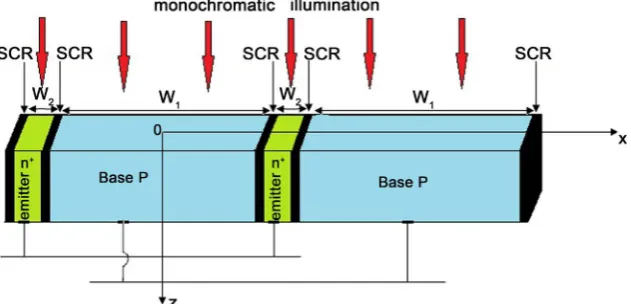
[image:2.595.219.535.562.714.2]A schematic diagram of the vertical parallel junction silicon solar cell is given in
Figure 1.
As noted before, cells are connected in a parallel manner, one emitter with another and one base to another.PN junction. The metal contacts are made on the lateral sides of the sub-cells so there is no shading. The width of the sub-cell can be made smaller [7] and then the series resistance will be also reduced. Un-der illumination, there are the three major phenomena that occur inside a solar cell: carrier generation, re-combination and drift/diffusion. We consider the base region of the VMJ cell, neglecting the emitter given its contribution is very low compared to that of the base. We also assume a quasi-neutral p-type base (QNB)
[8], low injection condition and no lateral effect; then, the principal transport mechanism remains a one dimension diffusion of minority carriers. In steady state, we then have:
( )
( )
( )
2
2
n
n
n x n x
D g z
x τ
∂
⋅ − = −
∂ . (1)
with:
( )
(
1)
e zg z = ⋅ −α R ⋅ ⋅I − ⋅α being the carrier generation rate under
monoch-romatic illumination at the depth z in the base [9], I is the incident flux, n(x) the minority carrier density in the base.
α is the absorption coefficient [10], R is the reflexion coefficient at the wave-length λ, Dn the diffusion coefficient traducing the ability of the carrier to diffuse into the base. This coefficient depends strongly on the base doping density and is
given by the following expression [11]:
( )
18 1350 81 1 3.2 10 T n B B B V D N N N ⋅ = ⋅ + + ×. (2)
The minority carrier lifetime τn in the base also depend on the base doping density and can be expressed as:
( )
16 12 1 5 10 n B B N N τ = + ×. (3)
The diffusion length Ln being the mean distance covered by minority carrier before they recombine is related to both carrier lifetime and diffusion coefficient and then to base doping density. This dependence can be written in the form:
( )
( ) ( )
n B n B n B
L N = D N ⋅τ N . (4)
2.1. Excess Minority Carrier Density in the Base
Carrier generation, recombination and drift/diffusion are the three major phe-nomena that occur inside a solar cell under illumination. If we consider only the base region of the cell, neglecting the emitter since its contribution is very low in comparison to that of the base and also assume a quasi-neutral p-type base (QNB) in low injection condition and no lateral effect, then, the principal trans-port mechanism remain a one dimensional diffusion of minority carriers (elec-trons).
In steady state we have:
( )
( )
( )
( )
2 2
1 ( )
n B
n B
n x g z
n x
D N
x L N
∂
− ⋅ =
∂ . (5)
The solution of Equation (5) can be written as:
( )
1 cosh 1 sinh 2(
1)
ez n
t t t
n n n
L
x x
n x A B I R
L L D
α
α − ⋅
= ⋅ + ⋅ + ⋅ ⋅ ⋅ − ⋅
. (6)
Coefficients A1 and B1 are determined considering the two following boun-dary conditions:
- At the junction (x= −W1 2):
( )
( )
1 1 2 2 f W W n x x S n x n xx =− D =−
∂
= ⋅
∂ . (7)
With Sf being the junction dynamic velocity corresponding to the flow of car-rier through the junction.
- In the middle of the base (x = 0):
( )
0 0 x n x x = ∂ =∂ . (8)
calcu-lations, the final expression of the minority carrier density is written as:
( )
1 cosh 2(
1)
ez n
t t t
n n
L x
n x A R I
L D
α
α − ⋅
= ⋅ + ⋅ ⋅ − ⋅ ⋅
. (9)
2.2. Photocurrent Density and Photovoltage
Based on the excess minority carrier density, we can derive both photocurrent density Jn and photovoltage respectively as:
( )
1 2 2 ph n W x n xJ q D
x =−
∂
= ⋅ ⋅ ⋅
∂ . (10)
with q the elementary charge ; the factor 2 comes from the presence of the two junctions on both sides of the base. For the photovoltage, thanks to Boltzmann’s law, we have:
1 2 2 ln 1 B Ph T i W N n V V n ⋅ − = ⋅ +
. (11)
with ni the intrinsic concentration and VT the thermal voltage:
T k T V
q
⋅
= . (12)
where k is the Boltzmann’s constant and T the temperature.
2.3. Output Power
When the solar cell is illuminated, it can deliver the power P given by:
ph ph
P=V ⋅J . (13)
The power loss in the intrinsic diode is neglected given it is negligible com-pared to the whole power.
2.4. Internal Quantum Efficiency
The measurement of the quantum efficiency of solar cells is generally used to quantify recombination losses. The internal quantum efficiency RQ of a solar cell is defined as the fraction of collected electron/hole pairs per photon of wave-length that enters the solar cell. The commonly applied analysis uses a plot of the inverse quantum efficiency versus the inverse of the absorption; in this study, it is the dependence on the base doping that is analyzed and how it is related to the conversion efficiency.
The internal quantum efficiency is expressed as:
(
1)
ph Q
J R
A q I R
=
⋅ ⋅ ⋅ − . (14)
3. Results and Discussions
various base doping densities and also different illumination wavelengths. The obtained results are presented below.
3.1. Minority Carrier Density
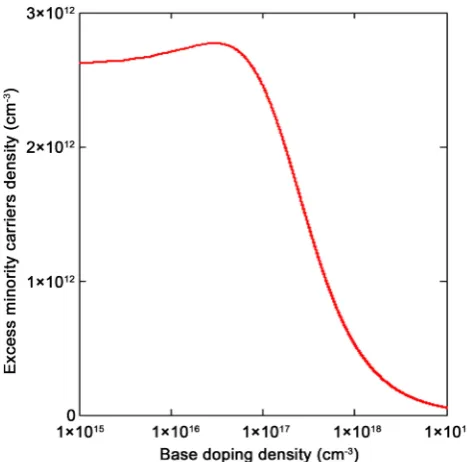
[image:5.595.254.488.475.706.2]We present on Figure 2 the excess minority carrier density versus base doping density for various illumination wavelengths.
Figure 2 shows that excess minority carrier density in the base slightly in-creases firstly until a base doping density of about 1017 cm−3. Above that doping density, carrier density decreases very significantly. Indeed, below 1017 cm−3, an increase of base doping leads to a little increase in base doping but above 1017 cm−3 recombination processes becomes more and more predominant, leading to a decrease of the carrier density as observed.
3.2. Photocurrent Density
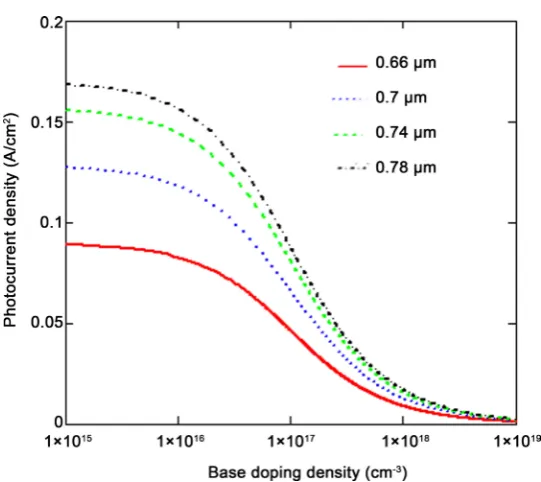
In the following figures, we plotted the photocurrent density versus base doping density for various illumination wavelengths. In Figure 3 we considered wave-length range of 0.66 µm to 0.78 µm and in Figure 4 we considered wavelength range of 0.8 µm to 0.92 µm.
These figures show clearly that photocurrent density is more interesting while the base doping density is of the order of 1017 cm−3 and below. These curves also show that there is a limit to base doping density as we can observe a very marked decrease of the photocurrent densities near and above 1017 cm−3. Given that re-combination activities (centers) are directly related to base doping density that is why photocurrent density is so sensitive to base doping density.
Below 0.8 µm, photocurrent density increases with illumination wavelength contrary to wavelengths above 0.8 µm; this could be explained by the illumina-
Figure 2. Excess minority carrier density versus base doping (Dn = 26 cm2/s, z = 200 µm,
Figure 3. Photocurrent density versus base doping for different wavelengths (Dn = 26
cm2/s, z = 200 µm, Sf = 3 × 103 cm/s).
Figure 4. Photocurrent density versus base doping for various wavelengths (Dn = 26
cm2/s, z = 200 µm, Sf = 3 × 103 cm/s).
tion spectrum with lower wavelengths associated to higher energy, generating more carriers in the base of the solar cell.
3.3. Maximum Output Power
The maximum output power is computed versus base doping density and the results are presented in Figure 5.
[image:6.595.236.510.344.527.2]Figure 5. Maximum power versus base doping density (Dn = 26 cm2/s, z = 200 µm, Sf = 3
× 103 cm/s).
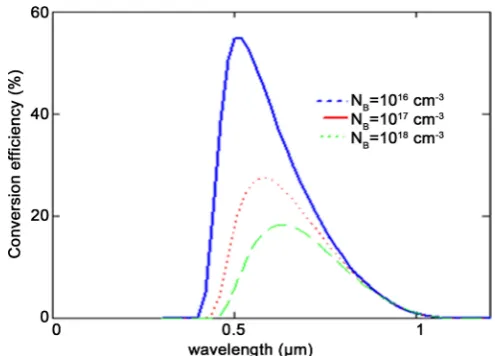
Figure 6. Conversion efficiency versus wavelength for various base doping densities (Dn
= 26 cm2/s, z = 200 µm, Sf = 5 × 105 cm/s).
This result has been predicted previously but the difficulty is that the exact profile of the maximum power versus base doping density was not known. This blank is now filled for vertical parallel junction solar cells.
3.4. Internal Quantum Efficiency
The internal quantum efficiency of the VMJ cell has also been evaluated for var-ious illumination wavelengths and different base doping densities on Figure 6.
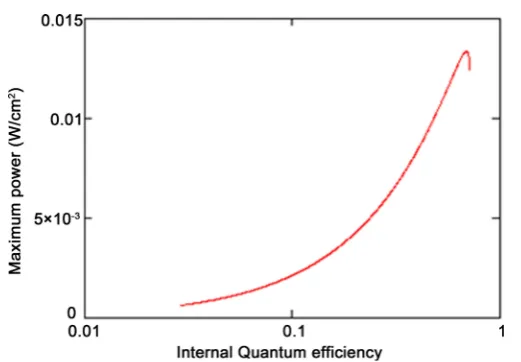
[image:7.595.248.496.285.463.2]Figure 7. Maximum power versus base doping density (Dn = 26 cm2/s, z = 200 µm, Sf = 5
× 105 cm/s).
We then see the importance of doping density on the VMJ solar cell perfor-mance.
We want to know now how the maximum output power is related to the in-ternal quantum efficiency; we then plotted the maximum output power versus internal quantum efficiency in Figure 7.
This figure shows that the output power increases with increasing internal quantum efficiency. Given that internal quantum efficiency is the fraction of collected electron/hole pairs per photon of wavelength that enters the solar cell, an increase in IQE mean that there are more and more collected electron/hole pairs and more collected electron/hole pairs also means more generation and then more power.
4. Conclusions
In this paper, we have presented a theoretical investigation of a vertical parallel junction silicon solar cell under monochromatic illumination. We showed how internal quantum efficiency is related to the illumination wave-length and the decreasing effect of the base doping density on this quantum efficiency. We pre-sented for the first time, to the best of our knowledge, the dependency of the maximum output power on the internal quantum efficiency of the vertical junc-tion solar cell.
The dependency profile of the maximum output power versus the base doping density shows a base doping density limit from which the maximum power de-creases are in agreement with other works.
References
[1] APS News. This Month in Physics History (2009) April 25, 1954: Bell Labs Demon- strates the First Practical Silicon Solar Cell.
http://www.aps.org/publications/apsnews/200904/physicshistory.cfm
https://doi.org/10.1109/T-ED.1974.17927
[3] Xing, Y., Han, P., Wang, S., Fan, Y., Liang, P., Ye, Z., Li, X., Hu, S., Lou, S., Zhao, C. and Mi, Y. (2013) Performance Analysis of Vertical Multi-Junction Solar Cell with Front Surface Diffusion for High Concentration. Solar Energy, 94, 8-18.
https://doi.org/10.1016/j.solener.2013.04.030
[4] Sarfaty, R., Cherkun, A., Pozner, R., Segev, G., Zeierman, E., Flitsanov, Y., Kribus, A. and Rosenwaks, Y. (2012) Vertical Junction Si Micro-Cells for Concentrating Photovoltaics. Progress in Photovoltaics: Research and Applications, 20, 197-208.
https://doi.org/10.1002/pip.1118
[5] Terheiden, B., Hahn, G., Fath, P. and Bucher, E. (2000) The Lamella Silicon Solar Cell. Proceedings of the 16thEuropean Photovoltaic Solar Energy Conference, Glasgow, 1-5 May 2000, 1377-1380.
[6] Ayvazyan, G.E., Kirakosyan, G.H. and Minasyan, G.A. (2004) Characteristics of So-lar Cells with Vertical P-N Junction. Proceedings of the 19th European Photovoltaic
Solar Energy Conference, Paris, 7-11 June 2004, 117-119.
[7] Franklin, E., Blakers, A. and Everett, V. (2009) Sliver Solar Cells for Concentrator PV Systems with Concentration Ratio below 50. Progress in Photovoltaics: Research
and Applications, 17, 403-418. https://doi.org/10.1002/pip.896
[8] Mathieu, H. and Fanet, H. (2009) Physique des Semi-Conducteurs et des Compo- sants électroniques. 6th Edition, Dunod, France.
[9] Heinbockel, J.H. (1986) Summary of Mathematical Models for a Conventional and Vertical Junction Photoconverter. NASA-CR-177144 Progress Report, NASA, Washington DC.
[10] Green, M.A. (2008) Self-Consistent Optical Parameters of Intrinsic Silicon at 300 K Including Temperature Coefficients. Solar Energy Materials and Solar Cells, 92, 1305-1310. https://doi.org/10.1016/j.solmat.2008.06.009
[11] Liou, J.J. and Wong, W.W. (1992) Comparison and Optimization of the Perfor- mance of Si and GaAs Solar Cells. Solar Energy Materials and Solar Cells, 28, 9-28.
https://doi.org/10.1016/0927-0248(92)90104-W
Submit or recommend next manuscript to SCIRP and we will provide best service for you:
Accepting pre-submission inquiries through Email, Facebook, LinkedIn, Twitter, etc. A wide selection of journals (inclusive of 9 subjects, more than 200 journals)
Providing 24-hour high-quality service User-friendly online submission system Fair and swift peer-review system
Efficient typesetting and proofreading procedure
Display of the result of downloads and visits, as well as the number of cited articles Maximum dissemination of your research work
Submit your manuscript at: http://papersubmission.scirp.org/