
http://www.scirp.org/journal/jcpt ISSN Online: 2161-7686
ISSN Print: 2161-7678
First-Eutectic Features of Polar Metals in
Double Systems
Alexander L. Shimkevich, Inessa Yu. Shimkevich
NRC Kurchatov Institute, Moscow, Russia
Abstract
It is known that the dense part of any liquid metal consists of ramified clusters of almost regular tetrahedrons (triangular pyramids with atoms in their ver-texes) that are connected into chains by faces. Any metal additive as a second component of liquid alloy can be both beyond these clusters as separated atoms and into them as inherent clusters. The liquid-metal alloy transfers into the second state, at the first eutectic of the solvent. This polymorphic transi-tion of liquid matrix is discovered in the systems, Pb-K and Na-Pb, by mole-cular-dynamic simulating their microstructure and in experiments on scat-tering slow neutrons by these alloys of different compositions. In the first sys-tem, the obtained results identify both the homogeneous alloy at low concen-trations of potassium in liquid lead and the alloy clustering, (Pb4K)n, at potas-sium concentrations following the eutectic, Pb0.91K0.09. In the second one at the concentrations of lead more than 2%, just the second state is discovered with the clusters, (Na4Pb)n. One can expect the same polymorphic transition in the eutectic, Na0.93Tl0.07, with the micro-inhomogeneity, (Na6Tl)n, and with the melt-ing point of 64 C. This eutectic maintained by the oxygen-free technology and enriched by the isotope, 205Tl, can become the best coolant for fast nuclear reactors due to the depressed chemical activity of sodium and composition stability.
Keywords
Tetrahedral Cluster, Liquid-Metal Eutectic, Lead and Potassium, Sodium and Thallium, Polymorphic Transition
1. Introduction
The liquid alkali metals and heavy metals are always characterized by existence of chemical compound clusters in their alloys [1][2]. For example, the clusters, (Na4Pb)n and (NaPb)m, are being formed in liquid sodium by lead at 20 and 50 How to cite this paper: Shimkevich, A.L.
and Shimkevich, I.Y. (2017) First-Eutectic Features of Polar Metals in Double Systems. Journal of Crystallization Process and Tech-nology, 7, 55-63.
https://doi.org/10.4236/jcpt.2017.73004 Received: May 31, 2017
Accepted: July 3, 2017 Published: July 6, 2017
Copyright © 2017 by authors and Scientific Research Publishing Inc. This work is licensed under the Creative Commons Attribution International License (CC BY 4.0).
mol% respectively [2]. The first cluster is caused by the chemical compound, Na15Pb4, which manages the liquid-alloy microstructure on the sodium side of the phase diagram due to the strong polarity of these metals: sodium is the elec-tropositive element and lead is the electronegative one. Therefore, the first gives away electron (Na+) while the second accepts it (Pb−) and serves as an oxidizer in liquid sodium.
If unifying their contrasts in the alloy after the first eutectic, we will obtain the liquid-metal coolant with components that fulfill differing technological func-tions: sodium provides the low corrosion activity of the eutectic and lead in the colloidal form inhibits the chemical activity of sodium right up to automatic shut-down its fire outdoors [3][4].
Such polymorphic model seems most realistic for the liquid sodium alloy with any heavy metal [5][6][7][8]. However some aspects of forming the colloidal alloy remain not quite understood and they require the analysis of phase dia-grams in the neighborhood of the first eutectic of solvent. This knowledge can be useful for choosing the optimal eutectic modification of the sodium coolant for the fast nuclear reactors.
In this connection, it is reasonable to choose for sodium a polar additive which has the first eutectic in the concentration range of 1% - 10%, for example, Na0.93Tl0.07, [9] with melting point of 64 C. Such liquid alloy enriched by the iso-tope, 205Tl, can become attractive modification of sodium coolant maintained by oxygen-free technology for depressing its chemical activity. We will argue this choice in this paper.
On the other hand, one can verify the model of clustering the second compo-nent in the first eutectic of the basic compocompo-nent (solvent) by such analysis.
2. Polymorphic Transition of Liquid Alloy
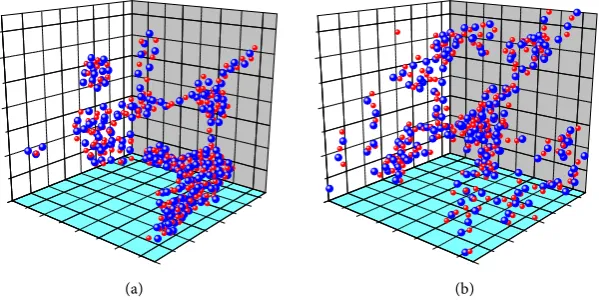
The molecular-dynamic (MD) simulation shows that clustering the ions (Na+, Pb−) in the alloy, Na-Pb, form the ramified percolation chain which is quickly being transformed in separate clusters [6][8] [10]. At the same time, frequent (by period of ≤3 ps) recharging sodium particles (Na↔Na+) only quickens the lead clustering (see Figure 1) but not changes the composition of these clusters, (Na2Pb)n in liquid sodium corresponding to the chemical compound, Na15Pb4.
These clusters are characterized by strong molecular bonds between the ions, Na+ and Pb−, and by a quick decay of their oscillations that is caused by the ex-change of sodium atoms between clusters and the liquid matrix.
Thus, one can prove the impurity clustering and explain the strong changes of the microstructure of liquid sodium by little lead additives using the bipolar model, Na + Na+ + Pb−, in MD simulation of Na0.98Pb0.02 liquid system with pe-riodic recharging the nearest neighbors of solvent (Na ↔ Na+). It turned out that the typical time of the colloidal formation in this alloy does not exceed 50 ps [10].
(a) (b)
Figure 1. The ionic configurations in the MD cell on 9625 Na atoms (are not shown), 201 Na+ (red balls), and 201 Pb− (blue balls) in 100 ps after beginning the MD simulation without recharging sodium particles (а) and with this recharging (b); data are taken out of [10].
case, potassium ions are situated on the external faces of tetrahedrons in rami-fied tetrahedral chains of the lead dense part [5] [6][11]. This liquid alloy has been named an introduction solution[7] as opposed to the addition one when the alloy contain clusters, (Pb4K)n at the potassium concentration is more than 9%. The addition solution is the result of the first-order component phase tran-sition [12] that is being demonstrated by the forepeak on the radial distribution function of atoms found in the neutron-diffraction experiments and by the MD simulation [5].
The dual character of topological position of the second component in the liquid basic component is caused by density fluctuations of the last. At the low concentration, impurity atoms cannot affect these fluctuations and cannot change the microstructure of dense liquid part, i.e., they are being introduced into the liquid (the introduction solution). At the increased concentration, the impurity atoms become the inherent elements of liquid dense part for forming proper clusters and the solution becomes colloidal (biphasic) for the second and homogeneous for the basic one (solvent) due to the quick exchange of its atoms between colloids and liquid matrix, i.e., they form the addition solution for the second component [7].
Such solution in the liquid metal system, A1-xBx, is arising in the first eutectic, xe1, of the solvent, A. Indeed, the liquidus line, T xl
( )
, on the branch(
0≤ ≤x xe1)
ofthis eutectic is related to the introduction solution where the thermodynamic ac-tivity, a1, of the solvent is being defined by the equation [7]
(
) (
)
1 A 1 2 1
a = γ − x −x
(1)
where γ = γA 1exp
(
−∆A T)
is the activity coefficient of the solvent in thenon-ideal introduction solution. Then, the equation for T xl
( )
on its branch(
0≤ ≤x xe1)
is being found from Equation (1) for a1=1:( )
Aln 1 ln 1(
1 2) (
1)
l m
T x =T γ γ − x −x . (2)
opposite branch
(
xe1≤ ≤x xc)
of this eutectic related to the chemical com-pound, AkB, using the thermodynamic activity, a2, of metal additive, B, in theaddition solution [7]:
(
)
(
)
(
)
1/2 B 1 1 1 2
k kn
a =
γ
kx + k− x x − x (3)
where γ = γB 2exp
(
−∆A Bk T)
is the activity coefficient of impurity, B, in the non-ideal addition solution. Then, T xl( )
on the branch(
xe1≤ ≤x xc)
is be-ing found from Equation (3) for a2=1:( )
( )
(
(
)
)
( )
(
(
)
)
2
2
ln 1 1
ln 1 1
c c c
l mc
C x kx k x
T x T
C x kx k x
γ + −
=
γ + −
(4)
where xc≈1 1
(
+k)
for the first chemical compound, AkB, and(
)
21/
( ) 1 2 k n
C x =x − x is the amendment of clusters, (AkB)n, to the liquid us line of the addition solution.
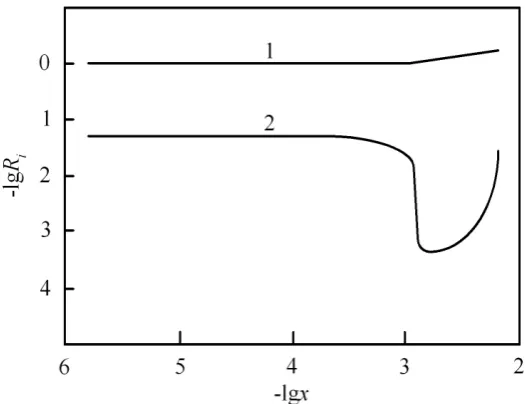
Obviously, the intersection of lines of Equations ((2) and (4)) defines the eu-tectic coordinate, xe1, which characterizes the polymorphous transition of the liquid metal alloy [6]. In this transition point, the correlation radii, R1 and R2
(in relative units) that define representative regions of density and compound fluctuations respectively [13] differ sharply as a function of x shown in Figure 2.
One can see that sharply falling in the eutectic point R2 specifies the decay
of compound fluctuations in clusters of the chemical compound, AkB, against the density fluctuations of long waves in liquid alloy. The monotonous increase of R2 in the some interval of B concentration should be interpreted as a region
of cluster existence up to the precipitation of AkB from the addition solution when R2 increases sharply. The observed clustering of the component, B, in
[image:4.595.242.505.487.689.2]the addition solution is the first-order phase transition in micro regions of liquid which has homogeneous character for the solvent, A, and is characterized by the
eutectic break of liquidus line as a change of the B form in the alloy, A1-xBx, [13].
3. Non-Homogeneity of Liquid-Metal Eutectics
The contrasting properties of density and compound fluctuations (see Figure 2) are caused by the charge polarity of the alloy components: if one of them is elec-tropositive, the other must be electronegative [4][7]. Then, the first gives up an electron to the second for forming the colloidal particles, (AkB)n, of the chemical compound, AkB, in the liquid-metal alloy. They can so change the properties that the first alloy eutectic will become an attractive liquid-metal coolant because its components fulfill differing technological functions: one of them can reduce the corrosion activity of the eutectic alloy and the other can inhibit its chemical activity. In addition, the boiling temperature of the alloy can be increased by the addition of high-boiling metal, for example, lead in liquid sodium [3]. The phase diagram of this system is shown in Figure 3 where the red dotted line is ob-tained using the equation (4) at the obob-tained activity coefficient of lead, γ2 ~ 4 × 10⁻³, for clusters (Na4Pb)3.
Thus, the model of lead addition solution in liquid sodium good describes the liquidus line on the sodium side of the phase diagram of the system, Pb-Na. Here, γ2 ~ 4 × 10⁻³ indicates to strong bond of sodium and lead atoms in this solution by forming clusters, (Na4Pb)3. From the value of γ2, one can estimate a possible increase of the eutectic boiling point, ∆Tb, by equation
(
2)
2
ln
b b e
T RT k H
[image:5.595.208.542.379.675.2]∆ = ∆ γ
(5)
Figure 3. The phase diagram for double system, Na1-xPbx [14]; the red dotted curve of li-quidus is obtained by (4) when γ2 ~ 4 × 10⁻³ for the addition solution of lead in liquid so-dium; one can see that this curve is in the good agreement with the experimental data
that can amount to 150 K for the boiling point Tb of sodium equal to 1156 K, the heat of its evaporation, ∆He equal to 97.42 kJ/mol, and R = 8.31 J/mol⋅K as the
gas constant [15].
In the Pb1-xKx system, the model (1) - (4) identifies both the homogeneous in-troduction solution at low concentrations of potassium in liquid lead and the clusters, (Pb4K)3, in the addition solution at potassium concentrations following the eutectic, Pb0.91K0.09. The phase diagram of this system is shown in Figure 4 where the red dotted lines for liquidus near the first eutectic are obtained by Eq-uations ((2) and (4)) at γ2 ~ 2 × 10⁻⁴.
Thus, the first eutectic of any liquid metal can essentially change its physical and chemical properties by forming inhomogeneous solution of polar additive in the liquid-metal alloy. Therefore using a metal additive of other polarity, one can modify a pure liquid-metal coolant for more effective operation in fast nuclear reactors.
4. Modification of Sodium Coolant
[image:6.595.208.540.419.667.2]As seen in Figure 5, the double system, Na1-xTlx, has the first eutectic at xe1 = 0.071 [9]. Therefore, one can expect the same polymorphic transition of liquid alloy in this eutectic by forming the micro-inhomogeneity, (Na6Tl)n, at the melting point of 337 K. This concept is checked by calculating the liquidus of this system (red dotted lines in Figure 5) near the eutectic, Na0.93Tl0.07, obtained by Equations ((2) and (4)) at γ2 ~ 2 × 10⁻⁵.
Figure 5. The phase diagram for double system, Na1-xTlx [9]; the left red dotted curve of liquidus is obtained by (2) for the introduction solution of thallium in liquid sodium and the right curve is calculated by (4) when γ2 ~ 2 × 10⁻⁵ for the addition solution of thallium near the first eutectic (xe1 = 0.071); this calculation is in accord with the experimental data
[9].
Using (5) for this very small value of γ2, one can estimate the increase of the eutectic boiling point, Tb, up to 1350 K. Then, this eutectic maintained by the oxygen-free technology and enriched by the isotope, 205Tl, can become the best high-boiling coolant for the fast nuclear reactors having low chemical activity [4] [17].
5. Conclusions
It turned out that one can describe the liquidus near the first eutectic of the sol-vent in double systems of polar liquid metals as a solidification of two solutions (introduction and addition) on both branches of this eutectic respectively. The introduction solution is homogeneous and impurity atoms turn out introduced into the liquid matrix of the solvent.
In the eutectic and after, these atoms become the inherent elements of the liq-uid dense part and the alloy becomes colloidal (biphasic) for the impurity and homogeneous for the solvent due to a quick exchange of its atoms between col-loids and the liquid matrix of the addition solution.
This concept is in the good agreement with the experimental data for double systems: Na1−xPbx, Pb1−xKx, Na1−xTlx, near their first eutectics of the solvent.
It is shown that the first eutectic of the basic component changes essentially the physical and chemical properties of the alloy by forming colloidal solution of the second component which can increase the boiling point of the solvent, for example in Na0.93Tl0.07, on more than 150 K.
coo-lants of the fast nuclear reactors, for example, modifying them by eutectics: Na0.93Tl0.07 for the first and Pb0.83Mg0.17 for the second.
Acknowledgements
Authors thank their colleagues for active discussing the all aspects of eutectic modification of liquid-metal coolants of the fast nuclear reactors.
References
[1] Van der Lugt, W. (1991) Zintl Ions as Structural Units in Liquid Alloys. Physica Scripta, 39, 372. https://doi.org/10.1088/0031-8949/1991/T39/059
[2] Reijers, H.T.J. and van der Lugt, W. (1990) Molecular-Dynamics Study of Liquid NaPb, KPb, RbPb, and CsPb Alloys. Physical Review B, 42, 3395-3405.
https://doi.org/10.1103/PhysRevB.42.3395
[3] Subbotin, V.I., Arnoldov, M.N., Kozlov, F.A. and Shimkevich, A.L. (2002) Liquid- Metal Coolants for Nuclear Power. Atomic Energy, 92, 29-40.
https://doi.org/10.1023/A:1015050512710
[4] Alekseev, P.N. and Shimkevich, A.L. (2016) Efficacy of Eutectic Modification of Liquid-Metal Coolants. Atomic Energy, 119, 218-219.
https://doi.org/10.1007/s10512-015-0050-2
[5] Blagoveshchenskii, N.M., Morozov, V.A., Novikov, A.G., Savostin, V.V., Shimke-vich, A.L and ShimkeShimke-vich, I.Y. (2005) Microscopic Structure of Liquid Lead-Potas- sium Alloys: Neutron-Diffraction and Molecular Dynamics Investigation. Physica B: Condensed Matter, 364, 255-262. https://doi.org/10.1016/j.physb.2005.04.021
[6] Kolokol, A.S., Shimkevich, А.L. and Shimkevich, I.Y. (2008) On Composition Con-verting Liquid Metal Alloys. Journal of Physics: Conference Series, 98, Article ID: 042021.
[7] Shimkevich, A.L. (2008) The Composition Principles for Designing Nuclear-Reactor Materials. N.N. PonomarevStepnoi Edition, IzdAt, Moscow. (In Russ)
[8] Shimkevich, I.Y. and Shimkevich, A.L. (2014) MD Simulated Microstructure of Liquid Sodium Alloyed with Lead. Materials Sciences and Applications, 5, 556-567.
https://doi.org/10.4236/msa.2014.58058
[9] Grube, G. and Schmidt, A. (1936) The Na-Tl Phase Diagram. Zeitschrift für Elek-trochemie, 42, 201-209.
[10] Shimkevich, A.L. and Shimkevich, I.Y. (2011) Molecular Dynamics Simulation of the Clustering of Minor Lead Additives in Liquid Sodium. Journal of Metallurgy, 2011, Article ID: 890321. https://doi.org/10.1155/2011/890321
[11] Kolokol, A.S. and Shimkevich, A.L. (2010) Topological Structure of Density Fluctu-ations in Condensed Matter. Journal of Non-Crystalline Solids, 356, 220-223. [12] Ivanovsky, M.N., Morozov, V.A., Ponomarev-Stepnoi, N.N. and Shimkevich, A.L.
(1988) Component First-Order Phase Transition. Soviet Atomic Energy, 65, 878- 881. https://doi.org/10.1007/bf01121245
[13] Shimkevich, A.L. (1999) The Fluctuation Theory of Impurity Micro-Heterogeneity of Liquid-Metal Coolants. Proceedings of the High School. Nuclear Power, No. 3, 6- 16.
[14] Lamprecht, G.J., Dicks, L. and Crowther, P. (1968) Solubility of Metals in Liquid Sodium. II. The System Sodium-Lead. The Journal of Physical Chemistry, 72, 1439- 1441. https://doi.org/10.1021/j100851a006
[16] Meijer, J.A., Geertsma, W. and Van der Lugt, W. (1985) Electrical Resistivities of Liquid Alkali-Lead and Alkali-Indium Alloys. Journal of Physics F: Metal Physics, 15, 899-910. http://iopscience.iop.org/0305-4608/15/4/014
https://doi.org/10.1088/0305-4608/15/4/014
[17] Alekseev, P.N., Shimkevich, A.L. and Shimkevich, I.Y. (2015) Eutectic Na-Tl and Pb-Mg Alloys as Liquid-Metal Coolants for Fast Nuclear Reactors. In: Brebbia, C., Ed., Computational Methods and Experimental Measurements XVII, WIT Press, Southampton, 343-353. https://doi.org/10.2495/cmem150311
Submit or recommend next manuscript to SCIRP and we will provide best service for you:
Accepting pre-submission inquiries through Email, Facebook, LinkedIn, Twitter, etc. A wide selection of journals (inclusive of 9 subjects, more than 200 journals)
Providing 24-hour high-quality service User-friendly online submission system Fair and swift peer-review system
Efficient typesetting and proofreading procedure
Display of the result of downloads and visits, as well as the number of cited articles Maximum dissemination of your research work
![Figure 3. The phase diagram for double system, Nadium; one can see that this curve is in the good agreement with the experimental data [14]1-xPbx [14]; the red dotted curve of li-quidus is obtained by (4) when γ2 ~ 4 × 10⁻³ for the addition solution of lea](https://thumb-us.123doks.com/thumbv2/123dok_us/7744317.708573/5.595.208.542.379.675/figure-diagram-nadium-agreement-experimental-obtained-addition-solution.webp)
![Figure 4. The phase diagram for double system, Pbliquidus is obtained by (2) for the introduction solution of potassium in liquid lead and the left curve is calculated by (4) when γdata 1-xKx [16]; the right red dotted curve of 2 ~ 2 × 10⁻⁴ for the additio](https://thumb-us.123doks.com/thumbv2/123dok_us/7744317.708573/6.595.208.540.419.667/figure-pbliquidus-obtained-introduction-solution-potassium-calculated-additio.webp)
![Figure 5. The phase diagram for double system, Na[9]near the first eutectic (x1-xTlx [9]; the left red dotted curve of liquidus is obtained by (2) for the introduction solution of thallium in liquid sodium and the right curve is calculated by (4) when γ2 ~](https://thumb-us.123doks.com/thumbv2/123dok_us/7744317.708573/7.595.208.539.68.307/figure-eutectic-liquidus-obtained-introduction-solution-thallium-calculated.webp)
